Research Articles
Cross-Dataset Validation for Wheat Anthesis Prediction: Enhancing Model Robustness and Generalizability
This article provides a comprehensive analysis of cross-dataset validation strategies for wheat anthesis prediction, a critical task in plant phenotyping and breeding.
Evaluating Deep Learning Architectures for 3D Plant Phenotyping: A Comprehensive Review from Data Acquisition to Clinical Translation
This article provides a systematic evaluation of deep learning (DL) architectures for 3D plant phenotyping, a field crucial for advancing plant science and precision agriculture.

Beyond Accuracy: Evaluating Performance Metrics in Multimodal AI for Plant Disease Diagnosis
This article provides a comprehensive analysis of performance metrics for multimodal deep learning systems in plant disease diagnosis, tailored for researchers and scientists in agricultural technology and bioinformatics.
Multimodal Data Fusion in Plant Science: Strategies, Applications, and Optimization for Enhanced Analysis
This article provides a comprehensive analysis of fusion strategies for multimodal plant data, catering to researchers and scientists in plant biology and agricultural technology.
Building Robust Multimodal Plant Datasets: A Comprehensive Guide to Data Preprocessing Pipelines for Agricultural AI and Drug Discovery
This article provides a comprehensive guide for researchers and scientists on constructing effective data preprocessing pipelines for multimodal plant datasets.
Achieving Pixel-Precise Alignment in Multimodal Plant Imaging: Methods, Applications, and Validation
This article provides a comprehensive overview of the field of pixel-precise multimodal image registration for plant phenotyping.
Synthetic Solutions: How Generative AI is Overcoming Data Scarcity in Plant Phenotyping
This article addresses the critical challenge of data scarcity in plant phenotyping, a major bottleneck for training robust deep learning models in agricultural and biomedical research.
Graph Learning for Multimodal Plant Disease Diagnosis: Advanced Architectures and Real-World Applications
This article explores the transformative potential of graph learning in automating plant disease diagnosis by integrating heterogeneous data modalities.
Overcoming Parallax: Advanced 3D Registration Techniques for Multimodal Plant Phenotyping
This article addresses the critical challenge of parallax effects in close-range multimodal plant imaging, a significant obstacle for researchers and scientists in high-throughput phenotyping and drug development from natural products.
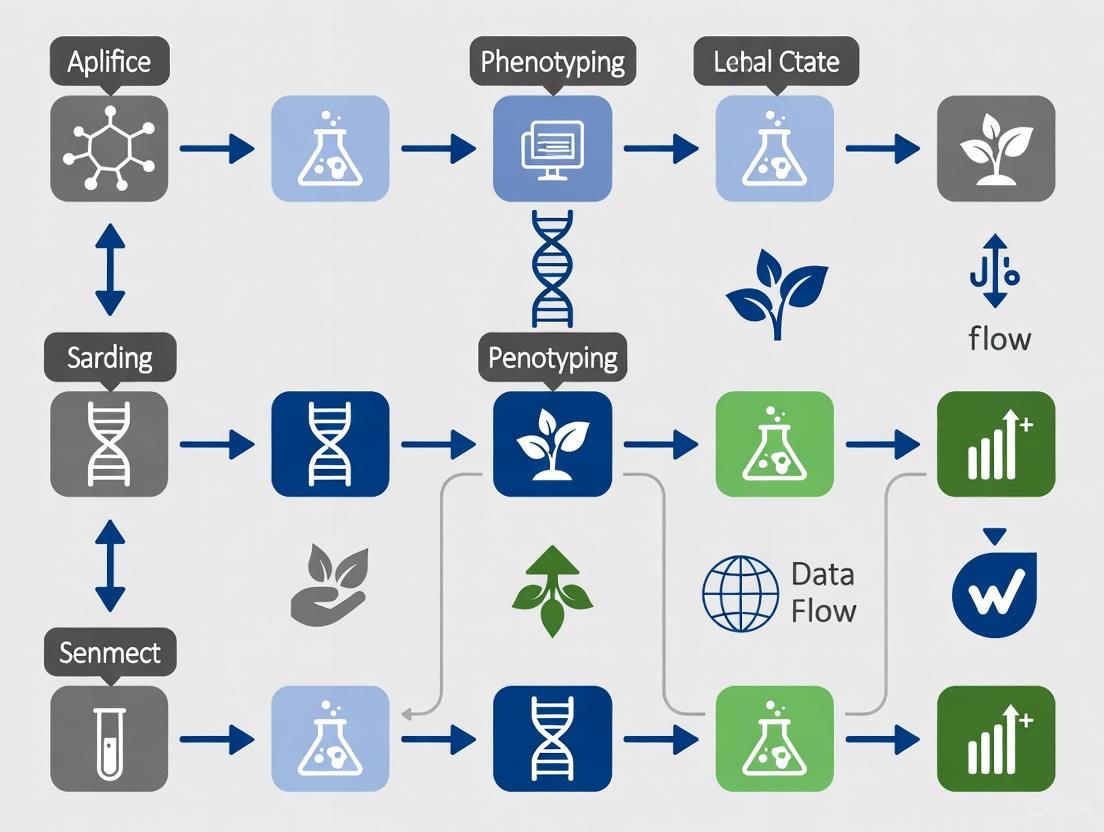
Building End-to-End Non-Destructive Plant Phenotyping Workflows: From Foundational Concepts to Validated Applications
This article provides a comprehensive guide to developing and implementing end-to-end workflows for non-destructive plant phenotyping.