Optimizing Nanosensor Sensitivity for Low-Concentration Hydrogen Peroxide Detection: Strategies for Biomedical Research and Drug Development
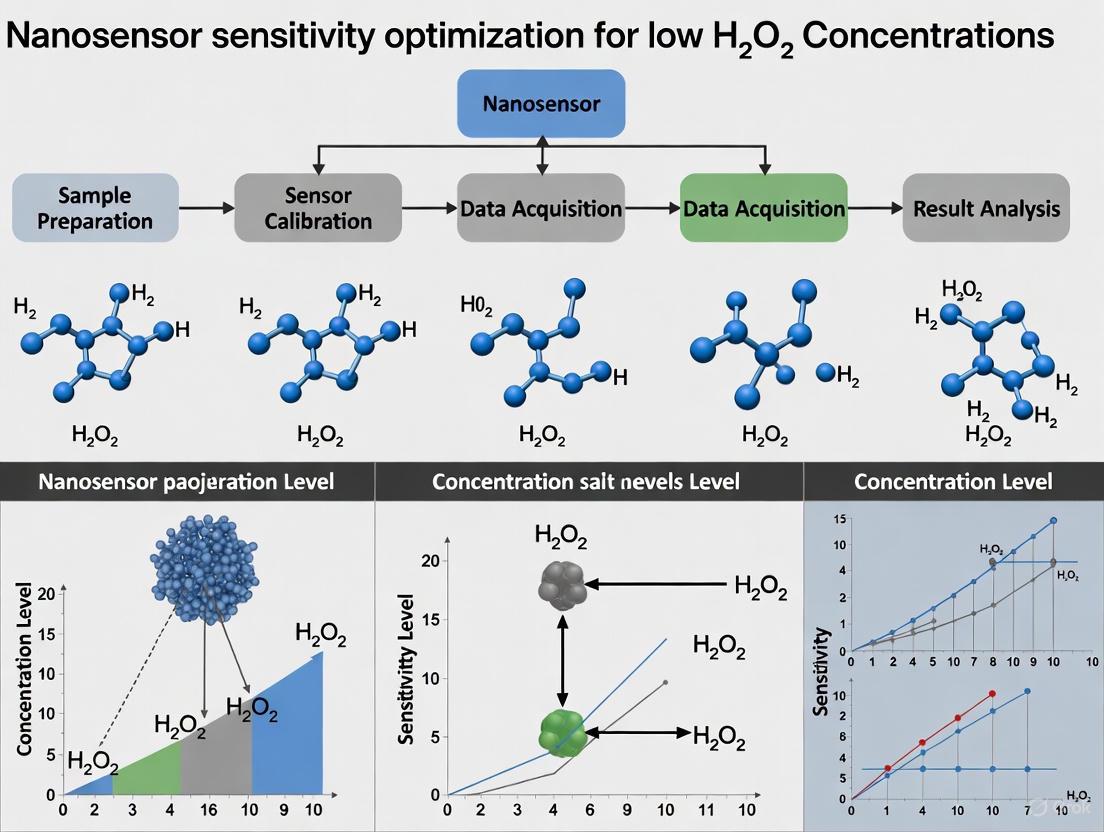
The accurate detection of low-concentration hydrogen peroxide (H₂O₂) is critical for understanding its dual role in cellular signaling and oxidative stress, with significant implications for drug development and disease diagnostics.
Optimizing Nanosensor Sensitivity for Low-Concentration Hydrogen Peroxide Detection: Strategies for Biomedical Research and Drug Development
Abstract
The accurate detection of low-concentration hydrogen peroxide (H₂O₂) is critical for understanding its dual role in cellular signaling and oxidative stress, with significant implications for drug development and disease diagnostics. This article provides a comprehensive resource for researchers and scientists, exploring the foundational principles of H₂O₂ nanosensing, from electrochemical and optical mechanisms to advanced material design. It details methodological approaches for enhancing sensitivity and selectivity, presents practical troubleshooting and optimization strategies to overcome common analytical challenges, and establishes a framework for the rigorous validation and comparative analysis of sensor performance. By synthesizing the latest advances, this review aims to equip professionals with the knowledge to develop next-generation nanosensors for precise, real-time monitoring in complex biological environments.
Understanding H₂O₂ Signaling and the Fundamental Principles of Nanosensor Design
Hydrogen peroxide (H₂O₂) is a key reactive oxygen species that functions as a crucial signaling molecule in physiological processes at low concentrations but can become a harmful agent at elevated levels, contributing to disease pathogenesis. This dual role makes it a significant biomarker and target for therapeutic intervention. In healthy cells, H₂O₂ participates in vital signaling pathways regulating growth, differentiation, and immune response [1]. However, cancer cells often exhibit increased H₂O₂ production rates and impaired redox balance, affecting both the microenvironment and anti-tumoral immune response [1]. Understanding these concentration-dependent effects is fundamental for optimizing nanosensor sensitivity for low H₂O₂ concentration research.
Frequently Asked Questions (FAQs)
Q1: Why is detecting low concentrations of H₂O₂ so important in biological research?
A1: H₂O₂ functions as a vital second messenger in redox signaling at low, physiological concentrations (typically in the micromolar range), influencing cell differentiation, proliferation, and immune responses [1]. However, concentrations as low as 10 µM can induce cell death [2]. Precise detection of these low levels is therefore crucial for understanding normal physiology and the early stages of disease development, where subtle changes in H₂O₂ signaling can have significant impacts [2] [1].
Q2: My nanosensor results are inconsistent when measuring H₂O₂ in cell culture media. What could be causing this?
A2: Inconsistencies often stem from the rapid degradation of H₂O₂ by antioxidant enzymes present in the serum or released by cells, such as catalases, glutathione peroxidases (GPxs), and peroxiredoxins (Prxs) [1]. This enzymatic activity can create a dynamic concentration gradient, making accurate measurement a challenge. To troubleshoot:
- Use serum-free media for the duration of the experiment to reduce external antioxidant activity.
- Shorten the time between sample collection and measurement.
- Validate your sensor in a controlled, cell-free system with known H₂O₂ additions to establish a baseline performance.
Q3: How does the cellular context influence H₂O₂ signaling and detection?
A3: The effect of H₂O₂ is highly context-dependent, influenced by cell type, subcellular localization, and exposure time [1]. For instance, in immune cells, low concentrations of H₂O₂ can attract innate immune cells like neutrophils but may simultaneously impede the migration of activated human T cells, illustrating a complex, concentration-dependent role in inflammation [3]. Furthermore, tumor cells often have upregulated anti-oxidative systems (e.g., via the transcription factor Nrf2), altering the local H₂O₂ landscape and how cells respond to it [1].
Q4: What are the advantages of using a label-free nanosensor like Au@Ag nanocubes?
A4: Label-free nanosensors offer several key advantages for H₂O₂ detection [2]:
- Simplicity: They eliminate the need for complex enzyme-based detection systems (e.g., horseradish peroxidase), simplifying the assay protocol.
- Stability: Nanostructures are generally more stable than biological enzymes, leading to a longer shelf life and consistent performance.
- Direct Detection: They often rely on direct oxidation-reduction reactions (the degradation of Ag shell by H₂O₂), which can be monitored in real-time via changes in optical properties like localized surface plasmon resonance (LSPR) [2].
Experimental Protocols & Methodologies
Protocol: Synthesis of Au@Ag Nanocubes for H₂O₂ Sensing
This protocol is adapted from a study demonstrating a label- and enzyme-free H₂O₂ sensor [2].
Principle: The detection is based on the H₂O₂-induced degradation of the silver shell on gold nanospheres, leading to a decrease in UV-Vis extinction intensity that is proportional to H₂O₂ concentration [2].
Materials:
- Gold seed solution: Chloroauric acid (HAuCl₄), sodium citrate.
- Growth solution: Silver nitrate (AgNO₃), ascorbic acid (reducing agent), cetyltrimethylammonium chloride (CTAC, capping agent).
- Ultrapure water, heating mantle, magnetic stirrer, transmission electron microscope (TEM), UV-Vis-NIR spectrophotometer.
Procedure:
- Synthesize Au Nanospheres: Heat HAuCl₄ solution under reflux while stirring. Rapidly add sodium citrate solution. Continue heating and stirring until the solution turns deep red, indicating the formation of ~8.8 nm Au nanospheres. Cool to room temperature [2].
- Grow Au@Ag Nanocubes: To the growth solution containing CTAC and AgNO₃, add ascorbic acid. Then, introduce a small amount of the synthesized Au nanospheres (seeds) to the growth solution and incubate to allow the formation of Au@Ag nanocubes (~31.8 nm) [2].
- H₂O₂ Sensing Assay:
- Incubate the synthesized Au@Ag nanocubes with your sample containing H₂O₂ for 40 minutes at room temperature.
- Transfer the solution to a cuvette and measure the UV-Vis extinction spectrum.
- The absolute change in extinction intensity (|Δ Extinction|) at the LSPR peak (around 429 nm) is used for quantification [2].
Troubleshooting Tip: If the sensitivity is low, ensure the nanocubes are uniform by checking their size and shape via TEM. Aggregation or irregular shapes can impair sensor performance [2].
Protocol: Investigating H₂O₂-Mediated T Cell Signaling
This protocol outlines methods to study how oxidative stress impacts T cell chemotaxis, a key process in immune response [3].
Principle: Low oxidative concentrations of H₂O₂ can impair chemotaxis in activated human T cells by reducing the surface expression of the chemokine receptor CXCR3 and activating the lipid phosphatase SHIP-1, a negative regulator of PI3K signaling [3].
Materials:
- SEB-activated human T lymphocytes.
- H₂O₂ working solution (low concentration, e.g., sub-micromolar to micromolar range).
- Chemokines: CXCL11, CXCL10, CXCL12.
- Flow cytometry buffer, anti-CXCR3 PE-conjugated antibody, isotype control antibody.
- Permeabilization/Wash buffer, anti–phospho-SHIP-1 antibody, FITC-conjugated secondary antibody.
- Flow cytometer, migration assay chamber (e.g., transwell).
Procedure:
- Cell Treatment: Resuspend SEB-activated T lymphocytes in supplemented RPMI 1640 medium. Treat cells with either vehicle (control) or the desired low concentration of H₂O₂ for 30 minutes [3].
- Surface Receptor Analysis (Flow Cytometry):
- Wash cells with ice-cold FACS buffer.
- Stain cells with PE-conjugated anti-CXCR3 antibody or an isotype control on ice for 1 hour.
- Wash cells twice and analyze via flow cytometry to measure changes in CXCR3 surface expression [3].
- Intracellular Signaling (Flow Cytometry):
- After treatment, fix and permeabilize cells using a commercial fixation/permeabilization kit.
- Incubate cells with an anti–phospho-SHIP-1 primary antibody, followed by a FITC-conjugated secondary antibody.
- Analyze cells via flow cytometry to measure the mean fluorescence intensity, indicating SHIP-1 activation levels [3].
- Functional Chemotaxis Assay:
- Place a chemokine attractant (e.g., CXCL11) in the lower chamber of a transwell system.
- Add H₂O₂-treated or control T cells to the upper chamber.
- Incubate to allow migration. Count the number of cells that migrate to the lower chamber to assess chemotactic efficiency [3].
Troubleshooting Tip: If you do not observe inhibition of migration to CXCL11, verify the activation status of the T cells and confirm the functionality of the CXCL11 stock. This effect is specific to certain chemokine pathways [3].
Table 1: Performance Metrics of a Au@Ag Nanocube H₂O₂ Sensor
This table summarizes the detection capabilities of a nanosensor as reported in the literature, providing a benchmark for your own sensor development [2].
| Sensor Type | Linear Range (µM) | Limit of Detection (LOD) | Correlation Coefficient (r²) | Key Principle |
|---|---|---|---|---|
| Au@Ag Nanocubes | 0 - 200 | 1.11 µM | 0.904 | H₂O₂-induced Ag degradation, measured by LSPR shift [2]. |
| Au@Ag Nanocubes | 0 - 40 | 0.60 µM | 0.941 | Enhanced sensitivity in a narrower, physiologically relevant range [2]. |
Table 2: Biological Effects of H₂O₂ on Different Immune Cells
H₂O₂ has cell-type-specific effects, which underscores the importance of context in experimentation and data interpretation.
| Cell Type | H₂O₂ Concentration | Observed Effect | Proposed Mechanism |
|---|---|---|---|
| Neutrophils | Low concentrations | Acts as a chemoattractant [3]. | Early damage cue for innate immune recruitment [3]. |
| Activated Human T Cells | Low oxidative concentrations | Impedes chemotaxis to CXCL11 [3]. | Reduced CXCR3 surface expression & SHIP-1 activation, inhibiting PI3K signaling [3]. |
| T Cells (Mouse) | Uptake required | Facilitates migration toward CXCL12 [3]. | H₂O₂ uptake via aquaporin-3 [3]. |
| Tumor Cells | Persistently upregulated | Promotes pro-survival signaling and growth [1]. | Inactivation of phosphatases (e.g., PTEN), oxidation of redox-sensitive transcription factors [1]. |
Signaling Pathways and Experimental Workflows
H₂O₂ Signaling Pathway in Immune Cell Migration
Diagram Title: H₂O₂ Inhibits T Cell Chemotaxis via Dual Signaling
This diagram illustrates the molecular mechanism by which low concentrations of H₂O₂ can impair the migration of activated human T cells. The pathway shows two concurrent processes: the activation of Src family kinases (SFKs) leading to SHIP-1 activation and PI3K pathway inhibition, and the reduction of CXCR3 chemokine receptor surface expression. Both converge to disrupt cytoskeletal dynamics and impair chemotaxis specifically towards CXCL11 [3].
Experimental Workflow for Nanosensor-Based H₂O₂ Detection
Diagram Title: Workflow for H₂O₂ Detection with Au@Ag Nanosensor
This workflow outlines the key steps in using Au@Ag nanocubes for the label-free detection of H₂O₂. The process begins with the synthesis of the core-shell nanostructure, followed by incubation with the analyte. The degradation of the silver shell by H₂O₂ causes a measurable change in the optical properties of the nanocubes, which is quantified to determine the H₂O₂ concentration [2].
The Scientist's Toolkit: Research Reagent Solutions
Table 3: Essential Reagents for H₂O₂ Signaling and Detection Research
| Research Reagent | Function / Application | Key Notes |
|---|---|---|
| Au@Ag Nanocubes | Label-free, enzyme-free optical detection of H₂O₂ [2]. | Sensitive to low µM concentrations; LSPR peak at ~429 nm [2]. |
| Anti-CXCR3 Antibody | Flow cytometric analysis of chemokine receptor surface expression on immune cells [3]. | Used to study H₂O₂-induced downregulation of CXCR3 in T cells [3]. |
| Anti–Phospho-SHIP-1 Antibody | Intracellular staining for detecting SHIP-1 activation via flow cytometry [3]. | Key for probing the H₂O₂-SFK-SHIP-1 signaling axis [3]. |
| PP2 | Pharmacological inhibitor of Src Family Kinases (SFKs) [3]. | Tool to validate the involvement of SFKs in H₂O₂-mediated signaling [3]. |
| AQX1 | Allosteric activator of SHIP-1 [3]. | Mimics H₂O₂ effect on SHIP-1; used to study SHIP-1's role in migration [3]. |
| Ascorbic Acid | Reducing agent in the synthesis of metallic nanostructures [2]. | Critical for controlled growth of silver shells on gold seeds [2]. |
| CTAC (Cetyltrimethylammonium Chloride) | Capping agent in nanomaterial synthesis [2]. | Directs the morphological growth of Ag shells into a cubic shape [2]. |
Hydrogen peroxide (H₂O₂) is a crucial molecule in living organisms, and its dysregulation is implicated in diseases such as diabetes, neurodegenerative disorders, and cancer [4]. Accurate, real-time monitoring of H₂O₂ at low concentrations in biological systems is notoriously challenging due to its instability and typically low concentration [4] [5]. Traditional detection methods, including colorimetry and fluorescence, often suffer from limitations such as an inability to provide continuous monitoring, background noise, and sample self-luminescence [4].
Field-effect transistor (FET) nanosensors functionalized with nanozymes represent a paradigm shift, overcoming these traditional limits by synergizing the superior electrical properties of nanomaterials with the high catalytic activity of artificial enzymes [4] [5]. This technical support center provides a foundational overview, detailed protocols, and troubleshooting guidance for researchers optimizing these sensors for ultralow-concentration H₂O₂ detection.
The Scientist's Toolkit: Research Reagent Solutions
The table below details essential materials and their functions for fabricating and operating a nanozyme-enhanced FET for H₂O₂ sensing.
Table 1: Key Research Reagents and Materials
| Item | Function/Description |
|---|---|
| Urea | Precursor for the synthesis of carbon nitride (C₃N₄) support material via a thermal process [4]. |
| Platinum(IV) Chloride (PtCl₄) | Platinum source for the creation of platinum oxide (PtO/PtO₂) nanozymes [4]. |
| Reduced Graphene Oxide (RGO) | Forms the highly conductive channel of the FET, facilitating excellent electron transfer; nanozymes are assembled on its surface via π-π stacking [4] [5]. |
| Carbon Nitride (C₃N₄) | A supporting substrate that prevents the aggregation of Pt-based nanoparticles, thereby maintaining their high catalytic activity and stability [4]. |
| Prussian Blue (PB) | An "artificial peroxidase" that catalyzes H₂O₂ reduction at very low voltages (~0 V), minimizing interference from other electroactive species [6]. |
| Screen-Printed Electrodes (SPEs) | Low-cost, disposable electrode substrates that can be modified with nanomaterials like Prussian Blue nanoparticles for scalable sensor production [6]. |
Detailed Experimental Protocols
Protocol 1: Synthesis of PtO/PtO₂-C₃N₄ Nanozymes
This protocol outlines the creation of the high-performance catalyst used to functionalize the FET sensor [4].
Synthesis of C₃N₄ Support:
- Place urea in a furnace and heat to 300 °C for 3 hours.
- Remove the product, grind it into a fine powder, and then calcine it at 520 °C for 4 hours.
- Wash the resulting yellowish product with water, filter it, and vacuum-dry it at 60 °C for 24 hours.
Incorporation of PtO/PtO₂ Nanoparticles:
- Disperse the synthesized C₃N₄ in water via sonication.
- Mix this dispersion with 0.27 mmol of PtCl₄.
- Stir the mixture vigorously at 90 °C for 48 hours.
- Centrifuge the final product to collect the nanozymes, wash with water and acetone, and vacuum-dry.
Protocol 2: Fabrication of the Nanozyme-Functionalized FET Sensor
This protocol details the assembly of the core sensing device [4].
FET Channel Preparation:
- Drop-cast a diluted suspension of Reduced Graphene Oxide (RGO) onto the fabricated FET channel.
- Allow it to dry to form the conductive channel.
Nanozyme Functionalization:
- Drop-cast the synthesized PtO/PtO₂-C₃N₄ nanozyme suspension onto the RGO-coated channel.
- The nanozymes will assemble on the RGO surface via π-π stacking interactions.
Sensor Characterization:
- Use Transmission Electron Microscopy (TEM) to confirm the enfolded, crumpled sheet-like structure of C₃N₄ with spherical nanoparticles distributed on it.
- Perform X-ray Photoelectron Spectroscopy (XPS) to verify the chemical states of the elements, confirming the successful formation of PtO and PtO₂.
The workflow for the entire experimental process, from synthesis to sensing, is visualized below.
Troubleshooting Guides & FAQs
Frequently Asked Questions
Q1: What are the key performance metrics that make nanozyme-FET sensors superior for low-concentration H₂O₂ detection? These sensors demonstrate a combination of high sensitivity, a wide linear range, and an ultralow detection limit, outperforming many traditional methods. The quantitative performance of a state-of-the-art sensor is summarized below.
Table 2: Performance Metrics of a Nanozyme-Enhanced FET for H₂O₂
| Performance Metric | Result | Significance |
|---|---|---|
| Detection Limit | 0.5 pM [5] | Capable of detecting ultra-trace amounts of H₂O₂, far below levels detectable by conventional methods. |
| Linear Detection Range | 1 pM – 10 nM [5] | Allows for accurate quantification across a wide concentration span, relevant for various biological conditions. |
| Operating Potential | Low potential [4] | Minimizes disruption to cellular environments and reduces non-specific signals from other electroactive substances. |
Q2: Why are nanozymes like PtO/PtO₂-C₃N4 preferred over natural enzymes like Horseradish Peroxidase (HRP) in these sensors? While natural enzymes like HRP have excellent specificity, they suffer from poor stability under extreme conditions and are susceptible to inhibitors, which limits their use in complex biological systems [4]. Nanozymes offer superior stability under harsh conditions, enhanced catalytic versatility, and cost-effectiveness, making them ideal for complex applications [4].
Q3: Besides FETs, what other nanomaterial-based sensing strategies are effective for H₂O₂? Electrochemical sensors using nanomaterials like Prussian Blue (PB) are highly effective. PB acts as an "artificial peroxidase" and can catalyze H₂O₂ reduction at voltages close to 0 V, effectively avoiding signals from common interferents like ascorbic acid and uric acid [6]. These sensors can be fabricated on low-cost screen-printed electrodes (SPEs) [6].
Troubleshooting Common Experimental Issues
Issue 1: Low or Unstable Sensor Signal
- Potential Cause: Insufficient amount of nanozyme fixed on the sensor surface or aggregation of nanoparticles reducing catalytic activity [4] [7].
- Solutions:
- Optimize the concentration of the nanozyme suspension used for drop-casting.
- Ensure the use of a supporting substrate like C₃N₄ to prevent nanoparticle aggregation [4].
- Verify the proper formation of the RGO conductive channel.
Issue 2: Poor Selectivity (Interference from Other Substances)
- Potential Cause: The sensor is operating at a potential that is too high, oxidizing other electroactive species present in the sample (e.g., ascorbate, urate) [4] [6].
- Solutions:
Issue 3: Limited Sensor Stability and Lifespan
- Potential Cause: Degradation of the catalytic layer over time, especially a known issue for Prussian Blue at neutral pH [6].
- Solutions:
The fundamental working principle of the sensor, from H₂O₂ interaction to signal generation, is illustrated in the following diagram.
The accurate detection of hydrogen peroxide (H₂O₂) is critical across biological, medical, and environmental fields. H₂O₂ plays a vital role in cellular signaling but can cause cell damage, Alzheimer’s disease, cardiovascular disease, and neurodegeneration at high concentrations [8]. For researchers focusing on optimizing nanosensor sensitivity for low H₂O₂ concentrations, selecting the appropriate sensing mechanism is foundational. This technical support center outlines the core principles, troubleshooting, and methodologies for three primary platforms: electrochemical, fluorescent, and Förster Resonance Energy Transfer (FRET)-based sensors.
Electrochemical biosensors are celebrated for their cost-effectiveness and high sensitivity [8]. Fluorescent biosensors provide powerful optical visualization, while FRET-based systems offer exceptional specificity for monitoring molecular interactions and conformational changes in the 1-10 nanometer range through non-radiative energy transfer from an excited donor fluorophore to a nearby acceptor fluorophore [9] [10]. The following sections provide detailed troubleshooting guides, experimental protocols, and reagent information to support your research.
Technical Support Center
Troubleshooting Guides
FRET-Based Sensor Troubleshooting
FRET-based sensors allow for specific and sensitive detection of biomolecules without the need for direct labeling or modification [9]. The table below addresses common experimental issues.
| Problem | Possible Cause | Solution |
|---|---|---|
| Low FRET Efficiency | Donor and acceptor fluorophores too far apart (>10 nm) | Verify sensor design; ensure conformational change brings fluorophores within 1-10 nm proximity [10]. |
| Poor spectral overlap between donor emission and acceptor absorption | Select FRET pairs with substantial overlap (>30%). Confirm using spectrophotometry [11]. | |
| Incorrect fluorophore orientation (κ² factor) | Consider linker length and flexibility between fluorophores and sensing domain [11]. | |
| No Signal Change Upon Analyte Addition | Sensor not functional or misfolded | Check protein expression and purification; confirm sensing domain integrity via gel electrophoresis. |
| Analyte concentration outside dynamic range | Titrate analyte to determine effective concentration range; consider developing affinity mutants if needed [12]. | |
| High Background Noise | Non-specific binding of fluorophores | Include blocking agents (e.g., BSA) in the assay buffer and optimize washing steps. |
| Direct excitation of the acceptor | Use a filter set that minimizes direct acceptor excitation; always use an acceptor-only control to correct for this [11]. | |
| Poor Signal in Live-Cell Imaging | Sensor expression level too low | Optimize transfection protocol and use stronger promoter if necessary. |
| Photobleaching during imaging | Reduce illumination intensity and exposure time; use an oxygen-scavenging system in the medium. |
Electrochemical Sensor Troubleshooting
Nonenzymatic electrochemical sensors, such as those using NiO/3D graphene hydrogel (3DGH) composites, offer high stability and sensitivity for H₂O₂ detection [8]. The guide below addresses common performance issues.
| Problem | Possible Cause | Solution |
|---|---|---|
| Low Sensitivity | Inefficient electrocatalytic material | Synthesize nanostructured materials (e.g., NiO octahedrons) with high surface area to increase active sites [8]. |
| Electrode fouling | Clean the electrode surface (e.g., polishing for GCE) and use antifouling agents (e.g., Nafion). | |
| High Background Current | Non-specific adsorption of interferents (e.g., UA, AA, DA) | Use a selective membrane (e.g., chitosan) or perform sample pre-treatment to remove interferents. |
| Unstable reference electrode | Check and replenish the reference electrode solution (e.g., KCl in Ag/AgCl). | |
| Poor Reproducibility | Inconsistent electrode modification | Standardize the drop-casting and drying process for composite inks; ensure homogeneous ink dispersion. |
| Variation between electrode batches | Prepare a large batch of sensing material and characterize it fully before dividing for multiple electrodes. |
Frequently Asked Questions (FAQs)
Q1: What are the key advantages of FRET-based biosensors over other conventional techniques? FRET provides a unique capability to probe interactions at very short distances (less than 10 nm), which is difficult with other techniques. It allows for real-time, non-invasive monitoring of biomolecular interactions in live cells with high spatial resolution without requiring direct chemical modification of the target biomolecule [9].
Q2: My electrochemical sensor for H₂O₂ has a narrow linear range. How can I improve it? The dynamic detection range of a sensor is often linked to the binding affinity of its sensing element. A strategy successfully used in FRET-based sensors is to create a set of affinity mutants via site-directed mutagenesis of the amino acid residues involved in analyte binding. This generates sensors with varied dynamic ranges suitable for different physiological scales [12]. For electrochemical sensors, optimizing the nanocomposite composition (e.g., the ratio of NiO to 3D graphene hydrogel) can significantly widen the linear response [8].
Q3: Why is the 3D graphene hydrogel (3DGH) a better support material than 2D graphene for my electrochemical sensor? 2D graphene sheets are prone to agglomeration and restacking due to strong interlayer interactions, which reduces the active surface area and number of electrochemically active sites. The 3D hydrogel structure prevents this, offering a large surface area, high intrinsic electrical conductivity, and superior controllable pore size distribution, which enhances electron transport, ion diffusion, and analyte accessibility [8].
Q4: What are the essential criteria for selecting a good FRET pair? An optimal FRET pair should have [10] [11]:
- Substantial spectral overlap: The donor's emission spectrum must significantly overlap with the acceptor's absorption spectrum.
- Adequate distance separation: The donor and acceptor must be positioned within 1-10 nm.
- High donor quantum yield: The donor should have a high efficiency of converting absorbed light into emitted light.
- High acceptor extinction coefficient: The acceptor should be efficient at absorbing light energy.
- Good photostability: Both fluorophores should resist bleaching during the experiment.
Experimental Protocols & Data Presentation
Protocol: Fabrication of a 3DGH/NiO Nanocomposite H₂O₂ Sensor
This protocol details the creation of a high-sensitivity, nonenzymatic electrochemical sensor for H₂O₂, adapted from recent research [8].
Step 1: Synthesis of NiO Octahedrons
- Dissolve 10 mg of mesoporous silica (SBA-15) in 100 ml of anhydrous ethanol containing 10 mg of nickel nitrate hexahydrate (Ni(NO₃)₂·6H₂O).
- Stir the mixture for 24 hours at room temperature.
- Dry the solution at 80°C for 48 hours. Grind the resulting powder and repeat the rinsing and drying process.
- Calcinate the product in a muffle furnace at 550°C for 3 hours with a heating rate of 2°C per minute.
- Remove the silica template by treating the final product twice with 2 M NaOH at 60°C.
- Wash repeatedly with ethanol and deionized water, then dry in a vacuum oven at 70°C for 12 hours.
Step 2: Self-Assembly of 3D Graphene Hydrogel/NiO (3DGH/NiO)
- Disperse 48 mg of synthesized graphene oxide (GO) in 32 mL of deionized water.
- Add 12 mg of the prepared NiO octahedrons and sonicate the mixture for 2 hours in a bath sonicator, followed by 1.5 hours of probe sonication.
- Transfer the homogeneous dispersion to a 45 mL Teflon-lined autoclave and maintain at 180°C for 12 hours.
- After cooling to room temperature, wash the resulting 3DGH/NiO25 hydrogel thoroughly with deionized water.
- Dry the composite via freeze-drying to obtain the final porous material.
Step 3: Electrode Modification and Electrochemical Measurement
- Prepare an ink by dispersing the 3DGH/NiO25 nanocomposite in a solvent (e.g., water/ethanol mixture with a binder like Nafion).
- Drop-cast a precise volume of the ink onto a polished glassy carbon electrode (GCE) and allow it to dry.
- Perform cyclic voltammetry (CV) and chronoamperometry (CA) in 0.1 M phosphate buffer saline (PBS, pH 7.4) to characterize the sensor's performance.
- Calibrate the sensor by adding successive aliquots of H₂O₂ standard solution under stirred conditions and record the amperometric response.
The table below summarizes the performance metrics of the described 3DGH/NiO nonenzymatic sensor, providing a benchmark for your experimental results.
Table: Performance metrics of the 3DGH/NiO25 nonenzymatic H₂O₂ sensor [8]
| Parameter | Value | Experimental Conditions |
|---|---|---|
| Sensitivity | 117.26 µA mM⁻¹ cm⁻² | Phosphate Buffer (pH 7.4) |
| Linear Range | 10 µM – 33.58 mM | Wide dynamic range suitable for physiological and environmental levels. |
| Detection Limit (LOD) | 5.3 µM (S/N=3) | Demonstrates capability for low-concentration detection. |
| Selectivity | Excellent against UA, DA, AA, Glucose, NaCl | Key for accurate measurement in complex biological samples. |
| Reproducibility | Good | Consistent performance across multiple electrode preparations. |
| Long-Term Stability | Good | Maintains performance over time, critical for practical application. |
Signaling Pathways and Experimental Workflows
The following diagrams illustrate the core working principles of the sensing platforms discussed.
FRET-Based Sensing Mechanism
Electrochemical H2O2 Sensing Workflow
The Scientist's Toolkit: Research Reagent Solutions
This table lists key materials used in the fabrication and implementation of the featured FRET and electrochemical sensors.
Table: Essential research reagents and their functions
| Reagent/Material | Function/Application | Key Characteristics |
|---|---|---|
| Enhanced Cyan Fluorescent Protein (ECFP) & Venus | A common FRET pair for genetically encoded sensors [12] [13]. | Genetically encodable; suitable for live-cell imaging; ECFP serves as donor, Venus as acceptor. |
| Sialic Acid Binding Protein (SiaP) | Sensory element in a FRET-based nanosensor for N-acetyl-5-neuraminic acid [13]. | Undergoes conformational change upon analyte binding, altering FRET efficiency. |
| Nickel Oxide (NiO) Octahedrons | Electrocatalytic material in nonenzymatic H₂O₂ sensors [8]. | High surface area; excellent electrochemical activity; facilitates H₂O₂ oxidation. |
| 3D Graphene Hydrogel (3DGH) | Scaffold/Support material in composite electrodes [8]. | Prevents agglomeration; high conductivity and porosity; large surface area. |
| Mesoporous Silica (SBA-15) | Hard template for synthesizing NiO octahedrons [8]. | Defines and controls the morphology of the metal oxide nanostructure. |
| Graphite Powder | Starting material for the synthesis of graphene oxide (GO) [8]. | Precursor for creating the 3D graphene hydrogel network. |
Core Metric Definitions and Importance
Question: What are Sensitivity, Limit of Detection (LOD), and Selectivity, and why are they critical for my H₂O₂ nanosensor research?
These three metrics form the foundation for evaluating any nanosensor's performance, determining its reliability and practical usefulness in detecting Hydrogen Peroxide (H₂O₂).
- Sensitivity refers to the magnitude of your sensor's signal change per unit change in H₂O₂ concentration. In simple terms, a highly sensitive sensor produces a large, easily measurable signal even for a tiny change in H₂O₂ levels. In electrochemical sensors, this is often reported as a current output per concentration unit (e.g., µA mM⁻¹ cm⁻²) [8].
- Limit of Detection (LOD) is the lowest concentration of H₂O₂ that your sensor can reliably distinguish from a blank sample (one with no H₂O₂). It represents the sensitivity limit and is crucial for detecting low, biologically relevant concentrations of H₂O₂, which is a vital biomarker and reactive oxygen species [14] [8].
- Selectivity is the sensor's ability to respond exclusively to H₂O₂ while ignoring other interfering substances commonly found in complex samples, such as glucose, dopamine, uric acid, and ascorbic acid [8] [15]. High selectivity ensures that your signal is truly from H₂O₂ and not from other compounds.
Frequently Asked Troubleshooting Questions
Question: My nanosensor shows a low signal. How can I improve its Sensitivity?
A low signal often indicates insufficient sensitivity. Consider these strategies:
- Increase Active Surface Area: Use nanomaterials with high surface-to-volume ratios, such as 3D nanostructures (e.g., 3D graphene hydrogel) or flower-like nanosheets, to provide more active sites for H₂O₂ reaction and enhance electron transfer [8] [16].
- Enhance Catalytic Activity: Incorporate nanomaterials with known electrocatalytic or optical catalytic properties towards H₂O₂. For example, transition metal oxides like NiO octahedrons or copper selenide (Cu₁.₈Se) nanosheets can significantly boost the sensor's response [8] [16].
- Amplify the Signal: Employ signal amplification strategies. In optical sensors, this can involve using materials that enhance fluorescence or utilize phenomena like Surface-Enhanced Raman Scattering (SERS) [17] [16]. In electrochemical sensors, combining nanomaterials like metal nanoparticles with carbon-based materials can reinforce electron transport [8] [15].
Question: The LOD of my sensor is too high for detecting low concentrations of H₂O₂. What steps can I take to lower it?
A high LOD means your sensor cannot detect very low concentrations. To achieve a lower, more sensitive LOD:
- Optimize Nanomaterial Composition and Morphology: The shape and structure of nanomaterials directly influence LOD. For instance, tuning the dimensions of metallic nanoparticles can optimize their localized surface plasmon resonance (LSPR), leading to lower detection limits [17].
- Minimize Background Noise: Ensure thorough purification of reagents and solvents to reduce electrochemical or optical background interference. Properly functionalize your sensor surface to prevent non-specific binding of molecules, which can cause false signals [14].
- Use Ratiometric Sensing Designs: For optical sensors, implement ratiometric fluorescence methods. These sensors measure the ratio of signals at two different wavelengths, which self-corrects for environmental interference and improves the signal-to-noise ratio, leading to a lower LOD [14].
Question: My sensor's signal is unstable in complex samples like blood serum or milk. How can I enhance its Selectivity for H₂O₂?
Instability in complex matrices is typically a selectivity issue. Address it with these methods:
- Utilize Selective Catalytic Materials: Choose sensor materials that inherently catalyze H₂O₂ reduction or oxidation without reacting with other common interferents. Non-enzymatic materials like NiO and Cu₁.₈Se have shown good selectivity for H₂O₂ in the presence of other biological molecules [8] [16].
- Employ Physical Barriers: Modify the sensor surface with a selective membrane (e.g., Nafion) that allows H₂O₂ to pass through while blocking larger molecules or negatively charged interferents like ascorbic acid [15].
- Validate with Real Samples: Always test your sensor's performance in the real sample matrix (e.g., milk, serum) to identify and account for specific interferents. Chronoamperometry and recovery studies can quantitatively demonstrate selectivity [8].
Detailed Experimental Protocol: Enzymeless Electrochemical H₂O₂ Detection
The following protocol is adapted from a recent study developing a high-performance nonenzymatic H₂O₂ sensor, illustrating the practical application of these performance metrics [8].
1. Sensor Fabrication: Preparing a 3D Graphene Hydrogel/NiO Octahedron Nanocomposite
- Objective: To synthesize a nanocomposite electrode with high sensitivity and a low LOD for H₂O₂.
- Materials:
- Graphene Oxide (GO) suspension
- Nickel (II) nitrate hexahydrate (Ni(NO₃)₂·6H₂O)
- Mesoporous silica template (SBA-15)
- Sodium hydroxide (NaOH)
- Ethanol
- Teflon-lined autoclave
- Method:
- Synthesis of NiO Octahedrons: Dissolve SBA-15 silica and nickel nitrate in ethanol. Stir for 24 hours, dry, and calcinate the powder at 550°C for 3 hours. Remove the silica template by washing with NaOH solution.
- Self-Assembly of 3DGH/NiO: Disperse GO and the synthesized NiO octahedrons in deionized water via sonication. Transfer the mixture to an autoclave and heat at 180°C for 12 hours. The resulting 3D graphene hydrogel/NiO composite is then washed and freeze-dried.
- Performance Validation: The optimized sensor (3DGH/NiO25) achieved a sensitivity of 117.26 µA mM⁻¹ cm⁻² and a LOD of 5.3 µM using chronoamperometry [8].
2. Performance Characterization: Measuring Sensitivity, LOD, and Selectivity
- Objective: To quantitatively determine the key performance metrics of the fabricated sensor.
- Materials:
- Potentiostat/Galvanostat
- Standard three-electrode cell (fabricated sensor as working electrode, Pt counter electrode, Ag/AgCl reference electrode)
- Phosphate Buffer Saline (PBS, 0.1 M, pH 7.4)
- H₂O₂ standard solutions
- Potential interferents (Glucose, Uric Acid, Dopamine, Ascorbic Acid, etc.)
- Method:
- Sensitivity and LOD Measurement:
- Place the sensor in PBS and perform chronoamperometry at a fixed potential.
- Successively add known concentrations of H₂O₂ and record the steady-state current.
- Plot the current response against H₂O₂ concentration. The slope of the linear calibration curve is the sensitivity.
- The LOD is calculated as 3 times the standard deviation of the blank (signal from PBS) divided by the sensitivity of the calibration curve (3σ/slope).
- Selectivity Test:
- Under the same chronoamperometric conditions, add a physiologically relevant concentration of a potential interfering species (e.g., 0.1 mM ascorbic acid).
- Observe the current response. A highly selective sensor will show a negligible current change compared to the response from H₂O₂.
- Repeat with other common interferents.
- Sensitivity and LOD Measurement:
Research Reagent Solutions Toolkit
The table below lists essential materials used in advanced H₂O₂ nanosensing research.
| Reagent/Material | Function in H₂O₂ Nanosensor Development |
|---|---|
| Transition Metal Oxides (e.g., NiO) | Serve as electrocatalysts for H₂O₂ reduction, enabling sensitive, non-enzymatic detection [8]. |
| 3D Graphene Hydrogel | Provides a highly conductive, porous scaffold that prevents nanomaterial agglomeration and increases active surface area [8]. |
| Copper Selenide (Cu₁.₈Se) Nanosheets | Acts as a dual-function material for both electrochemical sensing and SERS-based detection of H₂O₂ [16]. |
| Quantum Dots (QDs) | Fluorescent nanomaterials used as probes in optical sensors; their fluorescence is quenched or enhanced upon H₂O₂ exposure [18] [14]. |
| Metal-Organic Frameworks (MOFs) | Nanozymes with catalytic activity; used in advanced fluorescence sensors for H₂O₂ due to their high porosity and tunability [14]. |
| Broad-Spectrum Antibodies | Biological recognition elements in immunosensors, providing high specificity for target molecules [15]. |
Experimental Workflow and Signaling Pathways
The following diagram illustrates the general experimental workflow for developing and characterizing a nanosensor, from material synthesis to performance validation.
Diagram 1: General workflow for nanosensor development and performance validation.
The diagram below outlines the primary signaling mechanisms in optical fluorescence-based H₂O₂ sensors, which are key to understanding sensitivity.
Diagram 2: Key optical signaling mechanisms for H₂O₂ detection.
Advanced Materials and Fabrication Techniques for Enhanced H₂O₂ Sensing
Technical Support Center: FAQs & Troubleshooting Guides
This technical support center addresses common challenges in developing nanomaterials for sensitive hydrogen peroxide (H2O2) detection, supporting thesis research on optimizing nanosensor sensitivity.
Frequently Asked Questions (FAQs)
Q1: My nanoparticle size measurements differ significantly from manufacturer specifications. What could be wrong? Manufacturer specifications can be unreliable. A study of commercial silver nanoparticles showed DLS measurements of 34, 38, 65, and 91 nm for particles sold as 20, 40, 60, and 80 nm, respectively [19]. TEM measurements showed even greater discrepancies [19]. Always characterize materials yourself before use. For DLS, the intensity distribution is most reliable for detecting large aggregates, while number distributions better emphasize smaller particles [20].
Q2: How can I remove endotoxin contamination from my nanoformulation? High endotoxin levels can cause immunostimulatory reactions and mask true biocompatibility [19]. Precautions are better than removal:
- Work under sterile conditions using biological safety cabinets, not chemical fume hoods [19].
- Use LAL-grade/pyrogen-free water in buffers and confirm commercial reagents are endotoxin-free [19].
- Depyrogenate glassware and use only sterile filters [19].
- Test equipment, like tubing, for endotoxin by rinsing and analyzing wash samples [19].
Q3: My DLS results vary when measured at different scattering angles. Is this normal? Yes, for larger particles. Scattering profiles change with particle size; larger particles scatter more light in forward angles [20]. Forward angle data may contain stronger signals from any large particles present. When converted to a volume distribution, results from different angles should align [20].
Q4: What are the critical safety controls for handling dry nanopowders? Handling dry nanostructured powders presents a high exposure potential [21] [22]. Key controls include:
- Engineering Controls: Perform work in an enclosed system (glove box, glove bag) or, if not practicable, a laboratory fume hood [21] [22].
- PPE: Wear disposable coveralls, two layers of gloves, chemical splash goggles, and respiratory protection as needed [22].
- Work Practices: Use wet wiping methods or HEPA vacuums for cleaning. Never dry sweep or use compressed air [21] [22].
Q5: Why would I use hybrid composites like 3D graphene with metal oxides for H2O2 sensing? Hybrid materials create synergistic effects that enhance sensor performance. For instance, 3D graphene hydrogel provides a large surface area and high electrical conductivity, preventing the restacking issues of 2D graphene [8]. Decorating it with a metal oxide like NiO introduces excellent electrocatalytic activity. The integration reinforces electron transport and ion diffusion, leading to higher sensitivity and a wider linear detection range for H2O2 [8].
Troubleshooting Guide: Common Experimental Issues
| Problem | Possible Cause | Solution |
|---|---|---|
| High background signal in electrochemical sensing | Non-specific binding; electrode fouling | Functionalize nanomaterial surface with specific recognition elements; use blocking agents like BSA [23]. |
| Low sensor sensitivity | Poor electron transfer; low catalytic activity; agglomerated nanomaterials. | Use conductive hybrids (e.g., carbon nanotubes/MXenes) [23]; integrate catalytic metal oxides (e.g., NiO) [8]; ensure proper dispersion of nanomaterials. |
| Inconsistent results between batches | Endotoxin contamination [19]; variable nanoparticle size/purity [19]. | Implement sterile techniques and screen reagents for endotoxin [19]; strictly control synthesis parameters (time, temperature, precursor concentration). |
| DLS shows a large particle size in biological media | Formation of a "protein corona" on the nanoparticle surface [19]. | This is expected. Characterize the hydrodynamic size in the relevant biological medium (e.g., plasma) for accurate in vivo predictions [19]. |
| Nanoparticle aggregation in solution | Lack of surface stabilizers; high ionic strength dispersant. | Use appropriate surfactants or surface functionalization (e.g., PEGylation); ensure solvent compatibility [20]. |
Experimental Protocols for Key Experiments
Protocol 1: Synthesis of a 3D Graphene Hydrogel/NiO Octahedron Composite for H2O2 Detection
This protocol details the creation of a high-performance nonenzymatic H2O2 sensor, yielding a sensor with high sensitivity (117.26 µA mM⁻¹ cm⁻²) and a wide linear range (10 µM–33.58 mM) [8].
1. Materials and Reagents
- Graphite powder (for GO synthesis)
- Nickel (II) nitrate hexahydrate (Ni(NO₃)₂·6H₂O)
- Mesoporous silica (SBA-15 template)
- Sodium hydroxide (NaOH) pellets
- Ethanol (EtOH)
- Phosphate buffer saline (PBS, 0.1 M, pH 7.4)
2. Methodology
- Step 1: Synthesis of NiO Octahedrons
- Dissolve 10 mg SBA-15 silica in 100 mL ethanol containing 10 mg Ni(NO₃)₂·6H₂O.
- Stir for 24 hours at room temperature.
- Dry the mixture at 80°C for 48 hours, then grind the powder.
- Repeat the dissolution and drying process.
- Calcinate the final product at 550°C for 3 hours (heating rate: 2°C/min).
- Remove the silica template by treating the product with 2 M NaOH at 60°C, followed by repeated washing with ethanol and water [8].
- Step 2: Self-Assembly of 3DGH/NiO Composite
- Disperse 48 mg of graphene oxide (GO) in 32 mL deionized water with 12 mg of the synthesized NiO octahedrons.
- Sonicate the mixture (bath sonication for 2 h, then probe sonication for 1.5 h) to achieve a homogeneous dispersion.
- Transfer the mixture to a 45 mL Teflon-lined autoclave and maintain at 180°C for 12 h.
- After cooling, wash the resulting 3DGH/NiO hydrogel and dry via freeze-drying [8].
3. Characterization and Sensing
- Characterize the composite using FE-SEM, HR-TEM, XRD, and Raman spectroscopy.
- Perform electrochemical detection of H₂O₂ using cyclic voltammetry and chronoamperometry in 0.1 M PBS (pH 7.4) [8].
Protocol 2: Assessing and Mitigating Endotoxin Contamination
1. Materials
- LAL-grade water
- Limulus Amoebocyte Lysate (LAL) assay kits (e.g., chromogenic and turbidity)
- Inhibition and Enhancement Control (IEC) standards
- Sterile, endotoxin-free labware
2. Methodology
- Testing: Routinely apply two different LAL formats (e.g., chromogenic and turbidity) to account for nanoparticle interference [19].
- Controls: Always perform IEC to detect assay interference [19].
- Interpretation: If results are ambiguous due to interference (e.g., from colored nanoparticles or cellulose filters), use alternative methods like the recombinant Factor C assay [19].
LAL Assay Decision Workflow
The Scientist's Toolkit: Research Reagent Solutions
Table: Essential Materials for Nanocomposite-Based H₂O₂ Sensor Development
| Material / Reagent | Function in Research | Example from Literature |
|---|---|---|
| Graphene Oxide (GO) | Precursor for forming 3D conductive scaffolds; provides high surface area for material integration [8]. | Served as the backbone for self-assembling 3D graphene hydrogel (3DGH) in a composite with NiO [8]. |
| Transition Metal Oxides (e.g., NiO) | Acts as an electrocatalyst; provides the active sites for the redox reaction of H₂O₂, enabling non-enzymatic detection [8]. | NiO octahedrons were decorated onto 3DGH, yielding a sensor with 117.26 µA mM⁻¹ cm⁻² sensitivity [8]. |
| Metal-Doped Carbon Dots (CDs) | Nanozymes that mimic natural enzyme activity (e.g., peroxidase); used for colorimetric/fluorometric sensing of contaminants and H₂O₂ [24]. | Fe-doped CDs exhibited higher peroxidase-like catalytic activity than pristine CDs, useful for environmental sensing [24]. |
| MXenes | Provide metal-like conductivity and abundant surface functional groups; enhance signal transduction in electrochemical sensors [23]. | Used with carbon-based nanomaterials to create hybrids that significantly boost electrochemical sensor performance [23]. |
| Mesoporous Silica (SBA-15) | Hard template for synthesizing nanostructures with controlled and defined morphologies [8]. | Used as a template to create the well-defined octahedron morphology of NiO particles [8]. |
| Limulus Amoebocyte Lysate (LAL) | Gold-standard test for detecting and quantifying biologically active endotoxin contamination in nanoformulations [19]. | Critical for preclinical assessment; required for formulations progressing to in vivo studies [19]. |
Technical Support Center
Troubleshooting Guides
Guide 1: Troubleshooting Low Sensitivity in Ag-CeO₂/Ag₂O/GCE Sensors
Problem: The fabricated sensor shows a significantly lower sensitivity than the expected ~2.728 µA cm⁻² µM⁻¹ during H₂O₂ detection [25] [26].
Q1: Is the electron transfer efficiency insufficient?
- Check: Perform electrochemical impedance spectroscopy (EIS). A high electron transfer resistance (Rₑₜ) suggests poor conductivity.
- Solution: Ensure the Ag-doping process was performed correctly. The Ag-CeO₂/Ag₂O nanocomposite should be synthesized via a chemical co-precipitation method using 0.1 M Ce(NO₃)₃·6H₂O and 0.1 M AgNO₃ with 0.3 M NaOH as a precipitating agent, followed by drying at 160 °C for 12 hours. Ag doping is crucial for enhancing electron transfer [25].
Q2: Are there fewer active sites than required?
- Check: Characterize the nanocomposite using FE-SEM/HR-TEM. Look for a non-uniform morphology or inadequate distribution of Ag on CeO₂.
- Solution: Confirm the synthesis protocol includes the use of Polyvinylpyrrolidone (PVP, MW 40,000) as a stabilizing agent to achieve a homogeneous nanocomposite with a high number of active sites [25].
Q3: Is the electrode modification process sub-optimal?
- Check: Inspect the electrode coating for uniformity.
- Solution: Standardize the drop-casting procedure. Disperse 5 mg of the Ag-CeO₂/Ag₂O nanocomposite in 1 mL deionized water and sonicate for 2 hours. Then, deposit 10 µL of this suspension onto a meticulously cleaned GCE surface and allow it to dry at ambient temperature [25].
Guide 2: Addressing Poor Selectivity in Pt-Pd/CFME Sensors
Problem: The sensor response is significantly affected by common interferents like ascorbic acid (AA), dopamine (DA), and uric acid (UA) during H₂O₂ detection in biological samples [27].
Q1: Is the catalytic material not optimally synthesized?
- Check: Review the fabrication parameters of the Pt-Pd bimetallic nanocoral.
- Solution: Utilize a one-step electrochemical deposition method to fabricate the Pt-Pd nanocoral on the carbon fiber microelectrode (CFME). The synergetic effect between uniformly covered Pt and Pd is critical for selective H₂O₂ reduction [27].
Q2: Is the sensor being used in the correct electrochemical setting?
- Check: Verify the applied potential and electrolyte used during amperometric detection.
- Solution: For Pt-Pd/CFME, perform amperometric i-t curve measurements at a defined working potential in 0.1 M phosphate buffer solution (PBS, pH 7.4). The correct environment minimizes interference [27].
Q3: Are you testing with relevant biological interferents?
- Check: Validate sensor selectivity with a relevant mixture of interferents.
- Solution: Always test selectivity by adding common biological interferents such as AA, DA, UA, and glucose to the PBS solution at their typical physiological concentrations. A well-fabricated sensor should show a stable response to H₂O₂ with minimal current change upon the introduction of interferents [27].
Guide 3: Overcoming Fabrication Challenges in Microelectrode Production
Problem: The process of pulling and sealing Pt wires into quartz capillaries for nanoelectrode fabrication is inconsistent and often leads to broken wires or misshapen tips [28].
Q1: Is the sealing process of the Pt wire in the quartz capillary incomplete?
- Check: Use a microscope to examine if the Pt wire is fully encapsulated by the glass.
- Solution: During the laser-assisted sealing process with a Sutter P2000 puller, ensure the vacuum is stable and applied for at least 2 minutes before starting. Perform multiple laser cycles (e.g., laser on for 30 seconds and off for 30 seconds, repeated 4 times) to achieve a complete seal without melting the Pt wire [28].
Q2: Are the laser puller parameters misaligned?
- Check: The specific parameters (Heat, Filament, Velocity, Delay, Pull) vary between instruments.
- Solution: There is no single recipe. Systematically vary each parameter to optimize for your specific instrument. For example, as a starting point on one machine, a "Seal" program could use Heat: 840, Filament: 5, Pull: 0, and a subsequent "Pull" program could use Heat: 817, Filament: 2, Pull: 250. Mark the capillary to center the Pt wire and always handle capillaries with gloves to avoid contamination [28].
Frequently Asked Questions (FAQs)
Q1: What are the key advantages of using non-enzymatic nanosensors for H₂O₂ detection over enzymatic ones? A1: Non-enzymatic sensors offer superior stability as they are not vulnerable to denaturation caused by environmental factors like pH and temperature. They typically exhibit a faster response and have a longer operational lifetime, making them suitable for harsh industrial or continuous monitoring applications [29].
Q2: For intracellular H₂O₂ detection, why is a microelectrode like Pt-Pd/CFME preferred? A2: Microelectrodes offer enhanced mass transfer rates, fast response times, and extremely low background currents and double-layer capacitance. This allows for the detection of feeble signals from trace analytes like H₂O₂ released by single cells without damaging them, a feat difficult to achieve with conventional macroelectrodes [27].
Q3: My Ag-CeO₂/Ag₂O sensor has good sensitivity but a high detection limit. How can I improve it? A3: The limit of detection (LOD) is closely tied to the electrocatalytic activity and surface area of the nanomaterial. Focus on optimizing the nanocomposite synthesis to create a more porous morphology and increase the number of oxygen vacancies, which are active sites for H₂O₂ reduction. Fine-tuning the Ag doping concentration can also significantly enhance electron transfer efficiency, thereby improving the LOD [25].
Q4: How critical is the role of carbon nanofibers (CNFs) in composites like ZIF-67/CNFs for sensing? A4: CNFs act as a "molecular wire." While the metal-organic framework (MOF) like ZIF-67 provides high catalytic activity, its conductivity is often poor. Incorporating CNFs into the composite significantly enhances electrical conductivity, facilitates electron transfer, and can prevent the aggregation of catalytic nanoparticles, leading to a synergistic improvement in sensing performance [29].
Performance Data Comparison
Table 1: Comparative Analytical Performance of Featured H₂O₂ Sensors
| Sensor Material | Sensitivity | Limit of Detection (LOD) | Linear Range | Selectivity (Key Interferents Tested) | Reference |
|---|---|---|---|---|---|
| Ag-CeO₂/Ag₂O/GCE | 2.728 µA cm⁻² µM⁻¹ | 6.34 µM | 1 × 10⁻⁸ to 0.5 × 10⁻³ M | Excellent (Ascorbic Acid, Dopamine, Uric Acid, Glucose) [25] | [25] [26] |
| Pt-Pd Nanocoral/CFME | Information not explicitly quantified in search results | Information not explicitly quantified in search results | Information not explicitly quantified in search results | Excellent (Ascorbic Acid, Dopamine, Uric Acid, Glucose) [27] | [27] |
| ZIF-67/CNFs/GCE | 323 µA mM⁻¹ cm⁻² | 0.62 µM | 0.0025 to 0.19 mM | Satisfactory | [29] |
Experimental Protocols
Protocol 1: Synthesis of Ag-Doped CeO₂/Ag₂O Nanocomposite [25]
- Solution Preparation: Dissolve 0.1 M of Ce(NO₃)₃·6H₂O in 50 mL of de-ionized water. Add 0.5 g of PVP (MW 40,000) to this solution.
- Mixing: Combine the above solution with 0.1 M AgNO₃ dissolved in 50 mL of de-ionized water.
- Precipitation: Gradually add 0.3 M NaOH (in 50 mL de-ionized water) to the mixture under constant stirring.
- Reaction: Continue stirring the colloidal solution for 2 hours.
- Washing and Drying: Wash the resultant precipitate several times with deionized water, acetone, and ethanol. Dry the final product in an oven at 160 °C for 12 hours to obtain the Ag-doped CeO₂/Ag₂O nanocomposite.
Protocol 2: Fabrication of Pt-Pd Nanocoral Modified Carbon Fiber Microelectrode (Pt-Pd/CFME) [27]
- Preparation: Clean and prepare a carbon fiber microelectrode (CFME) substrate.
- Deposition Solution: Prepare an aqueous solution containing 2.0 mM H₂PtCl₆ and 2.0 mM (NH₄)₂PdCl₄.
- Electrodeposition: Use a one-step electrochemical deposition method. Apply a constant potential of -0.8 V (vs. SCE) for 300 seconds to deposit the Pt-Pd bimetallic nanocoral structure directly onto the CFME surface.
Experimental Workflow and Material Relationships
Diagram 1: Nanosensor Development Workflow
Research Reagent Solutions
Table 2: Essential Materials for H₂O₂ Nanosensor Fabrication
| Reagent / Material | Function / Role in Experiment | Example Use Case |
|---|---|---|
| Cerium Nitrate Hexahydrate (Ce(NO₃)₃·6H₂O) | Cerium oxide (CeO₂) precursor. Provides the host metal oxide with oxygen vacancies and redox activity (Ce³⁺/Ce⁴⁺). | Primary material in Ag-CeO₂/Ag₂O nanocomposite [25]. |
| Silver Nitrate (AgNO₃) | Silver (Ag) dopant and Ag₂O source. Enhances electrical conductivity and electrocatalytic activity. | Dopant and co-catalyst in Ag-CeO₂/Ag₂O nanocomposite [25]. |
| Chloroplatinic Acid (H₂PtCl₆) & Ammonium Tetrachloropalladate ((NH₄)₂PdCl₄) | Precursors for Platinum (Pt) and Palladium (Pd) nanoparticles. Provide high electrocatalytic activity for H₂O₂ reduction. | Active bimetallic catalyst in Pt-Pd nanocoral/CFME [27]. |
| Carbon Fiber | Substrate for microelectrodes. Offers good biocompatibility, favorable surface structure, and low background current. | Base electrode material for Pt-Pd/CFME [27]. |
| Polyvinylpyrrolidone (PVP) | Stabilizing and capping agent. Controls particle growth and prevents agglomeration during synthesis. | Used in the co-precipitation synthesis of Ag-CeO₂/Ag₂O [25]. |
| 2-Methylimidazole | Organic linker for constructing metal-organic frameworks (MOFs). | Ligand for synthesizing ZIF-67 [29]. |
| Carbon Nanofibers (CNFs) | Conductive additive. Enhances electron transfer rate and provides a high surface area support. | "Molecular wire" in ZIF-67/CNFs composite to improve conductivity [29]. |
FAQs: Core Principles and Operational Mechanisms
What is a self-reporting quantum sensor, and how does it differ from a traditional fluorescent probe? A self-reporting quantum sensor is an advanced nanoscale device that integrates both the detection function and the reporting mechanism into a single entity. Unlike traditional fluorescent probes, which may only change intensity in response to an analyte, a true self-reporting quantum sensor like the fluorescent nanodiamond (ND) system for H₂O₂ leverages its intrinsic quantum properties to both catalyze a reaction and quantify the products with molecular-level sensitivity. It performs a complete sensing cycle: its surface catalyzes the decomposition of H₂O₂, producing radical intermediates, while its internal nitrogen-vacancy (NV) centers act as quantum sensors to detect and quantify these radicals, all within the same nanostructure [30] [31].
What does "molecular-level sensitivity" mean in practical terms for detecting H₂O₂? Molecular-level sensitivity refers to the sensor's ability to detect and respond to an extremely low number of target molecules. In a landmark demonstration, sub-10 nm fluorescent nanodiamonds were used to detect and quantify the radical intermediates produced from just a few hydrogen peroxide molecules. This was achieved by measuring the effects of the magnetic noise from the electron spins of these radicals on the T1 relaxation time of the NV centers inside the nanodiamonds [30].
My sensor's T1 relaxation time signal is unstable. What could be causing this? Instability in the T1 relaxation signal, which is critical for detection, can often be traced to external electromagnetic interference or issues with the sensor's environment.
- Electromagnetic Interference: Quantum sensors are exceptionally sensitive to external electromagnetic fields. Ensure all measurements are conducted in a shielded environment, away from sources like mobile phones, Wi-Fi routers, and computers [32].
- Sensor Aggregation: Nanodiamonds in solution can aggregate over time, changing their hydrodynamic diameter and effective sensing surface. Always characterize your batch with Dynamic Light Scattering (DLS) before use and sonicate if necessary to ensure a monodisperse suspension [30].
- Chemical Environment: The presence of other paramagnetic species in the buffer not related to the reaction can also influence the T1 time. Running a control experiment without H₂O₂ is essential to establish a clean baseline [30].
Why is my nanodiamond sensor showing low catalytic activity despite being the correct size? The catalytic activity of nanodiamonds for H₂O₂ decomposition is highly dependent on surface chemistry, not just size.
- Surface Termination: The presence of specific oxygen-containing groups, particularly carbonyl and carboxyl groups, is critical for the peroxidase-mimicking functionality. Verify your surface functionalization using techniques like X-ray Photoelectron Spectroscopy (XPS) [30].
- Sensor Size: Smaller sensors generally have higher activity. Confirm that your nanodiamonds are in the sub-10 nm range for optimal performance, as larger particles (e.g., ~40 nm) show significantly weaker catalytic activity [30].
Troubleshooting Guides: Common Experimental Challenges
Issue 1: Inconsistent or No Colorimetric Response (TMB Assay)
| Symptom | Possible Cause | Solution |
|---|---|---|
| No blue color development in solution. | 1. Compromised catalytic surface of NDs.2. Inactive TMB substrate.3. H₂O₂ concentration too low. | 1. Verify ND surface oxygenation via XPS. Use fresh ND-NV-10 samples [30].2. Prepare a fresh TMB solution. Run a positive control with a known peroxidase [30].3. Confirm H₂O₂ concentration spectrophotometrically. |
| Weak or slow color development. | 1. ND particle aggregation.2. Sub-optimal pH or buffer conditions. | 1. Sonicate ND suspension and check hydrodynamic diameter via DLS [30].2. Ensure the reaction is conducted in an acidic buffer (e.g., acetate buffer, pH ~4.5) for maximum TMB oxidation efficiency. |
| High background signal in control (without H₂O₂). | Contaminated buffers or labware. | Use fresh, high-purity water and clean labware. Include a full set of controls (NDs only, TMB only, H₂O₂ only). |
Issue 2: Poor Signal-to-Noise Ratio in T1 Relaxometry
| Symptom | Possible Cause | Solution |
|---|---|---|
| Low signal change (ΔT1) upon H₂O₂ addition. | 1. Low number of NV- centers.2. Insufficient H₂O₂ concentration.3. Low sensor concentration. | 1. Source NDs with a high, confirmed NV- density [30].2. Titrate H₂O₂ to find the optimal dose for your sensor concentration.3. Concentrate the ND suspension, ensuring it remains monodisperse. |
| High noise in T1 measurement. | 1. External RF/magnetic interference.2. Laser power or instability.3. Sample fluorescence from impurities. | 1. Perform experiments inside a mu-metal magnetic shield cage [32].2. Check laser stability and alignment. Ensure power is optimized for T1 measurement, not fluorescence brightness.3. Wash ND samples thoroughly via centrifugation and resuspension in clean buffer. |
Issue 3: Poor Performance in Complex Biological Media
| Symptom | Possible Cause | Solution |
|---|---|---|
| Sensor response is quenched in cell culture media or serum. | Non-specific binding of proteins (fouling) onto the ND surface. | Pre-incubate the sensors in a solution of 1-2% BSA or serum to passivate the surface before introducing them to the complex medium [30]. |
| Reduced catalytic activity in biological buffers. | Interference from salts or biomolecules. | The catalytic activity is often retained but may be slowed. Always run a calibration curve in the exact same buffer/medium used for the experiment to establish new baselines and sensitivity metrics [30]. |
| Inability to resolve single-molecule events in cells. | High background from auto-fluorescence or other paramagnetic centers. | Use time-gated detection to filter out short-lived auto-fluorescence. Correlate T1 maps with high-resolution confocal images to distinguish sensor signal from cellular background. |
Experimental Protocols
Core Protocol: Detecting H₂O₂ with Self-Reporting Nanodiamond Quantum Sensors
This protocol details the methodology for using fluorescent nanodiamonds as self-reporting sensors for H₂O₂, based on established research [30].
Principle: Sub-10 nm, oxygen-terminated nanodiamonds (ND-NV-10) exhibit peroxidase-mimicking activity. They catalyze the decomposition of H₂O₂, producing radical intermediates (e.g., HO•). The NV- centers within the same nanodiamonds then act as quantum sensors, using T1 relaxometry to detect the magnetic noise from the electron spins of these radicals.
Materials and Reagents
| Item | Function / Specification | Notes |
|---|---|---|
| Fluorescent Nanodiamonds (ND-NV-10) | Self-reporting quantum sensor. High-pressure high-temperature (HPHT) type, oxygen-terminated, avg. diameter ~10 nm [30]. | Confirm size and surface termination with TEM and XPS. |
| Hydrogen Peroxide (H₂O₂) | Primary analyte. | Standardize concentration before use via UV-Vis. |
| TMB (3,3',5,5'-Tetramethylbenzidine) | Colorimetric substrate for validating catalytic activity [30]. | - |
| Buffer Solutions | e.g., Acetate buffer (for TMB), DPBS (for bio-studies). | - |
| Confocal Microscope / NV Platform | Must be equipped for fluorescence lifetime (T1) imaging magnetometry (FLIM). | Requires pulsed laser and time-correlated single-photon counting. |
| Dynamic Light Scattering (DLS) | Instrument to characterize ND size distribution and aggregation state [30]. | - |
| X-ray Photoelectron Spectrometer (XPS) | For verifying oxygen-containing surface groups (carbonyl, carboxyl) [30]. | - |
Step-by-Step Procedure
Part A: Validation of Catalytic Activity (TMB Assay)
- Sensor Preparation: Suspend ND-NV-10 in the desired buffer (e.g., acetate buffer, pH 4.5) at a concentration of ~0.1 mg/mL. Sonicate briefly to disperse aggregates.
- Reaction Setup: In a cuvette, mix:
- 500 µL of ND suspension.
- 500 µL of TMB solution (e.g., 0.5 mM).
- 10 µL of H₂O₂ solution (concentration range: 1-100 µM).
- Kinetic Measurement: Immediately monitor the absorbance at 652 nm using a UV-Vis spectrometer for up to 120 minutes. A successful reaction will show a time-dependent increase in absorbance, confirming peroxidase-mimicking activity [30].
Part B: Quantum Sensing via T1 Relaxometry
- Baseline Measurement:
- Place a droplet of the pure ND suspension on a coverslip or in a welled sample plate.
- Using the confocal/NV magnetometry setup, locate a single ND or a small cluster.
- Perform a T1 relaxation time measurement. This involves initializing the NV center with a green laser pulse, waiting a variable time delay, and then applying a second laser pulse to read out the remaining population. This decay curve gives the baseline T1.
- Sensing Experiment:
- Introduce the H₂O₂ solution to the sample at the desired final concentration.
- Allow 1-2 minutes for the catalytic reaction to occur and radicals to be generated near the ND surface.
- On the same ND, perform a new T1 relaxation time measurement.
- Data Analysis:
- Fit the data from both measurements to an exponential decay curve to extract the T1 time.
- A measurable shortening of the T1 time after H₂O₂ addition indicates the presence of radical intermediates. The magnitude of the change (ΔT1) can be correlated with the H₂O₂ concentration [30].
Key Research Reagent Solutions
This table outlines the essential materials used in the featured experiment for easy reference.
| Reagent / Material | Function in the Experiment |
|---|---|
| ND-NV-10 (Oxygen-terminated) | Core sensor material. Provides the catalytic surface and hosts the NV- quantum centers [30]. |
| Hydrogen Peroxide (H₂O₂) | Target analyte. Its decomposition by the sensor produces the detectable radical species [30]. |
| TMB Substrate | Colorimetric indicator. Validates the peroxidase-mimicking catalytic activity of the nanodiamonds independently of quantum sensing [30]. |
| Acetate Buffer | Provides an optimal acidic environment (pH ~4.5) for the catalytic oxidation of TMB [30]. |
| DPBS with FBS | Complex biological medium used to test and calibrate sensor performance under physiologically relevant conditions [30]. |
Troubleshooting Guide: Common Experimental Issues and Solutions
| Problem Category | Specific Issue | Possible Cause | Recommended Solution |
|---|---|---|---|
| Sensor Performance | Low signal-to-noise ratio | Sensor concentration too low; high autofluorescence; photobleaching [33] | Optimize expression level; use ratiometric sensors (e.g., oROS-Gr) to normalize for concentration [33] [34]. |
| Slow or no response to H₂O₂ | Disruption of sensor structural flexibility; slow kinetics [34] | Utilize ultrasensitive sensors like oROS-G with optimized cpGFP insertion (e.g., between residues 211-212 of ecOxyR) [34]. | |
| Non-specific signal | Dye-based sensors with low specificity; cross-reactivity with other ROS [34] | Employ genetically encoded sensors based on specific domains like OxyR (e.g., oROS, HyPer family) for H₂O₂ specificity [34]. | |
| Cellular Application | Cytotoxicity | Overexpression of sensor; transfection/transduction stress [33] | Titrate transfection reagent/DNA; use milder viral vectors (e.g., lentivirus vs. adenovirus); confirm lack of cytotoxicity [33]. |
| Incorrect subcellular localization | Missing or ineffective localization signals [33] | Fuse sensor with validated targeting sequences (e.g., nuclear, mitochondrial) and confirm localization [33]. | |
| Imaging & Data | Photobleaching during time-lapse | High-intensity or frequent excitation [33] | Reduce illumination intensity/exposure time; use cameras with high quantum efficiency; employ intensity-independent ratiometric sensors [33]. |
| Difficulty quantifying data | Intensity-based sensors affected by concentration, thickness [33] | Switch to ratiometric sensors (e.g., excitation/emission ratiometric) to minimize artifacts from concentration and path length [33]. |
Frequently Asked Questions (FAQs)
Q1: What are the main advantages of using genetically encoded fluorescent biosensors over synthetic dyes for real-time H₂O₂ monitoring?
Genetically encoded biosensors offer several key advantages: they enable long-term, real-time monitoring in live cells with high specificity due to their defined biological sensing element (e.g., OxyR for H₂O₂) [33] [34]. They can be targeted to specific organelles to probe localized signaling events. Furthermore, they are compatible with ratiometric measurements, which reduces artifacts caused by variations in sensor concentration, photobleaching, or cell thickness, leading to more reliable quantitative data [33].
Q2: My current H₂O₂ sensor (e.g., HyPer) has slow kinetics and low sensitivity. What are the latest engineered solutions, and how do they perform?
Recent structure-guided engineering has led to vastly improved sensors like oROS-G. Traditional HyPer sensors, with cpFP inserted in the C199-C208 loop, can disrupt structural flexibility. The novel oROS-G sensor inserts cpGFP between residues 211-212 of ecOxyR and incorporates an E215Y mutation, resulting in dramatically improved sensitivity and speed [34]. It shows a 2-fold greater response amplitude at saturation and a 7-fold larger response to low-level (10µM) H₂O₂ compared to HyPerRed. Its oxidation kinetics are about 38 times faster, enabling it to capture the diffusion of H₂O₂ across the field of view [34].
Q3: How can I ensure that the fluorescence changes I'm measuring are due to H₂O₂ and not other cellular factors like pH changes?
Many modern genetically encoded H₂O₂ sensors are designed to be pH-stable within the physiological range. However, it is a critical factor to control. You can perform a pH calibration at the end of your experiment using buffers of known pH. Furthermore, using ratiometric sensors that are insensitive to pH, or running parallel control experiments with pH sensors, can help rule out confounding effects. The sensing mechanism of OxyR-based sensors like oROS and HyPer is specifically triggered by H₂O₂-induced conformational changes, providing inherent specificity [34].
Q4: What are the best practices for expressing these biosensors in sensitive primary cells, such as neurons?
For hard-to-transfect primary cells like neurons, viral transduction is often the most effective method. Lentiviral vectors can provide stable, long-term expression, while adeno-associated viruses (AAV) offer high transduction efficiency with low toxicity. It is crucial to titrate the viral titer to achieve sufficient sensor expression without causing cellular stress or toxicity. The functionality of oROS sensors has been successfully demonstrated in diverse systems, including human stem cell-derived neurons and primary neurons [34].
Research Reagent Solutions: Essential Materials for H₂O₂ Sensor Experiments
| Item Name | Function/Application | Key Notes |
|---|---|---|
| oROS-G Sensor | Ultrasensitive, green-fluorescent H₂O₂ sensor. | Based on E. coli OxyR with cpGFP insertion between residues 211-212; features E215Y mutation for enhanced performance [34]. |
| oROS-Gr Sensor | Ratiometric H₂O₂ sensor for precise quantification. | A variant of oROS-G fused with mCherry; allows normalization of signal to sensor expression level [34]. |
| HyPer Family Sensors | Established single-wavelength or ratiometric H₂O₂ sensors. | Classical OxyR-based sensors; useful for comparisons but may have slower kinetics and lower sensitivity than oROS [34]. |
| Menadione | Pharmacological agent for generating intracellular H₂O₂. | Induces oxidative stress via redox cycling; used for validating sensor response to internally produced H₂O₂ [34]. |
| Dithiothreitol (DTT) | Reducing agent. | Used to reduce and reset the oxidized state of the OxyR sensing domain, allowing for repeated measurements [34]. |
Quantitative Sensor Performance Data
Table 1: Key Performance Metrics of oROS-G vs. HyPerRed
| Performance Metric | oROS-G | HyPerRed | Experimental Context |
|---|---|---|---|
| Response at Saturation (300µM H₂O₂) | 192.34% ΔF/Fo [34] | 97.74% ΔF/Fo [34] | HEK293 cells, exogenous H₂O₂ application [34]. |
| Response at Low H₂O₂ (10µM) | 116.22% ΔF/Fo [34] | 16.45% ΔF/Fo [34] | HEK293 cells, exogenous H₂O₂ application [34]. |
| On-Kinetics (25-75% ΔF/Fo) | ≈ 1.06 seconds [34] | ≈ 40.3 seconds [34] | HEK293 cells, measures speed of response [34]. |
| Key Structural Feature | cpGFP between ecOxyR 211-212, E215Y mutation [34] | cpmApple between ecOxyR 205-206 [34] | N/A |
Table 2: Comparison of Biosensor Readout Mechanisms
| Readout Mechanism | Principle | Advantages | Limitations |
|---|---|---|---|
| Intensity-Based | Change in fluorescence intensity of a single FP [33]. | Simple signal acquisition. | Susceptible to artifacts from concentration, focus drift, and excitation light fluctuations [33]. |
| Ratiometric (Excitation/Emission) | Ratio of fluorescence at two excitation/emission wavelengths [33]. | Minimizes artifacts, more reliable for quantification [33]. | Requires specific filter sets and can be harder to design. |
| FRET/BRET | Energy transfer between two fluorophores upon analyte binding [33]. | Large Stokes shift; sensitive to conformational changes. | Requires two compatible FPs; can have low dynamic range [33]. |
| Bioluminescence | Light emission from luciferase enzyme reaction [33]. | No excitation light needed, very low background. | Generally lower signal intensity than fluorescence [33]. |
Experimental Protocol: Validating oROS-G Sensor Performance in Live Cells
Aim: To characterize the sensitivity and kinetics of the oROS-G sensor in response to exogenous H₂O₂ in a live-cell imaging setup.
Materials:
- Cell line (e.g., HEK293 cells) [34].
- Plasmid DNA encoding oROS-G sensor [34].
- Standard cell culture reagents and transfection reagent.
- Live-cell imaging buffer (e.g., Hanks' Balanced Salt Solution, HBSS).
- H₂O₂ stock solution (e.g., 1M, prepare fresh or calibrate concentration).
- Imaging system: Epifluorescence or confocal microscope with a 488 nm excitation laser and a bandpass filter ~515/30 nm for emission capture [34].
- Perfusion system (optional but recommended for rapid solution exchange).
Method:
- Cell Preparation: Seed HEK293 cells onto poly-D-lysine-coated glass-bottom dishes 24 hours before transfection. Transfect with the oROS-G plasmid using a standard method (e.g., lipofection) optimized for your cells.
- Imaging Setup: 24-48 hours post-transfection, replace the culture medium with pre-warmed imaging buffer. Place the dish on the microscope stage maintained at 37°C and 5% CO₂.
- Baseline Acquisition: Focus on a field of transfected cells. Begin time-lapse acquisition using 488 nm excitation, collecting images every 1-5 seconds for at least 1 minute to establish a stable baseline (F₀).
- H₂O₂ Stimulation: At the defined time point, rapidly add a bolus of H₂O₂ to the dish to achieve the desired final concentration (e.g., 10µM for low-level, 300µM for saturation). For fast kinetics, a perfusion system is ideal.
- Data Acquisition: Continue time-lapse imaging for 5-15 minutes to capture the full response dynamics.
- Data Analysis:
- Region of Interest (ROI): Define ROIs for each cell expressing the sensor.
- Fluorescence Trace: Calculate the average fluorescence intensity (F) within each ROI for each frame.
- Response Calculation: Calculate the relative change in fluorescence as ΔF/F₀ = (F - F₀) / F₀.
- Kinetics: Determine the time taken for the signal to rise from 25% to 75% of its maximum value (on-kinetics).
Signaling Pathways and Experimental Workflows
oROS-G H2O2 Activation
oROS-G Experimental Flow
Overcoming Analytical Challenges and Optimizing Sensor Performance
Frequently Asked Questions (FAQs)
FAQ 1: What are the most common sources of interference when detecting H₂O₂ with fluorescent nanosensors in biological samples?
The most prevalent interferents depend on the sensor's design and the sample matrix. Key challenges include:
- Other Reactive Oxygen/Nitrogen Species (ROS/RNS): Probes using boronate-based chemistry, while highly selective for H₂O₂ over other ROS like superoxide, can still react with highly oxidizing species such as peroxynitrite (ONOO⁻) at high, often non-physiological, concentrations [35] [36].
- Background Autofluorescence: Cellular components like NAD(P)H and flavoproteins can emit fluorescence, obscuring the sensor's signal, especially in "turn-off" (quenching) assays [14].
- Sample Opacity and Light Scattering: Complex media like blood, tissue homogenates, or turbid solutions can scatter excitation and emission light, leading to inaccurate fluorescence intensity measurements [37].
- Metal Ions: Certain metal ions (e.g., Fe²⁺, Cu⁺) can catalytically decompose H₂O₂ via Fenton reactions, reducing the available analyte and causing underestimation [38]. They may also directly quench the fluorescence of some nanomaterials [37].
- Enzymatic Degradation: In live cell or in vivo applications, cellular esterases or other enzymes may degrade the molecular components of the sensor, compromising its function over time.
FAQ 2: My sensor shows a high background signal. What steps can I take to troubleshoot this?
A high background signal often points to incomplete probe reaction or non-specific interactions.
- Verify Probe Purity and Stability: Ensure your fluorescent probe or nanosensor is pure and has not partially decomposed during storage. Decomposition can lead to background fluorescence from the unreacted fluorophore [35].
- Include a Proper Negative Control: Always run an experiment with a control probe that cannot be activated by H₂O₂. For example, Ctrl-Peroxymycin-1, which cannot undergo self-immolation to release the puromycin tag, is used to confirm that the signal is H₂O₂-specific and not due to non-specific binding or background [35].
- Optimize Washing Protocols: After incubation with the sensor, increase the number or stringency of wash steps to remove unbound or non-specifically adsorbed probes, especially when working with fixed cells or tissue sections [35].
- Switch to a Ratiometric Sensor: If available, use a ratiometric nanosensor. These sensors measure the ratio of fluorescence at two different wavelengths, which self-corrects for variations in probe concentration, sensor distribution, and background autofluorescence, providing a more reliable signal [14].
- Check for Probe Overloading: Using too high a concentration of the sensor can lead to significant non-specific signal. Titrate the sensor concentration to find the minimum dose that provides a robust response upon H₂O₂ stimulation.
FAQ 3: How can I confirm that my observed signal is truly from H₂O₂ and not another ROS or an artifact?
Validation is critical for reliable data. A multi-pronged approach is recommended:
- Use Scavenging Enzymes: The most specific method is to pre-treat samples with catalase, an enzyme that decomposes H₂O₂. A significant reduction in signal upon catalase addition confirms the involvement of H₂O₂. Conversely, superoxide dismutase (SOD) can be used to rule out the contribution of superoxide [38] [36].
- Employ Multiple Probes: Use at least two different probes with distinct chemical mechanisms (e.g., a boronate-based probe and a different chemical class) to detect the same stimulus. Concordant results strongly support the presence of H₂O₂ [36].
- Genetic/Pharmacological Manipulation: Modulate H₂O₂ levels genetically (e.g., by overexpressing peroxidases or knocking down NOX enzymes) or with specific pharmacological inhibitors (e.g., VAS2870 for NOX) rather than non-specific agents like apocynin [38].
- Control Experiments with H₂O₂ Generators: Apply a known, controlled source of H₂O₂, such as glucose oxidase, to see if it elicits the expected response. This validates the sensor's functionality in your specific experimental setup [38].
Troubleshooting Guide: Common Problems and Solutions
| Problem | Possible Cause | Recommended Solution |
|---|---|---|
| Low or No Signal | Sensor degradation or instability [37] | Prepare fresh sensor stocks; verify storage conditions (e.g., 4°C, protected from light). |
| H₂O₂ concentration below detection limit [37] | Use a sensor with higher sensitivity; concentrate sample if possible; confirm H₂O₂ generation. | |
| Quenching by metal ions or other media components [37] [38] | Use chelating agents (e.g., DTPA) to sequester metal ions; dilute or dialyze the sample. | |
| Incorrect instrument settings | Confirm excitation/emission wavelengths; check for photobleaching by reducing light exposure. | |
| High Background Signal | Non-specific binding of the probe [35] | Include control probe; optimize washing steps; use blocking agents (e.g., BSA). |
| Sample autofluorescence [14] | Switch to a red/NIR-emitting sensor; use time-gated fluorescence if possible; employ ratiometric sensors [14]. | |
| Incomplete removal of unreacted probe [35] | Increase wash stringency (e.g., more washes, use of mild detergents). | |
| Inconsistent Results | Fluctuations in temperature/pH [39] | Tightly control the experimental environment (e.g., use a thermostated chamber, use buffered solutions). |
| Probe concentration not optimized | Perform a dose-response curve for the sensor in your specific media. | |
| Sensor not properly calibrated [39] | Re-calibrate the sensor with standard H₂O₂ solutions in the same complex media. |
Experimental Protocols for Validation and Optimization
Protocol 1: Validating Sensor Specificity with Enzymatic Scavengers
This protocol is essential for confirming that your fluorescent signal is derived specifically from H₂O₂.
Materials:
- Nanosensor suspension
- Complex sample (e.g., cell culture supernatant, tissue homogenate)
- Phosphate Buffered Saline (PBS), pH 7.4
- Catalase (from bovine liver)
- Superoxide Dismutase (SOD)
- Hydrogen Peroxide (H₂O₂) stock solution
- Fluorescence plate reader or spectrophotometer
Method:
- Sample Preparation: Divide your sample into four aliquots in a 96-well plate:
- Test Group: Sample + Nanosensor
- Catalase Control: Sample + Nanosensor + Catalase (250 U/mL)
- SOD Control: Sample + Nanosensor + SOD (50 U/mL)
- Positive Control: Sample + Nanosensor + Known [H₂O₂] (e.g., 10 µM)
- Incubation: Pre-incubate the "Catalase Control" and "SOD Control" with their respective enzymes for 30 minutes at 37°C. Keep other groups at the same temperature.
- Stimulation and Measurement: Add the nanosensor to all groups. If studying a specific stimulus, apply it now. Immediately transfer the plate to the reader.
- Data Acquisition: Monitor fluorescence intensity over time (e.g., 60-90 minutes) using the appropriate wavelengths.
- Interpretation: A significant signal reduction in the "Catalase Control" compared to the "Test Group" confirms H₂O₂-specific sensing. The "SOD Control" helps rule out superoxide-driven pathways. The "Positive Control" verifies sensor functionality [38] [36].
Protocol 2: Distinguishing H₂O₂ from Peroxynitrite Using Boronate-Based Probes
This method leverages differential reactivity and inhibitor studies to distinguish between these two key oxidants.
Materials:
- Boronate-based fluorescent probe (e.g., Peroxymycin-1, Coumarin Boronic Acid)
- Cell culture (e.g., differentiated HL-60 cells as a Nox2 model)
- HBSS buffer with HEPES
- Phorbol Myristate Acetate (PMA) for Nox2 activation
- NOS inhibitor (e.g., L-NAME)
- Catalase
Method:
- Cell Stimulation: Seed cells and pre-treat one group with a NOS inhibitor (e.g., 1 mM L-NAME) for 1 hour to suppress •NO (and thus peroxynitrite) production.
- Probe Loading: Load all cells with the boronate-based probe.
- Activation and Inhibition: Stimulate oxidative burst with PMA (e.g., 1 µM). Include groups with catalase and L-NAME + catalase.
- Analysis: Measure fluorescence. Boronate probes can react with both H₂O₂ and peroxynitrite. However, if the signal is abolished by catalase, it is primarily H₂O₂. If the signal is significantly reduced by the NOS inhibitor (L-NAME), it indicates a major contribution from peroxynitrite [35] [36].
Research Reagent Solutions: Essential Materials for H₂O₂ Sensing
This table details key reagents used in the development and application of H₂O₂ fluorescent nanosensors.
| Reagent / Material | Function / Role in H₂O₂ Detection | Key Considerations |
|---|---|---|
| Boronate-based Probes (e.g., Peroxymycin-1, Coumarin Boronic Acid) [35] [36] | Core sensing element; H₂O₂ selectively oxidizes the boronate ester, triggering a fluorescence turn-on or release of a reporter molecule. | Highly selective for H₂O₂ over other ROS, but can react with peroxynitrite. Check membrane permeability for intracellular use. |
| Quantum Dots (QDs) [37] [14] | Fluorescent nanomaterial; serves as a highly bright and photostable signal transducer. Can be quenched or recovered by H₂O₂. | Superior optical properties but potential cytotoxicity. Surface chemistry must be engineered for stability and specificity. |
| Metal-Organic Frameworks (MOFs) & Nanozymes [14] | Nanostructured platforms that can mimic peroxidase enzyme activity, catalyzing H₂O₂-mediated reactions to amplify signal. | Provide high sensitivity and design versatility. Catalytic activity must be tuned to avoid non-specific reactions. |
| Catalase [38] [36] | Validation enzyme; specifically decomposes H₂O₂ to water and oxygen. Used in control experiments to confirm H₂O₂ is the source of the signal. | The most specific tool for verifying H₂O₂ involvement. Ensure enzyme is active in your buffer system. |
| Superoxide Dismutase (SOD) [36] | Validation enzyme; catalyzes the dismutation of superoxide (O₂•⁻) to H₂O₂ and O₂. Used to rule out or confirm superoxide's role. | Useful for dissecting complex ROS pathways. Can increase H₂O₂ levels. |
| Specific Nox2 Inhibitors (e.g., VAS2870, GSK2795039) [38] | Pharmacological tool; inhibits a major cellular source of H₂O₂/superoxide. Prefer over non-specific agents like apocynin. | Used to modulate endogenous H₂O₂ production. Verify specificity for your cellular model. |
| d-amino acid oxidase (DAAO) [38] | Genetic tool; allows controlled, localized generation of H₂O₂ upon addition of d-alanine, useful for sensor calibration and pathway studies. | Enables precise manipulation of intracellular H₂O₂ flux without external addition. |
Workflow for Systematic Troubleshooting
The following diagram outlines a logical pathway for diagnosing and resolving issues with H₂O₂ nanosensor performance in complex media.
Frequently Asked Questions (FAQs)
Q1: Why is pH sensitivity a major concern in hydrogen peroxide (H₂O₂) sensing, and how can it be mitigated? pH sensitivity is a critical issue because fluctuations in the local chemical environment can produce false positive or false negative signals, compromising data integrity. Many fluorescent probes, including earlier versions of the HyPer family, are inherently pH-sensitive, making it difficult to distinguish between a true change in H₂O₂ concentration and a simple shift in pH. This is particularly problematic when studying low, basal levels of H₂O₂ where signal changes are subtle.
Mitigation Strategy: Employ next-generation probes like HyPer7. HyPer7 is a genetically encoded fluorescent probe that is specifically engineered to be resistant to pH changes. Its design, which utilizes a circularly permuted GFP integrated into the ultrasensitive OxyR domain from Neisseria meningitidis, provides a stable ratiometric signal (F500/F400) that is specific to H₂O₂ oxidation, not proton concentration. For any experiment, it remains crucial to use the C121S mutant control (a redox-insensitive variant) to confirm that observed signals are not pH-related artifacts [40].
Q2: What are the common causes of poor reproducibility in nanosensor fabrication and signal response? Reproducibility issues stem from two main areas: fabrication and assay design.
- Fabrication: Inconsistent sensor fabrication, especially for electrodes or cantilevers, is a primary source of error. For laser-pulled nanoelectrodes, tiny variations in parameters like heat, laser filament setting, pull strength, and vacuum can lead to significant differences in tip geometry and sealing quality, directly impacting performance [28].
- Assay Design: For nanomechanical cantilevers, the spatial arrangement of capture molecules (e.g., antibodies) on the sensor surface dramatically influences the mechanical signal. Discontinuous or poorly connected patches of receptors yield weak and inconsistent signals. The highest sensitivity and reproducibility are achieved when capture molecules form a continuous network that connects to the sensor's hinge region [41].
Q3: How does material degradation affect nanosensor performance, and how can it be monitored? Material degradation, such as the corrosion of sensor components or the breakdown of functional coatings, alters the sensor's physical and chemical properties. This can lead to signal drift, decreased sensitivity, and ultimately, sensor failure. In corrosive environments (e.g., those with high H₂O₂ concentration and acidic pH), unprotected metal surfaces can corrode, changing their electrical characteristics and catalytic activity.
Monitoring and Improvement: Electrochemical impedance spectroscopy and ion release measurements can be used to monitor corrosion. Studies on biomolecular coatings show that a protective layer, like type I collagen on a titanium alloy, can significantly improve corrosion resistance, even in acidic environments containing high concentrations of H₂O₂. This principle can be applied to nanosensor design by using stable, protective coatings to shield sensitive components [42].
Troubleshooting Guides
Guide 1: Troubleshooting Laser-Pulled Nanoelectrode Fabrication
Laser-assisted fabrication of platinum nanoelectrodes is a common but sensitive process. The table below outlines common failures, their likely causes, and solutions based on systematic parameter optimization [28].
| Problem Observed | Probable Cause | Recommended Solution |
|---|---|---|
| Pt wire is melted or not sealed within the quartz capillary. | Laser Heat setting is too high. | Decrement the heat parameter in small steps (e.g., -5 units). Ensure the laser is cycled (e.g., 30s on, 30s off) rather than constant high heat [28]. |
| Capillary seal is incomplete or of poor quality. | Insufficient number of heating cycles or incorrect Filament setting. | Increase the number of laser sealing cycles. Adjust the Filament parameter, which controls the laser's focus area, to ensure uniform heating [28]. |
| Elongated, thread-like tips instead of a sharp pull. | Pull force parameter is too low. | Increase the Pull value to exert a stronger force during the final pulling step, creating a finer tip [28]. |
| Tips are too short or break prematurely. | Pull force is too high or Velocity is too fast. | Decrease the Pull and Velocity parameters to create a more controlled and gradual pull [28]. |
| General inconsistency between fabrication sessions. | Uncontrolled variables and equipment differences. | Always handle capillaries with gloves, clean the outer glass with solvent, and center the Pt wire precisely. Mark the capillary position for consistent placement. Note that optimal parameters can vary between individual laser puller instruments [28]. |
Guide 2: Troubleshooting Low or Irreproducible Signals in Nanomechanical Cantilevers
When using cantilever-based sensors, signal generation depends on the efficient transduction of molecular binding into a mechanical force [41].
| Problem Observed | Probable Cause | Recommended Solution |
|---|---|---|
| Low signal sensitivity despite surface modification. | Capture molecules are patterned at the free-end or in disconnected patches. | Repattern the capture molecules in a continuous strip that runs along the long axis of the cantilever and connects directly to the hinge region. The hinge is more sensitive to stress changes [41]. |
| High signal variability between identical cantilevers. | Inconsistent surface chemistry or insufficient connectivity between binding sites. | Ensure a high density of capture molecules and a patterning strategy that promotes a continuous network. The signal depends on the power-law relationship between force and the connected geometric area of capture molecules [41]. |
| No signal upon analyte binding. | The surface coverage of capture molecules is below the percolation threshold. | Increase the surface concentration of capture molecules. A measurable mechanical signal is only generated when the fraction of surface coverage ((x)) exceeds a critical threshold ((x_c)), creating a continuous connected pathway for stress propagation [41]. |
Experimental Protocols
Protocol 1: Validating H₂O₂ Specificity Against pH Interference
Purpose: To confirm that a measured signal originates from H₂O₂ and not from a change in pH.
Background: This protocol is essential when working with any H₂O₂-sensitive probe, especially in complex biological environments where pH can fluctuate.
Materials:
- Genetically encoded H₂O₂ probe (e.g., HyPer7) [40]
- Redox-insensitive mutant control (e.g., HyPer7 C121S) [40]
- Appropriate imaging setup (e.g., ratiometric fluorescence microscope)
- H₂O₂ stock solution (e.g., 1 mM, 10 mM)
- Buffers for pH calibration (e.g., pH 6.0, 7.0, 8.0)
Methodology:
- Transfection/Expression: Express both the active HyPer7 probe and the mutant C121S control in your cell model.
- Ratiometric Imaging: Set up your microscope to acquire excitation ratiometric images (F500/F400 for HyPer7). Use exposure times that avoid saturation.
- pH Challenge Control: Expose cells expressing the C121S mutant to buffers of different pH (e.g., from 7.4 to 6.0). Measure the ratio change. A perfect pH-stable probe should show no ratio shift, but any observed shift indicates the pH-sensitive component of the signal.
- H₂O₂ Stimulation: Stimulate cells expressing the active HyPer7 probe with a low, physiologically relevant concentration of H₂O₂ (e.g., 2 µM).
- Data Analysis: Calculate the ratio change in response to H₂O₂. The signal is considered specific if a significant ratio change occurs in the active probe while the C121S control shows no change under the same experimental conditions. Any ratio change in the C121S control during pH challenges must be subtracted from the experimental data [40].
Protocol 2: Optimizing Cantilever Patterning for Maximum Sensitivity
Purpose: To functionalize a cantilever surface to achieve a highly sensitive and reproducible mechanical response to target binding.
Background: The sensitivity of a nanomechanical cantilever is not uniform. Stress generated at the hinge region produces a larger bending moment than an equivalent stress at the free-end.
Materials:
- Silicon cantilever arrays
- Capture molecules (e.g., antibodies, vancomycin)
- Microfluidic spotting system or appropriate surface chemistry tools
- Phosphate-buffered saline (PBS)
Methodology:
- Surface Activation: Clean and activate the cantilever surface (e.g., with oxygen plasma) to ensure uniform functionalization.
- Patterning Design: Using a microspotter, pattern the capture molecules in a continuous line that runs from the base (hinge) along the central axis towards the free-end of the cantilever. Avoid discontinuous or transverse strips.
- Blocking: Incubate the cantilever with a blocking agent (e.g., BSA) to passivate any non-specific binding sites.
- Binding Assay: Introduce the target analyte (e.g., in PBS) while measuring the cantilever's bending in real-time.
- Signal Analysis: The mechanical response (ΔF) should follow the relationship derived from percolation theory for a connected network: ΔFeq ∝ ( (x - xc) / (1 - x_c) )^α, where
xis the fraction of surface covered by the continuous pattern andx_cis the percolation threshold. A strong, reproducible signal confirms optimal patterning [41].
Data Presentation
Table 1: Comparison of High-Sensitivity Nanosensor Technologies
This table summarizes various nanosensor detection methods, their performance metrics, and key advantages and challenges, providing a quick reference for technology selection [17].
| Detection Method | Nanotechnology Used | Biomarker Detection Limit | Pros | Cons |
|---|---|---|---|---|
| Optical (SERS) | AuNPs-dye enhanced with Ag, Au–Ag core–shell nanodumbbells | zepto-molar (10⁻²¹ M) | In vivo detection capability | Signal blinking can occur [17] |
| Mechanical | Microcantilevers, suspended microchannel resonators | femto-molar (10⁻¹⁵ M) | Requires very low sampling volumes | Sensitivity is affected by viscous fluid [17] |
| Electrical | Silicon nanowires, carbon nanotubes, graphene sheets | femto-molar (10⁻¹⁵ M) | Very fast analysis time | Sensitivity is affected by salt concentrations [17] |
| Magnetic Resonance | Superparamagnetic iron oxide nanoparticles | zepto-mole (10⁻²¹ mol) | Suitable for in vivo detection | Requires an intricate signal detection system [17] |
Table 2: Key Research Reagent Solutions
This table lists essential materials and their functions for foundational experiments in nanosensor development for H₂O₂ detection and general biomarker sensing.
| Reagent / Material | Function / Explanation |
|---|---|
| HyPer7 Probe | A genetically encoded, pH-stable, ratiometric fluorescent probe for ultrasensitive detection of low, basal levels of H₂O₂ in living cells [40]. |
| OxyR Regulatory Domain (OxyR-RD) | The bacterial H₂O₂-sensing protein domain that confers high sensitivity and selectivity to probes like HyPer. The version from N. meningitidis offers ultra-sensitivity [40]. |
| Quartz Capillaries with Pt Wire | The base material for fabricating laser-pulled nanoelectrodes, which are valuable tools for electrochemical sensing with high spatial resolution [28]. |
| Functionalized Cantilevers | Micro-fabricated silicon sensors that transduce molecular binding events (e.g., antibody-antigen) into a quantifiable nanomechanical bending signal [41]. |
| Protective Biomolecular Coatings (e.g., Type I Collagen) | Coatings applied to sensor surfaces to improve corrosion resistance and stability in harsh chemical environments, such as those with high H₂O₂ and low pH [42]. |
Signaling Pathways and Workflow Diagrams
Diagram 1: Core Workflow for Developing Stable Nanosensors. This chart outlines the key stages in creating reliable nanosensors, with red boxes highlighting critical actions at each step to mitigate pH sensitivity and material degradation.
Diagram 2: Signaling Pathway for Nanomechanical Sensing. This diagram illustrates the general pathway from molecular binding to signal output, emphasizing that continuous network connectivity (a critical factor) is essential for effective signal propagation through the sensor [41].
Frequently Asked Questions (FAQs)
FAQ 1: What are the most effective catalytic materials for amplifying H2O2 detection signals in complex biological samples?
The most effective catalytic materials combine high catalytic activity with good stability in physiological conditions. Single-atom nanozymes (SAzymes), particularly those with Fe-N-C structures like Fe2NC, demonstrate exceptional oxidase-like activity, enabling catalytic signal amplification without the need for unstable hydrogen peroxide [43]. For electrochemical sensing, porous SnO2 nanoparticles with abundant surface oxygen vacancies offer high sensitivity (381.12 μA mM−1 cm−2) and a low detection limit (0.61 μM) [44]. Metal hydrogels, such as Pt-Ni hydrogels composed of alloyed nanowires and Ni(OH)2 nanosheets, provide dual peroxidase-like and electrocatalytic properties with remarkable long-term stability up to 60 days [45]. Core-shell nanostructures like Au@Pt nanorods, especially those with "hairy" surfaces rich in catalytically active Pt(0), achieve wider detection ranges (500 nM–50 μM) and lower detection limits (189 nM) [46].
FAQ 2: How can I implement dual-mode detection to minimize false positives in my H2O2 sensing experiments?
Dual-mode detection can be implemented using materials that inherently support multiple readout mechanisms. Mesoporous core-shell Co-MOF/PBA probes enable both colorimetric and electrochemical detection from a single platform [47]. The colorimetric mode functions through a Fenton-like reaction where self-catalytic redox cycling of Co3+/Fe2+ generates ∙OH radicals that oxidize chromogenic substrates, while the electrochemical mode leverages accelerated Co3+/Co2+ cycling coupled with efficient electron transfer. Similarly, Pt-Ni hydrogels can be integrated into systems supporting both colorimetric detection (through TMB oxidation) and electrochemical sensing on screen-printed electrodes [45]. This approach provides independent verification through different transduction pathways, significantly improving measurement reliability.
FAQ 3: What structural design strategies can enhance signal amplification in wearable H2O2 sensors?
Floating-gate organic electrochemical transistors (FG OECTs) represent an advanced structural design that separates the signal amplification unit from the sensing unit, preventing contamination of the transistor channel by enzyme-catalyzed reaction byproducts [48]. This architecture employs a poly(benzimidazobenzophenanthroline) (BBL)-Nafion-enzyme-Nafion stacking structure as the sensing layer, where BBL catalyzes H2O2 and induces an electrochemical Nernst potential that controls the gate potential. Integration with flexible microfluidic systems enables on-skin detection of metabolites like glucose, lactate, and uric acid through their enzymatic conversion to H2O2, with high sensitivities (74.27–152.15 μA·dec−1) [48]. This design physically decouples biochemical sensing from signal amplification, allowing independent optimization of both functions.
Troubleshooting Guides
Issue 1: Low Catalytic Activity in Nanozyme-Based H2O2 Detection
Problem: Nanozymes exhibit insufficient catalytic activity, resulting in weak signal amplification and poor detection sensitivity.
Solution:
- Synthesize single-atom nanozymes (SAzymes) with dual-atom sites: Prepare Fe2NC SAzymes by pyrolyzing ZIF-8 doped with Fe2(CO)9 at 800°C under argon atmosphere. This creates Fe-Fe dimer active sites anchored on porous nitrogen-doped carbon, significantly enhancing oxidase-like activity for catalytic signal amplification [43].
- Utilize metal hydrogels with dual structures: Synthesize Pt-Ni hydrogels via coreduction of metal salt solutions using NaBH4. Optimize the Pt/Ni ratio to create interconnected networks of alloyed nanowires and Ni(OH)2 nanosheets, providing abundant active sites and enhanced electron transfer pathways [45].
- Implement mesoporous core-shell structures: Fabricate Co-MOF/PBA probes through self-assembly and cation-exchange methods at ambient temperature. The mesoporous core-shell architecture facilitates efficient mass transport and exposes more active sites for H2O2 catalysis [47].
Prevention:
- Characterize nanozymes using TEM, XPS, and XRD to confirm structural properties and active site formation [43] [45].
- Compare Michaelis constant (Km) and catalytic constant (Kcat) values with natural enzymes to verify enhanced affinity and activity [45].
Issue 2: Poor Stability and Reproducibility in H2O2 Sensing Platforms
Problem: Sensor performance degrades rapidly, showing significant signal drift and poor reproducibility between measurements.
Solution:
- Employ SnO2 nanoparticles with oxygen vacancies: Synthesize sodium-alginate-templated SnO2 nanoparticles (SnO2-SA) through a green templating route. The abundant surface oxygen vacancies and permeable mesoporous network enhance stability, retaining 97.8% of initial response after 15 days [44].
- Utilize Prussian blue analogue composites: Develop Co-MOF/PBA probes where transition metal centers are stabilized in N4 coordination environments that mimic natural enzymes. This structure remains stable in aqueous solutions where traditional MOFs might disintegrate [47].
- Implement protective layering: Apply Nafion-enzyme-Nafion stacking structures on sensing electrodes to prevent enzyme leakage and improve specificity during long-term testing [48].
Prevention:
- Conduct accelerated aging tests to assess long-term stability.
- Perform reproducibility tests with multiple sensor batches (n ≥ 3) and report relative standard deviations.
Issue 3: Limited Detection Range and Sensitivity for Physiological H2O2 Levels
Problem: Sensor cannot detect H2O2 across the full physiological concentration range (nM to μM) with sufficient sensitivity.
Solution:
- Optimize core-shell nanorod morphology: Fabricate "Hairy" Au@Pt nanorods with appendaged surfaces that provide increased catalytically active Pt(0) sites. This morphology enhances kinetics, achieving a wider linear detection range (500 nM–50 μM) and lower detection limit (189 nM) compared to smooth-surfaced nanorods [46].
- Leverage dual-mode detection: Implement Co-MOF/PBA-based sensors that offer both colorimetric (LOD: 0.59 μM, range: 1–400 μM) and electrochemical (LOD: 0.47 nM, range: 1–2041 nM) detection modes to cover different concentration ranges [47].
- Utilize signal amplification strategies: Incorporate peptide-self-assembly-engineered signal amplification that enhances electrochemical signal through improved loading of electroactive molecules like methylene blue and ferrocene [49].
Prevention:
- Validate sensor performance in biologically relevant matrices including PBS and simulated serum.
- Test interference from common biological molecules (ascorbate, uric acid, glutathione) to ensure specificity.
Performance Comparison of Signal Amplification Techniques
Table 1: Quantitative performance metrics of advanced H2O2 detection platforms
| Amplification Strategy | Detection Method | Linear Range | Detection Limit | Sensitivity | Stability | Reference |
|---|---|---|---|---|---|---|
| SnO2-SA nanoparticles | Electrochemical | 0.02–2.8 mM | 0.61 μM | 381.12 μA mM−1 cm−2 | 97.8% (15 days) | [44] |
| Pt-Ni hydrogels | Colorimetric | 0.10 μM–10.0 mM | 0.030 μM | N/R | 60 days | [45] |
| Pt-Ni hydrogels | Electrochemical | 0.50 μM–5.0 mM | 0.15 μM | N/R | 60 days | [45] |
| Co-MOF/PBA probe | Colorimetric | 1–400 μM | 0.59 μM | N/R | N/R | [47] |
| Co-MOF/PBA probe | Electrochemical | 1–2041 nM | 0.47 nM | N/R | N/R | [47] |
| Au@Pt Hairy Nanorods | Electrochemical | 500 nM–50 μM | 189 nM | Enhanced vs. smooth | N/R | [46] |
| Au@Pt Smooth Nanorods | Electrochemical | 1–50 μM | 370 nM | Baseline | N/R | [46] |
Table 2: Catalytic properties of nanozymes for H2O2 detection
| Nanozyme Material | Catalytic Type | Key Structural Features | Km Value | Advantages | Reference |
|---|---|---|---|---|---|
| Fe2NC SAzyme | Oxidase-like | Fe-Fe dimer on N-doped carbon | N/R | H2O2-free operation, high atomic utilization | [43] |
| Pt-Ni hydrogel | Peroxidase-like | Alloy nanowires + Ni(OH)2 nanosheets | Lower than HRP | Dual catalytic & electrocatalytic activity | [45] |
| Co-MOF/PBA | Peroxidase-like | Mesoporous core-shell structure | N/R | Self-catalytic redox cycling, wide pH range | [47] |
| BiOIO3/γ-FeOOH | Piezo-catalytic | Single-crystal BIO with FNPs | N/R | In-situ H2O2 generation, wide pH operation | [50] |
Experimental Protocols
Protocol 1: Synthesis and Application of Fe2NC Single-Atom Nanozymes for Catalytic Amplification
Purpose: To synthesize high-activity oxidase-like nanozymes for sensitive lateral flow immunoassays.
Materials:
- Hemin, 2-Methylimidazole (2-MI), Diiron Nona carbonyl (Fe2(CO)9)
- Zinc nitrate hexahydrate (Zn(NO3)2•6H2O), Polyacrylic acid (PAA)
- N-hydroxy succinimide (NHS), 1-ethyl-(3-dimethylaminopropyl) carbodiimide hydrochloride (EDC)
Procedure:
- Synthesis of Fe2(CO)9@ZIF-8 precursor: Dissolve 2-MI in methanol, then add Zn(NO3)2•6H2O and Fe2(CO)9 under vigorous stirring. Stir for 24 hours at room temperature [43].
- Pyrolysis: Place the precursor in a tube furnace and calcine at 800°C for 3 hours under argon atmosphere to form Fe2NC SAzymes.
- Characterization: Analyze morphology using SEM/TEM, chemical state by XPS, and structure by XRD.
- Conjugation: Activate Fe2NC with EDC/NHS, then conjugate with detection antibodies for lateral flow immunoassay development.
Validation: Test oxidase-like activity using TMB substrate in the absence of H2O2. Measure catalytic efficiency through steady-state kinetic assays.
Protocol 2: Fabrication of Dual-Mode Co-MOF/PBA Probe for Colorimetric and Electrochemical H2O2 Detection
Purpose: To create a mesoporous core-shell probe for simultaneous colorimetric and electrochemical H2O2 sensing.
Materials:
- 3D Co-MOF precursor, K3[Fe(CN)6], Ethanol
- Glassy carbon electrode, Phosphate buffer (pH 7.4)
- TMB substrate for colorimetric detection
Procedure:
- Probe Synthesis: Uniformly disperse 22 mg of Co-MOF precursor in 15 mL ethanol. Quickly add 50 mg K3[Fe(CN)6] solution under persistent agitation and react for 5 minutes [47].
- Electrode Modification: Drop-cast the Co-MOF/PBA probe suspension onto a polished glassy carbon electrode and dry at room temperature.
- Colorimetric Detection: Mix probe with TMB substrate and H2O2 sample. Monitor blue color development at 652 nm.
- Electrochemical Detection: Perform amperometric measurements at optimized potential in PBS containing H2O2.
Validation: Test with standard H2O2 solutions to establish calibration curves for both detection modes. Assess selectivity against common interferents (ascorbate, uric acid, glucose).
Protocol 3: Development of FG OECT-Based Wearable Enzyme Sensor for Metabolite Detection
Purpose: To construct a floating-gate OECT sensor for continuous monitoring of H2O2 generated from enzyme-catalyzed reactions.
Materials:
- Poly(benzimidazobenzophenanthroline) (BBL), Nafion, Enzymes (GOx, LOX, UOx)
- Ag/AgCl electrodes, PEDOT:PSS, Polyimide film
- Microfluidic chip, M5stack development board
Procedure:
- Electrode Fabrication: Prepare Au microelectrodes on PI film using microfabrication technology. Sputter Ag nanoparticles and convert to Ag/AgCl in FeCl3 solution [48].
- Sensing Layer Formation: Sequentially modify FG2 electrode with BBL film, Nafion layer, enzyme solution, and outer Nafion protection layer.
- Device Integration: Assemble FG OECT with flexible microfluidic system for sweat delivery.
- Signal Processing: Connect to M5stack development board for portable signal acquisition and processing.
Validation: Test with standard metabolite solutions (glucose, lactate, uric acid) to establish calibration curves. Assess operational stability over 7 days.
Experimental Workflow and Signaling Pathways
Diagram 1: Experimental workflow for developing H2O2 sensors with signal amplification
Diagram 2: Signaling pathways and catalytic mechanisms in H2O2 detection
The Scientist's Toolkit: Essential Research Reagents and Materials
Table 3: Key research reagents and materials for H2O2 signal amplification experiments
| Reagent/Material | Function | Application Examples | Key Characteristics | |
|---|---|---|---|---|
| Fe2(CO)9 | Iron precursor for SAzymes | Fe2NC synthesis | Forms Fe-Fe dimer active sites in N-doped carbon | [43] |
| ZIF-8 | Metal-organic framework template | Fe2NC carrier | Pyrolyzes to porous N-doped carbon support | [43] |
| SnO2-SA | Sensing nanomaterial | Non-enzymatic H2O2 detection | Abundant oxygen vacancies, mesoporous structure | [44] |
| Pt-Ni Hydrogels | Dual-functional catalyst | Colorimetric & electrochemical sensing | Alloy nanowires + Ni(OH)2 nanosheets structure | [45] |
| Co-MOF/PBA | Core-shell probe | Dual-mode detection | Mesoporous structure, self-catalytic redox cycling | [47] |
| BBL Polymer | H2O2 catalyst in OECT | Wearable enzyme sensors | N-type, catalyzes H2O2 reduction, stable | [48] |
| Au@Pt Nanorods | Electrode modifier | Electrochemical sensing | Core-shell structure, tunable Pt oxidation states | [46] |
| TMB Substrate | Chromogenic agent | Colorimetric detection | Oxidizes to blue product (652 nm) | [43] [45] |
Frequently Asked Questions (FAQs)
Q1: What does "biocompatibility" mean for a nanosensor, and why is it critical for detecting H2O2 in biological systems?
Biocompatibility means that the sensor does not cause an unacceptable adverse biological response when it comes into direct or indirect contact with body tissues [51] [52]. For a nanosensor, this includes ensuring its materials and any chemical components they release are not cytotoxic, irritating, or cause systemic effects [52]. This is critical because H2O2 is a key reactive oxygen species involved in cell signaling, and elevated levels are linked to diseases like cancer and neurodegenerative disorders [2] [37]. An un-biocompatible sensor could itself induce an inflammatory response or cell death, skewing the very H2O2 concentrations you are trying to measure and compromising your experimental results.
Q2: My sensor shows excellent sensitivity in buffer solutions, but the signal drifts in cell culture media. What could be the cause?
Signal drift in complex biological media is a common challenge. The primary causes are:
- Biofouling: Proteins and other biomolecules in the media can non-specifically adsorb onto the sensor surface, creating a barrier that slows the diffusion of H2O2 to the active sensing site and reduces the signal amplitude over time [53].
- Chemical Interference: Cell culture media contains antioxidants (e.g., ascorbic acid), enzymes (e.g., catalase), and other redox-active species that can consume H2O2 or directly interfere with the sensing mechanism, leading to a false or diminished signal [2] [37].
- Degradation of Sensing Elements: In the case of metallic nanostructures like Au@Ag nanocubes, the Ag shell can be degraded by chloride ions or other components in the media, permanently altering the sensor's optical properties and sensitivity [2].
Q3: What are the key material properties to consider when designing a biocompatible and high-performance H2O2 sensor?
Key properties to balance include:
- Material Composition: Use inherently biocompatible or biodegradable materials like dextran, starch gel, polyvinyl alcohol (PVA), or polydimethylsiloxane (PDMS) for the sensor substrate and matrix [53] [54].
- Mechanical Compatibility: The sensor should have a low modulus, high flexibility, and be stretchable to form a conformal contact with biological tissues without restricting movement. This is often achieved using thin layers, serpentine structural designs, and elastic materials [53].
- Sensing Performance: The material must enable high sensitivity and a rapid response. Incorporating ionic liquids into a dextran nanofiber membrane, for example, can create an electric double layer that drastically boosts sensitivity for capacitive sensors [54].
- Biodegradability: For transient implants, materials like dextran and starch gel are ideal as they safely break down in the body, eliminating the need for surgical removal [54].
Q4: How do I validate the selectivity of my H2O2 nanosensor against other common reactive oxygen species and biological interferents?
Validating selectivity is a multi-step process. You should expose your sensor to a panel of potential interferents at physiologically relevant concentrations. Key interferents to test include:
- Other ROS/RNS: Such as superoxide (O₂•⁻), hydroxyl radical (•OH), peroxynitrite (ONOO⁻), and hypochlorite (ClO⁻).
- Biological Ions and Metabolites: Such as Na⁺, K⁺, Ca²⁺, Zn²⁺, Cu²⁺, uric acid, and glucose [2]. A selective H2O2 sensor will show a significant signal change only upon exposure to H2O2 and minimal to no response when exposed to these other species. For optical sensors, this involves monitoring fluorescence or absorbance changes; for electrochemical sensors, it involves monitoring current or potential changes.
Q5: What regulatory guidance exists for demonstrating the biocompatibility of a sensor intended for human use?
The FDA provides guidance based on the international standard ISO 10993-1, "Biological evaluation of medical devices within a risk management process." [51]. The evaluation is not on the materials alone but on the final finished device in its sterilized form [51]. The required testing depends on:
- Nature and Duration of Contact: Is the device wearable, ingestible, or implantable? How long will it be in contact with the body (e.g., short-term vs. long-term monitoring)? [53] [51].
- Device Composition: You must understand the biocompatibility of every material and any interactions between them [51]. Common required tests include assessments for cytotoxicity, sensitization, and irritation [52]. It is strongly recommended to develop a Biological Evaluation Plan (BEP) as part of your risk management process [52].
Troubleshooting Guides
Issue 1: Low Sensitivity to H2O2 in Physiological Buffers
| Possible Cause | Diagnostic Experiments | Recommended Solution |
|---|---|---|
| Slowed H2O2 Diffusion | Test sensor response in a range of buffer viscosities. A sharp drop in response with increased viscosity confirms diffusion limitations. | Incorporate micro- or nano-structures (e.g., fingerprint-like patterns, porous membranes) to increase effective surface area and enhance mass transport [54]. |
| Passivation of Active Sites | Characterize the sensor surface pre- and post-exposure to buffer using XPS or FTIR to identify adsorbed species. | Use a protective porous membrane (e.g., a thin layer of Nafion) or apply a passivating layer that is selectively permeable to H2O2 to block interferents. |
| Sub-optimal Sensor Material | Compare the limit of detection (LOD) of your sensor with state-of-the-art materials (see Performance Table below). | Switch to a higher-performance sensing material, such as Au@Ag nanocubes for optical detection or a dextran@IL composite for capacitive sensing [2] [54]. |
Issue 2: Poor Signal Stability and Sensor Lifespan
| Possible Cause | Diagnostic Experiments | Recommended Solution |
|---|---|---|
| Chemical Degradation | For metal-based sensors, use ICP-MS to check for leaching of metal ions into solution over time. | For Ag-based sensors, ensure a stable capping agent (e.g., CTAC) is used. Consider using more inert core-shell structures like Au@Ag [2]. |
| Physical Delamination/ Wear | Inspect the sensor under a microscope after cyclic loading tests to check for cracks or detachment. | Improve mechanical interlocking and chemical bonding between layers. Use structurally robust designs like "island-bridge" layouts for flexible sensors [53]. |
| Biofouling | Measure the water contact angle and protein adsorption on the sensor surface after exposure to media. | Functionalize the surface with anti-fouling polymers like polyethylene glycol (PEG) or zwitterionic materials to resist non-specific protein adsorption [53]. |
Issue 3: Lack of Selectivity for H2O2
| Possible Cause | Diagnostic Experiments | Recommended Solution |
|---|---|---|
| Non-specific Redox Reactions | Test the sensor's response to other common oxidants (e.g., ClO⁻, ONOO⁻) and reductants (e.g., ascorbate). | Employ a catalytic sensing element with high specificity for H2O2 decomposition, such as Prussian Blue or certain porphyrin complexes. |
| Overlapping Optical Signals | For fluorescent sensors, collect full emission spectra upon addition of interferents to check for spectral overlap. | Develop a ratiometric sensor using two fluorophores: one that reacts with H2O2 and an internal reference that is inert, allowing for signal self-calibration [37]. |
Protocol 1: Synthesis and Characterization of Au@Ag Nanocubes for H2O2 Sensing
This protocol enables label- and enzyme-free detection of H2O2 based on the H2O2-induced degradation of the Ag shell, leading to a decrease in UV-Vis extinction intensity [2].
Materials:
- Gold(III) chloride trihydrate (HAuCl4·3H2O): Precursor for gold nanosphere seeds.
- Silver nitrate (AgNO3): Silver precursor for shell growth.
- Sodium borohydride (NaBH4): Strong reducing agent for seed synthesis.
- Ascorbic acid: Mild reducing agent for shell growth.
- Cetyltrimethylammonium chloride (CTAC): Capping agent to direct cubic morphology.
Procedure:
- Synthesize Au Nanosphere Seeds: Add an ice-cold NaBH4 solution to a stirred mixture of HAuCl4 and CTAC. The solution should turn pinkish-red immediately. Stir for 2 minutes and then age at room temperature for 2-3 hours before use.
- Prepare Growth Solution: In a separate vial, mix CTAC, AgNO3, and ascorbic acid.
- Grow Au@Ag Nanocubes: Inject a specific volume of the aged Au seed solution into the growth solution. Let the reaction proceed undisturbed for several hours. The color will change to a turbid green or brown.
- Purification: Centrifuge the resulting nanocube suspension and re-disperse the pellets in deionized water.
Characterization:
- TEM: Confirm the cubic morphology and measure size (e.g., 31.8 ± 4.4 nm) [2].
- UV-Vis Spectroscopy: Verify the localized surface plasmon resonance (LSPR) peak is around 429 nm [2].
H2O2 Sensing Assay:
- Incubate a fixed concentration of purified Au@Ag nanocubes with varying concentrations of H2O2 (e.g., 0 - 200 µM) for a fixed time (e.g., 40 minutes).
- Record the UV-Vis extinction spectra.
- Plot the absolute change in extinction intensity at the LSPR peak versus H2O2 concentration to generate a calibration curve.
Protocol 2: Fabrication of a Biocompatible & Biodegradable Flexible Pressure Sensor
This protocol outlines the creation of a capacitive sensor with a fingerprint-inspired structure, suitable for wearable health monitoring due to its high biocompatibility and biodegradability [54].
Materials:
- Dextran (MW ≈ 70,000): Biocompatible and biodegradable polymer for the dielectric layer.
- 1-Butyl-3-methylimidazolium tetrafluoroborate ([BMIM]BF4): Ionic liquid to enhance capacitance via the electric double layer effect.
- Starch, PVA, Glycerol: Components for creating the flexible, fingerprint-patterned gel electrode substrate.
- Conductive silver paste: The conductive element for the electrodes.
Procedure:
- Prepare Dielectric Layer:
- Dissolve dextran in deionized water with magnetic stirring at 40°C for 2 hours.
- Add [BMIM]BF4 ionic liquid dropwise to the dextran solution.
- Use electrospinning to fabricate a uniform dextran@IL nanofiber membrane.
- Prepare Electrodes:
- Create a starch/PVA/glycerol gel mixture.
- Cast the gel into a fingerprint-patterned mold and coat it with conductive silver paste after demolding.
- Assemble Sensor: Sandwich the dextran@IL dielectric layer between the two structured gel electrodes.
Characterization:
- Performance: Measure sensitivity (e.g., 13.7 kPa⁻¹ in 0–2 kPa range), response/recovery time (e.g., 22 ms/15 ms), and operational stability (e.g., 10,000 cycles) [54].
- Biodegradability: Record the mass loss of the sensor in an aqueous environment (e.g., complete degradation within 36 hours) [54].
The table below compares different sensor types for H2O2 detection and biocompatible sensor performance.
| Sensor Type / Material | Detection Method | Limit of Detection (LOD) | Linear Range | Key Performance Metrics | Reference |
|---|---|---|---|---|---|
| Au@Ag Nanocubes | Label-free Optical (UV-Vis) | 0.60 µM (in 0-40 µM range) | 0 - 200 µM | r² = 0.941 (narrow range), Excellent selectivity over ions/metabolites [2]. | [2] |
| Flexible Capacitive Sensor (Dextran@IL) | Capacitive (Pressure) | N/A (Pressure Sensor) | 0 - 2 kPa | Sensitivity: 13.7 kPa⁻¹, Response/Recovery: 22/15 ms, Biodegradable (36 hrs), Biocompatible [54]. | [54] |
| Fluorescent Nanosensors | Fluorescence | Varies (often sub-µM) | Varies | High spatial resolution, real-time imaging in cells, can be susceptible to photobleaching [37]. | [37] |
The Scientist's Toolkit: Research Reagent Solutions
| Item | Function in Research | Example Use Case in H2O2 Sensing |
|---|---|---|
| Au@Ag Core-Shell Nanocubes | Enzyme-free, optical probe for H2O2. The Ag shell is oxidized and degraded by H2O2, causing a measurable change in the Localized Surface Plasmon Resonance (LSPR) signal [2]. | Used for sensitive, label-free detection of H2O2 in buffer solutions. Ideal for quantifying H2O2 concentration in a sample without complex instrumentation [2]. |
| Ionic Liquids (e.g., [BMIM]BF4) | Incorporated into polymer matrices to form Electric Double Layer (EDL) capacitors. This drastically increases the capacitance and thus the sensitivity of capacitive sensors [54]. | Mixed with dextran to create the dielectric layer in a flexible capacitive sensor. The EDL effect enables the detection of very subtle pressure changes, such as a pulse waveform [54]. |
| Biocompatible Polymers (Dextran, Starch, PVA) | Serve as the structural substrate for flexible and biodegradable sensors. They provide mechanical compatibility with biological tissues and break down into safe byproducts [53] [54]. | Used to fabricate the main body of a transient implantable or wearable sensor, ensuring patient safety and eliminating the need for a second surgery for removal [54]. |
| Cetyltrimethylammonium Chloride (CTAC) | A cationic surfactant that acts as a capping and shape-directing agent in the synthesis of metallic nanostructures [2]. | Critical for controlling the growth of the Ag shell into a uniform cubic morphology around the Au nanosphere seeds during the synthesis of Au@Ag nanocubes [2]. |
Experimental Workflow and Signaling Pathways
H2O2 Sensing with Au@Ag Nanocubes
Biocompatibility Risk Assessment for Sensors
Benchmarking Sensor Performance and Validating Real-World Applicability
Hydrogen peroxide (H₂O₂) plays a critical dual role in biological systems, acting as both a cytotoxic agent linked to oxidative stress, aging, and diseases like Alzheimer's and cancer, and as a vital cellular signaling agent and redox signal transmitter [55]. Its precise quantification is essential in pharmaceutical, industrial, and environmental sectors, as well as in biomedical research for monitoring cellular oxidative stress [56] [57]. However, measuring H₂O₂ at low concentrations, particularly in complex biological matrices, presents significant challenges due to its reactivity, diffusion ability, and the presence of interfering species [55].
Two primary sensing platforms have emerged for this task: electrochemical and optical nanosensors. Electrochemical sensors measure changes in chemical energy using an electrical transducer, while optical sensors rely on changes in optical properties upon analyte interaction [57] [55]. This technical resource provides a comparative analysis, troubleshooting guidance, and experimental protocols to assist researchers in selecting and optimizing these platforms for low-concentration H₂O₂ detection.
Platform Comparison: Electrochemical vs. Optical Nanosensors
The table below summarizes the key characteristics of electrochemical and optical nanosensors for H₂O₂ detection.
Table 1: Comparative overview of electrochemical and optical nanosensors for H₂O₂ detection.
| Feature | Electrochemical Nanosensors | Optical Nanosensors |
|---|---|---|
| Transduction Principle | Measures electrical current, potential, or impedance change from electrocatalytic reaction [56] | Measures change in optical properties (e.g., fluorescence intensity, absorbance) [55] |
| Key Nanomaterials | Metal oxides (CeO₂, NiO), noble metal nanoparticles (Au, Ag, Pt), graphene, carbon nanotubes [56] [6] [8] | Fluorescent dyes (coumarin, BODIPY, fluorescein), functionalized with oxidative cleavage groups (e.g., boronate) [55] |
| Typical Sensitivity | High (e.g., 2.728 µA cm⁻² µM⁻¹ for Ag-CeO₂/Ag₂O) [56] | Varies widely; many probes are not quantitative |
| Limit of Detection (LOD) | Can achieve µM to nM range (e.g., 6.34 µM for Ag-CeO₂/Ag₂O; 5.3 µM for 3DGH/NiO) [56] [8] | Often limited to µM range; challenges at sub-µM concentrations [55] |
| Selectivity | Good; can be engineered via potential control and nanomaterials [56] | Often poor; significant cross-reactivity with other ROS (e.g., peroxynitrite) [55] |
| Reversibility | Reversible or pseudo-reversible [55] | Often irreversible (single-use) [55] |
| Temporal Resolution | Real-time, continuous monitoring possible [57] | Real-time monitoring challenging with irreversible probes [55] |
| Ease of Miniaturization | Excellent for in-situ measurements [57] | Challenging for intracellular quantitative sensing [55] |
| Susceptibility to Fouling | Can be affected by complex matrices (e.g., cell culture media) [57] | Less susceptible to biofouling in some configurations |
Experimental Protocols for Key Sensor Platforms
Protocol: Fabrication of an Ag-Doped CeO₂/Ag₂O Nanocomposite Electrochemical Sensor
This protocol details the synthesis of a highly sensitive non-enzymatic sensor for H₂O₂, adapted from recent research [56].
Principle: A nanocomposite of silver-doped cerium oxide and silver oxide (Ag-CeO₂/Ag₂O) is synthesized and used to modify a glassy carbon electrode (GCE). The nanomaterial enhances electrocatalytic activity for H₂O₂ reduction, providing high sensitivity and a low detection limit [56].
Materials & Reagents:
- Cerium(III) nitrate hexahydrate (Ce(NO₃)₃·6H₂O)
- Silver nitrate (AgNO₃)
- Polyvinylpyrrolidone (PVP, MW 40,000)
- Sodium hydroxide (NaOH)
- De-ionized water, acetone, and ethanol
- Phosphate Buffered Saline (PBS, 0.1 M, pH 7.4)
- Glassy Carbon Electrode (GCE)
Procedure:
- Precursor Solution Preparation: Dissolve 0.1 M of Ce(NO₃)₃·6H₂O in 50 mL of de-ionized water. Add 0.5 g of PVP to this solution and stir until fully dissolved.
- Silver Incorporation: Mix the above solution with 0.1 M AgNO₃ dissolved in 50 mL of de-ionized water.
- Co-precipitation: Gradually add 0.3 M NaOH (in 50 mL de-ionized water) to the mixed colloidal solution under constant stirring. Continue stirring for 2 hours to ensure complete reaction.
- Washing and Drying: Wash the resulting precipitate several times with deionized water, acetone, and ethanol to remove impurities. Dry the final product in an oven at 160 °C for 12 hours.
- Electrode Modification: Prepare an ink by dispersing the synthesized Ag-CeO₂/Ag₂O nanocomposite in a suitable solvent (e.g., ethanol/nafion mixture). Deposit a known volume of this ink onto the pre-polished surface of a GCE and allow it to dry, resulting in the Ag-CeO₂/Ag₂O/GCE sensor.
Characterization: The synthesized nanocomposite should be characterized using XRD, FT-IR, FE-SEM, and HR-TEM to confirm its structure and morphology [56].
Protocol: Using an AuNPs-rGO Optical Sensor in Cell Culture Media
This protocol describes the use of a reduced graphene oxide and gold nanoparticle (AuNPs-rGO) sensor for detecting H₂O₂ released from cells, highlighting strategies to mitigate media interference [57].
Principle: A nanostructured electrode of AuNPs-rGO electrocatalyzes H₂O₂. The choice of electrochemical technique is crucial to minimize fouling from the complex cell culture medium, enabling in-situ analysis [57].
Materials & Reagents:
- AuNPs-rGO modified ITO/PET electrode [57]
- Cell culture media (e.g., RPMI, MEM, DMEM)
- Phosphate Buffered Saline (PBS, pH 7.4)
- Hydrogen peroxide standard solutions
- Cell line of interest (e.g., A549, 16HBE, PBEC)
Procedure:
- Sensor Preparation: If not pre-made, prepare the AuNPs-rGO sensor by electrodepositing gold nanoparticles and reduced graphene oxide onto an ITO/PET flexible substrate [57].
- Technique Selection:
- For diluted media, Chronoamperometry (CH) can be used. Dilute the cell culture sample 50% (v/v) with PBS.
- For undiluted media, Linear Scan Voltammetry (LSV) is preferred. The short test time reduces electrode fouling compared to CH.
- Calibration: Perform calibrations (LSV or CH) in the specific cell culture medium spiked with known concentrations of H₂O₂ to establish a standard curve.
- Real Sample Measurement: Apply the sensor directly into the culture well or a sample aliquot from the cell culture. Use LSV for a rapid measurement to quantify H₂O₂ released by cells after stimulation (e.g., with cigarette smoke extract or antioxidants).
- Validation: Validate sensor results against a standard method like flow cytometry with ROS-sensitive fluorescent probes (e.g., Carboxy-H2DCFDA) [57].
Troubleshooting Tip: Store the sensor at 4°C to maintain performance for up to 21 days [57].
Troubleshooting Guides & FAQs
FAQ Section
Q1: My electrochemical sensor shows a declining signal when used repeatedly in cell culture medium. What could be the cause? A: This is likely due to electrode fouling from proteins and other components in the complex matrix of the culture medium [57]. To mitigate this:
- Use the Linear Scan Voltammetry (LSV) technique instead of chronoamperometry, as its shorter operation time reduces fouling.
- If possible, dilute the sample 50% (v/v) with PBS.
- Ensure your nanostructured coating is stable and firmly attached to the electrode surface.
Q2: Why does my optical probe show a high background signal in cellular experiments? A: This is a common issue with many fluorescent H₂O₂ probes. First, check for pH interference, as many dyes (e.g., fluorescein, resorufin) are inherently pH-sensitive [55]. Ensure the cellular pH is buffered or simultaneously monitored. Second, assess cross-sensitivity; most optical probes are not specific to H₂O₂ and react faster with other Reactive Oxygen/Nitrogen Species (ROS/RNS) like peroxynitrite [55].
Q3: How can I improve the sensitivity of my non-enzymatic electrochemical sensor for low H₂O₂ concentrations? A: Focus on nanomaterial engineering. Doping or creating composites can significantly enhance performance. For example, doping CeO₂ with Ag to create an Ag-CeO₂/Ag₂O nanocomposite dramatically increased sensitivity from 0.0404 to 2.728 µA cm⁻² µM⁻¹ by providing more active sites and enhancing electron transfer [56]. Using 3D structures like graphene hydrogel can prevent nanomaterial aggregation and increase active surface area [8].
Q4: I need continuous, real-time monitoring of H₂O₂ dynamics from cells. Which platform is more suitable? A: Electrochemical sensors are generally better suited for this task. They are capable of reversible or pseudo-reversible operation, allowing for continuous monitoring [57] [55]. Most optical probes rely on irreversible reactions, providing only an accumulative concentration rather than real-time dynamics [55].
Troubleshooting Flowchart
The following diagram outlines a logical workflow for diagnosing and resolving common issues in H₂O₂ sensing.
The Scientist's Toolkit: Essential Research Reagents & Materials
Table 2: Key reagents and materials for developing and using H₂O₂ nanosensors.
| Reagent/Material | Function/Application | Example Usage |
|---|---|---|
| Cerium Nitrate Hexahydrate | Precursor for synthesizing CeO₂ nanostructures, which provide catalytic sites via Ce³⁺/Ce⁴⁺ redox couple [56]. | Ag-doped CeO₂/Ag₂O nanocomposite for electrochemical sensing [56]. |
| Silver Nitrate (AgNO₃) | Source of silver for doping or forming nanocomposites to enhance electrical conductivity and catalytic activity [56]. | Improving sensitivity in CeO₂-based electrochemical sensors [56]. |
| Nickel Nitrate Hexahydrate | Precursor for synthesis of NiO nanostructures, a transition metal oxide with good electrochemical activity [8]. | NiO octahedrons for non-enzymatic H₂O₂ biosensors [8]. |
| Graphene Oxide (GO) | Starting material for creating 3D conductive scaffolds like graphene hydrogel, preventing restacking of 2D sheets [8]. | 3D graphene hydrogel/NiO octahedron composite electrode [8]. |
| Gold Nanoparticles (AuNPs) | Electrocatalytic nanomaterial that enhances electron transfer and sensing performance [57] [6]. | AuNPs-rGO composite sensor for detection in cell culture media [57]. |
| Prussian Blue (PB) | "Artificial peroxidase" that catalyzes H₂O₂ reduction at low potentials, minimizing interference [6]. | Modified electrodes for selective H₂O₂ detection [6]. |
| Boronate-based Fluorescent Probes | Undergo oxidative cleavage by H₂O₂, leading to a fluorescent signal. (Note: Limited selectivity) [55]. | Intracellular H₂O₂ imaging (use with caution due to cross-reactivity) [55]. |
| Polyvinylpyrrolidone (PVP) | Stabilizing agent in nanoparticle synthesis, preventing agglomeration [56]. | Used in the co-precipitation synthesis of Ag-CeO₂/Ag₂O nanocomposite [56]. |
Decision Workflow: Selecting the Right Sensor Platform
The diagram below provides a guided pathway for researchers to select the most appropriate H₂O₂ sensor platform based on their specific experimental requirements.
Frequently Asked Questions
Q1: What are the key performance parameters I need to evaluate when developing a nanosensor for H₂O₂ detection? When developing a nanosensor for hydrogen peroxide (H₂O₂) detection, you must evaluate three core performance parameters: the Limit of Detection (LOD), the Linear Range, and the Sensitivity. The LOD is the lowest analyte concentration that can be reliably distinguished from a blank sample. The Linear Range is the concentration interval over which the sensor's response is directly proportional to the analyte concentration. Sensitivity refers to the change in sensor signal per unit change in analyte concentration [58].
Q2: My nanosensor shows high sensitivity in buffer but fails in complex biological samples. What could be the issue? This is a common challenge. The issue likely stems from interfering species present in the complex sample matrix (like urine, blood, or sputum) that affect the nanosensor's response. To address this, consider modifying your nanosensor platform with chemical receptors (e.g., boronic acid for glycoside toxins) or physical barriers (e.g., Metal-Organic Framework coatings like ZIF-8) to enhance selectivity. Using a standard addition method instead of a predetermined calibration curve can also improve quantification accuracy in unknown matrices [59] [60].
Q3: How can I improve the poor contrast and low signal-to-noise ratio in my sensor's readout? A poor signal-to-noise ratio directly impacts your LOD. To improve it, you can:
- Amplify the Signal: Employ signal amplification strategies like the CEST (Chemical Exchange Saturation Transfer) mechanism used in MR methods, which can provide over 1000-fold signal amplification compared to direct detection [59].
- Reduce Noise: Ensure instrument stability and use high-purity reagents to minimize background noise. The detection limit is formally defined as the concentration that yields a signal twice the noise level (S/N ≥ 2) [58].
- Use Advanced Materials: Integrate nanomaterials like plasmonic Ag nanocubes or upconversion nanoparticles that offer intense, configurable optical properties for better signal transduction [60].
Troubleshooting Guides
Problem: High Limit of Detection (LOD)
Potential Causes and Solutions:
Cause 1: Insufficient Signal Amplification
- Solution: Implement a more sensitive transduction method. For H₂O₂, a CEST-based MR method can detect specific signals down to ~6.2 ppm from water resonance, achieving detection in the millimolar range (e.g., 1.47 mM) [59].
- Solution: Utilize plasmonic nanomaterials (e.g., Au or Ag nanostructures) for Surface-Enhanced Raman Scattering (SERS), which can enhance Raman signals by up to 10¹⁰-fold [60].
Cause 2: High Background Noise
- Solution: Perform blank analyses and replicate measurements (at least 20 times) to accurately determine the standard deviation of the blank (σ), which is crucial for calculating LOD (e.g., D.L. = 4.6σ) [58].
- Solution: Chemically modify the nanosensor with specific receptors (e.g., aptamers, peptides) to increase analyte affinity and reduce non-specific binding [60].
Problem: Narrow Linear Range
Potential Causes and Solutions:
Cause 1: Saturation of Sensor Binding Sites
- Solution: Characterize the full Optimum Concentration Range of your method, which is defined by the lower and upper limits of determination. The upper limit is the maximum concentration that can be quantified within a predetermined error margin [58].
- Solution: Use quantification metrics that maintain a linear relationship over a broader range. For CEST-based detection, the
MTRrexmetric provides better linearity compared to the conventionalMTRasymmetric [59].
Cause 2: Non-Linear Instrument Response at High Concentrations
- Solution: Construct a detailed calibration curve using a series of standard solutions that have undergone the same pretreatment process as your samples (a "working curve"). This helps define the true linear range of your method [58].
Problem: Poor Selectivity in Complex Matrices
Potential Causes and Solutions:
- Cause: Interference from Structurally Similar Metabolites or Sample Components
- Solution: Apply physical-based modifications. Coating nanosensors with porous materials like ZIF-8 MOF can selectively filter analytes based on size, leading to a 14-fold signal increase for target molecules like CO₂ and selectivity over interfering gases [60].
- Solution: Employ array-based configurations. Using a combination of different nanosensors (e.g., Au nanospheres and Au nanorods) with various surface modifications allows for pattern recognition, enabling the discrimination of complex metabolite mixtures without needing to identify each component individually [60].
Table 1: Key Performance Metrics from Cited Studies
| Study Focus | Detection Method | Analyte | Limit of Detection (LOD) | Linear Range | Sensitivity & Key Metrics |
|---|---|---|---|---|---|
| H₂O₂ Quantification [59] | CEST-based MR | Hydrogen Peroxide (H₂O₂) | Down to 0.005% (1.47 mM) | 0 - 0.1% (0 - 29.4 mM) | >1000x signal amplification via CEST; Used MTRrex for linearity; Quantified via standard addition. |
| Nanosensor Platforms [60] | SERS / Electrochemical | Various Metabolites | ppt to nM levels (e.g., <100 nM for NO) | Varies by configuration | High selectivity via molecular receptors (e.g., boronic acid, peptides); MOF coatings enhance signal 2.5-14x. |
| General Analytical Method [58] | Spectrophotometry | General Analyte | D.L. = 4.6σ (σ: blank std dev) | Defined by Lower/Upper Limit of Determination | LOD calculated from blank precision; Lower Limit of Quantification (LLOQ) often set at 4-10x MDL. |
1. Sample Preparation:
- Prepare H₂O₂ solutions in phosphate-buffered saline (PBS) at desired concentrations (e.g., 0%, 0.005%, 0.01%, 0.025%, 0.05%, 0.1%).
- Titrate all samples to a consistent pH (e.g., pH 6.0).
- For relaxation time studies, add Gadolinium-based contrast agents (e.g., Gd-DTPA) at varying concentrations.
2. MRI Measurement:
- Instrument: 9.4 T Bruker Avance system with a 20 mm birdcage RF coil.
- Sequence: Modified single slice rapid acquisition with relaxation enhancement (RARE) sequence.
- Imaging Parameters: TR = 10 s, effective TE = 43.2 ms, matrix size = 64 × 64, resolution = 0.25 × 0.25 mm².
- Saturation Parameters: Saturation offset frequencies from -8 to 8 ppm (step = 0.2 ppm); saturation times (Tsat) = 1-6 s; saturation field strengths (B1) = 1.2-5.9 μT.
- B0 Correction: Use the WASSR method to correct for B0 inhomogeneity.
3. Data Analysis:
- Process data using custom Matlab scripts.
- Calculate the CEST effect using the
MTRasymmetric:(S₋Δω - S₊Δω)/S₀. - For a broader linear concentration range, use the
MTRrexmetric:(S₀/S₊Δω - S₀/S₋Δω). - For T1-compensated quantification, use the
AREXmetric:AREX = MTRrex / T1.
The workflow for this experimental protocol is summarized in the diagram below:
1. Blank Analysis:
- Perform repeated measurements (n ≥ 20) of a blank solution (without the analyte) under the same conditions as the sample analysis.
- Calculate the mean value (Xb) and standard deviation (σ or Sb) of the blank measurements.
2. LOD Calculation:
- Apply the formula: LOD = Xb + k' * Sb
- The concentration corresponding to k' * Sb is the detection limit, where k' is a coefficient based on the desired confidence level (k'=3 is common, representing ~90% confidence).
- If the sensitivity of the method (K, the slope of the calibration curve) is known, the LOD can be expressed as a concentration: D.L. = (k' * Sb) / K.
- Alternative definitions, such as the concentration corresponding to an absorbance of 0.01 in spectrophotometry, or a signal-to-noise ratio (S/N) of 2 or 3, are also widely used.
The Scientist's Toolkit: Research Reagent Solutions
Table 2: Essential Materials for Nanosensor Development
| Item | Function / Application | Example from Literature |
|---|---|---|
| Phosphate Buffered Saline (PBS) | Provides a stable, physiological pH environment for sample preparation and analysis. | Used to prepare H₂O₂ solutions for CEST-based MR quantification [59]. |
| Gadolinium-Based Contrast Agents (Gd-DTPA) | Used to modulate longitudinal (T1) relaxation times in MR studies to investigate relaxation effects on sensor quantification. | Added to H₂O₂ solutions at concentrations of 0.01-0.5 mM to study T1/T2 effects [59]. |
| Metal-Organic Frameworks (ZIF-8, HKUST-1) | Porous coatings that enhance selectivity by acting as molecular sieves and increase local analyte concentration, boosting signal response. | ZIF-8 coating on Ag NPs increased CO₂ signal response 14-fold; HKUST-1 also used for gas sensing [60]. |
| Molecular Receptors (Boronic Acid, DNA Aptamers) | Chemically modified onto nanosensor surfaces to provide specific binding sites for target metabolites, greatly improving selectivity. | 4-Mercaptophenylboronic acid used for selective detection of toxins and enantiomers; DNA aptamers for ATP sensing [60]. |
| Plasmonic Nanomaterials (Ag Nanocubes, Au Nanorods) | Provide intense electromagnetic fields for signal transduction in SERS and LSPR-based sensors, enabling ultra-sensitive detection. | Ag nanocubes used as SERS platforms for detecting nitric oxide in live bacteria and other metabolites [60]. |
Workflow for Performance Evaluation
The following diagram illustrates the logical process for evaluating and troubleshooting the key performance parameters of a nanosensor:
Technical Support Center
Troubleshooting Guides & FAQs
This technical support resource is designed for researchers working to optimize nanosensor sensitivity for the detection of low concentrations of hydrogen peroxide (H₂O₂) in complex sample matrices. The following guides address common experimental challenges.
Troubleshooting Low Sensitivity and High Limit of Detection (LOD)
Q: The measured LOD of my nanosensor for H₂O₂ is higher than reported in the literature. What factors could be causing this, and how can I improve it?
- A: A higher-than-expected LOD often stems from suboptimal sensor-material interactions or sample interference. To diagnose and resolve this:
- Verify Nanosensor Integrity: Confirm that your nanosensors have not degraded or aggregated. Use TEM and UV-Vis spectroscopy to check for changes in size, shape, and the Localized Surface Plasmon Resonance (LSPR) peak. A broadening or shift of the LSPR peak can indicate instability [2].
- Check Incubation Parameters: Ensure the reaction between H₂O₂ and the nanosensor has reached completion. For Au@Ag nanocubes, the extinction intensity change levels off after approximately 40 minutes; shorter incubation times can lead to underestimated sensitivity [2].
- Assess Sample Matrix Effects: Complex biological samples (e.g., cell culture media, plasma) contain interfering species like proteins, enzymes (catalase), and other redox-active molecules. These can consume H₂O₂ or foul the sensor surface. Implement sample preparation steps such as centrifugation, filtration, or dilution to reduce interference.
- Calibrate in a Relevant Matrix: Always perform your calibration curve in a matrix that closely mimics your sample (e.g., buffer spiked with a controlled amount of serum or media) to account for matrix effects.
Addressing Specificity and Interference Issues
Q: My H₂O₂ nanosensor shows a signal change in the presence of complex samples, but I suspect interference from other biological molecules. How can I confirm the signal is specific to H₂O₂?
- A: Specificity is a common challenge. The following validation experiments are crucial:
- Perform Interference Tests: As demonstrated with Au@Ag nanocubes, challenge your sensor with common biological interferents at physiologically relevant concentrations. Test against ions (Na⁺, K⁺, Ca²⁺, Zn²⁺, Cu²⁺), sucrose, and uric acid. A robust sensor should show minimal response to these compared to its response to H₂O₂ [2].
- Use Enzymatic Controls: Introduce catalase, an enzyme that specifically decomposes H₂O₂ into water and oxygen, to your sample. A significant reduction or elimination of the sensor signal upon catalase addition confirms that the signal was indeed from H₂O₂.
- Employ a Secondary Detection Method: Validate your results with an established, orthogonal method such as colorimetric kits (e.g., using horseradish peroxidase and a chromogen like TMB) or HPLC where feasible [61].
Managing Nanosensor Stability and Reproducibility
Q: My nanosensor signals are inconsistent between batches or degrade rapidly during storage and experiments. How can I improve stability and reproducibility?
- A: Inconsistency points to issues with nanosensor synthesis, storage, or operational stability.
- Standardize Synthesis: For core-shell nanostructures like Au@Ag nanocubes, ensure high uniformity by strictly controlling synthesis parameters (e.g., seed-mediated growth, reactant concentrations, temperature, and mixing speed). Characterization of each batch with TEM and UV-Vis is essential [2].
- Optimize Storage Conditions: Store nanosensors in dark, cold conditions (often 4°C) in an inert buffer to prevent oxidation, aggregation, and photodegradation. The stability of the sensing platform should be validated over time, as shown by stable performance over a four-week period [2].
- Monitor Operational Stability: For fluorescent nanosensors, continuous illumination can cause photobleaching. Optimize excitation light intensity and duration, or use more photostable nanomaterials (e.g., quantum dots, silicon nanoparticles) to mitigate this issue [37].
Validating Methods for Pharmaceutical Formulations
Q: I am adapting an H₂O₂ nanosensor for quality control in pharmaceutical formulations. What are the key regulatory and validation considerations?
- A: Transitioning from research to a pharmaceutical analytical method requires a structured, validated approach.
- Adopt a Lifecycle Management Approach: Follow ICH Q14 guidelines for Analytical Procedure Development and ICH Q2(R2) for validation. This involves three phases: procedure design, procedure performance qualification, and ongoing procedure performance verification [62].
- Implement Quality-by-Design (QbD): Use a risk-based approach to identify Critical Quality Attributes (CQAs) of your method. Employ Design of Experiments (DoE) to statistically model and optimize method parameters (e.g., pH, temperature, incubation time) to establish a robust Method Operational Design Range (MODR) [62].
- Validate Key Parameters: Your method must be rigorously tested for:
- Specificity: Ability to measure H₂O₂ accurately in the presence of other formulation excipients and degradation products.
- Accuracy and Precision: Determine through spike-recovery experiments and repeated measurements.
- Linearity and Range: Establish the concentration range over which the method provides accurate results.
- Robustness: Assess the method's resilience to small, deliberate variations in method parameters [62].
Performance Data for Key Nanosensors
The table below summarizes the performance of selected nanosensors for H₂O₂ detection to aid in material selection and benchmark comparison.
Table 1: Comparison of H₂O₂ Nanosensor Performance
| Nanosensor Material | Detection Mechanism | Linear Range | Limit of Detection (LOD) | Key Advantages & Applications |
|---|---|---|---|---|
| Au@Ag Nanocubes [2] | Colorimetric (LSPR extinction) | 0 - 40 µM / 0 - 200 µM | 0.60 µM (narrow range) / 1.11 µM (wide range) | Label-free, enzyme-free; suitable for biological monitoring (plasma H₂O₂ ~1-5 µM) |
| Ag NP-Modified Cellulose [61] | Colorimetric | 5 - 200 µM | 5 µM (visual) | Low-cost, portable; used for on-site detection in food samples (fruits) |
| Zr-MOF-PVP Nanocomposite [61] | Colorimetric (Peroxidase-mimic) | Information missing | Information missing | High stability, enzyme-like activity; used with chromogenic substrates like TMB |
| Fluorescent Quantum Dots [37] | Fluorescence (Intensity change) | Varies by specific QD | Can achieve nanomolar (nM) levels | High sensitivity, potential for real-time detection and intracellular imaging |
Experimental Protocols for Core Methodologies
Protocol 1: Label-Free H₂O₂ Detection Using Au@Ag Nanocubes
This protocol is adapted for detecting low micromolar concentrations of H₂O₂ in buffer or simple biological matrices [2].
Materials:
- Synthesized and characterized Au@Ag nanocubes (LSPR peak ~429 nm).
- Hydrogen peroxide (H₂O₂) standard solution.
- Test samples (e.g., cell culture supernatant, buffer).
- UV-Vis spectrophotometer or plate reader.
Procedure:
- Preparation: Dilute the stock Au@Ag nanocube solution to a consistent optical density in a clear buffer.
- Calibration Curve:
- Prepare a series of H₂O₂ standard solutions in the concentration range of 0 µM to 40 µM (for highest sensitivity) or up to 200 µM.
- In a 96-well plate or cuvette, mix a fixed volume of the diluted nanocube solution with an equal volume of each H₂O₂ standard.
- Incubate the reaction mixture for 40 minutes at room temperature.
- Measure the UV-Vis extinction spectrum of each solution.
- Plot the absolute value of the extinction change (|Δ Extinction|) at the LSPR maximum (e.g., 429 nm) against the H₂O₂ concentration to generate the calibration curve.
- Sample Measurement:
- Mix your unknown sample with the nanocube solution and incubate for 40 minutes.
- Measure the extinction and calculate the |Δ Extinction|.
- Determine the H₂O₂ concentration from the linear regression equation of the calibration curve.
Validation: Test the specificity by running the assay with potential interfering species and confirm the signal is quenched by catalase.
Protocol 2: High-Throughput Optimization of Sensing Formulations
This semi-automated workflow is ideal for efficiently optimizing multi-component nanosensor or formulation parameters [63].
Materials:
- Liquid handling robot (e.g., Opentrons OT-2).
- Microplate reader (spectrophotometer or fluorometer).
- Plates and reagents.
Procedure:
- Define State Space: Identify the components (e.g., excipients, surfactant concentrations) and their ranges to create a large potential formulation space.
- Generate Seed Dataset: Use an algorithm (e.g., k-means clustering) to select a diverse initial set of ~96 formulations for the robot to prepare in triplicate.
- Characterize: Centrifuge plates if needed, dilute, and measure the output (e.g., absorbance/fluorescence corresponding to H₂O₂ concentration or sensor performance).
- Iterative Optimization: Feed the data into a Bayesian Optimization (BO) algorithm. The algorithm will design the next set of ~32 promising formulations to test. The liquid handler executes this design.
- Loop: Repeat the characterization and BO design loop 4-5 times. The system will quickly converge on high-performing formulations.
Research Reagent Solutions
Table 2: Essential Materials for H₂O₂ Nanosensor Development
| Reagent / Material | Function in Research | Example Application |
|---|---|---|
| Au@Ag Nanocubes [2] | Core sensing element; Ag shell oxidized by H₂O₂, causing a measurable LSPR shift. | Label-free, enzyme-free colorimetric detection of H₂O₂ in biological buffers. |
| Tween 20, Tween 80, Polysorbate 188 [63] | Non-ionic surfactants used as excipients to improve solubility and stability of formulations. | Component in high-solubility formulations for poorly soluble drugs or sensor components. |
| 3,3',5,5'-Tetramethylbenzidine (TMB) [61] | Chromogenic substrate; produces a blue color when oxidized by H₂O₂ in the presence of a peroxidase (or peroxidase-mimic). | Used in colorimetric assays with nanozymes (e.g., Zr-MOF) for H₂O₂ detection. |
| Quantum Dots (QDs) [37] | Fluorescent nanomarkers; their fluorescence is quenched or enhanced in the presence of H₂O₂. | Highly sensitive fluorescent nanosensors for intracellular H₂O₂ imaging and detection. |
| Catalase | Validating H₂O₂ presence. | Serves as a negative control by specifically decomposing H₂O₂ and abolishing the sensor signal. |
Workflow and Pathway Diagrams
H2O2 Sensor Validation Pathway
H2O2 Sensor Mechanisms
Frequently Asked Questions (FAQs)
Q1: What is the key advantage of Data-Independent Acquisition (DIA) over Data-Dependent Acquisition (DDA) for quantitative proteomics in clinical studies?
DIA mass spectrometry provides superior quantitative performance compared to DDA. A recent multicenter evaluation demonstrated that DIA methods outperform DDA-based approaches in several critical areas: they yield more protein identifications, have greater data completeness, and offer better quantitative accuracy and precision. DIA achieves excellent technical reproducibility, with coefficients of variation (CVs) at the protein level between 3.3% and 9.8%, making it ideal for long-term projects or large sample sets that require highly consistent quantitation [64] [65].
Q2: Our research involves analyzing complex biological fluids like plasma. How can we achieve accurate quantification despite the high dynamic range of protein concentrations?
The high dynamic range of plasma proteins, which spans over 11 orders of magnitude, is a significant challenge [65]. Label-free DIA quantitation is a robust strategy for this. Furthermore, employing innovative standardization algorithms can be crucial. One approach is to use internal references within the sample itself. For instance, the SantaOmics algorithm leverages the discovery that blood plasma contains a set of stable internal standards. It uses a characteristic "knee point" in the mass spectrum—a point which remains relatively stable (CV of 7.7%) even when individual metabolites show high biological variation (average CV of 46%)—to convert data into a standardized, instrument-independent scale [66].
Q3: Why is standardization and cross-platform benchmarking critical for the future of precision medicine?
Standardization ensures that data from different instruments, sites, and studies are directly comparable and reliable. Ground-truth benchmark samples, like the PYE set (human plasma with spike-ins of yeast and E. coli proteomes), allow labs to assess and harmonize their quantitative performance. This multi-site validation proves that accurate and precise measurements are feasible across different platforms, which is a foundational requirement for developing robust clinical biomarkers and diagnostic tests [65].
Troubleshooting Guide
| Issue | Possible Cause | Solution |
|---|---|---|
| High technical variability in protein quantification (High CVs) | Inconsistent sample preparation; suboptimal LC-MS instrument performance. | Adopt a standardized, multi-site validated sample preparation protocol [65]. Use Data-Independent Acquisition (DIA) instead of DDA for more reproducible results [64] [65]. |
| Inability to detect low-abundance proteins in complex samples (e.g., plasma) | Signal from highly abundant proteins overwhelms the detector, masking low-abundance targets. | Implement immunoaffinity depletion or bead-based enrichment to reduce dynamic range prior to LC-MS analysis [65]. Utilize state-of-the-art instrumentation like Orbitrap Astral or timsTOF Pro for enhanced sensitivity [64]. |
| Data from different instruments or labs are not comparable | Lack of standardized calibration; instrument-specific variability. | Use a label-free data standardization algorithm (e.g., SantaOmics) to convert data into an instrument-independent scale [66]. Employ a common benchmark sample set (e.g., PYE) to calibrate and validate performance across platforms [65]. |
| Low proteome coverage in DDA mode | Stochastic precursor selection in data-dependent acquisition misses many low-intensity peptides. | Switch to a DIA-based workflow, which provides more consistent and broader proteome coverage by fragmenting all ions in a given m/z window [64] [65]. |
Experimental Protocol: Label-Free DIA Quantitative Proteomics
This protocol summarizes the best-practice workflow for achieving accurate and reproducible protein quantification from complex samples like plasma, based on multi-site evaluations [64] [65].
1. Sample Preparation
- Sample Type: Human plasma.
- Digestion: Use sequence-specific proteases (e.g., trypsin) for in vitro digestion to generate peptides for bottom-up proteomics [65].
- Quality Control: Strictly control the enzymatic hydrolysis process with QC analysis via LC-MS [64].
- Fractionation: For deeper proteome coverage, include HPLC fractionation after digestion [64].
2. Liquid Chromatography-Mass Spectrometry (LC-MS/MS) Analysis
- Acquisition Mode: Data-Independent Acquisition (DIA).
- Instrumentation: The analysis can be performed on various state-of-the-art mass spectrometers, such as Orbitrap Astral, timsTOF Pro, or Orbitrap Fusion Lumos [64].
- Data Generation: The method involves nano-flow LC-MS/MS with DIA scanning to acquire comprehensive spectral data [64].
3. Data Processing and Quantitation
- Centralized Analysis: For consistency in multi-center studies, perform centralized data analysis.
- Software: Use specialized software like DIA-NN for processing DIA data [65].
- Output: The primary output is a protein identification and quantification list.
4. Bioinformatics Analysis A standard bioinformatics report includes [64]:
- Differential protein statistics and volcano plots.
- Principal component analysis (PCA) and cluster analysis.
- Gene Ontology (GO) annotation and enrichment analysis of differential proteins.
- Protein-protein interaction analysis.
Research Reagent Solutions
| Item | Function / Application |
|---|---|
| Trypsin | Sequence-specific protease for digesting sample proteins into peptides for bottom-up proteomics analysis [65]. |
| PYE Benchmark Set | A multispecies ground-truth sample (Human Plasma, Yeast, E. coli) for assessing quantitative accuracy, precision, and cross-platform reproducibility [65]. |
| DIA-NN Software | A software tool for the centralized analysis of Data-Independent Acquisition (DIA) mass spectrometry data [65]. |
| Orbitrap Astral Mass Spectrometer | State-of-the-art MS instrumentation used for high-sensitivity proteomic analysis, providing high dynamic range [64]. |
| SantaOmics Algorithm | A standardization algorithm that converts metabolomics/proteomics data into a standardized, instrument-independent scale using internal standards in blood plasma [66]. |
Workflow: Label-Free DIA Quantitative Proteomics
The diagram below illustrates the key steps in the label-free DIA quantitative proteomics workflow, from sample to data analysis.
Concept: Standardization via Internal Reference
This diagram visualizes the core concept of using a stable internal "knee point" for data standardization, as utilized by the SantaOmics algorithm.
Conclusion
Optimizing nanosensors for low-concentration H₂O₂ detection requires a multidisciplinary approach, integrating advanced nanomaterials, innovative sensing mechanisms, and rigorous validation. The field is moving toward platforms that offer unprecedented molecular-level sensitivity and nanoscale spatial resolution, as demonstrated by quantum sensors and genetically encoded probes. Future advancements will depend on overcoming challenges related to long-term stability in biological systems and standardizing performance metrics for clinical translation. These developments promise to unlock a deeper understanding of redox biology, accelerate drug discovery by providing precise tools for therapeutic monitoring, and ultimately pave the way for new diagnostics and personalized medicine approaches based on H₂O₂ signaling pathways.
References
- 1. Hydrogen peroxide – production, fate and role in redox ... [https://biosignaling.biomedcentral.com/articles/10.1186/s12964-015-0118-6]
- 2. Au@Ag nanostructures for the sensitive detection of ... [https://www.nature.com/articles/s41598-022-24344-w]
- 3. Hydrogen Peroxide Triggers a Dual Signaling Axis To ... [https://pmc.ncbi.nlm.nih.gov/articles/PMC5392728/]
- 4. Nanozymes Enhancing Field-Effect Transistor Nanosensor ... [https://www.sciencedirect.com/science/article/abs/pii/S0956566325005172]
- 5. Nanozymes enhancing field-effect transistor nanosensor ... [https://pubmed.ncbi.nlm.nih.gov/40460459/]
- 6. Nanostructures in Hydrogen Peroxide Sensing - PMC [https://pmc.ncbi.nlm.nih.gov/articles/PMC8004286/]
- 7. BLI and SPR Protocol FAQs: Your Essential Guide [https://www.alpha-lifetech.com/bli-and-spr-protocol-and-faqs/]
- 8. Enzymeless electrochemical detection of hydrogen ... [https://www.nature.com/articles/s41598-025-10472-6]
- 9. FRET Based Biosensor: Principle Applications Recent ... [https://pmc.ncbi.nlm.nih.gov/articles/PMC10136898/]
- 10. Fluorescence Resonance Energy Transfer (FRET) ... [https://evidentscientific.com/en/microscope-resource/knowledge-hub/techniques/fluorescence/fret/fretintro]
- 11. A Guide to Fluorescent Protein FRET Pairs - PMC [https://pmc.ncbi.nlm.nih.gov/articles/PMC5038762/]
- 12. Enhanced sensitivity and detection range of FRET-based ... [https://pmc.ncbi.nlm.nih.gov/articles/PMC7000600/]
- 13. Designing and Development of FRET-Based Nanosensor ... [https://www.frontiersin.org/journals/nutrition/articles/10.3389/fnut.2021.621273/full]
- 14. Advances in Nanostructured Fluorescence Sensors for H 2 ... [https://www.mdpi.com/2673-8023/5/2/15]
- 15. Enhancing Sensitivity and Selectivity: Current Trends in ... [https://www.mdpi.com/2079-6374/14/10/496]
- 16. H2O2 Electrochemical Detection and SERS Substrate - PMC [https://pmc.ncbi.nlm.nih.gov/articles/PMC12250787/]
- 17. High-sensitivity nanosensors for biomarker detection - PMC [https://pmc.ncbi.nlm.nih.gov/articles/PMC3629948/]
- 18. Fluorescent-based nanosensors for selective detection of a ... [https://www.sciencedirect.com/science/article/pii/S0141813022003890]
- 19. Common Pitfalls in Nanotechnology: Lessons Learned ... [https://pmc.ncbi.nlm.nih.gov/articles/PMC3499664/]
- 20. Tips and Tricks for Nanoparticles - Zetasize Materials Talks [https://www.malvernpanalytical.com/en/learn/knowledge-center/insights/tips-tricks-for-nanoparticle-characterization]
- 21. Nanomaterials - Stanford Environmental Health & Safety [https://ehs.stanford.edu/topic/hazardous-materials/nanomaterials]
- 22. Nanomaterials Quick Guide | Environmental Health & Safety [https://ehs.ucr.edu/laboratory/nanomaterials/quickguide]
- 23. Hybrid Nanomaterials: A Brief Overview of Versatile ... [https://pmc.ncbi.nlm.nih.gov/articles/PMC10887000/]
- 24. metal-doped and hybrid carbon dots as enzyme mimics ... [https://www.frontiersin.org/journals/materials/articles/10.3389/fmats.2025.1553214/full]
- 25. Sensitive and Selective Electrochemical Detection of ... [https://pmc.ncbi.nlm.nih.gov/articles/PMC12467245/]
- 26. Sensitive and Selective Electrochemical Detection of ... [https://doaj.org/article/5afe7233016a4680aa8cdb7661a8e2ca]
- 27. Pt-Pd bimetallic nanocoral modified carbon fiber ... [https://www.sciencedirect.com/science/article/abs/pii/S0925400517325157]
- 28. A Troubleshooting Guide for Laser Pulling Platinum ... [https://pmc.ncbi.nlm.nih.gov/articles/PMC10330549/]
- 29. A Novel Non-Enzymatic Electrochemical Hydrogen ... [https://pmc.ncbi.nlm.nih.gov/articles/PMC6222608/]
- 30. Detection of Few Hydrogen Peroxide Molecules Using Self ... [https://pmc.ncbi.nlm.nih.gov/articles/PMC9305977/]
- 31. Detection of Few Hydrogen Peroxide Molecules using Self ... [https://chemrxiv.org/engage/chemrxiv/article-details/61e1553ff81dfeff76b83237]
- 32. Troubleshooting Common Issues with a Quantum Magnetic ... [https://vniolifeshop.com/blogs/news/troubleshooting-common-issues-with-a-quantum-magnetic-resonance-analyzer?srsltid=AfmBOoposL5ZTIAaKEaXNUN-4idAQUMR2JpVw4wJoApHf68VZK3bQ2h-]
- 33. Genetically Encoded Fluorescent Biosensors for Biomedical ... [https://pmc.ncbi.nlm.nih.gov/articles/PMC8615007/]
- 34. Ultra-fast genetically encoded sensor for precise real-time ... [https://pmc.ncbi.nlm.nih.gov/articles/PMC10996778/]
- 35. Versatile Histochemical Approach to Detection of Hydrogen ... [https://pmc.ncbi.nlm.nih.gov/articles/PMC6069982/]
- 36. Mitigation of NADPH Oxidase 2 Activity as a Strategy to Inhibit ... [https://pmc.ncbi.nlm.nih.gov/articles/PMC4807286/]
- 37. Fluorescent nanosensors for the detection of hydrogen ... [https://www.sciencedirect.com/science/article/abs/pii/S0143720824006594]
- 38. Guidelines for measuring reactive oxygen species and ... [https://www.nature.com/articles/s42255-022-00591-z]
- 39. How to Calibrate Nanosensors for Process Monitoring [https://www.linkedin.com/advice/0/what-recommended-steps-calibrating-nanosensors-fa0qf]
- 40. Ultrasensitive genetically encoded indicator for hydrogen ... [https://pmc.ncbi.nlm.nih.gov/articles/PMC7088435/]
- 41. Modified cantilever arrays improve sensitivity and ... [https://www.nature.com/articles/s42003-018-0179-3]
- 42. Synergetic effects of H2O2 concentration and pH value on ... [https://www.sciencedirect.com/science/article/pii/S223878542402996X]
- 43. Sensitive lateral flow immunoassay enabled by signal ... [https://www.sciencedirect.com/science/article/abs/pii/S2212429225006467]
- 44. Electrochemical sensing of hydrogen peroxide using SnO 2 [https://pubs.rsc.org/en/content/articlelanding/2025/ay/d5ay01394a]
- 45. Portable visual and electrochemical detection of hydrogen ... [https://www.nature.com/articles/s41378-023-00623-y]
- 46. Various Configurations of Au@Pt Nanostructures on ... [https://pmc.ncbi.nlm.nih.gov/articles/PMC12322878/]
- 47. High-sensitivity dual-mode detection of H2O2 secreted by ... [https://www.sciencedirect.com/science/article/abs/pii/S0925400524015752]
- 48. A wearable enzyme sensor enabled by the floating-gate ... [https://pmc.ncbi.nlm.nih.gov/articles/PMC11837302/]
- 49. Peptide self-assembly-engineered signal amplification ... [https://www.sciopen.com/article/10.26599/NR.2025.94907541]
- 50. Piezo-catalytic in-site H2O2 generation and activation ... [https://www.nature.com/articles/s41467-025-63337-x]
- 51. Basics of Biocompatibility: Information Needed for ... [https://www.fda.gov/medical-devices/biocompatibility-assessment-resource-center/basics-biocompatibility-information-needed-assessment-fda]
- 52. Biocompatibility Testing for Medical Devices 101 [https://www.greenlight.guru/blog/medical-device-biocompatibility]
- 53. Biocompatible and Long-Term Monitoring Strategies of ... - PMC [https://pmc.ncbi.nlm.nih.gov/articles/PMC10054135/]
- 54. Biocompatible, biodegradable, and high-performance ... [https://www.sciencedirect.com/science/article/abs/pii/S2211285525003891]
- 55. Possibilities and Challenges for Quantitative Optical ... [https://www.mdpi.com/2227-9040/5/4/28]
- 56. Sensitive and Selective Electrochemical Detection of ... [https://www.mdpi.com/2079-6374/15/9/617]
- 57. Electrochemical Quantification of H2O2 Released by Airway ... [https://pmc.ncbi.nlm.nih.gov/articles/PMC9611932/]
- 58. Explanation of Limit of Detection, Limit of Determination ... [https://www.linkedin.com/pulse/explanation-limit-detection-determination-optimum-concentration-hmcbc]
- 59. Detection and Quantification of Hydrogen Peroxide in ... [https://pmc.ncbi.nlm.nih.gov/articles/PMC5779864/]
- 60. Emerging nanosensor platforms and machine learning ... [https://pmc.ncbi.nlm.nih.gov/articles/PMC9516957/]
- 61. Chemosensors for H2O2 Detection: Principles, Active ... [https://www.mdpi.com/2227-9040/13/2/54]
- 62. 2025 Trends In Pharmaceutical Analytical Methods ... [https://agnopharma.com/blog/trends-in-pharmaceutical-analytical-methods-development-validation/]
- 63. Efficient discovery of new medicine formulations using a semi ... [https://pubs.rsc.org/en/content/articlehtml/2025/dd/d5dd00171d]
- 64. Label-free DIA Quantitation - BGI - Global [https://www.bgi.com/global/service/mass-spec-services/label-free-dia-quantitation]
- 65. Multicenter evaluation of label-free quantification in human ... [https://www.nature.com/articles/s41467-025-64501-z]
- 66. Label-free data standardization for clinical metabolomics [https://pmc.ncbi.nlm.nih.gov/articles/PMC5329969/]