Optimizing Cas9 Protein Expression in Plant Cells: Strategies for Enhanced Genome Editing Efficiency
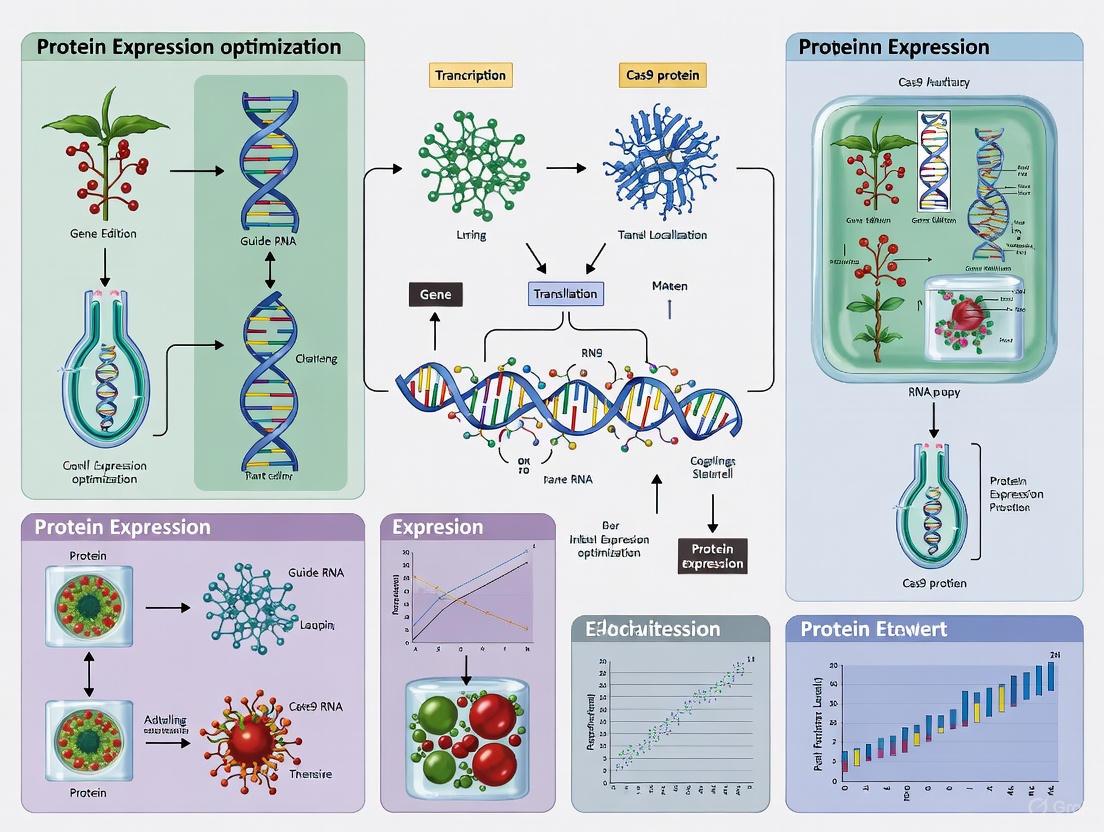
The efficacy of CRISPR-Cas9 technology in plant molecular breeding is fundamentally constrained by the efficiency of Cas9 protein expression within plant cells.
Optimizing Cas9 Protein Expression in Plant Cells: Strategies for Enhanced Genome Editing Efficiency
Abstract
The efficacy of CRISPR-Cas9 technology in plant molecular breeding is fundamentally constrained by the efficiency of Cas9 protein expression within plant cells. This article provides a comprehensive analysis of strategies to optimize Cas9 expression, covering foundational principles, methodological applications, systematic troubleshooting, and validation techniques. We explore codon optimization, promoter selection, advanced delivery systems, and the use of high-fidelity Cas9 variants to boost editing efficiency while minimizing off-target effects. Targeted at researchers and biotechnologists, this review synthesizes recent advances to offer a practical framework for developing robust plant genome editing protocols, ultimately accelerating crop improvement and functional genomics research.
Understanding Cas9 Expression Fundamentals in Plant Systems
The Critical Role of Cas9 Expression Levels in Plant Genome Editing Efficiency
Frequently Asked Questions (FAQs)
Q1: Why are Cas9 expression levels so critical for efficient plant genome editing? High levels of Cas9 protein are necessary to ensure that the nuclease is present in sufficient quantities to create double-strand breaks at the target DNA site when guided by the sgRNA. However, excessive or poorly-timed expression can lead to increased off-target effects and cellular toxicity. Research shows that optimizing Cas9 expression through promoter selection or suppression of plant RNA-silencing pathways can significantly increase mutagenesis frequencies [1] [2].
Q2: What molecular factors in plants can limit Cas9 expression? Plants possess innate RNA-silencing pathways (post-transcriptional gene silencing) that recognize and degrade foreign RNA, including Cas9 and sgRNA transcripts. Mutants defective in this pathway, such as ago1-27 and dcl2-1/dcl3-1/dcl4-2, show significantly higher Cas9 and sgRNA transcript levels, resulting in higher mutagenesis frequencies compared to wild-type controls [1] [2].
Q3: Which promoter strategies are most effective for boosting Cas9 expression in plants? Using strong, tissue-specific promoters, particularly those active in callus or meristematic tissues, has proven highly effective. For example, replacing the constitutive 35S promoter with the callus-specific promoter pYCE1 in cassava significantly increased the overall mutation rate from 62.07% to 95.24%, and the homozygous mutation rate from 37.93% to 52.38% [3]. Similarly, using the egg cell-specific promoter EC1.2 and the meristem-specific promoter YAO has achieved editing efficiencies of 80.9%–100% in T0 transgenic plants [3].
Q4: How can viral suppressor proteins help improve CRISPR/Cas9 editing efficiency? Viral suppressor proteins, such as p19 from the tomato bushy stunt virus, inhibit the plant's RNA-silencing machinery. Co-expressing p19 with CRISPR/Cas9 components shows a strong correlation between the severity of p19-induced phenotypic effects and gene editing efficiency. This system can also facilitate the identification of transgene-free T2 plants through simple visual observation of p19 symptom severity [1] [2].
Q5: What are the practical benefits of optimizing Cas9 expression for researchers? Optimized Cas9 expression enables: (1) Higher detection rates of CRISPR/Cas9-induced mutations in T1 plants, (2) More efficient identification of transgene-free edited plants in subsequent generations, and (3) Significant reduction in the time and resources needed to obtain homozygous mutants, which is particularly valuable for species with long life cycles or difficult transformation processes [1] [3] [2].
Troubleshooting Guides
Table 1: Common Cas9 Expression Problems and Solutions
| Problem Symptom | Potential Cause | Recommended Solution | Supporting Evidence |
|---|---|---|---|
| Low mutation efficiency in T1 plants | RNA silencing of Cas9/sgRNA | Use RNA-silencing mutants (ago1, dcl) or co-express viral suppressor p19 | Mutants showed 71% (ago1-27) vs 46% (WT) mutagenesis frequency [2] |
| Low homozygous mutation rate | Constitutive promoter (e.g., 35S) not optimized for transformation tissues | Switch to tissue-specific promoters (e.g., pYCE1 for callus, EC1.2 for egg cells) | pYCE1 increased homozygous rate in cassava from 37.93% to 52.38% [3] |
| Low editing efficiency in polyploid crops | Insufficient Cas9 expression to edit multiple gene copies | Use strong, optimized promoters (RPS5A) and bipartite NLS for nuclear localization | RPS5A promoter + bipartite NLS achieved 99% editing in Arabidopsis [4] |
| Low protein yield for RNP editing | Poor recombinant Cas9 expression in E. coli | Use BL21(DE3)-pLysS strain, optimize IPTG concentration (0.5 mM) and temperature | BL21(DE3)-pLysS strain showed efficient SpCas9 protein expression [5] |
Table 2: Quantitative Comparison of Promoter Performance in Different Plant Species
| Plant Species | Promoter Type | Promoter Name | Editing Efficiency | Homozygous Mutation Rate | Key Findings |
|---|---|---|---|---|---|
| Cassava | Callus-specific | pYCE1 | 95.24% | 52.38% | Superior to 35S promoter (62.07%) for callus-mediated transformation [3] |
| Cassava | Constitutive | 35S | 62.07% | 37.93% | Baseline for comparison in cassava editing experiments [3] |
| Arabidopsis | Various | RPS5A + bipartite NLS | >99% (1+ edits); >70% (4-7 edits) | N/A | Highest multiplex editing efficiency achieved in Arabidopsis [4] |
| Maize | Callus-specific | ZmDMC1 | 85.0% | 66.0% | Significantly higher than 35S and UBQ promoters [3] |
| Multiple species | Egg cell-specific | EC1.2 | 80.9%-100% | High | Efficient editing in T0 plants [3] |
Key Experimental Protocols
Protocol 1: Enhancing Cas9 Expression by Suppressing RNA Silencing
Methodology: Introduce CRISPR/Cas9 constructs into Arabidopsis mutants defective in RNA-silencing pathways (ago1-27, ago2-1, ago4-6/ago6-2, dcl1-3, dcl2-1/dcl3-1/dcl4-2). Alternatively, co-express the viral suppressor p19 from tomato bushy stunt virus or include an AGO1-RNAi cassette in the CRISPR/Cas9 vector [1] [2].
Workflow:
- Select appropriate RNA-silencing mutant backgrounds
- Introduce CRISPR/Cas9 construct targeting a visible marker gene (e.g., TT4)
- Analyze T1 seeds for mutant phenotypes (pale yellow vs. brown)
- Calculate mutagenesis frequency by counting "mutant" and "chimera" plants
- Verify by molecular analysis of Cas9 and sgRNA transcript levels
Figure 1: Workflow for enhancing Cas9 expression via RNA-silencing suppression.
Protocol 2: Optimizing Cas9 Expression with Tissue-Specific Promoters
Methodology: Identify and clone tissue-specific promoters (e.g., callus-specific promoter pYCE1) to drive Cas9 expression instead of constitutive promoters like 35S. Specifically target transformation tissues like friable embryogenic callus (FEC) [3].
Workflow:
- Analyze transcriptome data from various tissues to identify specific promoters
- Clone selected promoter (pYCE1) to replace 35S in CRISPR/Cas9 vector
- Transform friable embryogenic callus (FEC) with the new construct
- Regenerate plants and analyze mutation rates in T0 generation
- Compare editing efficiency with 35S-driven Cas9 controls
Key Results in Cassava: The callus-specific pYCE1 promoter drove highly specific EGFP transcription in callus tissues. When used for Cas9 expression, it achieved 95.24% overall mutation rate and 64.71% dual-gene homozygous mutation rate in dual-gene editing experiments [3].
Protocol 3: Producing Recombinant Cas9 Protein in E. coli
Methodology: Systematically optimize recombinant SpCas9-His expression in different E. coli strains for in vitro editing or RNP delivery [5].
Workflow:
- Transform pET-28b-Cas9-His plasmid into four E. coli strains: Rosetta2, BL21(DE3), BL21(DE3)-pLysS, BL21(DE3)-Star
- Test culture conditions (temperature: 18°C, 25°C, 37°C; IPTG concentration: 0.1-1.0 mM)
- Induce expression with optimal IPTG concentration (0.5 mM)
- Purify using immobilized metal affinity chromatography (IMAC)
- Verify protein activity and concentration
Figure 2: Recombinant Cas9 protein production workflow.
The Scientist's Toolkit: Research Reagent Solutions
Table 3: Essential Reagents for Optimizing Cas9 Expression
| Reagent Name | Type/Function | Application Example | Key Benefit |
|---|---|---|---|
| pYCE1 promoter | Callus-specific promoter from cassava | Driving Cas9 expression in cassava FEC transformation | Increased homozygous mutation rate to 52.38% [3] |
| TBSV p19 | Viral suppressor of RNA silencing | Co-expression with CRISPR/Cas9 to inhibit RNA silencing | Increases Cas9/sgRNA transcript levels and editing efficiency [1] |
| BL21(DE3)-pLysS | E. coli expression strain with T7 lysozyme | Recombinant Cas9 protein production | Reduces basal expression; suitable for toxic genes [5] |
| RPS5A promoter + bipartite NLS | Promoter and nuclear localization signal combination | Multiplex editing in Arabidopsis | 99% of plants had ≥1 mutation; >70% had 4-7 mutations [4] |
| AGO1-RNAi cassette | RNA interference against ARGONAUTE1 | Silencing key RNAi component in plant cells | Increases gene editing efficiency when built into vector [2] |
Advanced Optimization Strategies
Table 4: Emerging Technologies for Cas9 Expression Optimization
| Technology Approach | Mechanism | Current Evidence | Potential Applications |
|---|---|---|---|
| AI-Guided gRNA Design | Machine learning predicts optimal gRNA sequences with high activity | DeepCRISPR and CRISPRon models improve gRNA efficiency prediction [6] | All plant species, especially those with complex genomes |
| Dual-Component Systems (DDS) | Separates Cas9 and sgRNA into independent transcription units | Achieved near-total editing efficiency in tomato [7] | Crops where high efficiency is challenging |
| Virus-Induced Genome Editing (VIGE) | Viral delivery of editing components to Cas9-expressing lines | TRV-based system achieved up to 100% heritable editing in tomatoes [7] | Tissue culture-free editing in established lines |
| Ribonucleoprotein (RNP) Delivery | Direct delivery of pre-assembled Cas9-gRNA complexes | Achieved 17.3% editing efficiency in carrot protoplasts [7] | Transgene-free editing; avoids DNA integration |
| CRISPR-dCas9 Epigenetic Editing | Targeting repressive chromatin marks without DSBs | Successful demethylation of H3K27me3 at CUC3 in Arabidopsis [7] | Gene activation without permanent sequence changes |
Troubleshooting Guide and FAQs for Cas9 Protein Expression in Plant Cell Research
This technical support center addresses the key challenges of solubility, cytotoxicity, and nuclear localization in CRISPR-Cas9 experiments for plant research. These hurdles frequently impede progress in developing climate-resilient crops and conducting precise functional genomics studies. The following troubleshooting guides, FAQs, and optimized protocols synthesize current research to help scientists overcome these specific technical barriers in their work on Cas9 protein expression and application in plant systems [8] [9].
Troubleshooting Guide: Cas9 Protein Solubility and Expression
Table 1: Troubleshooting Low Cas9 Protein Solubility and Yield
| Problem | Possible Cause | Solution | Reference |
|---|---|---|---|
| Low protein yield | Incorrect E. coli strain | Use BL21(DE3)-pLysS for toxic genes or Rosetta2 for rare codons | [5] |
| Protein aggregation | Insufficient solubility tags | Use MBP or GST fusion tags; His-tag alone may be insufficient | [10] |
| Inconsistent expression | Leaky expression before induction | Use BL21(DE3)-pLysS with T7 lysozyme to reduce basal expression | [5] |
| Plasmid loss | Unstable expression construct | Add antibiotic selection and monitor plasmid stability | [10] |
| Low purity | Inadequate binding to affinity resin | Optimize imidazole concentration (10-20 mM binding, 250-500 mM elution) | [10] |
Experimental Protocol: Recombinant Cas9 Expression and Purification
This optimized protocol from recent studies yields 10-30 mg/L of active Cas9 protein [10].
Plasmid Transformation: Transform pET-28b-Cas9-His or pMJ922 (Addgene #78312) into E. coli BL21(DE3)-pLysS competent cells [5] [10].
Protein Expression:
- Grow culture in LB medium at 37°C until OD600 reaches 0.6-0.8
- Induce with 0.5 mM IPTG
- Incubate overnight at 18°C for optimal solubility [5]
Protein Purification:
- Lyse cells using sonication in lysis buffer (50 mM Tris-HCl, 500 mM NaCl, 10 mM imidazole, 10% glycerol, 1 mM TCEP, pH 7.5)
- Clarify lysate by centrifugation at 15,000 × g for 45 minutes
- Purify using immobilized metal affinity chromatography (IMAC) with Ni²⁺ or Co²⁺ resins
- Elute with high-imidazole buffer (250-500 mM)
- Optional: Remove tags with TEV protease cleavage [10]
Buffer Exchange and Storage:
- Use desalting columns to exchange into storage buffer (20 mM HEPES, 150 mM KCl, 10% glycerol, 1 mM DTT, pH 7.5)
- Concentrate to >5 mg/mL, flash-freeze in liquid nitrogen, and store at -80°C [10]
Figure 1: Cas9 Protein Expression and Purification Workflow
Troubleshooting Guide: Cas9 Cytotoxicity
Table 2: Addressing Cas9-Mediated Cytotoxicity
| Problem | Possible Cause | Solution | Reference |
|---|---|---|---|
| Cellular toxicity | Off-target effects | Use high-fidelity Cas9 variants; optimize sgRNA specificity | [11] |
| Cell death | Constitutive Cas9 expression | Switch to ribonucleoprotein (RNP) delivery; use inducible systems | [12] |
| Reduced cell viability | Excessive nuclease activity | Regulate exposure time; use anti-CRISPR proteins (6×NLS-Acr) | [13] |
| Inflammatory responses | Bacterial endotoxin contamination | Include endotoxin removal steps in purification | [5] |
| Apoptosis activation | Persistent DSBs | Use Cas9 nickase (nCas9) for single-strand breaks | [11] |
Experimental Protocol: Cytotoxicity Mitigation Using Anti-CRISPR Proteins
Recent studies demonstrate that cell-permeable anti-CRISPR proteins can inhibit up to 99% of Cas9 activity, significantly reducing off-target effects [13].
Acr Protein Preparation:
- Express and purify 6×NLS-Acr (fused to six nuclear localization signals)
- Confirm functionality through in vitro inhibition assays
Treatment Protocol:
- Add 6×NLS-Acr at 0.47 µM IC50 concentration to cells
- Incubate for 5 minutes to allow cellular uptake
- Apply simultaneously with or immediately after Cas9 RNP delivery
- For plant protoplasts, optimize concentration (typically 0.5-5 µM) [13]
Efficiency Validation:
Figure 2: Cytotoxicity Troubleshooting Decision Tree
Troubleshooting Guide: Nuclear Localization
Table 3: Overcoming Nuclear Localization Challenges
| Problem | Possible Cause | Solution | Reference |
|---|---|---|---|
| Poor editing efficiency | Inadequate nuclear import | Add bipartite NLS (SV40 NLS) to both Cas9 termini | [10] |
| Cytoplasmic retention | Weak NLS strength | Use multiple NLS copies (e.g., 6×NLS fusion) | [13] |
| Cell-type dependent variation | Differential import machinery | Optimize NLS type (SV40, c-Myc, or nucleoplasmin) for plant cells | [14] |
| Delayed nuclear entry | Large protein size | Use smaller Cas9 orthologs (SaCas9, NmCas9) | [11] |
| Protoplast-specific issues | Plant-specific barriers | Optimize PEG-mediated transformation parameters | [14] |
Experimental Protocol: Enhancing Nuclear Localization in Plant Systems
NLS Engineering:
PEG-Mediated Protoplast Transformation (for Coconut and Other Plants):
- Isolate protoplasts (3% cellulase, 1.5% macerozyme, 2% pectinase)
- Incubate 5 hours at 28°C in darkness, 60 rpm
- Transform with 40% PEG-4000, 0.4 M CaCl₂, 40 µg plasmid DNA
- Apply heat shock (1 minute at 45°C)
- Incubate 30 minutes before washing [14]
Efficiency Validation:
Frequently Asked Questions (FAQs)
Q: What is the optimal E. coli strain for expressing recombinant Cas9 with high solubility?
A: BL21(DE3)-pLysS is generally optimal for Cas9 expression, as it controls leaky expression and improves yields of soluble protein. For Cas9 variants with rare codons, Rosetta2 may be preferable [5].
Q: How can I quickly test sgRNA efficiency without full plant transformation?
A: Use in vitro cleavage assays with purified Cas9 protein and synthesized sgRNAs. Alternatively, employ protoplast-based transient expression systems, which can provide editing efficiency data within days [10] [14].
Q: What strategies can reduce Cas9 cytotoxicity in sensitive plant cell cultures?
A: Three effective approaches are: (1) Use Cas9 ribonucleoprotein (RNP) complexes instead of plasmid-based expression, (2) Implement inducible promoter systems to limit Cas9 expression duration, and (3) Apply cell-permeable anti-CRISPR proteins (6×NLS-Acr) to inhibit excessive nuclease activity [12] [13].
Q: How can I improve nuclear localization of Cas9 in plant protoplasts?
A: Ensure your Cas9 construct contains strong bipartite NLS sequences on both termini. For PEG-mediated transformation, optimize the parameters: 40% PEG-4000, 0.4 M CaCl₂, with brief heat shock treatment [10] [14].
Q: What is the typical yield I can expect from recombinant Cas9 purification?
A: With optimized protocols using E. coli BL21(DE3)-pLysS, yields of 10-30 mg of purified Cas9 per liter of bacterial culture are achievable, with purity >80% as confirmed by SDS-PAGE [10].
Research Reagent Solutions
Table 4: Essential Reagents for Cas9 Protein Experiments
| Reagent | Function | Example Sources |
|---|---|---|
| pET-28b-Cas9-His | Cas9 expression plasmid | Addgene #47327 |
| pMJ922 | His-MBP-TEV-Cas9-NLS-GFP expression | Addgene #78312 |
| BL21(DE3)-pLysS | Expression strain for toxic genes | ThermoFisher C602003 |
| Ni-NTA/Co-NTA resin | IMAC purification of His-tagged Cas9 | Various suppliers |
| TEV protease | Removal of affinity tags | Commercial sources |
| Protease inhibitor tablets | Prevent protein degradation during purification | Roche #05892970001 |
| TCEP/DTT | Reducing agents for protein stability | Various suppliers |
| HiTrap SP HP columns | Ion exchange chromatography | GE Healthcare #GE29-0513-24 |
The selection of a promoter to drive Cas9 nuclease expression is a critical determinant of success in plant genome editing experiments. The core challenge lies in balancing editing efficiency with precision, a trade-off often governed by the choice between constitutive and tissue-specific promoter systems. Constitutive promoters, such as the CaMV 35S and ubiquitin promoters, provide robust, widespread expression of Cas9 throughout the plant, which can simplify system design and has facilitated the rapid adoption of CRISPR technology in plants [15] [16]. However, this ubiquitous expression can lead to unintended consequences, including off-target effects, cellular toxicity, and the accumulation of somatic mutations in non-target tissues, which can complicate the analysis of editing outcomes and reduce the recovery of homozygous mutants [17] [18].
In contrast, tissue-specific promoters offer a more refined approach by restricting Cas9 expression to particular cell types or developmental stages. This spatial and temporal control is particularly advantageous in plant research, where transformation and regeneration often occur through specific tissues like callus [17]. By concentrating editing activity in these regenerative tissues, researchers can significantly increase the frequency of heritable, homozygous mutations while minimizing potential off-target effects and the metabolic burden of constitutive Cas9 expression on the plant [17] [16]. This guide provides a technical deep-dive into the selection, implementation, and troubleshooting of these promoter systems to optimize Cas9 expression in your plant research.
Promoter System Comparison and Selection Guide
The decision to use a constitutive or tissue-specific promoter should be guided by the specific goals of your experiment. The table below summarizes the core characteristics, advantages, and limitations of each system.
Table 1: Core Characteristics of Promoter Systems for Driving Cas9 Expression
| Feature | Constitutive Promoters | Tissue-Specific Promoters |
|---|---|---|
| Expression Pattern | Ubiquitous, high-level expression across most tissues and cell types [16] | Restricted to specific cell types, tissues, or developmental stages [17] [19] |
| Primary Advantages | Simplicity; ensures Cas9 is present in all cells; widely available and validated vectors [15] | Higher rates of heritable, homozygous mutations; reduced off-target effects and potential for cellular toxicity [17] [20] |
| Common Examples | CaMV 35S, Ubiquitin (Ubi) [17] [16] | Callus-specific (e.g., pYCE1), meristem-specific (e.g., RPS5A), cell-layer specific (e.g., LTPG20, PER03) [17] [16] [19] |
| Typical Applications | Rapid proof-of-concept experiments; systems where the target is not part of a regenerative pathway | High-efficiency generation of stable, transgene-free edited lines; functional genomics in specific cell types; synthetic biology [17] [19] |
The quantitative impact of promoter choice on editing outcomes is striking, as demonstrated by recent studies.
Table 2: Quantitative Comparison of Editing Efficiencies Driven by Different Promoters
| Plant Species | Promoter | Target Gene(s) | Overall Mutation Rate | Homozygous Mutation Rate | Citation |
|---|---|---|---|---|---|
| Cassava | 35S (Constitutive) | Single Gene | 62.07% | 37.93% | [17] |
| Cassava | pYCE1 (Callus-Specific) | Single Gene | 95.24% | 52.38% | [17] |
| Cassava | pYCE1 (Callus-Specific) | Dual-Gene | N/R | 64.71% (Homozygous) | [17] |
| Rice | OsRPS5-H1 (Meristem-associated) | OsPDS | ~50% (Albino Phenotype) | Confirmed in sequencing | [16] |
This data clearly shows that tissue-specific promoters can dramatically enhance the efficiency of CRISPR/Cas9 systems, particularly for obtaining biallelic, homozygous edits, which are essential for functional knockout studies and trait stabilization.
The Scientist's Toolkit: Essential Research Reagents
Table 3: Key Reagent Solutions for Promoter-Driven Cas9 Expression
| Reagent / Material | Function / Explanation | Example Applications |
|---|---|---|
| Callus-Specific Promoter (pYCE1) | Drives Cas9 expression specifically in friable embryogenic callus (FEC), the material used for transformation in many species like cassava [17]. | Maximizing heritable mutation rates in monocots and dicots with transformation systems reliant on callus regeneration. |
| RPS5A Homolog Promoters (e.g., OsRPS5) | Drives strong expression in meristematic and embryonic tissues, promoting highly efficient and heritable editing [16]. | A versatile alternative to constitutive promoters in both dicots (Arabidopsis, tomato) and monocots (rice) for improving editing efficiency. |
| Cell-Layer Specific Promoters (e.g., LTPG20, PER03) | Enables extremely precise spatial control of CRISPRa (activation) systems within specific root cell layers like the endodermis or epidermis [19]. | Synthetic biology and metabolic engineering to re-wire pathways in specific cell types without affecting the whole plant. |
| Nuclease-Deficient Cas9 (dCas9) | The core component of CRISPR activation (CRISPRa) systems; binds DNA without cutting and can be fused to transcriptional activators [19]. | Multiplexed transcriptional activation of endogenous genes for gain-of-function studies or engineered metabolic pathways. |
| Activation Domain Fusions (e.g., VP64, 2xTAD) | Protein domains fused to dCas9 that recruit the cellular transcription machinery to initiate gene expression [19]. | Enhancing the efficiency of gene activation in CRISPRa systems; different domains may have varying strengths and specificities. |
Troubleshooting Guides and FAQs
FAQ: Fundamental Questions on Promoter Selection
Q1: My primary goal is to create a stable, transgene-free edited plant line. Which promoter system is generally more effective? A: Tissue-specific promoters are strongly recommended for this objective. By confining Cas9 activity to the cells that give rise to the germline (e.g., callus or meristematic tissues), you increase the probability that edits occur in the progenitor cells of gametes. This strategy significantly boosts the recovery of homozygous T0 plants with the desired edit and simplifies the segregation of the Cas9 transgene in subsequent generations [17] [16].
Q2: Does long-term, constitutive expression of Cas9 harm my plants and confound experimental results? A: In animal models, comprehensive phenotyping of mice with tissue-specific Cas9 expression revealed no detrimental effects on body weight, tissue function, glucose tolerance, or heart health, suggesting that Cas9 itself is not inherently toxic [20]. However, in plants, the constant, high-level expression of Cas9 can lead to increased somatic mutation loads and potential metabolic drain. Therefore, while not necessarily "toxic," constitutive expression can introduce unwanted variability, making tissue-specific systems preferable for clean experimental outcomes [17].
Q3: Are plants edited using tissue-specific promoters subject to the same GMO regulations as traditional transgenic plants? A: The regulatory landscape is evolving. A key distinction is that plants edited to be "transgene-free" — where the CRISPR/Cas9 construct has been segregated out — contain only the intended mutation and are genetically indistinguishable from products of traditional mutagenesis. Many jurisdictions, though not all, are moving to exempt such transgene-free edited plants from the strict regulations applied to classical GMOs [15]. Using tissue-specific promoters facilitates the generation of such transgene-free lines by increasing the frequency of homozygous editing in the first generation.
Troubleshooting Guide: Common Experimental Challenges
Problem: Low Efficiency of Homologous Directed Repair (HDR) or Prime Editing
- Potential Cause: The donor template or pegRNA is not present in the cell at the same time as the Cas9-induced double-strand break or nick.
- Solutions:
- Use a tissue-specific promoter that is active in rapidly dividing cells (e.g., RPS5A). HDR is more active in the S/G2 phases of the cell cycle, which are abundant in meristematic tissues [16].
- Consider delivering the repair template as a double-stranded DNA vector or a single-stranded DNA oligonucleotide alongside the CRISPR machinery.
- For stable transformation, ensure the repair template is integrated into the T-DNA along with the Cas9 and guide RNA expression cassettes.
Problem: High Off-Target Mutation Rate
- Potential Cause: Cas9 is expressed at high levels for prolonged periods in many cell types, increasing the chance of cleavage at partially complementary sites.
- Solutions:
- Switch from a constitutive promoter (like 35S) to a tissue-specific promoter. This limits the window of time and the number of cells in which Cas9 is active, thereby reducing off-target opportunities [17].
- Use high-fidelity versions of the Cas9 nuclease (e.g., SpCas9-HF1, eSpCas9) which are engineered to reduce off-target activity while maintaining on-target efficiency [21].
- Deliver the CRISPR/Cas9 system as a pre-assembled Ribonucleoprotein (RNP) complex. This method provides rapid but transient activity, drastically cutting down off-target effects [18].
Problem: Inconsistent Editing Outcomes Between Independent Transgenic Lines
- Potential Cause: This is often due to "position effect," where the random integration of the transgene into different regions of the genome leads to varying levels of Cas9 expression. It can also be caused by somatic mosaicism, where editing occurs at different times in development.
- Solutions:
- For position effects: Screen a sufficient number of independent T0 lines (e.g., 20-30) to identify those with the desired strong, specific expression pattern. The use of self-reporting fluorescent marker lines, as done in CRISPRa systems, is invaluable for this screening [19].
- For mosaicism: Employ a promoter that drives expression early in the developmental lineage of your target tissue. For example, the PER03 promoter drives expression in the meristematic endodermis earlier than LTPG20, which can lead to more consistent editing within that tissue [19].
Detailed Experimental Protocols
Protocol 1: Evaluating a Novel Tissue-Specific Promoter for Cas9 Expression
This protocol outlines the steps to identify and validate a tissue-specific promoter for improving CRISPR/Cas9 editing efficiency, based on methodologies from recent literature [17].
Step-by-Step Methodology:
- Identification: Begin by analyzing transcriptome data from a wide range of plant tissues (e.g., leaf, stem, root, callus) to identify genes that are highly and exclusively expressed in your tissue of interest (e.g., friable embryogenic callus).
- Cloning: Clone the candidate promoter sequence (typically a 1.5 - 3.0 kb region upstream of the start codon) into a binary vector, using it to drive the expression of a reporter gene like EGFP. A constitutive promoter (e.g., 35S) driving a different reporter (e.g., mCherry) can serve as a positive control [19].
- Transformation and Validation: Stably transform the plant species of interest. For callus-specific promoters, this involves Agrobacterium-mediated transformation of friable embryogenic calli. Analyze the resulting transgenic tissues or plants using fluorescence microscopy to confirm that the reporter gene expression is strong and specific to the intended tissue [17].
- CRISPR/Cas9 Testing: Replace the reporter gene in your vector with the Cas9 nuclease. Construct a CRISPR vector using this promoter-Cas9 cassette and a Pol III promoter (e.g., U6 or U3) to drive the sgRNA. Target a well-characterized gene (e.g., Phytoene desaturase, PDS, which produces an albino phenotype when disrupted).
- Efficiency Quantification:
- Phenotypic Screening: For a visual marker like PDS, record the percentage of transgenic lines showing an albino or chimeric phenotype.
- Genotypic Analysis: Isolate genomic DNA from transgenic lines. PCR-amplify the target region and subject it to Sanger sequencing or Next-Generation Sequencing (NGS). Calculate the mutation frequency and the percentage of lines that are homozygous or biallelic for the mutation. Compare these results directly with a control group transformed with a 35S-Cas9 construct [17] [16].
Protocol 2: Implementing a Cell-Type-Specific CRISPR Activation (CRISPRa) System
This protocol details the setup for multiplexed gene activation in specific cell types, a powerful application of tissue-specific promoters [19].
Step-by-Step Methodology:
- System Selection: Choose an efficient CRISPRa system, such as the optimized dCas9-Suntag system, which consists of two components: a dCas9 protein fused to a GCN4 peptide array and a separate single-chain antibody (scFv) fused to a superfolder GFP and a transcriptional activation domain like VP64.
- Promoter Selection: Select a characterized cell-type-specific promoter (e.g., LTPG20 for endodermis, GPAT3 for epidermis). Clone this promoter to drive the expression of the dCas9-Suntag component.
- Guide RNA Design: Design 3-4 sgRNAs per target gene, targeting them to a region within 200 bp upstream of the transcriptional start site. Use a Pol III promoter (e.g., AtU6-26) in a vector capable of expressing multiple sgRNAs.
- Reporter Line Transformation: Generate stable transgenic lines expressing the dCas9-Suntag component under the cell-type-specific promoter. Cross these lines with a reporter line where a fluorescent protein is under the control of one of the target gene promoters. Alternatively, co-transform all components and screen T1 lines directly.
- Screening and Validation:
- Primary Screening: Use fluorescence microscopy to screen T1 seedlings for ectopic expression of the reporter in the expected cell layer. Score a large number of independent lines (>50) to account for position effects and identify the best performers [19].
- Secondary Validation: In the best-performing lines, use RT-qPCR on fluorescence-activated cell sorting (FACS)-isolated cells from the target tissue to quantitatively measure the upregulation of all target genes. Finally, confirm the functional outcome, such as the production of a metabolic compound (e.g., flavonols) detected via in-situ fluorescence or HPLC [19].
Conceptual Diagrams and Workflows
Diagram 1: Promoter Selection Workflow. This flowchart guides researchers in choosing between constitutive and tissue-specific promoters based on their primary experimental objective, leading to the expected outcomes associated with each path.
Diagram 2: Promoter Testing Protocol. This workflow outlines the key experimental steps for identifying and validating a novel tissue-specific promoter for CRISPR/Cas9 applications, highlighting the critical validation points.
Codon Optimization Strategies for Enhanced Translation in Plant Cells
Troubleshooting Guides
FAQ: Addressing Common Experimental Challenges
Q1: My codon-optimized Cas9 gene shows poor editing efficiency in Arabidopsis despite high CAI scores. What could be wrong? The Codon Adaptation Index (CAI) alone is insufficient for predicting expression success. Research demonstrates that simply replacing codons with the most frequent synonymous codons can decrease transgene expression by 77- to 111-fold [22]. Beyond codon usage, these factors critically impact efficiency:
Intron Inclusion: Incorporating multiple introns into the Cas9 coding sequence dramatically improves editing efficiency. One study found that while Cas9 genes without introns produced 0% primary transformants with knockout phenotypes, intronized versions achieved 70-100% efficiency [23].
Nuclear Localization Signals (NLS): Using two NLS sequences (both N- and C-terminal) performs better than a single NLS for efficient nuclear targeting [23] [24].
Regulatory Sequence Compatibility: The compatibility between 5' UTRs and the 5' coding sequence significantly influences translation initiation efficiency [22].
Solution: Implement a multi-factorial optimization approach that includes:
- Adding 13 Arabidopsis introns to your Cas9 coding sequence [23]
- Ensuring dual N-terminal and C-terminal nuclear localization signals [24]
- Verifying compatibility between your promoter/UTR elements and the coding sequence
Q2: How can I accurately quantify insoluble Cas9 protein expression when standard methods fail? Traditional ELISA and western blot methods have limitations for quantifying insoluble or multimeric proteins due to issues with protein transfer, denaturation, solubility, and stability [22]. Instead, use:
Targeted Mass Spectrometry with Parallel Reaction Monitoring (PRM):
- Protocol: Use strong denaturing and reducing conditions (high SDS and DTT concentrations) during sample preparation [22]
- Advantage: PRM provides accurate quantitation even for insoluble proteins or protein complexes, and has been successfully validated for in planta quantitation of biopharmaceuticals [22]
- Application: This method is particularly useful for proteins like Cas9 that may form complexes or exhibit poor solubility
Q3: What strategy improves Cas9-RNP editing efficiency in wheat and other cereals? Cas9 Ribonucleoprotein (RNP) delivery provides benefits like transient activity without genomic integration, but efficiency can be suboptimal [25]. Two key enhancements include:
- Temperature Optimization: Incubating transfected tissues at 30°C increases editing rates compared to standard 25°C conditions [25]
- Prolonged Activity: Editing persists for at least 14 days post-bombardment in wheat immature embryos [25]
- gRNA Validation: Use protoplast transfections as a rapid assay to screen gRNA efficacy before proceeding to regenerable tissue experiments [25]
Q4: Why does my heterologously expressed Cas9 protein cause cellular toxicity in plants? Cellular resource allocation significantly impacts protein synthesis capacity [26]. Consider these metabolic constraints:
- Resource Balancing: Protein synthesis consumes substantial nitrogen, sulfur, phosphate, and energy resources [26]
- Diurnal Regulation: Translation rates fluctuate ~3-fold over day-night cycles, peaking during daylight hours [26]
- Solution: Use tissue-specific promoters that limit expression to meristematic and reproductive tissues, which naturally support high protein synthesis rates and improve heritable mutation efficiency [24]
Quantitative Data on Optimization Parameters
Table 1: Impact of Different Optimization Strategies on Editing Efficiency
| Optimization Parameter | Experimental Approach | Efficiency Result | Reference |
|---|---|---|---|
| Intron inclusion in Cas9 | 13 Arabidopsis introns added to Cas9 coding sequence | 70-100% knockout phenotypes in primary transformants vs. 0% without introns | [23] |
| Nuclear localization signals | Dual NLS (N- and C-terminal) vs. single NLS | Significant improvement in mutation rates with dual NLS | [23] [24] |
| Temperature enhancement | 30°C vs. 25°C during editing | Consistent increase in editing rates across sgRNAs | [25] |
| Codon optimization approach | psbA-based hierarchy vs. simple rare codon elimination | 22.5-28.1-fold increase in protein expression with proper optimization | [22] |
Table 2: Comparison of Codon Optimization Tools and Methods
| Tool/Method | Key Features | Advantages | Considerations | |
|---|---|---|---|---|
| Deep learning-based optimization | BiLSTM-CRF model trained on host codon distribution | Captures complex codon usage patterns beyond simple CAI | Requires computational expertise; mutation risk needs monitoring | [27] |
| Commercial algorithms (IDT, VectorBuilder) | CAI optimization, GC content balancing, repeat reduction | User-friendly; integrates multiple parameters | May over-emphasize CAI without considering translational pauses | [28] [29] |
| psbA gene-based optimization | Uses codon usage hierarchy from 133 plant psbA genes | Maintains natural translation rhythm; avoids excessive optimization | 4.9-28.1-fold increase in protein expression demonstrated | [22] |
Experimental Protocols
Protocol 1: Intron-Enhanced Cas9 Vector Assembly for Arabidopsis
Purpose: Dramatically improve Cas9 editing efficiency through intron-mediated enhancement [23]
Materials:
- Z. mays codon-optimized Cas9 sequence with high GC content (55%)
- 13 Arabidopsis intron sequences
- RPS5a promoter or other strong plant-specific promoter
- Modular cloning system (e.g., MoClo)
- Dual nuclear localization signals (N-terminal and C-terminal)
Method:
- Synthesize Cas9 coding sequence using Zea mays codon usage with high GC content to facilitate efficient splicing
- Insert 13 Arabidopsis introns at strategic positions within the coding sequence
- Clone the intronized Cas9 sequence downstream of the RPS5a promoter
- Incorporate dual NLS sequences at both N- and C-termini
- Assemble the final construct with your selected sgRNA expression cassette
- Transform Arabidopsis via floral dip method
Validation: Screen T1 transformants for mutant phenotypes. Expect 70-100% of primary transformants to show full knockout phenotypes with the intronized version versus 0% with non-intronized controls [23]
Protocol 2: Cas9-RNP Mediated Editing in Wheat with Temperature Enhancement
Purpose: Achieve high-efficiency, DNA-free genome editing in wheat [25]
Materials:
- Purified Cas9 protein with C-terminal double nuclear localization tag
- Synthesized sgRNAs (Pi21gD, Tsn1g2, Tsn1g3, Snn5g1, Snn5g2)
- Wheat immature embryos (IEs)
- Gold particles for biolistic delivery
- PEG transformation solution
Method:
- Assemble Cas9-RNP complexes by incubating purified Cas9 with sgRNA (3:1 molar ratio)
- Coat gold particles with assembled RNPs
- Bombard wheat immature embryos using biolistic particle delivery
- Incubate transfected tissues at 30°C for 24-48 hours
- Maintain tissues at standard culture conditions for 14 days to allow editing persistence
- Regenerate plants through tissue culture without antibiotic selection
- Screen for edits using amplicon sequencing
Validation: Editing rates should show linear correlation between protoplast assays and regenerable embryos. Expect sustained editing activity for at least 14 days post-bombardment [25]
Visualization of Optimization Workflows
Cas9 Optimization Pathway
Codon Optimization Decision Framework
The Scientist's Toolkit: Research Reagent Solutions
Table 3: Essential Reagents for Cas9 Optimization in Plants
| Reagent/Category | Specific Examples | Function & Application Notes |
|---|---|---|
| Codon Optimization Tools | IDT Codon Optimization Tool, VectorBuilder, Deep learning models | Convert heterologous sequences for plant expression; balance CAI, GC content, and repetitive elements [28] [27] [29] |
| Cas9 Expression Systems | Intronized zCas9, fcoCas9 (fungal and plant codon-optimized) | Enhanced expression variants; intronized versions show dramatic efficiency improvements [23] [24] |
| Promoters for Plant Expression | RPS5a, 35S CaMV, meristematic- and reproductive-tissue-specific promoters | Drive Cas9 expression; tissue-specific promoters improve heritable mutation rates [23] [24] |
| Delivery Methods | Cas9-RNPs, Gold particles for biolistics, Agrobacterium vectors | DNA-free editing (RNPs) avoids integration; traditional methods offer selection capabilities [25] |
| Quantification Methods | Parallel reaction monitoring (PRM), Amplicon NGS, Cel-1 assay | Accurate protein measurement (PRM) and editing efficiency quantification [22] [25] |
The Impact of Nuclear Localization Signals (NLS) on Cas9 Function and Editing Rates
Nuclear Localization Signals (NLS) are critical components for the efficiency of the CRISPR-Cas9 system. They are short amino acid sequences that facilitate the active transport of the Cas9 protein through nuclear pore complexes into the nucleus, where genome editing occurs. For plant cell research, optimizing Cas9 protein expression and nuclear import is a fundamental step in developing efficient genome editing protocols. This technical support center provides troubleshooting guides and FAQs to help researchers address specific challenges related to NLS and Cas9 function in their experiments.
FAQs: Nuclear Localization Signals and Cas9 Editing
1. Why is nuclear import a critical bottleneck for Cas9 editing efficiency? The CRISPR-Cas9 system requires the Cas9 nuclease to be physically present inside the nucleus to access and cut chromosomal DNA. Most current Cas9 designs incorporate NLS motifs at the protein's termini to facilitate this nuclear entry. However, this method is often inefficient, and a significant portion of the Cas9 protein delivered to cells never reaches the nucleus. Overcoming this bottleneck is especially critical for transient delivery formats (like ribonucleoproteins or mRNA), where the editing window is brief [30].
2. How does the number of NLS motifs affect Cas9 performance? Research consistently shows that increasing the number of NLS motifs can boost editing rates, but the relationship is not purely linear.
- Dual NLS vs. Single NLS: A study in Arabidopsis thaliana found that Cas9 constructs with two NLSs performed better than those with a single NLS. While Cas9 with one NLS produced almost no primary transformants with a knockout phenotype, a version with two NLSs achieved a 3.2% rate of chimeric mutant phenotypes. The most dramatic improvement, however, came from the addition of introns to the Cas9 coding sequence [23].
- Multiple NLS Modules: Another study demonstrated that adding multiple NLS modules internally within the Cas9 protein structure (hiNLS) significantly improves editing in primary human T cells. A variant with two hiNLS module inserts knocked out a target gene in over 80% of T cells via electroporation, compared to about 66% with traditional Cas9. It was noted that the quality of the NLS sequence matters as much as the quantity [30].
3. What is the difference between terminal and internal NLS fusion? Traditional designs fuse NLS motifs to the N- and C-termini of the Cas9 protein. While simple, this approach can become problematic when adding multiple NLSs, as it can lead to poor recombinant protein expression yields, making large-scale production impractical [30].
An innovative solution is the hairpin internal NLS (hiNLS) strategy. Instead of extending the terminal tails, additional NLS motifs are inserted into surface-exposed loops within the Cas9 protein's structure. This places the NLS motifs more evenly across the protein and avoids the stability issues associated with long terminal tags. These hiNLS-Cas9 variants can be produced with high purity and yield, even with up to nine NLS motifs [30] [31].
4. Can optimizing NLS improve editing in hard-to-transfect cells like plant cells? Yes. Improved nuclear localization is particularly valuable for difficult-to-edit cell types. In plant research, using Cas9 with dual NLSs has been shown to be an important factor for efficient mutagenesis. One study found that Cas9 with a single NLS failed to produce detectable mutations, while Cas9 with double NLSs resulted in mutation rates of up to 100% in some transgenic lines, as detected by Cel-1 assay [24]. This confirms that sufficient nuclear signaling is critical for effective editing in plant cells.
Table 1: Comparison of NLS Configurations and Their Performance
| NLS Configuration | Experimental System | Key Finding | Reference |
|---|---|---|---|
| Single vs. Dual NLS | Arabidopsis thaliana | Cas9 with two NLSs showed improved mutant phenotype rates (3.2%) compared to a single NLS (~1%). | [23] |
| Dual vs. Single NLS | Arabidopsis thaliana | Cas9 with double NLSs achieved high mutation rates (93-100%); Cas9 with a single NLS showed no detectable mutations. | [24] |
| Internal hiNLS Modules | Primary Human T Cells | A hiNLS-Cas9 variant with two modules achieved >80% knockout efficiency, outperforming traditional Cas9 (~66%). | [30] [31] |
Troubleshooting Guide
Table 2: Common NLS-Related Issues and Proposed Solutions
| Problem | Potential Cause | Suggested Solution |
|---|---|---|
| Low editing efficiency despite high Cas9 expression. | Inefficient nuclear import; Cas9 is trapped in the cytoplasm. | Increase the number of NLS motifs. Consider using a dual NLS system (both N- and C-terminal) or the novel hiNLS approach. [30] [24] |
| Low yield of recombinant Cas9 protein during purification. | Terminal fusion of multiple NLS motifs can negatively impact protein stability and expression. | Switch to a Cas9 variant with internal NLS (hiNLS) insertions, which maintains high protein yield. [30] [31] |
| Inconsistent editing between cell types. | Variation in nuclear import machinery. | Optimize the NLS type and number for your specific cell type. Note that c-Myc-derived NLS may outperform SV40 NLS. [30] |
| High cell death following RNP electroporation. | Toxicity or inefficiency of the delivery method. | Combine hiNLS-Cas9 with gentler delivery methods like peptide-mediated delivery (PERC), which can achieve high editing with less impact on viability. [30] |
Experimental Protocols
Protocol 1: Evaluating NLS-Dependent Editing Efficiency in Plants
This protocol is adapted from plant genome editing studies that successfully used dual NLS to enhance mutation rates [23] [24].
Vector Construction:
- Clone your Cas9 coding sequence into your plant transformation vector. For initial tests, compare constructs with a single C-terminal NLS versus dual NLS (both N- and C-terminal).
- Use a strong, constitutive promoter (e.g., 35S CaMV or Arabidopsis RPS5a) to drive Cas9 expression.
- Clone the guide RNA expression cassette, using a U6 promoter, into the same vector.
Plant Transformation and Selection:
- Transform your plant model (e.g., Arabidopsis via floral dip) with the constructed vectors.
- Select for stable transformants using the appropriate antibiotic or herbicide.
Efficiency Analysis:
- Extract genomic DNA from primary transformants (T1 generation).
- PCR-amplify the genomic region surrounding the target site.
- Analyze the PCR products for mutations using one of the following methods:
- Restriction Fragment Length Polymorphism (PCR-RFLP): If the edit disrupts a restriction site.
- CEL-I Endonuclease Assay: To detect heteroduplex formation caused by indels.
- Sequencing: Sanger sequencing of individual clones or next-generation amplicon sequencing for a deep view of mutation types and frequencies.
Protocol 2: Purification of Recombinant Cas9 from E. coli
Producing functional Cas9 protein is a prerequisite for RNP-based editing. This protocol summarizes findings from a systematic optimization of recombinant SpCas9 expression [5].
Expression Strain Selection:
- Use E. coli BL21(DE3)-pLysS for efficient expression. This strain contains a plasmid encoding T7 lysozyme, which suppresses basal expression of the toxic Cas9 gene before induction, improving protein yield [5].
Expression and Induction:
- Transform the pET-28b-Cas9-His plasmid (or similar) into the competent BL21(DE3)-pLysS cells.
- Grow cultures in LB medium at 37°C until the OD600 reaches ~0.6.
- Induce protein expression with 0.5 mM Isopropyl β-d-1-thiogalactopyranoside (IPTG).
- Lower the temperature to 18°C and incubate with shaking for 16-20 hours (overnight) for optimal soluble protein production.
Protein Purification via Immobilized Metal Affinity Chromatography (IMAC):
- Lyse the cell pellet using a lysis buffer (e.g., containing Tris-HCl, KCl, imidazole).
- Clarify the lysate by centrifugation.
- Incubate the supernatant with Ni-NTA resin, which binds the His-tag on the recombinant Cas9.
- Wash the resin with a buffer containing a low concentration of imidazole (e.g., 20-30 mM) to remove weakly bound proteins.
- Elute the purified Cas9 protein using an elution buffer with a high concentration of imidazole (e.g., 300-500 mM).
- Dialyze the eluted protein into a storage buffer (e.g., containing HEPES, KCl, glycerol, DTT) to remove imidazole and stabilize the protein. Store at -80°C.
Essential Research Reagent Solutions
Table 3: Key Reagents for NLS and Cas9 Optimization Experiments
| Reagent / Material | Function / Description | Example Use |
|---|---|---|
| hiNLS-Cas9 Variants | Cas9 proteins with internal hairpin NLS modules. | Boosts nuclear import and editing efficiency in primary cells without compromising protein yield. [30] |
| pET-28b-Cas9-His Plasmid | A common bacterial expression vector for producing recombinant His-tagged Cas9. | Used for high-yield expression and purification of Cas9 protein for RNP delivery. [5] |
| E. coli BL21(DE3)-pLysS | An expression strain with tightly controlled protein induction, ideal for toxic genes like Cas9. | Critical for obtaining high yields of soluble, functional recombinant Cas9 protein. [5] |
| Tru-gRNAs (Truncated gRNAs) | gRNAs truncated at the 5' end (17-18 nt) to improve specificity. | Can be combined with NLS-optimized Cas9 to achieve high efficiency with reduced off-target effects. [24] |
| Intronized Cas9 Gene | A Cas9 coding sequence containing multiple plant introns within its coding sequence. | Dramatically increases editing efficiency in stable transgenic plants, often used in conjunction with dual NLS. [23] |
Visualizing the Concepts
Diagram 1: Mechanism of hiNLS vs Terminal NLS. The hiNLS strategy (top) integrates NLS motifs internally, leading to efficient nuclear import and high editing. The traditional terminal NLS strategy (bottom) can result in inefficient import and lower functional yield.
Advanced Delivery and Expression System Optimization
This technical support center provides targeted troubleshooting guides and FAQs to help researchers optimize Agrobacterium-mediated transformation, specifically for enhancing Cas9 protein expression in plant cells.
Troubleshooting Common Transformation Efficiency Issues
FAQ: What are the most effective Agrobacterium strains for high-efficiency transformation?
The choice of Agrobacterium strain significantly impacts transformation efficiency, especially when delivering complex CRISPR-Cas9 constructs. Research indicates that hypervirulent strains often yield superior results.
Table: Agrobacterium Strain Performance for Plant Transformation
| Strain | Classification/Type | Reported Efficiency | Best Use Cases | Key Findings |
|---|---|---|---|---|
| AGL1 | Hypervirulent (derived from Bo542) | ~100% (in Arabidopsis suspension cells) [32] | Suspension cells; challenging species | Achieved near-total infection of photosynthetic Arabidopsis suspension cells [32]. |
| EHA105 | Hypervirulent (derived from Bo542) | Effective for chimeric plant generation [33] | Woody plants; tissue with low regeneration capacity | Successfully used to generate gene-edited chimeric plants in Fraxinus mandshurica [33]. |
| A4 | Wild-type A. rhizogenes | 58.75% (in Coleus forskohlii) [34] | Hairy root induction | Optimal for inducing transgenic hairy roots in medicinal plants [34]. |
| GV3101 | Common lab strain | >90% (transient in sunflower) [35] | Transient transformation; agroinfiltration | Reliable for high-throughput transient expression assays [35]. |
FAQ: How can I optimize my infection and co-cultivation protocol?
Optimizing the infection and co-cultivation phases is critical for maximizing T-DNA delivery and stable integration. Key parameters to optimize are summarized below.
Table: Optimization Parameters for Infection and Co-cultivation
| Parameter | Optimal Range / Condition | Experimental Example | Impact on Efficiency |
|---|---|---|---|
| Bacterial Density (OD600) | 0.6 - 0.8 [34] [35] [33] | Sunflower transient transformation [35] | Balanced cell density prevents tissue damage while ensuring sufficient bacteria for infection. |
| Acetosyringone | 100 - 200 µM [32] [34] [33] | Coleus hairy root induction [34] | A critical virulence inducer; enhances T-DNA strand transfer. |
| Co-cultivation Medium | Solidified medium with AB salts [32] | Arabidopsis suspension cells [32] | Co-cultivation on solid medium plates was a key factor in achieving ~100% transformation. |
| Co-cultivation Duration | 2 - 3 days [32] [34] | Coleus hairy roots (optimal at 60h) [34] | Sufficient time for T-DNA transfer and integration. |
| Additives | Surfactants (e.g., Silwet L-77, Pluronic F68) [32] [35] | Sunflower (Silwet L-77) [35]; Arabidopsis (Pluronic F68) [32] | Surfactants improve tissue wettability and Agrobacterium contact, boosting infection rates. |
The Scientist's Toolkit: Key Research Reagents
Table: Essential Reagents for Optimizing Agrobacterium-mediated Transformation
| Reagent / Solution | Function | Application Notes |
|---|---|---|
| Acetosyringone | Phenolic compound that activates the bacterial vir genes, initiating T-DNA transfer [34] [33]. | Add to both bacterial pre-culture and co-cultivation media. Essential for transforming non-model species. |
| AB Minimal Salts | Used in resuspension medium during co-cultivation [32]. | Helps maintain Agrobacterium virulence during the infection process. |
| Silwet L-77 | Surfactant that reduces surface tension, allowing the bacterial suspension to fully infiltrate plant tissues [35]. | Critical for in planta infiltration methods. Concentration must be optimized to avoid phytotoxicity. |
| Pluronic F68 | Non-ionic surfactant used in suspension culture systems to protect cells from shear stress [32]. | Can enhance transformation efficiency in cell suspension cultures. |
| MES Buffer [2-(N-morpholino)ethanesulfonic acid] | A buffering agent used in infection solutions to maintain a stable pH (~5.4-5.6) favorable for vir gene induction [33]. |
Optimizing for Cas9 Expression and Genome Editing
FAQ: What strategies can improve the delivery and expression of Cas9 in plants?
Successfully delivering the CRISPR-Cas9 machinery is the first step. Ensuring stable and efficient expression is crucial for achieving high editing rates.
- Strain Virulence Matters: The hypervirulent strain AGL1, which achieved near-100% transformation in suspension cells, is an excellent candidate for delivering large Cas9 constructs due to its enhanced T-DNA transfer machinery [32] [36].
- Vector Design and Promoter Choice: For stable expression, strong constitutive promoters like the CaMV 35S are commonly used to drive Cas9 expression [33] [18]. The integration of transgenes into specific, transcriptionally active genomic "hotspots" can also enhance Cas9 expression stability and editing efficiency [18].
- Visual Marker Assistance: Using non-invasive visual reporters like RUBY, which produces a red betalain pigment, allows for rapid and easy identification of transformed tissues without specialized equipment. This enables early selection of editing events and has been successfully applied in hairy root and other transformation systems [34].
Experimental Workflow Guide
The following diagram outlines a systematic workflow for establishing and troubleshooting an Agrobacterium-mediated transformation protocol.
Systematic Workflow for Protocol Optimization
Key Takeaways for Cas9 Protein Expression Research
For researchers focused on optimizing Cas9 protein expression, the foundational step is achieving highly efficient and robust transformation. The strategies discussed here—selecting hypervirulent strains like AGL1, meticulously optimizing co-cultivation conditions with additives like acetosyringone and surfactants, and employing visual markers like RUBY for rapid screening—create a pipeline for successfully introducing and expressing the Cas9 transgene. This directly increases the likelihood of obtaining plants with the desired genomic edits, accelerating functional genomics research and crop improvement programs [32] [36] [18].
Tissue-Specific Promoters for Targeted Cas9 Expression in Meristematic and Reproductive Tissues
Frequently Asked Questions (FAQs)
Q1: Why should I use tissue-specific promoters instead of constitutive ones like 35S or Ubiquitin for Cas9 expression?
Constitutive promoters lead to ubiquitous Cas9 expression, which can cause several issues. Research shows that replacing the 35S promoter with the callus-specific promoter pYCE1 in cassava dramatically increased the homozygous mutation rate in edited plants from 37.93% to 52.38% in single-gene editing, and achieved a 64.71% dual-gene homozygous mutation rate [3]. Furthermore, tissue-specific expression minimizes Cas9 accumulation in non-target tissues, reducing the risk of off-target effects and potential cell toxicity [37] [16]. This approach is particularly valuable for generating heritable mutations, as editing the germline ensures changes are passed to the next generation.
Q2: Which specific promoters are recommended for targeting meristematic and reproductive tissues?
Several well-characterized promoters drive high Cas9 expression in these tissues. The choice depends on your plant species (monocot vs. dicot) and the specific reproductive cell type you aim to target. The table below summarizes key promoters and their performance.
Table 1: Key Promoters for Meristematic and Reproductive Tissues
| Promoter Name | Origin | Expression Specificity | Demonstrated Efficiency | Compatible Species |
|---|---|---|---|---|
| RPS5A [37] [16] | Arabidopsis thaliana | Meristematic tissues, embryonic tissues, female germ cells | High efficiency in T1 plants; superior to 35S and UBQ promoters in dicots [16] | Dicots (e.g., Arabidopsis, tomato, grapevine) |
| pYCE1 [3] | Cassava (Manihot esculenta) | Callus (specifically Friable Embryogenic Callus - FECs) | 95.24% overall mutation rate; 52.38% homozygous rate in cassava [3] | Cassava |
| OsRPS5-H1 [16] | Rice (Oryza sativa) | Active in protoplasts; drives heritable editing | ~50% of T0 transgenic lines showed mutant phenotypes [16] | Monocots (e.g., rice) |
| DD45/EC1.2 [37] | Arabidopsis thaliana | Egg cell, early embryo | Efficient for heritable gene targeting via both NHEJ and HDR [37] | Dicots (e.g., Arabidopsis) |
| YAO [37] | Arabidopsis thaliana | Embryo sac, embryo, endosperm, pollen, SAM | Efficiently generates progeny with a high diversity of mutations [37] | Dicots (e.g., Arabidopsis) |
| SPL [37] | Arabidopsis thaliana | Sporogenous cells, microsporocytes (male gametocytes) | Efficient for germline-specific Cas9 expression [37] | Dicots (e.g., Arabidopsis) |
Q3: What other factors, beyond promoter choice, are critical for maximizing editing efficiency?
Promoter selection is just one part of an optimized system. The following factors are also crucial:
- Nuclear Localization Signals (NLS): Cas9 requires NLS for nuclear import. Using two NLSs (both N- and C-terminal) has been shown to work significantly better than a single NLS [24] [23].
- Codon Optimization and Intron Addition: The Cas9 coding sequence itself can be optimized. One study demonstrated that introducing 13 introns into the Cas9 coding sequence dramatically boosted efficiency, resulting in 70-100% of primary transformants showing mutant phenotypes, compared to nearly 0% with an intron-less version [23].
- Guide RNA (gRNA) Design: Always use validated bioinformatics tools (e.g., CRISPR-P2.0, CasOT) to select gRNA sequences with high on-target activity and minimal potential off-target sites [3] [24]. Truncated gRNAs (tru-gRNAs) can also help reduce off-target effects [24].
Q4: I'm working on a monocot species. Are the promoters identified in Arabidopsis directly applicable?
Not always. While the function is conserved, the specific promoter sequences are not. You should use homologous promoters from your species of interest or a close relative. For example, the Arabidopsis RPS5A promoter is highly effective in dicots, but for rice (a monocot), the homologous OsRPS5-H1 promoter has been successfully used to drive Cas9 with high editing efficiency [16].
Troubleshooting Guides
Problem: Low Mutation Efficiency in Regenerated Plants
Potential Causes and Solutions:
- Cause 1: Weak or Unsuitable Promoter Activity
- Solution: Switch to a stronger, validated promoter specific to your plant's regenerative tissue. For transformation via callus, use a strong callus-specific promoter like pYCE1 (in cassava) or a meristem-active promoter like RPS5A [3] [16]. Confirm promoter activity in your target species using a GUS or GFP reporter gene first.
- Cause 2: Suboptimal Cas9 Coding Sequence
- Solution: Use a codon-optimized Cas9 gene for your host plant. Critically, consider using an "intronized" Cas9 version, where multiple plant introns have been inserted into the coding sequence to dramatically enhance expression and editing efficiency [23].
- Cause 3: Inefficient Delivery or Transformation
- Solution: Optimize your transformation protocol. Ensure your Agrobacterium strain or delivery method (e.g., biolistics) is efficient for your plant genotype. The use of Friable Embryogenic Callus (FECs) as transformation material, as done in cassava, can be a key factor [3].
Problem: High Off-Target Effects or Somatic Mosaicism
Potential Causes and Solutions:
- Cause 1: Prolonged and Ubiquitous Cas9 Expression
- Solution: The primary solution is to use tissue-specific promoters as described in this article. By restricting Cas9 expression to the intended reproductive or meristematic tissues, you limit the window and location for off-target cutting [37].
- Cause 2: Non-specific gRNA
- Solution: Re-design your gRNA using computational tools to ensure uniqueness in the genome. Consider using truncated gRNAs (tru-gRNAs, 17-18 nt) which can improve specificity, or high-fidelity Cas9 variants [24].
- Cause 3: Mosaicism from Editing in Somatic Tissues
- Solution: To obtain non-chimeric, heritable mutations, it is essential to edit the germline or initial cells. Use promoters like DD45 (egg cell), SPL (pollen precursors), or RPS5A (initiating cells) that drive expression in the plant's reproductive lineage, ensuring edits are incorporated into gametes [37].
Experimental Protocols
Protocol 1: Evaluating a Tissue-Specific Promoter for Cas9 Expression
This protocol outlines how to test a candidate promoter's ability to drive efficient genome editing.
1. Objective: To compare the editing efficiency of a candidate tissue-specific promoter (e.g., OsRPS5-H1) against a constitutive promoter (e.g., Ubiquitin) by targeting a visible marker gene.
2. Materials:
- Research Reagent Solutions:
- Plant Codon-Optimized Cas9: The nuclease that performs the DNA cut.
- Tissue-Specific Promoter Clone: e.g., pOsRPS5-H1, pYCE1, or pRPS5A.
- Constitutive Promoter Clone: e.g., p35S or pUbi, for comparison.
- gRNA Expression Cassette: A Polymerase III promoter (U3/U6) driving expression of your target gRNA.
- Binary Vector: A T-DNA vector for plant transformation.
- Agrobacterium tumefaciens Strain: For plant transformation (e.g., GV3101 for Arabidopsis, LBA4404 for monocots).
3. Methodology: 1. Vector Construction: Clone your candidate promoter and the constitutive control promoter to drive the Cas9 gene in your binary vector. Include the same gRNA expression cassette targeting a marker gene (e.g., OsPDS which causes an albino phenotype when disrupted) in both constructs [16]. 2. Plant Transformation: Introduce the constructs into your plant system (Arabidopsis via floral dip, rice/cassava via callus transformation) [3] [16]. 3. Phenotypic Screening: Analyze T0 transgenic plants for the expected mutant phenotype (e.g., count albino plants for PDS knockout). Calculate the percentage of lines showing a strong, non-chimeric mutant phenotype. 4. Genotypic Validation: Isolate genomic DNA from transgenic lines. Amplify the target region by PCR and sequence it (via Sanger or amplicon deep sequencing) to determine the exact mutation patterns and calculate the homozygous and biallelic mutation rates [3].
4. Expected Outcome: A successful tissue-specific promoter, like the OsRPS5-H1, should produce a high percentage (e.g., ~50% for OsRPS5-H1 targeting OsPDS [16]) of T0 plants with clear, non-mosaic mutant phenotypes, with efficiency comparable or superior to the constitutive promoter.
Table 2: Quantitative Data from Promoter Performance Studies
| Study / Plant | Promoter | Target Gene | Overall Mutation Rate | Homozygous/Biallelic Mutation Rate |
|---|---|---|---|---|
| Cassava [3] | 35S (Control) | Single Gene | 62.07% | 37.93% |
| pYCE1 (Callus-specific) | Single Gene | 95.24% | 52.38% | |
| pYCE1 (Callus-specific) | Dual Gene | Information Not Shown | 64.71% | |
| Rice [16] | OsRPS5-H1 | OsPDS | ~50% (Albino Phenotype) | Confirmed by sequencing |
Protocol 2: Optimizing Cas9 Cassette for Maximum Activity
This protocol is for advanced optimization of the Cas9 expression unit itself.
1. Objective: To enhance editing efficiency by modifying the Cas9 coding sequence with introns and nuclear localization signals.
2. Key Materials: In addition to standard molecular biology reagents, you will need: * "Intronized" Cas9 Gene: A Cas9 gene synthesized with multiple plant introns (e.g., 13 introns) within its coding sequence [23]. * Dual-NLS Cas9 Gene: A Cas9 gene with nuclear localization signals at both the N- and C-termini.
3. Methodology: 1. Design several Cas9 expression constructs: * Construct A: Standard Cas9 with a single NLS. * Construct B: Standard Cas9 with dual NLS. * Construct C: Intronized Cas9 with dual NLS [23]. 2. Clone these variants downstream of a strong, appropriate promoter (e.g., RPS5A). 3. Transform the constructs into your model plant (e.g., Arabidopsis). 4. Assess the editing efficiency in the T1 generation by phenotyping (if a visible marker is used) and genotyping. The construct with the intronized, dual-NLS Cas9 is expected to yield the highest proportion of transformants with full knockout phenotypes [23].
Diagrams and Workflows
Experimental Optimization Workflow
The Scientist's Toolkit: Research Reagent Solutions
Table 3: Essential Reagents for Optimizing Cas9 Expression
| Reagent / Material | Function / Purpose | Examples & Notes |
|---|---|---|
| Tissue-Specific Promoters | Drives Cas9 expression in specific cells/tissues (meristems, egg, pollen, callus) to increase heritable mutations and reduce off-targets. | pRPS5A (meristem/embryo) [16], pDD45/EC1.2 (egg cell) [37], pYCE1 (cassava callus) [3], pSPL (pollen) [37]. |
| Optimized Cas9 Coding Sequence | Enhances Cas9 protein expression and nuclear import, directly boosting editing efficiency. | Intronized Cas9 (contains multiple plant introns) [23], Dual-NLS Cas9 (has NLS at both N- and C-termini) [24] [23]. |
| gRNA Design & Validation Tools | Bioinformatics platforms to select gRNAs with high on-target activity and predict potential off-target sites. | CRISPR-P2.0 [3], CasOT, FOCAS [24]. Essential for designing specific gRNAs. |
| Binary Vectors | T-DNA plasmids used for stable integration of CRISPR/Cas9 components into the plant genome via Agrobacterium. | Standard plant transformation vectors (e.g., pCAMBIA, pGreen). Must be compatible with your plant species. |
| Visible Marker Genes | Genes whose disruption produces a clear phenotype (e.g., albinism), allowing rapid visual assessment of editing efficiency. | Phytone Desaturase (PDS) [16], GLABRA1 (GL1) [24]. Useful for initial protocol testing. |
Multiplexed gRNA Expression Systems for Coordinated Cas9 Activity
Core Concepts of Multiplexed CRISPR Systems
Multiplexed CRISPR technologies represent a significant advancement over single-guide RNA approaches by enabling simultaneous expression of numerous gRNAs or Cas enzymes, vastly enhancing the scope and efficiency of both genetic editing and transcriptional regulation [38]. In their natural context in bacteria and archaea, CRISPR systems are inherently multiplexed, containing arrays of spacers that are processed into multiple crRNAs to provide adaptive immunity [38] [39]. Repurposing this natural capability for genome engineering in plants and other eukaryotes allows researchers to address biological complexity that cannot be tackled with single-target approaches.
Why Use Multiplexed gRNA Systems? Multiplexing provides several distinct advantages for plant research:
- Overcoming Genetic Redundancy: Plant genomes frequently contain duplicated genes and gene families with overlapping functions. Simultaneous targeting of multiple paralogs is often necessary to reveal phenotypic effects [39]. For example, in cucumber, triple mutants of
Csmlo1,Csmlo8, andCsmlo11genes were required to achieve full powdery mildew resistance, whereas single knockouts showed no effect [39]. - Engineering Polygenic Traits: Many agriculturally important traits, such as yield, stress tolerance, and metabolic pathways, are controlled by multiple genes. Multiplexed editing enables coordinated manipulation of these distributed genetic networks [39].
- Large-Scale Genomic Rearrangements: Using two gRNAs targeting different genomic locations enables deletion of large DNA fragments, chromosomal inversions, translocations, and other structural variations [40] [41]. This approach has been successfully used to excise entire selectable marker gene cassettes from transgenic plants [41].
- Enhanced Editing Efficiency: Targeting multiple gRNAs to a single genetic locus can significantly improve the efficiency of both DNA editing and transcriptional control [38].
Table 1: Key Applications of Multiplexed gRNA Systems in Plant Research
| Application | Objective | Example Outcome |
|---|---|---|
| Gene Family Analysis | Overcome functional redundancy in paralogous genes | Revealed requirement for triple MLO gene knockout for powdery mildew resistance in cucumber [39] |
| Metabolic Engineering | Rewire complex metabolic pathways | Simultaneous regulation of multiple genes in metabolic pathways to enhance desirable compounds [38] |
| Selectable Marker Excision | Remove antibiotic resistance genes from transgenic plants | Successful deletion of DsRED marker gene with ~10% efficiency in tobacco using 4 gRNAs [41] |
| Chromosomal Engineering | Induce structural variations | Create large deletions, inversions, and translocations for functional genomics [40] |
Genetic Architectures for Multiplexed gRNA Expression
Several strategic architectures have been developed to express multiple gRNAs in plant systems. The choice of architecture depends on the specific application, number of targets, and desired control over gRNA expression.
Figure 1: Genetic architectures for multiplexed gRNA expression in plants, showing three principal strategies with their respective advantages.
Individual Promoter Systems
The most straightforward approach involves expressing each gRNA from its own RNA polymerase III (Pol III) promoter, such as U3 or U6 promoters [42]. This two-component transcriptional unit (TCTU) system typically places Cas9 under a Pol II promoter while gRNAs are expressed from Pol III promoters [42]. While this approach provides high-fidelity expression and is well-established, it has limitations including potential promoter cross-talk when multiple identical promoters are used, and limited spatiotemporal control [42].
Single Transcript with Processing Systems
More advanced systems express multiple gRNAs as a single transcript that is subsequently processed into individual functional gRNAs. This coordinated approach offers several advantages, including more compact vector design and synchronized gRNA expression. Processing can be achieved through several mechanisms:
Ribozyme-Mediated Processing: gRNAs are flanked by self-cleaving hammerhead (HH) and hepatitis delta virus (HDV) ribozymes, which excise the functional gRNAs through autocatalytic activity [38] [42]. This system is compatible with both Pol II and Pol III promoters and has been demonstrated in multiple organisms [38].
tRNA-Mediated Processing: The polycistronic tRNA-gRNA (PTG) system exploits endogenous cellular machinery by flanking gRNAs with tRNA sequences [43]. Eukaryotic RNases P and Z naturally recognize and cleave these tRNA sequences, releasing the individual gRNAs [43]. This system has been used to express up to 8 gRNAs simultaneously in plants and requires no additional processing enzymes [43].
Csy4-Mediated Processing: The bacterial endoribonuclease Csy4 from Pseudomonas aeruginosa can be co-expressed to process gRNAs flanked by 28-base pair Csy4 recognition sites [38] [43] [44]. This system enables temporal and spatial control of gRNA activity, as functional gRNAs are only released where and when Csy4 is expressed [43].
Cas12a Self-Processing: The Cas12a (Cpf1) system naturally processes its own CRISPR arrays through recognition of hairpin structures formed within spacer repeats [38]. This inherent capability has been leveraged to express and process numerous gRNAs from a single transcript in plants, yeast, and bacteria [38].
Table 2: Comparison of Multiplexed gRNA Expression Systems
| System | Processing Mechanism | Max gRNAs Demonstrated | Advantages | Limitations |
|---|---|---|---|---|
| Individual Pol III Promoters | Independent transcription | 7+ in plants [43] | Simple design, reliable expression | Promoter cross-talk, large vector size |
| Ribozyme (HH/HDV) | Self-cleaving ribozymes | Not specified | Compatible with Pol II promoters | Potential imprecise cleavage |
| tRNA-gRNA (PTG) | Endogenous RNase P/Z | 8 in plants [43] | No additional enzymes, highly efficient | May require optimization of tRNA sequences |
| Csy4 | Exogenous endoribonuclease | 12 in yeast [38] | Temporal/spatial control, precise | Cytotoxicity at high Csy4 concentrations [38] |
| Cas12a Array | Self-processing by Cas12a | 10 in human cells [38] | Natural system, efficient | Limited to Cas12a system |
Experimental Protocols for Implementing Multiplex Systems
Golden Gate Assembly for Multiplex Vector Construction
Golden Gate assembly has emerged as the predominant method for constructing multiplex CRISPR vectors due to its efficiency in assembling multiple gRNA expression cassettes [40] [43].
Protocol: Golden Gate Assembly for 4-gRNA Plant Vector
gRNA Insert Cloning:
- Design oligonucleotides for each target sequence with appropriate overhangs for BsaI or BbsI restriction sites.
- Clone each gRNA target sequence into intermediate vectors containing promoter-gRNA scaffolds using BbsI digestion and ligation [43].
- Verify correct insertion by colony PCR and sequencing.
Multiplex Assembly:
- Digest the intermediate gRNA vectors and destination Cas9 vector with BsaI type IIS restriction enzyme [43].
- Purify the digested fragments containing promoter-gRNA units.
- Set up a one-pot Golden Gate reaction with the destination vector and gRNA fragments using T4 DNA ligase and BsaI enzyme.
- Use a molar ratio of approximately 3:1 for each insert:vector ratio.
- Cycle between digestion (37°C) and ligation (16°C) 25-30 times [43].
Transformation and Verification:
- Transform the Golden Gate reaction into competent E. coli cells.
- Select on appropriate antibiotics and screen colonies by restriction digest.
- Confirm final assembly by diagnostic PCR and Sanger sequencing across all junctions.
Critical Notes:
- The Yamamoto Lab Multiplex CRISPR/Cas9 Assembly Kit enables expression of up to 7 gRNAs with custom destination vectors for different gRNA numbers [43].
- For plant systems, the Liu Lab Golden Gate system can assemble up to 8 gRNAs using BsaI cloning into pCAMBIA-based destination vectors [43].
Marker Excision Protocol Using Multiplex CRISPR
This protocol demonstrates a practical application of multiplex CRISPR for removing selectable marker genes from transgenic plants [41].
Materials:
- Transgenic tobacco plants containing DsRED marker gene and gene of interest
- Agrobacterium strain LBA4404 with multiplex CRISPR vector containing 4 gRNAs
- Shoot regeneration medium (3% MS media + 2 mg/L Kinetin + 1 mg/L IAA)
Method:
- Design 4 gRNAs targeting flanking regions of the SMG cassette [41].
- Clone gRNAs into a CRISPR vector using Golden Gate assembly as described above.
- Transform leaf discs from transgenic plants via Agrobacterium-mediated transformation [41].
- Regenerate shoots on selection medium without antibiotic selection for the marker gene.
- Screen regenerated shoots for loss of red fluorescence (approximately 20% efficiency) [41].
- Confirm SMG excision by PCR amplification across target sites (expect smaller amplicon).
- Sequence the target regions to verify deletion and identify any small indels.
- Advance successful events to T1 generation to segregate out CRISPR components.
Expected Outcomes:
- Approximately 10% of regenerated shoots should show complete SMG excision [41].
- SMG-free plants display normal growth, flowering, and seed production [41].
- Cas9-free, marker-free transgenic plants can be recovered through segregation in T1 generation [41].
Troubleshooting Common Experimental Issues
FAQ 1: Why do I observe irregular protein expression after successful CRISPR edits?
This common issue often stems from biological complexity rather than technical failure:
Alternative Isoforms: If not all protein isoforms were considered during gRNA design, one or more isoforms may still be expressed despite successful editing of the targeted exon [45]. Always use genomic databases (e.g., Ensembl) to identify all prominent isoforms and target exons present in all variants [45].
Truncated Proteins: Alternative start sites or exon skipping can produce N-terminally truncated proteins that evade your knockout strategy [45]. Target early exons common to all isoforms, and consider using multiple gRNAs against different regions of the gene.
Incomplete Editing: In pooled cell populations, a mixture of edited and unedited cells may persist. Perform limiting dilution to isolate clonal populations and verify editing at both genomic and protein levels [45].
FAQ 2: How can I improve editing efficiency in multiplex systems?
gRNA Design Optimization: Ensure gRNAs do not begin with extra guanine nucleotides, as this common synthesis artifact can cause misalignment with DNA targets and reduce efficiency [46]. Redesigned gRNAs with precise 5' ends showed dramatically improved efficiency (22 of 23 targets cut with near-perfect efficiency versus 4 of 10 with extra nucleotides) [46].
Promoter Selection: For complex multiplexing, consider mixing promoter types (e.g., U6, 7SK, H1) to reduce potential homologous recombination between identical sequences [43]. The Gersbach lab system uses four different promoters for 4-gRNA expression [43].
Processing System Choice: For high-level multiplexing (≥8 gRNAs), the tRNA-gRNA system often provides robust performance without requiring additional processing enzymes [43].
FAQ 3: Why do I obtain inconsistent results when assembling multiplex vectors?
Golden Gate Optimization: Ensure the type IIS restriction enzyme (BsaI, BsmBI) is fresh and active. Include sufficient cycling between digestion and ligation temperatures (25-30 cycles). Verify the design of overhangs to ensure proper directional assembly.
Vector Stability: Highly repetitive gRNA arrays can cause plasmid instability in bacterial systems [39]. Use recombination-deficient E. coli strains (e.g., Stbl3) for propagation and minimize the number of bacterial generations.
Assembly Verification: With multiple gRNAs, standard restriction digestion may not be sufficient. Always include diagnostic PCR across assembly junctions and Sanger sequencing of the final construct.
Figure 2: Troubleshooting guide for common issues in multiplexed gRNA experiments, showing problems and their corresponding solutions.
Research Reagent Solutions
Table 3: Essential Research Reagents for Multiplexed CRISPR Plant Research
| Reagent/Kit | Supplier/Source | Function | Application Notes |
|---|---|---|---|
| Yamamoto Lab Multiplex Kit | Addgene [43] | Assembly of 2-7 gRNAs with custom destination vectors | No filler sequences needed; multiple Cas9 variants available |
| Liu Lab Golden Gate System | Addgene [43] | Plant-optimized system for up to 8 gRNAs | Based on pCAMBIA; options for monocots and dicots |
| tRNA-gRNA (PTG) System | Yang Lab [43] | Polycistronic system using endogenous RNases | No additional enzymes; high efficiency for 8 gRNAs |
| CRISPathBrick System | Koffas Lab [43] | For E. coli intermediate assembly | Type II-A CRISPR arrays for dCas9 repression |
| pX333 Two-gRNA Vector | Addgene [43] | Mammalian two-gRNA system with different restriction sites | Uses BbsI and BsaI for sequential cloning |
| Csy4 Processing System | Joung Lab [43] [44] | Inducible gRNA processing | Enables temporal/spatial control; requires Csy4 expression |
Emerging Technologies and Future Directions
The field of multiplexed genome engineering continues to evolve rapidly. Several emerging technologies show particular promise for plant systems:
CRISPR Activation (CRISPRa) for Multiplexed Overexpression: While most multiplex applications focus on gene knockouts, CRISPRa systems using deactivated Cas9 (dCas9) fused to transcriptional activators enable multiplexed gene activation [47]. This approach is particularly valuable for gain-of-function studies and activating endogenous defense genes in crops [47]. Recent success includes upregulation of SlPR-1 in tomato for enhanced disease resistance [47].
Inducible and Tissue-Specific Systems: There is growing demand for experimentally validated inducible or tissue-specific promoters to achieve spatiotemporal control of multiplex editing [39]. Such systems would enable more precise functional studies and avoid pleiotropic effects.
Advanced Delivery Systems: The emergence of CRISPR ribonucleoprotein (RNP) delivery methods, including engineered nanoparticles, promises to revolutionize transgene-free multiplex genome editing [42]. These approaches could potentially bypass the current limitations of DNA vector delivery.
As these technologies mature, multiplex CRISPR editing is poised to become a foundational platform for next-generation crop improvement, enabling researchers to address increasingly complex questions in plant biology and develop novel solutions for agricultural challenges [39].
Technical Support Center
Frequently Asked Questions (FAQs)
FAQ 1: What is an "all-in-one" CRISPR/Cas9 vector, and what are its main advantages for plant research? An "all-in-one" vector is a single DNA construct that contains all the necessary components for the CRISPR/Cas9 system: the Cas9 gene, a guide RNA (gRNA) sequence, and often a selectable marker. Its primary advantage is simplified experimental workflow. By eliminating the need to co-deliver or co-express multiple separate constructs, it increases the likelihood that a transformed plant cell will receive all components, thereby enhancing the efficiency of generating edited events [48]. This streamlined delivery is crucial for optimizing Cas9 protein expression and ensuring consistent editing.
FAQ 2: I am experiencing low mutation rates in my edited plants. What could be the cause? Low mutation rates can stem from several factors related to vector design and delivery:
- Inefficient gRNA Design: The gRNA may have low on-target activity. Solutions are detailed in Troubleshooting Guide 1 below.
- Low Cas9 Expression: The promoter driving the Cas9 gene may not be optimal for your plant species, leading to insufficient Cas9 protein production.
- Inefficient Delivery System: The transformation method (e.g., Agrobacterium-mediated) may be inefficient for your specific plant. Consider alternative delivery methods like protoplast transfection to rapidly test your vector's functionality before stable transformation [49].
- Silencing of Transgenes: The vector's genetic elements might be recognized and silenced by the plant's defense mechanisms.
FAQ 3: My transformation is successful, but I detect no Cas9 protein expression. How should I troubleshoot? This issue often lies in the genetic parts used in your vector. Focus on:
- Promoter Selection: Ensure you are using a strong, constitutive promoter that is known to be functional in your plant species (e.g., CaMV 35S for many dicots, Ubiquitin for monocots) [18].
- Terminator Sequence: Verify the presence of a robust terminator sequence at the 3' end of the Cas9 gene to ensure proper transcription.
- Codon Optimization: The Cas9 coding sequence should be codon-optimized for your plant host to enhance translation efficiency and protein yield [18].
- Validation Method: Use a Western blot with an anti-Cas9 antibody for definitive confirmation of protein expression, as PCR only confirms the presence of the DNA.
FAQ 4: Are there alternatives to stable transformation for rapidly testing my all-in-one vector? Yes, transient expression systems are excellent for rapid validation.
- Protoplast Transfection: Isolate plant cells without cell walls and transfert them with your vector using polyethylene glycol (PEG). This allows for quick assessment of editing efficiency (often within days) without going through a full regeneration process [49].
- Viral Vector Delivery: Engineered plant viruses (e.g., based on Geminivirus) can be used to transiently deliver CRISPR/Cas9 components. These systems can achieve high levels of replication and gene expression within 1-2 weeks, providing a fast platform for testing [50].
FAQ 5: How can I avoid persistent transgenes and achieve "transgene-free" edited plants? The all-in-one vector is typically integrated into the genome. To obtain plants without the foreign DNA, you have two main strategies:
- Genetic Segregation: Cross the primary edited plant (T0) with a wild-type plant. In the next generation (T1), select progeny that have the desired edit but have lost the Cas9/gRNA transgene through Mendelian segregation.
- Transient Expression: Use the viral vector or RNP (Ribonucleoprotein) delivery methods mentioned above, which do not involve genomic integration from the start, making the edits inherently transgene-free [50].
Troubleshooting Guides
Troubleshooting Guide 1: Addressing Low On-Target Editing Efficiency
| Symptom | Potential Cause | Recommended Solution | Key References |
|---|---|---|---|
| Low or no mutations detected at the target site. | Inefficient guide RNA (gRNA) design with poor specificity or activity. | - Use AI-powered tools (e.g., CRISPR-GPT, Pythia) to design and select high-efficiency gRNAs.- Perform in vitro cleavage assays to validate gRNA activity before plant transformation.- Design and test multiple gRNAs for the same target. | [51] [49] |
| Low expression or stability of the Cas9 protein. | - Use a strong, species-appropriate promoter (e.g., CaMV 35S, Ubiquitin).- Ensure the Cas9 sequence is codon-optimized for your plant host.- Include introns in the Cas9 gene to boost expression in plants. | [18] [52] | |
| Target site in inaccessible chromatin region. | - Use bioinformatics tools to analyze chromatin accessibility data if available.- Target a different region within the same gene. | - | |
| Troubleshooting Guide 2: Resolving Problems with Vector Delivery and Transformation | |||
| Symptom | Potential Cause | Recommended Solution | Key References |
| :--- | :--- | :--- | :--- |
| Poor transformation efficiency or no transformation events. | Suboptimal Agrobacterium strain or concentration. | - Titrate the optical density (OD600) of the Agrobacterium culture; typical optimal range is 0.5-0.8.- Use a different, more virulent Agrobacterium strain (e.g., EHA105, GV3101). | [48] |
| Toxic effects of Cas9 expression on plant cells. | - Use an inducible promoter to control Cas9 expression, limiting it to short periods after transformation. | [18] | |
| High recalcitrance of the plant species to transformation. | - Optimize the tissue culture and regeneration protocol.- Use a protoplast-based system to bypass regeneration hurdles and test vector efficiency. | [48] [49] |
Experimental Protocols for Validation
Protocol 1: Rapid Validation of All-in-One Vectors Using Protoplast Transfection
This protocol allows for quick testing of gRNA efficiency and Cas9 functionality before undertaking lengthy stable transformation [49].
Protoplast Isolation:
- Plant Material: Use young, fully expanded leaves from 2-4 week-old sterile plants.
- Enzyme Solution: Prepare a solution containing MES (20 mM, pH 5.7), KCl (20 mM), CaCl₂ (10 mM), BSA (0.1%), Mannitol (0.3-0.6 M), Cellulase R-10 (1-2.5%), and Macerozyme R-10 (0-0.6%). The exact concentrations must be optimized for your plant species, as demonstrated in pea [49].
- Procedure: Remove mid-ribs and slice leaves into thin strips. Immerse in enzyme solution and incubate in the dark with gentle shaking for several hours.
Protoplast Purification:
- Filter the enzymolysate through a 40 μm mesh to remove debris.
- Centrifuge the filtrate at low speed (e.g., 100 x g) to pellet protoplasts.
- Resuspend the pellet in a W5 solution (154 mM NaCl, 125 mM CaCl₂, 5 mM KCl, 2 mM MES).
PEG-Mediated Transfection:
- Vector DNA: Use 20 µg of plasmid DNA for the all-in-one vector.
- Transfection Mix: Combine protoplasts with DNA and an equal volume of 40% PEG solution.
- Incubation: Incubate for 15 minutes.
- Stop: Dilute the mixture with W5 solution, wash, and culture the protoplasts in the dark.
Efficiency Analysis:
- Genomic DNA Extraction: Extract DNA from transfected protoplasts after 48-72 hours.
- Mutation Detection: Use restriction enzyme (RE) assays or Sanger sequencing of PCR-amplified target sites to assess mutation efficiency. Studies in pea protoplasts have reported up to 97% mutagenesis using this approach [49].
Protocol 2: Agrobacterium-Mediated Stable Transformation of Plant Growth Points
This method is adapted from a system developed for the recalcitrant tree species Fraxinus mandshurica and highlights key optimizations [48].
Vector Construction:
- Clone your gRNA sequence(s) into a BsaI-digested all-in-one vector backbone (e.g., pYLCRISPR/Cas9P35S-N).
- Transform the final construct into an Agrobacterium strain such as EHA105.
Plant Material Preparation:
- Use sterile plantlets or embryonic axes (growth points) as explants.
Agrobacterium Infection and Co-cultivation:
- Culture: Grow Agrobacterium to an OD600 of 0.5-0.8.
- Infection: Immerse explants in the bacterial suspension for an optimized duration.
- Co-cultivation: Blot-dry the explants and co-cultivate them on solid medium for 2-3 days in the dark.
Selection and Regeneration:
- Transfer explants to selection media containing antibiotics (e.g., Kanamycin) to eliminate non-transformed tissue and promote the growth of transformed cells.
- Induce shoot formation on regeneration media, potentially using a clustered bud system to increase the yield of edited events [48].
Molecular Characterization:
- Screen regenerated shoots (T0 plants) by PCR for the presence of the transgene.
- Sequence the target genomic loci to identify mutations.
- For transgene-free editing, proceed with genetic segregation in the T1 generation.
Research Reagent Solutions
Table: Essential Reagents for All-in-One Vector Experiments in Plants
| Reagent / Material | Function in the Experiment | Specific Examples & Notes |
|---|---|---|
| All-in-One Vector Backbone | Serves as the primary plasmid for housing Cas9 and gRNA expression cassettes. | Vectors like pYLCRISPR/Cas9P35S-N [48]. Must contain a plant selection marker (e.g., Kanamycin resistance). |
| Cas9 Protein | The effector enzyme that creates double-strand breaks in the target DNA. | Can be expressed from the vector in planta. For RNP delivery, purified protein is used directly. |
| Guide RNA (gRNA) | Directs the Cas9 protein to the specific genomic target site. | Designed using online tools (e.g., Target Design [48]) and cloned into the vector. |
| Agrobacterium tumefaciens Strain | A biological vector for delivering the all-in-one T-DNA into the plant genome. | Common strains: EHA105, GV3101. Concentration (OD600) is critical for efficiency [48]. |
| Protoplast Isolation Enzymes | Digest the plant cell wall to create permeable cells for direct DNA uptake. | Cellulase R-10 and Macerozyme R-10. Concentrations must be optimized for each species [49]. |
| Polyethylene Glycol (PEG) | A chemical transfection agent that facilitates DNA uptake into protoplasts. | A concentration of 20% PEG is commonly used for protoplast transfection [49]. |
| Plant Growth Regulators | Hormones used in tissue culture media to induce callus formation and shoot regeneration. | Auxins (e.g., 2,4-D) and Cytokinins (e.g., BAP). Critical for recovering whole plants from transformed cells. |
Experimental Workflow Visualizations
All-in-One Vector Workflow: Stable vs. Transient
For researchers aiming to optimize Cas9 protein expression in plant cells, the choice between transient and stable transformation is a fundamental strategic decision. This choice directly impacts experimental timelines, the quality of data obtained, and the resources required. Transient transformation allows for rapid but short-term gene expression, where the introduced DNA does not integrate into the plant genome, leading to a temporary presence of the encoded protein [53]. In contrast, stable transformation involves the permanent integration of foreign DNA into the host genome, resulting in inherited genetic modifications [53]. The table below summarizes the core distinctions between these two systems, providing a high-level overview to guide your experimental planning.
Table 1: Core Characteristics of Transient and Stable Transformation Systems
| Feature | Transient Transformation | Stable Transformation |
|---|---|---|
| Genomic Integration | No [53] | Yes [53] |
| Inheritance | Not heritable [53] | Heritable by subsequent generations [53] |
| Time to Detectable Protein | 3-7 days [50] [54] | Months to years [50] [54] |
| Typical Workflow Duration | Days to weeks [53] | Months to years [53] |
| Key Equipment Needs | Basic molecular biology tools [50] [54] | Tissue culture facilities, growth chambers [50] [54] |
| Relative Cost | Low [50] [54] | High [50] [54] |
| Ideal Application for Cas9 Research | Rapid prototyping of CRISPR systems, sgRNA validation, and initial knockout efficiency tests [55] [18] | Generation of stable gene-edited plant lines, long-term functional studies, and trait stacking [56] [18] |
Key Considerations for Experimental Design
What is the primary factor in choosing between transient and stable transformation for my Cas9 project?
The most critical factor is your experimental goal and required timeline.
- Choose Transient Transformation if: Your goal is rapid functional analysis, such as quickly testing the efficiency of different sgRNAs or Cas9 variants, or when you need to produce a recombinant protein like Cas9 for initial characterization within a single academic semester. Its speed and simplicity make it ideal for proof-of-concept experiments [50] [54] [18].
- Choose Stable Transformation if: Your research requires permanent genetic modification, such as creating a stable knockout mutant plant line, studying long-term effects of gene editing, or conducting multi-generational studies. This method is necessary when the edited trait needs to be inherited [53] [18].
How can I quickly test Cas9 gene editing efficiency before creating stable lines?
You can efficiently prototype your CRISPR/Cas9 system using Agrobacterium-mediated transient transformation (agroinfiltration) in leaves of model plants like Nicotiana benthamiana. This approach allows you to:
- Co-infiltrate constructs expressing your Cas9 protein and guide RNAs.
- Extract genomic DNA from the infiltrated tissue within a few days.
- Use sequencing methods (e.g., T7E1 assay, Sanger sequencing) to assess the frequency and types of induced mutations at the target locus.
This rapid feedback on editing efficiency can save months of work by allowing you to optimize your constructs before committing to the lengthy process of stable transformation [50] [18].
My transient expression of Cas9 is low, what could be the cause?
Low Cas9 expression in transient systems can be attributed to several factors. The table below outlines common issues and their solutions.
Table 2: Troubleshooting Guide for Low Transient Cas9 Expression
| Problem | Potential Causes | Recommended Solutions |
|---|---|---|
| Low Protein Yield | Inefficient vector, poor Agrobacterium strain selection, suboptimal delivery [50] [35] | Use viral vector-based systems (e.g., TMV, Geminivirus replicons) to amplify copy number and boost expression [50] [54]. |
| Low Transformation Efficiency | Incorrect Agrobacterium concentration, insufficient infiltration, lack of surfactant [35] [57] | Optimize optical density (OD600=0.8 is often effective) [35] [57]; ensure infiltration thoroughly; include a surfactant like Silwet L-77 (e.g., 0.02%) to enhance tissue penetration [35]. |
| Plant Stress Response | Agrobacterium-induced phytotoxicity [58] | Lower the Agrobacterium cell density for infiltration to reduce stress on the plant tissue [58]. |
| Species-Recalcitance | The plant species is not easily transformed by Agrobacterium [58] | Consider alternative delivery methods such as particle bombardment or emerging nanomaterial-based techniques (e.g., carbon nanofiber arrays) [58] [55]. |
How can I improve Cas9 expression and editing efficiency in stable transformation?
For stable transformation, a key strategy is codon optimization. The Cas9 gene originates from bacteria, and its codon usage is not ideal for expression in plants. Optimizing the codon sequence to match the preferred codon usage of your target plant species can dramatically increase Cas9 protein accumulation and, consequently, editing efficiency.
- Evidence from Research: A 2024 study in Japanese cedar demonstrated that a codon-optimized Cas9 (CjSpCas9) resulted in a 1.8 to 4.9-fold higher biallelic mutation efficiency compared to Cas9 genes optimized for other species like Arabidopsis or rice. Western blot analysis confirmed that this improvement was due to increased accumulation of the Cas9 protein [56].
- Action: When ordering or cloning your Cas9 construct, ensure it has been codon-optimized for your specific plant host.
The Scientist's Toolkit: Essential Research Reagents
The following table lists key materials and reagents commonly used in establishing efficient transformation protocols for Cas9 expression.
Table 3: Research Reagent Solutions for Plant Transformation
| Reagent / Material | Function / Application | Examples / Notes |
|---|---|---|
| Agrobacterium tumefaciens | A biological vector for delivering T-DNA containing your gene of interest (e.g., Cas9) into plant cells [53] [35]. | Common disarmed strains: GV3101, LBA4404 [35] [57]. |
| Viral Vectors | Engineered plant viruses that act as high-expression vectors for rapid, high-level transient protein production [50] [54]. | Tobacco Mosaic Virus (TMV), Bean Yellow Dwarf Virus (BeYDV) [50] [54]. |
| Reporter Genes | Visual or enzymatic markers used to quickly assess transformation success and efficiency [53] [35]. | GFP (visualized with UV lamp), GUS (β-glucuronidase, requires staining) [50] [35]. |
| Acetosyringone | A phenolic compound that induces the Agrobacterium Vir genes, crucial for enhancing T-DNA transfer efficiency, especially in recalcitrant species [57]. | Often used at 100-200 µM in the co-cultivation medium [57]. |
| Surfactants | Chemicals that reduce surface tension, improving the wetting and penetration of the Agrobacterium suspension into plant tissues during infiltration [35]. | Silwet L-77 is widely used and effective (e.g., at 0.02%) [35]. |
| Model Plant Systems | Easily transformable plants used for rapid prototyping and method development. | Nicotiana benthamiana (for transient), Arabidopsis thaliana (for stable) [50] [54]. |
Visualizing the Workflows
The following diagrams illustrate the standard workflows for establishing both transient and stable transformation systems, highlighting their key differences in process and timeline.
Optimizing Cas9 protein expression in plant cells is not about choosing one method over the other, but about strategically integrating both transient and stable transformation into your research pipeline. A powerful and efficient strategy is to use transient systems for rapid prototyping and validation of your CRISPR components. Once functionality is confirmed, you can then proceed to stable transformation to generate heritable, genetically edited plant lines. This combined approach leverages the speed of transient expression to de-risk and inform the more resource-intensive stable transformation process, ultimately accelerating your research in plant genome engineering and drug development.
Solving Expression Challenges and Enhancing Editing Precision
Frequently Asked Questions (FAQs)
Q1: How does elevated temperature improve CRISPR-Cas9 editing efficiency in plants? Applying heat stress, such as three cycles of 24 hours at 37°C, can significantly increase the efficiency of CRISPR-Cas9 and Cas12a systems. The elevated temperature is thought to enhance the activity of the Cas nuclease and the expression of guide RNAs, leading to a higher frequency of somatic mutations. In some cases, this treatment has been shown to increase the recovery of biallelic mutant progeny by up to 25% [59]. The effect can be promoter-dependent; for instance, in wheat, elevated temperature improved editing when Cas9 was driven by the ZmUbi promoter but not the OsActin promoter [60].
Q2: What is a simple and effective heat stress protocol I can implement? A simplified and effective protocol involves applying three 24-hour heat shocks (37°C) to in vitro-grown seedlings, with each shock alternated by a 24-hour recovery period at standard growth temperature (e.g., 21°C). The entire process is completed within six days post-stratification. After the final heat shock, seedlings are grown for another 14 days before phenotyping and genotyping [59]. This method uses commonly available laboratory equipment like bacterial incubators.
Q3: Does heat treatment improve all types of CRISPR-mediated edits? The effect of heat is not universal across all editing outcomes. Research shows that heat treatment consistently improves the efficiency of indel mutations and CRISPR base editors, with reports of a 22-27% increase in C-to-T base editing [59]. However, studies have found that the same heat treatment did not positively affect the generation of large deletions or Homology-Directed Repair (HDR) under the tested conditions [59].
Q4: Besides temperature, how can I optimize the Cas9 expression construct for higher efficiency? A key strategy is the "intronization" of the Cas9 coding sequence. Introducing multiple introns (e.g., 13 Arabidopsis introns) into the Cas9 gene can dramatically boost its editing efficiency. One study showed that while constructs with intron-less Cas9 produced no primary transformants with a complete knockout phenotype, the intronized version resulted in 70-100% of primary transformants displaying a full mutant phenotype [23]. Using two nuclear localization signals (NLSs) also improves efficiency compared to a single NLS [23].
Troubleshooting Guides
Problem: Low Somatic Mutation Efficiency
Potential Causes and Solutions:
- Cause 1: Suboptimal growth temperature for nuclease activity.
- Solution: Implement a controlled heat stress regimen. Apply three 24-hour heat shocks at 37°C during the early growth stages, interspersed with recovery periods [59].
- Cause 2: Weak Cas9 expression due to non-optimized coding sequence.
- Solution: Use a Cas9 construct that has been codon-optimized for plants and contains multiple introns within its coding sequence to enhance expression [23].
- Cause 3: Inefficient delivery of CRISPR components.
- Solution: Ensure high-efficiency transformation. For Agrobacterium-mediated transformation in tomato, use specific culture media (CIM II with acetosyringone) during co-cultivation and appropriate selection media (SIM I/II with antibiotics) thereafter [61].
Problem: Poor Heritability of Mutations to Progeny
Potential Causes and Solutions:
- Cause: Mutations are primarily somatic and do not enter the germline.
- Solution: Applying heat stress can sometimes increase the rate of heritable biallelic mutations. For three out of five gRNAs tested in one study, heat treatment increased the transmission of biallelic mutations to the progeny by up to 25% compared to non-heat controls [59]. Ensure the Cas9 is driven by a promoter with activity in the germline or reproductive tissues.
The following table consolidates key experimental data from research on optimizing culture conditions for CRISPR efficiency in plants.
Table 1: Impact of Temperature on CRISPR Editing Efficiency
| Plant Species | Temperature Treatment | Control Efficiency | Post-Treatment Efficiency | Key Finding |
|---|---|---|---|---|
| Arabidopsis thaliana [59] | 3x 24h at 37°C | ~0% (pds3 phenotype) | 5-55% (pds3 phenotype) | Increased somatic indel frequency and heritable mutations. |
| Arabidopsis thaliana [59] | 3x 24h at 37°C | N/A | 22-27% increase | Boost in C-to-T base editing efficiency. |
| Wheat (ZmUbi promoter) [60] | Elevated during tissue culture | ~10% (expected) | Significantly increased | Increased mutation frequency was promoter-dependent. |
| Wheat (OsActin promoter) [60] | Elevated during tissue culture | ~10% (expected) | No increase | No positive effect with the OsActin promoter. |
Table 2: Impact of Cas9 Construct Engineering on Editing Efficiency
| Optimization Strategy | Experimental Group | Control Group | Result |
|---|---|---|---|
| Intron Addition [23] | Cas9 with 13 introns | Cas9 without introns | 70-100% vs. 0% of primary transformants with full knockout phenotype. |
| Nuclear Localization Signals (NLSs) [23] | Cas9 with two NLSs | Cas9 with one NLS | Two NLSs showed improved editing efficiency. |
Detailed Experimental Protocols
Protocol 1: Simplified Heat Stress Treatment for Enhanced Editing
This protocol is adapted from a study demonstrating increased efficiency of LbCas12a and Cas9 in Arabidopsis and tobacco [59].
1. Materials and Reagents
- In vitro-grown transgenic seedlings on solid culture medium.
- Standard plant growth chamber (set to standard temperature, e.g., 21-22°C).
- Bacterial incubator or another precise incubator capable of maintaining 37°C.
2. Workflow
- After stratification and seed germination, proceed with the following cycle for a total of three heat shocks:
- Move plates to a 37°C incubator for 24 hours.
- Return plates to the standard growth chamber for 24 hours of recovery.
- After the third heat shock, continue growing the seedlings at standard conditions for an additional 14 days before analysis.
The workflow can be visualized as a simple cycle:
Protocol 2: Agrobacterium-Mediated Tomato Transformation for Gene Knockout
This protocol provides a robust method for generating transgene-free edited tomato plants, a key step in assessing the outcomes of optimization [61].
1. Materials and Reagents
- Biological Materials: Tomato seeds (Solanum lycopersicum cv. MoneyMaker), Agrobacterium tumefaciens GV3101.
- Vectors: CRISPR-Cas9 binary vector (e.g., pICH47742::2x35S-5'UTR-hCas9(STOP)-NOST) with two sgRNA expression cassettes.
- Culture Media:
- Antibiotics: Kanamycin (for plant selection), Timentin (to eliminate Agrobacterium).
2. Workflow
- Cloning: Design two sgRNAs targeting the first exon of the gene of interest. Assemble the expression cassettes into the binary vector using a system like GoldenGate.
- Transformation: Introduce the vector into Agrobacterium.
- Plant Transformation:
- Explants: Use cotyledons from 7-8 day old tomato seedlings.
- Co-cultivation: Immerse explants in Agrobacterium suspension, blot dry, and co-cultivate on CIM II medium in the dark for 2 days.
- Callus Induction: Transfer explants to CIM I with Timentin for 7 days.
- Shoot Induction: Transfer to SIM I for 14 days, then to SIM II, subculturing every 14 days until shoots develop.
- Root Induction: Excise shoots and transfer to RIM. Once roots are established, transfer plants to soil.
- Screening: Genotype regenerated plants (T0) for edits. Self-pollinate transgene-positive plants and screen the T1 progeny to identify transgene-free, homozygous edited lines.
The Scientist's Toolkit: Key Research Reagent Solutions
Table 3: Essential Reagents for Optimizing Cas9 Expression in Plants
| Reagent / Tool | Function / Application | Example & Notes |
|---|---|---|
| Intronized Cas9 | Enhances Cas9 expression and editing efficiency. | A Zea mays codon-optimized Cas9 with 13 Arabidopsis introns [23]. |
| Promoters for Cas9 | Drives nuclease expression; choice affects efficiency and response to heat. | RPS5a [23], ZmUbi (responsive to heat in wheat) [60], 2x35S [61]. |
| Heat Stress Protocol | Simple method to increase somatic and heritable mutation rates. | Three cycles of 24h at 37°C [59]. |
| Agrobacterium Strains | Delivery vector for CRISPR constructs. | GV3101 for tomato transformation [61]. |
| Selection Agents | Selects for transformed plant tissue. | Kanamycin in SIM and RIM media [61]. |
| Agrobacterium Eliminator | Prevents overgrowth after co-cultivation. | Timentin in CIM I, SIM, and RIM media [61]. |
Strategic Diagram for a Multi-Factor Optimization Workflow
A holistic approach to optimizing Cas9 expression involves systematically addressing construct design, culture conditions, and plant regeneration. The following diagram outlines this integrated strategy.
Addressing Protein Toxicity Through Inducible Expression Systems
FAQs: Core Concepts and Troubleshooting
This section addresses frequently asked questions about the causes of protein toxicity in plant cell experiments and provides targeted solutions, with a focus on Cas9 expression.
Q1: What are the primary causes of Cas9 protein toxicity in plant cells, and how can an inducible system help?
A1: Cas9 protein toxicity in plant cells primarily stems from two issues: the metabolic burden of constitutive expression and off-target activity.
- Metabolic Burden: Continuous, high-level expression of heterologous proteins like Cas9 consumes cellular resources (amino acids, ATP) and can disrupt normal cellular processes, leading to reduced cell growth or viability [62]. This is analogous to the burden observed in engineered soil bacteria expressing heterologous genes [62].
- Off-Target Effects: Wildtype Cas9 can cleave DNA at unintended genomic sites with sequences similar to the target, leading to unwanted mutations and potential cellular damage [63] [64] [65].
Inducible systems mitigate these problems by providing temporal control. Instead of constant expression, Cas9 is produced only at the desired stage of the experiment, minimizing the metabolic burden and limiting the window for off-target activity. This is a form of "dynamic regulation," which has been shown to improve the fitness and performance of engineered biological systems [62].
Q2: My plant protoplasts show low survival after CRISPR/Cas9 transfection. What are the key optimization strategies?
A2: Low protoplast survival can be due to cytotoxicity from Cas9 expression or harsh transfection conditions. Key optimization strategies include:
- Optimize Transfection Conditions: For PEG-mediated transfection in pea protoplasts, the highest efficiency (59%) was achieved using 20% PEG, 20 µg plasmid DNA, and an incubation time of 15 minutes [49]. Parameters should be optimized for your specific plant species and tissue type.
- Use Inducible Cas9 Expression: As outlined in FAQ 1, moving from a constitutive promoter (e.g., CaMV 35S) to an inducible one reduces the duration of Cas9 exposure, thereby decreasing cytotoxicity.
- Employ High-Fidelity Cas9 Variants: To reduce off-target effects, which contribute to cellular stress, consider using high-fidelity Cas9 variants engineered for greater specificity [65].
- Validate Guide RNA Specificity: Carefully designed gRNAs are critical for minimizing off-target effects. Use computational tools to predict and avoid gRNAs with potential off-target sites [65].
Q3: The editing efficiency of my inducible Cas9 system is low. How can I improve it?
A3: Low editing efficiency in an inducible system can be addressed by troubleshooting the following components.
- Verify Inducer Efficacy and Concentration: Ensure the inducer molecule (e.g., dexamethasone, estradiol, or a small-molecule glue for degron systems) is used at an effective concentration and can penetrate your plant tissue or cells efficiently.
- Check Promoter Strength and Leakiness: The inducible promoter should have low basal (uninduced) expression and high dynamic range. Leaky expression can lead to toxicity before induction, while a weak promoter may not produce sufficient Cas9 for effective editing.
- Optimize Cas9 and gRNA Expression Levels: The use of cell type-specific promoters that drive high expression of Cas9 and the gRNA is crucial for efficient editing [66]. Codon-optimization of the Cas9 gene for your plant species can also enhance expression.
- Confirm gRNA Design: The gRNA should have high on-target activity. In vitro cleavage assays can be used to validate gRNA efficiency before proceeding to plant experiments [49].
Q4: What methods can I use to rapidly validate the performance of my inducible Cas9 system before stable transformation?
A4: Protoplast-based transfection is a high-throughput platform for rapid validation.
- Protoplast Transfection: Isolated plant protoplasts can be transfected with CRISPR/Cas9 constructs to test editing efficiency in vivo without going through a lengthy stable transformation process. This system allows for quick assessment of gRNA efficiency and Cas9 activity. For example, one study demonstrated up to 97% targeted mutagenesis in pea protoplasts [49].
- Key Advantages: This approach helps eliminate chimerism (a mixture of edited and unedited cells in regenerated plants) and provides a precise, reliable assessment of gene editing outcomes at the single-cell level [49].
Troubleshooting Guides
Troubleshooting Low Cell Viability
| Problem | Possible Cause | Recommended Solution |
|---|---|---|
| High cell death after transfection | Cytotoxicity from constitutive Cas9 expression | Switch to a tightly controlled inducible expression system for Cas9 [62]. |
| Suboptimal protoplast isolation or transfection conditions | Systematically optimize enzyme concentrations (e.g., 1-2.5% cellulase, 0-0.6% macerozyme) and osmolarity (0.3-0.6M mannitol) during protoplast isolation [49]. | |
| Excessive amount of DNA or transfection reagent | Titrate the amount of plasmid DNA used in transfection. For pea protoplasts, 20 µg was found to be effective [49]. |
Troubleshooting Inefficient Genome Editing
| Problem | Possible Cause | Recommended Solution |
|---|---|---|
| No detectable edits at the target locus | Low expression or activity of the Cas9 protein | Use a stronger or different inducible promoter; ensure Cas9 is codon-optimized for the plant host [66]. |
| Inefficient gRNA design | Redesign gRNAs using validated algorithms; test gRNA efficiency with an in vitro cleavage assay before plant experiments [49]. | |
| Poor delivery of CRISPR components into plant cells | Optimize the transfection method (e.g., PEG concentration, incubation time). For stable transformation, optimize Agrobacterium strains or biolistic parameters [49]. | |
| High off-target editing | Non-specific gRNA binding | Design highly specific gRNAs using prediction tools; use high-fidelity Cas9 variants to reduce off-target cleavage [65]. |
Experimental Protocols for Validation
Protocol: Optimized PEG-Mediated Transfection of Plant Protoplasts for Cas9 Testing
This protocol is adapted from an efficient method established in pea (Pisum sativum L.) [49] and can be adapted for other plant species.
1. Protoplast Isolation:
- Plant Material: Use fully expanded leaves from 2-4 week-old plants grown under controlled conditions.
- Enzyme Solution: Prepare a solution containing:
- 20 mM MES (pH 5.7)
- 20 mM KCl
- 10 mM CaCl₂
- 0.1% BSA
- Mannitol (0.3-0.6 M, to be optimized)
- Cellulase R-10 (1-2.5%, to be optimized)
- Macerozyme R-10 (0-0.6%, to be optimized)
- Procedure: Remove mid-ribs and slice leaves into thin strips (0.5 mm). Submerge strips in the enzyme solution and incubate in the dark with gentle shaking (30-50 rpm) for several hours (e.g., 6-16 h). Filter the digested mixture through a 40 μm mesh and purify protoplasts by centrifugation in a W5 solution (2 mM MES, 154 mM NaCl, 125 mM CaCl₂, 5 mM KCl) [49].
2. Protoplast Transfection:
- DNA: Use 20 µg of plasmid DNA per transfection.
- Transfection Mixture: Combine purified protoplasts with DNA and an equal volume of PEG solution (40% PEG final concentration).
- Incubation: Incubate the mixture for 15 minutes at room temperature.
- Washing: Gently stop the reaction by adding W5 solution and collect the protoplasts by centrifugation [49].
3. Analysis:
- Assess transfection efficiency 24-48 hours post-transfection using a reporter gene like GFP.
- Extract genomic DNA from transfected protoplasts to check for targeted mutations using assays like T7 Endonuclease I or sequencing [49].
Workflow Diagram: Protoplast-Based Validation of Inducible Cas9 Systems
The diagram below illustrates the integrated experimental workflow for validating an inducible Cas9 system using plant protoplasts.
The Scientist's Toolkit: Research Reagent Solutions
The table below details key reagents and materials used in the featured experiments for optimizing inducible Cas9 expression in plants.
| Research Reagent | Function/Benefit | Example Use Case |
|---|---|---|
| Inducible Promoter Systems (e.g., Dexamethasone-, Estradiol-inducible) | Provides temporal control of Cas9 expression, minimizing metabolic burden and cytotoxicity [62]. | Controlling the timing of genome editing in plant protoplasts or whole tissues. |
| High-Fidelity Cas9 Variants | Engineered to have reduced off-target effects while maintaining high on-target activity [65]. | Improving the specificity of genome editing in plant cells. |
| Protoplast Isolation Enzymes (Cellulase R-10, Macerozyme R-10) | Degrades plant cell walls to release intact protoplasts for transfection [49]. | Creating a cell suspension for high-throughput testing of CRISPR/Cas9 reagents. |
| Polyethylene Glycol (PEG) | A chemical transfection reagent that facilitates the delivery of plasmid DNA into protoplasts [49]. | Transfecting CRISPR/Cas9 plasmids into plant protoplasts with high efficiency. |
| T7 Endonuclease I Assay Kit | Detects small insertions/deletions (indels) at the target genomic locus caused by CRISPR/Cas9 cleavage [67]. | Rapidly validating the efficiency of genome editing in transfected protoplasts. |
Enhancing Homologous Recombination Efficiency via Co-expression of Repair Factors
Troubleshooting Guide: Frequently Asked Questions
Why is my homologous recombination (HR) efficiency low in plant cells?
Low HR efficiency is a common challenge in plant genome engineering. The table below summarizes the primary causes and corresponding solutions.
| Problem Area | Specific Issue | Recommended Solution | Expected Outcome |
|---|---|---|---|
| DNA Repair Pathway Dominance | Non-homologous end joining (NHEJ) is the primary repair pathway in higher plants, outcompeting HR. [68] | Knock out key NHEJ genes (e.g., Ku70, Ku80, Lig4) or overexpress HR factors (e.g., RAD51, RAD52, RAD54). [68] | Shift repair balance from error-prone NHEJ to precise HR. |
| Donor Template Design | Suboptimal design or delivery of the donor DNA template. [69] [68] | Use long homology arms (>2 kb); linearize the donor construct; use geminivirus-based replicons to increase template dosage. [69] [68] | Increased recognition of donor template by repair machinery, boosting HR frequency. |
| Cellular Environment | Endogenous levels of HR factors are insufficient. [70] | Co-express homologous recombination factors, such as RAD51 and RAD52. [70] | Enhanced repair of DNA breaks, promoting successful HR-mediated editing. |
| Cas9 Expression & DSB Induction | Low or inefficient Cas9 protein expression fails to create a strong DSB stimulus for HR. [71] | Use an intron-optimized Cas9 gene and ensure strong, constitutive expression. [71] | Highly efficient DSB induction at target locus, priming the site for HR. |
How can I experimentally increase HR rates using repair factors?
Co-expression of key homologous recombination factors is a powerful strategy to shift the DNA repair balance in your favor.
Detailed Protocol: Enhancing HR via Co-expression of RAD51 and RAD52
Vector Construction:
- Clone the coding sequences for RAD51 and RAD52 under the control of strong, constitutive plant promoters (e.g., CaMV 35S or Ubiquitin).
- These constructs can be on the same T-DNA as your CRISPR/Cas9 system and donor template, or on a separate vector for co-transformation.
Plant Transformation:
Selection and Screening:
- Regenerate and select transgenic plants on appropriate antibiotic or herbicide media.
- Genotype primary transformants (T0) using PCR/sequencing to identify successful gene targeting events at the intended locus.
- The efficiency can be measured as the percentage of primary transformants showing precise HR-mediated editing. [71]
Underlying Principle: Embryonic stem cell research has demonstrated that combined ectopic expression of recombinases like RAD51 and RAD52 enhances cellular differentiation by efficiently repairing global DNA breaks, a process analogous to the repair of nuclease-induced DSBs during genome editing. [70] This strategy directly bolsters the cellular machinery required for homology-directed repair.
What specific reagents are essential for these experiments?
The table below lists key reagents and their functions for HR enhancement studies.
| Research Reagent | Function in Experiment | Example & Notes |
|---|---|---|
| Intronized Cas9 | Nuclease for inducing a clean double-strand break (DSB) at the target genomic locus. | A Cas9 gene containing multiple introns dramatically improves editing efficiency in plants compared to intron-less versions. [71] |
| HR Factor Constructs (RAD51, RAD52) | Modulates the cellular DNA repair pathway by enhancing the homology-directed repair (HDR) machinery. | Co-expression of Rad51 and Rad52 was shown to promote efficient repair of DNA breaks. [70] |
| Geminivirus Replicon | Donor template vector that achieves high copy number in plant nuclei, increasing the availability of the repair template. | A geminivirus-based replicon (GVR) significantly enhances HR frequency by providing a high dosage of the donor template. [68] |
| NHEJ Knockout Mutants | Genetic background that suppresses the error-prone NHEJ pathway. | Mutations in genes like Ku70, Ku80, or Lig4 reduce NHEJ competition, thereby increasing the relative frequency of HR. [68] |
| Optimized Donor Template | DNA template containing the desired edit, flanked by homology arms, used by the HDR pathway for precise repair. | Homology arms longer than 2 kb and linearized donor fragments have been shown to improve HR efficiency. [69] |
How do different strategies work together to enhance HR?
The following diagram illustrates how the various troubleshooting strategies converge to promote homologous recombination over the competing NHEJ pathway.
What is a proven experimental workflow from start to finish?
For a comprehensive approach to achieving high-efficiency HR in a challenging plant system, follow this workflow, which was successfully used in Fraxinus mandshurica. [33]
This workflow enabled the generation of homozygous FmbHLH1 knockout plants in Fraxinus mandshurica with an editing efficiency of 18% in the induced clustered buds, demonstrating the effectiveness of a well-optimized CRISPR/Cas9 system even in recalcitrant species. [33]
gRNA Engineering for Improved Specificity and Reduced Off-Target Effects
Frequently Asked Questions (FAQs)
Q1: What are the primary factors to consider when designing a gRNA for high on-target activity in plants? The initial and most crucial step is comprehensive in silico analysis of your target gene. For polyploid plants, you must verify the target sequence across all sub-genomes to ensure the gRNA binds uniquely. Key factors include the 20-nucleotide guide sequence, the presence of a Protospacer Adjacent Motif (PAM), and the gRNA's secondary structure. A gRNA with a high on-target score and minimal self-complementarity, especially in the seed region, is essential for success [72]. Furthermore, for plants with complex genomes like wheat, utilizing specialized databases such as the Wheat PanGenome database is critical for cultivar-specific design [72].
Q2: How can I experimentally validate the off-target effects of my designed gRNAs? After in silico prediction, experimental validation is mandatory. A robust approach involves using a protoplast-based transient transfection system. Isolate protoplasts from your target plant species, transfert them with your CRISPR-Cas9 constructs (as plasmid DNA or ribonucleoprotein complexes), and then sequence the potential off-target sites identified by computational tools in the transfected protoplast population. This method provides a high-throughput platform for in-vivo testing of gRNA specificity before undertaking stable transformation, which is more time-consuming [49] [73]. Deep sequencing of the entire genome of edited lines remains the gold standard for identifying unexpected off-target mutations [74].
Q3: What is the advantage of using ribonucleoprotein (RNP) complexes over plasmid DNA for delivery in plant cells? Delivering pre-assembled CRISPR-Cas9 RNP complexes offers several key advantages for reducing off-target effects and simplifying the editing process:
- Reduced Off-Targets: RNP complexes have a shorter cellular lifetime than plasmid DNA, which continuously expresses the Cas9 protein. This transient activity minimizes the window for unintended cleavage [73].
- DNA-free Editing: The RNP method is a DNA-free approach, eliminating the risk of transgene integration into the plant genome. This helps in developing transgene-free edited plants, which can simplify regulatory approval [73].
- No Codon Optimization Needed: Using a purified Cas9 protein bypasses the need for codon optimization of the Cas9 gene for expression in plants [73].
- High Efficiency: Studies in pea protoplasts have demonstrated that PEG-mediated transfection of RNPs can achieve targeted mutagenesis efficiency up to 97% [49].
Q4: How is Artificial Intelligence (AI) revolutionizing gRNA design? AI and machine learning models are transforming gRNA design by moving beyond simple rule-based systems. These models are trained on vast datasets from high-throughput screens to predict gRNA on-target activity and off-target effects with high accuracy. For example, models like DeepCRISPR and CRISPRon can simultaneously predict efficiency and off-target profiles [6]. Newer frameworks, such as CCLMoff, use deep learning and RNA language models to improve generalization to novel gRNA sequences, addressing a critical limitation of earlier tools [75]. Furthermore, AI is being used to design entirely novel Cas proteins with optimal properties, as demonstrated by the AI-generated editor OpenCRISPR-1 [76].
Troubleshooting Guide
Table 1: Common gRNA Specificity Issues and Solutions
| Problem | Potential Cause | Recommended Solution |
|---|---|---|
| High off-target activity in sequencing data | gRNA sequence has high similarity to multiple genomic loci. | Redesign gRNA with stricter in silico specificity checks. Use AI-powered tools (e.g., CCLMoff [75]) for prediction. Consider increasing the stringency of the seed region. |
| Low on-target editing efficiency | Poor gRNA binding affinity or inaccessible chromatin structure. | Redesign gRNA with tools that predict on-target activity (e.g., Rule Set 3 [6]). Select a gRNA with a high predicted efficiency score and verify the target site is not in a tightly packed heterochromatin region [72]. |
| Inconsistent editing outcomes | Variable Cas9 protein expression levels. | Switch to RNP delivery for consistent and transient activity [73]. If using plasmid DNA, ensure a strong and reliable promoter for Cas9 expression in your plant species. |
| Chimeric edited plants | Editing occurred after the first cell division during regeneration. | Use a protoplast-based system for transformation, as it operates at a single-cell level and helps eliminate chimerism [49]. |
Table 2: Computational Tools for gRNA Design and Off-Target Prediction
| Tool Name | Primary Function | Key Feature / Application |
|---|---|---|
| CCLMoff [75] | Off-target effect prediction | Uses deep learning and an RNA language model for improved accuracy on novel gRNA sequences. |
| Rule Set 2/3 [6] | On-target activity prediction | ML models trained on large-scale gRNA activity data in human and mouse cells; concepts apply broadly. |
| DeepCRISPR [6] | On-target & off-target prediction | A deep learning model that predicts both efficiency and off-target effects simultaneously. |
| CRISPRon [6] | On-target efficiency prediction | Considers gRNA-DNA binding energy as a key feature in its predictive model. |
| Wheat PanGenome [72] | Target site selection | Database for cultivar-specific gRNA designing in polyploid wheat; critical for avoiding off-targets in complex genomes. |
Experimental Protocols for Validation
Protocol 1: Rapid Validation of gRNA Efficiency and Specificity in Plant Protoplasts
This protocol, adapted from pea and Solanum studies [49] [73], provides a quick in vivo test before stable transformation.
Key Research Reagents:
- Plant Material: Young leaves from 2-4 week-old plants.
- Enzyme Solution: Cellulase R-10 (1-2.5%), Macerozyme R-10 (0.2-0.6%), dissolved in osmoticum (e.g., 0.6 M mannitol) with MES and CaCl₂.
- Transfection Reagent: Polyethylene Glycol (PEG) solution (e.g., 40% PEG4000).
- CRISPR Reagents: Purified Cas9 protein complexed with in vitro-transcribed gRNA (RNP) or plasmid DNA expressing Cas9 and gRNA.
- W5 Solution: For washing and protoplast resorption (154 mM NaCl, 125 mM CaCl₂, 5 mM KCl, 2 mM MES).
Methodology:
- Protoplast Isolation: Slice young leaves into thin strips and digest in the enzyme solution for 3-16 hours in the dark with gentle shaking. Filter the digestate through a 40 μm mesh to remove debris.
- Purification: Centrifuge the filtrate and wash the pelleted protoplasts with W5 solution. Purify using a sucrose or Percoll gradient to obtain viable protoplasts.
- Transfection: Incubate ~2x10⁵ protoplasts with 20 μg of plasmid DNA or 20 pmol of RNP complex. Add 20% (v/v) PEG solution, mix gently, and incubate for 15-30 minutes.
- Termination and Culture: Stop the reaction by diluting with W5 solution. Pellet the protoplasts and culture them in a suitable medium in the dark for 24-48 hours.
- DNA Extraction and Analysis: Harvest protoplasts, extract genomic DNA, and amplify the target region by PCR. Analyze editing efficiency via restriction enzyme digestion (if the edit disrupts a site) or by sequencing (Sanger or NGS). To check for off-targets, perform targeted amplicon sequencing of the top predicted off-target loci.
Protocol 2: In vitro Cleavage Assay for Pre-screening gRNA Activity
This simple biochemical assay validates the functionality of gRNA in vitro before moving to cellular systems [49].
Key Research Reagents:
- Purified Cas9 protein (commercial or in-house [52])
- In vitro transcribed gRNA
- Target DNA plasmid or PCR amplicon containing the target site
- Nuclease-free buffer and water
Methodology:
- Assembly: Set up a reaction mixture containing 100-200 ng of target DNA, 50-100 nM of purified Cas9 protein, and a 1:1 to 1:2 molar ratio of gRNA in a suitable reaction buffer.
- Incubation: Incubate the reaction at 37°C for 1 hour.
- Visualization: Run the reaction products on an agarose gel. Successful cleavage will result in two smaller DNA fragments from a single larger band, confirming that the gRNA can guide Cas9 to cut the intended target site.
Workflow and Pathway Visualizations
The Scientist's Toolkit: Research Reagent Solutions
Table 3: Essential Reagents for gRNA Engineering and Validation Experiments
| Category | Item | Function in Experiment |
|---|---|---|
| gRNA Design | AI/Computational Tools (e.g., CCLMoff, CRISPRon) | To predict on-target efficiency and off-target effects of gRNA designs before synthesis. [6] [75] |
| Delivery | Purified Cas9 Protein | For forming RNP complexes, enabling DNA-free editing and reduced off-target effects. [73] |
| Polyethylene Glycol (PEG) | A transfection reagent used for delivering CRISPR components into plant protoplasts. [49] | |
| Validation | Enzyme Solution (Cellulase, Macerozyme) | For digesting plant cell walls to isolate protoplasts for transient assays. [49] [73] |
| Sanger Sequencing / NGS Kits | For confirming targeted mutations and screening for off-target effects at the DNA level. [74] [49] | |
| Novel Systems | AI-Designed Editors (e.g., OpenCRISPR-1) | Novel Cas proteins generated by AI, offering potential for improved specificity and activity. [76] |
CRISPR-Cas9 technology has revolutionized plant genetic engineering, but its application faces a critical challenge: balancing high editing activity with minimal off-target effects. Standard CRISPR-Cas9 systems can cause unintended mutations at sites with sequence similarity to the target, compromising experimental results and potential therapeutic applications. High-fidelity Cas9 variants address this fundamental problem by maintaining robust on-target activity while significantly reducing off-target effects, making them essential tools for precise plant genome engineering. This technical support center provides comprehensive guidance for researchers navigating the complexities of high-fidelity editing systems in plant cells, where cellular environment and repair mechanisms create unique optimization challenges.
FAQs: High-Fidelity Cas9 Fundamentals
What are high-fidelity Cas9 variants and how do they differ from wild-type SpCas9?
High-fidelity Cas9 variants are engineered versions of the native Streptococcus pyogenes Cas9 (SpCas9) protein designed to minimize off-target editing while preserving on-target efficiency. These variants contain specific mutations that alter how the Cas9-sgRNA complex interacts with target DNA. Wild-type SpCas9 tolerates some mismatches between the sgRNA and target DNA, particularly in the PAM-distal region, which can lead to off-target cleavage [77]. High-fidelity variants like eSpCas9(1.1) contain alanine mutations (K848A/K1003A/R1060A) that weaken non-specific binding interactions with the non-target DNA strand, reducing off-target effects by over 10-fold while maintaining robust on-target editing [78]. Other variants such as SpCas9-HF1 use a different mutational strategy (N497A/R661A/Q695A/Q926A) to achieve similar fidelity improvements.
Why should I use high-fidelity variants in plant systems specifically?
Plant genomes often contain duplicated regions and gene families with high sequence similarity, increasing the risk of off-target effects [77]. Additionally, the process of plant transformation and regeneration is time-consuming, making it crucial to minimize wasted effort on lines with unintended mutations. High-fidelity variants are particularly valuable when working with complex plant genomes or when introducing multiple edits simultaneously, as they reduce the likelihood of cumulative off-target effects across the genome. Research in tomato protoplasts has shown that precise repair is a prominent feature of the DSB repair process in plants, highlighting the importance of using precise editing tools [79].
What are the trade-offs when using high-fidelity Cas9 variants?
The primary trade-off is potentially reduced on-target efficiency in some contexts. High-fidelity variants achieve their specificity through stricter binding requirements, which can sometimes decrease editing rates, particularly at challenging targets with suboptimal sgRNAs or chromatin contexts [78]. Additionally, some high-fidelity variants may have altered PAM specificities that can slightly reduce the targeting range. However, with proper sgRNA design and delivery optimization, these limitations can be effectively mitigated.
Can high-fidelity Cas9 variants be used with advanced editing systems like base or prime editing?
Yes, high-fidelity Cas9 variants are compatible with advanced editing systems. Prime editing systems, which can introduce all 12 possible base-to-base conversions, small insertions, and deletions without double-strand breaks, already utilize a nickase version of Cas9 (nCas9-H840A) fused to a reverse transcriptase [80] [77]. The precision of prime editing can be further enhanced by incorporating high-fidelity mutations into the nickase backbone. Similarly, base editors that combine catalytically impaired Cas9 variants with deaminase enzymes can benefit from high-fidelity mutations to reduce off-target effects while maintaining efficient base conversion [78].
Troubleshooting Guide: Solving Common Experimental Problems
Problem 1: Low Editing Efficiency with High-Fidelity Variants
Potential Causes and Solutions:
Suboptimal sgRNA design: High-fidelity variants are more sensitive to sgRNA quality.
- Solution: Redesign sgRNAs with optimized on-target efficiency scores. Ensure minimal off-target potential by performing thorough genome-wide specificity checks. Focus on sgRNAs with high-quality seed regions and avoid those with high similarity to other genomic regions [77].
Insufficient Cas9 expression:
- Solution: Verify Cas9 expression levels through Western blotting. Consider using plant-codon-optimized versions of high-fidelity Cas9 variants under strong, plant-specific promoters such as UBQ10 or 35S enhancer versions.
Inefficient delivery to plant cells:
- Solution: Optimize delivery method. For Agrobacterium-mediated transformation, ensure optimal bacterial density (OD600 = 0.5-0.8) and infection duration [33]. For ribonucleoprotein (RNP) delivery, complex purified Cas9 protein with sgRNA prior to transformation and optimize concentration.
Problem 2: Persistent Off-Target Effects
Potential Causes and Solutions:
Incomplete specificity of high-fidelity variant:
- Solution: Combine high-fidelity Cas9 with optimized sgRNA scaffolds and chemical modifications. Use computational tools to identify potential off-target sites and screen edited lines for mutations at these sites.
High sgRNA expression levels:
- Solution: Moderate sgRNA expression levels using Pol III promoters with medium strength or inducible systems. Excessive sgRNA can saturate the high-fidelity Cas9 and increase off-target effects.
Unexpected editing at homologous sites:
- Solution: For plants with complex genomes containing many duplicated genes, consider using two different high-fidelity variants with orthogonal PAM requirements to target the same gene, reducing the chance of off-target editing at paralogous loci.
Problem 3: Cell Viability and Transformation Issues
Potential Causes and Solutions:
Cellular toxicity:
- Solution: Use RNP delivery instead of persistent expression to limit Cas9 exposure time. For stable transformation, employ inducible expression systems that minimize prolonged Cas9 activity, which can reduce cellular stress.
Poor regeneration of edited plants:
- Solution: Optimize selection markers and concentration for your plant species. For Fraxinus mandshurica, researchers determined optimal kanamycin concentrations (20-70 mg/L) through empirical testing [33]. Similarly, establish species-specific lethal antibiotic concentrations.
Performance Comparison of Editing Tools
Table 1: Comparison of CRISPR System Characteristics in Plant Cells
| Editing System | Editing Type | DSB Formation | Key Components | Primary Applications | Advantages | Limitations |
|---|---|---|---|---|---|---|
| Standard SpCas9 | Substitutions, insertions, deletions | Yes | SpCas9 + sgRNA | Gene knockouts, large deletions | High efficiency, well-established | Significant off-target effects |
| High-Fidelity Cas9 (eSpCas9) | Substitutions, insertions, deletions | Yes | Engineered Cas9 + sgRNA | Precision knockouts, therapeutic applications | Reduced off-target effects, high specificity | Potentially reduced on-target efficiency |
| Base Editors (BE) | Point mutations (C→T, A→G) | No | Cas9 nickase/dead Cas9 + deaminase + sgRNA | Single nucleotide substitutions, correction of point mutations | No DSB, higher product purity, reduced indels | Limited to specific base transitions, bystander edits |
| Prime Editors (PE) | All point mutations, small insertions/deletions | No | Cas9 nickase + reverse transcriptase + pegRNA | Precise edits without donor templates, most nucleotide changes | Versatile, no DSB, high precision | Complex design, variable efficiency depending on version [80] |
Table 2: High-Fidelity Cas9 Variants and Properties
| Variant | Mutations | Off-Target Reduction | On-Target Efficiency | PAM Requirement | Plant System Validation |
|---|---|---|---|---|---|
| eSpCas9(1.1) | K848A/K1003A/R1060A | >10-fold | Comparable to wild-type | NGG | Arabidopsis, rice, tomato [78] |
| SpCas9-HF1 | N497A/R661A/Q695A/Q926A | >85% reduction | Slightly reduced | NGG | Tobacco, rice |
| HypaCas9 | N692A/M694A/Q695A/H698A | ~70% reduction | Comparable to wild-type | NGG | Arabidopsis, wheat |
| evoCas9 | Directed evolution-derived | >100-fold | Context-dependent | NGG | Limited plant data |
Experimental Protocols
Protocol 1: High-Efficiency Plant Transformation Using Ribonucleoprotein (RNP) Complexes
Materials:
- Purified high-fidelity Cas9 protein (commercial or in-house)
- Synthetic sgRNA with optimized design
- Plant protoplasts or tissue explants
- PEG transformation solution (2 mM MES-KOH, pH 5.4, 10 mM CaCl₂, 120 μM acetosyringone, 2% sucrose, 270 mM mannitol) [33]
- Appropriate culture media
Procedure:
- Complex formation: Mix high-fidelity Cas9 protein with sgRNA at a 1:2 molar ratio in nuclease-free buffer. Incubate at 25°C for 15 minutes to form RNP complexes.
- Plant material preparation: Isolate protoplasts or prepare tissue explants using standard methods for your plant species.
- Transformation: Combine RNP complexes with plant material. Add PEG transformation solution gradually with gentle mixing. Incubate for 15-30 minutes.
- Washing and culture: Wash transformation mixture with appropriate osmotium to remove PEG. Culture transformed material on regeneration media.
- Selection and screening: Apply appropriate selection 3-7 days post-transformation. Screen regenerated plants for edits using PCR-based methods and sequencing.
Protocol 2: Testing High-Fidelity Variant Specificity in Plant Systems
Materials:
- High-fidelity Cas9 expression construct
- sgRNA expression vector
- Plant transformation system
- PCR reagents and sequencing primers
- Off-target prediction software
Procedure:
- Off-target prediction: Use multiple computational tools to identify potential off-target sites with up to 5 nucleotide mismatches to your sgRNA.
- Plant transformation: Transform plants with high-fidelity Cas9 and sgRNA constructs using your standard method.
- Genomic DNA extraction: Harvest tissue from transformed and control plants 2-3 weeks after transformation.
- On-target efficiency assessment: Amplify and sequence the target locus. Calculate editing efficiency by tracking indels or using cleavage assays.
- Off-target screening: Amplify top predicted off-target sites (10-15 sites) from genomic DNA. Use deep sequencing or T7E1 assay to detect mutations at these sites.
- Specificity calculation: Compare off-target mutation rates between high-fidelity variants and standard SpCas9 controls.
Research Reagent Solutions
Table 3: Essential Reagents for High-Fidelity Editing in Plants
| Reagent Category | Specific Examples | Function | Considerations for Plant Systems |
|---|---|---|---|
| High-Fidelity Cas9 Variants | eSpCas9(1.1), SpCas9-HF1, HypaCas9 | Precision nuclease with reduced off-target effects | Select plant-codon-optimized versions with appropriate promoters |
| sgRNA Scaffolds | Modified sgRNAs with minimal 5' G | Guide Cas9 to target sequence | Avoid extra 5' G nucleotides which can impair activity [46] |
| Delivery Vectors | Agrobacterium binary vectors, viral vectors | Deliver editing components to plant cells | Consider T-DNA structure, selection markers, and plant-specific regulatory elements |
| Plant-Specific Promoters | UBQ10, 35S, pTaU6 | Drive expression of editing components | Select promoters with appropriate strength and tissue specificity |
| Selection Agents | Kanamycin, Hygromycin, Bialaphos | Select for transformed tissue | Determine optimal concentration for each plant species [33] |
| Detection Reagents | T7E1, PCR primers, sequencing kits | Detect and characterize edits | Validate with appropriate positive and negative controls |
Workflow Visualization
High-Fidelity Cas9 Experimental Workflow
Advanced Applications and Future Directions
The field of precision genome editing continues to evolve rapidly. Prime editing systems represent a significant advancement beyond high-fidelity Cas9, enabling precise edits without double-strand breaks [80] [77]. The development of PE2, PE3, PE4, and PE5 systems with improved efficiency through protein engineering and optimized pegRNA designs demonstrates the ongoing innovation in this space [80]. Additionally, artificial intelligence is now being applied to design novel editors like OpenCRISPR-1, which show comparable or improved activity and specificity relative to SpCas9 while being highly divergent in sequence [76]. For plant biotechnologists, these advances promise more precise engineering of complex traits, improved crop varieties, and enhanced production of recombinant therapeutic proteins in plant systems [18]. As these technologies mature, researchers should consider a tiered approach: using high-fidelity Cas9 variants for standard knockout experiments and reserving more advanced prime editing systems for precise nucleotide changes or therapeutic applications requiring the highest precision.
Assessing Efficiency and Performance Across Systems
Quantitative Methods for Measuring Cas9 Expression and Editing Efficiency
FAQ: What are the primary quantitative methods for measuring on-target editing efficiency?
Several well-established methods exist for quantifying CRISPR-Cas9 editing efficiency, each with distinct strengths, limitations, and optimal use cases. The choice of method depends on your required precision, throughput, and available resources [81].
Table 1: Comparison of Primary Methods for Quantifying Editing Efficiency
| Method | Principle | Key Metric | Throughput | Advantages | Limitations |
|---|---|---|---|---|---|
| T7 Endonuclease I (T7EI) Assay [81] | Mismatch-specific enzyme cleaves heteroduplex DNA at indel sites. | Indel frequency via gel band intensity. | Medium | Cost-effective; technically simple; no specialized equipment. | Semi-quantitative; lower sensitivity; cannot identify specific edit types. |
| Tracking of Indels by Decomposition (TIDE) [81] | Decomposes Sanger sequencing chromatograms from edited cell pools. | Indel frequency and type. | High | Quantitative; provides indel sequence information; rapid. | Accuracy relies on sequencing quality; less effective for complex edits. |
| Inference of CRISPR Edits (ICE) [82] [81] | Computational analysis of Sanger sequencing traces. | Indel frequency and type. | High | Quantitative; user-friendly interface (web tool); widely adopted. | Computational estimate; requires validation for precise variant calling. |
| Droplet Digital PCR (ddPCR) [81] | Partitioning of PCR reactions into droplets for absolute quantification using fluorescent probes. | Absolute frequency of specific edits (NHEJ or HDR). | Medium | High precision and sensitivity; absolute quantification; no standard curve needed. | Requires specific probe design; cannot detect novel or unexpected indels. |
| Fluorescent Reporter Assays [81] | Live-cell system where functional edits restore a fluorescent protein gene. | Editing efficiency via flow cytometry or microscopy. | Very High | Enables live-cell tracking and sorting of edited cells; highly sensitive. | Measures editing in an artificial locus, not the endogenous genomic context. |
Detailed Protocols
Protocol for T7EI Assay [81]:
- PCR Amplification: Amplify the target genomic region from both edited and unedited (wild-type control) samples.
- DNA Denaturation/Renaturation: Purify the PCR products. Denature and reanneal them to form heteroduplex DNA (wild-type/indel allele hybrids).
- T7EI Digestion: Incubate the heteroduplex DNA with the T7 Endonuclease I enzyme.
- Analysis: Run the digested products on an agarose gel. The indel frequency is calculated using densitometric analysis of the gel band intensities with the formula: Indel (%) = [1 - √(1 - (b + c)/(a + b + c))] × 100, where
ais the integrated intensity of the undigested PCR product band, andbandcare the intensities of the cleavage products.
Protocol for Sanger Sequencing-based Analysis (TIDE/ICE) [82] [81]:
- PCR and Sequencing: Amplify the target region from edited cells and perform Sanger sequencing.
- Data Upload: For TIDE, upload the wild-type (reference) and edited sample sequencing chromatogram files (.ab1) to the respective web tool (http://shinyapps.datacurators.nl/tide/). For ICE (https://ice.synthego.com/), upload the sequencing data.
- Parameter Setting: Define the CRISPR cut site (typically 3 bp upstream of the PAM sequence) and the analysis window.
- Result Interpretation: The algorithms decompose the complex sequencing trace and report the overall editing efficiency and a breakdown of the predominant indel sequences.
Quantitative Analysis Workflow
FAQ: How can I rapidly screen and identify highly effective sgRNAs?
Selecting sgRNAs with high on-target activity and low off-target potential is critical for experimental success. A combination of computational prediction and experimental validation is recommended [82] [83].
Key Steps for Functional sgRNA Screening:
- In Silico Design with Validated Algorithms: Use bioinformatics tools to design sgRNAs. A comparative study found that the Benchling platform provided the most accurate predictions of cleavage activity, though other tools like CCTop and CHOPCHOP are also widely used [82] [83].
- Experimental Validation of Protein Knockout: An optimized screening protocol involves:
- Transfection: Deliver the candidate sgRNAs into an inducible Cas9-expressing cell line.
- Efficiency Check: Use ICE or TIDE analysis on the bulk edited cell pool to determine the INDEL frequency for each sgRNA.
- Essential Validation Step: Perform Western blotting on the same cell pools to confirm the loss of target protein. This is crucial, as studies have identified "ineffective sgRNAs" that can generate high INDEL rates (e.g., 80%) but fail to eliminate protein expression, potentially due to in-frame edits that do not disrupt the reading frame [82].
- High-Throughput Screening with Reporter Systems: For scalable assessment, a protocol using a mutation-based fluorescent readout can be employed. This involves:
- Cell Line Engineering: Create a cell line stably expressing enhanced Green Fluorescent Protein (eGFP).
- Editing and Readout: Transfect with CRISPR reagents designed to disrupt eGFP, mutating it to a blue fluorescent protein (BFP) or a non-fluorescent phenotype.
- Quantification: Use Fluorescence-Activated Cell Sorting (FACS) to rapidly quantify the percentages of green, blue, and non-fluorescent cells, which directly correlate with the homology-directed repair and non-homologous end joining activity and overall editing efficiency [84].
FAQ: What strategies can improve Cas9 editing efficiency in challenging systems like plant cells?
Optimizing delivery and expression systems is key to enhancing efficiency, especially in organisms with complex genetics or transformation challenges, such as plants [85] [86].
Table 2: Strategies for Optimizing Cas9 Editing Efficiency
| Optimization Area | Strategy | Application & Benefit |
|---|---|---|
| Expression System | Use endogenous, highly active promoters to drive Cas9 expression. | In larch, a screened endogenous promoter (LarPE004) in a Single Transcription Unit (STU) system significantly outperformed common constitutive promoters like CaMV 35S, achieving high-efficiency single and multiple gene knockout [86]. |
| Delivery Method | Choose the optimal method for your cell type. For plant cells, Agrobacterium-mediated transformation is common, but nanoparticle delivery is emerging. | Lipid Nanoparticles (LNPs) have shown excellent efficiency for in vivo delivery in human clinical trials, particularly for liver targets. Their key advantage is the potential for re-dosing, which is difficult with viral vectors due to immune reactions [87] [88]. |
| Protein Control | Implement a degron system for controllable Cas9 degradation. | The "Cas9-degron" system uses the FDA-approved drug pomalidomide to rapidly degrade Cas9. This reduces prolonged Cas9 activity, leading to a 3- to 5-fold decrease in off-target editing and genotoxicity while maintaining on-target efficiency [89]. |
| Cargo Format | Utilize pre-assembled Ribonucleoprotein (RNP) complexes. | Direct delivery of Cas9 protein complexed with sgRNA as an RNP leads to rapid editing, reduced off-target effects, and higher efficiency in many cell types compared to plasmid DNA, as it avoids delivery and transcription delays [88]. |
- Protoplast Preparation and Transformation Optimization:
- Isolate protoplasts with high viability (>90%). Optimize transformation conditions to achieve high transient transformation efficiency (>40%).
- Endogenous Promoter Screening:
- Use integrated genome and transcriptome data to identify and clone candidate endogenous promoters with high expression levels.
- Test promoter activity via transient expression in protoplasts to select the most potent one (e.g., LarPE004).
- Vector Assembly:
- Construct a Single Transcription Unit (STU) vector where the selected endogenous promoter drives the expression of both the Cas9 protein and the sgRNA.
- Efficiency Evaluation:
- Transfer the optimized system into the target organism and evaluate editing efficiency using the quantitative methods described in FAQ 1 (e.g., T7EI or sequencing).
Cas9 Optimization Strategy Map
The Scientist's Toolkit: Key Research Reagent Solutions
Table 3: Essential Reagents for CRISPR-Cas9 Efficiency Analysis
| Reagent / Tool | Function & Application |
|---|---|
| T7 Endonuclease I (T7EI) [81] | Mismatch-cleaving enzyme for initial, cost-effective screening of editing efficiency via gel electrophoresis. |
| Droplet Digital PCR (ddPCR) System [81] | Provides absolute quantification of specific edit types (NHEJ/HDR) with high precision using water-oil emulsion droplet technology. |
| ICE (Inference of CRISPR Edits) [82] [81] | Web-based tool for quantitative decomposition of Sanger sequencing traces from edited cell pools to determine indel frequencies. |
| TIDE (Tracking of Indels by Decomposition) [81] | Computational alternative to ICE for analyzing Sanger sequencing chromatograms to quantify genome editing outcomes. |
| Inducible Cas9 (iCas9) Cell Line [82] | Stably integrated, drug-controlled Cas9 expression system (e.g., using Doxycycline) for tunable nuclease activity and improved editing efficiency. |
| Fluorescent Reporter Cell Line [84] [81] | Engineered cells containing a fluorescent protein (e.g., eGFP) that can be disrupted by editing. Enables rapid, high-throughput efficiency screening via FACS. |
| Chemically Modified sgRNA [82] | sgRNA with 2’-O-methyl-3'-thiophosphonoacetate modifications at its ends to enhance stability within cells and prolong activity. |
| Pomalidomide [89] | FDA-approved drug used to control Cas9-degron (Cas9-d) systems, inducing rapid degradation of Cas9 protein to limit off-target effects. |
| Lipid Nanoparticles (LNPs) [87] [88] | Non-viral delivery vehicle for in vivo CRISPR component delivery, enabling IV administration and potential for re-dosing. |
The CRISPR-Cas9 system has revolutionized plant genome editing, yet its efficacy is highly dependent on the efficient expression of the Cas9 protein within the plant cell environment. Optimizing this expression is a critical step for successful gene editing outcomes, influencing factors from mutation frequency to the generation of transgene-free progeny. This technical support center addresses the core challenges faced by researchers when working with different Cas9 variants—including the widely used SpCas9, the smaller FcoCas9, and the emerging class of AI-designed editors. The selection of an appropriate Cas9 variant, coupled with its optimal expression configuration, is paramount for achieving high editing efficiency while minimizing off-target effects in plant systems. The following sections provide a detailed, practical guide for troubleshooting common experimental issues, supported by comparative data and step-by-step protocols.
Key Characteristics and Applications
| Feature | SpCas9 | FcoCas9 | AI-Designed Editors |
|---|---|---|---|
| Origin | Streptococcus pyogenes [77] | Filifactor cocoides [77] | De novo AI protein design [6] |
| Protein Size | ~1368 amino acids [77] | Smaller than SpCas9 (exact size not specified in sources) | Varies by design |
| PAM Requirement | NGG [85] [77] | NGG [77] | Expanded / altered PAM preferences [6] |
| gRNA Scaffold | Specific to SpCas9 [77] | Specific to FcoCas9 | Compatible or modified scaffolds |
| Primary Use Case | Standard gene knockouts, high-efficiency editing [90] | Applications where smaller size is beneficial (e.g., viral delivery) [77] | Overcoming natural PAM limitations, enhancing specificity [6] |
| Considerations in Plants | High efficiency reported in rice, tomato [90] [85] | Reduces off-target effects compared to SpCas9 [77] | Potential for higher precision and novel functionalities [6] |
Decision Workflow: Selecting the Right Cas9 Variant
The following diagram outlines a systematic approach for selecting the most appropriate Cas9 variant based on experimental goals and constraints.
Troubleshooting Common Experimental Issues
Frequently Asked Questions (FAQs)
Q1: My transformation is successful, but I detect no mutations at the target site. What could be wrong?
- Check your Cas9 expression. Low mutation frequency is often linked to the Cas9 expression cassette itself. Ensure you are using a strong, plant-appropriate promoter (e.g., double 35S CaMV or plant ubiquitin promoter) and that the Cas9 codon usage is optimized for your plant species [90] [33].
- Verify gRNA efficacy and design. The choice of gRNA promoter is critical. In rice, the OsU6 promoter was shown to be superior to the OsU3 promoter [90]. Use AI-powered prediction tools (e.g., DeepSpCas9, CRISPRon) to select gRNAs with high predicted on-target activity [6].
- Confirm target accessibility. The target chromatin state may affect efficiency. If possible, consult epigenomic data for your cell type to ensure the region is accessible.
Q2: I suspect off-target editing is occurring in my lines. How can I confirm and mitigate this?
- Select a high-fidelity variant. If using SpCas9, consider switching to a high-fidelity version (e.g., SpCas9-HF1) or using FcoCas9, which has been reported to exhibit reduced off-target effects [77].
- Leverage AI prediction tools. Use computational models like DeepCRISPR to predict and then screen for potential off-target sites across the genome [6].
- Optimize gRNA design. Avoid gRNAs with high similarity to other genomic regions, especially in the seed sequence adjacent to the PAM. Mismatches in the "PAM-proximal" region are particularly detrimental to off-target activity [77].
Q3: I need to create large deletions, but Cas9 only produces small indels. Is there a solution?
- Fuse Cas9 with exonucleases. To shift the editing profile towards larger deletions, fuse an exonuclease to your Cas9 variant. Research in rice has shown that fusing sbcB (a 3' to 5' exonuclease) to SpCas9 significantly increased the proportion of deletions larger than 5 bp, in some cases by over 10-fold [91]. TREX2 is another effective exonuclease for this purpose.
Q4: What is the most efficient way to deliver the CRISPR-Cas9 system into my plant?
- Agrobacterium-mediated transformation remains the most common and effective method for stable transformation in many species, including rice and tomato [90] [85] [33].
- For difficult-to-transform species, consider novel approaches. A recent study in Fraxinus mandshurica established a successful system by directly transforming plant growth points using Agrobacterium, bypassing the need for a mature tissue culture system [33].
Detailed Experimental Protocols
Protocol: Agrobacterium-Mediated Transformation of Rice Calli
This standardized protocol is adapted from research that successfully compared Cas9 construct efficiencies in rice [90].
Research Reagent Solutions
| Reagent/Solution | Function in Protocol |
|---|---|
| pZH_MMomegaCas9 vector (or similar) | An all-in-one vector containing Cas9 and gRNA expression cassettes [90]. |
| Agrobacterium tumefaciens strain (e.g., EHA105) | Vector for delivering T-DNA containing CRISPR constructs into plant cells [90] [33]. |
| Callus Induction Medium (CIM) | Promotes the formation and proliferation of calli from explant tissue [90]. |
| Co-cultivation Medium | Allows Agrobacterium to transfer T-DNA to plant cells during co-culture [90]. |
| Selection Medium (CIM + Hygromycin) | Selects for plant cells that have successfully integrated the T-DNA [90]. |
| Acetosyringone | Phenolic compound that induces virulence genes in Agrobacterium, enhancing T-DNA transfer [33]. |
Step-by-Step Workflow:
Key Technical Notes:
- Codon Optimization: The Cas9 gene should be codon-optimized for the host plant (e.g., rice) to maximize translation efficiency [90].
- All-in-one vs. Sequential Transformation: Using an all-in-one vector harboring both Cas9 and gRNA cassettes resulted in a much-improved frequency of targeted mutagenesis in rice compared to sequential transformation [90].
- Callus Culture Duration: Prolonged callus culture can increase the proportion of mutated cells; however, standardize the period to ensure consistent results across experiments [90].
Protocol: Enhancing Deletion Sizes with Exonuclease Fusions
This protocol describes a method to engineer larger genomic deletions using SpCas9 fused to exonucleases, based on research in rice [91].
Step-by-Step Workflow:
Key Technical Notes:
- Exonuclease Choice: The 3' to 5' exonucleases sbcB and TREX2 showed the most robust increase in deletion sizes when fused to SpCas9 [91].
- Repair Pathway: The increase in large deletions is often associated with a shift towards the Microhomology-Mediated End Joining (MMEJ) repair pathway. Inspect deletion junctions for evidence of microhomology (2+ bp) [91].
The Scientist's Toolkit: Essential Research Reagents
The following table catalogs key materials and computational tools referenced in this guide.
Research Reagent Solutions
| Category | Item | Specific Example / Function | Reference |
|---|---|---|---|
| Expression Vectors | All-in-one Cas9/gRNA vector | pZHOsU6gRNAMMCas9; improves mutation frequency | [90] |
| Cas9 codon-optimized vector | pZH_MMomegaCas9; uses rice-optimized codons | [90] | |
| gRNA Design Tools | AI-based gRNA activity predictor | DeepSpCas9; uses CNN to predict on-target efficiency | [6] |
| Off-target effect predictor | DeepCRISPR; predicts genome-wide off-target sites | [6] | |
| Cas9 Variants | High-fidelity SpCas9 | Reduced off-target effects | [77] |
| Cas9-exonuclease fusion | sbcB-SpCas9; induces larger deletions | [91] | |
| Delivery Tools | Agrobacterium strain | EHA105; for plant transformation | [33] |
| Growth point transformation | For species with immature tissue culture systems | [33] | |
| Analysis Software | Protein structure prediction | AlphaFold; models Cas9 protein/DNA interactions | [6] |
FAQs: Understanding and Addressing CRISPR-Cas9 Off-Target Effects
Q1: What are CRISPR off-target effects, and why are they a significant concern in genetic research and therapy?
CRISPR off-target editing refers to the non-specific activity of the Cas nuclease at genomic sites other than the intended target, causing unintended double-stranded breaks. This occurs because wild-type CRISPR systems, particularly the commonly used Streptococcus pyogenes Cas9 (SpCas9), can tolerate between three and five base pair mismatches between the guide RNA (gRNA) and target DNA, as long as the correct protospacer adjacent motif (PAM) sequence is present [92].
The level of risk depends on the application. In basic research, off-target effects can confound experimental results and decrease repeatability. When developing human therapies, they pose critical safety risks—if an off-target edit occurs in an oncogene or tumor suppressor gene, it could have life-threatening consequences. Regulatory agencies like the FDA now require thorough off-target characterization for CRISPR-based therapies [92].
Q2: What computational tools are available for predicting potential off-target sites during gRNA design?
Multiple in silico tools have been developed for off-target prediction, falling into four main categories [93]:
- Alignment-based methods (e.g., Cas-OFFinder, CHOPCHOP, GT-Scan) employ mismatch pattern recognition and efficient genome-wide scanning.
- Formula-based methods (e.g., CCTop, MIT) assign different mismatch weights to PAM-distal and PAM-proximal regions.
- Energy-based methods (e.g., CRISPRoff) approximate binding energy models for the Cas9-gRNA-DNA complex.
- Learning-based methods (e.g., DeepCRISPR, CRISPR-Net, CCLMoff) use deep learning to automatically extract sequence features from training datasets.
The recently developed CCLMoff incorporates a pretrained RNA language model from RNAcentral and is trained on a comprehensive dataset from 13 genome-wide off-target detection technologies, demonstrating strong cross-dataset generalization ability [93].
Q3: What experimental methods can detect and validate off-target effects after CRISPR editing?
Experimental detection methods fall into three categories based on what they detect [93]:
Table 1: Experimental Methods for Off-Target Detection
| Category | Detection Focus | Examples | Key Characteristics |
|---|---|---|---|
| Cas9 Binding | Protein-DNA interactions | Extru-seq, SITE-seq | Detects where Cas9 binds, not necessarily cleavage |
| Double-Strand Breaks (DSBs) | Physical DNA breaks | CIRCLE-seq, DISCOVER-seq, Digenome-seq | Identifies actual cleavage sites; some work in vitro, others in vivo |
| Repair Products | End-joining repair outcomes | GUIDE-seq, IDLV, HTGTS | Captures how cells repair CRISPR-induced breaks |
For comprehensive analysis, whole genome sequencing (WGS) remains the gold standard as it can detect all mutation types, including chromosomal rearrangements, though it is more expensive than targeted methods [92].
Q4: What strategies can minimize off-target effects in CRISPR experiments?
Three primary strategies can reduce off-target activity [92] [65]:
Nuclease Selection: High-fidelity Cas9 variants (e.g., SpCas9-HF1, eSpCas9) have been engineered with reduced off-target cleavage while maintaining on-target efficiency. Alternative nucleases like Cas12a have different off-target profiles. For applications not requiring DSBs, base editing or prime editing systems offer greater specificity.
gRNA Optimization: Careful gRNA design is crucial. Tools like CRISPOR help select guides with high specificity. Shorter gRNAs (17-18 nt instead of 20 nt) can reduce off-target binding. Chemical modifications (e.g., 2'-O-methyl analogs) can also enhance specificity.
Delivery Optimization: Using ribonucleoprotein (RNP) complexes rather than plasmid DNA limits CRISPR activity duration, reducing off-target potential. The transient expression from RNP delivery decreases the time window for off-target cleavage events.
Q5: How can researchers troubleshoot low editing efficiency while maintaining specificity?
When facing low editing efficiency [65]:
- Verify gRNA design targets a unique genomic sequence with optimal length
- Ensure delivery method (electroporation, lipofection, viral vectors) is optimized for your cell type
- Confirm Cas9/gRNA expression using appropriate promoters for your cell type
- Implement codon optimization of Cas9 for your host organism
- Validate component quality and concentration to prevent degradation
- Include proper positive controls (well-characterized gRNAs) to benchmark system performance
Experimental Protocols for Off-Target Assessment
Protocol 1: Computational Prediction Using CCLMoff
Purpose: To identify potential off-target sites during gRNA design phase using state-of-the-art deep learning prediction.
Materials:
- CCLMoff tool (publicly available at github.com/duwa2/CCLMoff)
- Target genome sequence files
- Proposed gRNA sequences
- Computing environment with appropriate specifications
Methodology [93]:
- Input Preparation: Format sgRNA sequence and candidate target sites. The tool transforms DNA target sites into pseudo-RNA by substituting thymine (T) with uracil (U).
- Tokenization: The sgRNA and pseudo-RNA sequences are tokenized at the nucleotide level with a [SEP] delimiter to indicate discontinuity.
- Feature Extraction: The pretrained RNA language model (RNA-FM) processes the tokenized sequences through 12 transformer blocks to extract contextual features.
- Classification: The final hidden layer state of the [CLS] token is fed into a multilayer perceptron (MLP) to generate an off-target probability score.
- Result Interpretation: Sites with scores above the recommended threshold (typically 0.5) should be considered potential off-target candidates for experimental validation.
Protocol 2: Experimental Validation Using GUIDE-Seq
Purpose: To empirically detect off-target sites in living cells through capture of double-strand break repair products.
Materials:
- GUIDE-seq oligonucleotide tag
- Transfection reagent appropriate for your cell type
- PCR reagents and primers for tag amplification
- Next-generation sequencing platform
- Bioinformatics pipeline for GUIDE-seq data analysis
- Tag Delivery: Co-deliver GUIDE-seq oligonucleotide with CRISPR components into cells using appropriate transfection method.
- Genomic DNA Extraction: Harvest cells 72-96 hours post-transfection and extract genomic DNA.
- Tag Amplification: Perform PCR amplification using primers specific to the GUIDE-seq oligonucleotide.
- Library Preparation & Sequencing: Prepare sequencing libraries and run on an NGS platform with sufficient coverage.
- Bioinformatic Analysis: Use established GUIDE-seq analysis pipelines to identify genomic locations where the tag has integrated, indicating DSB repair sites.
Protocol 3: Protoplast-Based Validation for Plant Systems
Purpose: To rapidly test gRNA efficiency and specificity in plant protoplasts before stable transformation.
Materials [49]:
- Plant tissue (e.g., pea leaves from 2-4 week old plants)
- Enzyme solution: Cellulase R-10 (1-2.5%), Macerozyme R-10 (0-0.6%), Mannitol (0.3-0.6 M)
- W5 solution: 2 mM MES, 154 mM NaCl, 125 mM CaCl₂, 5 mM KCl
- Polyethylene glycol (PEG) solution
- CRISPR/Cas9 plasmid constructs
Methodology [49]:
- Protoplast Isolation: Remove mid-ribs from leaves and cut into 0.5 mm strips. Transfer to enzyme solution and incubate 3-6 hours with gentle shaking.
- Protoplast Purification: Filter enzymolysate through 40 μm strainer, centrifuge at 100×g for 5 minutes. Resuspend in W5 solution.
- Transfection: Mix 20 μg plasmid DNA with protoplasts, add 20% PEG solution, incubate 15 minutes.
- Efficiency Assessment: After 48 hours, extract DNA and analyze editing efficiency using T7 endonuclease assay or sequencing.
- Specificity Validation: Sequence predicted off-target sites to confirm editing specificity.
Research Reagent Solutions for Off-Target Assessment
Table 2: Essential Reagents for CRISPR Specificity Validation
| Reagent/Category | Specific Examples | Function/Application |
|---|---|---|
| Prediction Tools | CCLMoff, CRISPR-Net, Cas-OFFinder | Computational off-target prediction during gRNA design |
| Detection Kits | GUIDE-seq, CIRCLE-seq, DISCOVER-seq | Experimental identification of off-target sites |
| High-Fidelity Nucleases | SpCas9-HF1, eSpCas9, Cas12a | Engineered variants with reduced off-target activity |
| Control Elements | Positive control gRNAs, Non-targeting gRNAs | Experimental quality control and benchmarking |
| Validation Reagents | T7 Endonuclease I, Sequencing primers | Confirmation of editing efficiency and specificity |
| Protoplast Systems | PEG transfection optimized protocols | Plant-specific validation platform [49] |
Workflow Visualization for Off-Target Assessment
Advanced Considerations for Plant Systems
Integration with Cas9 Protein Expression Optimization
When expressing Cas9 protein in plant systems, several factors influence both on-target efficiency and off-target effects [52] [49]:
Nuclear Localization Signals: Ensure proper nuclear targeting of Cas9 protein for efficient DNA binding while minimizing cytoplasmic residence time that could promote non-specific activity.
Expression Level Modulation: Moderate Cas9 expression levels typically provide the best balance between editing efficiency and specificity. Very high expression can increase off-target effects.
Cell Type Considerations: Different plant tissues may exhibit varying susceptibility to off-target editing. Protoplast systems provide a valuable intermediate validation platform before whole plant transformation [49].
Emerging Technologies for Enhanced Specificity
Recent advances continue to improve CRISPR specificity:
- Prime Editing Systems: These "search-and-replace" technologies can achieve precise edits without double-strand breaks, significantly reducing off-target concerns [66].
- Deep Learning Enhancements: Tools like CCLMoff continuously improve as more training data becomes available, enhancing prediction accuracy [93] [94].
- Dual-Guide Systems: Using two gRNAs with Cas9 nickase variants requires both guides to bind in close proximity for editing to occur, dramatically increasing specificity.
For plant researchers specifically, combining computational prediction with empirical validation in protoplast systems provides a robust framework for ensuring editing specificity while optimizing Cas9 protein expression parameters.
Frequently Asked Questions (FAQs)
Q1: Why is optimizing Cas9 protein expression critical in plant research? Optimizing Cas9 expression is fundamental for achieving high editing efficiency and obtaining clear, interpretable phenotypic outcomes. Effective expression ensures sufficient Cas9 protein is present to create the intended double-stranded breaks at target genomic loci. In plants, this often requires tailoring delivery methods and expression cassettes to the specific species or even cultivar to overcome challenges like low transformation efficiency or gene silencing [18] [48].
Q2: What are the most common reasons for observing irregular or low protein expression after a CRISPR edit? Several factors can lead to unexpected protein expression, even after a confirmed genomic edit:
- Isoform Expression: The guide RNA may target an exon not present in all protein-coding isoforms, allowing truncated or alternative isoforms to still be produced [45].
- Inefficient Delivery: The method used to deliver CRISPR components (e.g., transfection, Agrobacterium infection) may be inefficient for your specific plant cell type, leading to a mixed population of edited and unedited cells [95] [49].
- Editing Efficiency: The CRISPR reagents themselves may have low on-target activity, resulting in a low percentage of edited cells within the sampled tissue [52] [49].
- Cell Line Recalcitrance: Some plant cells and tissues are notoriously difficult to transform and edit, which can be a major bottleneck [48] [49].
Q3: How can I quickly validate my CRISPR-Cas reagents before committing to a long stable transformation process? Protoplast-based transfection systems offer a high-throughput platform for in vivo testing of CRISPR reagents. Isolated plant protoplasts can be transfected with CRISPR constructs via PEG-mediated transformation, allowing for rapid assessment of editing efficiency—often within days. This approach helps confirm gRNA functionality and can eliminate chimerism, providing a reliable preview of editing outcomes before initiating lengthy stable transformation and regeneration protocols [49].
Q4: My genotyping confirms the edit, but the expected phenotype is absent. What could be wrong? This discrepancy between genotype and phenotype can arise from:
- Genetic Redundancy: Other genes in the same family may compensate for the loss of function of the edited gene [47].
- Epigenetic Regulation: Histone modifications or DNA methylation can maintain the expression of a genetically altered gene or silence it despite the intended edit, influencing the phenotypic outcome [96].
- Incomplete Knockout: The edit may not be a complete knockout, and a partially functional protein is still being produced [45].
Troubleshooting Guides
Problem: Low Mutation Efficiency in Regenerated Plants
Potential Causes and Solutions:
| Potential Cause | Diagnostic Steps | Recommended Solution |
|---|---|---|
| Inefficient gRNA | Test gRNA cleavage efficiency in an in vitro cleavage assay or a protoplast system. | Redesign gRNAs with high on-target scores; use multiplexed gRNAs to target the same gene. [52] [49] |
| Suboptimal Cas9 Expression | Check Cas9 protein levels via Western blot. Verify the promoter is functional in your plant species. | Use a strong, species-appropriate promoter (e.g., CaMV 35S, Ubiquitin). [18] [48] |
| Poor Delivery Method | Assess transformation efficiency using a reporter gene like GFP. | Optimize Agrobacterium strain, concentration, and infection time, or explore alternative delivery methods like protoplast transfection. [95] [48] [49] |
Problem: Chimeric Plants After Regeneration
Potential Causes and Solutions:
| Potential Cause | Diagnostic Steps | Recommended Solution |
|---|---|---|
| Editing occurred after the initial cell division | Sequence the target locus in different tissue samples from the same plant. | Use a protoplast system that enables editing in a single cell, avoiding chimerism. [49] |
| Inefficient early editing | N/A | Employ morphogenic regulators like BABY BOOM or WUSCHEL to improve the recovery of non-chimeric shoots. [95] |
Problem: Unexpected Protein Expression Patterns in Knockout Lines
Potential Causes and Solutions:
| Potential Cause | Diagnostic Steps | Recommended Solution |
|---|---|---|
| Alternative Splicing / Isoforms | Use transcriptome data to identify all isoforms. Design gRNAs against an exon common to all major isoforms. | Redesign gRNAs to target a shared constitutive exon, preferably near the 5' end of the gene. [45] |
| Epigenetic interference | Perform bisulfite sequencing or ChIP-qPCR on the target gene's locus to check methylation/histone marks. | Use demethylating agents or histone deacetylase inhibitors in tissue culture to test if epigenetic silencing is a factor. [96] |
| Off-target effects | Perform whole-genome sequencing or use specific off-target prediction tools to identify and assay potential off-target sites. | Select gRNAs with minimal off-target potential; use high-fidelity Cas9 variants. [45] |
Quantitative Data for Experimental Planning
Table 1: Optimized Parameters for Agrobacterium-mediated Transformation in Recalcitrant Plants
| Plant Species | Optimal Agrobacterium Concentration (OD₆₀₀) | Optimal Infection Time | Key Additives/Strategies | Transformation Efficiency Achieved |
|---|---|---|---|---|
| Fraxinus mandshurica [48] | 0.6 | 15 minutes | Use of plant growth points | 18% of induced clustered buds were gene-edited |
| Various Species [95] | Species-dependent | Species-dependent | Overexpression of morphogenic regulators | Greatly increased success of transformation and regeneration |
Table 2: Optimized Parameters for PEG-mediated Protoplast Transfection in Pea
| Parameter | Optimized Condition | Purpose/Effect |
|---|---|---|
| PEG Concentration | 20% | Mediates plasmid DNA uptake into protoplasts |
| Plasmid DNA Amount | 20 µg | Provides sufficient genetic material for editing |
| Incubation Time | 15 minutes | Allows for adequate DNA-PEG-protoplast interaction |
| Resulting Transfection Efficiency | 59 ± 2.64% [49] | |
| Resulting Targeted Mutagenesis Efficiency | Up to 97% [49] |
Essential Research Reagent Solutions
Table 3: Key Reagents for Cas9 Expression Optimization in Plants
| Reagent / Tool | Function in Experiment | Example & Application Note |
|---|---|---|
| Species-Appropriate Promoters | Drives the expression of Cas9; critical for efficiency. | CaMV 35S promoter is a common workhorse; Ubiquitin promoters are also widely used for strong constitutive expression. [18] |
| Morphogenic Regulators | Increases transformation and regeneration success in recalcitrant species. | Combinations of genes like BBM and WUS can dramatically expand the range of transformable genotypes. [95] |
| Protoplast Isolation System | Provides a single-cell system for rapid, high-throughput testing of CRISPR reagents. | An optimized protocol for pea uses specific concentrations of cellulase (1-2.5%) and macerozyme (0-0.6%) for high yield and viability. [49] |
| In-vitro Cas9 Production | Allows for cost-effective production of active Cas9 protein for RNP complex delivery. | A protocol using E. coli BL21 Rosetta with plasmids like pHis-parallel1 or pMJ922 can produce Cas9 with high enzymatic activity. [52] |
| Efficiency Validation Tools | Confirms the success of genomic edits before phenotyping. | Sanger sequencing followed by analysis with tools like Synthego's ICE; T7 Endonuclease I assay. [45] [49] |
Experimental Workflow and Pathway Diagrams
CRISPR Troubleshooting Workflow
Cas9 Optimization Strategy Map
Frequently Asked Questions (FAQs)
FAQ 1: What are the most effective strategies to increase Cas9 expression and editing efficiency in plants? Several key strategies have been proven effective:
- Codon Optimization and Intron Addition: Using a Cas9 gene that is codon-optimized for the specific plant species, and incorporating intronic sequences, can dramatically boost expression. One study in grapevine found that switching from a human-optimized Cas9 (hCas9) to a maize-optimized Cas9 with 13 introns (zCas9i) increased mutation rates from low efficiency to 100% biallelic mutation in regenerated plantlets [97].
- Promoter Selection: The choice of promoter driving Cas9 expression is critical. Constitutive promoters like the 35S Cauliflower Mosaic Virus (CaMV) promoter are common, but tissue-specific promoters, particularly those active in meristematic and reproductive tissues, can enhance heritable mutations. The A. thaliana RPS5a promoter has been shown to be highly effective for this purpose [98] [97].
- Nuclear Localization Signals (NLS): Fusing two NLS domains to Cas9 (one at the N-terminus and one at the C-terminus) ensures efficient import into the nucleus, which is essential for its activity. Experiments have demonstrated that a double NLS configuration results in significantly higher mutation rates compared to a single NLS [98] [97].
FAQ 2: My editing efficiency is low. How can I quickly test and select the most effective gRNAs? A rapid and effective method is to use protoplast transfection assays. You can deliver pre-assembled Cas9-gRNA ribonucleoproteins (RNPs) into protoplasts and quantify the initial mutation rates at your target loci via next-generation sequencing. Research in wheat has shown a strong linear correlation between editing efficiency in protoplasts and the efficiency later observed in regenerable immature embryos. This allows you to screen multiple gRNAs in vivo and select the best performer before committing to a lengthy plant regeneration process [25].
FAQ 3: Are there non-genetic factors that can boost editing efficiency? Yes, environmental factors like temperature can have a significant impact. Studies in wheat protoplasts and immature embryos have demonstrated that incubating tissues at 30°C after RNP delivery can increase editing rates compared to the standard 25°C. For example, in wheat protoplasts, editing efficiency for one gRNA increased from about 50% at 25°C to 62% at 30°C [25]. This suggests that a mild heat treatment can enhance Cas9 activity.
FAQ 4: What is a key advantage of using Cas9-RNP complexes over DNA-based delivery? The primary advantage is the production of transgene-free edited plants. Because the editing machinery is delivered as a pre-formed protein-RNA complex and is eventually degraded by the cell, the resulting edited plants do not contain any foreign DNA. This eliminates the need for subsequent breeding to segregate out the transgenes, saving significant time and simplifying the regulatory landscape [25].
Troubleshooting Guides
Problem: Low Mutation Rate in Regenerated Plants
Potential Causes and Solutions:
Cause: Suboptimal Cas9 Expression
- Solution A: Re-engineer your transformation vector to use a Cas9 gene that is codon-optimized for your plant species and includes multiple introns [97].
- Solution B: Switch to a stronger or more tissue-specific promoter, such as the RPS5a promoter, to drive Cas9 expression, especially in germline cells [98] [97].
- Solution C: Ensure your Cas9 construct has a double NLS (N- and C-terminal) for maximum nuclear localization [98].
Cause: Inefficient gRNA
- Solution: Implement a protoplast-based gRNA validation pipeline. Test several gRNAs for the same target using RNP transfection and select the one with the highest indel frequency before stable transformation [25].
Cause: Suboptimal Environmental Conditions
- Solution: Apply a controlled heat treatment (e.g., 30°C for 16-24 hours) to the plant tissues immediately after delivery of the CRISPR components [25].
Problem: High Off-Target Effects
Potential Causes and Solutions:
- Cause: High-fidelity Cas9 variants can reduce off-target cleavage but may also reduce on-target efficiency.
- Solution: Use truncated gRNAs (tru-gRNAs). Research in Arabidopsis has shown that using gRNAs that are 17-18 nucleotides long instead of 20 nt can significantly decrease off-target mutations while maintaining effective on-target activity [98].
Experimental Protocols
Protocol 1: Rapid gRNA Validation in Protoplasts
This protocol allows for quick screening of gRNA efficiency in wheat, a method that can be adapted for other plants [25].
- Isolation: Isolate mesophyll protoplasts from partially etiolated wheat seedlings.
- RNP Assembly: Complex purified Cas9 protein (with NLS tags) with chemically synthesized sgRNA at a molar ratio of 1:2 to form ribonucleoproteins (RNPs). Incubate for 15 minutes at 37°C.
- Transfection: Transfect the RNPs into the protoplasts using polyethylene glycol (PEG)-mediated transformation.
- Temperature Treatment: Divide the transfected protoplasts and incubate one batch at 25°C and another at 30°C for 24 hours.
- Genotyping: Harvest protoplasts, extract genomic DNA, and amplify the target locus by PCR. Analyze the editing efficiency using next-generation sequencing (e.g., Illumina MiSeq) or a Cel-1 assay.
- Selection: Choose the gRNA that shows the highest and most consistent editing efficiency across temperatures for stable plant transformation.
Protocol 2: Optimized Plant Transformation for High-Efficiency Editing
This protocol summarizes key vector design and handling steps to achieve high editing rates in stable transformations, based on success in grapevine [97].
- Vector Design:
- Cas9 Gene: Use a highly expressed, codon-optimized version (e.g., zCas9i for dicots).
- Promoter: Drive Cas9 expression with a strong, constitutive (e.g., 35S) or meristem-specific (e.g., RPS5a) promoter.
- NLS: Use a construct with two nuclear localization signals.
- Selection: Include a fluorescent marker (e.g., DsRed2) for early and easy visualization of transformed tissues.
- Transformation: Perform Agrobacterium tumefaciens-mediated transformation of embryogenic cells.
- Selection and Regeneration: Select transformed cells using appropriate antibiotics and screen for fluorescence at the embryonic and plantlet stages to minimize chimerism.
- Molecular Analysis: Genotype regenerated plantlets by sequencing the target locus to identify homozygous knock-out mutants.
Table 1: Comparison of Cas9 Variants and Promoters on Editing Efficiency in Grapevine ('Chardonnay') [97]
| Cas9 Variant | Promoter | Nuclear Localization Signals (NLS) | Editing Efficiency (Biallelic Mutants) |
|---|---|---|---|
| Human-codon optimized (hCas9) | 35S | Single | Low |
| Maize-codon optimized with introns (zCas9i) | 35S | Double | High (Up to 100%) |
| Maize-codon optimized with introns (zCas9i) | RPS5a | Double | High (Correlated with high Cas9 expression) |
Table 2: Effect of Temperature on Cas9-RNP Editing Efficiency in Wheat Protoplasts [25]
| Target Gene | Editing Efficiency at 25°C | Editing Efficiency at 30°C |
|---|---|---|
| Pi21gD | ~50% | ~62% |
| Tsn1g2 | ~15% | ~25% |
| Tsn1g3 | ~10% | ~20% |
| Snn5g1 | ~4% | ~9% |
| Snn5g2 | ~2.5% | ~5.8% |
Research Reagent Solutions
Table 3: Essential Reagents for Optimizing Cas9 Expression in Plants
| Reagent / Tool | Function | Example & Notes |
|---|---|---|
| Codon-Optimized Cas9 | Enhances translation efficiency in plant cells. | zCas9i: Maize-optimized Cas9 with 13 introns from A. thaliana; shown to be highly effective in dicots [97]. |
| Tissue-Specific Promoters | Drives Cas9 expression in germline or meristematic cells to increase heritable mutations. | RPS5a promoter: From A. thaliana, effective for Cas9 expression [98] [97]. |
| Dual Nuclear Localization Signals (NLS) | Ensures efficient import of Cas9 protein into the nucleus. | SV40 NLS sequence fused to both the N- and C-terminus of Cas9 [98] [97]. |
| Fluorescent Selection Markers | Allows for non-destructive, early visual screening of transformed tissues. | DsRed2: A red fluorescent protein used to identify transformed embryogenic cells and reduce chimeras [97]. |
| Truncated gRNAs (tru-gRNAs) | 17-18 nucleotide gRNAs that reduce off-target effects while maintaining on-target activity. | Validated in Arabidopsis for editing with high specificity [98]. |
| Ribonucleoproteins (RNPs) | Pre-assembled complexes of Cas9 protein and gRNA for DNA-free delivery. | Enables transgene-free editing; efficiency can be boosted with heat treatment [25]. |
Workflow and Pathway Diagrams
Conclusion
Optimizing Cas9 protein expression in plant cells represents a cornerstone for advancing plant genome editing applications. The integration of refined promoter systems, codon optimization, tissue-specific expression strategies, and high-fidelity Cas9 variants has substantially improved editing efficiency while mitigating off-target effects. The emergence of AI-designed editors and novel delivery methods promises further enhancements in precision and applicability. These advancements not only accelerate crop improvement through development of stress-resistant and high-yielding varieties but also establish robust platforms for plant molecular farming of therapeutic proteins. Future research should focus on developing plant-specific transcriptional activators, overcoming transformation barriers in recalcitrant species, and establishing standardized validation protocols to fully realize the potential of optimized Cas9 expression systems in both agricultural and biomedical contexts.
References
- 1. Manipulating plant RNA-silencing pathways to improve the gene... [https://pubmed.ncbi.nlm.nih.gov/30266091/]
- 2. Manipulating plant RNA-silencing pathways to improve the gene... [https://genomebiology.biomedcentral.com/articles/10.1186/s13059-018-1529-7]
- 3. Frontiers | Improving gene editing of CRISPR/ Cas using the... 9 [https://www.frontiersin.org/journals/plant-science/articles/10.3389/fpls.2025.1600438/full]
- 4. CRISPR- Cas in 9 : What's the... | Technology Networks Editing Plants [https://www.technologynetworks.com/genomics/articles/multiplex-crispr-cas9-editing-in-plants-the-latest-research-387762]
- 5. Insights from E. coli BL21(DE3) Strains for Enhanced ... [https://www.mdpi.com/2227-9059/12/6/1226]
- 6. Revolutionizing CRISPR technology with artificial intelligence [https://www.nature.com/articles/s12276-025-01462-9]
- 7. CARBON Newsletter (29 April 2025) - Your Latest ... [https://crisprmedicinenews.com/news/carbon-newsletter-29-april-2025-your-latest-news-about-crispr-in-agrobio/]
- 8. Emerging applications of gene editing technologies for the ... [https://www.frontiersin.org/journals/genome-editing/articles/10.3389/fgeed.2025.1524767/full]
- 9. Unlocking crop resilience through CRISPR Cas9 mediated ... [https://link.springer.com/article/10.1007/s44372-025-00408-9]
- 10. A Robust Expression and Purification Method for ... [https://pmc.ncbi.nlm.nih.gov/articles/PMC9228339/]
- 11. Emerging trends in the development of efficient CAS ... [https://www.sciencedirect.com/science/article/abs/pii/S0168945225004388]
- 12. Combinatorial protein engineering identifies potent ... [https://www.nature.com/articles/s41467-025-65986-4]
- 13. Nuclear Localization Signals Enable the Cellular Delivery ... [https://pubmed.ncbi.nlm.nih.gov/41279041/]
- 14. PEG-mediated transformation and CRISPR/Cas9 gene ... [https://www.sciencedirect.com/science/article/pii/S0926669025012208]
- 15. Gene editing in plants: progress and challenges - PMC [https://pmc.ncbi.nlm.nih.gov/articles/PMC8291443/]
- 16. Application of the OsRPS5 promoter for CRISPR/Cas9 ... [https://applbiolchem.springeropen.com/articles/10.1186/s13765-025-01046-1]
- 17. Improving gene editing of CRISPR/Cas9 using the callus- ... [https://pmc.ncbi.nlm.nih.gov/articles/PMC12130021/]
- 18. Perspectives on the use of the CRISPR system in plants ... [https://www.sciencedirect.com/science/article/abs/pii/S0168165625001348]
- 19. Efficient, cell-type-specific production of flavonols by ... [https://www.nature.com/articles/s41467-025-61742-w]
- 20. Tissue-specific expression of Cas9 has no impact on whole ... [https://pmc.ncbi.nlm.nih.gov/articles/PMC8361256/]
- 21. CRISPR-Cas9: What are the pros and cons? [https://eu.idtdna.com/page/support-and-education/decoded-plus/crispr-cas9-what-are-the-pros-and-cons/]
- 22. Codon Optimization to Enhance Expression Yields Insights ... [https://pmc.ncbi.nlm.nih.gov/articles/PMC5074611/]
- 23. High-efficiency genome editing in plants mediated by a ... [https://pmc.ncbi.nlm.nih.gov/articles/PMC8060730/]
- 24. Optimization of CRISPR/Cas9 genome editing to modify ... [https://www.nature.com/articles/srep26685]
- 25. Optimization of highly efficient exogenous-DNA-free Cas9- ... [https://www.frontiersin.org/journals/plant-science/articles/10.3389/fpls.2022.1084700/full]
- 26. Translational Gene Regulation in Plants: A Green New Deal [https://pmc.ncbi.nlm.nih.gov/articles/PMC9258721/]
- 27. Codon optimization with deep learning to enhance protein ... [https://www.nature.com/articles/s41598-020-74091-z]
- 28. Codon Optimization Tool | IDT [https://eu.idtdna.com/pages/tools/codon-optimization-tool]
- 29. Codon Optimization Tool [https://en.vectorbuilder.com/tool/codon-optimization.html]
- 30. Turbocharging Cas9's Nuclear Entry [https://www.genengnews.com/topics/genome-editing/turbocharging-cas9s-nuclear-entry/]
- 31. Hairpin Internal Nuclear Localization Signals in CRISPR- ... [https://pubmed.ncbi.nlm.nih.gov/40163415/]
- 32. Efficient Agrobacterium‐Mediated Transformation of Green ... [https://pmc.ncbi.nlm.nih.gov/articles/PMC12550646/]
- 33. Establishment of a CRISPR/Cas9 gene editing system based ... [https://bmcplantbiol.biomedcentral.com/articles/10.1186/s12870-025-07094-5]
- 34. Optimization of Agrobacterium-mediated gene ... [https://link.springer.com/article/10.1007/s44372-025-00116-4]
- 35. Establishment of Agrobacterium-Mediated Transient ... [https://www.mdpi.com/2223-7747/14/15/2412]
- 36. Engineering Agrobacterium for improved plant transformation [https://pmc.ncbi.nlm.nih.gov/articles/PMC11885899/]
- 37. Genome editing approaches using reproductive cells ... [https://pmc.ncbi.nlm.nih.gov/articles/PMC9873966/]
- 38. Multiplexed CRISPR technologies for gene editing and ... [https://www.nature.com/articles/s41467-020-15053-x]
- 39. harnessing multiplex editing for polygenic trait engineering ... [https://pmc.ncbi.nlm.nih.gov/articles/PMC12527382/]
- 40. Applications of multiplexed CRISPR–Cas for genome ... [https://www.nature.com/articles/s12276-025-01500-6]
- 41. Application of a multiplex CRISPR/Cas9 strategy for ... [https://www.frontiersin.org/journals/genome-editing/articles/10.3389/fgeed.2025.1633104/full]
- 42. Efficient expression of multiple guide RNAs for CRISPR/ ... [https://pmc.ncbi.nlm.nih.gov/articles/PMC9590505/]
- 43. CRISPR 101: Multiplex Expression of gRNAs [https://blog.addgene.org/crispr-101-multiplex-expression-of-grnas]
- 44. Multiplexed and Programmable Regulation of Gene ... [https://www.sciencedirect.com/science/article/pii/S1097276514003554]
- 45. Irregular Protein Expression After CRISPR Edits [https://www.synthego.com/blog/crispr-irregular-protein-expression/]
- 46. Simple Change Cuts Down on CRISPR Errors [https://uofuhealth.utah.edu/newsroom/news/2019/12/12-crispr-improvement]
- 47. CRISPR activation: identifying and using novel genes for ... [https://pmc.ncbi.nlm.nih.gov/articles/PMC12450905/]
- 48. Establishment of a CRISPR/Cas9 gene editing system ... [https://pmc.ncbi.nlm.nih.gov/articles/PMC12379479/]
- 49. Efficient protoplast isolation and transfection for CRISPR ... [https://link.springer.com/article/10.1007/s11240-025-03198-w]
- 50. Viral vector-based transient expression systems for plant ... [https://www.frontiersin.org/journals/education/articles/10.3389/feduc.2025.1598673/full]
- 51. Can AI take the guesswork out of CRISPR? [https://www.drugdiscoverynews.com/can-ai-take-the-guesswork-out-of-crispr-16818]
- 52. Optimization of a CRISPR-Cas9 in vitro protocol for ... [https://www.frontiersin.org/journals/plant-science/articles/10.3389/fpls.2025.1523884/full]
- 53. An Overview of Stable and Transient Transformation [https://www.goldbio.com/blogs/articles/a-deep-overview-of-stable-and-transient-transformation?srsltid=AfmBOoqCgiooh3uN4jBQbasEHcsrCC6mydpPC1Yb9fPL4kGBwekADDdE]
- 54. Viral vector-based transient expression systems for plant ... [https://pmc.ncbi.nlm.nih.gov/articles/PMC12165451/]
- 55. A CRISPR/Cas9-induced restoration of bioluminescence ... [https://www.nature.com/articles/s41598-025-25062-9]
- 56. Improvement of genome editing efficiency by Cas9 codon ... [https://pmc.ncbi.nlm.nih.gov/articles/PMC11897717/]
- 57. An efficient system for Agrobacterium-mediated transient ... [https://plantmethods.biomedcentral.com/articles/10.1186/s13007-020-00594-5]
- 58. An efficient and broadly applicable method for transient ... [https://pmc.ncbi.nlm.nih.gov/articles/PMC9728956/]
- 59. The heat is on: a simple method to increase genome ... [https://pmc.ncbi.nlm.nih.gov/articles/PMC8951696/]
- 60. Turning Up the Temperature on CRISPR [https://www.frontiersin.org/journals/plant-science/articles/10.3389/fpls.2020.583374/full]
- 61. CRISPR-Cas9 Protocol for Efficient Gene Knockout and ... [https://en.bio-protocol.org/en/bpdetail?id=5012&type=0]
- 62. A Pseudomonas fluorescens AND-gate biosensor for ... [https://www.frontiersin.org/journals/systems-biology/articles/10.3389/fsysb.2025.1620608/full]
- 63. CRISPR/Cas9 FAQs Answered! [https://blog.addgene.org/crispr-cas9-faqs-answered]
- 64. Challenges Facing CRISPR/Cas9-Based Genome Editing ... [https://pmc.ncbi.nlm.nih.gov/articles/PMC9169250/]
- 65. Troubleshooting Guide for Common CRISPR-Cas9 Editing ... [https://synapse.patsnap.com/article/troubleshooting-guide-for-common-crispr-cas9-editing-problems]
- 66. Prime Editing for Crop Improvement: A Systematic Review ... [https://pmc.ncbi.nlm.nih.gov/articles/PMC12385346/]
- 67. CRISPR-Based Genome Editing Support—Troubleshooting [https://www.thermofisher.com/us/en/home/technical-resources/technical-reference-library/genome-editing-support-center/crispr-based-genome-editing-support/crispr-based-genome-editing-support-troubleshooting.html]
- 68. Enhancing HR Frequency for Precise Genome Editing in ... [https://www.frontiersin.org/journals/plant-science/articles/10.3389/fpls.2022.883421/full]
- 69. Efficient homologous recombination-mediated genome ... [https://pmc.ncbi.nlm.nih.gov/articles/PMC4197590/]
- 70. Combined Ectopic Expression of Homologous ... [https://www.sciencedirect.com/science/article/pii/S152500161830056X]
- 71. High-efficiency genome editing in plants mediated by a ... [https://www.sciencedirect.com/science/article/pii/S2590346220301784]
- 72. Comprehensive approaches to design efficient gRNA for ... [https://www.frontiersin.org/journals/genome-editing/articles/10.3389/fgeed.2025.1579165/full]
- 73. Optimized protocols for protoplast isolation, transfection, and ... [https://applbiolchem.springeropen.com/articles/10.1186/s13765-024-00870-1]
- 74. Off-target effects in CRISPR-Cas genome editing for ... [https://www.sciencedirect.com/science/article/pii/S2162253125001908]
- 75. Deep learning predicts CRISPR off-target effects [https://crisprmedicinenews.com/news/deep-learning-predicts-crispr-off-target-effects/]
- 76. Design of highly functional genome editors by modelling ... [https://www.nature.com/articles/s41586-025-09298-z]
- 77. A long journey towards genome editing technologies in ... [https://www.frontiersin.org/journals/genome-editing/articles/10.3389/fgeed.2025.1663352/full]
- 78. CRISPR/Cas9 Genome Editing Services丨 ... [https://www.genscript.com/crispr-services.html]
- 79. Uncovering the dynamics of precise repair at CRISPR ... [https://pmc.ncbi.nlm.nih.gov/articles/PMC11178868/]
- 80. Emerging trends in prime editing for precision genome ... [https://pmc.ncbi.nlm.nih.gov/articles/PMC12322275/]
- 81. Comparative Analysis of Methods for Assessing On-Target ... [https://pmc.ncbi.nlm.nih.gov/articles/PMC11932317/]
- 82. Optimization of gene knockout approaches and sgRNA ... [https://www.nature.com/articles/s41598-025-24184-4]
- 83. CRISPR-Cas9 and Its Bioinformatics Tools: A Systematic ... [https://pmc.ncbi.nlm.nih.gov/articles/PMC12109910/]
- 84. Protocol to rapidly screen CRISPR-Cas9 gene editing ... [https://www.sciencedirect.com/science/article/pii/S2666166725003569]
- 85. Key issues in editing elite-tomato lines by CRISPR-Cas9 ... [https://link.springer.com/article/10.1007/s10681-025-03648-8]
- 86. Development and activity evaluation of a highly efficient ... [https://www.sciencedirect.com/science/article/pii/S2468014125001190]
- 87. CRISPR Clinical Trials: A 2025 Update [https://innovativegenomics.org/news/crispr-clinical-trials-2025/]
- 88. CRISPR/Cas9 Delivery Systems to Enhance Gene Editing ... [https://www.mdpi.com/1422-0067/26/9/4420]
- 89. Controlling CRISPR-Cas9 genome editing in human cells ... [https://www.sciencedirect.com/science/article/pii/S2162253125001945]
- 90. Comparison of CRISPR/Cas9 expression constructs for ... [https://pmc.ncbi.nlm.nih.gov/articles/PMC4523696/]
- 91. Increasing Cas12a- and Cas9-mediated deletion sizes with ... [https://pmc.ncbi.nlm.nih.gov/articles/PMC12581816/]
- 92. CRISPR Off-Target Editing: Prediction, Analysis, and More [https://www.synthego.com/blog/crispr-off-target-editing/]
- 93. A versatile CRISPR/Cas9 system off-target prediction tool ... [https://www.nature.com/articles/s42003-025-08275-6]
- 94. Deep Learning Based Models for CRISPR/Cas Off-Target ... [https://pubmed.ncbi.nlm.nih.gov/40468633/]
- 95. New strategies to advance plant transformation [https://www.sciencedirect.com/science/article/pii/S0958166924001770]
- 96. Transgenerational Memory of Phenotypic Traits in Plants [https://pmc.ncbi.nlm.nih.gov/articles/PMC12192256/]
- 97. New improvements in grapevine genome editing: high efficiency... [https://plantmethods.biomedcentral.com/articles/10.1186/s13007-024-01173-8]
- 98. of CRISPR/ Optimization genome editing to modify abiotic stress... Cas 9 [https://www.nature.com/articles/srep26685?error=cookies_not_supported&code=80eac317-59d0-4672-8eb1-ebed34aa7109]