LiDAR-Based Canopy Height Models: From Data Collection to Validation for Ecological and Clinical Applications
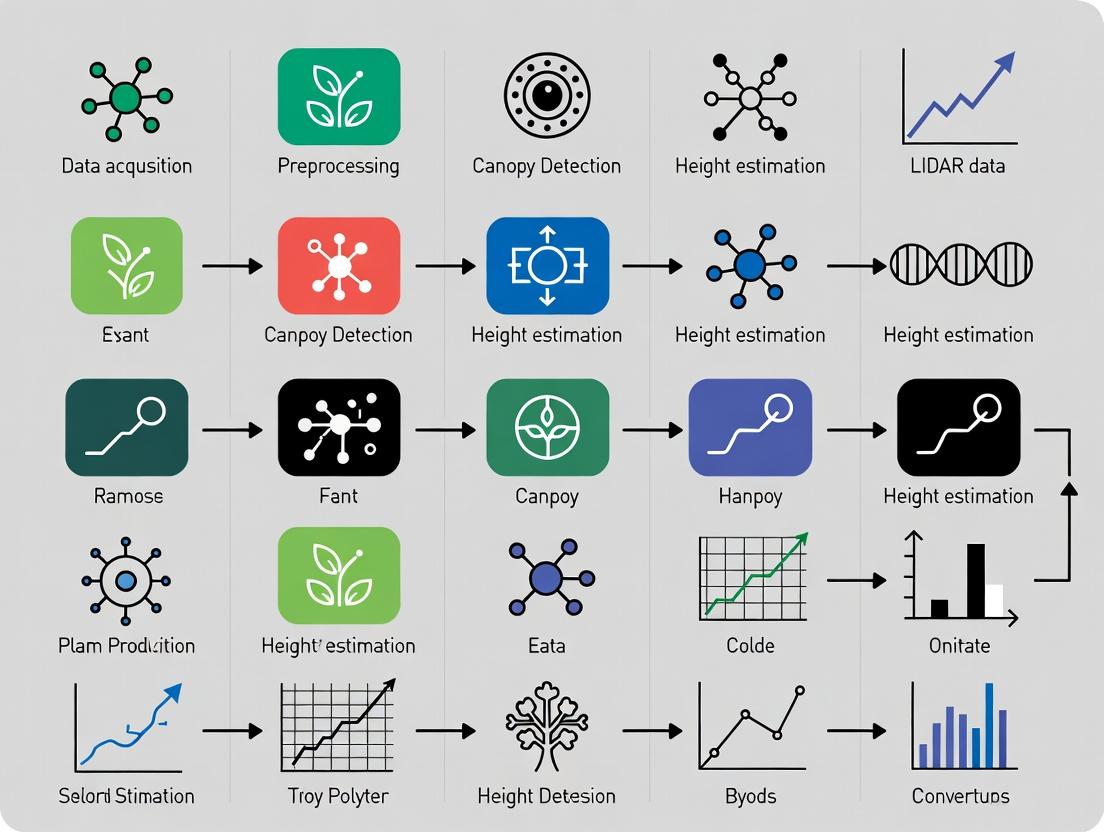
This article provides a comprehensive guide to LiDAR data processing for accurate canopy height estimation.
LiDAR-Based Canopy Height Models: From Data Collection to Validation for Ecological and Clinical Applications
Abstract
This article provides a comprehensive guide to LiDAR data processing for accurate canopy height estimation. It covers foundational LiDAR principles and forestry relevance, detailed methodologies for processing raw point clouds into Digital Terrain and Canopy Height Models (DTM & CHM), common challenges and optimization techniques, and rigorous validation protocols. Designed for researchers and professionals, it bridges remote sensing techniques with applications in environmental monitoring, ecosystem modeling, and associated biomedical research contexts.
Understanding LiDAR and Canopy Height: Principles, Data Sources, and Core Applications
What is LiDAR? Principles of Light Detection and Ranging
LiDAR (Light Detection and Ranging) is an active remote sensing technology that measures distances by illuminating a target with pulsed laser light and measuring the reflected pulses with a sensor. The fundamental principle is analogous to radar but uses light waves. The time difference between the emission and detection of the laser pulse, combined with the known speed of light, allows for precise calculation of range (distance = (speed of light × time of flight) / 2). When integrated with positional data from GPS and Inertial Measurement Units (IMU), these range measurements generate dense, high-resolution three-dimensional point clouds of the scanned environment. In the context of canopy height estimation research, LiDAR provides a direct, volumetric sampling of forest structure, enabling the derivation of key biophysical parameters such as canopy height, canopy cover, and above-ground biomass.
Core Principles and Data Acquisition Systems
LiDAR systems are categorized by their platform:
- Airborne Laser Scanning (ALS): Sensors mounted on aircraft or drones.
- Terrestrial Laser Scanning (TLS): Ground-based static or mobile systems.
- Spaceborne LiDAR: Systems on satellite platforms (e.g., GEDI, ICESat-2).
The interaction of laser pulses with vegetation is critical for canopy studies. A single emitted pulse may generate multiple returns as it interacts with leaves, branches, and the ground. The first return typically represents the canopy top, while the last return often represents the ground. The full waveform of returns can be digitized, providing a continuous vertical profile of vegetation density.
Table 1: Comparison of LiDAR Platform Characteristics for Forestry Applications
| Platform | Typical Altitude | Footprint Size | Point Density | Primary Use in Canopy Research |
|---|---|---|---|---|
| Airborne (ALS) | 500m - 2000m | 0.2m - 1.0m | 5 - 50 pts/m² | Regional-scale canopy height models, biomass estimation. |
| Drone (UAV-LiDAR) | 50m - 150m | 0.05m - 0.2m | 100 - 500+ pts/m² | High-resolution plot-level studies, individual tree analysis. |
| Terrestrial (TLS) | 1m - 5m (sensor height) | Millimeter-scale | 1000 - 10,000 pts/m² | Detailed understory and trunk structure, validation source. |
| Spaceborne (e.g., GEDI) | ~400km (orbit) | ~25m | Sampled waveforms | Global-scale canopy height and structure metrics. |
Experimental Protocols for Canopy Height Model (CHM) Generation
The standard protocol for deriving a Canopy Height Model from Airborne LiDAR data involves the following steps:
Protocol 1: Standard Canopy Height Model (CHM) Generation from Discrete-Return ALS Data
Objective: To produce a continuous raster model representing the height of vegetation above the ground.
Materials & Software: Raw LiDAR point cloud (.las/.laz format), GPS/IMU trajectory data, GIS software (e.g., LAStools, FUSION, CloudCompare, R lidR package).
Procedure:
- Data Quality Check & Pre-processing: Visually inspect point cloud for data voids or anomalies. Verify point density and classification fields.
- Ground Point Classification: Apply an algorithm (e.g., Progressive Morphological Filter, Axelsson's TIN densification) to classify points representing the ground surface.
- Digital Terrain Model (DTM) Creation: Interpolate the classified ground points into a continuous raster surface (e.g., using TIN to raster or inverse distance weighting) at the desired spatial resolution (e.g., 1.0m).
- Digital Surface Model (DSM) Creation: Interpolate all first-return LiDAR points (representing the top surface of all features) into a continuous raster surface at the same resolution as the DTM.
- Canopy Height Model Calculation: Perform raster arithmetic:
CHM = DSM - DTM. This subtracts the ground elevation from the surface elevation at each pixel. - CHM Post-Processing: Apply a smoothing filter (e.g., Gaussian kernel) to reduce noise and artifacts from interpolation. Optionally, fill small data gaps using neighborhood statistics.
Diagram: LiDAR Canopy Height Processing Workflow
Protocol 2: Individual Tree Detection and Height Measurement
Objective: To delineate individual tree crowns and extract their height from a LiDAR-derived CHM.
Materials & Software: High-resolution CHM (e.g., from UAV-LiDAR), individual tree detection software (e.g., lidR R package, find_trees function).
Procedure:
- CHM Smoothing: Apply a slight Gaussian smoothing to the CHM to reduce excessive local maxima.
- Local Maximum Detection: Use a variable or fixed-size moving window to identify local peaks in the CHM as potential tree apexes.
- Watershed Segmentation: Using the identified local maxima as seeds, apply a marker-controlled watershed segmentation algorithm to delineate crown boundaries around each apex.
- Height Extraction: For each delineated crown polygon, extract the maximum CHM value within the polygon, representing the tree's height.
- Validation: Compare LiDAR-derived tree heights and locations with field-measured tree data (e.g., from a stem-mapped plot) using metrics like root-mean-square error (RMSE) and bias.
Table 2: Key Metrics for Validating LiDAR-Derived Canopy Height
| Metric | Formula | Ideal Value | Interpretation in Canopy Context |
|---|---|---|---|
| Root Mean Square Error (RMSE) | √[ Σ(Predᵢ - Measᵢ)² / n ] | 0 m | Measures dispersion of errors. RMSE < 10% of mean height is often acceptable. |
| Bias (Mean Error) | Σ(Predᵢ - Measᵢ) / n | 0 m | Systematic over- or under-estimation. Negative bias suggests ground finding issues. |
| Coefficient of Determination (R²) | (Cov(Pred,Meas) / (σₚσₘ))² | 1 | Proportion of variance in field height explained by LiDAR height. |
The Scientist's Toolkit: Research Reagent Solutions for LiDAR Forestry
Table 3: Essential Materials and Tools for LiDAR Canopy Research
| Item | Function/Description |
|---|---|
| Discrete-Return or Full-Waveform Airborne LiDAR Data | The primary raw data source. Discrete-return is common for structure, while waveform is valuable for vertical density profiles. |
| High-Precision GPS & IMU Unit | Integrated with the LiDAR sensor to provide precise geolocation and orientation for each laser pulse. |
| Field Colocated Validation Data | Precisely georeferenced field measurements of tree height (e.g., from clinometer/laser hypsometer) and stem locations for algorithm validation. |
| LAStools / FUSION / SPDLib | Specialized software suites for processing raw LiDAR data (classification, filtering, normalization). |
R lidR package / Python laspy & PDAL |
Open-source programming libraries for customized, reproducible LiDAR data processing and analysis pipelines. |
| GIS Software (QGIS, ArcGIS Pro) | For visualization, raster manipulation, integration with other geospatial data, and map production. |
| Computational Resources | High-performance computing resources are often necessary for processing large (>100 GB) point cloud datasets. |
Diagram: LiDAR-Ground Validation Data Integration
Why Measure Canopy Height? Key Applications in Ecology, Forestry, and Climate Science
Within the thesis "Advanced LiDAR Data Processing for Robust Canopy Height Model (CHM) Generation," quantifying canopy height is established as a fundamental biophysical variable. Accurate height estimation is not an endpoint but a critical input for modeling ecological processes, managing forest resources, and understanding climate dynamics. These Application Notes detail the protocols and applications derived from this core research.
Key Applications and Quantitative Data
The following tables summarize the primary applications and associated quantitative metrics enabled by precise canopy height measurement.
Table 1: Core Applications in Ecology and Forestry
| Application Area | Key Measurable Parameters | Derived Metrics / Use Cases |
|---|---|---|
| Biodiversity Assessment | Canopy height heterogeneity, vertical structural complexity | Species distribution models, habitat suitability indices (e.g., for birds, arboreal mammals) |
| Biomass & Carbon Stock Estimation | Tree height, canopy cover, stem density | Aboveground Biomass (AGB, Mg/ha), Carbon stocks (Mg C/ha), carbon sequestration rates |
| Forest Health & Disturbance | Canopy height change over time, gap detection | Mortality rates from pests/drought, storm damage assessment, deforestation/degradation alerts |
| Sustainable Timber Management | Dominant height, stand density, individual tree metrics | Timber volume yield (m³/ha), growth and yield models, harvest planning |
Table 2: Applications in Climate and Earth System Science
| Application Area | Key Measurable Parameters | Contribution to Climate Models |
|---|---|---|
| Surface Roughness Parameterization | Canopy height standard deviation, rugosity | Momentum transfer, calculation of aerodynamic roughness length (z₀) for weather/climate models |
| Albedo & Energy Balance | Canopy height & structure influence on light interception | Surface albedo estimation, partitioning of solar radiation into sensible/latent heat fluxes |
| Hydrological Cycle | Canopy height influencing interception & evaporation | Rainfall interception capacity, evapotranspiration modeling, watershed studies |
Experimental Protocols for CHM-Driven Research
Protocol 1: Aboveground Biomass (AGB) Estimation using LiDAR-derived Height
Objective: To model and map forest aboveground biomass using canopy height metrics as primary predictors.
Methodology:
- Data Acquisition: Acquire high-density Airborne Laser Scanning (ALS) point cloud data and coincident field plots with measured tree DBH, species, and height.
- CHM Generation (Thesis Core): Process raw point clouds using the thesis-developed pipeline:
- Ground Classification: Apply an improved progressive TIN densification algorithm.
- Normalization: Subtract the digital terrain model (DTM) from all non-ground points to obtain normalized heights.
- Surface Modeling: Create a 1m-resolution Canopy Height Model (CHM) using a pit-free algorithm to reduce data artifacts.
- Metric Extraction: For each field plot boundary (e.g., 25m radius circle), extract height metrics from the CHM and point cloud:
Hmax,Hmean,Hstd, height percentiles (e.g.,p95,p99), canopy cover. - Allometric Model Calibration: Calculate field-based AGB for each plot using species-specific allometric equations. Develop a regression model (e.g., power law, multiple linear) where field AGB is the dependent variable and LiDAR height metrics are independent variables.
- Spatial Prediction: Apply the calibrated model to all CHM pixels across the study area to generate a continuous wall-to-wall AGB map.
- Validation: Use a leave-one-out or independent set of field plots to calculate model accuracy metrics: R², RMSE (Mg/ha), and bias.
Protocol 2: Monitoring Disturbance and Recovery via Multi-Temporal CHMs
Objective: To quantify canopy height loss from disturbances (e.g., fire, harvest) and track subsequent regrowth.
Methodology:
- Temporal Data Stack: Acquire ALS or high-resolution satellite LiDAR (e.g., GEDI, ICESat-2) data for pre- and post-disturbance time epochs (T1, T2, T3...).
- Co-registration & Consistent Processing: Precisely align all point clouds. Generate CHMs for each epoch using identical processing parameters and algorithms (as defined in the thesis).
- Height Difference Calculation: Perform pixel-wise subtraction:
ΔCHM = CHM_T2 - CHM_T1. - Thresholding & Classification: Apply expert or statistically derived thresholds to the
ΔCHMto classify pixels into:- Loss:
ΔCHM < -Δthreshold(e.g., < -5m) - Growth:
ΔCHM > +Δthreshold(e.g., > +2m) - Stable: Values between thresholds.
- Loss:
- Quantification: Calculate the area (ha) and magnitude (mean height loss/gain) for each change class. For regrowth monitoring (T2 to T3), model height recovery trajectories over time.
Visualization of Methodological Workflows
CHM to Biomass Estimation Workflow
Multi-Temporal Canopy Change Detection
The Scientist's Toolkit: Research Reagent Solutions
Table 3: Essential Tools for LiDAR-Based Canopy Height Research
| Item / Solution | Category | Function / Purpose |
|---|---|---|
| Airborne Laser Scanner (e.g., RIEGL VQ-1560i) | Hardware | Provides the primary active remote sensing data (point clouds) with high pulse repetition rates for detailed canopy sampling. |
| Terrestrial Laser Scanner (TLS, e.g., FARO Focus) | Hardware | Captures extremely detailed 3D structure of forest plots for validating ALS CHMs and developing fine-scale structural metrics. |
| LAStools / PDAL | Software | Industry-standard suite for efficient point cloud processing tasks (classification, filtering, thinning). Often used in pre-processing. |
| R with 'lidR' package | Software | Open-source environment for advanced, reproducible LiDAR data processing, analysis, and CHM generation (core to thesis methods). |
| Global Navigation Satellite System (GNSS) Receiver | Hardware | Provides high-precision geolocation for field plot corners, enabling accurate co-registration of field and LiDAR data. |
| GEDI L4A Footprint AGBD Dataset | Data Product | Pre-processed spaceborne LiDAR-derived Aboveground Biomass Density product for calibration/validation at regional-global scales. |
| Allometric Equation Database (e.g., Jenkins et al., 2003; Chojnacky et al., 2014) | Reference | Provides the species- or biome-specific coefficients to convert field measurements (DBH, H) to biomass for model calibration. |
Within the broader thesis focused on LiDAR data processing for canopy height estimation research, the selection and application of the appropriate platform are foundational. The platform dictates data resolution, coverage, and acquisition geometry, all of which critically influence the accuracy of derived canopy height models (CHMs) and subsequent ecological or pharmaceutical analyses. This document provides application notes and experimental protocols for utilizing Airborne (ALS), Terrestrial (TLS), and UAV/Satellite LiDAR systems in this specific research context.
Platform Comparison & Application Notes
| Feature | Airborne LiDAR (ALS) | Terrestrial LiDAR (TLS) | UAV/Satellite LiDAR |
|---|---|---|---|
| Typical Altitude | 500 - 2000 m AGL | 1 - 10 m above ground | UAV: 50 - 150 m; Satellite: ~500 km |
| Spatial Coverage | Regional (1-1000 km²) | Local/Plot (0.01-1 ha) | UAV: Local (1-100 ha); Satellite: Global |
| Point Density | 5 - 50 pts/m² | 500 - 10,000 pts/m² | UAV: 100 - 1000 pts/m²; Satellite: 2 - 30 pts/m² |
| Primary Canopy View | Predominantly top-down | Predominantly side & understory | UAV: Top-down; Satellite: Top-down/Variable |
| Key Strength | Broad-area CHM generation | Detailed 3D forest structure & understory | UAV: Flexible, high-res CHM; Satellite: Global repeatability |
| Key Limitation | Limited vertical profile detail | Limited top canopy coverage, occlusion | UAV: Limited coverage/battery; Satellite: Low point density |
| Primary Thesis Application | Baseline wide-area CHM, biomass estimation | Validation of ALS/UAV CHMs, vertical profile metrics | UAV: Gap-filling, rapid revisit; Satellite: Large-scale trend analysis |
Application Notes:
- Data Fusion is Critical: The thesis workflow should integrate data from multiple platforms. TLS provides the ground-truth vertical structure for validating and calibrating the CHMs derived from ALS or UAV data.
- Platform Choice Follows Question: For canopy height variability within plots, use TLS or UAV. For mean canopy height over a landscape, use ALS or satellite (e.g., GEDI, ICESat-2).
- UAV LiDAR is Disruptive: It bridges the gap between TLS detail and ALS coverage, offering on-demand, very-high-resolution CHMs ideal for experimental plots or small watersheds.
Experimental Protocols for Canopy Height Estimation
Protocol 3.1: Multi-Platform CHM Validation Workflow
Objective: To generate and validate a high-accuracy Canopy Height Model (CHM) by fusing ALS and TLS data. Materials: ALS point cloud, TLS point clouds from georeferenced plots, high-accuracy GPS, LiDAR processing software (e.g., LAStools, CloudCompare, R lidR).
Site Selection & TLS Acquisition:
- Establish 3-5 rectangular plots (e.g., 40m x 40m) within the ALS coverage area.
- Georeference plot corners with survey-grade GPS (RTK) to achieve <5 cm absolute accuracy.
- Perform TLS scanning from multiple positions (≥4 per plot) to minimize occlusion. Use spherical targets for co-registration.
Data Pre-processing:
- ALS: Classify ground points using an iterative algorithm (e.g., Axelsson's). Generate a 1m resolution Digital Terrain Model (DTM) via interpolation.
- TLS: Merge scans, apply noise filters, and classify ground points. Generate a plot-specific, high-resolution DTM (0.25m).
Co-registration & Normalization:
- Co-register the TLS DTM to the ALS DTM using common points (e.g., plot corners).
- Normalize both ALS and TLS point clouds (calculate height above ground) using their respective DTMs to create nDSM (normalized Digital Surface Models).
CHM Generation & Comparison:
- Generate a 1m CHM from ALS nDSM (pixel = 99th percentile of heights).
- Generate a "reference" 1m CHM from the TLS nDSM.
- Extract ALS CHM values at the plot locations and compute statistics (RMSE, Bias, R²) against the TLS reference CHM.
Title: CHM Validation Workflow Using ALS and TLS
Protocol 3.2: UAV LiDAR for Temporal Canopy Change Detection
Objective: To monitor canopy height growth or disturbance at high temporal and spatial resolution. Materials: UAV LiDAR system, Ground Control Points (GCPs), Processing software (e.g., UgCS for flight planning, proprietary sensor software, lidR).
Mission Planning & Baseline Acquisition:
- Design a flight plan with ≥80% sidelap and ≥70% frontlap at a constant AGL (e.g., 80m). Ensure IMU and GNSS are initialized.
- Distribute 5-10 permanent GCPs across the site. Survey with RTK GPS.
- Conduct the baseline flight under stable atmospheric conditions (low wind).
Repeat Survey & Precise Co-registration:
- Repeat the identical flight plan at the desired interval (e.g., monthly/quarterly).
- Process each LiDAR dataset independently using the same GCPs to generate normalized point clouds and a 0.25m CHM for each epoch.
CHM Differencing & Analysis:
- Perform precise co-registration of the multi-epoch CHMs using stable terrain features.
- Calculate the difference CHM (CHMepoch2 - CHMepoch1).
- Apply a height change threshold (e.g., >0.2m) to identify significant growth or loss. Quantify changes per plot or canopy segment.
The Scientist's Toolkit: Research Reagent Solutions
Table 2: Essential Materials & Software for LiDAR Canopy Height Research
| Item Category | Specific Example/Name | Function in Canopy Height Research |
|---|---|---|
| Validation Hardware | Survey-Grade RTK GPS (e.g., Trimble R12) | Provides sub-centimeter accuracy for georeferencing TLS plots and GCPs, critical for co-registration and validation. |
| Field Equipment | Permanent Ground Control Points (GCPs) | Stable, visible targets for precise co-registration of multi-temporal LiDAR datasets (UAV/ALS). |
| TLS Accessory | Calibrated Spherical Targets | Enables automatic, high-accuracy registration of multiple TLS scans into a single point cloud. |
| Software - Processing | LAStools / lidR (R package) |
Industry-standard & open-source tools for batch processing, filtering, classifying, and deriving metrics from large LiDAR point clouds. |
| Software - Analysis | CloudCompare / FUSION | Interactive 3D point cloud comparison and analysis; and USDA Forest Service software for LiDAR metric extraction. |
| Reference Data | NASA's GEDI L4A Dataset | Provides pre-processed canopy height and structure metrics from spaceborne LiDAR for calibration or large-scale context. |
| Calibration Target | Portable Barometric Altimeter | Used to verify and correct pressure-based altitude readings of UAV platforms, improving vertical accuracy. |
Title: LiDAR Platform Decision Logic for Canopy Research
This application note details the core data products of airborne and terrestrial LiDAR systems, framed within a thesis on LiDAR data processing for canopy height estimation in forest ecology and drug discovery research. Accurate canopy height models (CHMs) are critical for quantifying above-ground biomass, a key parameter in carbon cycle modeling and in the discovery of novel phytochemicals for pharmaceutical development.
Core Data Product Specifications
Table 1: Core LiDAR Data Products and Attributes
| Data Product | Description | Typical Format | Primary Use in Canopy Research |
|---|---|---|---|
| Point Cloud | A 3D set of vertices (X,Y,Z coordinates) representing intercepted surfaces. | LAS/LAZ, ASCII (XYZ) | Digital Terrain Model (DTM) and Canopy Surface Model (CSM) generation. |
| Intensity | A scalar value per point representing the amplitude of the backscattered signal. | 8-bit or 16-bit integer appended to point record. | Discriminating material types (e.g., leaf vs. bark, species ID). |
| Return Number | The order of a given return within the return sequence for a single laser pulse. | Integer (e.g., 1, 2, 3) appended to point record. | Understanding canopy penetration and vertical structure. |
Table 2: Quantitative Characteristics of Discrete-Return LiDAR Data
| Parameter | Typical Range/Value | Impact on Canopy Height Estimation |
|---|---|---|
| Point Density | 1 - 50+ pts/m² | Higher density improves crown delineation and height accuracy. |
| Intensity Range | 0 - 255 (8-bit) or 0 - 65535 (16-bit) | Normalization for sensor/range effects is required for comparison. |
| Maximum Returns per Pulse | 1 - 5 (commonly 3-4) | Higher max returns improve characterization of understory. |
| Vertical Accuracy (RMSE) | 5 - 30 cm (varies with platform and terrain) | Directly influences error in derived canopy height metrics. |
Application Notes for Canopy Height Estimation
Point Cloud Processing for CHM Generation
The fundamental workflow involves classifying ground points, interpolating a Digital Terrain Model (DTM), normalizing the point cloud heights (creating height-above-ground values), and then generating a Canopy Height Model (CHM) as the difference between a Digital Surface Model (DSM) and the DTM.
Intensity Data Calibration and Application
Intensity values are affected by range, incidence angle, and target reflectance. For ecological applications, intensity can be used to improve ground classification in dense vegetation and assist in separating deciduous from coniferous canopies based on differential reflectivity.
Return Number for Vertical Profile Analysis
The distribution of return numbers is used to compute metrics like the Vertical Distribution Ratio (VDR). Pulses with multiple returns indicate penetration through canopy layers, which is essential for estimating Leaf Area Index (LAI) and canopy fuel layers.
Experimental Protocols
Protocol 4.1: Ground Point Classification and DTM Generation
Objective: To accurately separate ground from non-ground points to create a reliable DTM. Software Requirements: LAStools, PDAL, or FUSION.
- Input: Raw LiDAR point cloud in LAS format.
- Noise Filtering: Apply a statistical outlier filter to remove low and high noise points (e.g., birds, artifacts).
- Ground Classification: Execute an iterative progressive triangulated irregular network (TIN) densification algorithm (e.g., Axelsson's algorithm).
- Set initial terrain angle threshold to 6-12 degrees.
- Set iteration distance to 1.0-1.5 times the nominal point spacing.
- Iterate until no new ground points are added.
- DTM Interpolation: Rasterize the classified ground points using linear interpolation or natural neighbor at a resolution appropriate to the study (e.g., 1.0 m).
- Output: A georeferenced raster DTM (
.tif).
Protocol 4.2: Intensity-Based Canopy Segmentation
Objective: To use intensity data to segment individual tree crowns. Software Requirements: CloudCompare, Python (scikit-learn).
- Input: Normalized point cloud (height above ground) with intensity values.
- Intensity Normalization: Apply range correction using the radar equation:
I_norm = I_raw * (Range / R_ref)², whereR_refis a reference distance. - Point Cloud Segmentation:
- Use the cloth simulation function (CSF) or a simple region-growing algorithm seeded from local maxima identified in a smoothed CHM.
- Incorporate intensity as an additional dimension in the region-growing distance metric (e.g., Euclidean distance in XYZI space).
- Validation: Compare segmented crowns with field-mapped tree positions or high-resolution orthoimagery.
Protocol 4.3: Deriving Canopy Height Metrics from Return Profiles
Objective: To calculate ecologically relevant height metrics from the distribution of returns.
Software Requirements: FUSION's CloudMetrics, R with lidR package.
- Input: Ground-normalized point cloud, stratified by plot boundaries (e.g., 20m x 20m grid).
- Height Metric Calculation: For each plot, compute:
- Hmax: Maximum height.
- Hmean: Mean height of all returns.
- Hsd: Standard deviation of heights (canopy roughness).
- Canopy Cover: Percentage of returns above 2m height.
- VDR: (Hmean - Hmin)/(Hmax - Hmin) using all returns.
- Analysis: Correlate metrics (e.g., Hmax) with field-measured biomass or chemical yield samples from targeted plant species.
Visualizations
The Scientist's Toolkit
Table 3: Essential Research Reagents & Tools for LiDAR-Canopy Research
| Item | Function/Application |
|---|---|
| Discrete-Return Airborne LiDAR Data | Primary 3D data source for landscape-scale canopy structure and height. |
| Terrestrial Laser Scanner (TLS) | Provides ultra-high-resolution 3D scans for validating airborne CHMs and modeling fine-scale structure. |
| Field GPS/GNSS Receiver (RTK) | Provides sub-decimeter accuracy ground control points for LiDAR georeferencing and field plot location. |
| Dendrometry Tools (Clinometer, Densitometer) | For collecting ground-truth tree heights and canopy density measurements for model validation. |
| Biomass Sampling Kits | For destructive sampling to correlate LiDAR height metrics with actual biomass (AGB) for allometric model development. |
| Phytochemical Extraction Solvents | (e.g., Methanol, Ethyl Acetate) Used by drug development researchers to extract compounds from plant tissue samples collected from locations guided by LiDAR-derived canopy structure maps. |
| LAStools / FUSION / PDAL | Software suites for batch processing, classifying, and analyzing LiDAR point cloud data. |
R lidR / Python laspy |
Programming libraries for custom, reproducible pipelines for CHM calculation and metric extraction. |
Within the context of LiDAR data processing for canopy height estimation research, precise differentiation between surface models is paramount. These models form the foundational layers from which critical biophysical parameters, such as canopy height, are derived.
- Digital Elevation Model (DEM): A generic term representing the elevation of the Earth's surface. In many contexts, particularly in older literature and certain geographic information systems (GIS), it is used interchangeably with DTM. For rigorous scientific analysis, more specific terminology (DTM/DSM) is preferred.
- Digital Terrain Model (DTM): A digital representation of the bare-earth topographic surface, excluding all above-ground features like vegetation, buildings, and other cultural artifacts. It models the terrain.
- Digital Surface Model (DSM): A digital representation of the Earth's surface, including all objects upon it (e.g., vegetation canopy, buildings, power lines). It models the top of the visible surface.
Table 1: Core Characteristics of DTM, DSM, and Derived Products
| Feature | Digital Terrain Model (DTM) | Digital Surface Model (DSM) | Canopy Height Model (CHM) / Normalized DSM (nDSM) |
|---|---|---|---|
| Represents | Bare-earth elevation | Top-surface elevation (ground + objects) | Height above ground (objects only) |
| Source Data | Last/ground LiDAR returns, photogrammetric ground points | First LiDAR returns, photogrammetric point cloud surfaces | Arithmetic difference (DSM - DTM) |
| Key Content | Terrain morphology, slope, aspect | Topography, vegetation, infrastructure | Vegetation structure, building height |
| Primary Use in Canopy Research | Reference baseline for height normalization | Initial capture of vegetation top | Direct estimation of canopy height, density, and vertical structure |
Application Notes for Canopy Height Estimation
The accurate generation of a Canopy Height Model (CHM), calculated as CHM = DSM – DTM, is the critical step linking raw LiDAR data to ecological research metrics. Key applications include:
- Biomass Estimation: Tree height is a primary predictor in allometric equations for estimating above-ground biomass and carbon stocks.
- Forest Inventory: Derivation of tree metrics (height, crown area) for stand characterization.
- Habitat Mapping: Vertical structural complexity is a key descriptor of habitat quality and species diversity.
- Change Detection: Monitoring forest growth, disturbance (e.g., windthrow, fire), and land-use change over time.
- Drug Discovery Context: In the search for novel bioactive compounds, precise canopy structure data aids in understanding ecological niches of source organisms (e.g., plants, fungi), planning field collections, and assessing biodiversity in pharmacologically relevant ecosystems.
Experimental Protocols for LiDAR-Based CHM Generation
Protocol 3.1: DTM Generation from LiDAR Point Clouds
Objective: To create a high-fidelity bare-earth terrain model from classified LiDAR point cloud data.
- Data Input: Acquire classified LiDAR point cloud data (e.g., .las format) where ground points (Class 2) have been identified.
- Ground Point Selection: Filter the point cloud to isolate points classified as "Ground."
- Interpolation: a. Method Selection: Choose a robust interpolation algorithm. Triangulated Irregular Network (TIN) interpolation is often preferred for its ability to adapt to variable point density and capture breaklines. b. Parameterization: Set appropriate resolution (e.g., 1.0 m) matching the original point cloud density and study objectives. Apply smoothing or refinement filters (e.g., maximum angle, iteration distance) to remove spurious non-ground points.
- Rasterization: Convert the interpolated surface into a georeferenced raster grid (DTM) at the defined resolution.
- Quality Control: Visually inspect the DTM for artifacts (e.g., pits, spikes in vegetation areas) using hillshade models and cross-section profiles.
Protocol 3.2: DSM Generation from LiDAR Point Clouds
Objective: To create a digital model representing the top surface, including canopy and structures.
- Data Input: Use the same classified LiDAR point cloud as in Protocol 3.1.
- Surface Point Selection: Filter to include first returns or all returns, excluding noise and, optionally, low vegetation based on a height threshold.
- Interpolation: a. Method Selection: Use a maximum height value approach within each raster cell or interpolation methods like inverse distance weighting (IDW) applied to first returns. b. Rasterization: Generate a raster grid where each cell's value is the maximum elevation found among the points within that cell's spatial extent.
- Output: Produce a georeferenced raster DSM at the same spatial resolution as the DTM.
Protocol 3.3: Canopy Height Model (CHM) Derivation & Tree Metrics Extraction
Objective: To calculate vegetation height above ground and extract individual tree parameters.
- Normalization: Perform pixel-wise subtraction:
CHM = DSM - DTM. Ensure both rasters are perfectly aligned (same extent, resolution, coordinate system). - CHM Refinement: Apply a smoothing filter (e.g., Gaussian, median) to the CHM to reduce noise and data pits caused by interpolation artifacts.
- Individual Tree Detection (ITD): a. Local Maxima Detection: Use a variable or fixed-size moving window to identify local peaks in the CHM as potential tree apexes. b. Crown Delineation: Apply a region-growing algorithm (e.g., watershed segmentation) from the identified seed points, using the CHM values as the guiding surface.
- Metric Extraction: For each delineated crown polygon, calculate:
Tree Height = max(CHM value within polygon)Crown Area = area(polygon)Canopy Base Height(from statistical analysis of point distribution within crown).
Visualization of Workflows
Figure 1: LiDAR Processing Workflow for Canopy Height
Figure 2: Conceptual Relationship Between DTM, DSM, and CHM
The Scientist's Toolkit: Research Reagent Solutions
Table 2: Essential Software & Data Tools for LiDAR Canopy Analysis
| Tool / "Reagent" | Category | Primary Function in Analysis |
|---|---|---|
| LAStools / PDAL | Data Processing Library | "Digestion" and "purification" of raw LiDAR point clouds (format conversion, filtering, classification). |
| ArcGIS Pro / QGIS | Geographic Information System (GIS) | "Assay platform" for spatial data management, visualization, raster algebra (CHM creation), and basic analysis. |
| R (lidR package) | Statistical Programming Environment | "High-throughput analyzer" for programmatic, reproducible point cloud processing, CHM creation, and tree metric extraction. |
| FUSION | Forestry-Specific LiDAR Toolset | "Specialized sensor" for forestry metrics calculation, plot-based analysis, and visualization. |
| CloudCompare / QT Modeler | 3D Point Cloud Viewer & Editor | "Microscope" for detailed visual inspection and manual editing/validation of point clouds and models. |
| Classified LiDAR Point Cloud | Primary Data | The "raw sample" containing ground and non-ground returns, typically in .las or .laz format. |
| High-Resolution DTM (from Protocol 3.1) | Derived Reagent | The "control" or "baseline" representing the terrain, essential for normalization. |
| Field Validation Data (e.g., GPS-located tree heights) | Validation Standard | The "calibrator" or "reference standard" for assessing the accuracy of derived CHM and tree metrics. |
Primary Data Sources and Repositories for Researchers
Within a thesis on LiDAR data processing for canopy height estimation, the identification and utilization of primary data sources is foundational. This document provides application notes and protocols for accessing and processing data from key repositories, enabling reproducible research in environmental remote sensing and ecological modeling.
The following table summarizes the primary repositories relevant to airborne and spaceborne LiDAR data for canopy research.
Table 1: Primary Data Repositories for Canopy Height LiDAR Research
| Repository Name | Primary Data Type | Spatial Coverage | Access Model | Key Relevant Datasets |
|---|---|---|---|---|
| NASA Earthdata (ASDA) | Spaceborne LiDAR (GEDI, ICESat-2) | Global | Free, requires user registration | GEDI L2A Elevation & Height, ICESat-2 ATL08 Land & Vegetation |
| USGS 3D Elevation Program (3DEP) | Airborne LiDAR (Point Cloud) | United States | Free & open | 1-meter DEMs, classified LAS point clouds |
| OpenTopography | Airborne & Terrestrial LiDAR | Global (curated) | Free, tiered access | High-resolution topographic data & derivatives |
| NEON (National Ecological Observatory Network) | Airborne LiDAR + In-situ Validation | USA (Domestic) | Free, requires data use agreement | Discrete return LiDAR, canopy height model, field vegetation structure |
| ESA Earth Online | Spaceborne LiDAR & SAR | Global | Free, requires user registration | GEDI data mirror, Biomass mission (future) |
Protocol 1: Automated Download of GEDI Data for a Region of Interest (ROI)
Objective: To programmatically download GEDI L2A data granules covering a specified geographic area and time period.
Materials & Software:
- Computing environment with Python 3.8+.
- Libraries:
earthaccess,geopandas,h5py,shapely. - NASA Earthdata account (username & password/app token).
Procedure:
- Authentication: Use the
earthaccesslibrary to authenticate your NASA Earthdata login.
Define ROI: Create a geometry object for your Area of Interest (AOI) using a bounding box or shapefile.
Search for Granules: Query the NASA CMR for GEDI L2A data.
Download Data: Initiate parallel downloads for the found granules.
Verification: Check downloaded
.h5files can be opened and contain therh(relative height) andelev_lowestmodedatasets.
Protocol 2: Generation of a Canopy Height Model (CHM) from USGS 3DEP LiDAR
Objective: To process classified LAS data into a digital terrain model (DTM), digital surface model (DSM), and a derived canopy height model (CHM).
Materials & Software:
- LAZ/LAS file (e.g.,
USGS_LPC_CA_SanFran_2019.laz). - Software: LASTools, GDAL, R with
lidRpackage, or WhiteboxTools. - Computing resources with ≥16GB RAM for large datasets.
Procedure:
- Data Acquisition: Download a LAZ tile from the USGS TNM Download interface or using a bulk download script.
- Data Inspection: Use
lasinfo(LASTools) orreadLAS(lidR) to verify point classification, density, and extent. - Ground Point Classification (if not pre-classified): Apply a ground filtering algorithm.
DTM/DSM Creation: Interpolate ground and non-ground points to rasters.
CHM Calculation: Subtract DTM from DSM.
Validation: Visually inspect CHM against hillshade of DTM and original point cloud.
The Scientist's Toolkit: Key Research Reagent Solutions
Table 2: Essential Computational Tools for LiDAR Canopy Research
| Tool/Software | Category | Primary Function |
|---|---|---|
lidR R Package |
Data Processing | Comprehensive engine for LiDAR data manipulation, visualization, and analysis. |
| PDAL (Point Data Abstraction Library) | Data Processing | Pipeline-based tool for translating and processing point cloud data. |
| LASTools | Data Processing | Efficient suite for LiDAR data conversion, filtering, and rasterization. |
| GDAL/OGR | Geospatial Data I/O | Library for reading and writing raster and vector geospatial data formats. |
| Jupyter Notebook / RMarkdown | Documentation | Platform for creating reproducible, executable research narratives and code. |
| NASA Earthdata Login Token | Data Access | Authentication credential required for programmatic access to NASA-hosted data. |
| High-Performance Computing (HPC) Cluster | Computing Infrastructure | Enables processing of large-scale (national/global) LiDAR datasets. |
Visualization of Research Workflow
Canopy Height Research Data Workflow
CHM Derivation from Classified LiDAR
Step-by-Step Workflow: Processing Raw LiDAR Data to a Canopy Height Model (CHM)
Within the broader thesis on LiDAR Data Processing for Canopy Height Estimation Research, the initial stage of data acquisition and pre-processing forms the critical foundation. Accurate above-ground biomass and canopy structure models depend entirely on the fidelity of the raw point cloud data. This application note details standardized protocols for acquiring LiDAR data and executing essential pre-processing steps—specifically noise filtering and calibration—to ensure data integrity for subsequent height metric extraction and ecological analysis.
Data Acquisition Protocols
The acquisition protocol is designed to maximize point density and accuracy while minimizing systematic error.
2.1 Equipment Preparation and Flight Planning
- Platform: Fixed-wing or multi-rotor UAV equipped with a lightweight, high-frequency LiDAR sensor (e.g., RIEGL VUX-1LR, YellowScan Mapper).
- Pre-flight Calibration: Perform system calibration (boresight alignment) in a controlled environment with known targets prior to the survey campaign.
- Flight Parameters:
- Altitude: 80-120 m AGL (for a balance of coverage and point density).
- Overlap: ≥70% side-lap and ≥80% forward overlap.
- Speed: 4-6 m/s (UAV-dependent).
- Scan Frequency: ≥200 kHz.
- Ground Control: Establish a network of ≥5 permanent ground control points (GCPs) with known coordinates (via RTK-GNSS) distributed across the study area.
- Environmental Conditions: Survey under calm wind conditions (<15 km/h) and avoid precipitation.
Pre-Processing: Noise Filtering and Calibration
The pre-processing workflow transforms raw point clouds into a clean, georeferenced dataset.
3.1 Experimental Protocol: Trajectory Computation and Georeferencing
- Input: Raw LiDAR scans (.las/.laz), IMU data (.imu), and GNSS data (.gnss).
- Software: Use vendor software (e.g., RIEGL RIPROCESS, YellowScan CloudStation) or open-source tools like
PDAL. - Procedure: a. Trajectory Processing: Process GNSS and IMU data using kinematic post-processing (with base station data) to derive a precise sensor trajectory. b. Georeferencing: Combine the precise trajectory with raw scan data to compute the 3D coordinates of each laser return. Output is an unclassified point cloud in a projected coordinate system (e.g., UTM). c. Accuracy Check: Validate by comparing the LiDAR-derived coordinates of the visible GCPs against their surveyed coordinates. Target RMSE (X,Y,Z) < 10 cm.
3.2 Experimental Protocol: Noise Filtering
- Objective: Remove outliers and artifacts not representative of the terrain or canopy.
- Method: Statistical Outlier Removal (SOR) filter.
- Detailed Workflow: a. For each point in the cloud, compute the mean distance (d_mean) to its k nearest neighbors (e.g., k=20). b. Compute the global mean (μ) and standard deviation (σ) of all d_mean values. c. Identify and remove points where d_mean > μ + nσ, where n is a standard deviation multiplier (typically 1.5-2.0).
- Parameters & Tools: Execute in CloudCompare (GUI) or using
PDALpipeline:pdal pipeline noise_filter.json.
Short Title: Statistical Outlier Removal Filter Workflow
3.3 Experimental Protocol: Sensor Calibration & Bias Correction
- Objective: Correct systematic vertical bias (z-offset) often present in UAV-LiDAR data.
- Method: Ground-based calibration using returns from a flat, hard ground surface (e.g., paved road or parking lot within the study area).
- Detailed Workflow: a. Identify Calibration Area: Isolate ground points from a flat, horizontal control surface. b. Model Fitting: Fit a planar model (ax + by + cz + d = 0) to these ground points using least squares regression. c. Bias Calculation: The constant d from the fitted plane indicates the systematic bias. Alternatively, calculate the mean elevation difference between LiDAR ground points and the known elevation from RTK-GNSS survey. d. Application: Apply the calculated bias offset (e.g., +0.05 m) to the z-values of the entire point cloud.
Short Title: Ground-Based Vertical Calibration Workflow
Table 1: Recommended Parameters for Data Acquisition
| Parameter | Specification | Rationale |
|---|---|---|
| Flight Altitude | 80-120 m AGL | Optimizes point density (50-200 pts/m²) and coverage. |
| Scan Frequency | ≥200 kHz | Ensures sufficient ground point density under canopy. |
| Overlap (Side/Forward) | ≥70% / ≥80% | Eliminates data gaps, provides multiple view angles. |
| GNSS Mode | RTK/PPK | Ensures trajectory accuracy for direct georeferencing. |
| Number of GCPs | ≥5 | Provides robust accuracy assessment and check. |
Table 2: Standard Noise Filtering Parameters (Statistical Outlier Removal)
| Parameter | Typical Value | Effect of Increasing Value |
|---|---|---|
| k-neighbors | 15-25 | Smoothing effect; higher values may under-filter. |
| Std Dev Multiplier (n) | 1.5-2.0 | Aggressiveness; higher values remove fewer points. |
| Points Removed | 0.1-2% of total | Target range. >5% indicates potential signal loss. |
Table 3: Typical Calibration Bias in UAV-LiDAR Systems
| Sensor Type | Typical Vertical Bias Range (Uncalibrated) | Common Correction Method |
|---|---|---|
| Direct Georeferencing Systems | +0.02 m to +0.15 m | Ground control plane adjustment. |
| Systems with Lower-cost IMU | -0.10 m to +0.20 m | Empirical correction using known targets. |
The Scientist's Toolkit: Research Reagent Solutions
Table 4: Essential Materials and Software for LiDAR Pre-Processing
| Item | Function/Description | Example Product/Software |
|---|---|---|
| High-Precision RTK-GNSS Receiver | To establish highly accurate Ground Control Points (GCPs) for calibration and validation. | Trimble R12, Emlid Reach RS3 |
| Calibration Target Panels | High-contrast, flat targets for in-field system verification and boresight calibration. | AeroDots Ground Control Markers |
| Trajectory Processing Software | Processes raw GNSS/IMU data to produce a precise sensor position/orientation file. | Applanix POSPac, RIEGL RIPROCESS |
| Point Cloud Processing Suite | Main environment for visualization, filtering, classification, and analysis. | CloudCompare, Bentley ContextCapture |
| Pipeline Data Processing Library | For scripting and automating pre-processing workflows (filtering, calibration). | PDAL (Point Data Abstraction Library) |
| Statistical Analysis Environment | For calculating accuracy metrics (RMSE) and performing bias analysis. | R (lidR package), Python (SciPy, pandas) |
Application Notes
Within a thesis on LiDAR data processing for canopy height estimation, the classification of ground vs. non-ground returns is a foundational preprocessing step. Its accuracy directly influences the derived Digital Terrain Model (DTM) and the subsequent calculation of aboveground metrics like canopy height models (CHMs). For researchers, including those in ecological drug discovery who rely on accurate habitat and biomass assessments, robust classification is critical.
Current methodologies have evolved from simple elevation thresholding to sophisticated algorithms that handle complex topography and vegetation. The core challenge remains in minimizing Type I (misclassifying ground as object) and Type II (misclassifying object as ground) errors, especially under dense canopy or in urban settings.
Table 1: Comparison of Common Ground Filtering Algorithms
| Algorithm | Core Principle | Strengths | Weaknesses | Typical Accuracy (%)* |
|---|---|---|---|---|
| Morphological Filter | Uses progressive window sizes to identify lowest points. | Simple, computationally efficient for gentle terrain. | Struggles with steep slopes and low vegetation. | 85-92 |
| Slope-Based Filter | Classifies points based on slope between a point and its neighbors. | Effective in mountainous terrain. | Sensitive to parameterization (slope threshold). | 88-94 |
| Cloth Simulation Filter (CSF) | Inverts the point cloud and simulates a cloth draping over it. | Robust for complex landscapes, fewer parameters. | Can be computationally intensive for large datasets. | 92-97 |
| Random Forest Classification | Uses machine learning on features (elevation, intensity, echo width). | Highly accurate, can use full waveform attributes. | Requires training data, computationally heavy. | 95-99 |
*Accuracy is dataset-dependent and represents general performance in literature for vegetation-covered areas.
Experimental Protocols
Protocol 1: Implementation of the Cloth Simulation Filter (CSF)
Objective: To separate ground points from non-ground points in an airborne LiDAR point cloud for DTM generation.
Materials & Software:
- Raw classified or unclassified LiDAR point cloud (.las or .laz format).
- Computing environment with Python and
Laspylibrary. - CSF implementation (e.g.,
csfPython package, CloudCompare plugin, or PDAL pipeline).
Procedure:
- Data Preparation: Load the point cloud. If the data contains multiple returns, consider using all returns for maximum ground point detection under canopy gaps.
- Parameter Initialization: Set key CSF parameters:
cloth_resolution: Spatial resolution of the simulated cloth (e.g., 1.0 m). Start with 1/4 of the average point spacing.max_iterations: Number of iterations for cloth draping (e.g., 500).classification_threshold: Distance threshold to classify ground points (e.g., 0.5 m).
- Inversion & Simulation: The algorithm inverts the point cloud. A cloth with nodes defined by
cloth_resolutionis simulated above the inverted surface and allowed to fall iteratively under gravity. - Classification: For each original point, calculate the distance to the simulated cloth. Points with a distance less than the
classification_thresholdare classified as ground. - Output: Generate a new point cloud file with an updated classification field (ASPRS standard: 2 for ground, 1 for unclassified/non-ground).
Validation: Visually inspect cross-sections in GIS/point cloud software. Quantify accuracy using a manually classified reference subset, calculating commission and omission errors.
Protocol 2: Machine Learning-Based Classification Using Scikit-learn
Objective: To employ a Random Forest classifier for ground classification using 3D geometric features.
Materials & Software:
- LiDAR point cloud subset with reference ground truth labels.
- Python with
scikit-learn,numpy,pandas, andlaspy.
Procedure:
- Feature Extraction: For each point in a local neighborhood (e.g., 1m radius), calculate:
Height(Z) relative to a coarse minimum.Linearity,Planarity,Scatteringfrom eigenvalue decomposition.Verticalityof the normal vector.Number of neighborswithin radius.
- Dataset Creation: Split the labeled data into training (70%) and testing (30%) sets.
- Model Training: Train a Random Forest classifier (e.g.,
n_estimators=100,max_depth=10) on the training set. - Prediction & Evaluation: Predict on the test set. Generate a confusion matrix and calculate overall accuracy, precision, and recall for the "ground" class.
- Full Cloud Application: Apply the trained model to the entire point cloud to classify all points.
Diagrams
Ground Classification in CHM Workflow
Cloth Simulation Filter (CSF) Steps
The Scientist's Toolkit: Research Reagent Solutions
Table 2: Essential Tools for LiDAR Ground Classification Research
| Item | Function in Research |
|---|---|
| Airborne/UAV LiDAR System | Provides the raw 3D point cloud data. Full-waveform systems offer additional attributes like echo width for improved classification. |
| High-Performance Computing (HPC) Cluster | Enables processing of large-scale LiDAR datasets and running iterative machine learning training. |
| Reference Ground Truth Data | Manually classified point cloud subsets or high-accuracy GPS survey points for algorithm training and validation. |
| Python Data Stack (PDAL, SciPy, Scikit-learn) | Open-source libraries for reading, processing, feature extraction, and implementing ML classifiers on point clouds. |
| Commercial Software (LASTools, TerraSolid) | Provides robust, benchmarked implementations of standard algorithms (e.g., morphological filters) for comparison and production pipelines. |
| GIS Platform (QGIS, ArcGIS Pro) | For visualization, qualitative assessment of classification results, and deriving final terrain/canopy models. |
Within the broader research context of deriving high-accuracy canopy height models (CHM) from LiDAR data, the generation of a precise Digital Terrain Model (DTM) is a critical, foundational step. The CHM is calculated by subtracting the DTM from the Digital Surface Model (DSM), which represents the highest detected elevation, including vegetation and buildings. Consequently, any systematic error or bias in the DTM is directly propagated into the final canopy height estimates, impacting downstream ecological analyses, biomass calculations, and forest monitoring vital for environmental and pharmaceutical research into plant-based compounds. This application note details the core interpolation techniques employed to derive a continuous DTM from the sparse set of ground-classified LiDAR points, providing protocols for implementation and evaluation.
Key Interpolation Techniques: Comparative Analysis
The following table summarizes the principal interpolation methods used for DTM generation from irregularly spaced ground points.
Table 1: Comparative Analysis of DTM Interpolation Techniques
| Technique | Principle | Key Parameters | Strengths | Weaknesses | Best Use Case |
|---|---|---|---|---|---|
| Inverse Distance Weighting (IDW) | Estimates cell value as distance-weighted average of nearby sample points. | Power parameter (p), Search radius, Number of neighbors. | Simple, intuitive. Easy to implement. | Can create "bull's-eye" artifacts. Struggles with abrupt breaks in terrain. | Preliminary models, relatively smooth and dense ground data. |
| Triangulated Irregular Network (TIN) to Raster | Creates a network of Delaunay triangles from points, then interpolates to raster. | Maximum triangle edge length, Interpolation method within triangle (e.g., linear). | Preserves breaklines and spot features. Efficient with variable point density. | Surface is not continuously differentiable (facets). Output can appear "faceted". | Complex terrain with cliffs, ridges, and variable data density. |
| Kriging | Geostatistical method that uses spatial autocorrelation (variogram) to predict values. | Variogram model (spherical, exponential, etc.), Nugget, Sill, Range. | Provides statistical error surface (kriging variance). Optimal unbiased estimator. | Computationally intensive. Requires expert variogram modeling. | When error estimation is required and spatial structure is well-defined. |
| Spline | Fits a mathematically smooth, flexible surface that passes through or near the sample points. | Spline type (tension, regularized), Weight (smoothing parameter). | Produces very smooth, visually pleasing surfaces. | May overshoot or undershoot in areas with sparse data. Can smooth out genuine sharp features. | Gently rolling terrain, engineering, and visualization applications. |
| ANUDEM (Topo to Raster) | Specifically designed for hydrological correction, enforcing drainage enforcement. | Drainage enforcement aggressiveness, Tolerance for stream burning. | Creates a hydrologically correct surface, critical for flow analysis. Reduces spurious sinks. | Can be computationally demanding. May alter terrain in flat areas. | Landscapes where accurate hydrological modeling is paramount. |
Experimental Protocol: DTM Generation & Validation
This protocol outlines a standardized workflow for generating and validating a DTM from classified LiDAR ground points.
Materials and Input Data
- Classified LiDAR Point Cloud (.las/.laz): Ground points must be isolated (Classification Code = 2).
- GIS Software: e.g., ArcGIS Pro (3D Analyst), QGIS (GRASS, SAGA), Whitebox GAT, or dedicated LiDAR processing suites (LASer, FUSION).
- High-Accuracy Ground Control Points (GCPs): Independent survey-grade GPS points not used in interpolation.
Procedure
Part A: Data Preparation
- Extract Ground Points: Filter the LiDAR dataset to export only points classified as "Ground".
- Define Processing Extent & Resolution: Set the spatial extent and output cell size (e.g., 1.0 m) consistent with the original LiDAR data's nominal point spacing (NPS).
- Generate a Point Density Map: Calculate ground point density (points/m²) to identify areas of potential sparseness that may affect interpolation quality.
Part B: Interpolation Execution
- Select and Parameterize Technique: Choose an interpolation method from Table 1. Initialize with recommended parameters:
- IDW: Power = 2, Search radius = variable, Points to include = 10-12.
- TIN to Raster: Linear interpolation, maximum triangle size = 2-3 x cell size.
- Execute Interpolation: Run the algorithm to produce a preliminary DTM raster.
- Apply Hydrological Correction (Optional but Recommended): Use a pit-removal or "breach depressions" algorithm to eliminate artificial sinks from the DTM, ensuring proper drainage representation.
Part C: Validation & Accuracy Assessment
- Independent Accuracy Assessment: Compare the interpolated DTM values against the withheld GCPs.
- Calculate Error Metrics: Compute the following statistics:
- Root Mean Square Error (RMSE): √[Σ(Zpredicted - Zmeasured)² / n]
- Mean Absolute Error (MAE): Σ|Zpredicted - Zmeasured| / n
- Bias: Σ(Zpredicted - Zmeasured) / n
- Visual Inspection: Generate a hillshade or contour map of the DTM to check for interpolation artifacts (bull's-eyes, faceting, overshoots) in areas of known terrain.
Diagram: DTM Generation Workflow
DTM Generation and Validation Workflow
The Researcher's Toolkit
Table 2: Essential Tools and Reagents for DTM Generation Research
| Item | Category | Function/Description |
|---|---|---|
| LAS/LAZ Dataset | Input Data | Standardized format for LiDAR point cloud data, containing XYZ coordinates, intensity, and classification codes. |
| Ground Control Points (GCPs) | Validation Data | High-accuracy surveyed points (e.g., from RTK-GPS) used exclusively for independent vertical accuracy assessment of the DTM. |
| Spatial Analyst / 3D Analyst Extensions | Software Module | GIS toolbox suites containing the core interpolation functions (IDW, Kriging, Spline, etc.) and raster calculation tools. |
| LASTools / FUSION | Specialized Software | Command-line and GUI toolkits designed specifically for efficient processing, analysis, and visualization of LiDAR data. |
| Variogram Model | Statistical Model | The core function in Kriging that quantifies spatial autocorrelation; must be fitted to the empirical data for optimal results. |
| Pit Removal Algorithm | Processing Script | Critical for correcting the DTM by removing spurious depressions (sinks) to ensure a hydrologically sound surface for flow analysis. |
| Canopy Height Model (CHM) Formula | Derivative Product | The ultimate goal: CHM = DSM - DTM. The accuracy of the DTM directly determines the fidelity of canopy height estimates. |
The selection of an appropriate interpolation technique for DTM generation is not a one-size-fits-all decision but must be informed by terrain complexity, ground point density, and the specific requirements of the downstream canopy height analysis. For research aimed at quantifying forest structure for drug discovery—where accurate canopy height is linked to biomass and potentially to biochemical profiles—a rigorous, validated DTM is non-negotiable. A protocol combining TIN-based interpolation for complex topography, followed by careful hydrological correction and validation against high-accuracy GCPs, provides a robust foundation for reliable CHM creation and subsequent ecological and bioprospecting studies.
This application note details the fourth critical step in a LiDAR data processing workflow for canopy height estimation research. Generating a Digital Surface Model (DSM) from LiDAR point clouds is fundamental for capturing the top of the canopy (TOC), a primary metric in ecological studies, forest biomass estimation, and agricultural monitoring relevant to bioprospecting and drug discovery from plant sources. The DSM represents the first reflective surface, including vegetation, buildings, and ground features, in contrast to the Digital Terrain Model (DTM), which represents the bare earth.
Core Concepts & Data Presentation
Table 1: Comparison of Key Surface Models in LiDAR Forestry Applications
| Model | Acronym | Description | Primary Use in Canopy Research |
|---|---|---|---|
| Digital Surface Model | DSM | Represents the top surface of all landscape features (ground, canopy, structures). | Capturing the top-of-canopy elevation. Serves as the upper boundary for canopy height model (CHM) calculation. |
| Digital Terrain Model | DTM | Represents the bare-earth surface, with vegetation and structures removed. | Serves as the lower (ground) boundary for canopy height model (CHM) calculation. |
| Canopy Height Model | CHM | Normalized difference between DSM and DTM (CHM = DSM - DTM). | Directly estimates vegetation height above ground. |
Table 2: Common LiDAR Point Classes and Their Role in DSM Generation
| Class ID | Classification | Description | Relevance to DSM |
|---|---|---|---|
| 1 | Unclassified | Default class for unprocessed points. | Requires filtering before processing. |
| 2 | Ground | Points identified as bare earth. | Excluded from DSM generation. |
| 3 | Low Vegetation | Points typically < 0.5m above ground. | May be included or excluded based on study focus. |
| 4 | Medium Vegetation | Points between 0.5m and 2m above ground. | Key component for shrubland/crop DSMs. |
| 5 | High Vegetation | Points > 2m above ground (trees). | Primary component for forest canopy DSM. |
Experimental Protocol: DSM Generation from Classified LiDAR Point Clouds
Materials & Software Requirements
- Input Data: Classified LiDAR point cloud data in LAS or LAZ format (ASPRS standard).
- Software: Lastools, GDAL, PDAL, FUSION, CloudCompare, or ArcGIS Pro.
- Computing Resources: Workstation with sufficient RAM (≥32 GB recommended for large datasets).
Procedure
Step 1: Data Preparation and Filtering
- Load the classified point cloud into your chosen processing software.
- Filter points to exclude Class 2 (Ground). Optionally, include or exclude low vegetation (Class 3) based on research objectives (e.g., to capture understory or focus solely on overstory).
- Create a subset containing only the highest-return points (e.g., first return) if the dataset includes multiple returns, as these most accurately represent the canopy surface.
Step 2: Point Cloud to Raster Conversion (DSM Creation)
- Select a rasterization algorithm. The most common method is the "Maximum Z Value" within each grid cell.
- Define the output spatial resolution. This should be 1.5–3 times the average point spacing of your LiDAR data (e.g., for 5 pts/m², use 0.5m - 1.0m resolution).
- Set the extent of the output raster to cover the entire area of interest.
- Execute the rasterization. The algorithm will assign each grid cell the elevation (Z) of the highest LiDAR point falling within that cell, creating a continuous surface model of the canopy top.
Step 3: Post-Processing
- Apply a fill algorithm (e.g., focal mean/median) to small data voids (cells with no points).
- Apply a light smoothing filter (e.g., Gaussian low-pass) to reduce the "noisy" pixelated effect while preserving canopy structure. Avoid over-smoothing which removes genuine detail.
- Export the final DSM as a GeoTIFF (.tif) for compatibility with GIS and statistical software.
The Scientist's Toolkit: Research Reagent Solutions
Table 3: Essential Tools for LiDAR DSM Generation & Analysis
| Item / Software | Function in DSM Protocol | Key Consideration |
|---|---|---|
| LAStools (las2dem) | Industry-standard suite for efficient point cloud filtering and raster DSM/DTM generation. | Command-line based; highly efficient for batch processing large datasets. |
| PDAL (Point Data Abstraction Library) | Open-source pipeline tool for point cloud processing. Offers flexible filtering and rasterization stages. | Requires JSON pipeline construction; integrates well with Python workflows. |
| FUSION/LDV | Free software specifically designed for forestry LiDAR analysis. Provides CanopyModel function. |
User-friendly GUI; robust for forestry applications but less general than other tools. |
GDAL (gdal_grid) |
Translates point data to raster using various algorithms (nearest neighbor, inverse distance, etc.). | Useful when point data is already in a simple XYZ format. |
| Spatial Analyst (ArcGIS Pro) | Provides the "Point to Raster" tool with extensive environment settings for cell assignment. | Commercial license required; good for integrated GIS workflows. |
| Python (scipy, numpy, rasterio) | Custom scripting for specialized filtering, interpolation, and analysis not covered by standard tools. | Offers maximum flexibility for research-specific algorithms. |
Visualization of Workflows
DSM Generation from LiDAR Workflow
Relationship Between DSM, DTM, and CHM
Within the context of a broader thesis on LiDAR data processing for canopy height estimation, the calculation of the Canopy Height Model (CHM) is a critical, definitive step. The CHM represents the height of vegetation above the ground, a primary metric for ecological research, biomass estimation, and habitat modeling. It is derived by subtracting the Digital Terrain Model (DTM), representing the bare earth surface, from the Digital Surface Model (DSM), representing the top of surface features (e.g., trees, buildings). The resultant CHM is foundational for subsequent analyses such as individual tree detection, canopy structure quantification, and carbon stock assessment. For drug development professionals, accurate CHMs from forested areas are vital for bioprospecting, understanding medicinal plant habitats, and monitoring ecosystem health.
Current State of Data & Algorithms
A live search reveals that current best practices emphasize the use of high-resolution LiDAR point clouds and robust ground-point filtering algorithms to ensure DTM accuracy. The choice of interpolation method for raster creation significantly impacts CHM quality.
Table 1: Comparison of Common Interpolation Methods for DSM/DTM Rasterization
| Method | Description | Best Use Case | Computational Cost | Typical RMSE (m)* |
|---|---|---|---|---|
| TIN to Raster | Converts a Triangular Irregular Network (from points) to a raster via linear interpolation. | Complex terrain, high-density point clouds. | Medium | 0.1 - 0.3 |
| Inverse Distance Weighting (IDW) | Estimates cell values by averaging nearby point values, weighted by distance. | Moderately dense, uniformly distributed points. | Low to Medium | 0.2 - 0.5 |
| Kriging | A geostatistical method that uses spatial correlation to interpolate values. | When spatial autocorrelation in data is known. | High | 0.1 - 0.4 |
| Nearest Neighbor | Assigns the value of the closest point to each raster cell. | Classified data or for preserving categorical values. | Low | Varies |
*RMSE values are indicative and depend on point cloud density and terrain roughness.
Table 2: Impact of LiDAR Point Density on CHM Accuracy
| Point Density (pts/m²) | DTM Resolution (m) | CHM Resolution (m) | Expected Vertical Accuracy (m) | Suitable for |
|---|---|---|---|---|
| 1 - 4 | 1.0 | 1.0 | 0.5 - 1.0 | Regional forest cover mapping |
| 4 - 10 | 0.5 | 0.5 | 0.2 - 0.5 | Stand-level analysis |
| 10 - 50+ | 0.25 - 0.10 | 0.25 - 0.10 | 0.1 - 0.3 | Individual tree crown delineation, gap detection |
Experimental Protocol: CHM Generation from Classified LiDAR Point Clouds
A. Materials & Pre-Processing:
- Input Data: Classified LiDAR point cloud (LAS/LAZ format) with ground (
Class 2) and non-ground (e.g., vegetation,Class 3,4,5) points clearly labeled. - Software: Use a processing suite like LASTools, FUSION, R (
lidRpackage), or Python (laspy,PDAL). - Pre-Validation: Visually inspect point cloud classification accuracy in a 3D viewer (e.g., CloudCompare). Erroneous ground points in vegetation will cause negative artifacts in the CHM.
B. Protocol Steps:
Create the Digital Terrain Model (DTM):
- Isolate ground-classified points from the full point cloud.
- Method: Use a gridding/interpolation algorithm. A common and robust method is to create a TIN from ground points and then rasterize it to the desired spatial resolution (e.g., 0.5m).
Command Example (LASTools):
Rationale: The
-killparameter filters spikes by dropping triangles with an edge longer than 10m, filling small data voids.
Create the Digital Surface Model (DSM):
- Use all first-return points (or all points) to capture the highest detected surfaces.
- Method: Generate a raster using the maximum
Zvalue found within each grid cell ("max binning"). This prevents the DSM from being biased downward by lower vegetation or points penetrating the canopy. - Command Example (LASTools):
Calculate the Canopy Height Model (CHM):
- Core Operation: Perform pixel-wise subtraction:
CHM = DSM - DTM. - Critical Check: Ensure both rasters are exactly aligned (same extent, resolution, and coordinate system).
- Command Example (GDAL via command line):
- Core Operation: Perform pixel-wise subtraction:
Post-Processing & Artifact Removal:
- Smoothing: Apply a mild Gaussian or median filter (e.g., 3x3 window) to reduce "pit" artifacts caused by bare ground points incorrectly classified as vegetation in the DSM.
- Negative Value Correction: Set all negative values (resulting from DTM > DSM) to zero or a small positive value (e.g., 0.01), as negative canopy height is non-physical.
C. Validation Protocol:
- Field Data Comparison: Compare CHM-derived heights at specific coordinates with field-measured tree heights using a paired t-test or linear regression.
- Metrics: Calculate Root Mean Square Error (RMSE), Mean Absolute Error (MAE), and bias.
RMSE = sqrt( mean( (CHM_height - Field_height)^2 ) )
- Visual Inspection: Overlay CHM on aerial imagery to check for consistency and identify obvious errors.
Workflow Diagram
Title: LiDAR CHM Generation and Validation Workflow
The Scientist's Toolkit: Essential Research Reagents & Materials
Table 3: Key Solutions & Materials for LiDAR-based CHM Research
| Item / Solution | Function / Role in CHM Research |
|---|---|
| Classified LiDAR Point Cloud | The primary raw data. Classification (ground vs. non-ground) quality directly determines DTM and final CHM accuracy. |
| Ground Control Points (GCPs) | Precisely surveyed GPS points used to georeference and vertically calibrate the LiDAR data, reducing systemic error. |
| Field Tree Height Data | Validation dataset collected using tools like clinometers or laser hypsometers. Essential for quantifying CHM accuracy. |
| DTM Interpolation Algorithm | The mathematical model (e.g., TIN, IDW) used to convert sparse ground points into a continuous bare-earth surface raster. |
| Raster Processing Library | Software tools (e.g., GDAL, rasterio in Python) that perform the core subtraction, smoothing, and terrain analysis operations. |
| Smoothing Kernel/Filter | A small matrix (e.g., 3x3 median filter) applied to the raw CHM to reduce high-frequency noise and interpolation artifacts. |
This document provides detailed Application Notes and Protocols for the post-processing of the Canopy Height Model (CHM) within a thesis investigating LiDAR data processing for accurate canopy height estimation. A raw CHM, derived from the subtraction of a Digital Terrain Model (DTM) from a Digital Surface Model (DSM), often contains artifacts such as local pits (depressions) and excessive roughness due to data voids, sensor noise, and mixed pixels. These imperfections can significantly bias subsequent analyses, including individual tree detection, height metrics extraction, and biomass estimation. This step is critical for ensuring the CHM represents the true canopy surface geometry, thereby increasing the reliability of ecological and pharmacological research, such as habitat characterization for bioactive compound discovery.
Quantitative Comparison of Smoothing & Pit-Filling Methods
The choice of algorithm and its parameters significantly impacts CHM quality. The table below summarizes key methods, their quantitative effects, and typical use cases.
Table 1: Comparison of CHM Post-Processing Methods
| Method | Primary Function | Key Parameters | Quantitative Effect (Typical) | Advantages | Disadvantages |
|---|---|---|---|---|---|
| Median Filter | Smoothing (Noise Reduction) | Kernel Size (e.g., 3x3, 5x5) | Reduces local variance by 40-60%. | Preserves edges, simple to implement. | May expand flat crowns, not suitable for large pits. |
| Mean (Box) Filter | Smoothing | Kernel Size | Reduces high-frequency noise; blurs edges. | Effective for Gaussian noise. | Over-smooths, leads to crown shrinkage and height underestimation. |
| Gaussian Filter | Smoothing | Kernel Size, Sigma (σ) | Smooths with weighted average, minimizes "ringing". | Mathematically isotropic, good for natural surfaces. | Can over-smooth fine canopy structures. |
| Focal Statistics (Maximum) | Pit-Filling | Search Radius (e.g., 3px) | Fills pits ≤ specified depth within radius. | Conceptually simple for small data gaps. | Can create artificial plateaus, expands features. |
| Morphological Closing | Pit-Filling & Smoothing | Structuring Element (Size, Shape) | Fills pits smaller than the structuring element. | Integrates smoothing and filling; robust. | Can flatten small gaps within crowns. |
| IDW Interpolation | Gap-Filling | Search Radius, Power | Precisely fills null cells based on neighbors. | Good for irregular, large data voids. | Computationally intensive; can create artifacts in complex gaps. |
Experimental Protocols
Protocol 1: Systematic CHM Post-Processing Workflow
Objective: To generate a pit-free and appropriately smoothed CHM from a raw CHM for canopy height estimation.
Materials/Input Data: Raw CHM raster (floating-point), GIS/Remote Sensing software (e.g., R with 'raster', 'terra', 'lidR' packages; Python with scipy, gdal; or ArcGIS Pro).
Procedure:
- Initial Assessment: Visually inspect the raw CHM in 2D and 3D to identify the nature and extent of pits and noise. Calculate null cell statistics.
- Pit Identification: Apply a conditional filter to flag all CHM pixels where the height value is below a realistic ground offset (e.g., 0.5 m) or is
NoData. This creates a binary pit mask. - Primary Pit-Filling:
- For small, isolated pits, apply a morphological closing operation. In R (
lidR):
- For small, isolated pits, apply a morphological closing operation. In R (
- Smoothing: Apply a median filter to reduce speckle noise while preserving crown edges.
Secondary Gap-Filling: For any remaining
NoDatapixels (larger gaps), use Inverse Distance Weighting (IDW) interpolation.Validation: Compare the standard deviation and mean height within homogeneous forest stands between raw and processed CHMs. Visually assess crown delineation improvement.
Protocol 2: Parameter Optimization Experiment
Objective: To empirically determine the optimal kernel size for smoothing and the search radius for pit-filling for a specific forest type.
Materials: Sample tile of raw CHM representing varied canopy structure (e.g., open, dense, complex).
Procedure:
- Define parameter ranges: Kernel sizes [3, 5, 7] and search radii [1, 3, 5] pixels.
- Execute a full factorial experiment, processing the sample CHM with all parameter combinations (e.g., 3x3 = 9 outputs).
- Ground Truth Comparison: Calculate Root Mean Square Error (RMSE) and Mean Absolute Error (MAE) for each output against a set of manually interpreted, high-accuracy canopy heights from field measurements or photogrammetry.
- Internal Consistency Metrics: For each output, calculate the Chen et al. (2006) Q-index, which balances smoothing and edge preservation:
Q = (σ_raw / σ_smoothed) * (Edge_Gradient_smoothed / Edge_Gradient_raw)- A higher Q indicates better noise reduction while maintaining edge sharpness.
- Tabulate results (see example below) and select the parameter set that minimizes RMSE/MAE while maximizing the Q-index.
Table 2: Example Results from Parameter Optimization (Hypothetical Data)
| Kernel Size | Search Radius | RMSE (m) | MAE (m) | Q-index | Selected |
|---|---|---|---|---|---|
| 3 | 1 | 1.45 | 1.12 | 1.85 | |
| 3 | 3 | 1.38 | 1.05 | 1.92 | ✓ |
| 3 | 5 | 1.42 | 1.08 | 1.78 | |
| 5 | 3 | 1.51 | 1.18 | 1.65 | |
| 7 | 3 | 1.62 | 1.25 | 1.44 |
Visualization of Workflow
CHM Post Processing Sequential Workflow
The Scientist's Toolkit: Key Research Reagents & Materials
Table 3: Essential Tools for CHM Post-Processing Research
| Item | Function/Description | Example/Tool |
|---|---|---|
| High-Performance Computing (HPC) Environment | Enables processing of large LiDAR datasets and iterative parameter testing. | University HPC cluster, AWS EC2 instance. |
| Scripting Framework | Provides reproducible, automated workflows for batch processing. | R (lidR, terra), Python (laspy, scipy, opencv). |
| Validation Dataset | High-accuracy reference canopy heights for quantitative error assessment. | Field-measured tree heights, UAV-SfM derived canopy model. |
| Visualization Software | Allows for 3D inspection and qualitative assessment of CHM artifacts. | CloudCompare, ArcGIS Pro, QGIS with hillshade. |
| Synthetic CHM Benchmark | A simulated CHM with known tree locations and heights, used for method development without ground truth cost. | Generated using fractal tree models or simple geometric shapes. |
| Statistical Analysis Package | For calculating performance metrics (RMSE, MAE, Q-index) and significance testing. | R (stats, Metrics), Python (scikit-learn, scipy.stats). |
This document details the application protocols for deriving key forest structural metrics from LiDAR data, a core component of a broader thesis on advanced LiDAR processing for robust canopy height model (CHM) generation and forest parameter estimation. Accurate derivation of forest height, biomass, and canopy cover is critical for ecological monitoring, carbon accounting, and informing conservation and management strategies. The methodologies herein are designed for researchers and applied scientists requiring standardized, reproducible workflows.
| Metric | Definition | Typical Units | Ecological/Biophysical Significance |
|---|---|---|---|
| Canopy Height | The vertical distance from the ground surface to the top of the canopy. | Meters (m) | Indicator of forest age, site productivity, and habitat structure. Primary input for biomass estimation. |
| Aboveground Biomass (AGB) | The dry mass of live vegetative matter per unit area above the soil. | Megagrams per hectare (Mg/ha) | Central to carbon stock quantification and climate change mitigation studies. |
| Canopy Cover | The proportion of the forest floor covered by the vertical projection of tree crowns. | Percent (%) | Measures stand density, light availability, and understory conditions. |
Detailed Experimental Protocols
Protocol: Airborne LiDAR (ALS) Data Processing for Canopy Height Model Generation
Objective: To generate a high-resolution, pit-free Canopy Height Model (CHM) from raw ALS point clouds.
Materials/Input: Raw ALS point cloud (.las/.laz format), classified to 'ground' and 'non-ground' points (e.g., using LAS Ground classification).
Workflow:
- Ground Point Rasterization: Interpolate classified ground points into a Digital Terrain Model (DTM) using triangulated irregular network (TIN) to raster or inverse distance weighting (IDW). Resolution: 1.0 m.
- Surface Model Creation: Create a Digital Surface Model (DSM) by rasterizing the highest points within each grid cell (e.g., using the 'maximum' binning method) from the normalized point cloud. Resolution: 0.5-1.0 m.
- CHM Calculation: Perform pixel-wise subtraction:
CHM = DSM - DTM. - CHM Refinement (Pit Removal): Apply a morphological filter (e.g., a focal maximum filter with a 3x3 window) to remove spurious pits caused by data voids between flight lines.
- Output: A continuous raster CHM (GeoTIFF) where each pixel value represents canopy height above ground.
Protocol: Plot-Level Metric Extraction from a CHM
Objective: To derive summary statistics for forest height and canopy cover within defined field plots.
Materials/Input: CHM raster (from Protocol 3.1), shapefile of plot boundaries (e.g., circular 0.04-ha or 0.1-ha plots).
Workflow:
- Zonal Statistics: For each plot polygon, extract all CHM pixel values.
- Height Metric Calculation: Calculate:
H_mean= Arithmetic mean of all pixels.H_max= Maximum pixel value.H_sd= Standard deviation (height heterogeneity).H_quantiles= 25th, 50th (median), 75th, 95th percentiles.
- Canopy Cover Calculation:
- Define a height threshold (e.g., 2.0 m) to separate canopy from non-canopy.
Canopy Cover (%) = (Count of pixels with CHM > 2.0 m) / (Total pixels in plot) * 100.
- Output: A table linking plot IDs to calculated height metrics and canopy cover percentage.
Protocol: Aboveground Biomass Estimation using LiDAR-Derived Height Metrics
Objective: To model plot-scale Aboveground Biomass (AGB) using metrics from Protocol 3.2.
Materials/Input: Table of plot-level LiDAR metrics (H_mean, H_95, etc.), corresponding field-measured AGB data for a subset of plots (for model calibration).
Workflow:
- Model Calibration: Using the subset of plots with field AGB, develop an allometric model. A common form is the power law:
AGB_predicted = α * (LiDAR Metric)^βWhere(LiDAR Metric)is oftenH_95(95th percentile height) orRH100. - Model Fitting: Perform log-log transformation or nonlinear least squares regression to estimate parameters
αandβ. - Model Validation: Evaluate model performance on reserved validation plots using metrics: R², Root Mean Square Error (RMSE), and bias.
- Prediction: Apply the fitted model to all plots to generate a wall-to-wall map or plot-level estimates of AGB.
- Output: A regression model, performance statistics, and a spatial layer or table of predicted AGB values.
Visualized Workflows
Title: LiDAR Processing Workflow for Forest Metrics
The Scientist's Toolkit: Essential Research Reagents & Materials
| Item | Function/Description |
|---|---|
| Airborne LiDAR Scanner | Instrument emitting laser pulses to measure distance between sensor and target. Provides the primary 3D point cloud data. |
| High-Precision GNSS/GPS | Provides accurate georeferencing for LiDAR data acquisition and ground truth plot establishment. |
| Field Caliper & Hypsometer | Tools for measuring tree Diameter at Breast Height (DBH) and height in validation plots, essential for ground-truth AGB calculation. |
| LAS/LAZ Data Format | Standardized file formats for storing LiDAR point cloud data, maintaining classification, intensity, and return number. |
| LiDAR Processing Software (e.g., LAStools, FUSION, lidR) | Software suites for point cloud classification, DTM/DSM generation, CHM creation, and metric extraction. |
| R or Python (with libraries: lidR, pandas, numpy, scikit-learn) | Programming environments for custom analysis, statistical modeling, batch processing, and algorithm development. |
| Allometric Equation Database | Published species- or region-specific equations to convert field measurements (DBH, H) to individual tree biomass. |
| Plot Boundary Shapefiles | Geospatial vector files defining the exact location and perimeter of field survey and LiDAR analysis plots. |
Overcoming Common Challenges: Noise, Errors, and Optimizing Processing Parameters
Identifying and Mitigating Common Data Artifacts and Noise
Accurate canopy height models (CHMs) are foundational for ecological modeling, biomass estimation, and forest management. Light Detection and Ranging (LiDAR) data is pivotal for this task, yet it is invariably contaminated by artifacts and noise that propagate errors into derived products like the digital terrain model (DTM) and digital surface model (DSM), ultimately compromising canopy height accuracy. This Application Note details protocols for identifying, quantifying, and mitigating these artifacts within the context of high-fidelity forestry and ecological research.
Table 1: Common LiDAR Artifacts in Forestry Data Collection
| Artifact/Noise Type | Primary Cause | Impact on Canopy Height Estimation | Typical Magnitude/Indicator |
|---|---|---|---|
| System Noise (Random) | Sensor detector instability, photon shot noise. | Increased point cloud dispersion; biases in single-return canopy penetration. | Range error: σ = 1-5 cm (airborne topographic). |
| Striping/Banding | Inaccurate boresight calibration between scanner, IMU, and GPS. | Systematic elevation offsets between adjacent flight lines; false canopy topography. | Height discrepancy: 5-30 cm between strips. |
| Pulse Persistence/After-Pulsing | Detector recording a false return from a previous pulse. | Ghost points below true canopy or above ground. | Creates outliers at fixed time/distance intervals. |
| Multi-path Returns | Signal reflection between dense canopy elements before returning to sensor. | Incorrect point positioning within canopy volume. | Common in dense, closed canopies. |
| Flight Motion Artifacts | Vibration, roll, pitch, and yaw during data acquisition. | Point cloud distortion, "wobbly" tree outlines. | Correlated with IMU-reported attitude instability. |
| Edge Artifacts (Swath) | Variable point density and scan angle at swath edges. | Inconsistent canopy detection and height measurement at plot edges. | Point density drop >50% from nadir to edge. |
| Atmospheric Attenuation | Absorption and scattering by aerosols, rain, or fog. | Reduced point density, failure to penetrate to ground. | Intensity values abnormally low or attenuated. |
Experimental Protocols for Artifact Identification and Quantification
Protocol 3.1: Quantifying Striping Artifacts
Objective: To measure systematic elevation biases between overlapping flight lines. Materials: Classified (ground vs. non-ground) point cloud from overlapping flight strips. Procedure:
- Isolate ground points within the overlapping region of two adjacent strips (A and B).
- Generate a triangulated irregular network (TIN) or raster DTM from strip A's ground points.
- For each ground point in strip B, interpolate the elevation from the strip A DTM.
- Calculate the elevation difference (ΔZ = ZB - ZA_interpolated) for all sample points.
- Statistically summarize ΔZ (mean, standard deviation, histogram). A non-zero mean indicates a vertical offset bias.
- Repeat for all strip pairs. Visualize mean ΔZ per strip pair in a table or heatmap.
Protocol 3.2: Statistical Profiling of Canopy Point Noise
Objective: To characterize random noise within the canopy point cloud. Materials: A subset of the point cloud representing a single, dominant, isolated tree crown. Procedure:
- Manually select or segment points belonging to a single, well-formed tree.
- Normalize heights to above-ground level using a verified DTM.
- For horizontal slices of the crown (e.g., every 1m in height), fit a 2D planar model or convex hull to the points.
- Calculate the root mean square error (RMSE) of points from the fitted model for each slice.
- Plot RMSE vs. Height. Increased RMSE in upper, finer branches indicates expected structural variation, while high RMSE in the main crown may indicate system noise or multi-path effects.
Protocol 4: Mitigation Protocols and Data Correction Workflows
Table 2: Mitigation Strategies for LiDAR Artifacts
| Artifact Type | Mitigation Strategy | Protocol Summary | Key Parameters to Optimize |
|---|---|---|---|
| System Noise | Statistical outlier removal & smoothing filters. | Apply a Statistical Outlier Removal (SOR) filter: for each point, compute mean distance to k neighbors. Remove points where distance > μ ± (σ * multiplier). | k (neighbors, e.g., 10-20), multiplier (e.g., 1.0-2.0). |
| Striping/Banding | Boresight calibration refinement & vertical normalization. | 1. Compute strip adjustment values via Protocol 3.1. 2. Apply a height correction (ΔZ_mean) to all points in the offending strip. 3. Re-classify ground points on normalized data. | Use stable ground areas for ΔZ calculation; exclude vegetation. |
| Pulse Persistence | Trajectory-based filtering & intensity thresholding. | Identify points with abnormally short time intervals to previous return and low intensity. Flag or remove these points if they fall outside plausible physical models (e.g., below ground). | Minimum time interval threshold, intensity cutoff. |
| Flight Motion | Trajectory smoothing & high-frequency correction. | Post-process trajectory data using Kalman filtering or spline smoothing. Recompute point geolocation using smoothed trajectory. | Filter frequency cutoff (based on aircraft dynamics). |
| Low Density/Edge Effects | Density-aware interpolation & uncertainty mapping. | Create a point density map. In CHM generation, use an interpolation algorithm (e.g., inverse distance weighting) only where density > a defined threshold (e.g., 4 pts/m²). Mask areas below threshold. | Density threshold, interpolation search radius. |
The Scientist's Toolkit: Research Reagent Solutions
Table 3: Essential Tools for LiDAR Artifact Correction
| Tool / Software / Algorithm | Primary Function | Relevance to Artifact Mitigation |
|---|---|---|
| LAStoolkit / PDAL | Command-line tools for point cloud processing. | Batch processing for SOR filtering, height normalization, and data format conversion. |
| LAStools | Suite of efficient LiDAR processing utilities. | Specific tools (lasheight, lasgrid, lasoverlap) for vertical adjustment, density analysis, and strip comparison. |
| CloudCompare | 3D point cloud and mesh editing software. | Interactive visualization and manual editing for identifying and removing outlier clusters. |
| Statistical Outlier Removal (SOR) Algorithm | Point-level noise filter. | Core algorithm for mitigating random system noise within homogeneous surfaces. |
| Iterative Closest Point (ICP) Algorithm | Point cloud registration. | Can be used for fine, localized alignment of strips or scans. |
| Python (SciPy, NumPy, laspy) | Custom scripting and analysis. | Enables implementation of custom quantification protocols (e.g., Protocol 3.1) and automated reporting. |
| R (lidR package) | Forestry-specific LiDAR analysis. | Provides a comprehensive environment for CHM creation, tree segmentation, and artifact analysis within a statistical framework. |
Visual Workflow: From Raw Data to Corrected Canopy Height Model
Title: LiDAR CHM Processing & Artifact Mitigation Workflow
Decision Framework for Artifact Correction
Title: Decision Tree for LiDAR Artifact Mitigation
Application Notes: LiDAR Data Processing in Complex Environments
Accurate canopy height estimation in areas of steep slopes and dense understory is critical for ecological modeling, biomass estimation, and habitat assessment. These terrains introduce significant challenges to standard LiDAR processing pipelines. The primary issues are slope-correlated bias in height metrics and understory signal occlusion, which can lead to systematic underestimation or overestimation of canopy height and structure.
Table 1: Common Errors in Canopy Height Models (CHMs) from Complex Terrain
| Error Source | Typical Magnitude in Steep Terrain (>30° slope) | Impact on Canopy Height Estimate |
|---|---|---|
| Slope-induced Ground Misclassification | 2-10 m vertical error | Systematic overestimation (false high canopy) |
| Understory Occlusion (Signal Attenuation) | 10-40% loss of ground returns | Systematic underestimation (ground not detected) |
| Pulse Broadening in Dense Vegetation | Increased vertical scatter of 0.5-2 m | Increased noise, reduced precision in sub-canopy layers |
| Incorrect Normalization (using DTM) | Error proportional to slope: Δh = Δx * tan(θ) | Slope-correlated bias across the scene |
Table 2: Comparative Performance of Ground Point Filtering Algorithms in Dense Understory
| Algorithm (Class) | Ground Point Recall (%) | Commission Error (%) | Computational Intensity | Key Limitation in Dense Understory |
|---|---|---|---|---|
| Morphological Opening | 45-65 | 5-15 | Low | Fails with discontinuous ground returns |
| Slope-Based Filter | 70-85 | 10-25 | Medium | Requires careful slope threshold tuning |
| Iterative TIN Densification | 80-95 | 5-20 | High | Can propagate errors from initial seed points |
| Cloth Simulation (CSF) | 75-90 | 5-15 | Medium | Struggles with steep, rocky slopes |
Experimental Protocols
Protocol 1: Multi-Scale Curvature Classification (MCC) for Ground Point Filtering in Steep Terrain Objective: To reliably classify ground points in a mixed steep slope and dense understory environment, minimizing Type I (false ground) and Type II (missed ground) errors.
- Data Input: Acquire high-density (> 8 pts/m²) airborne or UAV LiDAR point cloud.
- Preprocessing: Apply noise removal filters. Decimate data to a manageable resolution for initial processing if necessary (e.g., 1m grid).
- Initial Segmentation: Use a low-resolution (5m) moving window to identify initial ground seed points with a high curvature tolerance.
- Iterative TIN Refinement:
a. Construct a Triangular Irregular Network (TIN) from seed points.
b. Iteratively add points to the TIN if they are within a defined distance (e.g., 0.5m) and angle (e.g., 8 degrees) of the TIN facet.
c. For steep slopes, apply a slope-adaptive distance threshold:
d_adaptive = d_base / cos(slope_angle). - Validation: Manually classify a stratified random sample of 500 points across slope gradients. Calculate confusion matrix metrics (Recall, Precision, F1-Score).
Protocol 2: Understory Penetration and Canopy Height Model (CHM) Generation Protocol Objective: To generate a Digital Terrain Model (DTM) and a normalized Canopy Height Model (CHM) that corrects for understory occlusion artifacts.
- DTM Creation: Using ground points from Protocol 1, generate a DTM via TIN interpolation to preserve breaklines, followed by conversion to a 1m raster.
- Point Cloud Normalization: Subtract the DTM elevation from the Z-value of each non-ground point:
Z_normalized = Z_point - Z_DTM. - Pseudo-waveform Deconvolution (for full-waveform data): a. Apply Gaussian deconvolution to each waveform to separate overlapping returns from canopy and understory. b. Classify returns below a normalized height of 2m and with low amplitude as "occluded ground candidates".
- CHM Generation: Create a digital surface model (DSM) from the highest returns. Use a pit-free algorithm (e.g., local maxima search with height weighting) to create the final CHM:
CHM = DSM - DTM. - Bias Correction: Apply a per-cell correction factor based on local slope and understory density (estimated from return intensity of mid-story points) using a pre-calibrated regression model.
Mandatory Visualization
Diagram 1: CHM Processing Workflow with Bias Correction
Diagram 2: Slope Effect on Height Normalization
The Scientist's Toolkit
Table 3: Essential Research Reagent Solutions for Complex Terrain LiDAR Analysis
| Item/Solution | Function & Relevance to Complex Terrain |
|---|---|
| High-Density, Multi-Return LiDAR Data (> 8 pts/m²) | Essential for penetrating dense understory and providing sufficient point sampling on steep, often occluded, ground surfaces. |
| Full-Waveform Deconvolution Software (e.g., Gaussian Decomposition) | Separates overlapping returns from canopy layers and understory, crucial for identifying obscured ground pulses. |
| Adaptive Ground Filtering Algorithm | Implements slope- and curvature-adaptive parameters (like MCC) to avoid misclassifying steep ground as vegetation or low vegetation as ground. |
| TIN-based DTM Interpolation Tool | Preserves terrain breaklines (cliffs, ridges) better than raster-based methods, critical for accurate normalization on slopes. |
| Pit-Free CHM Algorithm | Reduces spurious pits in the canopy surface model caused by point sampling artifacts, common in complex canopies. |
| Slope & Aspect Raster Calculator | Used to compute terrain derivatives for applying slope-dependent correction models to the raw CHM. |
| Intensity Normalization Routine | Corrects return intensity for range and incidence angle, enabling the use of intensity to differentiate understory from ground. |
Optimizing Ground Point Classification Algorithms and Parameters
Within the broader thesis on LiDAR data processing for canopy height estimation, the accurate classification of ground points is a foundational preprocessing step. Errors in ground point identification propagate directly into errors in Digital Terrain Model (DTM) generation, subsequently corrupting the normalized Digital Surface Model (nDSM) and all derived canopy height metrics. This protocol details the optimization of algorithms and their parameters for robust ground point classification, a critical prerequisite for ecological and forest biometric research relevant to environmental and drug discovery sectors seeking natural compounds.
Comparative Analysis of Ground Filtering Algorithms
The performance of ground filtering algorithms is highly dependent on landscape complexity and point density. The following table summarizes key characteristics and optimized parameter ranges based on current literature and software documentation (e.g., PDAL, LAStools, CloudCompare).
Table 1: Ground Filtering Algorithm Comparison & Parameter Optimization
| Algorithm | Core Principle | Optimal Parameters (Typical Range) | Strengths | Weaknesses | Best Suited For |
|---|---|---|---|---|---|
| Progressive Morphological Filter (PMF) | Iteratively increases window size to suppress non-ground objects. | Max Window Size: 20.0 m, Slope: 1.0, Max Distance: 1.5 m, Initial Distance: 0.5 m |
Simple, computationally efficient. | Struggles with steep terrain and large buildings. | Gentle, urban-vegetation mixes. |
| Simple Morphological Filter (SMRF) | Adaptive PMF variant using a slope-based height threshold. | Window Size: 18.0 m, Slope: 1.0, Elevation Threshold: 0.5 m, Elevation Scalar: 0.25 |
More adaptive to slope than PMF. | Parameter tuning required for complex scenes. | Rolling terrain with variable slopes. |
| Cloth Simulation Filter (CSF) | Inverts a cloth mesh onto the point cloud; points touching the cloth are ground. | Rigidness: 3 (1=soft, 3=rigid), Cell Size: 1.0 m, Threshold: 0.5 m |
Excellent for steep terrain and complex landscapes. | Slower; sensitive to Cell Size. |
Cliffs, terraces, forested steep slopes. |
| Multiscale Curvature Classification (MCC) | Uses curvature thresholds at multiple scales to identify ground points. | Scale (Curvature): 1.0, Curvature Threshold: 0.3, Slope Tolerance: 0.5 |
Robust to noise and diverse topography. | Computationally intensive. | High-noise data, rugged terrain. |
| Ground Filter by Axelsson (TIN Densification) | Iteratively densifies a TIN model based on angle and distance thresholds. | Angle Threshold: 6.0°, Distance Threshold: 1.0 m, Iteration Angle: 2.0° |
Very precise, often used as benchmark. | Slow on large datasets, sensitive to initial points. | High-accuracy applications, low vegetation. |
Experimental Protocol for Algorithm Evaluation
A standardized protocol is essential for comparative optimization.
Protocol 1: Cross-Terrain Algorithm Benchmarking
Objective: To quantitatively evaluate the performance of selected ground filtering algorithms across diverse terrain types. Materials: Sample LiDAR tiles covering: (1) Flat urban, (2) Rolling forested hills, (3) Steep mountainous terrain, (4) Complex coastal cliffs. Each tile must have a manually classified ground truth dataset. Software: PDAL, LAStools (or equivalent open-source/commercial libraries), statistical software (R, Python).
Procedure:
- Data Preparation: For each test tile, extract a subset of ~5-10 million points. Ensure the ground truth classification is reliable.
- Parameter Grid Setup: For each algorithm (e.g., PMF, SMRF, CSF), define a grid of key parameters (e.g.,
Max Window Size: [10m, 15m, 20m];Slope: [0.5, 1.0, 1.5]). - Batch Execution: Run each algorithm-parameter combination on all test tiles using a scripted workflow (e.g., PDAL pipelines).
- Accuracy Assessment: Compare output to ground truth using confusion matrix metrics:
- Type I Error (Commission): % of non-ground points incorrectly classified as ground.
- Type II Error (Omission): % of ground points incorrectly classified as non-ground.
- Total Error: Overall misclassification rate.
- Kappa Coefficient: Agreement statistic correcting for chance.
- Statistical Analysis: Perform ANOVA or similar to determine the significance of parameter and algorithm choice on error rates for each terrain type.
- Optimization: Identify the parameter set for each algorithm that minimizes Total Error or a weighted cost function for each terrain type.
Protocol 2: Canopy Height Model (CHM) Sensitivity Analysis
Objective: To quantify the propagation of ground classification errors into final canopy height estimates. Materials: Outputs from Protocol 1, interpolation software (e.g., for IDW or TIN DTM creation), raster calculator.
Procedure:
- DTM Generation: Generate a DTM (gridded, e.g., 1m resolution) from the ground points classified by each optimized algorithm from Protocol 1.
- DSM Generation: Generate a DSM from the first-return points of the same tile.
- CHM Calculation: Calculate nDSM/CHM:
CHM = DSM - DTM. - Reference CHM: Generate a reference CHM using the DTM derived from the manual ground truth.
- Error Metric Calculation: For each CHM, calculate:
- Mean Absolute Error (MAE) of canopy height across all canopy pixels.
- Root Mean Square Error (RMSE).
- Error in 95th Percentile Height (H95), a key forest structure metric.
- Correlation: Plot ground classification error rates (from Protocol 1) against CHM error metrics to establish sensitivity relationships.
Visual Workflows
Ground Classification to CHM Workflow
Factors Influencing Ground Classification Accuracy
The Scientist's Toolkit: Research Reagent Solutions
Table 2: Essential Tools & Resources for Ground Point Optimization
| Item/Category | Example(s) | Function in Research |
|---|---|---|
| LiDAR Processing Suites | PDAL, LAStools, Entwine, CloudCompare, FUSION/LDV. | Provide implemented algorithms, data I/O, and pipeline construction for batch processing. |
| Algorithm Libraries | lasground (LAStools), filters.ground (PDAL), CSF plugin. |
Core algorithmic "reagents" for performing the classification step. |
| Benchmark Datasets | ISPRS Test Project on Urban Classification, OpenTopography. | Provide standardized, truth-labeled data for algorithm validation and comparison. |
| Statistical & Scripting Environment | R with lidR package, Python with laspy, scikit-learn, pandas. |
Enables custom analysis, accuracy assessment, automated parameter grid searches, and visualization. |
| Visualization & QC Tools | QGIS with PDAL plugin, Quick Terrain Modeler. | Critical for qualitative inspection of ground classification results and DTM quality control. |
| High-Performance Computing (HPC) | Cluster or cloud computing access (AWS, GCP). | Facilitates large-scale parameter optimization runs over extensive LiDAR collections. |
Selecting the Right Interpolation Method and Resolution for DTM/DSM.
1. Introduction
Within the scope of a doctoral thesis on LiDAR data processing for canopy height estimation, the generation of Digital Terrain Models (DTMs) and Digital Surface Models (DSMs) is a foundational step. The DTM represents the bare earth topography, while the DSM includes the elevation of surface objects (e.g., vegetation, buildings). Canopy Height Models (CHMs) are derived via the simple raster calculation: CHM = DSM - DTM. The accuracy of the CHM, and consequently all subsequent ecological or biophysical metrics (e.g., canopy height, biomass), is critically dependent on the choices made in interpolating the LiDAR point clouds into these raster surfaces and the selected output resolution. This document provides application notes and experimental protocols for these decisions.
2. Core Interpolation Methods: Quantitative Comparison
The following table summarizes the characteristics, performance, and optimal use cases for common interpolation algorithms applied to ground (for DTM) and first-return (for DSM) LiDAR points.
Table 1: Comparison of Interpolation Methods for LiDAR DTM/DSM Generation
| Method | Principle | Key Advantages | Key Limitations | Typical Use Case in Canopy Height Research |
|---|---|---|---|---|
| Inverse Distance Weighting (IDW) | Uses linearly weighted combination of sample points, where weight decreases with distance. | Simple, computationally efficient. Exactly honors input point values. | Can create "bull's-eye" artifacts. Poor for capturing gradients or abrupt breaks. | Preliminary analysis or for homogeneous, densely sampled terrain. |
| Triangulated Irregular Network (TIN) to Raster | Creates a network of Delaunay triangles from points, then interpolates within each triangle. | Preserves breaklines and edges accurately. Efficient with variable point density. | Surface is not smooth; can appear faceted. Output sensitive to point distribution. | Complex terrain with natural breaklines (e.g., cliffs, riverbanks). |
| Kriging (Ordinary) | Geostatistical method that uses spatial autocorrelation (variogram) to predict values. | Provides a statistical best linear unbiased estimate (BLUE). Yields an estimation error (variance) surface. | Computationally intensive. Requires expert variogram modeling. Performance depends on correct model. | Research requiring quantified spatial uncertainty and rigorous statistical framework. |
| ANUDEM (Topo to Raster) | Uses an iterative finite-difference technique designed to honor topography and drainage. | Enforces hydrological consistency, reduces spurious pits. Excellent for generating realistic terrain. | Algorithm is proprietary (Esri). Less control over exact statistical parameters. | DTM-specific: Essential for studies where hydrological flow is a derived variable. |
| Natural Neighbor | Uses area-based weights from Voronoi (Thiessen) polygons. | Locally adaptive, produces smooth surfaces. Does not require parameters like IDW. | More computationally intensive than IDW. Can smooth over genuine sharp features. | General-purpose interpolation for both DTM and DSM when a smooth surface is desired. |
3. Resolution Selection: Trade-off Analysis
The choice of grid resolution (cell size) involves a fundamental trade-off between spatial detail, data volume, and model reliability.
Table 2: Implications of DTM/DSM Output Resolution
| Resolution | Advantages | Disadvantages | Guidance for Canopy Height Studies |
|---|---|---|---|
| High (e.g., 0.5m - 1m) | Captures fine-scale terrain variation and small canopy elements. Maximizes information content from dense point clouds. | Large data volumes. May incorporate noise; DTM may erroneously model within-canopy points. Can lead to excessive "data pits" under canopy. | Use with very high point density (>10 pts/m²). Requires exceptionally robust ground point classification. Ideal for individual tree crown analysis. |
| Medium (e.g., 1m - 5m) | Balances detail and generalization. Reduces noise and data volume. Aligns well with many ecological plot sizes (e.g., 20x20m to 40x40m). | May oversimplify microtopography. Can lose small canopy gaps or understory trees. | The most common choice for landscape-scale studies. Match resolution to the scale of the ecological process under investigation. |
| Low (e.g., >5m) | Very small data volumes. Highly generalized, smooth surfaces. Minimizes inclusion of classification errors. | Loss of all fine-scale topographic and canopy structural detail. Severe smoothing of terrain and canopy. | Suitable only for continental or biome-scale analyses where general trends are the focus. |
4. Experimental Protocol: Systematic Evaluation for Thesis Research
Protocol Title: Empirical Evaluation of Interpolation and Resolution Parameters for Optimized CHM Accuracy.
Objective: To determine the optimal interpolation method and grid resolution for generating DTMs and DSMs from a given LiDAR dataset, with the goal of maximizing the accuracy of derived canopy height estimates.
Materials: Classified LiDAR point cloud (.las/.laz format), high-accuracy ground validation data (e.g., RTK-GPS measured tree heights, TLS-derived terrain), GIS/Remote Sensing software (e.g., LAStools, FUSION, R with lidR package, ArcGIS Pro).
Procedure:
- Subset & Prepare Data: Delineate a representative study area (~1 km²) containing diverse terrain (slopes, aspects) and forest structure. Extract ground-classified points and first-return points (for DSM).
- Generate DTM/DSM Rasters: For the selected area, create multiple raster pairs (DTM & DSM) by systematically varying:
- Interpolation Method: Test IDW, TIN, Natural Neighbor, and Kriging.
- Output Resolution: Test 0.5m, 1m, 2m, and 5m cell sizes.
- Hold constant: The same ground classification algorithm and point filtering rules.
- Calculate CHMs: Generate a CHM for each combination:
CHM = DSM - DTM. - Validation & Accuracy Assessment:
- Terrain Accuracy: Compare each interpolated DTM against the validation terrain points. Calculate metrics: Root Mean Square Error (RMSE), Mean Absolute Error (MAE).
- Canopy Height Accuracy: Compare CHM-derived heights at validation tree locations against measured tree heights. Calculate RMSE, MAE, and bias (mean error).
- Statistical Analysis: Perform ANOVA or similar tests to determine if differences in accuracy metrics across interpolation-resolution combinations are statistically significant. The combination yielding the lowest RMSE and bias for canopy height is optimal for that specific dataset and landscape.
Workflow Diagram:
5. The Scientist's Toolkit: Essential Research Reagent Solutions
Table 3: Key Tools & Materials for LiDAR DTM/DSM Interpolation Research
| Item | Function in Research |
|---|---|
| Classified LiDAR Point Cloud | The primary raw data. Ground and non-ground points must be accurately classified as the basis for DTM and DSM creation. |
| High-Precision GNSS (e.g., RTK-GPS) | Provides ground control points for vertical accuracy assessment of the DTM and measured tree heights for CHM validation. |
| Terrestrial Laser Scanner (TLS) | Offers an ultra-high-resolution reference for both terrain under canopy and tree structure, serving as validation "truth" data. |
| Software Suite (e.g., lidR package in R) | Open-source environment for reproducible, scriptable processing of LiDAR data, including interpolation and accuracy assessment. |
| Statistical Software (e.g., R, Python SciPy) | For conducting rigorous statistical tests (e.g., ANOVA, Tukey's HSD) to compare the performance of different interpolation-resolution pairs. |
| Digital Elevation Model (DEM) of Coarser Resolution | Used for detecting and correcting large-scale systematic biases in the LiDAR-derived DTM. |
Decision Logic Diagram:
Within the broader thesis research on optimizing LiDAR-derived Canopy Height Models (CHMs) for ecological and pharmacological applications, the final CHM's integrity is paramount. CHMs, representing the top-of-canopy elevation minus the digital terrain model (DTM), are critical for estimating biomass, canopy structure, and habitat characteristics. These metrics can inform the search for biologically active compounds by identifying unique ecological niches. However, data gaps (voids) and edge effects are systematic artifacts that compromise CHM accuracy, leading to biased estimates in subsequent analyses. This application note details protocols for identifying, quantifying, and mitigating these issues to produce a robust final CHM for downstream research.
Table 1: Prevalence and Impact of CHM Artifacts in Typical ALS Projects
| Artifact Type | Typical Cause | Approximate Frequency* (% of CHM pixels) | Potential Height Bias |
|---|---|---|---|
| Data Gaps | Steep terrain, water absorption, sensor pathology | 1-5% | Undefined (NaN) or 0 m |
| Edge Effects (DTM) | Insufficient point density at tile edges | 5-15% (within 10-20m buffer) | +/- 0.5 - 2 m |
| Edge Effects (DSM) | Interpolation error at canopy boundaries | 2-10% (at crown perimeters) | -0.2 - 1.5 m (underestimation) |
| "Pit" Effects | Over-aggressive ground point classification | 0.5-3% | -1 - 5 m (severe underestimation) |
*Frequency varies with sensor, flight plan, and terrain/vegetation complexity.
Table 2: Comparison of Mitigation Strategies for CHM Gaps
| Strategy | Methodology | Pros | Cons | Recommended Use Case |
|---|---|---|---|---|
| Nearest Neighbor (NN) | Fills gaps with value of closest valid pixel. | Simple, fast. | Propagates local errors, creates blocky artifacts. | Small, isolated gaps in homogeneous areas. |
| Focal Mean/Median | Fills gaps with statistic from moving window. | Reduces noise, smoother output. | Blurs genuine canopy edges, computationally heavier. | Moderate gaps in non-complex canopy. |
| Inpainting (e.g., PDE-based) | Uses diffusion algorithms to propagate texture. | Preserves edge structures effectively. | Computationally intensive, can over-smooth. | Large, complex gaps in textured canopies. |
| LiDAR Point Re-interpolation | Re-grids the original point cloud in gap areas. | Most accurate, uses raw data. | Requires access to and processing of point cloud data. | Critical areas where accuracy is paramount. |
Experimental Protocols
Protocol 3.1: Systematic Detection and Quantification of CHM Artifacts
Objective: To identify and measure the spatial extent and severity of data gaps and edge effects in a preliminary CHM.
Materials: Preliminary CHM raster, DTM raster, DSM raster, GIS/Remote Sensing software (e.g., R with terra/raster, Python with rasterio/scipy, or ArcGIS Pro).
Procedure:
- Data Gap Detection:
- Load the preliminary CHM (
pre_chm.tif). - Create a binary mask where
pre_chmhas a value ofNoDataor is less than a realistic minimum (e.g., < 0 m). This is thegap_mask. - Calculate total gap area:
Total_Gap_Area = Count(gap_mask) * Pixel_Area. - Classify gaps by size (e.g., single-pixel, 2-10 pixels, >10 pixels) using clump/region grouping algorithms.
- Load the preliminary CHM (
DTM Edge Effect Detection:
- Load the DTM (
dtm.tif) used to create the CHM. - Calculate a slope raster from the DTM (
slope_dtm). - Create a boundary mask for the DTM's valid data area (often where the DTM slope is
NoDataor 0). Buffer this boundary inward by 20m to create anedge_bufferzone. - Within the
edge_buffer, calculate the standard deviation of DTM values. High standard deviation indicates potential interpolation instability.
- Load the DTM (
Canopy Edge Effect Identification:
- Calculate a Canopy Relief Ratio (CRR) or texture index (e.g., standard deviation) from the CHM using a 3x3 moving window (
chm_texture). - Segment the CHM to delineate individual tree crowns or canopy patches.
- Extract
chm_texturevalues specifically along the boundaries of these segments. Persistently high texture at boundaries may indicate genuine canopy edges, while anomalous low/high patches may indicate artifacts.
- Calculate a Canopy Relief Ratio (CRR) or texture index (e.g., standard deviation) from the CHM using a 3x3 moving window (
Validation: Visually inspect flagged areas against the original LiDAR point cloud intensity or hillshade models to confirm artifacts.
Protocol 3.2: Mitigation of Edge Effects via Tiled Processing with Buffers
Objective: To generate a seamless final CHM by eliminating edge effects introduced during the DTM/DSM interpolation and subtraction processes.
Materials: Full-coverage LiDAR point cloud (.las/.laz), point cloud processing software (e.g., LASTools, PDAL, Fusion).
Procedure:
- Define Processing Tiles: Overlay a grid of processing tiles (e.g., 1km x 1km) over the project area.
- Create Buffered Tiles: For each processing tile, create a buffered tile by extending all sides by a buffer distance (
buffer_dist).buffer_distshould be ≥ the width of the observed DTM edge effect (e.g., 25m). - Extract Point Cloud for Buffered Tiles: Clip the full LiDAR point cloud to each buffered tile.
- Process Each Buffered Tile Independently:
- Classify ground points (if not pre-classified) using an algorithm (e.g., Progressive Morphological Filter) within the buffered tile.
- Generate a DTM and DSM from the buffered tile's points.
- Create a CHM (DSM - DTM) for the buffered tile.
- Clip to Original Tile: For each buffered tile's CHM, clip out the central portion corresponding to the original, non-buffered tile.
- Mosaic Clipped Tiles: Merge all clipped CHM tiles to create the seamless, final CHM for the entire project area.
Protocol 3.3: Filling Data Gaps Using Context-Aware Interpolation
Objective: To fill data gaps in the CHM using an interpolation method that respects surrounding canopy structure.
Materials: CHM with identified gaps (chm_with_gaps.tif), binary gap mask (gap_mask.tif), statistical computing software (R/Python).
Procedure (Example using Focal Median/Inpainting Hybrid):
- Initial Filling with Focal Median:
- For all gap pixels in
chm_with_gaps, replace the value with the median of all non-gap pixels within a 5x5 pixel moving window. This createschm_filled_initial. - This step addresses small, isolated gaps.
- For all gap pixels in
- Advanced Filling for Large Gaps (Telea Inpainting):
- Use the
gap_maskto identify remaining large gaps inchm_filled_initial. - Apply a partial differential equation (PDE)-based inpainting algorithm (e.g., Telea or Navier-Stokes method). In R, use
zapfunction in theForestToolspackage; in Python, usecv2.inpaint. - Key Parameter: Set the inpainting radius to match the average crown size in the area (e.g., 3-7 pixels).
- Use the
- Quality Control: Subtract the final filled CHM from the original
chm_with_gaps(outside gaps) to ensure no alteration of valid data. Visually inspect filled areas for natural continuity.
Visualization: Workflows and Relationships
Diagram Title: CHM Processing Workflow with Artifact Mitigation
Diagram Title: Data Gap Decision Tree for Mitigation
The Scientist's Toolkit: Research Reagent Solutions
Table 3: Essential Tools for CHM Artifact Correction
| Tool / Reagent | Function / Purpose | Notes for Researchers |
|---|---|---|
| LASTools (lasground, las2dem) | Command-line tools for rapid ground classification and DTM/DSM rasterization from point clouds. | lasground with -step parameter critical for terrain-adaptive filtering. Enables Protocol 3.2. |
| PDAL Pipelines | Open-source data translation library for point cloud processing. Allows reproducible, JSON-defined workflows for tiling, classification, and rasterization. | Essential for automating Protocol 3.2 in a scalable, transparent manner. |
R lidR & terra packages |
Comprehensive R environment for LiDAR data manipulation, CHM creation, and spatial analysis. Includes gap detection and focal functions. | Primary tool for implementing Protocol 3.1 and 3.3. lidR::pixel_metrics aids in artifact quantification. |
Python scipy.ndimage & opencv |
Python libraries for advanced image processing. scipy.ndimage.generic_filter for focal operations; cv2.inpaint for PDE-based gap filling. |
Core engines for executing the interpolation methods listed in Table 2 (Protocol 3.3). |
| Validity Mask Raster | A binary raster (created in Protocol 3.1) defining valid data vs. artifact/gap areas. | Serves as the fundamental "reagent" to target treatments specifically to problematic areas without altering good data. |
| High-Resolution Reference Imagery | Co-registered aerial/satellite imagery (e.g., NAIP, PlanetScope). | Used for visual validation of artifact mitigation, confirming filled gaps align with canopy texture. |
Within the broader thesis on LiDAR data processing for canopy height estimation, managing computational efficiency is paramount. Large-scale LiDAR datasets, often encompassing hundreds of gigabytes to terabytes of point cloud data, present significant challenges in storage, processing, and analysis. This document provides application notes and protocols for researchers and scientists, including those in fields like drug development where vegetation analysis may inform ecological or bioprospecting studies, to handle these datasets effectively.
A live search reveals contemporary benchmarks and tools for large-scale LiDAR processing. The following table summarizes key quantitative findings related to computational performance.
Table 1: Performance Benchmarks of LiDAR Processing Tools & Formats (Representative Data)
| Tool / Format | Primary Use Case | Processing Rate (points/sec) | Max Dataset Size Demonstrated | Key Strength |
|---|---|---|---|---|
| LAStools (las2las, lasindex) | Format conversion, tiling, indexing | ~5-10 million (on SSD) | 500+ GB | Speed, pipeline integration |
| PDAL (Point Data Abstraction Library) | ETL, pipeline processing | ~1-3 million (varies with pipeline) | 100+ TB (distributed) | Flexibility, open-source |
| Entwine Point Tile (EPT) | Streaming web visualization | N/A (streaming) | 50+ TB | Efficient web-based access |
| LidR (R package) | Forest analysis, DTM/CHM | ~0.5-2 million (single-core) | ~50 GB (in-memory limit) | Rich analytics for ecology |
| CloudCompare | Interactive visualization, manual edit | ~10-50 million (for display) | ~10 GB (GUI limited) | GUI-based inspection |
Experimental Protocols for Canopy Height Model (CHM) Generation
This protocol details a computationally efficient workflow for generating a Canopy Height Model from a large-scale LiDAR survey, suitable for integration into a thesis methodology.
Protocol 3.1: Preprocessing and Tiling of Raw Point Clouds
Objective: To subdivide a massive LiDAR point cloud (.las/.laz) into manageable, spatially indexed tiles for parallel processing.
Materials: LAStools suite (or PDAL), high-performance computing (HPC) cluster or multi-core workstation with SSD storage.
Procedure:
- Quality Check: Run
lasinfoon the master file to verify point format, projection, and bounds. - Index Creation: Execute
lasindexto create a spatial index (.laxfile) for the dataset. This accelerates subsequent spatial queries. - Tiling: Use
lastileto split the data. For example:
- Parallelization Script: Write a batch script (e.g., using GNU Parallel) to distribute the tiling or subsequent steps across available CPU cores.
Protocol 3.2: Parallelized Ground Classification and Normalization
Objective: To classify ground points and create a Digital Terrain Model (DTM), then normalize point heights (height above ground) across all tiles. Materials: Tiled data from Protocol 3.1, PDAL or LAStools. Procedure:
- Ground Classification: Apply a ground classification algorithm (e.g., Progressive Morphological Filter) to each tile in parallel using
lasground.
DTM Generation: Use
las2demon classified ground tiles to create a raster DTM for each tile, then merge.Height Normalization: For each tile, use
lasheightto subtract the DModel value from each point's Z coordinate.
Protocol 3.3: Canopy Height Model (CHM) Computation
Objective: To generate a seamless, tiled CHM raster from normalized point clouds.
Materials: Normalized point clouds, LidR R package or las2dem.
Procedure (using LidR for analytical rigor):
- Setup Catalog: In R, create a
LAScatalogto manage tiles without loading all data.
Define CHM Function: Specify the algorithm. A pit-free method reduces artifacts.
Process Catalog: Apply the function in parallel across the catalog.
Visualization of Workflows and Relationships
Workflow for Large-Scale LiDAR CHM
Computational Architecture for LiDAR
The Scientist's Toolkit: Essential Research Reagent Solutions
Table 2: Essential Software & Hardware "Reagents" for Efficient Large-Scale LiDAR Processing
| Item | Category | Function & Rationale |
|---|---|---|
| LAStools / PDAL | Software (Processing) | Essential "enzyme" tools for core point cloud data conversion, filtering, and transformation operations. PDAL offers open-source pipeline flexibility, while LAStools provides high-speed command-line utilities. |
| Entwine / COPC | Software (Data Structuring) | "Buffer solution" for data organization. Creates a spatially indexed, multi-resolution pyramid format (like EPT or Cloud Optimized Point Cloud) that enables rapid streaming and access without loading entire datasets. |
| LidR / FUSION | Software (Analysis) | Specialized "assay kits" for ecological metrics. LidR (R) provides a comprehensive suite for forestry analytics (CHM, metrics), while FUSION is a stable benchmark tool for canopy surface modeling. |
| High-Core-Count CPU & SSD Array | Hardware (Compute/Storage) | The "reactor vessel." Parallel algorithms require many cores. SSDs are critical for high I/O throughput when reading/writing billions of points, reducing bottlenecks dramatically compared to HDDs. |
| GNU Parallel / Dask | Software (Orchestration) | The "pipetting robot." Automates and manages the parallel execution of processing tasks across available cores or cluster nodes, ensuring efficient resource utilization. |
| Python/R with HPC Libraries | Software (Scripting) | The "lab notebook and controller." Custom scripts glue workflows together. Libraries like parallel in R or joblib in Python, or distributed computing frameworks (Dask, Spark), enable scalable analysis. |
Validating CHM Accuracy: Ground Truthing, Error Assessment, and Method Comparisons
1. Introduction In LiDAR-derived canopy height model (CHM) research, validation is the process of quantifying the accuracy and uncertainty of estimates against a known reference. This is critical for ensuring that downstream ecological inferences, biomass calculations, or drug discovery from plant-derived compounds (e.g., taxol from yew canopies) are built upon a reliable metrological foundation. This document outlines application notes and protocols for rigorous validation within a canopy height estimation workflow.
2. Foundational Metrics and Quantitative Benchmarks Table 1: Core Validation Metrics for LiDAR CHM Accuracy Assessment
| Metric | Formula | Interpretation in Canopy Context | Typical Target Range |
|---|---|---|---|
| Mean Error (Bias) | (1/n) Σ (CHMi - Refi) | Systematic over- or under-estimation of canopy height. | ±0.1 m (for high-res. TLS/UAS) |
| Root Mean Square Error (RMSE) | √[ (1/n) Σ (CHMi - Refi)² ] | Overall magnitude of estimation error. | < 1.0 m (for ALS) |
| Mean Absolute Error (MAE) | (1/n) Σ |CHMi - Refi | | Robust measure of average error magnitude. | < 0.8 m |
| Coefficient of Determination (R²) | Covariance(Ref, CHM)² / (σ²Ref * σ²CHM) | Proportion of variance in reference heights explained by the model. | > 0.85 |
Table 2: Major Uncertainty Sources in LiDAR CHM Pipelines
| Source Category | Specific Examples | Potential Impact on Height Uncertainty |
|---|---|---|
| Platform & Sensor | GNSS/IMU errors, laser ranging noise, beam divergence. | 0.05 - 0.5 m (varies by platform: TLS, UAS, ALS) |
| Data Processing | Ground classification error, interpolation algorithm (e.g., for DTM), rasterization resolution. | 0.1 - 2.0 m (dominant source in dense forests) |
| Biological/Environmental | Canopy penetrability (wavelength dependent), wind effects, phenology (leaf-on/off). | 0.1 - 1.5 m (temporally variable) |
| Validation Reference | Field instrument error (e.g., clinometer), GPS error under canopy, tree identification mismatch. | 0.1 - 0.3 m (establishes the lower bound) |
3. Experimental Protocols
Protocol 3.1: Ground Truth Data Collection for Validation Objective: To establish an accurate, spatially registered reference dataset of canopy heights. Materials: Differential GNSS (D-GNSS) or Real-Time Kinematic (RTK) system, Total Station, laser hypsometer (e.g., TruPulse), measuring tape, field maps with pre-plotted sample plots or transects. Procedure:
- Site Stratification & Plot Design: Stratify study area by forest type/structural complexity. Randomly or systematically locate fixed-area plots (e.g., 20m x 20m) or transects.
- Geolocation: Use D-GNSS/RTK to establish precise coordinates for plot corners or transect start/end points under canopy gaps. For dense canopy, use a Total Station for optical surveying.
- Tree Measurement: Within each plot, measure all trees >10 cm DBH.
- Record species and DBH.
- Using a laser hypsometer, take multiple distance and angle measurements to the tree's base and its apparent top (highest visible leaf/branch). Compute height trigonometrically. Take measurements from multiple positions around the tree to find the maximum height.
- For a subset of "control" trees, direct tape measurement via climbing may be used.
- Data Compilation: Compute a "plot-level" reference height: the maximum measured height within the plot, or the Lorey's mean height (height weighted by basal area). Precisely link each reference point to its coordinates.
Protocol 3.2: LiDAR CHM Generation & Co-Registration Objective: To produce a raster CHM and align it precisely with the ground reference data. Materials: Raw LiDAR point clouds (.las/.laz), processing software (e.g., LAStools, FUSION, lidR), GIS software (e.g., ArcGIS, QGIS). Procedure:
- Point Cloud Processing: Classify ground points using an adaptive TIN densification algorithm. Generate a digital terrain model (DTM) via interpolation (e.g., inverse distance weighting) at a resolution matching the final CHM (e.g., 0.5m - 1.0m).
- Normalization: Compute a digital surface model (DSM) from the highest points within grid cells. Generate the CHM: CHM = DSM - DTM.
- Co-Registration: Using the precisely surveyed plot corners, create corresponding polygons in the GIS. Apply any necessary shift/transformation to align the LiDAR-derived CHM with the ground reference geometry. Extract the CHM pixel value(s) corresponding to each measured tree's location or plot's maximum.
Protocol 3.3: Accuracy Assessment and Uncertainty Propagation Analysis Objective: To calculate validation metrics and model the propagation of uncertainty. Materials: Statistical software (e.g., R, Python with pandas/sci-kit learn), paired CHM and reference height data. Procedure:
- Data Pairing: Create a table of paired observations: Reference Height (Href) and CHM-derived Height (Hchm) for each sample unit (individual tree or plot).
- Metric Computation: Calculate metrics from Table 1. Generate a 1:1 scatter plot with a regression line.
- Error Modeling: Analyze residuals (Hchm - Href) against covariates (e.g., slope, canopy density, distance from flight line) to identify bias patterns.
- Uncertainty Budget: Quantify individual uncertainty components (e.g., from Table 2) using standard error propagation formulas or Monte Carlo simulation, combining them into a total uncertainty estimate for the final canopy height product.
4. Visualization: Workflow and Uncertainty Pathways
Diagram 1: LiDAR CHM Validation Workflow & Uncertainty Sources
Diagram 2: The Validation-Iteration Cycle for CHM Improvement
5. The Scientist's Toolkit: Research Reagent Solutions Table 3: Essential Tools for LiDAR CHM Validation Research
| Item / Solution | Primary Function in Validation | Key Considerations |
|---|---|---|
| Terrestrial Laser Scanner (TLS) | Provides ultra-high-resolution 3D reference for small plots; used for "gold-standard" validation of UAS/ALS. | Computationally intensive; requires precise co-registration with airborne data. |
| UAS-borne LiDAR | Flexible, high-resolution data acquisition for targeted validation sites. | Flight planning critical for point density; limited spatial coverage. |
| Differential/RTK GNSS | Establishes ground control points and geolocates field plots with centimeter accuracy. | Signal degradation under dense canopy requires careful planning. |
| Laser Hypsometer | Rapid, direct measurement of individual tree heights for ground truthing. | Requires line-of-sight to tree top; accuracy ±0.1-0.5m. |
| lidR / FUSION / LAStools | Software suites for processing LiDAR point clouds into DTMs, DSMs, and CHMs. | Algorithm choice (e.g., for ground filtering) profoundly impacts CHM accuracy. |
| R Statistical Environment | Platform for comprehensive accuracy assessment, statistical modeling, and uncertainty propagation analysis. | Essential for scripting reproducible validation analyses. |
| Monte Carlo Simulation Packages | To model the propagation of individual uncertainty sources through the entire processing chain. | Quantifies total uncertainty, moving beyond simple RMSE. |
Within a thesis on LiDAR data processing for canopy height estimation, the collection of accurate ground truth (or reference) data is the critical, non-negotiable foundation for validating and calibrating remote sensing products. This document outlines the protocols for establishing field measurements and deploying reference platforms to generate high-fidelity vertical structure data.
Research Reagent Solutions & Essential Field Materials
Table 1: Key Equipment for Ground Truth Data Collection
| Item | Function | Example Specifications |
|---|---|---|
| Total Station | Precisely measures horizontal and vertical angles and distances to establish plot control and map individual tree locations. | Angle accuracy: ±2"; Range: 3,500m |
| Differential GNSS (RTK) | Provides highly accurate geo-referencing for plot corners and sample trees, achieving centimeter-level precision. | Horizontal accuracy: 8 mm + 1 ppm RMS; Requires base station |
| Terrestrial Laser Scanner (TLS) | Captures ultra-high-resolution 3D point clouds of forest plots from multiple scan positions for deriving reference canopy height models. | Range: up to 350m; Point accuracy: ±2mm @ 50m |
| Field Spectroscopy Kit | Measures in-situ spectral signatures to link biophysical parameters (e.g., chlorophyll, water content) with LiDAR structure. | Spectral range: 350-2500 nm; Includes calibrated white reference panel |
| Digital Inclinometer / Clinometer | Measures tree height and crown dimensions via trigonometric methods for rapid validation. | Resolution: 0.1°; Range: ±90° |
| Diameter Tape & Calipers | Measures tree diameter at breast height (DBH), a fundamental allometric variable for biomass estimation. | Tape calibrated to π; Caliper range: 0-150cm |
| Data Logger & Ruggedized Tablet | For efficient, error-minimized digital recording of all field attributes and metadata. | Waterproof, dustproof, long battery life |
| Permanent Plot Markers | Ensures the exact plot can be reliably re-located for longitudinal studies and repeat scans. | Aluminum stakes, PVC caps, or similar durable materials |
Experimental Protocols
Protocol 3.1: Establishment of Permanent Validation Plots
Objective: To establish fixed-area plots that serve as long-term ground reference sites co-located with LiDAR flight lines.
- Site Selection: Select plots (typically 1-ha squares or circles) that represent the dominant forest types and structural complexity within the study area. Ensure co-location with LiDAR swath and accessibility.
- Corner Monumentation: Using RTK-GNSS, survey the precise coordinates (WGS84, UTM) of plot corners. Drive permanent markers flush with the soil. Record the coordinates with associated accuracy estimates (e.g., PDOP, number of satellites).
- Control Network: Establish a local control network within the plot using a total station. Install secondary reference points (RP) with known coordinates, visible from multiple scan positions.
- Tree Mapping & Inventory: Record species, DBH, and social status for all trees >10cm DBH. Map each tree's position relative to the plot's control network using a total station (distance and azimuth from a known RP).
- Sample Tree Height Measurement: For a representative sub-sample (~50-100 trees per plot), measure true tree height (H) using the sine method with a clinometer or using a total station. Follow Protocol 3.2.
Protocol 3.2: Direct Tree Height Measurement (Sine Method)
Objective: To obtain accurate individual tree height measurements for calibrating LiDAR-derived height metrics.
- Instrument Setup: Calibrate a digital clinometer. Select a sample tree with a clearly visible top and base.
- Distance Measurement: Measure the horizontal distance (D) from the observer to the base of the tree using a laser rangefinder. Ensure D is ≥ 1.5 times the expected tree height.
- Angle Measurement: a. Sight to the top of the tree crown. Record the vertical angle (αtop). Ensure the instrument is level. b. Sight to the base of the tree (or root collar if on a slope). Record the vertical angle (αbase). A negative angle indicates the base is below eye level.
- Calculation: Calculate height (H) using the formula: H = D * [tan(αtop) - tan(αbase)]. If the tree base is at eye level, H = D * tan(α).
- Replication: Take 2-3 independent measurements from different positions around the tree. The final height is the mean. Record the standard deviation as a measure of uncertainty.
Protocol 3.3: Terrestrial Laser Scanning (TLS) for Reference Canopy Models
Objective: To generate a benchmark 3D point cloud from which a reference canopy height model (CHM) can be derived.
- Pre-Scan Planning: Identify multiple scan positions (≥8 per hectare) to minimize occlusion, typically in a grid or along plot diagonals. Ensure line-of-sight to control RPs.
- Scan Registration: Place high-visibility spherical or checkerboard targets at known control points (RPs). These will be used to co-register individual scans.
- Scan Acquisition: At each position, perform a high-resolution, 360° hemispherical scan. Set scanning parameters to maximize point density at canopy heights (e.g., medium to long range settings). Record scanner tilt and height.
- Data Processing (Workflow A in Diagram): a. Co-registration: Use target-based registration in proprietary software (e.g., Leila Cyclone, Faro Scene) to merge all scans into a single, geo-referenced point cloud. b. Ground Classification: Apply a ground-filtering algorithm (e.g., Cloth Simulation Function, CSF) to classify ground points. c. Digital Terrain Model (DTM) Creation: Interpolate ground points to a fine-resolution DTM (e.g., 0.25m grid). d. Normalization: Subtract the DTM height from the Z-value of every non-ground point to create a height-normalized point cloud. e. Canopy Height Model (CHM) Generation: Rasterize the normalized points, taking the maximum height value in each grid cell (e.g., 0.5m) to create a reference CHM.
Data Tables
Table 2: Summary of Key Ground Truth Metrics and Target Accuracies
| Metric | Measurement Tool | Target Accuracy (RMSE) | Primary Use in LiDAR Validation |
|---|---|---|---|
| Tree Height (Individual) | Clinometer/Total Station | ±5% of true height | Calibrating LiDAR top-of-canopy height (TCH) |
| Plot Corner Coordinates | RTK-GNSS | ≤ 5 cm horizontal | Precise co-registration of LiDAR and field data |
| Tree Position (XY) | Total Station | ≤ 10 cm | Linking field-measured trees to LiDAR segments |
| Diameter at Breast Height | Diameter Tape | ±2% | Allometric modeling for biomass validation |
| Reference CHM (0.5m grid) | TLS | Vertical accuracy: ≤ 10 cm | Direct pixel-to-pixel comparison with airborne LiDAR CHM |
Visualization: Workflow Diagrams
TLS & Field Data Workflow for LiDAR Validation
TLS Multi-Scan Co-Registration Process
Application Notes: Validation Metrics for LiDAR-Derived Canopy Height Models
Within the context of LiDAR data processing for canopy height estimation, the accurate validation of derived products, such as Canopy Height Models (CHMs), against field-measured ground truth is paramount. The selection and interpretation of appropriate validation metrics directly inform the reliability of subsequent ecological inferences, such as biomass estimation or canopy structural analysis. This document outlines the core validation metrics, their application protocols, and contextual interpretation for researchers in remote sensing and environmental sciences.
Core Metric Definitions & LiDAR-Specific Interpretation:
- Root Mean Square Error (RMSE): The square root of the average squared differences between predicted (LiDAR-estimated) and observed (field) heights. It is sensitive to large errors (outliers), which is critical in canopy height validation where occasional large errors from terrain mismatches or sensor artifacts can be significant. Units are in the measured unit (e.g., meters).
- Mean Absolute Error (MAE): The average of the absolute differences between predicted and observed values. MAE provides a linear score of average error magnitude, offering an intuitive measure of typical deviation. Less sensitive to outliers than RMSE.
- Bias (or Mean Error): The average of the differences (Predicted - Observed). A systematic overestimation (positive bias) or underestimation (negative bias) in CHMs. In LiDAR, positive bias may indicate insufficient ground point classification, while negative bias may suggest canopy penetration issues.
- Coefficient of Determination (R²): Represents the proportion of variance in the observed data that is predictable from the LiDAR estimates. It indicates the strength of the linear relationship but does not convey information about bias or absolute error.
Table 1: Summary of Key Validation Metrics for Canopy Height Estimation
| Metric | Formula | Ideal Value | Interpretation in LiDAR CHM Validation | Sensitivity |
|---|---|---|---|---|
| RMSE | $\sqrt{\frac{1}{n}\sum{i=1}^{n}(Pi - O_i)^2}$ | 0 | Overall accuracy indicator; penalizes large errors. | High to outliers. |
| MAE | $\frac{1}{n}\sum{i=1}^{n}|Pi - O_i|$ | 0 | Average error magnitude; easily interpretable. | Robust to outliers. |
| Bias | $\frac{1}{n}\sum{i=1}^{n}(Pi - O_i)$ | 0 | Systematic over/under-estimation trend. | Indicates directional error. |
| R² | $1 - \frac{\sum{i=1}^{n}(Oi - Pi)^2}{\sum{i=1}^{n}(O_i - \bar{O})^2}$ | 1 | Strength of linear fit between LiDAR and field data. | Scale-independent. |
Where: (n) = number of samples, (P_i) = Predicted height (LiDAR), (O_i) = Observed height (Field), (\bar{O}) = Mean of observed heights.
Experimental Protocol: Field Validation of LiDAR-Derived Canopy Height
Title: Protocol for Ground Truth Data Collection and Metric Calculation for CHM Validation.
Objective: To establish a rigorous ground reference dataset of tree heights and calculate validation metrics (RMSE, MAE, Bias, R²) to assess the accuracy of a LiDAR-derived Canopy Height Model (CHM).
I. Materials & Field Equipment (The Scientist's Toolkit)
Table 2: Essential Research Reagents & Solutions for Field Validation
| Item | Function in Validation Protocol |
|---|---|
| Terrestrial Laser Scanner (TLS) or Total Station | Provides highly accurate, plot-level 3D point clouds for deriving reference tree heights, serving as an intermediate validation standard. |
| Vertex Hypsometer or Laser Rangefinder | Directly measures individual tree height via trigonometric methods. Requires clear sight to tree top and base. |
| Differential GPS (DGPS) / RTK-GPS | Precisely geolocates sample plot centers and individual trees (< 2-10 cm accuracy) for co-registration with airborne LiDAR data. |
| Field Computer / Data Logger | Runs data collection software and records metadata, measurements, and observations in structured formats. |
| Calibrated Measurement Tapes & Clinometers | For manual height measurement (if electronic methods fail) and plot radius establishment. |
| Structured Field Protocol Sheet | Ensures consistent recording of species, health, coordinates, and any measurement anomalies for each sample. |
II. Methodology
Step 1: Stratified Sample Plot Design.
- Stratify the study area by forest type, topography, or canopy closure.
- Randomly deploy a minimum of 30-50 circular fixed-area plots across strata. Plot size should correspond to LiDAR CHM resolution and canopy heterogeneity.
Step 2: Precise Geo-location.
- Use DGPS to record the center coordinate of each plot. Establish plot radius.
- Permanently mark plot center and cardinal directions.
Step 3: Reference Tree Height Measurement.
- Within each plot, measure all trees above a defined Diameter at Breast Height (DBH) threshold (e.g., >10 cm).
- For each tree:
- Record species, DBH, and health status.
- Measure tree height using a Vertex hypsometer. Take a minimum of 3 measurements from different positions around the tree; average if within tolerance (e.g., ±0.5m). Record the final value.
- Alternatively, use TLS to scan the entire plot. Process the point cloud to extract individual tree heights via a canopy segmentation algorithm.
Step 4: LiDAR CHM Extraction & Co-Registration.
- Process the airborne LiDAR point cloud: classify ground points, generate a Digital Terrain Model (DTM) and Digital Surface Model (DSM).
- Calculate the CHM:
CHM = DSM - DTM. - Extract the LiDAR-predicted height for each field-measured tree. This is typically done by taking the 90th-99th percentile height value (to approximate the top) from the LiDAR points within a buffer around the tree's GPS location or within its crown polygon if delineated.
Step 5: Paired Dataset Creation & Metric Calculation.
- Create a paired dataset:
(Field_Height_i, LiDAR_Height_i)for i = 1 to N trees. - Apply the formulas from Table 1 to the complete paired dataset to compute RMSE, MAE, Bias, and R².
Step 6: Analysis & Reporting.
- Report all four metrics together for a comprehensive view.
- Generate a 1:1 scatterplot of LiDAR vs. Field heights with the regression line and the y=x line for visual interpretation of Bias and R².
- Disaggregate metrics by forest stratum or height class to identify systematic errors.
Visualization: Validation Workflow & Metric Relationships
Title: CHM Validation Workflow Diagram
Comparing LiDAR-Derived Heights with Other Methods (e.g., Photogrammetry, Radar)
This application note supports a thesis on LiDAR data processing for canopy height estimation by providing a structured comparison with photogrammetry and radar. Accurate canopy height models (CHMs) are critical for biomass estimation, a key parameter in ecological research and, by extension, in natural product discovery for drug development. Selecting the appropriate remote sensing technology is paramount for research validity.
Table 1: Key Technical Comparison of Canopy Height Measurement Methods
| Feature | Airborne LiDAR | UAV Photogrammetry (SfM) | Radar (SAR) |
|---|---|---|---|
| Primary Measurement | Time-of-flight of laser pulse | Parallax from overlapping images | Microwave backscatter & phase |
| Active/Passive | Active | Passive | Active |
| Canopy Penetration | Good (with multiple returns) | Poor (measures surface) | Limited (wavelength dependent) |
| Weather Dependency | Low (can operate at night) | High (requires clear, daylight) | Low (all-weather, day/night) |
| Typical Vertical Accuracy (RMSE) | 0.1 - 0.3 m | 0.1 - 0.5 m (highly variable) | 1 - 5 m (for InSAR height) |
| Spatial Resolution | High (point density) | High (image resolution dependent) | Low to Moderate |
| Key Output for CHM | 3D point cloud (first/last return) | 3D dense point cloud (DSM) | Digital Elevation Model (InSAR) |
| Major Cost Driver | Sensor & flight operation | Platform & processing | Sensor & complex processing |
| Best For | High-accuracy structural metrics | Cost-effective, high-visual detail | Large-scale, continuous monitoring |
Table 2: Quantitative Performance Summary from Recent Studies (2020-2024)
| Study Context (Forest Type) | LiDAR RMSE (m) | Photogrammetry RMSE (m) | Radar RMSE (m) | Notes |
|---|---|---|---|---|
| Temperate Broadleaf | 0.15 | 0.42 | 2.8 (L-band) | Photogrammetry error increased with canopy density. |
| Boreal Coniferous | 0.22 | 0.81 | N/A | Snow cover improved LiDAR ground detection. |
| Tropical Rainforest | 0.35 | 1.2+ (often fails) | 4.1 (P-band) | Photogrammetry struggled with homogeneous texture. |
| Agricultural (Orchard) | 0.08 | 0.11 | N/A | Both methods excellent in low, structured canopy. |
Experimental Protocols for Comparative Validation
Protocol 1: Field Validation Plot Establishment
- Objective: Establish ground truth data for canopy height.
- Materials: Differential GNSS (cm-accuracy), Total Station, laser hypsometer, measuring tape, plot markers.
- Procedure:
- Delineate 30m x 30m plots (or size relevant to sensor resolution) within the study area.
- Using Differential GNSS, survey the coordinates of all four plot corners and the plot center. Record elevation.
- Within each plot, randomly select 20-30 trees. For each tree:
- Measure tree location relative to a corner using a tape or total station.
- Using a laser hypsometer, measure the horizontal distance to the tree and the angle to the base and the top.
- Calculate tree height: Height = Distance * (tan(Angletop) - tan(Anglebase)).
- Record species and DBH (Diameter at Breast Height).
- Compute the Lorey's mean height (height weighted by basal area) for each plot as the dominant canopy height reference.
Protocol 2: Airborne LiDAR-Derived CHM Production
- Objective: Generate a Canopy Height Model from LiDAR data.
- Software: LAStools, TerraScan, FUSION, or open-source PDAL.
- Procedure:
- Pre-processing: Classify ground points from the raw point cloud using an algorithm (e.g., Progressive Morphological Filter).
- DEM Generation: Interpolate classified ground points into a Digital Terrain Model (DTM) at the desired resolution (e.g., 1m).
- DSM Generation: Create a Digital Surface Model using the highest returns within each grid cell.
- CHM Calculation: Perform pixel-wise subtraction: CHM = DSM - DTM.
- Normalization: (Optional) Apply a spike-free algorithm to reduce noise from erroneous high points.
- Extraction: Extract the mean and maximum height value within each field validation plot.
Protocol 3: UAV Photogrammetric CHM Production (SfM)
- Objective: Generate a CHM from overlapping nadir and oblique imagery.
- Software: Pix4Dmapper, Agisoft Metashape, OpenDroneMap.
- Procedure:
- Mission Planning: Design a flight with >80% front and side overlap. Include cross-hatch or double grid patterns.
- Ground Control: Use 5-10 visible ground control points (GCPs) per hectare, surveyed with GNSS.
- Processing: Align images, optimize camera parameters, and georeference the sparse cloud using GCPs.
- Dense Cloud: Build a georeferenced dense point cloud.
- DEM/DSM Generation: Classify ground points (often less reliable than LiDAR). Generate a DTM and a DSM from the dense cloud.
- CHM Calculation: Compute CHM = DSM - DTM. Apply smoothing filters to reduce noise.
- Extraction: Extract height statistics for validation plots.
Protocol 4: Comparative Accuracy Assessment
- Objective: Statistically compare remote sensing CHMs to field data.
- Software: R, Python (with pandas, scikit-learn), or GIS software (ArcGIS, QGIS).
- Procedure:
- Data Alignment: Ensure all raster CHMs and plot polygons are in the same coordinate system.
- Zonal Statistics: For each validation plot polygon, extract the mean, max, and standard deviation of CHM pixel values for each method (LiDAR, SfM).
- Statistical Analysis:
- Calculate Root Mean Square Error (RMSE): √[Σ(Predictedi - Measuredi)² / n]
- Calculate Mean Absolute Error (MAE): Σ|Predictedi - Measuredi| / n
- Calculate Bias: Σ(Predictedi - Measuredi) / n
- Perform linear regression: Measured Height vs. Predicted Height. Report R² and slope.
- Report: Present results in a consolidated table (see Table 2). Discuss sources of error per method.
Visualizations
Workflow for Height Method Comparison (93 chars)
Decision Tree for Method Selection (99 chars)
The Scientist's Toolkit: Research Reagent Solutions
Table 3: Essential Materials & Software for Comparative Canopy Height Research
| Item/Category | Example Product/Solution | Function in Research |
|---|---|---|
| High-Precision GNSS Receiver | Trimble R12, Emlid Reach RS3+ | Provides centimeter-accuracy georeferencing for Ground Control Points (GCPs) and field validation plots. |
| Laser Hypsometer | Nikon Forestry Pro, Haglöf Vertex | Direct, accurate measurement of individual tree heights for ground truth validation. |
| Airborne LiDAR Sensor | RIEGL VQ-1560i, Teledyne Optech Galaxy | Captures the primary 3D point cloud data via laser pulse time-of-flight. |
| UAV & Mapping Camera | DJI Matrice 350 RTK + Zenmuse P1 | Platform for collecting high-overlap, geotagged imagery for Structure-from-Motion photogrammetry. |
| Radar Satellite Data | ESA Sentinel-1 (C-band), NASA JPL UAVSAR (L-band) | Source of Synthetic Aperture Radar (SAR) data for interferometric (InSAR) height estimation. |
| LiDAR Processing Suite | LAStools, TerraSolid (TerraScan) | Software for point cloud classification, DTM/DSM generation, and CHM creation from LiDAR data. |
| Photogrammetry Software | Agisoft Metashape, Pix4Dmapper | Processes UAV imagery into dense point clouds, orthomosaics, and surface models. |
| SAR Processing Platform | ESA SNAP, SARscape | Processes radar imagery for interferometry, generating phase-based elevation models. |
| Geospatial Analysis Platform | QGIS (open-source), ArcGIS Pro | Core environment for raster/vector analysis, zonal statistics, and map production. |
| Statistical Programming | R (lidR, terra packages), Python (PyLAS, PDAL, scikit-learn) | Scriptable environment for customized data processing, accuracy assessment, and statistical testing. |
Application Notes: LiDAR-Derived Canopy Height Model (CHM) Validation for Ecological and Pharmacognosy Research
Accurate canopy height estimation is critical for ecological modeling, biomass calculation, and the identification of potential sources of plant-derived compounds for drug development. Recent research has focused on validating LiDAR (Light Detection and Ranging)-derived Canopy Height Models (CHMs) against traditional field measurements. The following application notes synthesize key validation results from three recent studies (2023-2024) that employ Airborne Laser Scanning (ALS) and Terrestrial Laser Scanning (TLS).
Table 1: Summary of Recent LiDAR CHM Validation Study Results
| Study & Source (Year) | Biome/Location | LiDAR Platform | Ground Truth Method | Key Validation Metric | Result (Mean ± SD or R²) | Primary Application Context |
|---|---|---|---|---|---|---|
| Silva et al. (2024)Remote Sens. Environ. | Tropical Rainforest, Amazon | UAV-LiDAR (GEDI simulator) | TLS & Field Inventory | R² (Height) | 0.89 ± 0.04 | Carbon stock estimation for climate models. |
| Greenwood et al. (2023) |
Temperate Forest, North America | Airborne (ALS) | Field Hypsometer | RMSE (m) | 1.2 m ± 0.3 m | Habitat structure mapping for species distribution. |
| Chen & Wong (2024)ISPRS J. Photogramm. | Mixed Forest, Southeast Asia | Airborne (ALS) | TLS & Drone SfM | Bias (m) | -0.15 m ± 0.8 m | High-resolution CHM for individual tree crown delineation. |
| All Studies | Various | ALS/UAV | Various | Mean Absolute Error (MAE) | Range: 0.8 m - 1.5 m | Core metric for algorithm comparison. |
Key Insight for Drug Development Professionals: High-accuracy CHMs enable the precise geolocation of specific tree species, including those known to produce bioactive compounds. This allows for targeted field collection and sustainable biomass assessment for natural product extraction.
Detailed Experimental Protocols
Protocol 2.1: Field Validation of LiDAR CHMs using Terrestrial Laser Scanning (TLS)
Adapted from Silva et al. (2024) and Chen & Wong (2024).
Objective: To collect high-precision, georeferenced 3D point clouds of forest plots for direct comparison with airborne LiDAR-derived CHMs.
Materials:
- Terrestrial Laser Scanner (e.g., RIEGL VZ-400i)
- High-accuracy GNSS receiver (RTK-capable)
- Survey prisms & tripods
- Laptop with scanning control & registration software (e.g., RiSCAN PRO)
- Permanent ground control points (GCPs)
Procedure:
- Plot Establishment: Establish a permanent forest plot (e.g., 1 ha). Mark the four corners with permanent stakes. Record coordinates using RTK-GNSS (2 cm accuracy).
- Scanner Setup: Place the TLS on a tripod at a pre-planned location within or adjacent to the plot to maximize coverage and minimize occlusion.
- Scan Registration: Place 3-5 survey prisms within the scan field of view. Perform the first scan. Move the TLS to the next position, ensuring overlap and visibility of at least three prisms. Repeat until the entire plot is covered (typically 8-12 scan positions).
- Data Acquisition: At each position, execute a 360° x 130° (vertical) scan with appropriate resolution (e.g., 0.04° angular step). Record intensity and range data.
- Point Cloud Registration: Use software to co-register all scan positions into a single, georeferenced point cloud using the prism targets and/or cloud-to-cloud matching.
- Digital Terrain Model (DTM) Generation: Manually classify ground points from the registered TLS cloud. Interpolate a high-resolution DTM (0.25 m grid).
- Canopy Height Normalization: Normalize the TLS point cloud by subtracting the DTM height from the Z-value of each non-ground point, creating a TLS-derived CHM.
- Co-registration & Comparison: Precisely co-register the TLS-CHM and the airborne LiDAR-CHM using the plot corner coordinates. Perform pixel-by-pixel or statistical comparison (e.g., height percentiles) to calculate RMSE, MAE, and R².
Protocol 2.2: Pharmacognosy-Targeted Tree Species Height & Location Mapping
Objective: To integrate validated CHMs with spectral data to map the height and location of specific tree species of interest for phytochemical screening.
Materials:
- Validated, high-resolution LiDAR CHM (<1 m pixel).
- Hyperspectral or multispectral aerial imagery (co-registered with CHM).
- Field-collected leaf/bark samples with GPS locations.
- Spectral analysis software (e.g., ENVI, R
hsdarpackage). - Machine learning library (e.g., Python scikit-learn).
Procedure:
- Training Data Collection: In the field, identify and tag individual trees of the target species. Collect a leaf/bark sample for later compound analysis. Record tree location with RTK-GNSS and measure height with a hypsometer.
- Spectral Signature Development: Extract the spectral signature from the imagery for each located tree. Develop a spectral library for the target species.
- Species Classification: Train a supervised classifier (e.g., Random Forest, Support Vector Machine) using the spectral library to create a species distribution map.
- Data Fusion: Fuse the species distribution map with the validated LiDAR CHM using GIS overlay analysis. This creates a map of "Target Species Height."
- Extraction Prioritization: Rank areas/trees by height and canopy position (emergent vs. understory), which may correlate with compound concentration. Generate GPS waypoints for prioritized collection.
Visualizations
TLS to CHM Validation Workflow
Species-Specific CHM Mapping for Drug Discovery
The Scientist's Toolkit: Key Research Reagent Solutions & Materials
Table 2: Essential Materials for LiDAR CHM Validation & Application
| Item | Category | Function & Rationale |
|---|---|---|
| RIEGL VZ-400i TLS | Hardware | High-speed, long-range terrestrial scanner. Captures detailed 3D structure of validation plots. Its high angular accuracy is the "gold standard" for ground truth. |
| RTK-GNSS System (e.g., Trimble R12) | Hardware | Provides centimeter-accurate georeferencing for scan positions and ground control points. Critical for co-registration of TLS and airborne datasets. |
| RIEGL RiSCAN PRO | Software | Specialized for TLS data management, target-based registration, and point cloud processing. Essential for creating the validation CHM. |
LASer (LAS) Toolset (lasground, lasheight) |
Software | Open-source CLI tools for automatic ground point classification and height normalization of LiDAR point clouds. Key for reproducible DTM/CHM creation. |
R lidR package |
Software | Comprehensive R library for LiDAR data manipulation, visualization, and algorithm application (e.g., individual tree detection, CHM-based metrics). |
| Field Hypsometer (e.g., Vertex Laser) | Hardware | Traditional tool for direct tree height measurement. Provides a rapid, independent check for LiDAR-derived heights in the field. |
| ENVI with LiDAR & SPEAR modules | Software | Integrated platform for fusing spectral and LiDAR data, performing classification, and extracting features for species mapping. |
| Plant DNA Barcoding Kit (e.g., matK/rbcL primers) | Reagent | Confirms the taxonomic identity of field-collected leaf samples, ensuring the accuracy of the spectral library for the target species. |
In LiDAR data processing for canopy height estimation, quantifying and propagating error is critical for producing reliable ecological metrics. Errors originate from sensor calibration, georeferencing, point cloud classification, and digital elevation model (DEM) generation, ultimately propagating into derived canopy height models (CHMs) and subsequent biomass estimates. This protocol details methodologies for identifying primary error sources and formally propagating their uncertainty through a standard processing chain to inform downstream analyses in forest research and, by methodological analogy, in quantitative drug development.
Table 1: Quantitative Error Budget for Key Processing Stages
| Processing Stage | Primary Error Source | Typical Magnitude (RMSE) | Impact on CHM (RMSE) | Control Method |
|---|---|---|---|---|
| Platform Positioning | GNSS/IMU Drift | 0.05 - 0.20 m | 0.05 - 0.20 m | Post-processed kinematic (PPK) trajectory solution |
| Point Cloud Georeferencing | Boresight Calibration | 0.10 - 0.30 m | 0.10 - 0.30 m | Multi-planar calibration flight |
| Ground Point Classification | Terrain Slope & Density | 0.10 - 0.50 m | Direct 1:1 Propagation | Adaptive TIN densification parameters |
| DEM Interpolation | Algorithm Selection (IDW vs. Kriging) | 0.15 - 0.40 m | Direct 1:1 Propagation | Cross-validation with check points |
| Height Normalization | DEM Subtraction Error | N/A | sqrt(σ²DEM + σ²Original Point) | Monte Carlo simulation |
| CHM Rasterization | Pixel Size Selection | Local smoothing < 0.5 m | Varies with canopy structure | Sensitivity analysis at multiple resolutions |
Experimental Protocols
Protocol 3.1: Quantifying Ground Classification Error
Objective: To empirically determine the RMSE of the ground surface model derived from classified LiDAR points.
- Field Survey: Establish a stratified random set of 50+ ground check points (GCPs) using a high-precision GNSS receiver (e.g., RTK with <0.03m RMSE).
- Data Processing: Classify ground points using a standard algorithm (e.g., Progressive Morphological Filter, Axelsson's TIN Densification).
- Interpolation: Generate a 1m resolution DEM from classified ground points using triangulation.
- Validation: Extract elevation values from the DEM at each GCP location. Calculate RMSE = sqrt[ Σ(DEMelev - GCPelev)² / n ].
- Output: A site-specific RMSE value (σ_DEM) for error propagation.
Protocol 3.2: Monte Carlo Simulation for Uncertainty Propagation
Objective: To propagate DEM and original point height error through height normalization to the final CHM.
- Define Distributions: Model the ground elevation error (εground) as N(0, σDEM) and the raw point height error (εpoint) as N(0, σpoint), where σ_point is from sensor specifications.
- Generate Realizations: Create 1000 realizations of the ground surface by adding εgroundi to each pixel of the original DEM.
- Normalize: For each realization, normalize the raw point cloud (subtract the perturbed DEM) to create 1000 realizations of canopy heights.
- Rasterize: Generate 1000 CHM realizations (e.g., using maximum height within pixel).
- Calculate Statistics: Compute the mean CHM and the per-pixel standard deviation, which represents the propagated uncertainty map.
Protocol 3.3: Sensitivity Analysis of Rasterization Parameters
Objective: To assess the impact of CHM pixel size on derived canopy metrics and their associated uncertainty.
- Generate Multi-Scale CHMs: From a normalized point cloud, create CHMs at 0.25m, 0.5m, 1.0m, and 2.0m pixel sizes using the same aggregation statistic (e.g., max).
- Extract Metrics: For a sample of 100+ field plots, extract mean height, max height, and canopy cover from each CHM.
- Compare to Field Data: Calculate correlation (R²) and RMSE between LiDAR-derived metrics and field-measured metrics (e.g., from terrestrial laser scanning or field inventory) for each resolution.
- Determine Optimal Scale: Identify the pixel size that optimizes the balance between accuracy, computational load, and ecological relevance.
Visualization of Uncertainty Propagation Workflow
Diagram Title: LiDAR Uncertainty Propagation Workflow
The Scientist's Toolkit: Key Research Reagent Solutions
Table 2: Essential Tools for LiDAR Error Analysis
| Item / Software | Primary Function in Uncertainty Analysis | Key Consideration |
|---|---|---|
| High-Precision RTK GNSS | Provides "ground truth" check points for validating DEM and CHM accuracy. | NMEA message rate should match LiDAR pulse rate; use local base station. |
| LAStools / PDAL | Open-source libraries for point cloud classification, ground filtering, and rasterization. | Algorithm parameter selection (e.g., step size for progressive TIN) directly influences σ_class. |
R with lidR & spatstat packages |
Statistical environment for Monte Carlo simulation, sensitivity analysis, and spatial error modeling. | Enables custom, scriptable uncertainty propagation frameworks beyond black-box software. |
| CloudCompare | Interactive 3D point cloud comparison software for visual assessment of classification errors. | Useful for quantifying discrepancies between different ground classification outputs. |
| Python (NumPy, SciPy, LASpy) | Custom scripting for batch processing, error modeling, and propagating covariance matrices. | Essential for complex, non-linear error propagation where linear assumptions fail. |
| Monte Carlo Simulation Engine (e.g., custom in R/Python) | Propagates input error distributions through the entire processing chain via repeated random sampling. | Number of realizations (N>1000) must balance accuracy and computational feasibility. |
Conclusion
Accurate LiDAR-derived canopy height estimation hinges on a robust, validated processing pipeline from raw data to final model. Mastering foundational concepts, applying meticulous methodological steps, and proactively troubleshooting errors are essential for generating reliable CHMs. Rigorous validation against ground truth remains the non-negotiable standard for ensuring data quality. These high-precision ecological datasets are increasingly vital, not only for forestry and climate science but also for biomedical research—informing studies on ecosystem services, environmental determinants of health, and the discovery of natural compounds. Future directions include the integration of multi-platform LiDAR with hyperspectral data and AI-driven processing, promising unprecedented detail for modeling complex ecosystems and their potential links to human health outcomes.