Genome Editing in Plants: A Comprehensive Comparison of CRISPR-Cas9, TALEN, and ZFN Efficiency, Specificity, and Applications
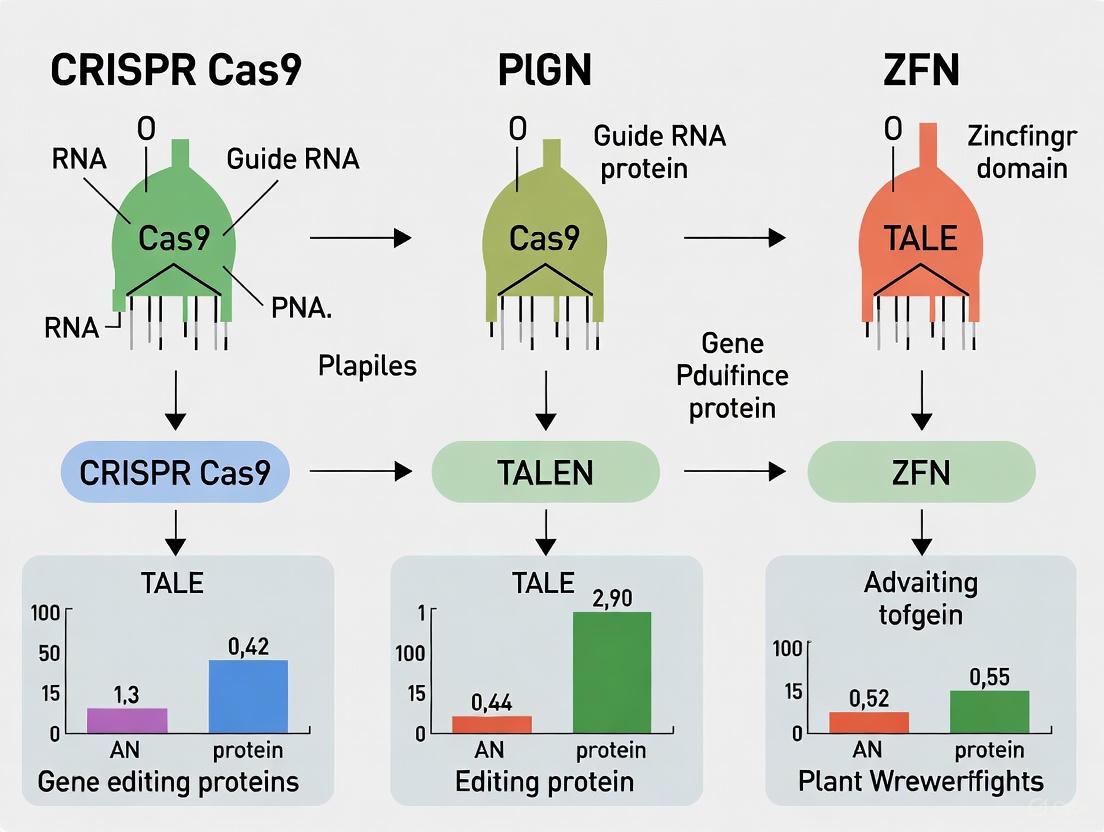
This article provides a systematic analysis of the three major genome-editing platforms—ZFNs, TALENs, and CRISPR-Cas9—in plant systems.
Genome Editing in Plants: A Comprehensive Comparison of CRISPR-Cas9, TALEN, and ZFN Efficiency, Specificity, and Applications
Abstract
This article provides a systematic analysis of the three major genome-editing platforms—ZFNs, TALENs, and CRISPR-Cas9—in plant systems. Tailored for researchers and biotechnology professionals, it examines the foundational mechanisms, methodological applications, and optimization strategies for each tool. By synthesizing recent advancements and comparative data on editing efficiency, specificity, and versatility, this review serves as a strategic guide for selecting the appropriate technology for specific plant genetic engineering projects, from crop improvement to metabolic pathway manipulation.
The Genome Editing Toolkit: Understanding ZFN, TALEN, and CRISPR-Cas9 Core Mechanisms
Zinc Finger Nucleases (ZFNs) represent a foundational milestone in the history of programmable genome editing. As the first generation of artificial restriction enzymes, ZFNs demonstrated the profound feasibility of targeting specific DNA sequences within complex genomes to induce controlled modifications [1] [2]. These chimeric nucleases are engineered by fusing a custom-designed, sequence-specific zinc finger protein (ZFP) DNA-binding domain to the non-specific DNA-cleavage domain of the FokI restriction endonuclease [1] [3]. The core innovation of ZFN technology lies in its DNA recognition code: each individual zinc finger domain within a larger array recognizes and binds to a specific 3-base pair (bp) DNA triplet [1] [2]. By assembling an array of multiple fingers, researchers can create a highly specific DNA-binding domain capable of recognizing extended sequences, typically ranging from 9 to 18 bp per ZFN monomer [1]. Since a functional FokI cleavage domain must dimerize to become active, a pair of ZFNs is designed to bind opposite DNA strands at precisely spaced intervals, typically 5-7 bp apart, forcing the nuclease domains to dimerize and create a double-strand break (DSB) at the targeted genomic location [1] [3]. This break then stimulates the cell's innate DNA repair machinery—either error-prone non-homologous end joining (NHEJ) leading to gene knockouts, or homology-directed repair (HDR) for precise gene editing or insertion [3] [4]. This elegant mechanism established the fundamental paradigm of targeted nuclease-based genome editing that subsequent technologies would build upon.
The Triplet Recognition Code: Design, Assembly, and Specificity
The DNA-binding specificity of ZFNs is governed by the architecture of Cys2-His2 zinc finger proteins, one of the most common DNA-binding motifs in eukaryotes [2]. Each finger consists of approximately 30 amino acids folded into a conserved ββα configuration, with specific amino acids on the surface of the α-helix making sequence-specific contacts with three adjacent base pairs in the major groove of DNA [2]. The true power of this system emerges from the modular assembly of multiple fingers into a continuous array; a three-finger array recognizes a 9-bp sequence, a four-finger array a 12-bp sequence, and so forth [1]. This modularity theoretically allows for the targeting of any genomic sequence. However, a significant design challenge exists due to "context-dependent" effects, where the DNA-binding specificity of an individual finger can be influenced by its neighboring fingers, making simple modular assembly unreliable in some cases [1].
To overcome this limitation, several sophisticated protein engineering strategies have been developed for constructing high-affinity ZF arrays. Modular Assembly involves linking together pre-characterized zinc finger modules, each selected to bind a specific 3-bp triplet, from large combinatorial libraries [1] [2]. The OPEN (Oligomerized Pool Engineering) system, developed by the Zinc-Finger Consortium, employs a bacterial two-hybrid selection to identify optimal 3-finger arrays from randomized libraries, taking into account the context-dependence between fingers [1]. More advanced methods combine these approaches, using context-dependent pre-selected modules for assembly [2]. The ultimate specificity is achieved when two ZFN monomers bind adjacent sites, creating a combined recognition sequence of 18-36 bp, which is statistically unique even within large plant or mammalian genomes [2] [5]. This high specificity is a defining characteristic of ZFNs and a key factor in their continued use for therapeutic applications where off-target effects are a critical concern.
Table 1: Key Methods for Engineering Zinc Finger DNA-Binding Domains
| Method | Description | Key Advantage | Limitation |
|---|---|---|---|
| Modular Assembly [1] [2] | Linking pre-selected fingers, each binding a 3-bp triplet, into a contiguous array. | Simplicity and straightforward design. | Can fail due to context-dependence between adjacent fingers. |
| OPEN (Oligomerized Pool Engineering) [1] | Selection of 3-finger arrays from randomized libraries using a bacterial two-hybrid system. | Accounts for context-dependence, leading to highly specific arrays. | More laborious and time-consuming than modular assembly. |
| Context-Dependent Modular Assembly [2] | Using libraries of two-finger modules pre-selected for optimized junction interactions. | Balances design simplicity with improved success rate. | Requires access to specialized, pre-validated two-finger modules. |
ZFNs in Plant Research: Applications and Methodologies
ZFN technology has been successfully applied to modify the genomes of a diverse range of plant species, including Arabidopsis, tobacco, soybean, and the complex hexaploid genome of bread wheat [1] [6] [3]. Its applications in plant biotechnology are extensive, enabling targeted mutagenesis for gene knockouts, precision gene editing through HDR to introduce agronomically valuable traits (e.g., herbicide tolerance), and even the deletion of large genomic segments [3] [4]. A critical supporting technology for plant genome editing is the ability to deliver ZFN constructs and, where applicable, donor DNA templates into plant cells, followed by the in vitro selection and regeneration of whole plants from successfully modified cells [3].
A standard experimental protocol for ZFN-mediated gene knockout in plants involves several key stages. First, Target Selection and ZFN Design is performed, identifying a 9-18 bp target site for each ZFN monomer within the gene of interest, ensuring they are spaced 5-7 bp apart on opposite strands. ZFNs are then designed using one of the engineering methods described in Table 1 [1] [3]. Next, Vector Construction is undertaken, where genes encoding the designed ZFN pair are cloned into plant transformation vectors, typically under the control of a constitutive or inducible plant promoter [3]. Plant Transformation follows, using established methods like Agrobacterium-mediated transformation or biolistics to introduce the ZFN-encoding vectors into plant cells [3]. After transformation, Regeneration and Selection occurs, where transformed tissues are cultured under selective conditions to regenerate whole plants. Finally, Molecular Analysis is conducted to confirm mutagenesis. This typically involves PCR amplification of the target locus from regenerated plants, followed by a surveyor nuclease assay to detect mismatches in heteroduplex DNA caused by NHEJ-induced indels, and ultimately, DNA sequencing to characterize the specific mutations [3].
Comparative Analysis of Genome Editing Technologies in Plants
When evaluating the major genome editing platforms for plant research, ZFNs, TALENs, and CRISPR/Cas9 each present a distinct profile of advantages and limitations. The following diagram illustrates the fundamental structural and mechanistic differences between these three systems.
Diagram 1: A comparison of the core components and targeting mechanisms of ZFNs, TALENs, and CRISPR/Cas9. ZFNs and TALENs use programmable protein domains fused to FokI, while CRISPR/Cas9 uses a guide RNA to direct the Cas9 nuclease.
Table 2: Comparative Analysis of ZFNs, TALENs, and CRISPR/Cas9 for Plant Genome Editing
| Feature | Zinc Finger Nucleases (ZFNs) | TALENs | CRISPR/Cas9 |
|---|---|---|---|
| DNA Recognition Molecule | Protein-based (Zinc Finger array) [1] | Protein-based (TALE repeats) [6] | RNA-based (Single guide RNA, sgRNA) [6] |
| Recognition Code | Triplet-based (Each finger ~3 bp) [1] [2] | Singlet-based (Each repeat 1 bp) [6] [2] | Linear RNA-DNA complementarity (sgRNA ~20 bp) [6] |
| Nuclease | FokI (requires dimerization) [1] [3] | FokI (requires dimerization) [6] [2] | Cas9 (functions as a monomer) [6] |
| Targeting Specificity | High (dimer target 18-36 bp) [2] [5] | High (dimer target 24-40 bp) [6] [2] | High (20 bp + PAM), but potential for more off-targets [6] |
| Ease of Design & Cloning | Complex and time-consuming due to context-dependence [1] [6] | Modular but repetitive, can be challenging to clone [6] [2] | Very simple; only the sgRNA needs to be redesigned [6] |
| Typical Development Time | Several months [6] | Several days to weeks [6] | A few days [6] |
| Key Limitation in Plants | High design complexity and cost; context-dependence [1] [6] | Large gene size complicates delivery; repetitive sequences [6] | Requires PAM sequence (e.g., NGG for SpCas9); most prominent off-target concerns [6] |
The Scientist's Toolkit: Essential Reagents for ZFN-Based Plant Genome Editing
Table 3: Key Research Reagent Solutions for ZFN Experiments in Plants
| Reagent / Solution | Function and Role in ZFN Workflow |
|---|---|
| Custom ZFN Expression Vectors | Plasmids designed for plant expression, containing genes for the left and right ZFNs under the control of constitutive (e.g., 35S) or inducible promoters [3]. |
| Plant Transformation Vectors | Vectors such as pZFN1 and pZFN2 [5] for Agrobacterium-mediated transformation or biolistic delivery into plant cells. |
| Donor DNA Template | For HDR-mediated editing, a designed DNA fragment homologous to the target region, containing the desired modification (e.g., single nucleotide change or gene insertion) [3] [4]. |
| Cell Culture & Regeneration Media | Aseptic media formulations for the selection (e.g., using antibiotics), maintenance, and regeneration of transformed plant cells into whole plants [3]. |
| Surveyor Nuclease Assay Kit | A key validation tool used post-regeneration to detect NHEJ-induced mutations at the target locus by cleaving heteroduplex DNA [3]. |
| Pre-Engineered ZFN Libraries | Commercially available libraries of zinc finger modules or arrays (e.g., CompoZr from Sigma-Aldrich/Sangamo Biosciences) to bypass the need for de novo design [2]. |
ZFNs, with their foundational triplet recognition code, undeniably paved the way for the modern era of precision genome editing. While the advent of simpler, more user-friendly technologies like CRISPR/Cas9 has shifted the mainstream of plant biotechnology research, ZFNs retain significant relevance in specific applications [6] [5]. Their compact, all-protein structure is advantageous for viral delivery methods like AAV, and their long recognition site contributes to exceptionally high specificity, a critical factor for therapeutic development [5]. Furthermore, continuous innovation in ZFN architecture, such as the development of N-terminal FokI fusions and base-skipping linkers, has enhanced their targeting precision and versatility [5]. Therefore, while TALENs and CRISPR/Cas9 may offer greater ease of use and scalability for high-throughput plant functional genomics, ZFNs remain a powerful and sophisticated tool for researchers requiring the utmost precision in complex genomic engineering tasks, solidifying their enduring legacy as the pioneer technology that first demonstrated the feasibility of programmable genome editing.
Transcription Activator-Like Effector Nucleases (TALENs) represent a groundbreaking advancement in the field of genome editing, distinguished by their unique modular architecture that enables precise single-base pair recognition [2] [7]. This technology has emerged as a powerful tool in plant research, offering distinct advantages for applications requiring high specificity and effectiveness in challenging genomic contexts [8]. As part of the broader genome editing toolkit that includes Zinc Finger Nucleases (ZFNs) and CRISPR-Cas9, TALENs occupy a specialized niche based on their protein-DNA binding mechanism and exceptional targeting precision [9].
The fundamental innovation of TALEN technology lies in its departure from triplet-based recognition systems like ZFNs toward a truly modular one-repeat-to-one-base pair recognition code [2] [10]. This simple yet powerful mechanism, combined with the nuclease capability of the FokI domain, enables researchers to induce targeted double-strand breaks at specific genomic locations across diverse plant species [8] [11]. This review provides a comprehensive comparison of TALEN technology with other major genome editing platforms, focusing on its modular recognition system, experimental performance data in plant systems, and practical implementation protocols to guide researchers in selecting the appropriate technology for their specific applications.
Technology Comparison: Molecular Mechanisms and Recognition Codes
The TALEN Architecture: Modular DNA Recognition
TALENs are chimeric proteins composed of two primary functional domains: a customizable DNA-binding domain derived from transcription activator-like effectors (TALEs) and a catalytic domain from the FokI restriction endonuclease [7] [8]. The DNA-binding domain consists of tandem repeats of 33-35 amino acids, each recognizing a single DNA base pair through two hypervariable amino acid residues at positions 12 and 13, known as repeat-variable diresidues (RVDs) [2] [7]. This one-to-one recognition code provides the foundation for TALEN's precision and programmability, with specific RVD-base pair correspondences: NI for adenine (A), HD for cytosine (C), NG for thymine (T), and NN or NH for guanine (G) [7] [11].
The FokI nuclease domain functions as a molecular scissor that cleaves DNA, but it requires dimerization to become active [8]. This requirement means that a pair of TALEN proteins must bind to opposite DNA strands with a specific spacer sequence between their binding sites (typically 13-18 base pairs) to facilitate FokI dimerization and subsequent DNA cleavage [7]. This dimerization constraint enhances targeting specificity by reducing the likelihood of off-target activity, as two independent binding events must occur in precise orientation and proximity to generate a double-strand break [8].
Table 1: Repeat-Variable Diresidue (RVD) Codes for DNA Recognition
| RVD | Recognized Base Pair | Specificity Strength |
|---|---|---|
| NI | Adenine (A) | High specificity |
| HD | Cytosine (C) | High specificity |
| NG | Thymine (T) | High specificity |
| NN | Guanine (G) | Medium specificity |
| NH | Guanine (G) | High specificity |
Comparative Analysis of Genome Editing Platforms
When evaluated against other major genome editing technologies, TALENs demonstrate distinctive strengths and limitations. Zinc Finger Nucleases (ZFNs), the first generation of programmable nucleases, utilize zinc finger proteins that typically recognize 3-base pair triplets, making their design more complex due to context-dependent effects between neighboring fingers [2] [10]. CRISPR-Cas9 systems employ a RNA-guided DNA recognition mechanism where a single guide RNA (sgRNA) directs the Cas9 nuclease to complementary DNA sequences adjacent to a protospacer adjacent motif (PAM) [12] [9]. While CRISPR-Cas9 offers simpler design and higher throughput capabilities, its RNA-DNA hybridization mechanism can be more permissive than protein-DNA interactions, potentially resulting in higher off-target effects in certain genomic contexts [8] [13].
Table 2: Comprehensive Comparison of Major Genome Editing Technologies
| Feature | ZFN | TALEN | CRISPR-Cas9 |
|---|---|---|---|
| DNA Recognition | Protein-based (3 bp/finger) | Protein-based (1 bp/repeat) | RNA-guided (sgRNA) |
| Nuclease Domain | FokI | FokI | Cas9 |
| Target Specificity | High (with optimal design) | Very high | Moderate to high |
| Targeting Density | ~1 site every 200 bp [14] | Virtually any sequence | Requires PAM sequence |
| Design Complexity | High (context effects) [10] | Medium (modular assembly) | Low (guide RNA design) |
| Construction Time | Several weeks [14] | ~1 week [9] | Days |
| Typical Efficiency | Variable (10-50%) [10] | High (often >50%) [10] | Very high (often >70%) |
| Off-Target Effects | Lower than CRISPR [9] | Lowest among platforms [8] | Highest concern [12] |
| Heterochromatin Editing | Moderate | Excellent [13] | Limited [13] |
| Multiplexing Capacity | Difficult | Challenging | Straightforward |
| Protein Size | Compact | Large | Large |
A critical differentiator for TALENs is their exceptional performance in heterochromatin regions. Single-molecule imaging studies have revealed that TALENs exhibit more efficient search behavior in constrained chromatin environments compared to CRISPR-Cas9 [13]. While Cas9 becomes encumbered by local searches on non-specific sites in heterochromatin, TALENs demonstrate superior navigation capabilities, resulting in up to fivefold higher editing efficiency in these challenging genomic regions [13].
Experimental Data and Performance Metrics in Plant Systems
Efficiency and Specificity Benchmarks
Comparative studies across various plant species have generated quantitative data demonstrating TALEN performance characteristics. In direct side-by-side comparisons with ZFNs, TALENs have shown substantially higher success rates in achieving targeted mutagenesis [10]. While early ZFN platforms often faced challenges with context-dependent failures, TALENs consistently achieved mutagenesis rates comparable to the most effective ZFNs but with significantly greater reliability [10]. This reliability stems from the more predictable and modular nature of the TALE DNA-binding code, which minimizes context effects that frequently hampered ZFN efficacy [2] [10].
When compared to CRISPR-Cas9 systems, TALENs generally exhibit lower off-target activity due to their longer recognition sequences and protein-DNA interaction mechanism [8] [9]. The requirement for dimerization of two TALEN subunits further enhances specificity by necessitating simultaneous binding at adjacent sites for DNA cleavage to occur [8]. This contrasts with CRISPR-Cas9 systems, where a single sgRNA guides the nuclease, and off-target effects can occur at sites with partial complementarity to the guide RNA, particularly in regions with high sequence similarity [12].
Applications in Plant Genome Engineering
TALEN technology has been successfully implemented in diverse plant species for both basic research and crop improvement applications. A prominent application involves the modification of metabolic pathways to enhance the production of valuable secondary metabolites in medicinal plants [8]. By targeting key genes in biosynthetic pathways for alkaloids, flavonoids, terpenoids, and phenolic compounds, researchers have demonstrated the ability to significantly increase yields of these bioactive compounds through TALEN-mediated genome editing [8].
In crop species, TALENs have been effectively employed to improve agronomic traits such as disease resistance, stress tolerance, and nutritional quality [8]. The technology has proven particularly valuable for introducing precise genetic variations without the extensive crossbreeding required in traditional approaches, significantly accelerating the development of improved plant varieties [8]. The high specificity of TALENs minimizes unintended effects on non-target traits, making them especially suitable for precision breeding applications where maintaining elite genetic backgrounds is crucial.
Experimental Protocols: Implementation and Validation
TALEN Assembly and Delivery Methods
The construction of functional TALEN arrays has been streamlined through various modular assembly systems that facilitate the rapid generation of custom nucleases. Among these, the Golden Gate cloning system has emerged as a particularly efficient method, enabling the ordered assembly of multiple TALE repeat modules into backbone vectors in a single reaction [2]. More recently, high-throughput solid-phase assembly and ligation-independent cloning techniques have further simplified the process, making TALEN construction more accessible to non-specialist laboratories [2].
For plant applications, the Emerald-Gateway TALEN system represents an optimized platform that combines the efficiency of the Platinum Gate TALEN kit with Gateway recombination technology [11]. This system utilizes entry vectors (pPlat plasmids) containing cloning sites between Esp3I restriction sites within the DNA-binding domain region, enabling efficient assembly of custom TALEN arrays [11]. The resulting TALEN genes are then transferred into binary destination vectors (e.g., pDual35SGw1301) containing dual expression cassettes with cauliflower mosaic virus (CaMV) 35S promoters for strong constitutive expression in plant cells [11].
Table 3: Essential Research Reagents for TALEN Implementation in Plants
| Reagent/Solution | Function | Application Notes |
|---|---|---|
| TALEN Assembly Kit | Modular construction of TALE repeat arrays | Platinum Gate TALEN kit provides pre-validated components [11] |
| Entry Vectors (pPlat) | Gateway-compatible vectors for TALEN gene construction | Contains cloning site between Esp3I sites [11] |
| Destination Vector | Binary vector for plant transformation | pDual35SGw1301 enables dual TALEN expression [11] |
| Esp3I Restriction Enzyme | Type IIS restriction enzyme for modular assembly | Enables seamless fusion of TALE repeat modules [11] |
| Single-Strand Annealing Reporter | Functional validation of TALEN activity | Luciferase-based system to quantify DNA cleavage efficiency [11] |
Validation and Functional Assessment
Rigorous validation of TALEN activity is essential before proceeding with plant transformation. The Single-Strand Annealing (SSA) assay coupled with luciferase reporter systems provides a robust method for quantitative assessment of DNA cleavage efficiency in bacterial systems [11]. This assay involves introducing target sequences into a divided luciferase gene vector and measuring the restoration of luciferase activity following TALEN-induced cleavage and recombination [11]. The Emerald-Gateway system has demonstrated high efficiency in such assays, with significant luciferase activity detected specifically when TALENs were matched with their corresponding target sequences [11].
Following validation, plant transformation is typically performed using Agrobacterium-mediated delivery of TALEN constructs [11]. Successful genome editing is confirmed through molecular analysis of transgenic lines, including PCR amplification of target regions and detection of modification events through restriction fragment length polymorphism (RFLP) analysis or sequencing [11]. Practical applications have demonstrated the efficacy of this approach, with documented cases of precise genome modifications in potato cells targeting the granule-bound starch synthase (GBSS) gene, resulting in specific mutations including nucleotide deletions, insertions, and substitutions [11].
Visualizing TALEN Architecture and Experimental Workflow
The following diagrams illustrate key concepts in TALEN technology and experimental implementation.
TALEN Modular Recognition Architecture
TALEN Implementation Workflow for Plants
TALEN technology represents a powerful genome editing platform with particular strengths in applications demanding high specificity and effectiveness in challenging genomic contexts. The modular single-base pair recognition mechanism provides unparalleled targeting precision, making TALENs especially valuable for plant research applications where minimizing off-target effects is paramount [8]. While CRISPR-Cas9 systems offer advantages in simplicity and multiplexing capacity, TALENs maintain a competitive edge in editing heterochromatin regions, targeting sequences with high GC content, and other challenging genomic contexts where RNA-guided systems may underperform [13].
For plant researchers, the choice between genome editing technologies should be guided by specific experimental requirements rather than presumed superiority of any single platform. TALENs represent an optimal choice for projects requiring: (1) maximal specificity with minimal off-target effects, (2) editing of heterochromatic regions, (3) modification of repetitive sequences or high-GC content targets, and (4) applications where the inherent protein-DNA recognition mechanism is advantageous [8] [13]. As the field of plant genome engineering continues to advance, TALEN technology remains an essential component of the molecular toolkit, particularly for precision breeding and metabolic engineering applications where its modular recognition system and high specificity deliver unmatched performance.
The advent of programmable nucleases has transformed genetic engineering, enabling precise, targeted modifications within complex genomes. Among these tools, Zinc Finger Nucleases (ZFNs) represented the first generation, followed by Transcription Activator-Like Effector Nucleases (TALENs), with the more recent CRISPR-Cas9 system emerging as a groundbreaking technology [12]. While ZFNs and TALENs rely on custom-designed protein domains to recognize specific DNA sequences, CRISPR-Cas9 utilizes a guide RNA (gRNA) for target recognition, making it uniquely versatile and programmable [15]. This article provides a comparative analysis of these three genome-editing technologies, with a specific focus on their mechanisms, efficiencies, and applications in plant research, offering scientists a comprehensive guide for selecting the appropriate tool for their experimental needs.
Comparative Mechanisms of Action
CRISPR-Cas9: The RNA-Guided System
The CRISPR-Cas9 system consists of two fundamental components: the Cas9 nuclease and a guide RNA (gRNA) [15]. The gRNA is a short RNA sequence engineered to be complementary to a target DNA locus. This RNA-guided complex scans the genome and induces a double-strand break (DSB) at the target site upon recognition [15]. The cell then repairs this break through one of two major pathways: the error-prone non-homologous end joining (NHEJ), which often results in insertions or deletions (indels) that disrupt gene function, or the more precise homology-directed repair (HDR), which can be used to introduce specific changes using a donor DNA template [15].
TALENs: Modular Protein-Based Recognition
TALENs are fusion proteins consisting of a TALE DNA-binding domain derived from plant pathogenic bacteria and a FokI nuclease domain [8]. The DNA-binding domain is composed of tandem repeats, each recognizing a single specific nucleotide, allowing for the engineering of proteins that can bind to virtually any desired DNA sequence [8]. A critical feature of TALENs is that the FokI nuclease must dimerize to become active, meaning a pair of TALENs must bind to opposite DNA strands in close proximity to cleave the target site [8].
ZFNs: The Pioneer Technology
ZFNs, like TALENs, are chimeric proteins combining a zinc finger DNA-binding domain with the FokI nuclease domain [12]. Each zinc finger module typically recognizes a triplet of nucleotides, and multiple fingers are assembled to create a domain with specificity for a longer sequence. Similar to TALENs, ZFNs function as pairs, requiring dimerization of the FokI domains to create a DSB [12]. However, the design of zinc finger arrays with high specificity and affinity is technically challenging, as individual zinc fingers can exhibit context-dependent binding, making their development more complex than TALEN or CRISPR-Cas9 systems [12].
Comparative Efficiency and Performance in Plants
The following table summarizes key performance metrics of the three genome-editing technologies based on recent applications in plant systems.
Table 1: Performance Comparison of Genome Editing Technologies in Plants
| Feature | CRISPR-Cas9 | TALENs | ZFNs |
|---|---|---|---|
| Targeting Mechanism | RNA-guided (gRNA) [15] | Protein-DNA (TALE repeats) [8] | Protein-DNA (Zinc fingers) [12] |
| Ease of Design & Cloning | Rapid and simple (guide RNA design) [12] | Moderately complex (protein engineering) [12] | Complex (protein engineering with context dependence) [12] |
| Editing Efficiency in Plants | High (e.g., 94.6-100% in banana [16]; 18% in Fraxinus [17]) | High, with high specificity [8] | Variable, can be high if well-designed [12] |
| Multiplexing Capacity | High (multiple gRNAs easily expressed) [18] | Low to moderate [12] | Low [12] |
| Off-Target Effects | Moderate (potential with imperfect gRNA pairing) [12] | Low (high specificity of protein-DNA binding) [8] [12] | Moderate (can vary with design) [12] |
| Optimal Use Cases | High-throughput screening, multiplexed editing, rapid prototyping [19] [16] | Editing repetitive regions, high-GC content targets, applications requiring minimal off-targets [8] [12] | Established for specific, well-characterized targets [12] |
| Typical Mutation Pattern | Primarily small indels via NHEJ [15] | Primarily small indels via NHEJ [8] | Primarily small indels via NHEJ [12] |
Detailed Experimental Protocols and Data
Case Study 1: CRISPR-Cas9 in East African Highland Bananas
A 2025 study established an efficient CRISPR-Cas9 system for the triploid East African Highland banana (EAHB), a vital staple crop [16].
- Experimental Objective: To knockout the phytoene desaturase (PDS) gene as a visual marker to validate editing efficiency in two EAHB cultivars, Nakitembe (NKT) and NAROBan5 (M30) [16].
- Methodology:
- sgRNA Design: Two sgRNAs were designed targeting exons 5 and 6 of the Nakitembe PDS gene [16].
- Vector Construction: The sgRNAs were cloned into the pYPQ142 vector and recombined with a Cas9 entry vector and the pMDC32 binary vector to create the final construct, pMDC32Cas9NktPDS [16].
- Plant Transformation: Agrobacterium tumefaciens strain AGL1 harboring the construct was used to transform banana embryogenic cell suspensions (ECS). Transformed cells were regenerated on selective media [16].
- Key Results:
- A total of 47 NKT and 130 M30 independent events were regenerated [16].
- 100% of NKT and 94.6% of M30 edited events exhibited albinism (a clear phenotype of PDS knockout) [16].
- Sequencing confirmed frameshift mutations in the PDS gene of all edited plants, demonstrating the system's high efficiency and precision even in a triploid genome [16].
Case Study 2: CRISPR-Cas9 in Fraxinus mandshurica
Researchers developed a CRISPR-Cas9 system for Fraxinus mandshurica (Manchurian ash), a hardwood tree species lacking a mature tissue culture system [17].
- Experimental Objective: To establish a functional gene-editing system by knocking out the FmbHLH1 gene, a transcription factor involved in drought stress response [17].
- Methodology:
- Target Selection and Vector Construction: Three specific knockout targets for FmbHLH1 were selected and cloned into a CRISPR/Cas9 vector (pYLCRISPR/Cas9P35S-N) [17].
- Plant Transformation: The vector was transformed into Agrobacterium tumefaciens strain EHA105. Sterile plantlets were infected via Agrobacterium-mediated transient transformation [17].
- Screening: A clustered bud system was used to induce and screen for homozygous edited plants [17].
- Key Results:
- Among 100 randomly transformed growing points, 18% of the induced clustered buds were successfully gene-edited, confirming the system's effectiveness in a recalcitrant species [17].
- Phenotypic analysis revealed that FmbHLH1 knockout plants had reduced drought tolerance, elucidating the gene's function [17].
Case Study 3: TALENs for Secondary Metabolite Engineering
TALENs have been effectively applied to enhance the production of valuable secondary metabolites in medicinal plants [8].
- Experimental Objective: To precisely manipulate genes in biosynthetic pathways for alkaloids, flavonoids, and terpenoids to increase their yield [8].
- Methodology:
- Key Results:
- TALENs have been used to create novel genetic variations that enhance the production of bioactive compounds without introducing foreign DNA, a significant advantage for consumer acceptance [8].
- The high specificity of TALENs minimizes off-target effects, which is crucial when engineering complex, interconnected metabolic pathways [8].
The workflow below generalizes the process of establishing a genome editing system in plants, as demonstrated in the case studies.
The Scientist's Toolkit: Essential Research Reagents
Successful genome editing requires a suite of specialized reagents and materials. The following table details key solutions used in the featured experiments.
Table 2: Essential Reagents for Plant Genome Editing
| Reagent / Solution | Function | Example from Research |
|---|---|---|
| CRISPR/Cas9 Vector | Delivers the Cas9 nuclease and gRNA(s) into the plant cell. | pMDC32Cas9NktPDS vector used in banana editing [16]. |
| TALEN Pair | A pair of plasmids encoding the left and right TALEN proteins that dimerize to cleave the target DNA. | Custom TALEN pairs designed for biosynthetic pathway genes [8]. |
| Agrobacterium tumefaciens Strain | A bacterium used as a vector to transfer T-DNA (containing the editing constructs) into the plant genome. | Strains AGL1 (banana) [16] and EHA105 (Fraxinus) [17] are commonly used. |
| Guide RNA (gRNA) | In CRISPR, a short RNA sequence that directs Cas9 to the specific genomic target. | Two sgRNAs designed from the Nakitembe PDS gene [16]. |
| Selection Agent (e.g., Kanamycin) | An antibiotic or herbicide added to growth media to select for plant cells that have successfully integrated the transformation vector. | Kanamycin used to select transformed Fraxinus embryos [17]. |
| Plant Tissue Culture Media | A nutrient medium supporting the growth and regeneration of whole plants from single cells or explants. | Woody Plant Medium (WPM) for Fraxinus [17]; specific media for banana ECS [16]. |
| PCR & Sequencing Primers | Oligonucleotides used to amplify and sequence the target locus to confirm successful editing. | Primers used for band-shift PCR and sequencing in banana study [16]. |
The choice between CRISPR-Cas9, TALENs, and ZFNs is not a matter of identifying a single "best" technology, but rather of selecting the most appropriate tool for a specific research context. CRISPR-Cas9 stands out for its unparalleled ease of design, high efficiency, and powerful multiplexing capabilities, making it the preferred choice for high-throughput functional genomics and rapid trait improvement in a wide range of plant species, from staples like banana to hardwoods like Fraxinus [17] [16]. In contrast, TALENs offer superior specificity with minimal off-target effects, proving highly valuable for applications requiring extreme precision, such as engineering complex secondary metabolite pathways or editing genomic regions with high sequence similarity [8] [12]. While ZFNs pioneered the field, their technical complexity and lower adoption have made them less common for new plant research projects [12].
The future of plant genome editing lies in the continued refinement of these tools. For CRISPR-Cas9, this includes the development of high-fidelity Cas variants, base editors, and prime editors that can make precise changes without creating double-strand breaks, thereby further reducing off-target potential [20] [15]. The integration of genome editing with other advanced technologies—such as multi-omics data analysis, artificial intelligence for improved gRNA and TALEN repeat design, and advanced tissue culture robotics—promises to accelerate the development of climate-resilient, high-yielding crop varieties [21]. As these technologies evolve and global regulatory frameworks adapt, programmable nucleases will undoubtedly play an increasingly critical role in ensuring future food security and advancing fundamental plant science.
Comparative Analysis of DNA Recognition and Binding Mechanisms
The advent of targeted genome editing has revolutionized biological research and therapeutic development. At the core of this revolution lie three powerful technologies: Zinc Finger Nucleases (ZFNs), Transcription Activator-Like Effector Nucleases (TALENs), and the Clustered Regularly Interspaced Short Palindromic Repeats (CRISPR)-Cas9 system. Each platform employs fundamentally different mechanisms for DNA recognition and binding, which directly impacts their efficiency, specificity, and application potential. Understanding these molecular mechanisms is crucial for researchers selecting the appropriate tool for specific experimental or therapeutic goals. This comparative analysis examines the structural basis, operational mechanisms, and functional consequences of DNA recognition by these genome-editing platforms, with particular emphasis on their applications in plant systems. The fundamental differences in how these systems locate and bind their DNA targets ultimately determine their performance characteristics across various biological contexts.
Fundamental Protein-DNA Recognition Mechanisms
Before examining specific genome editing technologies, it is essential to understand the basic principles governing how proteins recognize and bind DNA. Protein-DNA recognition occurs through multiple mechanisms that can be categorized as direct readout (specific interactions with nucleotide bases) and indirect readout (recognition of DNA shape and structural properties) [22].
The primary molecular interactions facilitating protein-DNA binding include hydrogen bonding, electrostatic interactions, hydrophobic effects, and van der Waals forces [23]. Hydrogen bonds form between protein functional groups and DNA bases or backbone atoms, with geometry affecting bond strength. Electrostatic interactions occur primarily between basic protein residues and the acidic DNA phosphate backbone. Hydrophobic effects drive the exclusion of water from interfaces, while van der Waals forces provide stabilizing contacts between complementary surfaces [23].
DNA-binding proteins typically employ structural motifs for DNA recognition. The helix-turn-helix (HTH) motif is common among prokaryotic and eukaryotic DNA-binding proteins, consisting of two nearly perpendicular α-helices connected by a short turn [24]. The second "recognition helix" inserts into the DNA major groove, where side chains contact nucleotide bases. Related winged helix-turn-helix variants incorporate additional structural elements that enhance DNA binding [24]. Understanding these fundamental mechanisms provides context for evaluating engineered DNA-binding platforms.
DNA Recognition Mechanisms by Editing Platforms
Zinc Finger Nucleases (ZFNs)
Mechanism of DNA Recognition: ZFNs utilize engineered Cys2-His2 zinc finger proteins, one of the most common DNA-binding motifs in eukaryotes [2]. Each zinc finger domain consists of approximately 30 amino acids arranged in a ββα configuration that recognizes primarily three base pairs in the DNA major groove [2]. Multiple fingers are assembled in tandem (typically 3-6 fingers) to recognize extended DNA sequences of 9-18 base pairs, providing sufficient length for unique genomic targeting [2] [14].
Structural Basis: The modular structure of zinc finger proteins enables their engineering for specific DNA recognition. Successful targeting requires assembly of fingers that maintain specificity in extended arrays, which has been addressed through various strategies including modular assembly and selection-based approaches like OPEN (Oligomerized Pool Engineering) [2]. Each finger recognizes its triplet primarily through amino acid residues at key positions on the α-helical surface, with context-dependent interactions between neighboring fingers influencing binding affinity [2].
Nuclease Component: The DNA-binding domain is fused to the non-specific FokI endonuclease domain, which requires dimerization for activation. Thus, ZFNs function as pairs binding opposite DNA strands with appropriate spacing and orientation to allow FokI domains to dimerize and create double-strand breaks [14].
Table 1: ZFN Architecture and Properties
| Feature | Specification |
|---|---|
| DNA recognition domain | Engineered zinc finger arrays |
| Recognition unit size | ~3 bp per zinc finger |
| Typical total recognition length | 9-18 bp per ZFN monomer |
| Nuclease domain | FokI endonuclease |
| Binding requirement | Pair binding in opposite orientation with spacer |
| Engineering approach | Modular assembly, OPEN, or commercial sources |
Transcription Activator-Like Effector Nucleases (TALENs)
Mechanism of DNA Recognition: TALENs utilize DNA-binding domains derived from Transcription Activator-Like Effectors (TALEs), proteins naturally produced by Xanthomonas plant pathogens [2] [8]. The DNA-binding domain consists of tandem repeats of 33-35 amino acids, with each repeat recognizing a single base pair [2] [8]. This one-to-one correspondence between repeats and nucleotides simplifies target site prediction and engineering.
Repeat-Variable Diresidues (RVDs): Specificity is determined by two hypervariable amino acids at positions 12 and 13 within each repeat, known as Repeat-Variable Diresidues (RVDs) [2]. The RVD code defines base recognition: NI for adenine, NG for thymine, HD for cytosine, and NN for guanine/adenine [2] [8]. This simple cipher enables predictable engineering for novel DNA targets.
Structural Basis: TALE repeats assemble into a right-handed superhelical structure that wraps around the DNA major groove, with each RVD contacting its cognate base pair [2]. The modular nature of TALE repeats allows engineering of arrays capable of recognizing virtually any DNA sequence, with binding affinity generally increasing with repeat number.
Nuclease Component: Similar to ZFNs, TALENs fuse the TALE DNA-binding domain to the FokI nuclease domain, requiring paired binding with proper spacing for dimerization and DNA cleavage [8].
Table 2: TALEN Architecture and Properties
| Feature | Specification |
|---|---|
| DNA recognition domain | TALE repeat arrays |
| Recognition unit size | 1 bp per TALE repeat |
| Typical total recognition length | 12-20 bp per TALEN monomer |
| Specificity determinant | Repeat-Variable Diresidues (RVDs) |
| Key RVD specificities | NI→A, NG→T, HD→C, NN→G/A |
| Nuclease domain | FokI endonuclease |
| Engineering advantage | Simple cipher, high success rate |
CRISPR-Cas9 System
Mechanism of DNA Recognition: The CRISPR-Cas9 system employs a fundamentally different recognition mechanism based on RNA-DNA complementarity rather than protein-DNA interactions [25]. The Cas9 nuclease is directed to target sites by a guide RNA (gRNA) of approximately 20 nucleotides that forms complementary base pairs with the target DNA sequence [26] [25].
Structural Basis: Cas9 undergoes conformational changes upon gRNA binding, creating a channel that accommodates the RNA-DNA heteroduplex. The recognition (REC) lobe contains domains that facilitate binding to the gRNA-DNA complex, while the nuclease (NUC) lobe contains the HNH and RuvC catalytic domains [25]. The HNH domain cleaves the complementary DNA strand, while the RuvC domain cleaves the non-complementary strand [25].
PAM Requirement: Cas9 requires a Protospacer Adjacent Motif (PAM) adjacent to the target sequence for recognition and cleavage [26]. For the most commonly used Streptococcus pyogenes Cas9, the PAM sequence is 5'-NGG-3', where N is any nucleotide [25]. The PAM requirement restricts potential target sites but provides a safeguard against self-targeting of the bacterial CRISPR locus.
Table 3: CRISPR-Cas9 Architecture and Properties
| Feature | Specification |
|---|---|
| DNA recognition domain | RNA-guided (gRNA:DNA complementarity) |
| Recognition unit size | 20 nt guide sequence |
| Total recognition length | 20 bp + PAM |
| Specificity determinant | RNA-DNA base pairing |
| Nuclease domain | HNH and RuvC in Cas9 |
| Additional requirement | Protospacer Adjacent Motif (PAM) |
| Engineering advantage | Simple gRNA design, multiplexing capability |
Comparative Analysis of Recognition and Binding Properties
Specificity and Off-Target Effects
ZFNs demonstrate moderate specificity, with off-target effects resulting from binding to sequences similar to the intended target. The challenge of engineering zinc finger arrays with high specificity, particularly due to context-dependent effects between adjacent fingers, can limit targeting density [14]. Studies in human stem cells have identified off-target mutations at sites with high sequence similarity to the target [14]. Specificity can be improved using obligate heterodimer FokI variants that prevent homodimer formation [14].
TALENs generally exhibit high specificity due to the precise one-to-one recognition code and the requirement for longer binding sequences. The protein-DNA interaction is highly specific, with reduced off-target effects compared to ZFNs and CRISPR-Cas9 in some studies [8]. The requirement for TALE repeats to begin with thymine (recognized by a truncated N-terminal domain) further constrains targetable sites [2].
CRISPR-Cas9 has raised concerns about off-target effects due to tolerance of mismatches, particularly in the PAM-distal region of the guide sequence [26] [25]. Off-target activity can occur at sites with up to 5 nucleotide mismatches, depending on their position and distribution [26]. However, high-fidelity Cas9 variants, truncated gRNAs, and improved design algorithms have significantly reduced off-target effects in recent implementations.
Efficiency and Practical Implementation
ZFNs were the first engineered nucleases to demonstrate efficient genome editing but present practical challenges in engineering. Publicly available platforms like OPEN address context dependence but require screening efforts, while commercial sources provide validated ZFNs but at higher cost [14]. Effective ZFN pairs can achieve mutation efficiencies of 1-50% in various cell types.
TALENs are considerably easier to design than ZFNs due to the simple RVD code, contributing to their rapid adoption. Golden Gate cloning and other modular assembly methods enable construction of custom TALEN arrays within days [2] [25]. TALENs typically show high activity across diverse target sites, with reported mutation efficiencies often exceeding those of ZFNs in side-by-side comparisons.
CRISPR-Cas9 offers the simplest design process, requiring only the synthesis of a ~20 nt guide RNA sequence to target new sites [25]. This simplicity enables rapid prototyping and multiplexing of targets. CRISPR-Cas9 generally demonstrates high efficiency across diverse organisms and cell types, though efficiency varies with gRNA sequence, chromatin accessibility, and cell division state.
Table 4: Comprehensive Comparison of Genome Editing Platforms
| Property | ZFNs | TALENs | CRISPR-Cas9 |
|---|---|---|---|
| Recognition mechanism | Protein-DNA (zinc fingers) | Protein-DNA (TALE repeats) | RNA-DNA (gRNA complementarity) |
| Targeting length | 9-18 bp per monomer | 12-20 bp per monomer | 20 bp + PAM |
| Engineering difficulty | High (context dependence) | Moderate (repeat assembly) | Low (gRNA design) |
| Targeting density | ~1 site/200 bp (open source) | ~1 site/1-2 bp | ~1 site/8 bp (NGG PAM) |
| Mutation efficiency | Variable (1-50%) | Generally high | Generally high |
| Off-target concerns | Moderate | Low | Moderate to high |
| Multiplexing capability | Difficult | Difficult | Straightforward |
| Typical delivery | DNA/mRNA | DNA/mRNA | DNA/RNA/protein |
| Commercial availability | Limited (CompoZr) | Various sources | Widely available |
Applications in Plant Research
Plant genome editing presents unique challenges including cell wall barriers, transformation efficiency, and regenerative capacity. All three platforms have been successfully implemented in diverse plant species, with distinct advantages for specific applications.
ZFNs in Plants: ZFNs demonstrated early success in plant genome editing, with applications in targeted gene mutagenesis in Arabidopsis, tobacco, and maize [25]. The relatively small size of ZFN constructs compared to TALENs facilitates delivery via plant transformation methods. However, the engineering challenges have limited widespread adoption in the plant research community.
TALENs in Plants: TALENs have been successfully applied in over 50 plant genes across species including Arabidopsis, barley, Brachypodium, maize, tobacco, rice, soybean, tomato, and wheat [25]. Optimized TALEN scaffolds have been developed for high activity in plants [25]. Notable applications include engineering disease resistance in rice by modifying promoter elements of susceptibility genes [25] and creating powdery mildew-resistant wheat by targeting MLO genes [25]. The high specificity of TALENs is particularly valuable for applications in polyploid plants where precise targeting of homologous genes is required.
CRISPR-Cas9 in Plants: The simplicity of CRISPR-Cas9 has made it the most widely adopted platform for plant genome editing. It has been used for targeted gene mutagenesis, multiplexed editing, gene regulation, and base editing in numerous crop species [26] [25]. In rice, CRISPR-Cas9 has achieved mutation efficiencies of 3-8% in transformed cells [26]. The ability to simultaneously target multiple genes is particularly valuable for studying gene families and engineering complex traits in plants.
Experimental Considerations and Methodologies
Design and Assembly Protocols
ZFN Engineering: The OPEN (Oligomerized Pool Engineering) platform involves identifying potential zinc finger arrays through screening of randomized libraries that account for context-dependent interactions [2]. Alternatively, modular assembly approaches utilize pre-characterized zinc finger modules, though these may suffer from reduced activity due to context effects [2]. ZFN pairs must be designed to bind opposite DNA strands with 5-7 bp spacing for proper FokI dimerization.
TALEN Assembly: Golden Gate cloning is the most common assembly method, utilizing type IIS restriction enzymes to sequentially ligate TALE repeat modules [2] [25]. Other methods include high-throughput solid-phase assembly and ligation-independent cloning techniques [2]. TALEN pairs typically require 14-20 bp binding sites per monomer with 12-20 bp spacing.
CRISPR-Cas9 Design: gRNA design involves selecting 20 nt sequences adjacent to PAM sites (5'-NGG-3' for SpCas9) with minimal off-target potential. Numerous computational tools are available for gRNA design, which consider factors like GC content, specific nucleotide positions, and genome-wide off-target sites [25]. Modified gRNA architectures including truncated gRNAs and extended gRNAs can enhance specificity.
Delivery Methods in Plant Systems
DNA Delivery: All three platforms are typically delivered as DNA constructs via Agrobacterium-mediated transformation or biolistics. For ZFNs and TALENs, mRNA delivery can reduce off-target effects and persistent nuclease expression [14]. CRISPR-Cas9 can be delivered as DNA, RNA, or ribonucleoprotein (RNP) complexes.
RNP Delivery: Direct delivery of preassembled Cas9-gRNA ribonucleoproteins has gained popularity for plant genome editing due to reduced off-target effects and transient activity [25]. RNPs can be delivered via biolistics or protoplast transfection, enabling editing without integration of foreign DNA.
Research Reagent Solutions
Table 5: Essential Research Reagents for Genome Editing Studies
| Reagent Category | Specific Examples | Function and Application |
|---|---|---|
| Nuclease platforms | ZFN pairs, TALEN pairs, SpCas9 variants | Core editing machinery for DSB induction |
| Assembly systems | Golden Gate TALEN kits, CRISPR gRNA cloning vectors | Modular construction of custom editors |
| Delivery vehicles | Agrobacterium strains, biolistic equipment, transfection reagents | Introduction of editing components into cells |
| Detection assays | T7E1 assay, SURVEYOR assay, deep sequencing | Validation of editing efficiency and specificity |
| Selection markers | Antibiotic resistance, fluorescent proteins, metabolic markers | Enrichment for successfully edited cells |
| Reporter systems | GFP reconstitution, luciferase assays | Rapid assessment of editing activity |
| Cell culture reagents | Plant growth media, hormones, protoplast isolation kits | Maintenance and transformation of plant cells |
The comparative analysis of DNA recognition and binding mechanisms reveals a clear evolution from protein-based recognition (ZFNs, TALENs) to RNA-guided systems (CRISPR-Cas9). Each platform offers distinct advantages: ZFNs as pioneering tools with moderate size, TALENs for high-precision applications with minimal off-target effects, and CRISPR-Cas9 for unparalleled simplicity and multiplexing capability. In plant research, all three platforms have demonstrated success, with choice depending on specific requirements for precision, efficiency, and regulatory considerations. The continued refinement of these technologies, including the development of high-fidelity variants and expanded targeting capabilities, promises to further enhance their utility for both basic research and agricultural biotechnology. As the field advances, the optimal application of each technology will increasingly depend on matching their inherent recognition and binding properties to the specific biological context and editing objectives.
The Critical Role of Double-Strand Breaks and Cellular Repair Pathways (NHEJ and HDR)
The advent of targeted genome editing has revolutionized biological research and therapeutic development, with its fundamental mechanics rooted in the cellular repair of DNA double-strand breaks (DSBs). DSBs represent the most severe form of DNA damage, posing a critical threat to genomic integrity and cell survival [27] [28]. When such breaks occur, cells activate a sophisticated network of DNA Damage Response (DDR) pathways to detect, signal, and repair the lesions [29]. The two primary mechanisms for repairing DSBs are Non-homologous end joining (NHEJ) and Homology-directed repair (HDR) [29] [27]. These repair pathways are not merely background biological processes; they are the essential mechanisms that researchers harness to achieve precise genetic modifications using engineered nucleases like ZFNs, TALENs, and CRISPR/Cas9 [2] [30]. The fundamental difference between these pathways lies in their requirement for a template: NHEJ directly ligates broken ends, while HDR requires a homologous DNA template to accurately restore the sequence [29] [31].
The competition and cooperation between NHEJ and HDR pathways determine the outcome of genome editing experiments. Understanding their distinct mechanisms, efficiencies, and cellular regulation is paramount for selecting the appropriate strategy for specific research goals, whether it's gene knockout, precise point mutation, or gene knockin [29] [31]. This knowledge is particularly crucial in plant research, where the efficiency of genetic modifications can significantly accelerate basic science and breeding programs [30].
Molecular Mechanisms of NHEJ and HDR
The Non-Homologous End Joining (NHEJ) Pathway
NHEJ is considered the dominant and faster DSB repair pathway in most eukaryotic cells, operating throughout the cell cycle but particularly dominant outside the S and G2 phases [27]. This pathway is often described as "error-prone" because it rejoins broken DNA ends without requiring a homologous template, frequently resulting in small insertions or deletions (INDELs) at the repair site [29] [31].
The molecular mechanism of NHEJ initiates with the Ku70/Ku80 heterodimer recognizing and binding to the broken DNA ends [27]. This complex then recruits and activates the DNA-dependent protein kinase catalytic subunit (DNA-PKcs), forming the complete DNA-PK complex [27]. Subsequently, end-processing enzymes such as the Artemis nuclease may be recruited to trim damaged ends or overhangs [27]. Finally, the XRCC4-DNA ligase 4 (Lig4) complex, stabilized by XRCC4-like factor (XLF), performs the ligation step that physically rejoins the DNA strands [27]. A recent groundbreaking study revealed that NHEJ employs distinct mechanisms to repair each strand of a double-strand break, with simpler breaks being joined near-simultaneously while more complex end structures require obligatorily ordered repair where the first strand repaired serves as a template for the second [32].
The Homology-Directed Repair (HDR) Pathway
In contrast to NHEJ, HDR is a precise, "error-free" repair mechanism that utilizes a homologous DNA template—typically a sister chromatid during the S and G2 phases of the cell cycle—to accurately restore the original sequence at the break site [29] [27]. This pathway is highly conserved and provides the foundation for precise genome editing applications.
The HDR process begins with the MRE11-RAD50-NBS1 (MRN) complex recognizing the DSB site [27]. This complex, along with its cofactor, initiates end resection, a 5' to 3' nucleolytic degradation of the broken DNA ends that generates 3' single-stranded DNA (ssDNA) overhangs [27]. The exposed ssDNA is rapidly coated by replication protein A (RPA), which removes secondary structures and prevents degradation [27]. Key mediator proteins, including BRCA1 and BRCA2, then facilitate the replacement of RPA with the RAD51 recombinase to form a nucleoprotein filament [27]. This RAD51-coated filament invades the homologous donor template—whether a sister chromatid or an exogenously supplied donor DNA—and uses this template to guide accurate DNA synthesis and repair [27].
Table 1: Key Protein Complexes in NHEJ and HDR Pathways
| Repair Pathway | Key Initiating Complex | Primary Effector Proteins | End Processing Enzymes | Ligation/Resolution Factors |
|---|---|---|---|---|
| NHEJ | Ku70/Ku80 heterodimer | DNA-PKcs | Artemis nuclease, Pol μ, Pol λ | XRCC4, Lig4, XLF |
| HDR | MRN complex (MRE11-RAD50-NBS1) | RPA, BRCA1, BRCA2, RAD51 | Exonucleases (e.g., MRE11) | DNA polymerase, DNA ligase |
Diagram 1: Molecular Mechanisms of NHEJ and HDR Pathways. NHEJ rapidly ligates broken ends, often generating INDELs, while HDR uses a homologous template for precise repair.
Comparative Analysis of Genome Editing Platforms
ZFNs, TALENs, and CRISPR/Cas9: Mechanisms and Applications
The three major genome editing platforms—ZFNs, TALENs, and CRISPR/Cas9—all operate through a common fundamental principle: creating targeted DSBs in the genome to harness cellular repair mechanisms [2]. Despite this shared mechanism, they differ significantly in their molecular architecture, specificity, and practical implementation.
Zinc-Finger Nucleases (ZFNs) are chimeric proteins composed of a customizable DNA-binding domain—formed by assembling multiple Cys2-His2 zinc-finger motifs (each recognizing approximately 3 bp)—fused to the FokI nuclease domain [2]. ZFNs function as dimers, requiring two complementary ZFN units to bind opposite DNA strands with precise spacing and orientation for FokI dimerization and subsequent DSB formation [2].
Transcription Activator-Like Effector Nucleases (TALENs) similarly fuse a customizable DNA-binding domain to the FokI nuclease domain. However, TALENs utilize TALE repeat domains derived from Xanthomonas bacteria, with each repeat recognizing a single base pair through two hypervariable amino acids known as repeat-variable diresidues (RVDs) [2]. This simpler, more predictable code (e.g., NI for A, NG for T, HD for C, NN for G) provides greater design flexibility compared to ZFNs [2].
CRISPR/Cas9 represents a fundamentally different approach, utilizing a RNA-guided DNA recognition mechanism. The system consists of two components: the Cas9 nuclease and a single guide RNA (sgRNA) that directs Cas9 to complementary genomic sequences adjacent to a Protospacer Adjacent Motif (PAM) [2] [30]. This RNA-based targeting eliminates the need for protein engineering for each new target, significantly simplifying and accelerating the design process [2] [30].
Table 2: Comparison of Major Genome Editing Platforms
| Feature | ZFNs | TALENs | CRISPR/Cas9 |
|---|---|---|---|
| DNA Recognition Mechanism | Protein-based (Zinc finger domains) | Protein-based (TALE repeats) | RNA-based (sgRNA) |
| Targeting Specificity | 18-24 bp (dimer) | 30-40 bp (dimer) | 20 bp + PAM |
| Nuclease Component | FokI (requires dimerization) | FokI (requires dimerization) | Cas9 (single protein) |
| Targeting Constraints | Requires G-rich sequences; context-dependent effects | Requires 5'-T precursor; repetitive cloning challenges | Requires PAM sequence (NGG for SpCas9) |
| Editing Efficiency | Moderate | Moderate to High | High |
| Multiplexing Capacity | Low | Low | High (multiple gRNAs) |
| Ease of Design & Construction | Complex (context-dependent effects) | Moderate (repetitive cloning) | Simple (cloning of sgRNA) |
| Relative Cost | High | Moderate to High | Low |
Efficiency and Specificity in Plant Genome Editing
In plant research, the choice of editing platform is influenced by multiple factors, including transformation efficiency, cell viability, and the ability to regenerate whole plants from edited cells [30]. CRISPR/Cas9 has emerged as the predominant system for plant genome editing due to its simplicity, high efficiency, and capacity for multiplexing [30].
A critical advantage of CRISPR/Cas9 in plants is the ability to create multiple gene knockouts simultaneously through NHEJ-mediated repair by introducing numerous DSBs at different genomic loci [30]. This is particularly valuable for studying gene families with redundant functions or complex polygenic traits. For precision plant breeding applications requiring specific nucleotide changes or gene insertions, HDR-based approaches with CRISPR/Cas9 are employed, though with lower efficiency due to the competitive dominance of the NHEJ pathway [29] [30].
The specificity of each platform—the frequency of off-target effects—varies significantly. ZFNs can display considerable off-target activity due to context-dependent effects between adjacent zinc fingers [2]. TALENs generally offer higher specificity with minimal off-target effects, attributed to their longer recognition sequences and the requirement for dimerization [2]. CRISPR/Cas9 specificity depends on the sgRNA design, with off-target cleavage occurring at genomic sites bearing partial complementarity to the sgRNA, particularly in sequences with mismatches in the 5' region while maintaining PAM compatibility [2] [30].
Experimental Approaches and Methodologies
Designing Experiments for Controlled DSB Repair
To achieve predictable genome editing outcomes, researchers must carefully design their experiments to steer DSB repair toward the desired pathway. For NHEJ-mediated gene knockouts, the experimental design is relatively straightforward: delivery of the nuclease (ZFN, TALEN, or CRISPR/Cas9) alone is typically sufficient to generate disruptive INDELs at the target locus [29]. The key consideration is designing targeting molecules that maximize on-target efficiency while minimizing off-target effects.
For HDR-mediated precise editing, the experimental design is more complex. Researchers must co-deliver the nuclease system with a donor DNA template containing the desired modification flanked by homology arms (sequences identical to those surrounding the DSB) [29] [31]. The length of these homology arms varies by system and organism but typically ranges from 400-800 bp for plasmid donors to shorter arms for single-stranded oligodeoxynucleotide (ssODN) donors [31]. Critical parameters to optimize include:
- Donor concentration and design: Higher donor concentrations generally improve HDR efficiency; nuclear localization signals can enhance donor delivery [33].
- Cell cycle synchronization: Since HDR is active primarily in S/G2 phases, synchronizing cells or timing nuclease expression to coincide with these phases can enhance HDR efficiency [33].
- Modulating repair pathway preferences: Co-expression of HDR-promoting factors or temporary inhibition of key NHEJ proteins can shift the balance toward HDR [29].
Diagram 2: Experimental Workflow for NHEJ and HDR Genome Editing. The experimental design diverges based on whether the goal is gene knockout (NHEJ) or precise editing (HDR).
Analytical Methods for Assessing Editing Outcomes
Validating genome editing outcomes requires specific analytical approaches tailored to the expected modifications. For NHEJ-generated INDELs, common detection methods include:
- T7 Endonuclease I (T7E1) or Surveyor Assay: Mismatch detection assays that identify heterogeneous PCR products from pools of edited cells.
- Restriction Fragment Length Polymorphism (RFLP): Useful when INDELs create or destroy restriction enzyme sites.
- High-resolution melt analysis (HRMA): Detects sequence variations through differential DNA melting properties.
- Sanger sequencing followed by decomposition analysis: Precisely characterizes the spectrum of INDEL mutations.
- Next-generation sequencing (NGS): Provides comprehensive quantitative analysis of editing efficiency and mutation profiles.
For HDR-mediated precise edits, validation typically involves:
- Allele-specific PCR: Amplifies specifically the edited allele using primers that match the introduced sequence.
- Restriction-based screening: Utilizes newly introduced restriction sites in the donor template.
- Sanger sequencing: Confirms the precise sequence change without collateral mutations.
- Digital PCR (dPCR): Enables absolute quantification of HDR efficiency, particularly valuable for low-efficiency events.
Research Reagent Solutions for Genome Editing
Table 3: Essential Reagents for Genome Editing Experiments
| Reagent Category | Specific Examples | Function in Genome Editing |
|---|---|---|
| Nuclease Systems | ZFN pairs, TALEN pairs, CRISPR/Cas9 (plasmid, mRNA, protein) | Creates targeted double-strand breaks at specific genomic loci |
| Donor Templates | dsDNA plasmids with homology arms, ssODNs, AAV vectors | Provides repair template for HDR-mediated precise editing |
| Delivery Tools | Electroporation systems, Lipofectamine, Viral vectors (Lentivirus, AAV) | Introduces editing components into target cells |
| Detection Assays | T7E1 enzyme, Surveyor nuclease, restriction enzymes, sequencing primers | Validates editing efficiency and characterizes mutations |
| Cell Culture Reagents | Cell synchronization agents (e.g., nocodazole), antibiotics, growth factors | Maintains optimal cellular conditions for editing and recovery |
| Enrichment Tools | Fluorescent markers, antibiotic resistance genes, FACS systems | Selects successfully edited cells from complex populations |
The strategic selection between NHEJ and HDR pathways, coupled with the appropriate genome editing platform, fundamentally determines the success of genetic engineering experiments. NHEJ offers higher efficiency and simplicity for gene disruption studies, making it ideal for functional genomics and loss-of-function studies [29] [31]. In contrast, HDR provides precision for sophisticated genetic modifications including point mutations, gene insertions, and sequence corrections, albeit with lower efficiency and greater technical complexity [29] [31].
In plant research and breeding, CRISPR/Cas9 has largely superseded ZFNs and TALENs due to its technical simplicity, high efficiency, and multiplexing capabilities [30]. However, the choice of editing platform should be guided by the specific application, with considerations for off-target potential, delivery constraints, and regulatory requirements.
The ongoing development of novel editing technologies—including base editors, prime editors, and CRISPR fusion systems that operate without creating DSBs—promises to further expand the toolbox available to researchers [20]. These advancements may eventually circumvent the inherent competition between NHEJ and HDR, offering more predictable outcomes. Nevertheless, understanding the fundamental biology of DSB repair pathways remains essential for maximizing the efficacy and safety of genome editing applications across basic research, therapeutic development, and agricultural biotechnology.
From Lab to Field: Practical Applications and Workflows for Plant Genome Editing
In plant genome editing, the journey from concept to a fully assembled vector is a critical determinant of research efficiency and success. The design and assembly of delivery vectors for Zinc Finger Nucleases (ZFNs), Transcription Activator-Like Effector Nucleases (TALENs), and Clustered Regularly Interspaced Short Palindromic Repeats (CRISPR)-Cas9 systems present vastly different challenges, time investments, and technical requirements [12]. While much attention focuses on the editing precision and efficiency of these systems at the genomic level, the initial stages of vector construction often pose significant bottlenecks that can dictate the feasibility of entire projects [8] [34]. This guide provides a systematic comparison of vector design and assembly complexities, timeframes, and methodologies for these three major genome-editing platforms, offering plant researchers objective data to inform their experimental planning.
Comparative Analysis of Design and Assembly Parameters
The assembly of genome editing vectors differs substantially across ZFNs, TALENs, and CRISPR-Cas9 systems, impacting researcher workload, project timelines, and technical feasibility.
Table 1: Comparative Overview of Vector Design and Assembly Characteristics
| Parameter | ZFN | TALEN | CRISPR-Cas9 |
|---|---|---|---|
| Design Complexity | High [12] | Moderate to High [12] | Low [12] |
| Assembly Process | Technically demanding protein engineering [12] | Laborious stepwise cloning of repetitive sequences [34] [12] | Simple guide RNA cloning [12] |
| Primary Bottleneck | Context-dependent effects on specificity; complex design [12] | Repetitive nature of TALE arrays complicates cloning [35] | Minimal; primarily limited to sgRNA design [12] |
| Modularity | Moderate | High [8] | High |
| Typical Assembly Time | Several weeks [12] | Traditional: 1-2 weeks [12]; ZQTALEN: Significantly reduced [34] | 1-3 days [12] |
| Key Recent Improvement | - | ZQTALEN system (2025) simplifies assembly [34] [36] | Viral delivery systems (e.g., ISYmu1) bypassing complex cloning [37] |
Detailed Methodologies and Experimental Protocols
TALEN Assembly: Traditional vs. Modern Protocols
Traditional TALEN Assembly
Traditional TALEN construction has been a significant barrier to widespread adoption [34]. The process involves sequentially assembling multiple repetitive DNA sequences that code for the TALE repeat units, each recognizing a single DNA base pair [8] [12]. This labor-intensive process requires:
- Stepwise Cloning: Each TALE repeat module (typically 33-35 amino acids) must be assembled in a specific order corresponding to the target DNA sequence [8].
- Repeat-Variable Diresidues (RVD) Engineering: The 12th and 13th amino acids in each repeat (the RVDs) must be carefully engineered to match the target nucleotide (NI for A, HD for C, NG for T, NN for G) [35].
- FokI Nuclease Domain Fusion: The assembled TALE DNA-binding domain must be fused to the FokI nuclease domain, which requires dimerization to become active [8].
- Quality Control: The highly repetitive nature of TALEN constructs makes them prone to recombination events in bacterial systems, requiring extensive sequence verification [35].
ZQTALEN Streamlined Protocol (2025)
The recently developed ZQTALEN system significantly simplifies this process through optimized modular assembly [34] [36]. The protocol involves:
- PCR Amplification of Repeat Units: TALE repeat units are obtained via PCR using a template vector as the amplification template [34].
- Modular Assembly: The repeats are sequentially assembled first into donor vectors to form entry vectors [34].
- Gateway Recombination: The entry vectors are transferred to destination vectors using Gateway recombination to generate the final binary vector [34].
- Codon Optimization: The system features optimized codon usage for plants and reduced repetitive sequences in the final vector, improving stability [34] [36].
This system was successfully validated by targeting the endogenous Nramp5 gene in rice, resulting in high-frequency acquisition of mutants with significantly reduced assembly time compared to traditional TALEN methods [34].
CRISPR-Cas9 Assembly Workflow
CRISPR-Cas9 vector construction is notably more straightforward, contributing to its rapid adoption [12] [35]. A typical protocol for a plant binary vector involves:
- sgRNA Design: A 20-nucleotide spacer sequence complementary to the target site is selected, considering genomic context and potential off-target sites [16].
- Oligonucleotide Annealing: Complementary oligonucleotides encoding the sgRNA target sequence are synthesized and annealed [16].
- Golden Gate Cloning: The annealed oligonucleotides are cloned into sgRNA expression plasmids (e.g., pYPQ131C, pYPQ132C) [16]. Multiple sgRNAs can be multiplexed in a single reaction (e.g., into pYPQ142) [16].
- Binary Vector Assembly: The sgRNA cassette is recombined with a Cas9 entry vector (e.g., pYPQ167) and a binary vector (e.g., pMDC32) to generate the final construct (e.g., pMDC32Cas9NktPDS) [16].
- Transformation: The final binary vector is transformed into Agrobacterium tumefaciens (e.g., strain AGL1) for plant transformation [16].
The entire process can be completed in days, with the simple replacement of sgRNAs enabling rapid targeting of different genomic loci without redesigning the entire system [12].
Figure 1: CRISPR-Cas9 Vector Construction Workflow. This streamlined process can be completed in days.
ZFN Assembly Challenges
ZFN assembly remains the most technically demanding approach, requiring extensive expertise and time [12]. Key challenges include:
- Complex Protein-DNA Interactions: Each zinc finger must be engineered to recognize a unique 3-nucleotide sequence, with context-dependent effects influencing specificity [12].
- Technical Expertise: The design and assembly require specialized knowledge of zinc finger protein engineering that is not readily accessible to most plant research laboratories [12].
- Low Throughput: The complexity of design and assembly limits the number of constructs that can be generated and tested within a practical timeframe [12].
Essential Research Reagent Solutions
Successful implementation of genome editing technologies requires specific molecular tools and reagents. The following table outlines key solutions for vector construction across the three platforms.
Table 2: Essential Research Reagents for Vector Construction
| Reagent/System | Technology | Function and Application |
|---|---|---|
| ZQTALEN System [34] [36] | TALEN | A novel 9-plasmid system for streamlined TALEN assembly featuring optimized codon usage and reduced repetitive sequences. |
| Golden Gate Assembly System | CRISPR-Cas9 | Modular cloning system (e.g., pYPQ vectors) enabling efficient multiplexing of sgRNA expression cassettes [16]. |
| Gateway Technology | TALEN, CRISPR | Site-specific recombination system for rapid transfer of DNA fragments between entry and destination vectors [34]. |
| FokI Nuclease Domain | ZFN, TALEN | Endonuclease that must dimerize to create double-strand breaks; used in both ZFN and TALEN architectures [8]. |
| pMDC32 Binary Vector | CRISPR-Cas9 | Plant binary vector used for Agrobacterium-mediated transformation of CRISPR-Cas9 constructs [16]. |
| ISYmu1 Compact System [37] | CRISPR | A compact CRISPR-like enzyme engineered for viral delivery (tobacco rattle virus), bypassing traditional vector assembly. |
The landscape of vector design and assembly for plant genome editing reveals clear trade-offs between specificity, versatility, and practical implementation. CRISPR-Cas9 systems offer unparalleled simplicity and speed in vector construction, making them accessible for high-throughput applications. While traditional TALEN assembly posed significant challenges, recent innovations like the ZQTALEN system have substantially reduced this barrier, maintaining the platform's advantage in targeting challenging genomic regions. ZFNs remain the most technically demanding option, limiting their widespread use. The choice between systems should therefore consider not only genomic editing outcomes but also the practical constraints of vector construction, including technical expertise, timeframe, and available reagents. As delivery methods continue evolving—particularly viral vectors for compact CRISPR systems—the logistical hurdles of vector assembly are likely to diminish further across all platforms.
The advancement of plant genetic engineering hinges on the efficient delivery of editing tools into plant cells. Within the context of a broader thesis comparing CRISPR-Cas9, TALEN, and ZFN efficiency, the choice of delivery method is not merely a technical step but a fundamental factor that influences editing precision, species applicability, and regulatory outcomes. Agrobacterium-mediated transformation, nanoparticle-based delivery, and viral vectors represent three pivotal strategies, each with distinct mechanisms and trade-offs. This guide provides an objective comparison of these methods, focusing on their performance in delivering modern genome-editing machinery to plant systems. We summarize quantitative data, detail experimental protocols, and visualize critical pathways to equip researchers and drug development professionals with the information necessary to select the optimal delivery system for their specific application.
Comparative Analysis of Delivery Methods
The efficacy of genome editing technologies—CRISPR-Cas9, TALEN, and ZFN—is profoundly affected by the delivery vehicle used to introduce them into plant cells. The plant cell wall presents a formidable physical barrier, and each method employs a unique strategy to overcome it.
Agrobacterium-mediated transformation exploits the natural genetic engineering capabilities of the bacterium Agrobacterium tumefaciens. This biological vector transfers a segment of DNA (T-DNA) from its tumor-inducing (Ti) plasmid into the plant genome, a process that can be harnessed to deliver gene-editing constructs [38]. Its high efficiency and ability to generate stable, low-copy-number integrations have made it a workhorse for many plant species [39].
Nanoparticle-mediated delivery utilizes synthetic nanocarriers, such as gold nanoparticles, carbon nanotubes, or magnetic nanoparticles, to transport biomolecules like DNA, RNA, or ribonucleoproteins (RNPs) into plant cells [39] [40]. This physical method can bypass the host-range limitations of Agrobacterium and is particularly promising for delivering pre-assembled CRISPR-Cas9 RNP complexes, which can reduce off-target effects and lead to transgene-free edited plants [41] [40].
Viral vector-mediated delivery employs engineered plant viruses (e.g., Tobacco Mosaic Virus, Cauliflower Mosaic Virus) as infectious vectors to carry and amplify editing components within plant tissues [38]. This method, particularly virus-induced gene editing (VIGE), enables highly efficient and rapid in planta editing without the need for tissue culture, making it suitable for high-throughput functional genomics [38].
Table 1: Overall Performance Comparison of Delivery Methods in Plants
| Feature | Agrobacterium-mediated | Nanoparticle-mediated | Viral Vector-mediated |
|---|---|---|---|
| Primary Mechanism | Biological; exploits natural DNA transfer mechanism of bacterium [38] | Physical/Chemical; uses nanocarriers to traverse cell wall [39] [40] | Biological; uses engineered virus for infection and systemic spread [38] |
| Typical Editing Efficiency | Variable; can be high in amenable species [42] | Actively optimized; can achieve high RNP delivery efficiency [41] | Very high transient efficiency; rapid amplification [38] |
| Species Applicability | Broad, but host-range limitations exist; many crops are recalcitrant [39] | Potentially universal; aims to be genotype-independent [39] [43] | Limited by viral host range [38] |
| Cargo Type | DNA (T-DNA containing editing construct) [38] | DNA, RNA, Proteins (including RNPs) [39] [40] | DNA or RNA (viral genome carrying editing cassette) [38] |
| Cargo Capacity | Large (>50 kb with binary vectors) [38] | Limited by nanoparticle loading capacity [39] | Small; limited by viral genome size [38] |
| Integration Pattern | Low-copy number, stable integration [39] | Can be transient (for RNPs) or lead to stable integration [38] | Typically transient; stable integration is rare [38] |
| Tissue Culture Requirement | Usually required for stable transformation [38] | Not always required (e.g., pollen magnetofection) [43] | Not required for transient editing (VIGE) [38] |
| Key Advantage | Well-established, stable inheritance | Versatile cargo delivery, genotype-independent potential | High efficiency, speed, no tissue culture |
| Key Limitation | Species-dependent efficiency, can be complex | Optimization for new species can be intensive | Limited cargo size, potential viral symptoms |
Table 2: Quantitative Data on Method Efficiencies and Applications
| Method | Reported Experimental Efficiency | Example Model Crops | Compatibility with Editing Tools |
|---|---|---|---|
| Agrobacterium-mediated | High transformation efficiency in model species like tobacco and Arabidopsis; efficiency can drop significantly in monocots and recalcitrant dicots [39] | Tobacco, Tomato, Potato, Arabidopsis [38] | CRISPR-Cas9 [42], TALENs [44], ZFNs [6] |
| Nanoparticle-mediated | Pollen magnetofection: successful transformation in maize; Silica NPs: high transient expression in tobacco, arugula, wheat [38] | Maize, Wheat, Tobacco, Cotton [38] [43] | Ideal for CRISPR-Cas9 RNPs [41]; also used for DNA and RNAi [40] |
| Viral Vector-mediated | Virus-Induced Gene Editing (VIGE): highly efficient somatic editing; capable of heritable mutations in subsequent generations [38] | Nicotiana benthamiana, Tomato [38] | Primarily CRISPR-Cas9 (due to cargo constraints) [38] |
Detailed Experimental Protocols
To ensure reproducibility and provide a clear technical reference, this section outlines standard protocols for each delivery method as commonly employed in plant research.
Agrobacterium-mediated Transformation Protocol
This protocol is adapted for leaf disc transformation in dicotyledonous plants like tobacco.
- Vector Construction: Clone the gene-editing construct (e.g., CRISPR-Cas9 with gRNA expression cassette) into a binary T-DNA vector. Transform this vector into a disarmed Agrobacterium tumefaciens strain (e.g., GV3101) via electroporation or freeze-thaw [38].
- Plant Material Preparation: Surface-sterilize leaves from in vitro-grown plants. Punch out or cut leaf discs (0.5-1 cm diameter) using a sterile cork borer or scalpel.
- Agrobacterium Culture and Induction: Grow the transformed Agrobacterium in selective liquid medium to mid-log phase (OD₆₀₀ ~0.5-1.0). Pellet the cells and resuspend in an induction medium (e.g., with acetosyringone) to activate Vir genes. Co-cultivate the leaf discs with the Agrobacterium suspension for 20-48 hours [38].
- Co-cultivation and Washing: After co-cultivation, gently wash the leaf discs with sterile water or antibiotic solution (e.g., cefotaxime) to remove excess Agrobacterium.
- Selection and Regeneration: Transfer the leaf discs to a regeneration medium containing both antibiotics to kill residual Agrobacterium and a selective agent (e.g., kanamycin) to select for transformed plant cells. Incubate under photoperiod conditions.
- Shoot and Root Development: As shoots develop, excise and transfer them to a rooting medium containing the selective agent.
- Molecular Confirmation: Once roots are established, genotype the regenerated plantlets by PCR, restriction enzyme digestion, or sequencing to confirm the presence of the edit [42].
Nanoparticle-mediated Delivery via Pollen Magnetofection
This protocol describes a tissue culture-free method for transforming species like maize [38] [43].
- Pollen Collection: Collect fresh, viable pollen from donor plants at anthesis.
- Nanoparticle Complex Preparation: Functionalize magnetic nanoparticles (MNPs) with cationic polymers (e.g., polyethylenimine). Incubate the functionalized MNPs with the plasmid DNA or RNP complexes encoding the editing machinery to form stable NP-cargo complexes via electrostatic interaction [38].
- Magnetic Transfection: Incubate the collected pollen grains with the NP-cargo complexes. Apply an external magnetic field to the pollen-NP mixture to facilitate the uptake of the complexes through the pollen pores [43].
- Pollination: Use the transfected pollen to pollinate emasculated flowers or receptive stigmas of the recipient plants.
- Seed Collection and Screening: Harvest the seeds (T1 generation) from the pollinated plants. Screen the seedlings for the desired genetic edit using molecular techniques.
Viral Vector-mediated Delivery (VIGE) Protocol
This protocol utilizes a virus-induced gene editing system for Nicotiana benthamiana [38].
- gRNA Clone into Viral Vector: Engineer an infectious cDNA clone of a plant RNA virus (e.g., Tobacco Rattle Virus) to incorporate the sequence for a target-specific gRNA into its genome.
- Agro-infiltration for Viral Delivery: Transform the viral vector into an Agrobacterium strain. Infiltrate the Agrobacterium culture, carrying the viral vector, into the leaves of young N. benthamiana plants that stably express the Cas9 protein. The Agrobacterium acts as a delivery vehicle to introduce the viral vector into the plant cells.
- Systemic Infection and Editing: Allow the virus to spread systemically throughout the plant. As the virus replicates, it produces the gRNA, which complexes with the resident Cas9 protein to create edits in the cells of newly emerged, non-infiltrated leaves.
- Tissue Sampling and Analysis: After 2-3 weeks, collect leaf tissue from the systemic (upper, non-infiltrated) leaves. Extract DNA and analyze the editing efficiency at the target locus.
Signaling Pathways and Workflows
The following diagrams, generated with Graphviz DOT language, illustrate the logical workflow for selecting a delivery method and the mechanism of nanoparticle-mediated delivery.
Diagram 1: Delivery Method Selection Workflow
Diagram 2: Nanoparticle-Mediated Delivery Mechanism
The Scientist's Toolkit: Essential Research Reagents
Successful implementation of plant genetic delivery methods requires a suite of specialized reagents and materials. The following table details key solutions and their functions.
Table 3: Essential Reagents for Plant Genetic Delivery Methods
| Reagent / Material | Function | Example Specifics & Notes |
|---|---|---|
| Binary Vector System | A shuttle vector for Agrobacterium; contains T-DNA borders and a multiple cloning site for the gene of interest [38]. | pCAMBIA, pGreen series; requires a helper plasmid in Agrobacterium for T-DNA transfer. |
| Disarmed Agrobacterium Strain | A non-pathogenic strain engineered to lack phytohormone genes but retain the ability to transfer T-DNA [38]. | Strains LBA4404, GV3101, and EHA105 are commonly used for their high transformation efficiency in various plants. |
| Acetosyringone | A phenolic compound that activates the Vir genes of the Agrobacterium Ti plasmid, enhancing T-DNA transfer efficiency [38]. | Added to the Agrobacterium co-cultivation medium. |
| Functionalized Nanoparticles | The nanoscale carrier designed to bind and protect genetic cargo and facilitate its entry into plant cells [39] [40]. | Gold nanoparticles (AuNPs), mesoporous silica nanoparticles (MSNs), magnetic nanoparticles (MNPs), carbon nanotubes (CNTs). |
| Cell-Penetrating Peptides (CPPs) | Short peptides that can be conjugated to nanoparticles or cargo to enhance translocation across the plant cell wall and plasma membrane [39]. | |
| Viral Infectious Clone | Engineered full-length cDNA of a plant virus genome, cloned into a plasmid under a constitutive promoter, used to launch infection [38]. | Vectors based on Tobacco Mosaic Virus (TMV), Potato Virus X (PVX), or Tobacco Rattle Virus (TRV). |
| Selective Agents (Antibiotics/Herbicides) | Chemicals added to growth media to eliminate non-transformed cells and allow only transformed cells to proliferate [42]. | Kanamycin, Hygromycin B, or herbicides like Glufosinate ammonium, depending on the selectable marker gene used. |
| Plant Growth Regulators (PGRs) | Phytohormones added to culture media to direct organogenesis (shoot and root formation) from transformed tissues [38]. | Auxins (e.g., NAA) and Cytokinins (e.g., BAP) in specific ratios for callus induction, shoot regeneration, and rooting. |
The landscape of plant biotechnology has been revolutionized by the advent of precise genome editing tools, primarily Zinc Finger Nucleases (ZFNs), Transcription Activator-Like Effector Nucleases (TALENs), and the Clustered Regularly Interspaced Short Palindromic Repeats-associated system (CRISPR-Cas9). These technologies enable targeted modifications of plant genomes, offering unprecedented opportunities for crop improvement. While all three systems function by creating double-stranded breaks (DSBs) in DNA at specific locations, which are then repaired by the cell's natural repair mechanisms, they differ significantly in their design, efficiency, and applicability [6].
This case study focuses on a groundbreaking application of CRISPR-Cas9 technology: the editing of the Phytoene Desaturase (PDS) gene in East African Highland Bananas (EAHBs). The PDS gene serves as a vital visual marker in plant genome editing studies because its disruption impairs carotenoid biosynthesis, resulting in albino or variegated phenotypes that provide clear evidence of successful gene editing [16] [45]. This research not only demonstrates the practical application of CRISPR-Cas9 in a challenging triploid crop but also provides a framework for comparing the relative efficiencies of different genome editing platforms in plant systems.
Comparative Analysis of Major Genome Editing Technologies
Mechanism and Design Characteristics
CRISPR-Cas9: Utilizes a guide RNA (gRNA) molecule that is complementary to the target DNA sequence and a Cas9 endonuclease that induces double-stranded breaks. The system requires a Protospacer Adjacent Motif (PAM) sequence adjacent to the target site for recognition. The gRNA can be easily designed to target virtually any genomic sequence, making the system highly adaptable [6] [46].
TALENs: Employ modular Transcription Activator-Like Effector (TALE) repeat domains that recognize specific single nucleotides. These DNA-binding domains are fused to a FokI nuclease domain that cleaves the target DNA. Each TALE repeat recognizes a single nucleotide, and these repeats can be assembled in various combinations to target specific sequences [6].
ZFNs: Utilize zinc finger proteins, each recognizing a specific three-nucleotide sequence, fused to a FokI nuclease domain. Creating functional ZFNs requires engineering multiple zinc finger domains to recognize the target sequence, which is technically challenging and time-consuming [6].
Table 1: Fundamental Characteristics of Genome Editing Technologies
| Feature | CRISPR-Cas9 | TALENs | ZFNs |
|---|---|---|---|
| Target Recognition | RNA-DNA hybridization | Protein-DNA interaction | Protein-DNA interaction |
| Nuclease Domain | Cas9 | FokI dimer | FokI dimer |
| Recognition Site Length | 20-nucleotide guide RNA + PAM | 30-40 bp | 18-24 bp |
| PAM Requirement | Yes (e.g., NGG for SpCas9) | No | No |
| Targeting Specificity | High | Very High | High |
| Ease of Design | Relatively simple | Moderately complex | Highly complex |
Efficiency, Precision, and Practical Applications
Editing Efficiency: CRISPR-Cas9 consistently demonstrates high editing efficiency across diverse plant species. In the banana PDS case study, albinism rates reached 100% in the Nakitembe cultivar and 94.6% in the M30 cultivar, indicating highly efficient gene disruption [16] [45]. TALENs also show high efficiency but require more complex protein engineering for each new target [6]. ZFNs, while effective, generally show lower efficiency rates compared to both CRISPR-Cas9 and TALENs [6].
Off-Target Effects: CRISPR-Cas9 may exhibit higher off-target effects compared to TALENs due to the tolerance of some mismatches between the gRNA and target DNA [6]. TALENs demonstrate reduced off-target activity because of their longer recognition sequences and the requirement for dimerization of FokI nuclease domains [6]. ZFNs show variable off-target effects that depend heavily on the specific design and targeting context [6].
Multiplexing Capacity: CRISPR-Cas9 excels in multiplexed applications, allowing simultaneous editing of multiple target sites by employing multiple guide RNAs [16]. The banana PDS study successfully utilized two sgRNAs targeting different exons of the PDS gene, demonstrating effective multiplexing [16]. Both TALENs and ZFNs are more challenging to multiplex due to the increased complexity of designing and delivering multiple large protein constructs [6].
Table 2: Performance Comparison of Genome Editing Technologies in Plants
| Parameter | CRISPR-Cas9 | TALENs | ZFNs |
|---|---|---|---|
| Mutation Efficiency | High (Up to 100% in banana PDS study) [16] | High | Moderate to High |
| Off-Target Rate | Moderate | Low | Variable |
| Multiplexing Capability | High | Limited | Limited |
| Development Time | Days to weeks | Weeks | Months |
| Technical Expertise Required | Moderate | High | Very High |
| Applicability to Polyploid Crops | Excellent (Demonstrated in triploid banana) [16] | Good | Moderate |
Experimental Protocol: CRISPR-Cas9 Mediated PDS Gene Editing in Banana
Vector Construction and sgRNA Design
The experimental workflow began with the identification and sequencing of the PDS gene from the East African Highland Banana cultivar 'Nakitembe' (NKT). Researchers mined a 4,006 bp sequence designated NktPDS from the full genome sequence of NKT and performed comparative analysis with the M. acuminata DH Pahang reference genome [16]. The gene model Ma08_t16510.2 showed 100% identity and was selected for exon mapping. This gene consists of 14 exons, with the first six exons selected for sgRNA design to maximize the likelihood of producing non-functional PDS transcripts [16].
Two specific sgRNAs were designed from a conserved 121 bp region in the first six exons of NktPDS. These sgRNAs were synthesized as oligonucleotide pairs with appropriate adaptor sequences and individually cloned into sgRNA expression plasmids pYPQ131C and pYPQ132C [16]. The sgRNAs were then multiplexed into plasmid pYPQ142 via Golden Gate cloning. The resulting cassette was recombined with a Cas9 entry vector (pYPQ167) and the binary vector pMDC32 to generate the final construct, pMDC32Cas9NktPDS [16]. This final construct was first transformed into E. coli DH5α for propagation and subsequently into Agrobacterium tumefaciens strain AGL1 for banana transformation.
Diagram 1: CRISPR/Cas9 Vector Construction and Transformation Workflow
Plant Transformation and Regeneration
Banana embryogenic cell suspension (ECS) lines NKT-732 and M30-885 were transformed with the pMDC32Cas9NktPDS construct using Agrobacterium-mediated transformation [16]. The transformation efficiency was confirmed through histochemical GUS assays on control cells transformed with pUBI:GUS construct, which showed definitive blue staining [45]. Transformed cells were sub-cultured on selective media containing antibiotics to regenerate edited plants.
A total of 47 NKT and 130 M30 gene-edited events were successfully regenerated [16]. Researchers noted that edited events exhibited slower growth compared to wild-type plants, with M30 edited events showing more pronounced browning and wilting after two weeks on proliferation media. NKT events displayed browning after approximately one month, suggesting cultivar-specific physiological responses to the editing process despite both cultivars sharing the same AAA genome group [45]. To maintain viability, gene-edited events were frequently sub-cultured on proliferation media every month, with many events kept in dark conditions to minimize photo-oxidation and reduce oxidative damage [45].
Molecular Analysis and Phenotypic Characterization
PCR analysis confirmed the successful integration of both Cas9 and hptII (hygromycin resistance) genes into the banana genome [45]. Sequence analysis of edited events revealed various frameshift mutations in the PDS gene, resulting from non-homologous end joining repair of CRISPR-Cas9-induced double-stranded breaks [16].
Phenotypic characterization showed striking visual evidence of successful gene editing. The Nakitembe cultivar exhibited up to 100% albinism rate, while the M30 cultivar showed a 94.6% albinism rate [16]. Additional albino-variegated and variegated phenotypes were observed in M30 edited events but not in NKT, further highlighting cultivar-specific differences [16]. Carotenoid analysis confirmed a significant reduction in total carotenoid content in edited events, with complete albinos showing no detectable carotenoids, demonstrating effective disruption of the carotenoid biosynthetic pathway [16].
The Scientist's Toolkit: Essential Reagents and Materials
Table 3: Key Research Reagent Solutions for CRISPR Plant Genome Editing
| Reagent/Material | Function | Specific Example from Banana Study |
|---|---|---|
| sgRNA Expression Plasmids | Cloning and expression of guide RNAs | pYPQ131C, pYPQ132C for individual sgRNAs; pYPQ142 for multiplexing [16] |
| Cas9 Vector | Source of Cas9 endonuclease | pYPQ167 Cas9 entry vector [16] |
| Binary Vector | T-DNA delivery for plant transformation | pMDC32 binary vector [16] |
| Agrobacterium Strain | Delivery vehicle for plant transformation | A. tumefaciens strain AGL1 [16] |
| Selective Media | Selection of successfully transformed events | Hygromycin-containing media [45] |
| Embryogenic Cell Suspensions | Target tissue for transformation and regeneration | NKT-732 and M30-885 banana ECS lines [16] |
Molecular Mechanisms of CRISPR-Cas9 vs. Alternative Systems
Diagram 2: Comparative Mechanisms of Genome Editing Technologies
The fundamental difference between these editing technologies lies in their DNA recognition mechanisms. CRISPR-Cas9 relies on RNA-DNA hybridization, where the guide RNA directs the Cas9 nuclease to the target site [46]. This system requires a specific PAM sequence adjacent to the target site, which varies depending on the specific Cas protein used. For the most commonly used Streptococcus pyogenes Cas9, the PAM sequence is 5'-NGG-3' [46].
In contrast, both TALENs and ZFNs utilize protein-DNA interactions for target recognition. TALENs employ TALE repeat domains that recognize specific single nucleotides, with each repeat binding to a single base pair through highly variable repeat regions [6]. ZFNs use zinc finger arrays where each zinc finger domain recognizes a specific three-nucleotide sequence [6]. Both TALENs and ZFNs utilize the FokI nuclease domain, which must dimerize to become active, thus requiring pairs of TALEN or ZFN proteins to bind opposite DNA strands in appropriate orientation and spacing for effective cleavage [6].
After double-stranded break formation, all three systems rely on the cell's endogenous DNA repair mechanisms. The predominant repair pathway, non-homologous end joining, often results in small insertions or deletions that can disrupt gene function, as demonstrated in the banana PDS study where frameshift mutations led to albino phenotypes [16]. The alternative pathway, homology-directed repair, can be utilized for precise gene insertion or correction when a donor DNA template is provided [46].
The successful application of CRISPR-Cas9 for PDS gene editing in East African Highland Bananas demonstrates the remarkable potential of this technology for genetic improvement of challenging triploid crops. The achieved editing efficiencies of 94.6-100% surpass what is typically attainable with either ZFNs or TALENs, particularly in complex plant genomes [16] [45].
When evaluated across the critical parameters of efficiency, specificity, ease of design, multiplexing capability, and accessibility, CRISPR-Cas9 emerges as the superior platform for most plant genome editing applications. While TALENs may offer marginally higher specificity in some contexts and ZFNs represent the pioneering technology that made targeted genome editing possible, CRISPR-Cas9 provides the most balanced combination of features for routine research applications [6].
The validation of CRISPR-Cas9 in EAHBs establishes a robust platform for targeting agriculturally important genes involved in disease resistance, stress tolerance, and quality traits. Future applications could include editing susceptibility genes to develop disease-resistant varieties or modifying key metabolic pathways to enhance nutritional content [47] [48]. As editing technologies continue to evolve with the development of base editors, prime editors, and other advanced tools, the precision and scope of genetic improvements in banana and other crops will expand significantly, contributing substantially to global food security.
The development of sequence-specific nucleases has revolutionized plant biotechnology, enabling precise genetic improvements in crops. Among the earliest tools, Transcription Activator-Like Effector Nucleases (TALENs) demonstrated particularly high efficacy for targeted genome modification. This case study examines the application of TALEN technology to enhance disease resistance in rice against bacterial blight, caused by Xanthomonas oryzae pv. Oryzae (Xoo). We will analyze the experimental methodology, efficiency, and performance of TALENs alongside comparative data for Zinc Finger Nucleases (ZFNs) and the CRISPR/Cas9 system, providing researchers with a comprehensive assessment of these genome editing platforms within the context of plant research.
TALEN Technology: Mechanism and Design
TALENs are engineered nucleases that combine a customizable DNA-binding domain with a FokI nuclease domain. The DNA-binding domain is derived from transcription activator-like effectors (TALEs), proteins naturally produced by plant-pathogenic bacteria of the genus Xanthomonas [8]. A key feature of TALEs is their central repeat domain, where each repeat comprises 33-35 amino acids and recognizes a single DNA base pair [49]. The specificity of each repeat is determined by two highly variable amino acids at positions 12 and 13, known as the Repeat-Variable Diresidue (RVD). The common RVD-DNA recognition code is NI for adenine (A), HD for cytosine (C), NG for thymine (T), and NH for guanine (G) [49] [8]. The FokI domain functions as a dimer to create double-strand breaks (DSBs) in the DNA at the targeted site, which are subsequently repaired by the cell's endogenous repair mechanisms, primarily non-homologous end joining (NHEJ) or homology-directed repair (HDR) [8].
The diagram below illustrates the structure and mechanism of TALENs.
Case Study: TALEN-Mediated Editing of TFIIAγ5 for Bacterial Blight Resistance
Experimental Objective and Rationale
Bacterial blight is a devastating rice disease that can cause yield losses of 20-30% and up to 50% in severe epidemics [50]. The recessive xa5 gene, which encodes a mutated version of the basal transcription factor TFIIAγ5, provides broad-spectrum resistance to Xoo. However, its recessive nature and limited presence in a few rice ecotypes have restricted its breeding utility [49]. The objective of this TALEN-based study was to edit the dominant TFIIAγ5 allele in susceptible rice varieties to create loss-of-function mutations that mimic the resistant xa5 phenotype.
Key Research Reagent Solutions
The table below details the essential reagents and their functions used in the featured TALEN experiment.
| Reagent/Material | Function/Role in Experiment |
|---|---|
| TALEN-Xa5 Plasmid | Custom-designed TALEN pair targeting the first exon of TFIIAγ5 gene [49]. |
| Rice Variety TP309 | Susceptible japonica rice variety used for transformation [49]. |
| Agrobacterium tumefaciens | Vector for TALEN plasmid delivery into rice callus via transformation [49]. |
| Xoo Strain PXO86 | Pathogenic bacterial strain used for disease resistance phenotyping [49]. |
| BbvCI & SacI Restriction Enzymes | Used in PCR-Restriction Enzyme (PCR-RE) assay to detect mutations at target site [49]. |
| PCR Primers for FokI Detection | Used to identify transgenic plants that had excised the TALEN construct [49]. |
Detailed Experimental Workflow and Methodology
The experimental pathway from TALEN design to the generation of resistant rice lines is summarized below.
- TALEN Design and Construction: A TALEN pair (TALEN-Xa5) was designed to target a 20 bp sequence within the first exon of the dominant
TFIIAγ5allele. The target sequence was selected to cover the two-nucleotide difference that distinguishes the susceptibleTFIIAγ5from the resistantxa5allele. The spacer sequence between the two TALEN binding sites contained restriction sites (BbvCI and SacI) to facilitate subsequent screening [49]. - Transformation and Regeneration: The engineered TALEN plasmid was delivered into embryogenic calli of the susceptible japonica rice variety TP309 via Agrobacterium-mediated transformation. Transformed calli were selected and regenerated into whole plants (T0 generation) [49].
- Mutation Screening and Selection: Initial screening of T0 plants was performed using a PCR-restriction enzyme (PCR-RE) assay. The presence of mutations within the target site was expected to disrupt the BbvCI and SacI restriction sites. Plants showing potential mutation signatures were further analyzed by Sanger sequencing to confirm the exact nature of the indel mutations. Homozygous mutant plants without the integrated TALEN transgene (FokI-negative) were identified in the T1 and T2 generations through segregation analysis [49].
- Phenotypic Evaluation: Selected T2 homozygous mutant lines and control plants (wild-type TP309 and transgenic null segregants with an intact
TFIIAγ5gene) were inoculated with Xoo strain PXO86. Disease susceptibility was quantified by measuring the lesion length on the leaves after inoculation. Experiments were conducted consecutively in Beijing and Hainan to ensure reproducibility [49].
Key Experimental Results and Efficacy Data
The TALEN-mediated editing successfully generated multiple mutant TFIIAγ5 alleles in rice. Sequencing revealed various insertion or deletion (indel) mutations, including frame-shift mutations expected to knock out gene function [49].
The table below summarizes the quantitative resistance data from the phenotyping experiments.
| Plant Line / Genotype | Lesion Length (Beijing Experiment) | Lesion Length (Hainan Experiment) | Resistance Level |
|---|---|---|---|
| Wild-type TP309 (Control) | 9.82 ± 1.90 cm | 6.51 ± 0.67 cm | Susceptible |
| Transgenic Control (No Edit) | 8.20 ± 1.20 cm | Not specified | Susceptible |
| TALEN-edited Line 119 | Significantly reduced | Significantly reduced | Enhanced Resistance |
| TALEN-edited Line 123 | Significantly reduced | Significantly reduced | Enhanced Resistance |
| IRBB5 (homozygous xa5) | Not specified | Not specified | Resistant (Reference) |
Note: Specific lesion length values for the edited lines were not fully detailed in the available excerpt, but they were described as being "significantly reduced" compared to the susceptible controls [49].
A critical finding was that knock-out mutations of TFIIAγ5 significantly reduced susceptibility to Xoo, although the resistance level did not quite reach that conferred by the natural xa5 allele. The study also identified specific amino acids critical for TFIIAγ5 function; mutations around the 32nd amino acid (deletion or insertion) conferred resistance levels similar to the knock-out, highlighting this region as a key functional site [49].
Comparative Analysis of Genome Editing Platforms
The following table provides a direct comparison of TALENs with other major genome editing technologies based on key performance metrics relevant to plant research.
| Feature | ZFNs | TALENs | CRISPR/Cas9 |
|---|---|---|---|
| DNA Binding Mechanism | Protein-DNA (Zinc finger motifs, each recognizes a 3-bp triplet) [6] | Protein-DNA (TALE repeats, each recognizes a single bp) [6] [8] | RNA-DNA (sgRNA base-pairs with target DNA) [6] |
| Target Design & Complexity | Complex and expensive design; limited to ~18 bp target size [6] | Modular but complex synthesis; can be extended to any length [6] | Simple and rapid (only sgRNA needs redesign) [6] [51] |
| Development Timeline | Several months [6] | Several days [6] | Fastest (days) [6] |
| Targeting Efficiency | High in some cases (e.g., wheat) [6] | High efficiency and binding affinity (~96%) [6] | High efficiency across diverse species [46] [50] |
| Specificity & Off-Target Effects | Moderate to high; demonstrated off-target effects [6] | High specificity; minimal off-target effects and cell toxicity [6] [8] | Generally high; potential for off-target effects with partial sgRNA complementarity [6] [8] |
| Multiplexing Capacity | Low | Challenging | High (easy with multiple sgRNAs) [51] [52] |
| PAM/Target Requirement | None specified in results | Requires 5' thymine [49] | Requires PAM (e.g., NGG for SpCas9) adjacent to target [6] |
| Advantages | Pioneering technology; demonstrated feasibility [6] | High precision and specificity; customizable target length [8] | Ease of use, high versatility, low cost, excellent multiplexing [6] [51] |
The case study demonstrates that TALENs are a highly effective tool for precise genome engineering in plants, successfully conferring enhanced bacterial blight resistance in rice by editing the TFIIAγ5 susceptibility gene. The technology offers distinct advantages, particularly its high specificity and precision, which stem from its protein-DNA binding mechanism and the requirement for FokI dimerization, leading to minimal off-target effects [6] [8].
However, when placed in the broader context of genome editing technologies, TALENs face strong competition. CRISPR/Cas9 has emerged as the most user-friendly and scalable system for most agricultural applications due to its simpler design process, lower cost, and superior multiplexing capabilities [6] [51]. The primary drawbacks of TALENs are their relative complexity and costly design process compared to CRISPR/Cas9, as well as challenges in delivery due to their larger plasmid size [6] [53].
Despite the rise of CRISPR/Cas9, TALENs remain a powerful technology for applications where the highest level of specificity is required or for targeting genomic loci that are less accessible to CRISPR/Cas9. The choice between these technologies ultimately depends on the specific research requirements, including target sequence, desired modification, and available resources. For rice improvement and plant research in general, the TALEN platform continues to be a valuable component of the genome editing toolkit.
The advent of genome editing technologies has revolutionized plant biotechnology, enabling precise modifications that were unimaginable with traditional breeding methods. Zinc-finger nucleases (ZFNs), transcription activator-like effector nucleases (TALENs), and CRISPR-Cas systems represent the foundational tools of this revolution, each with distinct mechanisms and applications [2] [9]. These technologies have empowered researchers to address complex challenges in crop improvement, including enhancing yield, improving nutritional quality, and developing resistance to biotic and abiotic stresses. In plants, where genetic complexity often poses significant challenges, the choice of editing technology can profoundly influence research outcomes and practical applications.
While CRISPR-Cas systems have gained widespread popularity due to their simplicity and versatility, TALENs maintain particular advantages in specific plant applications, especially where high specificity is paramount [8]. Furthermore, the recent development of more advanced techniques like base editing and prime editing has expanded the toolbox available to plant scientists, enabling even greater precision without introducing double-strand breaks (DSBs) in DNA [54] [20]. This evolution is particularly significant for plant species where DSB repair mechanisms may be inefficient or prone to introducing unwanted mutations. This guide provides a comprehensive comparison of these technologies, focusing on their efficiency, applications, and practical implementation in plant research systems.
Technology Comparison: Mechanisms and Applications
Fundamental Mechanisms of Editing Platforms
Zinc-Finger Nucleases (ZFNs) were among the first programmable nucleases used for genome editing. ZFNs consist of a DNA-binding domain composed of engineered zinc finger proteins, each recognizing approximately three base pairs, fused to the FokI nuclease domain [2] [9]. Typically, three to six zinc finger motifs are combined to recognize sequences ranging from 9 to 18 base pairs. For effective DNA cleavage, two ZFN monomers must bind opposite DNA strands with proper orientation and spacing, enabling FokI dimerization and subsequent DSB induction [9].
Transcription Activator-Like Effector Nucleases (TALENs) operate on a similar principle but utilize a different DNA recognition mechanism. TALENs consist of a DNA-binding domain derived from TALE proteins of Xanthomonas bacteria, with each TALE repeat comprising 33-35 amino acids and recognizing a single nucleotide [2] [8]. Specificity is determined by repeat-variable diresidues (RVDs), where specific amino acid pairs correspond to each nucleotide (NG for T, NI for A, HD for C, and NN, HN, or NK for G) [9] [8]. Like ZFNs, TALENs require dimerization of the FokI nuclease domain for activity, with binding sites typically separated by 12-19 base pairs [9].
CRISPR-Cas Systems represent a fundamentally different approach, utilizing RNA-DNA recognition rather than protein-DNA interactions. The most widely used CRISPR-Cas9 system employs a single guide RNA (sgRNA) complementary to the target DNA sequence, which directs the Cas9 nuclease to the genomic locus [9]. Cas9 cleavage requires the presence of a protospacer adjacent motif (PAM) adjacent to the target site, with the canonical SpCas9 recognizing NGG PAM sequences [9]. This RNA-guided mechanism significantly simplifies redesign compared to protein-based platforms.
Comparative Analysis of Editing Technologies
Table 1: Comparative Analysis of Major Genome Editing Technologies in Plants
| Feature | ZFNs | TALENs | CRISPR-Cas9 | Prime Editing |
|---|---|---|---|---|
| DNA recognition system | Zinc finger protein | TALE protein | Guide RNA | pegRNA [9] [54] |
| Nuclease domain | FokI | FokI | Cas9 | Cas9 nickase (H840A) + Reverse Transcriptase [9] [54] |
| Recognition length | 9-18 bp (3-6 fingers) | 14-20 bp | 20 bp + NGG PAM | 13-30 bp + NGG PAM [2] [9] [55] |
| Target specificity | High | Very high | Moderate to high | Very high [9] [54] |
| Typical editing efficiency | Variable | High | High | Variable (improving with recent systems) [9] [56] |
| Off-target effects | Lower than CRISPR | Lowest among DSB-inducing editors | Higher than ZFNs/TALENs | Minimal DSB-related off-targets [9] [54] |
| Multiplexing capacity | Difficult | Difficult | Easy | Moderate (with multiple pegRNAs) [57] |
| Design complexity | Complex (~1 month) | Complex (~1 month) | Very simple (within a week) | Moderate (pegRNA design crucial) [9] [55] |
| Delivery size | Compact | Large (~3 kb per TALEN) | Moderate (~4.2 kb for SpCas9) | Large (~6.3 kb for PE2) [9] [58] |
| PAM constraints | Moderate | Minimal (must begin with T) | Moderate (NGG for SpCas9) | Moderate (NGG for SpCas9) [9] [55] |
| Primary applications in plants | Gene knockouts, targeted insertion | Gene knockouts, metabolic engineering, trait stacking | Gene knockouts, regulation, multiplexed editing, screening | Precise point mutations, small insertions/deletions [54] [8] [57] |
Table 2: Experimentally Determined Editing Efficiencies of Advanced Systems
| Editing System | Cell Type/Organism | Target Gene/Locus | Editing Efficiency | Key Findings | Reference |
|---|---|---|---|---|---|
| TALENs | Medicinal plants | Secondary metabolite pathways | High efficiency reported | Success in enhancing alkaloids, flavonoids, terpenoids | [8] |
| PE2 (initial version) | HEK293T cells | Endogenous targets | ~10-20% | Proof-of-concept for search-and-replace editing | [54] |
| PE3 system | HEK293T cells | Endogenous targets | ~30-50% | Dual-nicking strategy enhances efficiency | [54] |
| PE6 variants | Mouse brain cells | Multiple genomic loci | Up to 40% (24-fold improvement) | Long DNA sequence insertion with high efficiency | [58] |
| PEmax with epegRNAs | K562 cells (benchmarking) | DNMT1 +6 G>C | 95% precise editing | Achieved with MMR deficiency and stable expression | [56] |
| Prime Editing (optimized) | Plant protoplasts | Endogenous genes | Varies widely (5-60%) | Highly dependent on pegRNA design and delivery | [54] |
The following diagram illustrates the fundamental mechanisms of DSB-dependent editors (ZFNs, TALENs, CRISPR-Cas9) versus the DSB-independent prime editing system:
Experimental Protocols and Workflows
TALEN-Mediated Genome Editing in Plants
Protocol: TALEN Assembly and Plant Transformation for Metabolic Engineering
TALEN construction typically employs modular assembly methods such as Golden Gate cloning, which facilitates the rapid assembly of repeat arrays [2] [8]. The following protocol outlines the key steps for implementing TALEN-mediated editing in plants:
Target Selection and TALEN Design: Identify specific genes involved in secondary metabolite biosynthesis pathways (e.g., alkaloids, flavonoids, terpenoids). Design TALEN pairs targeting 14-20 bp sequences with a spacer of 12-19 bp, ensuring the binding site begins with a thymine (T) [8]. Select appropriate RVDs (NI for A, HD for C, NG for T, NN for G) for each nucleotide in the target sequence.
TALEN Repeat Array Assembly: Utilize Golden Gate cloning with pre-assembled modules or commercial kits to construct the TALEN repeat arrays. This method uses type IIS restriction enzymes (e.g., BsaI) to clone multiple TALE repeats in a single reaction [8]. Verify assembly by sequencing the complete repeat array.
Vector Construction and Plant Transformation: Clone the assembled TALEN arrays into plant expression vectors containing the FokI nuclease domain. Use strong constitutive promoters (e.g., CaMV 35S for dicots, Ubiquitin for monocots) to drive expression. Introduce constructs into plant cells via Agrobacterium-mediated transformation, biolistics, or protoplast transfection [8].
Mutation Detection and Screening: After transformation, regenerate plants and extract genomic DNA. Screen for mutations using restriction fragment length polymorphism (RFLP) analysis if the target site contains a restriction enzyme recognition sequence. Alternatively, use mismatch detection assays (e.g., T7E1 or Surveyor assays) or high-resolution melting analysis. Confirm precise edits by Sanger sequencing of the target region [8].
Functional Validation: For metabolic engineering applications, analyze edited plants for altered secondary metabolite profiles using HPLC, LC-MS, or GC-MS. Evaluate expression changes in targeted biosynthetic pathway genes via qRT-PCR [8].
Prime Editing Implementation in Plant Systems
Protocol: Prime Editing for Precise Modifications in Plants
Prime editing enables precise changes without double-strand breaks. The following protocol adapts the latest PE systems for plant applications:
Prime Editor Selection: Choose an appropriate prime editor system based on the desired edit. For most plant applications, PEmax provides improved efficiency [56] [55]. For specific applications, consult the PE6 decision tree: PE6a/b for small size constraints, PE6c/d for balanced efficiency and size, and PE6e-g when Cas9 optimization is needed [58] [55].
pegRNA Design: Design pegRNAs with 3' extensions containing the primer binding site (PBS, typically 8-15 nt) and reverse transcriptase template (RTT, typically 10-16 nt + edit sequence). For improved stability, use engineered pegRNAs (epegRNAs) with 3' pseudoknot structures (e.g., tevopreQ1 motif) [56] [55]. Optimize PBS length to balance efficiency and specificity.
Delivery System Optimization: For plant systems, consider the large size of prime editing constructs (∼6.3 kb for PE2). Use split-intein systems or smaller Cas9 orthologs if size constraints exist in viral delivery [58]. For stable transformation, use plant codon-optimized versions of the reverse transcriptase and nuclear localization signals.
MMR Inhibition Enhancement: To improve editing efficiency in plants, co-express a dominant-negative version of MLH1 (MLH1dn) to temporarily suppress mismatch repair, which often favors the non-edited strand [56] [55]. This approach is particularly effective for edits that create heteroduplex DNA with minimal mismatches.
Analysis and Validation: Use amplicon sequencing to quantify prime editing efficiency and byproducts. For plant screening, include appropriate selection markers or visual reporters (e.g., GFP) to enrich for edited cells [56].
The following workflow illustrates the key steps in implementing a prime editing experiment:
The Scientist's Toolkit: Essential Research Reagents
Table 3: Essential Research Reagents for Advanced Genome Editing in Plants
| Reagent Category | Specific Examples | Function and Application | Considerations for Plant Systems |
|---|---|---|---|
| Editor Systems | PEmax, PE6 variants, TALEN kits | Core editing machinery | Plant codon optimization, promoter selection (35S, Ubiquitin) |
| Guide RNA Scaffolds | epegRNA with tevopreQ1 motif | Enhanced stability for prime editing | Expression from Pol III promoters (U6, U3) |
| Delivery Vectors | Plant binary vectors, viral vectors (Bean Yellow Dwarf Virus) | Delivery of editing components to plant cells | Size constraints for large editors, T-DNA border requirements |
| MMR Modulators | Dominant-negative MLH1 (MLH1dn) | Improve prime editing efficiency | Transient vs. stable expression, potential pleiotropic effects |
| Selection Markers | Hygromycin, Kanamycin resistance, GFP | Enrichment of edited cells/plants | Species-specific selection efficiency, marker-free approaches |
| Detection Reagents | T7E1 enzyme, Surveyor nuclease, sequencing primers | Mutation detection and validation | Plant polysaccharide/polyphenol removal in DNA extraction |
The expanding toolbox of genome editing technologies offers plant researchers unprecedented opportunities for precise genetic manipulation. While CRISPR-Cas systems provide remarkable flexibility and ease of design, TALENs maintain relevance for applications requiring exceptional specificity, particularly in complex plant genomes [8]. The emergence of base editing and, more recently, prime editing has further transformed the field by enabling precise nucleotide changes without double-strand breaks, thereby minimizing unintended mutations [54] [20].
Future developments in plant genome editing will likely focus on enhancing efficiency and specificity through improved editor architectures, optimized delivery methods, and better understanding of plant-specific DNA repair mechanisms [56] [58]. The integration of multi-omics approaches with genome editing will facilitate more sophisticated metabolic engineering strategies, particularly for enhancing the production of valuable secondary metabolites in medicinal plants [8]. As these technologies continue to evolve, they will undoubtedly play an increasingly vital role in addressing global challenges in agriculture, food security, and sustainable production of plant-based medicines.
Enhancing Precision and Efficiency: Strategies to Overcome Editing Challenges
Genome editing technologies, including CRISPR-Cas9, TALENs, and ZFNs, have revolutionized plant research by enabling precise genetic modifications. However, off-target effects—unintended edits at genomic sites with similarity to the target sequence—remain a significant concern for research accuracy and therapeutic safety. This comparison guide provides a systematic analysis of the specificity profiles of these three major editing platforms, focusing on their molecular mechanisms, frequency and patterns of off-target activity, and experimental strategies for detection and mitigation. By synthesizing current experimental data and methodologies, this guide aims to equip researchers with the knowledge to select appropriate editing tools and implement rigorous safety assessments for plant genome engineering applications.
The emergence of programmable nucleases has transformed plant genetic engineering, allowing researchers to move from random mutagenesis to precisely targeted genome modifications. Off-target effects pose a substantial risk to the reliability of experimental outcomes. In a plant research context, these unintended modifications can confound phenotypic analyses, potentially leading to erroneous conclusions about gene function. For crop development, undetected off-target mutations could introduce unintended traits, alter metabolic pathways, or affect agronomic performance.
The three major editing platforms—Zinc Finger Nucleases (ZFNs), Transcription Activator-Like Effector Nucleases (TALENs), and CRISPR-Cas9—differ fundamentally in their architectures and DNA recognition mechanisms, leading to distinct off-target profiles. CRISPR-Cas9 relies on RNA-DNA complementarity, TALENs and ZFNs utilize protein-DNA interactions, contributing to their differences in specificity and ease of design. Understanding these differences is critical for selecting the appropriate tool for specific plant research applications, particularly with the expanding regulatory framework for genome-edited crops where SDN-1 and SDN-2 products face less stringent regulation in many countries.
Molecular Mechanisms and Off-Target Profiles
Platform Architectures and DNA Recognition Mechanisms
The fundamental differences in how each platform recognizes and binds target DNA sequences directly influence their specificity and off-target potential.
CRISPR-Cas9 utilizes a guide RNA (gRNA) that pairs with the target DNA sequence through Watson-Crick base pairing, directing the Cas9 nuclease to genomic loci complementary to the gRNA. The system requires a Protospacer Adjacent Motif (PAM) immediately downstream of the target sequence—NGG for the most commonly used Streptococcus pyogenes Cas9 (SpCas9). CRISPR-Cas9's off-target effects primarily occur when the gRNA partially hybridizes to DNA sequences with mismatches, especially in the distal region from the PAM, or when Cas9 binds to non-canonical PAM sequences. Studies demonstrate that CRISPR/Cas9 can induce off-target cleavage even with up to six base mismatches in the DNA sequence at the distal region of the sgRNA binding site [59].
TALENs consist of a DNA-binding domain derived from transcription activator-like effectors (TALEs) fused to the FokI nuclease domain. The DNA-binding domain comprises tandem repeats, each recognizing a single base pair through highly specific repeat-variable diresidues (RVDs). TALENs function as pairs, binding opposite DNA strands with a spacer sequence in between. The requirement for FokI nuclease dimerization enhances specificity, as cleavage only occurs when two TALEN monomers bind in correct orientation and spacing. Their protein-DNA interaction mechanism generally provides high specificity with reduced off-target effects compared to CRISPR-Cas9 [8].
ZFNs employ zinc finger proteins, each typically recognizing three base pairs, arrayed in series to bind a specific DNA sequence. Like TALENs, ZFNs operate as pairs with the FokI nuclease domain requiring dimerization for DNA cleavage. However, ZFNs exhibit context-dependent specificity, where individual zinc fingers can influence neighboring finger binding, making reliable design more challenging. This complexity in design can sometimes lead to unpredictable off-target activity when not carefully optimized [59] [12].
Comparative Analysis of Off-Target Rates and Patterns
Table 1: Direct Comparison of Off-Target Profiles Across Platforms
| Parameter | CRISPR-Cas9 | TALENs | ZFNs |
|---|---|---|---|
| Reported Off-Target Frequency | Highly variable (0%-81% across studies) [60] | Generally low with reduced off-target activity [8] [12] | Less predictable, context-dependent [59] |
| Primary Cause of Off-Target Effects | gRNA-DNA mismatches, especially in seed region; non-canonical PAM recognition; DNA/RNA bulges [59] | Imperfect DNA-binding domain specificity; FokI homodimerization at non-target sites | Cross-reactivity of zinc finger arrays; FokI homodimerization issues |
| Mismatch Tolerance | Tolerates up to 6 base mismatches, especially in distal PAM region [59] | Lower mismatch tolerance due to protein-DNA recognition | Variable tolerance depending on zinc finger design |
| Influence of Epigenetic State | Significant (chromatin accessibility affects editing efficiency) [61] | Moderate influence | Moderate influence |
| Common Off-Target Patterns | Sites with sequence similarity to target, especially with NAG or NGA PAMs [59] | Sequences with homology to target binding sites | Sites with similar triplet nucleotide patterns |
Experimental data from plant studies reveals that CRISPR-Cas9 demonstrates the highest variability in off-target activity, influenced by gRNA design, Cas9 variant, and cellular context. While efficient, it can exhibit off-target rates as high as 81% in some reported cases [60]. TALENs generally provide more predictable and specific editing with minimal off-target effects due to their longer recognition sequences and requirement for paired binding [8] [12]. ZFNs show intermediate specificity but their off-target effects are less predictable due to the complexity of zinc finger design and context-dependent binding [59].
Experimental Detection Methodologies
Comprehensive off-target assessment requires multiple complementary approaches. The selection of detection methods should be guided by the editing platform, target organism, and required sensitivity.
Computational Prediction Tools
Computational methods provide the first line of screening for potential off-target sites by comparing the target sequence against reference genomes to identify loci with sequence similarity.
Table 2: Computational Prediction Methods for Off-Target Identification
| Method | Platform Compatibility | Key Features | Applications in Plant Research |
|---|---|---|---|
| in silico BLAST Analysis | All platforms | Identifies sequences with homology to target site; determines editing ability across sub-genomes [62] | Essential for polyploid crops like wheat to identify homologous off-target sites across sub-genomes |
| COSMID | CRISPR-Cas9 | Algorithmic comparison of sgRNA against reference genome evaluating sequence similarity and thermodynamic stability [59] | Pre-screening for gRNA design in plant systems |
| Rule Set Models | CRISPR-Cas9 | AI-based models (Rule Set 1, 2, 3) predicting gRNA activity using sequence features and machine learning [61] | Predicting gRNA efficacy and potential off-targets in plant cells |
| DeepCRISPR | CRISPR-Cas9 | Deep learning model predicting both on-target efficiencies and genome-wide off-target effects simultaneously [61] | Comprehensive gRNA design optimization for plant genome editing |
For plant research, especially in complex polyploid genomes like wheat, computational prediction must account for homoeologous sequences across sub-genomes. The Wheat PanGenome database facilitates cultivar-specific gRNA designing by incorporating presence-absence variations across diverse cultivars [62].
In Vitro Detection Assays
Digenome-seq is an in vitro method involving Cas9/sgRNA complex digestion of purified genomic DNA, followed by whole-genome sequencing to identify cleavage sites. It offers high sensitivity for genome-wide detection of CRISPR/Cas9 off-target effects without cellular context limitations [59].
The experimental workflow includes: (1) Isolation of high-molecular-weight genomic DNA from target plant tissue; (2) In vitro cleavage using preassembled Cas9 ribonucleoprotein (RNP) complexes; (3) Whole-genome sequencing at high coverage; (4) Bioinformatic analysis to map cleavage sites by identifying DNA fragments with identical 5' ends. This method is particularly valuable for initial gRNA screening before stable transformation in plants.
Cell-Based Detection Methods
BLESS (Direct In Situ Breaks Labeling, Enriched on Streptavidin and Next-Generation Sequencing) enables genome-wide detection of nuclease-induced double-strand breaks in fixed cells. The method labels unrepaired DSBs using biotinylated linkers, captures these fragments with streptavidin-enriched magnetic beads, and identifies them through next-generation sequencing [59].
The BLESS protocol includes: (1) Fixation of edited plant protoplasts or cell cultures to preserve genomic integrity; (2) In situ labeling of DSBs with biotinylated nucleotides; (3) Streptavidin-based enrichment of labeled fragments; (4) Library preparation and sequencing; (5) Bioinformatic mapping of breakpoints to reference genome. BLESS allows real-time detection of DSBs and is considered a sensitive method for CRISPR/Cas9 off-target profiling in plant cells [59].
Platform-Specific Off-Target Mitigation Strategies
CRISPR-Cas9 Optimization
Multiple strategies have been developed to enhance CRISPR-Cas9 specificity:
- Truncated sgRNAs: Using shorter guide sequences (17-18 nt instead of 20 nt) increases specificity by reducing tolerance to mismatches, particularly at the 5' end [59].
- High-Fidelity Cas9 Variants: Engineered Cas9 variants like SpCas9-HF1, eSpCas9, and xCas9 incorporate mutations to reduce non-specific interactions with DNA backbone, enhancing specificity [59] [63].
- Dual Nickase Systems: Using paired Cas9 nickases with offset sgRNAs creates staggered double-strand breaks only when both complexes bind adjacent sites, dramatically increasing specificity [59].
- Modified gRNA Design: Avoiding targets with high similarity to other genomic regions and selecting gRNAs with high predicted on-target efficiency scores minimizes off-target potential [62].
- Artificial Intelligence-Guided Design: AI and machine learning models like DeepSpCas9 and CRISPRon analyze large-scale gRNA activity datasets to predict and optimize gRNA specificity [61].
TALEN and ZFN Optimization
For TALENs, specificity enhancements focus on:
- Optimal Binding Site Design: Selecting target sequences with minimal homology to other genomic regions and ensuring appropriate spacer length between TALEN binding sites [8].
- High-Specificity FokI Variants: Using engineered FokI nuclease domains with improved dimerization requirements reduces off-target cleavage [8].
- Modular Design Optimization: Adjusting the repeat array composition and length to maximize binding specificity for the intended target [8].
ZFN specificity improvements include:
- Context-Dependent Design Algorithms: Advanced ZFN design tools account for context-dependent effects between adjacent zinc fingers to improve specificity [12].
- Obligate Heterodimer FokI Variants: Using engineered FokI nuclease domains that prevent homodimerization reduces off-target cleavage [12].
Special Considerations for Plant Research
Plant genome editing presents unique challenges for off-target assessment and mitigation:
- Polyploid Genomes: Crops like wheat (hexaploid) contain multiple homologous sub-genomes where legitimate targets in one sub-genome may become off-targets in another. Comprehensive identification of all homologous sequences across sub-genomes is essential [62].
- Repetitive DNA Content: Plant genomes often contain high proportions of repetitive sequences (over 80% in wheat), increasing the potential for off-target editing [62].
- Regulatory Frameworks: Plants developed through SDN-1 and SDN-2 editing are largely regulated as non-transgenic in many countries, but require thorough off-target assessment to ensure no unintended effects [62].
- Species-Specific Optimization: Detection methods and mitigation strategies must be adapted to specific plant species, considering their unique genomic architectures and transformation protocols.
Visualizing Experimental Workflows
The following diagram illustrates a comprehensive experimental workflow for off-target assessment in plant genome editing, integrating computational prediction, experimental detection, and validation steps:
Off-Target Assessment Workflow for Plant Genome Editing
The Scientist's Toolkit: Essential Research Reagents
Table 3: Key Research Reagents for Off-Target Assessment
| Reagent/Category | Function | Application Examples |
|---|---|---|
| High-Fidelity Cas9 Variants | Engineered nucleases with reduced off-target activity | SpCas9-HF1, eSpCas9 for improved specificity in plant transformations [59] [63] |
| Computational Prediction Tools | In silico identification of potential off-target sites | WheatCRISPR for species-specific gRNA design; COSMID for CRISPR off-target prediction [59] [62] |
| Whole-Genome Amplification Kits | Amplification of low-input plant DNA for sequencing | Required for Digenome-seq and BLESS protocols in plant systems with limited starting material |
| Next-Generation Sequencing Platforms | Genome-wide identification of editing events | Detection of large structural variations and off-target edits in edited plant genomes [63] |
| AI-Based Design Tools | Prediction of gRNA activity and specificity | DeepCRISPR, CRISPRon for optimized gRNA design [61] |
| Specialized Detection Assays | Experimental validation of off-target edits | Digenome-seq kits; BLESS reagent sets for genome-wide break mapping [59] |
Off-target effects remain a significant consideration in plant genome editing, with each major platform exhibiting distinct specificity profiles. CRISPR-Cas9 offers unparalleled ease of design and efficiency but requires careful optimization to minimize off-target activity. TALENs provide high specificity through protein-DNA recognition but are more complex to design. ZFNs represent the original targeted nuclease platform with moderate specificity but challenging design parameters. Comprehensive off-target assessment should combine computational prediction with experimental validation, using methods appropriate for the specific plant system and editing platform. As genome editing technologies continue evolving, integration of AI-guided design and novel detection methods will further enhance specificity, enabling more precise genetic modifications in plant research and crop development.
Navigating PAM Limitations and Target Site Selection
The precision of plant genome editing is fundamentally governed by the initial steps of target site selection, a process where Protospacer Adjacent Motif (PAM) requirements and target sequence characteristics create distinct technological landscapes for different editing platforms. CRISPR-Cas9, TALEN, and ZFN technologies each operate under unique constraints that directly influence their applicability, efficiency, and specificity in plant systems [6] [64]. For plant researchers aiming to implement these technologies, understanding these limitations is not merely theoretical but has immediate practical implications for experimental design, reagent development, and the successful generation of edited plant lines.
The PAM requirement, particularly for the CRISPR-Cas9 system, serves as the primary molecular gatekeeper for editing activity, determining which genomic loci are accessible to modification [65] [66]. Concurrently, local sequence features such as GC content, chromatin accessibility, and the potential for forming secondary structures further modulate editing outcomes [66]. This comparative analysis examines how CRISPR-Cas9, TALEN, and ZFN platforms navigate these fundamental constraints in plant research, providing a structured evaluation of their performance parameters to inform strategic experimental planning.
Fundamental PAM and Target Recognition Mechanisms Across Platforms
The molecular mechanisms underlying target recognition differ substantially among the three major genome editing platforms, directly impacting their targeting scope and design flexibility.
CRISPR-Cas9 relies on an RNA-guided DNA recognition system. The most commonly used Streptococcus pyogenes Cas9 (SpCas9) requires a specific NGG PAM sequence immediately adjacent to the 20-nucleotide target site specified by the guide RNA (gRNA) [65] [67]. The PAM sequence is recognized by arginine residues (R1335 and R1333) in the Cas9 protein, initiating DNA melting and R-loop formation that enables gRNA-DNA hybridization and subsequent cleavage [65]. This PAM dependency represents the most significant constraint for CRISPR-Cas9 targeting, as an NGG motif must be positioned precisely 3-4 nucleotides upstream of the intended cleavage site [67].
TALENs employ a protein-DNA recognition mechanism where each TALE repeat domain recognizes a single nucleotide through specific Repeat Variable Diresidues (RVDs) [64] [8]. The most common RVD-nucleotide recognition codes are NI for adenine, NG for thymine, HD for cytosine, and NN for guanine/adenine [8]. This modular protein-DNA interaction means TALENs have no fixed PAM requirement, offering greater theoretical freedom in target site selection. However, TALEN constructs must be designed as pairs binding opposite DNA strands with proper spacing (typically 14-20 bases) to allow FokI nuclease dimerization [64].
ZFNs also utilize protein-DNA recognition but through zinc finger motifs, where each motif typically recognizes 3-nucleotide sequences [6] [64]. Like TALENs, ZFNs function as dimers requiring two binding sites on opposite DNA strands with appropriate spacing for FokI nuclease activity. The context dependence between adjacent zinc finger motifs makes ZFN design complex and less predictable compared to TALENs [64].
Table 1: Fundamental Targeting Mechanisms of Major Genome Editing Platforms
| Editing Platform | Recognition Mechanism | PAM Requirement | Target Sequence Length | Recognition Code |
|---|---|---|---|---|
| CRISPR-Cas9 | RNA-DNA hybridization | Strict NGG for SpCas9 | 20 nt gRNA + NGG | gRNA complementarity |
| TALEN | Protein-DNA interaction | None | 14-20 bp per monomer, 14-20 bp spacer | RVD code (NI=A, HD=C, etc.) |
| ZFN | Protein-DNA interaction | None | 9-12 bp per monomer, 5-7 bp spacer | Zinc finger arrays |
Comparative Efficiency and Specificity in Plant Systems
The practical performance of genome editing tools in plants reflects a complex interplay between their molecular mechanisms and the cellular environment, with significant variations observed in editing efficiency, specificity, and success rates across different plant species and target loci.
Editing Efficiency and Practical Success Rates
CRISPR-Cas9 generally demonstrates high efficiency in inducing mutations across diverse plant species, with successful editing rates often exceeding 70% in optimally designed systems [6]. However, this efficiency is highly dependent on PAM availability and gRNA design. A critical study demonstrated that target sites harboring multiple PAM motifs within the gRNA target sequence can be refractory to Cas9-mediated editing, with sites containing 5-6 PAMs showing >10-fold reduction in editing efficiency compared to PAM-free targets [66]. This inhibition appears more pronounced when multiple PAMs are aligned on the same DNA strand targeted by the gRNA, suggesting potential interference with R-loop formation or Cas9 positioning.
TALENs typically show moderate to high efficiency in plant systems, though generally lower than CRISPR-Cas9 under optimal conditions [6] [8]. Their efficiency is influenced by TALE repeat length, RVD composition, and epigenetic context, as TALENs cannot target methylated DNA effectively [64]. In a direct comparison targeting the same site in the CCR5 gene, TALENs demonstrated significantly fewer off-target mutations compared to ZFNs, suggesting high specificity [6].
ZFNs, as the earliest precision editing technology, show variable efficiency highly dependent on design optimization. In hexaploid bread wheat, researchers found intentional double-strand breaks in all samples tested, indicating that ZFNs can navigate complex polyploid plant genomes [6]. However, the technical challenges in ZFN design have limited their widespread adoption in plant research despite their pioneering role.
Specificity and Off-Target Considerations
Off-target effects present significant concerns for all genome editing technologies, with distinct mechanisms and mitigation strategies for each platform.
CRISPR-Cas9 has raised concerns regarding off-target activity due to the tolerance of mismatches, particularly in the 5' region of the gRNA (distal to the PAM) [65] [67]. Mismatches in the "seed sequence" (8-10 bases at the 3' end adjacent to the PAM) typically prevent cleavage, while mismatches toward the 5' end often permit target cleavage [67]. Chromatin accessibility and cell-type-specific factors further influence off-target rates in plants [65].
TALENs generally exhibit higher specificity with minimal off-target effects due to their longer recognition sequences (typically 30-40 bp total including spacer) and the requirement for precise dimerization of FokI nuclease domains [64] [8]. The protein-DNA interaction mechanism provides greater discrimination against imperfect matches compared to RNA-DNA hybridization in CRISPR systems.
ZFNs demonstrate high specificity when properly designed, but context-dependent effects between zinc finger modules can sometimes lead to unanticipated off-target activity [6]. In one study analyzing 184 clones modified with ZFNs, researchers found one off-target mutation across ten potential off-target sites examined [6].
Table 2: Comparative Efficiency and Specificity in Plant Genome Editing
| Parameter | CRISPR-Cas9 | TALEN | ZFN |
|---|---|---|---|
| Typical Editing Efficiency | High (often >70%) | Moderate to High | Variable |
| Primary Specificity Concern | Mismatch tolerance in gRNA 5' region | Minimal off-target concerns | Context-dependent specificity |
| Key Specificity Features | Seed sequence requirement (PAM-proximal) | Long recognition sequence, FokI dimerization | Zinc finger context dependence |
| Factors Reducing Efficiency | High PAM density, chromatin inaccessibility | DNA methylation, long TALE arrays | Complex design requirements |
| Multiplexing Capability | High (multiple gRNAs) | Low to Moderate | Low |
Experimental Approaches for Assessing PAM Limitations and Target Site Accessibility
Robust experimental protocols are essential for evaluating how PAM constraints and sequence context impact editing outcomes in plant systems. The following methodologies provide frameworks for systematic assessment.
Traffic Light Reporter (TLR) System for PAM Multiplicity Testing
The TLR system enables simultaneous measurement of both NHEJ and HDR repair outcomes, making it particularly valuable for assessing how sequence features impact editing efficiency [66].
Protocol:
- Reporter Construct Design: Engineer TLR constructs with identical gRNA target sites except for variations in PAM density (0x to 6x PAMs), controlling for GC content.
- Stable Line Generation: Transform 293T cells (or plant protoplasts) to generate stably integrated single-copy TLR lines.
- Editing Delivery: Transfect with all-in-one vectors expressing Cas9 and the target-specific gRNA, along with a donor GFP repair plasmid.
- Repair Quantification: Analyze repair efficiencies via flow cytometry 72-96 hours post-transfection, comparing to an internal ZFN target site control.
- Data Analysis: Calculate inhibition ratios by comparing total repair efficiencies (NHEJ + HDR) for high-PAM versus PAM-free target sites.
Key Findings: Target sites with 5-6 PAMs showed >10-fold reduction in editing efficiency compared to PAM-free sites, with moderate inhibition (2-2.5-fold) for 3-4 PAM sites [66]. This effect was most pronounced when PAMs were aligned on the same DNA strand targeted by the gRNA.
Endogenous Locus Editing Assessment for Sequence Context Effects
This approach evaluates how native genomic context, including GC-rich regions and potential G-quadruplex forming sequences, impacts editing efficiency.
Protocol:
- Target Site Selection: Identify endogenous loci (e.g., FOS, TGFB1) with regions representing: (1) low GC-content sequences, (2) high GC-content with few NGG tracts, and (3) NGG-rich sequences predicted to form G-quadruplex structures.
- Vector Construction: Clone gRNAs targeting each site into all-in-one Cas9 expression vectors.
- Plant Transformation: Deliver constructs to plant cells (protoplasts or via Agrobacterium-mediated transformation).
- Mutation Analysis: Assess target site editing 3-7 days post-transfection using T7 endonuclease I assay or sequencing.
- Validation: Compare mutagenesis efficiencies across site types, controlling for transfection efficiency and Cas9 expression levels.
Key Findings: Sites predicted to form G-quadruplex structures showed no detectable mutagenesis, while both high and low GC-content targets showed similar editing efficiencies when PAM density was controlled [66].
Visualization of PAM Recognition and Technology Selection Workflows
The following diagrams illustrate key processes in PAM-dependent target recognition and the decision framework for selecting appropriate editing technologies based on target site characteristics.
CRISPR-Cas9 PAM Recognition and Activation Pathway
Technology Selection Based on Target Site Characteristics
Research Reagent Solutions for Plant Genome Editing
Successful implementation of genome editing in plants requires carefully selected reagents and tools optimized for plant-specific applications.
Table 3: Essential Reagents for Plant Genome Editing Studies
| Reagent Category | Specific Examples | Function in Experiment | Plant-Specific Considerations |
|---|---|---|---|
| Cas9 Variants | SpCas9, FnCas9, xCas9 | DNA cleavage initiation | Codon optimization for plant expression, plant-specific nuclear localization signals |
| gRNA Design Tools | CHOPCHOP, CRISPR-P, CCTop | Target selection & off-target prediction | Plant genome compatibility, species-specific parameters |
| Delivery Vectors | pCambia vectors, pGreen, pCAMBIA | CRISPR component delivery | Plant-specific promoters (Ubiquitin, 35S), plant selection markers |
| TALEN Assembly Systems | Golden Gate TALEN Kit, FLASH | TALE repeat assembly | Plant-optimized delivery systems, monocot/dicot specific promoters |
| ZFN Platforms | CoDA, OPEN | Zinc finger array design | Optimization for plant genomic context, polyploid genome targeting |
| Detection Assays | T7E1, RFLP, Sanger sequencing | Mutation efficiency validation | Adaptation to plant DNA isolation protocols, high-throughput plant genotyping |
The navigation of PAM limitations and target site selection requires careful consideration of the complementary strengths and constraints of available editing technologies. CRISPR-Cas9 offers unparalleled design simplicity and efficiency when suitable NGG PAM sequences are available, though its effectiveness can be dramatically reduced by high PAM density or G-quadruplex forming sequences [66]. TALENs provide superior targeting flexibility without PAM constraints and demonstrate high specificity, making them valuable for complex targets or applications requiring minimal off-target effects [64] [8]. ZFNs, while historically significant, present substantial design challenges that have limited their widespread adoption in plant research despite their proven capability in complex genomes [6].
The optimal technology selection depends fundamentally on the specific genomic context of the target site and the research objectives. For most applications, CRISPR-Cas9 represents the most practical starting point due to its ease of design and high efficiency, with TALENs serving as a powerful alternative for targets with unfavorable sequence contexts or when maximal specificity is required. As plant genome editing continues to evolve, engineering of improved Cas variants with relaxed PAM requirements and enhanced specificity promises to further alleviate current constraints, expanding the targeting landscape for plant biotechnology applications [67].
The advent of clustered regularly interspaced short palindromic repeats (CRISPR)-associated nuclease 9 (CRISPR-Cas9) has revolutionized the landscape of genetic engineering, offering unprecedented precision in genome manipulation. In plant biology, this technology holds immense promise for crop improvement, functional genomics, and sustainable agriculture. However, the rigid plant cell wall presents a significant barrier to the efficient delivery of CRISPR-Cas9 components, often resulting in low editing efficiency and limited applicability across diverse plant species. Traditional delivery methods, including Agrobacterium-mediated transformation and biolistic approaches, have been instrumental but are hampered by issues such as species-specific recalcitrance, random DNA integration, and the generation of transgenic remnants. Nanoparticle-driven delivery has emerged as a transformative solution to these challenges, enabling precise, efficient, and transgene-free genome editing. This review objectively compares the performance of nanoparticle-driven CRISPR-Cas9 with alternative delivery methods and other gene-editing technologies like TALEN and ZFN, providing a comprehensive analysis of experimental data and protocols to guide researchers in plant science and drug development.
The Genome Editing Landscape: CRISPR-Cas9 vs. TALEN vs. ZFN
Before delving into delivery mechanisms, it is essential to understand the fundamental differences between the major gene-editing technologies. Zinc Finger Nucleases (ZFNs) were the first engineered nucleases, utilizing zinc finger proteins to bind DNA and the FokI nuclease domain to create double-strand breaks. Transcription Activator-Like Effector Nucleases (TALENs) similarly employ the FokI nuclease but use TALE proteins for DNA recognition, offering greater specificity and flexibility. CRISPR-Cas9, derived from a bacterial immune system, uses a guide RNA (gRNA) to direct the Cas9 nuclease to the target DNA sequence, making it highly versatile and easily programmable [12].
The table below summarizes the key characteristics of these technologies:
| Feature | CRISPR-Cas9 | TALEN | ZFN |
|---|---|---|---|
| Programmability | RNA-guided (easy design of gRNA) | Protein-based (complex design of DNA-binding domains) | Protein-based (complex design of zinc finger motifs) |
| Efficiency | High efficiency in generating double-strand breaks [12] | High precision with reduced off-target activity [12] | High specificity when properly designed [12] |
| Target Range | Versatile; limited mainly by PAM (NGG) sequence requirement [68] | Effective in repetitive sequences or high GC content regions [12] | Limited by the availability of zinc finger motifs for specific triplets |
| Ease of Use | Simple vector construction and high adaptability [12] [68] | Labor-intensive and time-consuming to construct [12] | Technically demanding design and assembly [12] |
| Off-Target Effects | Potential concern, though improved variants exist [12] [68] | Lower off-target effects due to high specificity [12] | Can exhibit off-target effects if not carefully designed [12] |
| Multiplexing Capability | High (multiple gRNAs can be used simultaneously) [68] | Limited | Very Limited |
CRISPR-Cas9's simplicity, efficiency, and multiplexing capabilities have made it the preferred choice for most plant genome editing applications. However, its efficiency is highly dependent on the delivery method, which is a primary focus of this review.
Conventional Delivery Methods for CRISPR-Cas9 in Plants
The delivery of CRISPR-Cas9 components into plant cells is a critical step that directly influences editing efficiency and the nature of the final product (transgenic or transgene-free). The following table outlines the primary conventional delivery methods, their mechanisms, advantages, and limitations:
| Delivery Method | Mechanism | Advantages | Disadvantages/Limitations | Reported Editing Efficiencies |
|---|---|---|---|---|
| Agrobacterium-mediated | Uses Agrobacterium tumefaciens to transfer T-DNA containing CRISPR cassettes into the plant genome [69] [70] | Widely used; high editing efficiency in many species; stable integration [69] | Limited host range; random DNA integration; can produce transgenic plants; species recalcitrance [69] [70] | 59% in banana cv. Rasthali [69]; up to 100% in Cavendish banana [69] |
| Biolistic (Particle Bombardment) | Physical delivery of gold/tungsten particles coated with CRISPR DNA or ribonucleoproteins (RNPs) into plant cells [69] [70] | Species-independent; can deliver RNPs for DNA-free editing; no vector size limitation [69] | High cost; can cause significant cell damage; random integration; low editing efficiency (e.g., 2.4-9.7% in maize) [69] | 2.4% to 9.7% in maize [69] |
| PEG-mediated Protoplast Transfection | Chemical (Polyethylene Glycol) delivery of CRISPR DNA or RNPs into plant protoplasts (wall-less cells) [69] [70] | Highly efficient for RNP delivery; produces transgene-free edited plants [69] [71] | Technically challenging; protoplast isolation and regeneration are difficult for many species [69] [71] | Up to 46% in lettuce using RNPs [69] |
| Floral Dip | Immersing developing flowers in a solution containing Agrobacterium or other reagents to transform gametes [69] [72] | Simple; no tissue culture required; produces seeds with edits [69] | Largely restricted to Arabidopsis and a few close relatives [70] | Not widely quantified beyond model plants |
A significant challenge with DNA-based delivery methods is the potential integration of plasmid DNA into the host plant genome, resulting in transgenic plants. This poses regulatory hurdles in many countries. Consequently, there is a growing emphasis on developing DNA-free editing strategies, such as delivering pre-assembled Cas9-gRNA ribonucleoprotein (RNP) complexes, which minimize off-target effects and avoid transgene integration [69] [70] [71].
Nanoparticle-Driven Delivery: A Paradigm Shift
Nanoparticle-driven delivery represents a cutting-edge approach to overcoming the limitations of conventional methods. This innovative strategy utilizes nanomaterials as carriers to transport CRISPR-Cas9 components (DNA, RNA, or RNPs) into plant cells [41].
Mechanism of Action and Key Advantages
Nanoparticles, typically in the size range of 1-100 nm, can be engineered from various materials, including lipids, polymers, and inorganic substances. They facilitate the protection of CRISPR cargo from degradation and enable its efficient passage through the plant cell wall and membrane. The key advantages of this system include:
- Transgene-Free Editing: Nanoparticles can deliver RNP complexes directly into plant cells, leading to immediate genome editing without the integration of foreign DNA, thus generating transgene-free plants [41] [71].
- Enhanced Precision and Efficiency: The nanomaterial properties can be tuned to improve the stability and targeted delivery of CRISPR reagents, thereby enhancing editing efficiency and reducing off-target effects [41].
- Species Independence: This method holds promise for transforming plant species that are recalcitrant to Agrobacterium-mediated transformation or regeneration from protoplasts [41].
- Modulated Release: Nanoparticles can be designed for controlled release of CRISPR components or other agrochemicals, allowing for timed and sustained activity [41].
The following diagram illustrates the workflow for creating transgene-free edited plants using nanoparticle delivery, compared to DNA-based methods:
Experimental Data and Performance Comparison
While nanoparticle technology in plants is still advancing, experimental evidence demonstrates its significant potential. The table below summarizes comparative data between nanoparticle-driven delivery and other methods:
| Delivery Method | Cargo Type | Plant Species | Editing Efficiency | Key Experimental Outcome | Reference |
|---|---|---|---|---|---|
| PEG-mediated Protoplast | RNP | Lettuce | Up to 46% | DNA-free editing, no regulatory concerns in some regions | [69] |
| Biolistic | RNP | Maize | 2.4% - 9.7% | DNA-free editing, but low efficiency and plant regeneration challenges | [69] |
| Agrobacterium-mediated | DNA | Banana (cv. Rasthali) | 59% | High efficiency, but results in transgenic plants requiring segregation | [69] |
| Agrobacterium-mediated | DNA | Banana (cv. Williams) | ~100% | Very high efficiency, but stable DNA integration | [69] |
| Nanoparticle-driven | RNP (Theoretical) | Various (Model) | Data emerging | Aims to combine high efficiency of Agrobacterium with DNA-free status of RNP delivery [41] | [41] |
Nanoparticle-driven delivery aims to bridge the gap between the high efficiency of Agrobacterium and the clean, transgene-free nature of RNP delivery. It offers a versatile platform that can be optimized for different plant species and tissues, potentially surpassing the efficiency of biolistic methods while avoiding the host-range limitations of Agrobacterium.
Detailed Experimental Protocol: Nanoparticle-Mediated RNP Delivery
To facilitate practical application, here is a generalized protocol for conducting genome editing in plants using nanoparticle-mediated RNP delivery, compiled from recent reviews and studies [41] [69] [71]:
Preparation of CRISPR-Cas9 Ribonucleoprotein (RNP) Complexes:
- In vitro transcribe or synthesize the target-specific gRNA.
- Purify the Cas9 protein (commercially available or expressed in E. coli).
- Pre-assemble the RNP complexes by incubating the Cas9 protein with the gRNA in a suitable buffer (e.g., containing NaCl and HEPES) at 37°C for 10-15 minutes.
Loading of RNPs onto Nanoparticles:
- Select appropriate nanomaterials (e.g., layered double hydroxide (LDH) nanosheets, carbon nanotubes, or peptide-based nanoparticles).
- Incubate the pre-assembled RNP complexes with the nanoparticle suspension. The loading can be driven by electrostatic interactions, covalent bonding, or encapsulation, depending on the nanoparticle type.
Plant Material Preparation and Inoculation:
- Prepare the target plant tissue, such as embryogenic callus, immature embryos, or protoplasts.
- For callus or tissue explants, co-cultivate the tissues with the RNP-loaded nanoparticle suspension. For protoplasts, mix the nanoparticle suspension with the protoplasts, potentially with the aid of a chemical facilitator like PEG.
Regeneration of Whole Plants:
- Wash the treated plant material to remove excess nanoparticles.
- Culture the tissues on a regeneration medium that promotes somatic embryogenesis and organogenesis.
- The specific media composition and growth regulator ratios (auxins, cytokinins) must be optimized for each plant species.
Molecular Analysis and Screening:
- Extract genomic DNA from regenerated shoots or plantlets.
- Screen for mutations at the target locus using methods such as:
- Restriction enzyme loss assay (if the target site is disrupted).
- High-resolution melting curve analysis (HRM).
- Sanger sequencing followed by chromatogram decomposition analysis (e.g., using TIDE or ICE tools).
- Next-generation sequencing (NGS) for a comprehensive assessment of editing efficiency and off-target effects.
The Scientist's Toolkit: Essential Reagents for Nanoparticle-Driven Editing
The table below lists key reagents and materials required for setting up experiments on nanoparticle-driven CRISPR-Cas9 genome editing in plants.
| Reagent/Material | Function/Description | Example Sources/Notes |
|---|---|---|
| Cas9 Nuclease | The core enzyme that creates double-strand breaks in the target DNA. | Commercially available as purified recombinant protein (e.g., from NEB, Thermo Fisher). |
| Guide RNA (gRNA) | A synthetic RNA that directs Cas9 to the specific genomic locus. | In vitro transcription kits or chemical synthesis. |
| Nanoparticles | Carrier molecules for delivering RNP complexes. | Layered double hydroxide (LDH), cellulose nanocrystals, gold nanoparticles, etc. |
| Plant Tissue Culture Media | For regeneration of whole plants from edited cells. | MS (Murashige and Skoog) or Gamborg's B5 media, supplemented with plant growth regulators. |
| Selection Agents (Optional) | Antibiotics or herbicides to select for transformed cells, though not used in pure RNP delivery. | Hygromycin, Kanamycin, Glufosinate. |
| Molecular Analysis Kits | For DNA extraction, PCR amplification, and mutation detection. | Kits from Qiagen, Thermo Fisher, etc. |
| Protospacer Adjacent Motif (PAM) | The short DNA sequence (e.g., 5'-NGG-3' for SpCas9) adjacent to the target site that Cas9 requires for recognition. | N/A - inherent to the chosen Cas nuclease. |
Nanoparticle-driven delivery of CRISPR-Cas9 represents a significant leap forward in plant genome engineering, effectively addressing the critical bottleneck of reagent delivery. By enabling efficient, transgene-free editing, this technology outperforms conventional methods like Agrobacterium-mediated transformation and biolistics, particularly in terms of precision, reduced regulatory concerns, and potential applicability across a wider range of plant species. When framed within the broader thesis of CRISPR-Cas9 vs. TALEN vs. ZFN efficiency, the advantages of CRISPR-Cas9 are profoundly amplified by nanoparticle delivery, solidifying its position as the most versatile and powerful tool in the plant geneticist's arsenal.
Future research will focus on optimizing nanomaterial properties for enhanced tissue targeting and cellular uptake, scaling up the production of nanoparticle-RNP formulations, and establishing genotype-independent delivery protocols. As these innovations mature, nanoparticle-driven CRISPR-Cas9 is poised to accelerate the development of improved crop varieties, contributing substantially to global food security and sustainable agricultural practices.
In the evolving landscape of genome editing technologies, Transcription Activator-Like Effector Nucleases (TALENs) have maintained a significant position despite the widespread adoption of CRISPR-Cas9. TALENs are engineered nucleases that combine a customizable DNA-binding domain derived from transcription activator-like effectors (TALEs) found in Xanthomonas bacteria with the FokI nuclease domain [44] [73]. This architecture enables highly specific DNA recognition and cleavage, making TALENs particularly valuable for applications demanding exceptional precision, including plant genome editing and therapeutic development [44] [73]. The primary challenge historically associated with TALEN technology has been the complexity of their construction, stemming from the highly repetitive nature of the TALE DNA-binding domains [2] [6]. This review explores the development of streamlined workflows, including the ZQTALEN system, that have simplified TALEN assembly, making this technology more accessible while positioning it within the broader context of editing tool efficiency in plant research.
Fundamental Mechanisms of Major Genome Editing Technologies
TALEN Structure and Mechanism
TALENs function as dimeric proteins, with each monomer consisting of a central DNA-binding domain composed of 12-28 tandem repeats, each typically 33-35 amino acids in length [73]. A key discovery was that the specificity of each repeat is determined by two hypervariable amino acids at positions 12 and 13, known as Repeat Variable Diresidues (RVDs) [2] [73]. The four most common RVDs and their recognized nucleotides are: NN (recognizing G/A), NG (recognizing T), HD (recognizing C), and NI (recognizing A) [73]. This simple, modular code—where each repeat recognizes a single base pair—enables the rational design of TALENs to target virtually any DNA sequence [2] [44].
The DNA-binding domain is fused to the catalytic domain of the FokI restriction enzyme, which must dimerize to become active [44] [73]. Consequently, a pair of TALENs is designed to bind opposite DNA strands with their FokI domains facing each other. Dimerization induces a double-strand break (DSB) in the DNA, typically with a spacer of 14-20 base pairs between the two binding sites [74]. This break subsequently activates the cell's endogenous DNA repair mechanisms—primarily error-prone non-homologous end joining (NHEJ) or homology-directed repair (HDR)—leading to targeted gene knockouts or precise modifications, respectively [2] [73].
Comparative Mechanisms of ZFNs and CRISPR-Cas9
To appreciate the significance of streamlined TALEN construction, it is essential to understand the operational mechanisms of the other major genome-editing platforms.
Zinc Finger Nucleases (ZFNs): As first-generation programmable nucleases, ZFNs also utilize the FokI nuclease domain but employ zinc finger proteins as their DNA-binding domain [2] [6]. Each zinc finger module typically recognizes a 3-base pair DNA triplet, and multiple fingers are assembled to create arrays with longer specificity [2]. Like TALENs, ZFNs function as dimers. However, the context-dependent specificity of zinc fingers makes their design more complex and less predictable than TALENs [2] [74].
CRISPR-Cas9: This system operates on a fundamentally different principle. It uses a guide RNA (gRNA), approximately 100 nucleotides long, to direct the Cas9 nuclease to a complementary DNA target sequence [51] [75]. Cas9 cleavage requires the presence of a short Protospacer Adjacent Motif (PAM sequence, 5'-NGG-3' for the most common Streptococcus pyogenes Cas9) immediately downstream of the target site [74] [75]. The Cas9 protein contains two nuclease domains (HNH and RuvC) that together generate a double-strand break [75]. The simplicity of reprogramming CRISPR-Cas9 by merely changing the gRNA sequence has been a key driver of its widespread adoption [51] [74].
The table below summarizes the core characteristics of these three primary genome editing technologies.
Table 1: Fundamental Comparison of Major Genome Editing Technologies
| Feature | TALEN | ZFN | CRISPR-Cas9 |
|---|---|---|---|
| DNA-Binding Molety | TALE Protein (Protein-DNA interaction) | Zinc Finger Protein (Protein-DNA interaction) | Guide RNA (RNA-DNA interaction) |
| Recognition Code | 1 RVD ≈ 1 bp [73] | 1 finger ≈ 3 bp [2] | ~20 nt gRNA sequence + PAM [75] |
| Nuclease | FokI (requires dimerization) [73] | FokI (requires dimerization) [6] | Cas9 (single enzyme) [75] |
| Targeting Specificity | Very High (longer target sequence) [44] [73] | High | High (but potential for more off-targets due to RNA-DNA mismatches) [73] [75] |
| Ease of Design | Moderate (modular protein repeats) | Complex (context-dependent fingers) [6] | Simple (synthesis of gRNA) [74] |
| Typical Target Length | 14-20 bp per monomer | 18-24 bp per monomer [6] | ~23 bp (20 bp guide + PAM) |
The Challenge of TALEN Construction and Streamlined Solutions
Historical Barriers to TALEN Implementation
The primary obstacle to the broad adoption of TALEN technology has been the difficulty in constructing the expression plasmids encoding the TALE repeat arrays. The high degree of sequence similarity between the repetitive DNA sequences makes them prone to recombination during standard molecular cloning in E. coli, leading to incorrect assemblies [2]. Early methods were time-consuming, labor-intensive, and required specialized expertise, often taking weeks to months to generate a single functional TALEN pair [6]. This contrasted sharply with the ease of CRISPR-Cas9, where a new target requires only the synthesis and cloning of a short gRNA, a process that can be completed in days [74].
Advanced Workflows for Simplified TALEN Assembly
In response to these challenges, several robust cloning strategies were developed to streamline TALEN construction. While the search results do not explicitly detail the "ZQTALEN" system, they reference other established high-efficiency methods.
Golden Gate Assembly: This has been one of the most successful and widely adopted strategies [2]. It utilizes Type IIS restriction enzymes (e.g., BsaI), which cleave DNA outside of their recognition sequence, to generate unique, non-palindromic overhangs. Pre-cloned libraries of TALE repeats with specific RVDs are designed with these unique overhangs. In a one-pot reaction, the enzymes cleave the modules and ligate them in a pre-determined order into a backbone vector, efficiently assembling a complete TALE array [2] [51]. This method allows for the rapid and simultaneous assembly of multiple fragments with high accuracy.
Ligation-Independent Cloning (LIC): This technique uses T4 DNA polymerase to create single-stranded overhangs in both the vector and the DNA modules in a controlled reaction. These complementary overhangs allow for the specific annealing of the modules without the need for restriction enzymes or ligases, reducing the risk of internal restriction sites interfering with the assembly [2].
High-Throughput Solid-Phase Assembly: For large-scale projects, methods have been developed that immobilize DNA fragments on a solid support, enabling the automated, sequential assembly of TALE repeats. This approach is highly scalable and minimizes handling errors, making it suitable for generating extensive TALEN libraries [2].
The following diagram illustrates a generalized workflow for simplified TALEN construction, incorporating principles from these methods.
Figure 1: A generalized workflow for streamlined TALEN assembly.
Comparative Performance in Plant Research
When evaluating genome editing tools for plant applications, factors such as efficiency, specificity, and delivery are paramount. The following table synthesizes comparative data from plant studies, highlighting the relative performance of TALENs, ZFNs, and CRISPR-Cas9.
Table 2: Performance Comparison of Editing Tools in Plant Systems
| Performance Metric | TALEN | ZFN | CRISPR-Cas9 |
|---|---|---|---|
| Editing Efficiency | High (e.g., effective in polyploid wheat) [6] | Moderate to High [74] | Very High (widely reported across species) [51] [74] |
| Specificity (Off-Target Rate) | Very Low (protein-DNA interaction is highly specific) [44] [73] | Low to Moderate (potential for off-targets exists) [6] | Moderate to High (improving with high-fidelity Cas variants) [74] [75] |
| Multiplexing Capacity | Low (challenging to deliver multiple TALEN pairs) | Low | Very High (multiple gRNAs can be expressed simultaneously) [51] [75] |
| Delivery Challenge | High (large cDNA size, ~3kb) [6] | Moderate (smaller than TALENs) | Moderate (Cas9 is large, but a single unit suffices for multiple targets) |
| Notable Plant Applications | Rice resistance to bispyribac-sodium [6]; Enhancement of secondary metabolites [44] | Early proof-of-concept in various crops [6] [74] | High-GABA tomato [75]; Disease resistance; Herbicide tolerance [75] |
Experimental Validation of TALEN Efficacy
A key study demonstrating TALEN efficacy in crops involved engineering herbicide resistance in rice. Researchers designed TALENs to target the acetolactate synthase (ALS) gene. The experimental protocol involved:
- TALEN Design: TALEN pairs were designed to target a specific site within the ALS gene. The DNA-binding arrays were assembled using a high-throughput method like Golden Gate assembly.
- Plant Transformation: The constructed TALEN expression vectors were introduced into rice calli via Agrobacterium-mediated transformation.
- Selection and Screening: Transformed plants were selected and screened for mutations at the target locus. This typically involves PCR amplification of the genomic region followed by enzymatic mismatch cleavage assays or direct sequencing.
- Phenotypic Assay: The edited lines were tested for resistance to the herbicide bispyribac-sodium (BS). The study successfully obtained edited rice plants exhibiting strong resistance to BS compared to wild-type controls, validating the high efficiency and precision of TALENs for crop improvement [6].
Essential Reagents for TALEN-based Genome Editing
The following table details key reagents and resources required for conducting TALEN-mediated genome editing experiments in plants.
Table 3: Research Reagent Solutions for TALEN Experiments
| Reagent / Resource | Function and Importance |
|---|---|
| TALE Repeat Module Library | A comprehensive collection of pre-cloned plasmids, each encoding a TALE repeat with a specific RVD (HD, NG, NN, NI, etc.). This is the foundational resource for modular assembly [2]. |
| Golden Gate Assembly Kit | A specialized kit containing Type IIS restriction enzymes (e.g., BsaI), ligase, and appropriate buffers for efficient, one-pot assembly of TALE repeats into a backbone vector [2] [51]. |
| Plant-Specific TALEN Expression Vector | A binary vector containing plant regulatory elements (e.g., Ubi or 35S promoter), a multiple cloning site for inserting the TALE array, and the FokI nuclease domain. It must be compatible with Agrobacterium-mediated plant transformation [44]. |
| Validation Primers | Oligonucleotides designed to flank the genomic target site. They are used for PCR amplification to check for successful editing via sequencing or other genotyping methods. |
| Cell Culture & Transformation Reagents | Media, enzymes, and Agrobacterium strains required for propagating plant explants (e.g., callus) and delivering the TALEN constructs into the plant genome. |
The development of simplified workflows, such as Golden Gate assembly, has significantly lowered the technical barrier to constructing TALENs, transforming them from a specialist's tool into a more accessible option for the plant research community. While CRISPR-Cas9 remains the dominant platform due to its unparalleled ease of multiplexing and rapid prototyping, TALENs retain a crucial niche. Their high specificity, driven by protein-DNA recognition, and their ability to target regions that may be challenging for CRISPR-Cas9 (e.g., those with high methylation or lacking a suitable PAM) ensure their continued relevance [44] [73]. The choice of technology ultimately depends on the specific research requirements: CRISPR-Cas9 for projects demanding speed and multiplexity, and TALENs for applications where the highest possible precision is the primary objective. As plant genome editing advances toward more sophisticated applications, including synthetic biology and metabolic engineering, having a diverse and well-understood toolkit will be indispensable.
The precision of genome editing technologies has revolutionized plant biotechnology, enabling targeted modifications for crop improvement. However, editing complex genomic loci—such as those with repetitive sequences or high GC content—remains a significant challenge. These regions often impede the binding efficiency of editing tools and can exacerbate off-target effects. This guide objectively compares the performance of Zinc Finger Nucleases (ZFNs), Transcription Activator-Like Effector Nucleases (TALENs), and CRISPR-Cas9 when targeting these difficult sites in plants, providing a structured analysis of their efficiencies based on experimental data.
The three primary genome editing platforms—ZFNs, TALENs, and CRISPR-Cas9—function by inducing double-strand breaks (DSBs) at predetermined genomic sites, which are then repaired by the cell's endogenous repair mechanisms, primarily Non-Homologous End Joining (NHEJ) or Homology-Directed Repair (HDR) [76] [77]. Despite this common principle, their molecular architectures and modes of DNA recognition differ substantially, leading to variations in their suitability for complex loci.
The diagram below illustrates the core mechanism shared by these nucleases and the cellular repair pathways that are activated.
Comparative Performance Analysis
DNA Recognition and Targeting Flexibility
A critical differentiator among these technologies is their mechanism for DNA recognition, which directly impacts their ability to target complex loci.
| Feature | ZFN | TALEN | CRISPR-Cas9 |
|---|---|---|---|
| Recognition Mechanism | Protein-DNA (Zinc Finger domains) [78] | Protein-DNA (TALE repeats) [8] [35] | RNA-DNA (sgRNA) [76] [77] |
| Targeting Specificity | High (protein-driven) | Very High (protein-driven, longer sequence) [8] | Moderate (RNA-driven, potential for off-targets) [8] |
| PAM/PAM-like Requirement | Context-dependent (for FokI dimerization) | Context-dependent (for FokI dimerization) | Strict NGG PAM (for SpCas9) [76] [77] |
| Ease of Design & Scalability | Complex (assembly of finger arrays) [35] | Moderate (modular repeat assembly) [35] | Simple (sgRNA design) [35] |
| Best Suited For | Well-characterized, shorter targets | Repetitive regions, High GC content [8] | Multiplexing, high-throughput screening |
Experimental Efficiency Data in Plants
The following table summarizes key performance metrics from selected plant studies, illustrating how these tools perform in real-world applications.
| Technology | Target Gene / Plant Species | Editing Efficiency / Key Result | Notes on Locus Complexity |
|---|---|---|---|
| ZFN | ALS SuRA and SuRB / Tobacco |
>2% gene targeting frequency [79] | Successful editing of endogenous genes. |
| ZFN | NF-YA8 / Tomato |
Mutations in 2.85% of treated plants [78] | Successfully introduced indels via NHEJ. |
| TALEN | Various Metabolic Genes / Medicinal Plants | High specificity with minimal off-target effects [8] | Excels in complex genomes and polyploid species [8]. |
| CRISPR-Cas9 | FmbHLH1 / Fraxinus mandshurica |
18% editing in induced clustered buds [80] | Effective in a non-model tree species with a complex genome. |
| CRISPRa (dCas9) | SlPR-1, SlPAL2 / Tomato |
Successful upregulation, enhanced defense [76] | Activates genes in native context without altering DNA. |
Key Experimental Protocols
TALEN-Mediated Editing of Genes in Repetitive Regions
TALENs are particularly effective for complex loci due to their highly specific protein-DNA recognition and tolerance for challenging sequences [8].
Detailed Methodology:
- TALEN Design: Engineer the TALE repeat arrays to bind the specific DNA sequence flanking the target site within the repetitive region. Each repeat recognizes a single base pair via its Repeat-Variable Diresidues (RVDs), allowing for custom targeting [8] [35].
- Vector Construction: Clone the engineered TALE DNA-binding domain sequences into a plant expression vector, fusing them to the catalytic domain of the FokI nuclease. The use of plant-specific promoters (e.g., Ubi, 35S) ensures high expression [8].
- Plant Transformation: Deliver the TALEN constructs into plant cells via Agrobacterium-mediated transformation or particle bombardment.
- Regeneration and Screening: Regenerate whole plants from transformed cells on selective media. Screen putative mutants using PCR-based methods like high-resolution melting (HRM) analysis, followed by Sanger sequencing to confirm the introduction of indels at the target site [78].
CRISPR-Cas9 Workflow for Challenging Loci in Plants
While powerful, CRISPR-Cas9 can be hindered by high GC content and repetitive sequences, which complicate sgRNA design and can promote off-target effects.
Detailed Methodology:
- sgRNA Design Optimization: Utilize bioinformatic tools to select sgRNAs with minimal off-target potential. For high-GC content targets, avoid sgRNAs with >70% GC content, as this can reduce efficiency. For repetitive regions, ensure the sgRNA sequence is unique in the genome.
- Vector Assembly: Clone the selected sgRNA sequence(s) into a CRISPR-Cas9 binary vector under a U6 or U3 snRNA promoter. The Cas9 nuclease is typically driven by a constitutive promoter like CaMV 35S [80].
- Delivery and Regeneration: Introduce the vector into plant cells. The study on Fraxinus mandshurica optimized this by transforming plant growth points using Agrobacterium (OD~600~ 0.6-0.8), followed by co-cultivation and regeneration [80].
- Mutation Analysis: Extract genomic DNA from regenerated plants. An initial screen can be performed using the T7 Endonuclease I assay or PCR/HRM. Amplicons showing heteroduplex formation are sequenced to characterize the exact mutations [80].
The Scientist's Toolkit: Research Reagent Solutions
| Reagent / Material | Function in Genome Editing |
|---|---|
| TALEN Repeat Kits | Pre-assembled modules (Addgene) to streamline the construction of custom TALE arrays for targeting specific sequences [35]. |
| dCas9 Activator Systems (CRISPRa) | A deactivated Cas9 (dCas9) fused to transcriptional activators (e.g., VP64) for gene upregulation without DNA cleavage, ideal for functional studies in repetitive loci [76]. |
| FokI Nuclease Domain | The cleavage component used in both ZFNs and TALENs. It must dimerize to become active, which enhances targeting specificity by requiring two binding events [8] [78]. |
| Protospacer Adjacent Motif (PAM) | A short, mandatory DNA sequence (e.g., 5'-NGG-3' for SpCas9) adjacent to the target site that is required for Cas9 to initiate cleavage. This can be a limitation for targeting GC-rich deserts [76] [77]. |
| Agrobacterium tumefaciens Strain EHA105 | A disarmed strain commonly used for the stable delivery of genome editing components into plant cells via T-DNA transfer [80]. |
The choice of genome editing technology for complex loci in plants is a trade-off between specificity, flexibility, and ease of use.
- CRISPR-Cas9 is the most versatile and easily programmable system for high-throughput and multiplexed applications. However, its PAM requirement and potential for RNA-mediated off-target effects can limit its use in highly repetitive or GC-rich regions.
- TALENs demonstrate superior performance for editing complex loci characterized by repetitive sequences and high GC content. Their high specificity, driven by protein-DNA binding and the requirement for FokI dimerization, results in minimal off-target effects, making them the preferred tool for precision editing in these challenging contexts [8].
- ZFNs, while the pioneers in the field, have been largely superseded due to the complexity of their design and lower modularity compared to TALENs and CRISPR-Cas9.
For researchers prioritizing the highest possible specificity and success rate in complex genomic regions, TALENs currently hold a distinct advantage. However, rapid advancements in CRISPR systems, including the discovery of novel Cas variants with altered PAM specificities, are continuously expanding the targeting landscape of this powerful technology.
Side-by-Side Analysis: Validating Efficiency, Specificity, and Practicality in Plants
Direct Comparison of Editing Efficiency and Mutagenesis Rates
The advent of targeted genome editing technologies has revolutionized plant biology research and crop improvement, enabling precise genetic modifications that were previously unattainable. Among these tools, Zinc Finger Nucleases (ZFNs), Transcription Activator-Like Effector Nucleases (TALENs), and the CRISPR/Cas9 system represent three foundational generations of programmable nucleases [81] [2]. These systems function by creating targeted double-strand breaks (DSBs) in the DNA, which the cell's repair mechanisms then resolve through either error-prone non-homologous end joining (NHEJ) or homology-directed repair (HDR) [81]. The choice of editing tool significantly impacts the success of a project, with efficiency and specificity being paramount considerations. This guide provides a direct, data-driven comparison of editing efficiency and mutagenesis rates for ZFNs, TALENs, and CRISPR/Cas9, with a specific focus on applications in plant systems, to inform researchers and product developers in their experimental design.
The three genome editing platforms, while sharing a common functional outcome—induction of DSBs—diverge significantly in their molecular architecture and mechanism of DNA recognition.
Zinc Finger Nucleases (ZFNs): ZFNs are fusion proteins comprising an array of engineered Cys2-His2 zinc finger domains fused to the cleavage domain of the FokI endonuclease [81] [2]. Each zinc finger domain typically recognizes a 3-base pair (bp) sequence. Tandem arrays are constructed to bind a specific 9-18 bp DNA sequence, and because the FokI domain must dimerize to become active, a pair of ZFNs is designed to bind opposite strands of the DNA, flanking the cleavage site [81] [82]. A key limitation has been the context-dependency of zinc finger modules, where the binding affinity of one finger can be influenced by its neighbors, making de novo design challenging for nonspecialists [81].
Transcription Activator-Like Effector Nucleases (TALENs): Similar to ZFNs, TALENs are fusions of a DNA-binding domain to the FokI nuclease domain. The DNA-binding domain is derived from TAL effectors, proteins secreted by plant-pathogenic Xanthomonas bacteria [44] [35]. Their key advantage lies in a simple, modular code: each TALE repeat consists of 33-35 amino acids, with two hypervariable residues (Repeat-Variable Diresidues, RVDs) determining specificity for a single nucleotide [81] [35]. The one-to-one correspondence (one RVD to one base pair) makes TALENs easier to design and more reliable for targeting a wider range of sequences compared to ZFNs [81] [2].
CRISPR/Cas9 System: The CRISPR/Cas9 system represents a paradigm shift from protein-based to RNA-guided DNA recognition [2] [82]. The system requires two core components: the Cas9 endonuclease and a single guide RNA (sgRNA). The ~20 nucleotide spacer sequence within the sgRNA directs Cas9 to a complementary genomic target site, which must be adjacent to a Protospacer Adjacent Motif (PAM), typically 5'-NGG-3' for the commonly used Streptococcus pyogenes Cas9 (SpCas9) [16]. The Cas9 protein then induces a DSB within the target sequence [82]. The simplicity of designing sgRNAs, which only requires synthesizing a new RNA sequence rather than engineering proteins, is a primary reason for its widespread adoption.
The following diagram illustrates the fundamental mechanisms and workflow for applying these three nuclease systems in plant genome editing.
Comparative Performance Data
Direct, parallel comparisons of the three nuclease generations are rare, but available data from individual studies and meta-analyses provide clear performance trends. A seminal study directly comparing ZFNs, TALENs, and SpCas9 targeting the human papillomavirus (HPV16) genome revealed striking differences in specificity [83].
Table 1: Direct In Vivo Comparison of ZFNs, TALENs, and SpCas9 Targeting HPV16
| Nuclease System | Target Region | On-Target Efficiency | Off-Target Count (GUIDE-seq) |
|---|---|---|---|
| ZFN | URR | Not Specified | 287 |
| TALEN | URR | Not Specified | 1 |
| SpCas9 | URR | Not Specified | 0 |
| TALEN | E6 | Not Specified | 7 |
| SpCas9 | E6 | Not Specified | 0 |
| TALEN | E7 | Not Specified | 36 |
| SpCas9 | E7 | Not Specified | 4 |
Source: Adapted from [83]. The study used genome-wide GUIDE-seq to empirically identify off-target sites. ZFNs, particularly those with specific designs (e.g., high counts of middle "G" in zinc finger proteins), showed the highest number of off-target sites, while SpCas9 demonstrated superior specificity in most target regions.
Beyond direct comparisons, reports from plant systems highlight the practical efficiency of these tools. CRISPR/Cas9 consistently demonstrates high efficiency. For instance, in pea, using a zCas9i variant and endogenous U6 promoters resulted in 100% editing efficiency in transgenic plants, with all analyzed T0 shoots showing the expected phenotype [84]. Similarly, in East African Highland Bananas, CRISPR/Cas9 editing of the phytoene desaturase (PDS) gene achieved up to 100% albinism in one cultivar, a visual marker of successful gene knockout [16]. In larch, an optimized CRISPR/Cas9 system using an endogenous promoter (LarPE004) demonstrated high efficiency in protoplasts [18].
TALENs also show high success rates but are generally considered more cumbersome. One study noted that de novo-engineered TALE repeat arrays bind to desired DNA sequences with high affinity at rates as high as 96% [81]. However, the cloning of highly repetitive TALE arrays has been a technical barrier, though methods like Golden Gate assembly have mitigated this challenge [2].
Early work with ZFNs in plants, such as in Arabidopsis, successfully demonstrated proof-of-concept, with one study reporting mutation frequencies as high as 0.2 mutations per target in somatic cells, with 10% of individuals transmitting mutations to the next generation [85]. However, the design and optimization of ZFNs remain a significant hurdle.
Table 2: Summary of Characteristic Efficiencies and Mutagenesis Profiles in Plants
| Nuclease System | Typical Editing Efficiency (in Plants) | Typical Mutagenesis Profile (from NHEJ) | Key Design Constraint |
|---|---|---|---|
| ZFN | Low to Moderate (e.g., ~0.2 mutations/target in Arabidopsis [85]) | Small deletions (1-52 bp, median 4 bp); insertions (1-4 bp) [85] | Target sites every 50-200 bp; requires expert design [81] |
| TALEN | High (e.g., >96% binding success [81]) | Not specifically reported in plant studies, but generally small indels [81] | Must begin with a Thymine (T) [81]; repetitive sequence cloning |
| CRISPR/Cas9 | Very High (e.g., 100% in pea T0 plants [84], 94-100% in banana [16]) | Frameshift indels leading to gene knockout; profile varies by system [16] [84] | Requires PAM sequence (5'-NGG-3' for SpCas9) adjacent to target [16] |
Detailed Experimental Protocols
To contextualize the performance data, below are detailed methodologies from key plant studies that successfully implemented each technology.
CRISPR/Cas9 Protocol for Banana (Musa-AAA)
This protocol from [16] demonstrates a highly efficient editing system in a triploid crop.
sgRNA Design and Vector Construction:
- Two sgRNAs (gRNA1 and gRNA2) were designed from the first conserved 121 bp region of the Nakitembe phytoene desaturase (PDS) gene.
- sgRNAs were individually cloned into sgRNA expression plasmids pYPQ131C and pYPQ132C, then multiplexed into the vector pYPQ142 via Golden Gate cloning.
- The final construct, pMDC32Cas9NktPDS, was assembled by recombining the sgRNA cassette with a Cas9 entry vector (pYPQ167) and the binary vector pMDC32.
Plant Transformation and Regeneration:
- Embryonic cell suspensions (ECS) of banana cultivars Nakitembe and NAROBan5 were transformed via Agrobacterium-mediated transformation using strain AGL1 harboring the final construct.
- Transformed tissues were regenerated on selective media. A total of 47 (Nakitembe) and 130 (NAROBan5) independent events were regenerated.
Editing Analysis:
- Editing efficiency was assessed by observing the albino phenotype, which results from PDS disruption.
- Molecular confirmation was performed by sequencing the target loci to detect frameshift mutations and by measuring total carotenoid content, which was significantly reduced or undetectable in edited albino lines.
TALEN-Based Genome Editing for Secondary Metabolite Improvement
While not a single protocol, the review by [44] synthesizes the general approach for using TALENs in plants.
TALEN Assembly:
- TALEN pairs are designed to flank the target site within a gene of interest in a secondary metabolite pathway (e.g., for alkaloids or flavonoids).
- The repeat arrays are assembled using methods like Golden Gate cloning [2], with RVDs (e.g., NI for A, HD for C, NG for T, NN for G/A) specified to match the target DNA sequence.
Delivery and Plant Regeneration:
- The TALEN constructs are introduced into plant cells via Agrobacterium-mediated transformation or protoplast transfection.
- Transformed cells are regenerated into whole plants under selective conditions.
Screening and Validation:
- Regenerated plants (T0) are screened for targeted mutations using assays like surveyor nuclease assay or by direct sequencing of the target locus.
- Plants with desired mutations are advanced, and the metabolic output (e.g., concentration of a specific secondary metabolite) is quantified to confirm the functional impact of the edit.
ZFN Protocol for Arabidopsis thaliana
This early, foundational protocol from [85] established ZFN efficacy in plants.
Vector Design and Plant Transformation:
- A ZFN gene (e.g., QQR), driven by a heat-shock promoter (HSP18.2), and its target site were cloned into a binary vector.
- The construct was transformed into Arabidopsis (ecotype Landsberg erecta) via the floral dip method using Agrobacterium tumefaciens.
Induction of ZFN Expression:
- Transgenic T1 seedlings were exposed to a heat shock treatment (e.g., 37°C for 2-3 hours) to induce ZFN expression during seedling development.
Mutation Detection:
- Somatic mutations at the target site were detected by PCR amplification of the target locus from heat-shocked seedlings, followed by a surveyor nuclease assay to cleave heteroduplex DNA formed by wild-type and mutant strands.
- The mutation frequency was calculated as the number of assay-positive individuals per total number of individuals analyzed. Germinal mutations were identified by sequencing the target locus in subsequent generations.
Essential Research Reagent Solutions
Successful genome editing experiments rely on a suite of critical reagents and tools. The following table catalogues key solutions used in the studies cited in this guide.
Table 3: Key Research Reagent Solutions for Plant Genome Editing
| Reagent / Solution | Function in Genome Editing | Examples from Literature |
|---|---|---|
| Binary Vectors | T-DNA vectors for Agrobacterium-mediated plant transformation. | pMDC32 [16]; pCAMBIA2300 [85]; PsF2 (for pea) containing zCas9i, sgRNAs, DsRed, and NptII [84]. |
| Endonuclease Components | Engineered proteins or RNAs that perform targeted DNA cleavage. | SpCas9 [16] [84]; ZFNs (e.g., QQR) [85]; TALENs with FokI domain [81] [44]. |
| Guide RNA Expression Systems | For CRISPR/Cas9, expresses the targeting RNA component. | Endogenous plant U6 promoters (e.g., from pea [84] or larch [18]); sgRNA plasmids (pYPQ131C, pYPQ132C) [16]. |
| Delivery Tools | Methods for introducing editing constructs into plant cells. | Agrobacterium strains (e.g., AGL1 [16], EHA105 [84], LBA4404 [85]); Protoplast transient transformation [18]. |
| Selection & Screening Markers | Enables identification and selection of successfully transformed cells or plants. | Visual: DsRed [84]. Antibiotic: Neomycin phosphotransferase II (NptII) [84]. Phenotypic: Albino phenotype from PDS knockout [16]; tendril-less (tl) phenotype [84]. |
| Promoters | Drives expression of nucleases or guide RNAs in plant cells. | Constitutive: CaMV 35S, ZmUbi1 [18]. Inducible: Heat-shock promoter (HSP18.2) [85]. Endogenous/Tissue-specific: LarPE004 in larch [18]; AtRPS5A for Cas9 in pea [84]. |
The direct comparison of editing efficiency and mutagenesis rates clearly illustrates a trajectory of technological refinement from ZFNs to TALENs to CRISPR/Cas9. CRISPR/Cas9 emerges as the most efficient and user-friendly system for most plant applications, characterized by high editing rates (often approaching 100% in optimal conditions) and a simpler, highly flexible design process [16] [83] [84]. While TALENs offer high specificity and were instrumental in launching the genome editing revolution, their technical complexity limits their widespread use [81] [35]. ZFNs, the first-generation technology, demonstrated the feasibility of targeted mutagenesis in plants but are now largely superseded due to challenges in design and lower efficiency [81] [85] [83]. The choice of system ultimately depends on the specific experimental requirements, including the target sequence, desired modification, and the plant species. However, for most new projects in plant research and development, CRISPR/Cas9-based systems provide the most robust and effective platform.
The advent of programmable gene-editing technologies has revolutionized biological research and therapeutic development. Among these tools, Zinc Finger Nucleases (ZFNs), Transcription Activator-Like Effector Nucleases (TALENs), and CRISPR-Cas9 represent three foundational generations of nucleases capable of inducing targeted DNA double-strand breaks [86] [2]. While all three technologies facilitate precise genomic modifications, their mechanisms of action, specificity profiles, and cellular toxicity effects differ significantly—factors critically important for selecting the appropriate tool for plant research applications [8]. This guide provides an objective comparison of these platforms, focusing on their specificity and cell toxicity profiles, with particular emphasis on plant systems where TALENs have demonstrated unique advantages for editing complex genomes and enhancing secondary metabolite pathways [8].
Molecular Architectures and Recognition Mechanisms
Each nuclease platform employs a distinct molecular architecture for DNA recognition and cleavage:
ZFNs are fusion proteins comprising an array of zinc finger proteins (each recognizing 3-4 bp) attached to the FokI endonuclease domain. They function as pairs, with two ZFNs recognizing two sequences flanking the cleavage site [2] [81]. The FokI domains dimerize to create a double-strand break [14].
TALENs similarly fuse TALE repeat arrays (each recognizing a single bp) to the FokI nuclease domain. The DNA-binding domain consists of several tandemly repeated motifs, with repeat-variable diresidues (RVDs) determining nucleotide specificity [8] [2]. Like ZFNs, TALENs function as pairs requiring dimerization of FokI domains for cleavage activity [86].
CRISPR-Cas9 utilizes a Cas9 nuclease guided by a short RNA molecule (sgRNA) that base-pairs with the target DNA sequence via Watson-Crick complementarity [86] [82]. The system requires a protospacer adjacent motif (PAM) adjacent to the target site for recognition [86].
Table 1: Fundamental Characteristics of Programmable Nucleases
| Feature | ZFNs | TALENs | CRISPR-Cas9 |
|---|---|---|---|
| DNA Recognition Mechanism | Protein-DNA interaction [86] | Protein-DNA interaction [86] | RNA-DNA hybridization [86] |
| Recognition Site Length | 9-18 bp [86] [81] | 30-40 bp [86] | 22 bp + PAM sequence [86] |
| Cleavage Domain | FokI nuclease [2] [81] | FokI nuclease [8] [2] | Cas9 nuclease [86] |
| Dimerization Required | Yes [86] [81] | Yes [86] [8] | No [86] |
Experimental Workflow for Specificity Assessment
The GUIDE-seq (Genome-Wide Unbiased Identification of DSBs Enabled by Sequencing) method has been adapted as a universal pipeline for comparing off-target activities across all three nuclease platforms [87]. This approach involves:
- dsODN Tag Integration: After nuclease cleavage, double-stranded oligodeoxynucleotides (dsODNs) are integrated into double-strand break sites, serving as anchors for subsequent sequencing [87].
- Library Construction & Sequencing: Genomic DNA is fragmented, and libraries are prepared with primers specific to the dsODN tags [87].
- Bioinformatic Analysis: Sequencing reads are mapped to the reference genome to identify off-target sites, with novel algorithms developed for ZFN and TALEN off-target detection [87].
Comparative Specificity and Toxicity Analysis
Specificity Profiles and Off-Target Effects
Direct comparative studies using GUIDE-seq reveal significant differences in off-target activities:
ZFNs can generate substantial off-target effects (287-1,856 off-target sites in HPV16 studies), with specificity reversibly correlated with counts of middle "G" in zinc finger proteins [87]. The context-dependent effects between neighboring zinc finger motifs make off-target prediction challenging [86] [81].
TALENs demonstrate intermediate specificity, with off-target counts in HPV16 genes ranging from 1-36 sites depending on the target locus [87]. Their high specificity stems from protein-DNA interactions and the requirement for FokI dimerization [8]. However, designs with improved efficiency (e.g., using αN or NN domains) may increase off-target rates [87].
CRISPR-Cas9 showed superior specificity in direct comparisons, with zero off-targets detected in URR and E6 genes and only 4 off-targets in E7 gene of HPV16 [87]. However, off-target cleavage remains a concern due to potential recognition of partially complementary genomic sites by sgRNAs [86] [12].
Table 2: Experimental Off-Target Profile Comparison in HPV16 Model
| Nuclease Platform | Target Gene | Off-Target Count | Key Specificity Factors |
|---|---|---|---|
| ZFN | URR | 287 [87] | Middle "G" count in zinc fingers [87] |
| TALEN | URR | 1 [87] | N-terminal domains and G recognition modules [87] |
| TALEN | E6 | 7 [87] | RVD composition and spacer length [8] |
| TALEN | E7 | 36 [87] | Binding affinity and repeat array length [8] |
| CRISPR-Cas9 | URR | 0 [87] | sgRNA specificity and PAM recognition [86] |
| CRISPR-Cas9 | E6 | 0 [87] | Complementarity between sgRNA and target [86] |
| CRISPR-Cas9 | E7 | 4 [87] | Potential for partial complementarity [86] |
Cell Toxicity and Cytotoxic Profiles
Cellular toxicity represents a critical differentiator among editing platforms:
ZFNs demonstrate notable cellular toxicity, with studies reporting greater growth inhibition in treated cells compared to TALENs targeting the same site [81]. This toxicity stems from both off-target cleavage and the potential for single ZFNs to generate DSBs at adjacent off-target sites without dimerization requirements [81].
TALENs exhibit reduced cellular toxicity compared to ZFNs, with lower observed growth inhibition in treated cells [81]. The obligate dimerization requirement for FokI activity provides a inherent safety mechanism, as two discrete TALENs must bind adjacently for cleavage to occur [86] [8].
CRISPR-Cas9 toxicity varies with delivery method and Cas9 variant. While standard SpCas9 can induce significant off-target effects, engineered variants (HF-Cas9, eCas9, HypaCas9) and Cas9-FokI fusions demonstrate reduced off-target activity and associated toxicity [86]. dCas9 systems that eliminate nuclease activity entirely provide minimal toxicity for transcriptional regulation applications [86].
Applications in Plant Research
TALEN-Specific Advantages for Plant Systems
In plant research contexts, TALENs offer distinctive benefits for genome engineering:
Enhanced Specificity in Complex Genomes: TALENs' protein-DNA interaction mechanism provides superior specificity in plant genomes with high repeat content and GC-rich regions where CRISPR-Cas9 may struggle [12] [8]. This is particularly valuable for editing polyploid plants with multiple copies of similar sequences [8].
Secondary Metabolite Engineering: TALENs have successfully enhanced production of valuable secondary metabolites (alkaloids, flavonoids, terpenoids) in medicinal plants by precisely modifying key biosynthetic pathway genes [8]. Their high specificity minimizes disruption of interconnected metabolic networks [8].
Minimal Off-Target Effects in Regeneration: The reduced off-target profile of TALENs is advantageous for plant regeneration, where prolonged nuclease expression during callus formation could amplify CRISPR-Cas9 off-target effects [8].
Strategies for Enhanced Specificity Across Platforms
Multiple engineering approaches have been developed to improve nuclease specificity:
ZFN Optimization: Using obligate heterodimeric FokI domains prevents homodimerization and reduces off-target cleavage [81]. Delivery of purified ZFN proteins rather than encoding plasmids also limits off-target effects [81].
TALEN Design Refinements: Optimization of RVD combinations (e.g., NN for G, NG for T) enhances binding specificity [8]. Truncated TALEN architectures with reduced repeat numbers maintain efficiency while improving specificity [8].
CRISPR-Cas9 Enhancement: High-fidelity Cas9 variants (HF-Cas9, eCas9) with reduced non-specific DNA contacts decrease off-target activity [86]. Cas9 nickase pairs that require two adjacent sgRNAs for double-strand breaks dramatically improve specificity [86]. dCas9-FokI fusions combine RNA-guided targeting with FokI dimerization requirements [86].
Table 3: Specificity Enhancement Strategies by Platform
| Nuclease | Engineering Strategy | Mechanism of Action | Outcome |
|---|---|---|---|
| ZFN | Obligate heterodimer FokI domains [81] | Prevents homodimerization at off-target sites | Reduced off-target cleavage [81] |
| ZFN | Protein delivery (vs. plasmid) [81] | Limits exposure time and nuclease concentration | Decreased cell toxicity and off-target effects [81] |
| TALEN | RVD optimization [8] | Enhanced binding specificity and affinity | Improved on-target efficiency [8] |
| TALEN | Truncated architectures [8] | Reduced non-specific DNA interactions | Maintained efficiency with improved specificity [8] |
| CRISPR-Cas9 | High-fidelity Cas9 variants [86] | Reduced non-specific DNA contacts | Lower off-target rates [86] |
| CRISPR-Cas9 | Cas9 nickase pairs [86] | Requires two adjacent sgRNAs for DSB | Dramatically enhanced specificity [86] |
| CRISPR-Cas9 | dCas9-FokI fusions [86] | Combines RNA guidance with FokI dimerization | Superior specificity compared to standard Cas9 [86] |
Essential Research Reagents and Methodologies
Critical Experimental Components
Successful assessment of nuclease specificity and toxicity requires specific research tools:
- GUIDE-seq dsODNs: Double-stranded oligodeoxynucleotides that tag double-strand breaks for genome-wide off-target detection [87].
- T7 Endonuclease I (T7E1): Surveyor nuclease for initial efficiency assessment through detection of mismatched heteroduplex DNA [87].
- FokI Endonuclease Variants: Engineered obligate heterodimer domains for ZFN and TALEN systems to reduce off-target cleavage [81].
- High-Fidelity Cas9 Variants: Engineered SpCas9 proteins with reduced off-target activity (e.g., HF-Cas9, eCas9, HypaCas9) [86].
- Plant Transformation Vectors: Species-specific delivery systems for nuclease expression in plant tissues [8].
Specificity Assessment Workflow
The comparative analysis of ZFNs, TALENs, and CRISPR-Cas9 reveals a complex landscape where the optimal choice depends on specific research requirements. CRISPR-Cas9 offers superior efficiency and ease of design but requires careful attention to off-target effects through high-fidelity variants. TALENs provide excellent specificity with reduced cellular toxicity, making them particularly valuable for plant research applications requiring high precision in complex genomes. ZFNs, while historically important, present greater challenges in design and higher toxicity profiles that limit their current utility.
For plant researchers, the selection framework should prioritize TALENs for applications requiring maximal specificity in GC-rich regions or complex metabolic pathway engineering, while CRISPR-Cas9 high-fidelity systems may be preferable for high-throughput applications where efficiency is paramount. As these technologies continue to evolve, the integration of multi-omics approaches and synthetic biology platforms will further enhance their precision and applicability across diverse plant systems [8].
Scalability and User-Friendliness for High-Throughput Applications
The advent of targeted genome editing technologies has revolutionized plant biotechnology, offering unprecedented precision in crop improvement. Among the leading tools, Zinc Finger Nucleases (ZFNs), Transcription Activator-Like Effector Nucleases (TALENs), and the Clustered Regularly Interspaced Short Palindromic Repeats-associated system (CRISPR-Cas9) represent different generations of nucleases that enable researchers to make specific modifications to plant genomes [6]. While all three technologies create double-strand breaks (DSBs) in DNA that are repaired through cellular repair mechanisms such as non-homologous end joining (NHEJ) or homology-directed repair (HDR), they differ significantly in their design complexity, efficiency, and suitability for high-throughput applications [6] [53]. For plant research programs aiming to scale their editing efforts, understanding these differences is critical for selecting the appropriate technology platform. This guide provides an objective comparison of ZFNs, TALENs, and CRISPR-Cas9, focusing specifically on their scalability and user-friendliness for high-throughput applications in plant systems, supported by experimental data and detailed protocols.
Core Architecture and DNA Recognition Mechanisms
Each genome editing technology employs a distinct molecular architecture for DNA recognition and cleavage:
Zinc Finger Nucleases (ZFNs) are fusion proteins comprising an array of engineered zinc finger domains (each recognizing approximately 3 bp of DNA) linked to the FokI nuclease domain. ZFNs function as pairs, with each monomer binding to a target half-site to enable FokI dimerization and subsequent DNA cleavage [6]. The requirement for precise spacing between binding sites and the challenge of designing zinc finger arrays with high specificity and affinity have limited their widespread adoption [6].
Transcription Activator-Like Effector Nucleases (TALENs) similarly utilize the FokI nuclease domain but employ DNA-binding domains derived from TAL effectors (TALEs), natural proteins from plant-pathogenic bacteria [8]. Each TALE repeat recognizes a single nucleotide through highly variable repeat residues, following a simple cipher that facilitates rational design [35]. This one-to-one recognition code (where specific amino acid residues correspond to specific DNA bases) makes TALENs more straightforward to engineer than ZFNs, though their assembly remains technically challenging due to the highly repetitive nature of TALE arrays [6] [34].
CRISPR-Cas9 systems differ fundamentally as RNA-guided endonucleases. The core components include the Cas9 nuclease and a single guide RNA (sgRNA) that combines the functions of CRISPR RNA (crRNA) and trans-activating CRISPR RNA (tracrRNA) [6]. The sgRNA, with its 20-nucleotide spacer sequence, directs Cas9 to complementary DNA sites adjacent to a Protospacer Adjacent Motif (PAM), typically 5'-NGG-3' for Streptococcus pyogenes Cas9 (SpCas9) [6]. The RNA-based targeting mechanism simplifies redesigning for new targets, as it primarily requires synthesizing a new sgRNA rather than engineering entirely new proteins.
The following diagram illustrates the fundamental mechanisms and workflows of these three genome editing technologies:
Comparative Performance Analysis
Quantitative Comparison of Efficiency and Specificity
Direct comparisons of ZFNs, TALENs, and CRISPR-Cas9 in plant systems reveal significant differences in editing efficiency, off-target effects, and multiplexing capacity. The following table summarizes key performance metrics based on published experimental data:
Table 1: Performance comparison of major genome editing technologies in plants
| Parameter | ZFNs | TALENs | CRISPR-Cas9 |
|---|---|---|---|
| Targeting Efficiency | Moderate (30-70% in validated systems) [6] | High (up to 96% binding affinity in optimal conditions) [6] | High (often >80% in transformable cells) [16] |
| Off-Target Effects | Moderate (1 off-target mutation in 184 clones in stem cell study) [6] | Low (demonstrated significantly fewer off-target mutations than ZFNs) [6] [8] | Variable (depends on sgRNA design; can be optimized with high-fidelity variants) [8] |
| Multiplexing Capacity | Low (complex to design and deliver multiple pairs) | Moderate (possible but challenging due to vector size) | High (enables simultaneous targeting with multiple sgRNAs) [53] |
| Typical Development Timeline | Several months [6] | Days to weeks [6] [34] | Days [6] |
| PAM Requirement | None (based on protein-DNA recognition) | None (based on protein-DNA recognition) | Yes (NGG for SpCas9) [6] |
| Optimal Target Size | ~18 bp [6] | Flexible (can be extended to various lengths) [6] | 20 nt + PAM [6] |
Experimental Evidence from Plant Systems
TALEN Performance Data: In a direct comparison targeting the same site in the CCR5 gene, TALENs demonstrated significantly fewer off-target mutations compared to ZFNs, suggesting higher specificity [6]. Additionally, TALENs resulted in less cell toxicity, making them particularly suitable for applications in sensitive plant systems [6]. In rice, researchers successfully used TALENs to create plants with strong resistance to bispyribac-sodium (BS), demonstrating the practical application of this technology for crop improvement [6].
CRISPR-Cas9 Efficiency Data: A recent study in East African highland bananas (EAHBs) demonstrated the high efficiency of CRISPR-Cas9, with editing rates of 100% in the Nakitembe cultivar and 94.6% in the NAROBan5 (M30) cultivar when targeting the phytoene desaturase (PDS) gene [16]. The researchers designed two sgRNAs targeting exons in the PDS gene, transformed banana embryogenic cell suspensions via Agrobacterium-mediated transformation, and observed high rates of albinism indicating successful gene editing [16]. Sequencing analysis confirmed that all edited events had frameshift mutations leading to PDS disruption, demonstrating the precision and efficiency of the CRISPR-Cas9 system in a challenging triploid crop [16].
Scalability and User-Friendliness Assessment
Design and Assembly Complexities
The scalability of genome editing technologies for high-throughput applications depends heavily on the ease of design, assembly, and validation of editing reagents.
ZFNs present the most significant challenges for scaling. The development of effective ZFNs is technically demanding, requiring expertise in protein engineering to design zinc finger domains that recognize specific DNA triplets [6]. The multi-step process involves months of work for development, synthesis, and validation of effective nucleases [6]. Furthermore, the target range is limited to approximately 18 bp, restricting the sequences that can be targeted [6]. These limitations make ZFNs poorly suited for high-throughput applications where numerous targets need to be addressed simultaneously.
TALENs offer a moderate level of scalability. While still requiring protein engineering, the one-to-one correspondence between TALE repeats and individual nucleotides simplifies the design process compared to ZFNs [6]. Recent advancements, such as the ZQTALEN system, have addressed some scalability limitations by optimizing codon usage, TALE repeat array assembly methods, and vector backbone components [34] [36]. This system, which utilizes nine plasmids categorized into three types with PCR-amplified TALE repeat units, enables easier, more flexible, and efficient assembly while reducing repeated sequences in the final vector [34]. The developers successfully applied this system to target the endogenous Nramp5 gene in rice, achieving high-frequency mutation rates [34]. Despite these improvements, TALEN assembly remains more laborious than CRISPR-based systems, particularly for large-scale projects targeting hundreds of genes.
CRISPR-Cas9 represents the most scalable platform for high-throughput applications. The simplicity of redesigning the system for new targets—by simply replacing the 20-nucleotide spacer sequence in the sgRNA—enables rapid targeting of thousands of sites [6]. The system's modular nature facilitates the creation of complex multiplexed arrays targeting multiple genes simultaneously, a capability demonstrated in numerous plant species [53]. The advent of compact CRISPR systems, such as ISYmu1, further enhances scalability by enabling delivery via plant viruses like tobacco rattle virus (which infects over 400 plant species), creating heritable, transgene-free edits without the need for tissue culture [37]. This viral delivery system significantly streamlines the editing process, potentially reducing it to a single step and bypassing the bottleneck of getting editing tools into the right cells [37].
Delivery Considerations and Throughput Capacity
Delivery methods directly impact the scalability of genome editing technologies in plants:
Table 2: Delivery considerations for high-throughput plant genome editing
| Technology | Common Delivery Methods | Throughput Capacity | Limitations |
|---|---|---|---|
| ZFNs | Agrobacterium-mediated transformation, particle bombardment | Low | Large size and complexity make delivery challenging; limited multiplexing capability |
| TALENs | Agrobacterium-mediated transformation, protoplast transfection | Moderate | Large size (typically 2 kb larger than ZFNs) complicates delivery [6]; repetitive sequences may cause instability |
| CRISPR-Cas9 | Agrobacterium, viral vectors (e.g., tobacco rattle virus), particle bombardment, nano-particle driven delivery [41] | High | Compatible with versatile delivery methods; viral vectors enable rapid, culture-free editing [37] |
Experimental Protocols for High-Throughput Applications
CRISPR-Cas9 Protocol for Multiplexed Editing in Plants
The following detailed methodology is adapted from successful implementation in EAHBs [16] and can be scaled for high-throughput applications:
sgRNA Design and Vector Construction:
- Target Identification: Select 20-nucleotide target sequences adjacent to 5'-NGG-3' PAM sites in exonic regions of target genes. For knockout screens, prioritize targets in early exons to maximize likelihood of frameshift mutations.
- sgRNA Design: Design sgRNAs with minimal off-target potential using computational tools. Synthesize sgRNAs as oligonucleotide pairs with appropriate adaptor sequences for cloning.
- Vector Assembly: Clone individual sgRNAs into sgRNA expression plasmids (e.g., pYPQ131C and pYPQ132C), then multiplex into a final vector (e.g., pYPQ142) via Golden Gate cloning. Recombine the sgRNA cassette with a Cas9 entry vector (e.g., pYPQ167) and binary vector (e.g., pMDC32) to generate the final construct.
- Transformation: Introduce the final construct into Agrobacterium strain AGL1 for plant transformation.
Plant Transformation and Regeneration:
- Explant Preparation: Initiate embryogenic cell suspensions (ECS) from target plant species.
- Agrobacterium Co-cultivation: Transform ECS with the engineered Agrobacterium carrying the CRISPR construct, along with a positive control (e.g., pUBI:GUS).
- Selection and Regeneration: Culture transformed cells on selective media containing appropriate antibiotics. Subculture regularly until shoot regeneration occurs.
- Molecular Validation: Extract genomic DNA from regenerated plants and amplify target regions. Analyze editing efficiency via restriction fragment length polymorphism (RFLP) assays or sequencing to detect indels.
TALEN Assembly Using the ZQTALEN System
For researchers requiring the high specificity of TALENs in high-throughput applications, the ZQTALEN system offers a streamlined protocol [34]:
- TALE Repeat Unit Amplification: Obtain TALE repeat units through PCR using template vectors as amplification templates.
- Sequential Assembly: Assemble repeat units first into donor vectors to form entry vectors, then transfer to destination vectors to generate the final binary vector.
- Plant Transformation: Introduce the final TALEN construct into plants using standard transformation methods appropriate for the target species.
- Mutant Screening: Identify successful editing events through phenotypic screening and validate by sequencing target loci.
Essential Research Reagent Solutions
Successful implementation of high-throughput genome editing requires access to specific reagents and tools. The following table outlines essential materials and their applications:
Table 3: Essential research reagents for genome editing in plants
| Reagent/Tool Category | Specific Examples | Function and Application |
|---|---|---|
| Vector Systems | pYPQ131C/pYPQ132C (sgRNA cloning), pYPQ142 (multiplexing), pMDC32 (binary vector) [16] | Modular plasmid systems for assembling CRISPR constructs; enable efficient cloning and multiplexing of sgRNAs |
| TALEN Assembly Kits | ZQTALEN system (9 plasmid system) [34] | Streamlined toolkit for efficient TALEN construction; optimized for plant codon usage with reduced repetitive sequences |
| Delivery Tools | Agrobacterium strain AGL1 [16], tobacco rattle virus vectors [37] | Efficient delivery of editing constructs to plant cells; viral vectors enable simplified, culture-free editing |
| Editing Enzymes | SpCas9, ISYmu1 (compact CRISPR enzyme) [37] | Nucleases that induce targeted DNA breaks; compact variants enable viral delivery |
| Validation Tools | Band-shift PCR primers [16], sequencing assays, restriction enzymes | Molecular tools to confirm successful editing events and assess efficiency |
| Bioinformatics Resources | TALE-NT [35], sgRNA design tools, off-target prediction algorithms | Computational tools for designing specific nucleases and predicting potential off-target effects |
For high-throughput applications in plant research, CRISPR-Cas9 emerges as the most scalable and user-friendly technology, offering streamlined design, efficient multiplexing, and compatibility with versatile delivery methods [6] [16] [37]. TALENs provide a valuable alternative for applications requiring high specificity and precision, particularly with recent improvements such as the ZQTALEN system that address some scalability limitations [34] [36]. ZFNs are the least suitable for high-throughput applications due to their complex design process and limited targeting range [6]. The choice between these technologies should be guided by the specific requirements of the research program, considering factors such as the number of targets, available resources, and precision requirements. As genome editing continues to evolve, emerging technologies like nanoparticle-driven delivery [41] and advanced CRISPR systems [20] promise to further enhance the scalability and precision of plant genome engineering.
The advent of genome editing technologies has revolutionized plant biotechnology, providing researchers with powerful tools for precise genetic modification. Among the most prominent systems are Zinc Finger Nucleases (ZFNs), Transcription Activator-Like Effector Nucleases (TALENs), and the CRISPR-Cas9 system [6] [25]. Each technology functions by creating double-strand breaks (DSBs) at specific genomic locations, harnessing the cell's natural DNA repair mechanisms to achieve desired genetic alterations [77] [6]. The choice between these systems depends on various factors, including target specificity, efficiency, ease of design, and application requirements. This guide provides a comprehensive, data-driven comparison of these three technologies, with a specific focus on their applications in plant research, to enable informed tool selection for scientific research and development.
Technology Comparison at a Glance
The following table summarizes the key characteristics, advantages, and limitations of ZFNs, TALENs, and CRISPR-Cas9, providing a quick reference for researchers.
Table 1: Comparative Overview of Major Genome Editing Technologies
| Feature | Zinc Finger Nucleases (ZFNs) | Transcription Activator-Like Effector Nucleases (TALENs) | CRISPR-Cas9 |
|---|---|---|---|
| Origin | Eukaryotic transcription factors [25] | TAL effectors from Xanthomonas bacteria [44] [25] | Bacterial adaptive immune system [77] [25] |
| DNA Recognition Molety | Zinc finger protein domains (protein-DNA) [6] | TALE repeat arrays (protein-DNA) [44] [6] | Guide RNA (RNA-DNA) [77] [6] |
| Nuclease Component | FokI dimer [6] [25] | FokI dimer [44] [25] | Cas9 single protein [77] [6] |
| Target Specificity | High, but context-dependent design [25] | Very high, minimal off-target effects [44] [8] | High, but potential for off-target effects [77] [12] |
| Targeting Range | Limited, ~18 bp [6] | Broad [44] | Very broad, requires PAM sequence [77] [6] |
| Design & Cloning | Complex, time-consuming (months) [6] [25] | Modular but repetitive, medium complexity (days) [6] [12] | Simple and rapid (days) [6] [88] |
| Multiplexing Capacity | Difficult [6] | Challenging [44] | Straightforward [88] |
| Typical Mutation Efficiency | Variable [25] | High [44] [8] | High [77] [6] |
| Key Advantage | Pioneer technology, high specificity when optimized [6] | High precision, lower off-target effects, targets repetitive regions [44] [12] | Ease of design, cost-effectiveness, high versatility [6] [88] |
| Primary Limitation | Difficult and expensive design, toxicity concerns [6] [25] | Large size, challenging delivery, complex assembly [6] [12] | Off-target effects, PAM sequence dependency [77] [6] |
Detailed Analysis of Technologies
Zinc Finger Nucleases (ZFNs)
As one of the first programmable genome editing platforms, ZFNs demonstrated the feasibility of using engineered nucleases for targeted genetic modifications [6].
- Mechanism of Action: ZFNs are fusion proteins. Each monomer consists of a DNA-binding domain—composed of multiple zinc finger motifs, each recognizing a specific 3-base pair DNA triplet—fused to the catalytic domain of the FokI endonuclease [6] [25]. Since FokI requires dimerization to become active, a pair of ZFNs must be designed to bind opposite strands of the DNA with a specific spacer sequence in between, where the DSB occurs [6].
- Applications in Plants: ZFNs have proven effective even in plants with complex polyploid genomes, such as hexaploid bread wheat, where they induced intentional DSBs with high efficiency [6]. They can be used for both gene knockout via NHEJ and gene insertion or replacement via HDR [25].
- Limitations: The primary challenge is design complexity. A zinc finger's binding can be influenced by its neighbors (context dependency), making it difficult to predict the efficacy of a designed ZFN [25]. Furthermore, the design process is technically demanding, time-consuming (potentially taking months), and costly, which has limited its widespread adoption [6]. Off-target effects and cellular toxicity have also been reported [6] [25].
Transcription Activator-Like Effector Nucleases (TALENs)
TALENs emerged after ZFNs and offered significant improvements in design flexibility and targeting capacity [44] [25].
- Mechanism of Action: Similar to ZFNs, TALENs are also fusion proteins. Their DNA-binding domain is derived from Transcription Activator-Like Effectors (TALEs), proteins naturally produced by plant-pathogenic bacteria [44]. This domain is composed of tandem repeats, each ~34 amino acids long, where two specific residues (Repeat Variable Diresidues, or RVDs) determine binding to a single nucleotide. This one-repeat-to-one-nucleotide code makes TALEN design highly modular and predictable [44] [8]. This domain is fused to the FokI nuclease domain, which again requires dimerization to create a DSB [25].
- Applications in Plants: TALENs are renowned for their high specificity and low off-target effects, making them ideal for applications where precision is paramount [44] [8]. They have been successfully used to engineer disease resistance in rice and to improve the production of valuable secondary metabolites (e.g., alkaloids, flavonoids) in medicinal plants by precisely modifying biosynthetic pathways [44] [8]. Their high specificity is particularly advantageous for editing genes with high GC content or repetitive sequences [12].
- Limitations: The main drawbacks of TALENs are their large size, which complicates delivery via viral vectors, and the repetitive nature of their coding sequence, which makes cloning and stability challenging [6] [12]. While design is more straightforward than for ZFNs, the assembly of long, repetitive TALE arrays can still be laborious [12].
CRISPR-Cas9 System
The CRISPR-Cas9 system has become the most widely adopted genome-editing tool due to its unprecedented ease of use and versatility [77] [88].
- Mechanism of Action: The system consists of the Cas9 nuclease and a single guide RNA (sgRNA) [77] [6]. The ~20-nucleotide sequence at the 5' end of the sgRNA is programmable and directs Cas9 to a complementary DNA target site. A critical requirement for cleavage is the presence of a short Protospacer Adjacent Motif (PAM), which is "NGG" for the most commonly used Cas9 from Streptococcus pyogenes (SpCas9). Upon binding, Cas9 makes a DSB in the target DNA [77].
- Applications in Plants: CRISPR-Cas9's simplicity has led to its rapid application across numerous plant species. It is extensively used to create climate-resilient crops (e.g., drought-tolerant rice and wheat), improve nutritional quality, and develop disease resistance [88]. It is also a powerful tool for functional genomics, allowing researchers to quickly link genes to traits [77]. Furthermore, CRISPR is being explored to enhance the production of recombinant therapeutic proteins in plant biofactories by optimizing metabolic pathways and ensuring stable transgene expression [89].
- Limitations: The most significant concern is off-target activity, where the sgRNA binds to sequences with partial complementarity and causes unintended edits [77] [12]. This risk can be mitigated by using optimized sgRNA designs and high-fidelity Cas9 variants [77]. The system is also constrained by the PAM requirement, which can limit the targeting of certain genomic regions, though this is being addressed by the discovery of Cas9 orthologs with different PAM specificities [6].
Experimental Workflows and Protocols
Successful genome editing in plants requires a standardized workflow, from design to validation. The process is largely similar for all three technologies, with the key differences lying in the design and construction of the editing molecules.
Generalized Workflow for Plant Genome Editing
The following diagram illustrates the key stages of a typical genome editing experiment in plants.
Diagram 1: Genome Editing Workflow in Plants
Detailed Methodologies
1. Target Selection and Construct Design
- CRISPR-Cas9: Identify a 20-bp target sequence adjacent to a 5'-NGG-3' PAM. Use online tools (e.g., CRISPR-P, CCTop) to design sgRNAs and predict potential off-target sites. The sgRNA sequence is then cloned into a binary vector containing the Cas9 gene, often under the control of plant-specific promoters (e.g., U6 for sgRNA, 35S or UBQ for Cas9) [77] [89].
- TALENs: The target site should be chosen such that two TALEN binding sites are present on opposite DNA strands, separated by a 12-20 bp spacer. The RVDs (e.g., NI for A, HD for C, NG for T, NN for G/A) are assembled accordingly using modular cloning methods like Golden Gate assembly [44] [25].
- ZFNs: Target sites are typically 18-24 bp, with each ZFN monomer recognizing a 9-12 bp half-site. Design requires specialized expertise or proprietary platforms due to context dependency [6] [25].
2. Plant Transformation and Delivery Methods Effective delivery of editing components into plant cells is crucial. The table below summarizes common methods.
Table 2: Common Delivery Methods for Genome Editing Tools in Plants
| Method | Mechanism | Application Context | Key Considerations |
|---|---|---|---|
| Agrobacterium-mediated | Uses disarmed Agrobacterium tumefaciens to transfer T-DNA containing editing constructs into the plant genome [89]. | Stable transformation; widely used in dicots and many monocots. | Can lead to random integration of T-DNA, but is reliable and produces stable lines. |
| Biolistics (Gene Gun) | Tungsten or gold microparticles coated with DNA are propelled into plant cells using gas pressure [77]. | Useful for species recalcitrant to Agrobacterium transformation. | Can cause tissue damage and may result in complex integration patterns. |
| PEG-mediated Transfection | Polyethylene glycol (PEG) facilitates the uptake of DNA constructs into protoplasts (plant cells without cell walls) [89]. | Protoplast transformation; suitable for rapid screening. | Regeneration of whole plants from protoplasts can be difficult for many species. |
| Electroporation | Electrical pulses create temporary pores in the cell membrane, allowing DNA to enter [77]. | Often used with protoplasts. | Similar regeneration challenges as PEG-mediated transfection. |
3. Molecular Validation and Analysis After regeneration, putative edited plants must be rigorously analyzed.
- Genotyping: Extract genomic DNA from regenerated plantlets. Use PCR to amplify the target region. The resulting amplicons can be screened using:
- Restriction Enzyme (RE) Assay: If the edit disrupts a restriction site.
- T7 Endonuclease I or Cel-I Assay: Detects heteroduplex DNA formed by wild-type and mutant alleles.
- Sanger Sequencing: Provides the exact sequence of the edit. For polyploid plants, sequencing of multiple cloned PCR products may be necessary to resolve all alleles [25].
- Off-Target Analysis: For CRISPR-Cas9 especially, potential off-target sites predicted by bioinformatics tools should be amplified and sequenced to confirm editing specificity [77].
- Phenotypic Validation: Finally, the molecular genotype must be correlated with the expected phenotype, such as disease resistance, altered metabolite production, or improved stress tolerance [44] [88].
The Scientist's Toolkit: Essential Research Reagents
The following table lists key reagents and materials required for conducting genome editing experiments in plants.
Table 3: Essential Reagents and Materials for Plant Genome Editing
| Reagent/Material | Function | Examples & Notes |
|---|---|---|
| Binary Vectors | Plasmid backbones for Agrobacterium-mediated transformation; carry the gene editing constructs. | pCAMBIA, pGreen series; contain plant selection markers (e.g., for hygromycin or kanamycin resistance). |
| DNA Modifying Enzymes | For molecular cloning of ZFN, TALEN, or sgRNA expression cassettes. | Restriction enzymes, ligases, and high-fidelity DNA polymerases (e.g., Phusion). Golden Gate assembly kits are common for TALENs. |
| Plant Culture Media | To support the growth, regeneration, and selection of transformed plant tissues. | MS (Murashige and Skoog) medium, with added plant growth regulators (auxins, cytokinins) and selection agents. |
| Agrobacterium Strains | To deliver T-DNA vectors into plant cells. | Agrobacterium tumefaciens strains GV3101, LBA4404, or EHA105. |
| Selection Agents | To select for successfully transformed plant cells or tissues. | Antibiotics (kanamycin, hygromycin) or herbicides (phosphinothricin/BASTA), depending on the vector's resistance gene. |
| Genotyping Tools | To extract DNA and analyze edits. | DNA extraction kits, PCR reagents, restriction enzymes for RE assays, T7E1 enzyme, and Sanger sequencing services. |
| Cell Culture Tools | For protoplast isolation and transformation. | Cellulase and macerozyme enzymes for cell wall digestion, PEG solutions for transfection. |
ZFNs, TALENs, and CRISPR-Cas9 each occupy a unique niche in the plant genome editing landscape. ZFNs, as the pioneering technology, demonstrated feasibility but are now less commonly used due to design complexities. TALENs excel in applications demanding the highest possible specificity and are effective for challenging genomic targets, though their design and delivery can be cumbersome. CRISPR-Cas9 has become the predominant tool for most applications due to its unparalleled ease of design, low cost, and high efficiency, despite ongoing concerns about off-target effects.
The choice of tool is not one-size-fits-all. For high-throughput functional genomics and multiplexed editing, CRISPR-Cas9 is often the optimal choice. For therapeutic development or editing of complex metabolic pathways where precision is critical, TALENs may be preferable despite the extra effort [44] [8]. As the field advances, the integration of these technologies with omics data and synthetic biology will further empower researchers to engineer plants with enhanced traits for agriculture, medicine, and industrial biotechnology.
The field of plant genome editing has been revolutionized by the development of precise molecular tools, primarily Zinc Finger Nucleases (ZFNs), Transcription Activator-Like Effector Nucleases (TALENs), and the Clustered Regularly Interspaced Short Palindromic Repeats (CRISPR)-Cas9 system [53] [35]. These technologies enable researchers to make targeted modifications to plant genomes, facilitating advanced genetic research and crop improvement. While ZFNs represented the first generation of programmable nucleases, their complexity and cost limited widespread adoption [53]. TALENs emerged with a more straightforward design principle, utilizing a modular protein-based recognition system that offered greater targeting flexibility [35]. The subsequent discovery and adaptation of the CRISPR-Cas9 system, with its RNA-guided DNA targeting mechanism, have democratized genome editing due to its simplicity, efficiency, and multiplexing capabilities [53].
The integration of these editing tools with multi-omics data and synthetic biology approaches represents the next frontier in plant biotechnology. This synergy enables not only precise genetic modifications but also a systems-level understanding of their effects, allowing for the intelligent redesign of metabolic pathways and agronomic traits. As these technologies continue to evolve, their combined application promises to accelerate the development of improved crop varieties with enhanced nutritional profiles, climate resilience, and productivity, addressing pressing global challenges in food security and sustainable agriculture [8] [21].
Comparative Analysis of Major Genome Editing Technologies
Technology Mechanisms and Design Principles
CRISPR-Cas9: This system utilizes a guide RNA (gRNA) molecule to direct the Cas9 nuclease to specific DNA sequences through complementary base pairing. The requirement for a Protospacer Adjacent Motif (PAM) sequence adjacent to the target site is a key consideration in target selection. The simplicity of designing gRNAs makes CRISPR-Cas9 highly versatile and accessible [53]. Recent advances include the development of base editors and prime editors that enable precise nucleotide changes without creating double-strand breaks, expanding the toolbox for precise genome manipulation [53].
TALENs: TALENs are fusion proteins consisting of a TALE DNA-binding domain derived from Xanthomonas bacteria and a FokI nuclease domain [35]. The DNA-binding domain comprises tandem repeats of 33-35 amino acids, with repeat-variable diresidues (RVDs) at positions 12 and 13 determining nucleotide specificity. Each RVD recognizes a single base pair, following a simple cipher: NI for adenine, NG for thymine, HD for cytosine, and NN for guanine or adenine [35]. The FokI domain must dimerize to become active, necessitating paired TALENs binding opposite DNA strands with proper spacing [8].
ZFNs: ZFNs combine a zinc finger DNA-binding domain with the FokI nuclease domain. Each zinc finger typically recognizes 3-base pair sequences, and multiple fingers are assembled to create arrays with extended specificity. Like TALENs, ZFNs function as pairs requiring dimerization of the FokI domains for DNA cleavage [53]. The context-dependent specificity of zinc fingers and the challenge of engineering effective arrays have limited their widespread adoption compared to newer technologies [53].
Performance Comparison and Applications
Table 1: Comparative Analysis of Major Genome Editing Technologies in Plants
| Feature | CRISPR-Cas9 | TALENs | ZFNs |
|---|---|---|---|
| Molecular Component | RNA-guided (gRNA + Cas9 protein) | Protein-guided (TALE domain + FokI nuclease) | Protein-guided (Zinc finger domain + FokI nuclease) |
| Target Recognition | ~20-nucleotide gRNA sequence + PAM requirement | 12-31 bp recognition sequence per TALEN monomer | 18-36 bp total recognition sequence (3 bp per finger) |
| Editing Efficiency | High (e.g., near-total efficiency in tomato with optimized systems) [90] | High (e.g., high-frequency mutant acquisition in rice) [34] | Variable, often lower than newer systems [53] |
| Multiplexing Capacity | High (multiple gRNAs simultaneously) [53] | Limited (requires complex protein engineering) | Very limited |
| PAM/Restriction | PAM sequence required (e.g., NGG for SpCas9) | No PAM requirement | Limited by finger context |
| Assembly Complexity | Simple (oligonucleotide synthesis for gRNAs) | Moderate (modular assembly of TALE repeats) | Complex (context-dependent finger engineering) |
| Delivery Size | Compact (gRNA sequence); Larger Cas9 component | Very large (highly repetitive TALE sequences) | Moderate |
| Off-Target Effects | Moderate (dependent on gRNA specificity and Cas9 variant) | Low (high specificity of protein-DNA interaction) [8] | Low to moderate |
| Organelle Editing | Limited | Feasible (demonstrated in mitochondria) [35] | Limited |
| Epigenetic Sensitivity | Affected by DNA methylation | Less affected by epigenetic modifications [34] | Affected by DNA methylation |
Table 2: Recent Applications in Plant Research (2024-2025)
| Technology | Crop Species | Target Gene | Trait Modified | Efficiency/Outcome |
|---|---|---|---|---|
| CRISPR-Cas9 | Barley, Soybean | Protease inhibitor genes (CI-1A) | Improved protein digestibility | Markedly improved digestibility in edited lines [90] |
| CRISPR-Cas9 | Tomato | PDS gene (in validation studies) | Validation of editing systems | Near-total editing efficiency with DDS system [90] |
| CRISPR-Cas12a | Nicotiana benthamiana | Viral genomes | Disease resistance | >90% reduction in BSCTV loads [90] |
| TALENs (ZQTALEN) | Rice | Nramp5 gene | Gene function study | High-frequency acquisition of mutants [34] |
| CRISPR-dCas9 | Arabidopsis | CUC3 gene (epigenetic target) | Leaf and meristem development | Altered development via targeted demethylation [90] |
| CRISPR-Cas9 | Cotton | GhRLF1 | Delayed leaf abscission | Successful delay of defoliation [90] |
Integration with Multi-Omics and Synthetic Biology
Synergistic Approaches for Comprehensive Plant Engineering
The convergence of genome editing with multi-omics technologies (genomics, transcriptomics, proteomics, and metabolomics) creates a powerful framework for understanding and engineering complex biological systems in plants. Multi-omics data provides the blueprint for precision editing by identifying key regulatory nodes and rate-limiting steps in metabolic pathways [8]. For instance, integrating metabolomic profiles with genomic information can reveal critical genes involved in the biosynthesis of valuable secondary metabolites, which can then be precisely modulated using editing tools [8]. This approach is particularly valuable for enhancing the production of medicinally important compounds in plants, where multi-omics guidance can help prioritize editing targets within complex biosynthetic networks.
Synthetic biology principles further expand these capabilities by enabling the design and construction of novel genetic circuits in plant systems. The modular nature of TALENs and the programmability of CRISPR systems make them ideal for implementing synthetic genetic regulation. Recent advances include the development of CRISPR-dCas9 systems fused with effector domains that enable precise transcriptional control without altering DNA sequences [90]. For example, researchers have successfully employed heat-inducible CRISPR-dCas9 systems in solanaceous plants, where the editor relocates to the nucleus upon heat stress to activate or repress target genes, thereby improving stress tolerance and disease resistance [90]. Similarly, epigenetic editing using CRISPR-dCas9 fused with chromatin modifiers allows for targeted manipulation of gene expression states, potentially creating stable, heritable changes in gene regulation without changing the underlying DNA sequence [90].
Experimental Workflows and Methodologies
Table 3: Essential Research Reagent Solutions for Integrated Genome Editing
| Reagent Category | Specific Examples | Function/Application |
|---|---|---|
| Editing Delivery Systems | Lipid Nanoparticle Spherical Nucleic Acids (LNP-SNAs) [91] | Enhracellular delivery of CRISPR components with reduced toxicity |
| Agrobacterium strains (K599, C58C1) [90] | Stable DNA delivery for plant transformation | |
| Tobacco Rattle Virus (TRV) vectors [90] | Viral delivery for transient editing without integration | |
| Editing Enzymes | Cas9, Cas12a nucleases [90] [53] | Core editing machinery for DNA cleavage |
| TnpB compact editors [90] | Smaller alternatives for viral vector packaging | |
| dCas9 transcriptional regulators [90] [53] | Catalytically inactive variants for gene regulation | |
| Design Tools | gRNA design software (multiple platforms) | Predicting target specificity and minimizing off-target effects |
| TALEN RVD design platforms [35] | Planning TALE repeat arrays for specific target sequences | |
| Analysis Kits | Restriction digestion assays [90] | Initial screening for editing events |
| Sanger sequencing reagents | Confirmation of precise edits at target loci | |
| Next-generation sequencing kits | Comprehensive off-target assessment |
The following diagram illustrates a representative integrated workflow combining multi-omics data with genome editing for plant trait improvement:
Advanced Delivery Systems and Experimental Protocols
Recent advances in delivery technologies have significantly enhanced the efficiency and specificity of genome editing in plants. The development of Lipid Nanoparticle Spherical Nucleic Acids (LNP-SNAs) represents a breakthrough for safe and efficient delivery of CRISPR machinery [91]. These nanostructures wrap CRISPR components in a protective DNA coating that facilitates cellular uptake while reducing toxicity. In laboratory tests, LNP-SNAs demonstrated three times greater cell entry efficiency and tripled gene-editing efficiency compared to standard lipid nanoparticles, while also improving precise DNA repair rates by over 60% [91].
For plant systems, viral delivery vectors have been engineered to overcome genotype-dependent transformation barriers. The tobacco rattle virus (TRV) has been successfully modified to deliver compact editing enzymes like TnpB and guide RNAs in a single step, enabling transgene-free editing in Arabidopsis thaliana with heritable mutations [90]. Similarly, virus-induced genome editing (VIGE) systems have been optimized for tomatoes, achieving up to 100% heritable mutation rates by delivering mobile RNA-fused gRNAs to Cas9-expressing lines under reduced light conditions [90].
Detailed Protocol: LNP-SNA Mediated CRISPR Delivery in Plants
- CRISPR Component Preparation: Assemble the full set of CRISPR tools - Cas9 enzymes, guide RNA, and DNA repair template in appropriate buffers.
- Nanostructure Synthesis: Encapsulate CRISPR machinery inside lipid nanoparticle cores, then decorate the surface with a dense layer of short DNA strands to form the protective SNA coating.
- Particle Characterization: Verify nanoparticle size (approximately 50nm diameter) and uniformity using dynamic light scattering or electron microscopy.
- Plant Cell Treatment: Apply LNP-SNAs to cellular cultures (including skin cells, white blood cells, bone marrow stem cells, or kidney cells) via co-culture incubation.
- Efficiency Assessment: Measure cellular internalization rates, cytotoxicity, and gene-editing success through sequencing analysis and functional assays.
- Optimization: Adjust DNA coating density and lipid composition to maximize tissue-specific targeting and editing efficiency [91].
Future Perspectives and Challenges
The integration of genome editing with multi-omics and synthetic biology is poised to transform plant biotechnology, yet several challenges remain. Delivery limitations continue to restrict editing in some recalcitrant species, though emerging technologies like LNP-SNAs and advanced viral vectors show promise in overcoming these barriers [91] [90]. Regulatory frameworks for gene-edited crops are evolving, with recent developments such as the USDA-APHIS designation of certain CRISPR-edited crops as non-regulated products creating pathways for commercialization [90]. However, global regulatory harmonization remains incomplete, potentially limiting international deployment of edited crops.
Future directions will likely focus on engineering large structural variations rather than simple mutations, mimicking natural genome evolution for trait enhancement [90]. The development of programmable recombinases, improved delivery technologies, and non-integrative editing systems will be critical for next-generation crop improvement [90]. Furthermore, the integration of artificial intelligence and machine learning with genome editing will enhance target selection, gRNA design, and prediction of editing outcomes, potentially overcoming current limitations in efficiency and specificity [21].
As these technologies mature, their responsible application guided by ethical considerations and environmental stewardship will be essential for realizing their full potential in sustainable agriculture. The convergence of genome editing, multi-omics, and synthetic biology represents a powerful paradigm for addressing global food security challenges in the face of climate change and population growth.
Conclusion
The choice between CRISPR-Cas9, TALEN, and ZFN technologies is not one-size-fits-all but depends on the specific requirements of the plant engineering project. CRISPR-Cas9 currently leads in design simplicity, versatility, and cost-effectiveness for most applications. TALENs offer superior specificity and are advantageous for editing complex regions like those with high GC content or for organelle genome modification, albeit with more complex assembly. ZFNs, while pioneering, see limited use due to their design complexity and lower accessibility. The future of plant genome editing lies in the continued optimization of these tools—through improved delivery systems like nanoparticles and viral vectors, the development of novel enzymes, and the refinement of assembly methods—to enhance precision, expand target range, and unlock the full potential of crop improvement and medicinal plant enhancement.
References
- 1. Zinc-finger nuclease [https://en.wikipedia.org/wiki/Zinc-finger_nuclease]
- 2. ZFN, TALEN and CRISPR/Cas-based methods for genome ... [https://pmc.ncbi.nlm.nih.gov/articles/PMC3694601/]
- 3. Genome editing in plants via designed zinc finger nucleases [https://pmc.ncbi.nlm.nih.gov/articles/PMC4352198/]
- 4. Plant Biotechnology Applications of Zinc Finger Technology [https://pubmed.ncbi.nlm.nih.gov/30415344/]
- 5. Diversifying the structure of zinc finger nucleases for high- ... [https://www.nature.com/articles/s41467-019-08867-x]
- 6. A Comparative Review of Genetic Modification Tools for ... [https://nhsjs.com/2025/a-comparative-review-of-genetic-modification-tools-for-crop-improvement-efficiency-scalability-and-usability/]
- 7. TALEN Technology Information [https://www.thermofisher.com/us/en/home/life-science/genome-editing/genome-editing-learning-center/designer-talen-technology-information.html]
- 8. TALEN-Interceded Genome Editing in Plants - PubMed Central [https://pmc.ncbi.nlm.nih.gov/articles/PMC12526331/]
- 9. Precision gene editing: The power of CRISPR-Cas in ... [https://pmc.ncbi.nlm.nih.gov/articles/PMC12590234/]
- 10. Comparing Zinc Finger Nucleases and Transcription ... [https://pmc.ncbi.nlm.nih.gov/articles/PMC3789796/]
- 11. A simple Gateway-assisted construction system of TALEN ... [https://www.nature.com/articles/srep30234]
- 12. CRISPR-Cas9 vs TALEN vs ZFN: Precision Gene Editing ... [https://synapse.patsnap.com/article/crispr-cas9-vs-talen-vs-zfn-precision-gene-editing-compared]
- 13. TALEN outperforms Cas9 in editing heterochromatin target ... [https://www.nature.com/articles/s41467-020-20672-5]
- 14. Expanding the genetic editing tool kit: ZFNs, TALENs, and ... [https://www.jci.org/articles/view/72992]
- 15. Revolution of Biotechnology with CRISPR [https://www.nature.com/articles/s12276-025-01452-x]
- 16. Efficient CRISPR/Cas9-mediated genome editing of ... [https://www.frontiersin.org/journals/plant-science/articles/10.3389/fpls.2025.1677409/full]
- 17. Establishment of a CRISPR/Cas9 gene editing system ... [https://pmc.ncbi.nlm.nih.gov/articles/PMC12379479/]
- 18. Development and activity evaluation of a highly efficient ... [https://www.sciencedirect.com/science/article/pii/S2468014125001190]
- 19. CRISPR/Cas: A precise and advanced tool for quality trait ... [https://www.sciencedirect.com/science/article/abs/pii/S2405985425000254]
- 20. Recent advances in therapeutic gene-editing technologies [https://www.sciencedirect.com/science/article/pii/S152500162500200X]
- 21. Integrating genome editing with omics, artificial intelligence ... [https://pmc.ncbi.nlm.nih.gov/articles/PMC12281252/]
- 22. Mechanisms of DNA-binding specificity and functional ... [https://www.sciencedirect.com/science/article/abs/pii/S0959440X16300410]
- 23. Protein-DNA recognition mechanisms and specificity - PMC [https://pmc.ncbi.nlm.nih.gov/articles/PMC10643805/]
- 24. An overview of the structures of protein-DNA complexes [https://genomebiology.biomedcentral.com/articles/10.1186/gb-2000-1-1-reviews001]
- 25. Plant genome editing with TALEN and CRISPR [https://cellandbioscience.biomedcentral.com/articles/10.1186/s13578-017-0148-4]
- 26. RNA-Guided Genome Editing in Plants Using a CRISPR ... [https://www.sciencedirect.com/science/article/pii/S167420521460277X]
- 27. Double‐strand DNA break repair: molecular mechanisms and ... [https://pmc.ncbi.nlm.nih.gov/articles/PMC10556206/]
- 28. Comparison of High- and Low-LET Radiation-Induced ... [https://pmc.ncbi.nlm.nih.gov/articles/PMC7555951/]
- 29. HDR vs NHEJ: DNA Repair Pathway Comparison [https://invivobiosystems.com/crispr/hdr-vs-nhej/]
- 30. The CRISPR/Cas9 system for plant genome editing and ... [https://www.sciencedirect.com/science/article/pii/S0734975014001931]
- 31. HDR vs. NHEJ: CRISPR Gene Editing Techniques [https://www.zeclinics.com/blog/hdr-vs-nhej-in-crispr-gene]
- 32. Nonhomologous end-joining uses distinct mechanisms to ... [https://www.nature.com/articles/s41467-025-66528-8]
- 33. NHEJ vs HDR: Difference when Repairing CRISPR DSB [https://www.idtdna.com/pages/support/faqs/which-repair-pathway-is-most-commonly-used-to-repair-crispr-mediated-double-stranded-breaks-nhej-or-hdr]
- 34. A simple and efficient TALEN system for genome editing in ... [https://link.springer.com/article/10.1007/s11103-025-01551-3]
- 35. A Tale of How TALENs Launched the Genome Editing ... [https://www.the-scientist.com/a-tale-of-how-talens-launched-the-genome-editing-revolution-72719]
- 36. ZQTALEN: A Simple and Efficient Gene Editing Tool for ... [https://www.isaaa.org/kc/cropbiotechupdate/article/default.asp?ID=21193]
- 37. Researchers Say New Method Speeds Up Crop Editing [https://www.seedworld.com/us/2025/04/24/researchers-say-new-method-speeds-up-crop-editing/]
- 38. Advancements in delivery strategies and non-tissue culture ... [https://pmc.ncbi.nlm.nih.gov/articles/PMC11709142/]
- 39. Nanoparticle-mediated gene delivery techniques in plant ... [https://www.frontiersin.org/journals/nanotechnology/articles/10.3389/fnano.2025.1516180/full]
- 40. Using Nanomaterials for Plant Genetic Engineering [https://www.sciencedirect.com/science/article/pii/S2773111125000865]
- 41. Nanoparticle-driven CRISPR-Cas9 genome editing [https://pubmed.ncbi.nlm.nih.gov/41074985/]
- 42. The present and potential future methods for delivering ... [https://www.sciencedirect.com/science/article/pii/S1687157X23005747]
- 43. Genome editing in maize and sorghum [https://pmc.ncbi.nlm.nih.gov/articles/PMC12052613/]
- 44. TALEN-Interceded Genome Editing in Plants [https://www.mdpi.com/2223-7747/14/19/3024]
- 45. Efficient CRISPR/Cas9-mediated genome editing of phytoene ... [https://pmc.ncbi.nlm.nih.gov/articles/PMC12479461/]
- 46. Unlocking crop resilience through CRISPR Cas9 mediated ... [https://link.springer.com/article/10.1007/s44372-025-00408-9]
- 47. Turning Susceptibility into Strength: A New Era of Durable ... [https://pmc.ncbi.nlm.nih.gov/articles/PMC12526431/]
- 48. Genome editing for biotic and abiotic stress management ... [https://horizonepublishing.com/index.php/PST/article/view/8933]
- 49. TALEN-based editing of TFIIAy5 changes rice response to ... [https://www.nature.com/articles/s41598-020-59052-w]
- 50. Application of CRISPR/Cas9 Technology in Rice ... [https://pmc.ncbi.nlm.nih.gov/articles/PMC11593773/]
- 51. Applications of multiplexed CRISPR–Cas for genome ... [https://pmc.ncbi.nlm.nih.gov/articles/PMC12322214/]
- 52. The Enhancement of Plant Disease Resistance Using ... [https://www.frontiersin.org/journals/plant-science/articles/10.3389/fpls.2018.01245/full]
- 53. Harnessing genome editing for the advancement of ... [https://www.sciencedirect.com/science/article/abs/pii/S2352407325000459]
- 54. Emerging trends in prime editing for precision genome ... [https://pmc.ncbi.nlm.nih.gov/articles/PMC12322275/]
- 55. Prime Editing: Adding Precision and Flexibility to CRISPR ... [https://blog.addgene.org/prime-editing-crisp-cas-reverse-transcriptase]
- 56. A benchmarked, high-efficiency prime editing platform for ... [https://www.nature.com/articles/s41592-024-02502-4]
- 57. Applications of multiplexed CRISPR–Cas for genome ... [https://www.nature.com/articles/s12276-025-01500-6]
- 58. Evolved prime editors are smaller and more efficient for ... [https://www.broadinstitute.org/news/evolved-prime-editors-are-smaller-and-more-efficient-therapeutic-applications]
- 59. Methods for detecting off-target effects of CRISPR/Cas9 [https://www.sciencedirect.com/science/article/abs/pii/S0734975025002368]
- 60. Exploring CRISPR-Cas: The transformative impact of gene ... [https://pmc.ncbi.nlm.nih.gov/articles/PMC12506487/]
- 61. Revolutionizing CRISPR technology with artificial intelligence [https://www.nature.com/articles/s12276-025-01462-9]
- 62. Comprehensive approaches to design efficient gRNA for ... [https://pmc.ncbi.nlm.nih.gov/articles/PMC12259558/]
- 63. The hidden risks of CRISPR/Cas: structural variations and ... [https://www.nature.com/articles/s41467-025-62606-z]
- 64. Plant genome editing with TALEN and CRISPR - PMC [https://pmc.ncbi.nlm.nih.gov/articles/PMC5404292/]
- 65. How to use CRISPR/Cas9 in plants: from target site selection ... [https://pmc.ncbi.nlm.nih.gov/articles/PMC11389839/]
- 66. PAM multiplicity marks genomic target sites as inhibitory to ... [https://www.nature.com/articles/ncomms10124]
- 67. CRISPR Guide [https://www.addgene.org/guides/crispr/]
- 68. Strategies and Methods for Improving the Efficiency of ... [https://www.mdpi.com/2223-7747/12/7/1478]
- 69. The present and potential future methods for delivering ... [https://jgeb.springeropen.com/articles/10.1186/s43141-020-00036-8]
- 70. Advances in Delivery Mechanisms of CRISPR Gene- ... [https://pmc.ncbi.nlm.nih.gov/articles/PMC8819002/]
- 71. Strategies for delivery of CRISPR/Cas-mediated genome ... [https://www.frontiersin.org/journals/genome-editing/articles/10.3389/fgeed.2023.1209586/full]
- 72. The present and potential future methods for delivering ... [https://pubmed.ncbi.nlm.nih.gov/32638190/]
- 73. TALENs—an indispensable tool in the era of CRISPR: a mini ... [https://jgeb.springeropen.com/articles/10.1186/s43141-021-00225-z]
- 74. CRISPR for Crop Improvement: An Update Review [https://www.frontiersin.org/journals/plant-science/articles/10.3389/fpls.2018.00985/full]
- 75. Emerging applications of gene editing technologies for the ... [https://www.frontiersin.org/journals/genome-editing/articles/10.3389/fgeed.2025.1524767/full]
- 76. CRISPR activation: identifying and using novel genes for ... [https://pmc.ncbi.nlm.nih.gov/articles/PMC12450905/]
- 77. Challenges and Opportunities in the Application of CRISPR ... [https://pmc.ncbi.nlm.nih.gov/articles/PMC12503735/]
- 78. Genome Editing of the NF-YA8 Gene Modifies Tomato Plant ... [https://pmc.ncbi.nlm.nih.gov/articles/PMC12196555/]
- 79. -frequency modification of High genes using engineered... plant [https://pubmed.ncbi.nlm.nih.gov/19404258/]
- 80. Establishment of a CRISPR/Cas9 gene editing system based ... [https://bmcplantbiol.biomedcentral.com/articles/10.1186/s12870-025-07094-5]
- 81. Expanding the genetic editing tool kit: ZFNs, TALENs, and ... [https://pmc.ncbi.nlm.nih.gov/articles/PMC4191047/]
- 82. Pros and cons of ZNFs, TALENs, and CRISPR/Cas [https://www.jax.org/news-and-insights/jax-blog/2014/march/pros-and-cons-of-znfs-talens-and-crispr-cas]
- 83. The comparison of ZFNs, TALENs, and SpCas9 by GUIDE- ... [https://www.sciencedirect.com/science/article/pii/S216225312100202X]
- 84. Efficient and heritable gene editing through CRISPR‐Cas9 ... [https://pmc.ncbi.nlm.nih.gov/articles/PMC12310812/]
- 85. Targeted mutagenesis using zinc-finger nucleases in ... [https://pmc.ncbi.nlm.nih.gov/articles/PMC548540/]
- 86. - CRISPR , Cas and 9 - the battle in gene editing TALENs ZFNs [https://www.ptglab.com/news/blog/crispr-cas9-talens-and-zfns-the-battle-in-gene-editing/]
- 87. The comparison of ZFNs, TALENs, and SpCas9 by GUIDE ... [https://pmc.ncbi.nlm.nih.gov/articles/PMC8655392/]
- 88. CRISPR/Cas9: a sustainable technology to enhance ... [https://www.frontiersin.org/journals/genome-editing/articles/10.3389/fgeed.2025.1533197/full]
- 89. Perspectives on the use of the CRISPR system in plants ... [https://www.sciencedirect.com/science/article/abs/pii/S0168165625001348]
- 90. CARBON Newsletter (29 April 2025) - Your Latest ... [https://crisprmedicinenews.com/news/carbon-newsletter-29-april-2025-your-latest-news-about-crispr-in-agrobio/]
- 91. Scientists just made CRISPR three times more effective [https://www.sciencedaily.com/releases/2025/09/250907024543.htm]