Fluorescence Quenching Nanosensors for Real-Time H2O2 Detection in Plants: Mechanisms, Applications, and Future Directions
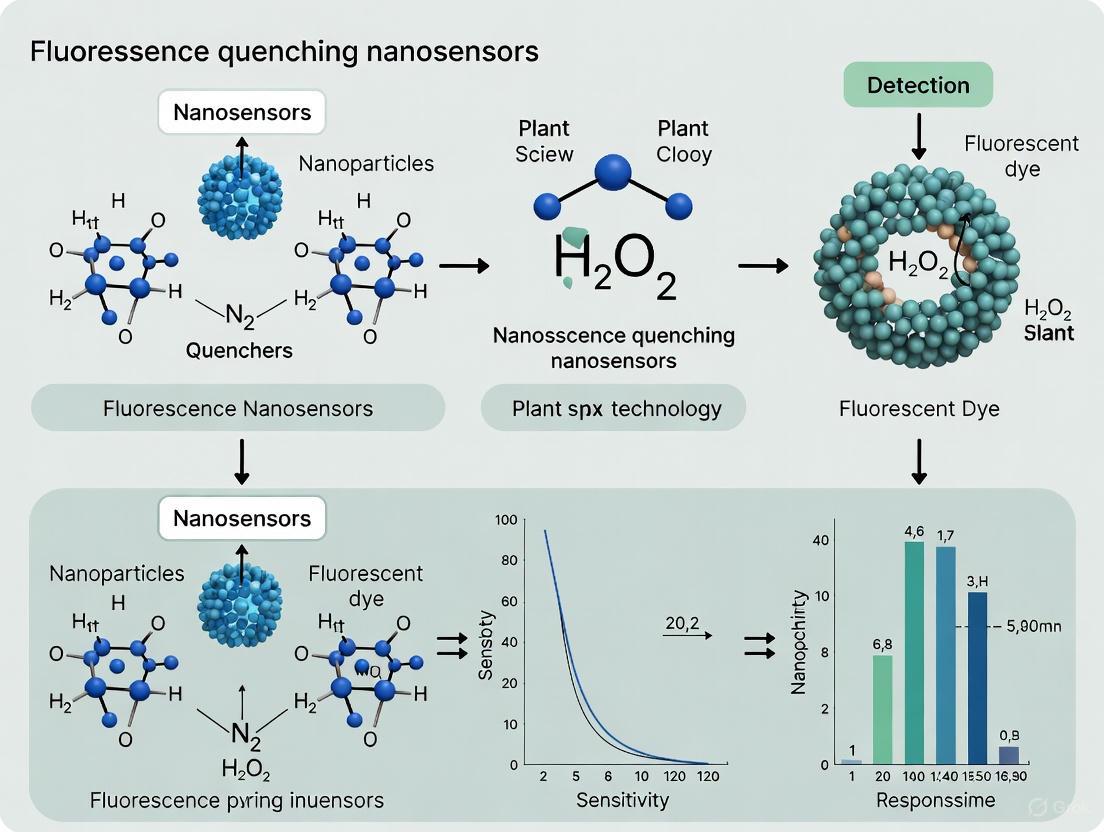
This article comprehensively reviews the development and application of fluorescence quenching nanosensors for detecting hydrogen peroxide (H2O2) in plants.
Fluorescence Quenching Nanosensors for Real-Time H2O2 Detection in Plants: Mechanisms, Applications, and Future Directions
Abstract
This article comprehensively reviews the development and application of fluorescence quenching nanosensors for detecting hydrogen peroxide (H2O2) in plants. H2O2 is a crucial reactive oxygen species (ROS) acting as a key signaling molecule in plant stress responses, defense mechanisms, and physiological processes. We explore the foundational principles of fluorescence quenching mechanisms, including electron transfer and FRET, utilized in nanosensors composed of materials like carbon nanotubes, carbon dots, nanoceria, and doped graphitic carbon nitride. The scope covers methodological advances for real-time, in planta monitoring of H2O2 signaling waves induced by biotic and abiotic stresses, discusses critical troubleshooting for sensor stability and biocorona formation in the complex plant environment, and provides a comparative analysis of sensor performance and validation. This resource is tailored for researchers and scientists in plant nanobionics, stress biology, and agricultural technology, aiming to bridge the gap between novel sensor design and practical field application for precision agriculture and improved crop management.
Understanding H2O2 Signaling and Fluorescence Quenching Fundamentals in Plant Systems
The Role of H2O2 as a Central Signaling Molecule in Plant Stress and Immunity
Hydrogen peroxide (H₂O₂) is a crucial reactive oxygen species (ROS) that functions as a central signaling molecule in plants, coordinating responses to both abiotic and biotic stresses. While historically considered merely a damaging oxidative agent, H₂O₂ is now recognized as a key regulator in plant metabolism and cellular signaling [1]. Its relative stability compared to other ROS and its ability to diffuse across membranes make it an ideal signaling molecule [2]. Under stress conditions, H₂O₂ levels increase significantly, triggering complex signaling networks that activate defense mechanisms and modulate plant immunity [3]. Recent advances in sensing technologies, particularly fluorescence-based nanosensors, have enabled real-time monitoring of H₂O₂ flux, providing unprecedented insights into its dynamic role in plant stress adaptation [4] [5]. This application note explores the signaling mechanisms of H₂O₂ in plant stress and immunity, with a specific focus on advanced detection methodologies.
H₂O₂ Signaling in Plant Stress and Immunity
H₂O₂ is continuously produced in plant cells as a byproduct of aerobic metabolism, primarily across several key organelles:
- Chloroplasts: Generated during photosynthesis through the Mehler reaction and electron transfer in photosystem II [6].
- Peroxisomes: Produced predominantly during photorespiration via the photosynthetic carbon oxidation cycle [1] [6].
- Mitochondria: Formed as a byproduct of the electron transport chain, particularly at complexes I and III, with superoxide dismutase converting superoxide to H₂O₂ [6].
- Apoplast: Generated by cell wall peroxidases, amine oxidases, and NADPH oxidases [6] [2].
Cellular H₂O₂ levels are tightly regulated by both enzymatic and non-enzymatic scavenging systems. Key enzymatic scavengers include catalase (CAT), ascorbate peroxidase (APX), glutathione peroxidase (GPX), and peroxiredoxins (Prxs) [6] [7]. Non-enzymatic antioxidants such as ascorbate (AsA) and glutathione (GSH) also play crucial roles in maintaining H₂O₂ homeostasis [6].
Signaling Mechanisms in Stress Response
H₂O₂ functions as a core signaling molecule in plant responses to diverse environmental challenges. The specific physiological outcome often depends on its concentration, timing, and subcellular localization [3].
Table 1: H₂O₂-Mediated Plant Responses to Environmental Stresses
| Stress Type | Plant Species | H₂O₂-Mediated Effect | Signaling Mechanism |
|---|---|---|---|
| Heavy Metal (e.g., Cu, Cd) | Rice, Arabidopsis | Induces antioxidant gene expression; improves metal tolerance | MAPK activation; crosstalk with Ca²⁺ and phytohormones [3] |
| Drought/Salinity | Wheat, Maize | Regulates stomatal closure; enhances osmotic adjustment | ABA-dependent and independent pathways; interaction with NO [3] [2] |
| Pathogen Attack | Multiple species | Activates defense gene expression; systemic acquired resistance | PTM of transcription factors (bHLH25, CHE) [8] |
| High Light/UV-B | Arabidopsis | Reduces photosynthetic efficiency; triggers photoprotection | NADPH oxidase activation; redox signaling [4] |
H₂O₂ transmits signals primarily through the reversible oxidation of cysteine thiols (-SH) in target proteins, leading to the formation of sulfenic acid (-SOH), which can subsequently form disulfide bonds or sulfenamides [7]. These post-translational modifications (PTMs) can significantly alter protein function, localization, and stability, thereby influencing downstream signaling events [8].
Role in Plant Immunity
In plant immunity, H₂O₂ acts as a secondary messenger that orchestrates both local and systemic defense responses. Recent research has elucidated that H₂O₂-driven immunity requires post-translational modification as a molecular switch [8]. Specifically, H₂O₂ fine-tunes the PTMs of key transcription factors such as basic helix-loop-helix 25 (bHLH25) and CCA1 HIKING EXPEDITION (CHE), which are integral components of plant immune signaling pathways [8]. This mechanism enhances disease resistance in both infected and distal tissues, providing a systemic protection effect.
The following diagram illustrates the core signaling pathway of H₂O₂ in plant immunity:
Advanced Detection Protocols: Fluorescence Quenching Nanosensors
Monitoring the dynamic changes of H₂O₂ in living plants is essential for understanding its signaling role. Traditional methods are often destructive and lack spatiotemporal resolution. The following protocols detail the use of advanced nanosensors for real-time, non-destructive H₂O₂ monitoring.
Protocol 1: Near-Infrared Fluorescent H₂O₂ Nanosensors
This protocol utilizes single-walled carbon nanotubes (SWCNTs) functionalized for H₂O₂ detection, enabling real-time monitoring of plant stress responses [4].
- Principle: Near-infrared (nIR) fluorescence of SWCNTs is quenched by H₂O₂ with high selectivity against other reactive species. The sensor operates within the plant physiological range (10-100 μM H₂O₂) [4].
- Applications: Remote monitoring of plant health in response to UV-B light, high light intensity, and pathogen-associated molecular patterns (e.g., flg22) [4].
Materials:
- SWCNTs functionalized for H₂O₂ sensing
- Arabidopsis thaliana plants (or other species)
- nIR fluorescence imaging system (>900 nm detection)
- Stress inducers: UV-B lamp, high light source, flg22 peptide solution
Procedure:
- Sensor Application: Apply the SWCNT nanosensor suspension to the leaf surface of living plants. Ensure even coating and allow for stabilization.
- Baseline Imaging: Acquire baseline nIR fluorescence images of sensor-treated leaves before applying stress.
- Stress Induction: Apply the desired stress treatment:
- UV-B Stress: Expose plants to controlled UV-B irradiation.
- High Light Stress: Subject plants to elevated light intensity.
- Biotic Elicitation: Infiltrate leaves with a solution of flg22 peptide.
- Real-Time Monitoring: Continuously monitor nIR fluorescence signals over time (e.g., 0-60 minutes post-stress) using the imaging system.
- Data Analysis: Quantify fluorescence quenching (ΔF) as an indicator of H₂O₂ production. Normalize data to baseline levels.
Protocol 2: Machine Learning-Powered NIR-II Activatable Nanosensor
This advanced protocol employs an activatable NIR-II (1000-1700 nm) fluorescent nanosensor combined with machine learning to not only detect H₂O₂ but also classify the type of stress [5].
- Principle: The nanosensor consists of an aggregation-induced emission (AIE) fluorophore co-assembled with polymetallic oxomolybdates (POMs) as a quencher. Upon interaction with H₂O₂, the POMs' quenching effect diminishes, "turning on" the NIR-II fluorescence [5].
- Advantages: Deeper tissue penetration, minimal background autofluorescence, high sensitivity (0.43 μM), and rapid response time (~1 minute) [5].
Materials:
- AIE1035NPs@Mo/Cu-POM nanosensor
- Target plants (e.g., Arabidopsis, lettuce, spinach, pepper, tobacco)
- NIR-II microscopy or whole-plant imaging system
- Various stress inducers (pathogen, drought, cold, chemical)
- Computing setup with machine learning algorithms for data classification
Procedure:
- Sensor Synthesis: Prepare the AIE1035NPs@Mo/Cu-POM nanosensor as described in the literature [5]. Characterize the nanosensor using TEM, XPS, and zeta potential measurements.
- Plant Infiltration/Treatment: Introduce the nanosensor into plant leaves via infiltration or external application.
- Stress Application & Imaging: Subject plants to various stress conditions. Perform time-lapse NIR-II fluorescence imaging post-stress onset.
- Signal Acquisition: Record the activation kinetics ("turn-on" fluorescence) of the nanosensor in different plant tissues and under different stresses.
- Machine Learning Analysis: Feed the fluorescence response profiles (kinetics, intensity, spatial distribution) into a pre-trained machine learning model (e.g., a convolutional neural network) to accurately classify the stress type with high accuracy (>96.67%) [5].
Protocol 3: Non-Enzymatic Fluorescence Quenching Detection
This solution-based protocol uses rhodamine B and tungsten-doped graphitic carbon nitride (W/GCN) for highly sensitive, non-enzymatic detection of H₂O₂, suitable for in vitro applications and sensor development [9].
- Principle: W/GCN nanoflakes catalyze the H₂O₂-mediated oxidation of the fluorescent dye rhodamine B, leading to fluorescence quenching. The degree of quenching is proportional to H₂O₂ concentration [9].
- Performance: Offers an exceptionally low limit of detection (8 nM) and a linear range from 10–500 nM [9].
Materials:
- W/GCN nanoflakes catalyst
- Rhodamine B (RhB) solution
- Hydrogen peroxide standards
- Phosphate buffer saline (PBS)
- Fluorescence spectrophotometer
Procedure:
- Catalyst Preparation: Synthesize W/GCN nanoflakes via a calcination method [9]. Prepare a stock suspension (2 mg mL⁻¹) in PBS.
- Reaction Mixture: Combine 83.5 μL of catalyst suspension with 2915 μL of RhB solution (67 ng mL⁻¹) in a cuvette. Sonicate and incubate for 30 minutes to establish adsorption-desorption equilibrium.
- Baseline Measurement: Record the initial fluorescence emission intensity (F₀) at 577 nm with excitation at 554 nm.
- H₂O₂ Addition: Add 1.5 μL of 1 mM H₂O₂ (or sample) to the reaction mixture. Incubate for 15 minutes.
- Final Measurement: Record the final fluorescence intensity (F₅₇₇).
- Quantification: Calculate the change in fluorescence (ΔF₅₇₇ = F₀ - F₅₇₇) and determine the H₂O₂ concentration using a pre-established calibration curve.
The Scientist's Toolkit: Key Research Reagents
Table 2: Essential Reagents for H₂O₂ Signaling Research and Detection
| Reagent / Material | Function / Role | Application Example |
|---|---|---|
| Functionalized SWCNTs | NIR fluorescent nanosensor for H₂O₂ | Real-time, non-destructive monitoring of H₂O₂ in living plants [4] |
| AIE1035NPs@Mo/Cu-POM | Activatable NIR-II nanosensor | High-contrast in vivo imaging and stress classification via machine learning [5] |
| Tungsten-doped GCN (W/GCN) | Nanozyme catalyst for H₂O₂ detection | Highly sensitive, non-enzymatic fluorescence quenching assay for H₂O₂ [9] |
| Rhodamine B | Fluorescent substrate/probe | Dye whose fluorescence is quenched by H₂O₂ in the presence of a W/GCN catalyst [9] |
| flg22 Peptide | Pathogen-associated molecular pattern (PAMP) | Biotic stress inducer to trigger H₂O₂ production and immune signaling [4] |
| Catalase (CAT) | H₂O₂-scavenging enzyme | Negative control to validate H₂O₂-dependent signals by decomposing H₂O₂ [6] |
H₂O₂ is a central hub in the complex signaling networks that govern plant stress adaptation and immunity. Its signaling functions are mediated through specific molecular mechanisms, including the oxidative post-translational modification of key proteins and transcription factors. The development of sophisticated fluorescence quenching nanosensors, particularly those operating in the NIR-II window and enhanced by machine learning, has revolutionized our ability to monitor H₂O₂ dynamics in real-time and with high spatial precision within living plants. These tools and protocols provide researchers with powerful means to decipher the intricate roles of H₂O₂, ultimately contributing to the development of strategies for improving crop resilience and productivity.
Fluorescence-based sensing provides a powerful tool for detecting specific analytes, such as hydrogen peroxide (H₂O₂), with high sensitivity and selectivity. These sensors are particularly valuable in plant science research for monitoring early stress responses, as H₂O₂ serves as a key distress signal activated by pests, drought, extreme temperatures, and infections [10] [11]. Understanding the fundamental mechanisms of fluorescence quenching and turn-on responses is essential for developing effective nanosensors. This document details the core principles, experimental protocols, and applications of these mechanisms within the context of a broader thesis on fluorescence quenching nanosensors for H₂O₂ detection in plants.
Core Sensing Mechanisms
The operation of fluorescence sensors primarily involves strategies that modulate the emission intensity of a fluorophore upon interaction with a target analyte. The mechanisms can be broadly categorized as follows.
Fluorescence Quenching ("Turn-Off")
Fluorescence quenching describes the reduction in fluorescence intensity of a fluorophore. This process facilitates non-radiative pathways for the transition from the excited state to the ground state [12]. The decrease in fluorescence emission intensity is quantitatively described by the Stern–Volmer equation [12] [13]:
$$ \frac{I}{I0} = 1 + K{sv}[Q] $$
Where:
- ( I ) is the fluorescence intensity in the presence of the quencher.
- ( I_0 ) is the initial fluorescence intensity.
- ( K_{sv} ) is the Stern–Volmer quenching constant.
- ( [Q] ) is the concentration of the quencher.
Quenching occurs through two primary mechanisms:
- Static Quenching: The quencher and fluorophore form a non-fluorescent complex in the ground state, preventing the fluorophore from absorbing light [12].
- Dynamic Quenching: This occurs through collisions between the excited-state fluorophore and the quencher, leading to the non-radiative return of the fluorophore to the ground state. This process is diffusion-driven and influenced by temperature and solvent viscosity [12].
Fluorescence Activation ("Turn-On")
"Turn-on" sensors are often preferred over "turn-off" sensors because the increase in luminescence against a dark background is easier to detect and less prone to interference or false positives [12]. Fluorescence enhancement can occur through several mechanisms [12]:
- Aggregation-Induced Emission Enhancement (AIEE): Restricts molecular rotation to reduce non-radiative decay.
- Crosslink-Enhanced Emission (CEE): Stabilizes the fluorophore to minimize vibrational relaxation.
- Chelation-Enhanced Fluorescence (CHEF): A common strategy for designing effective turn-on probes.
- Photoinduced Electron Transfer (PET) and Intramolecular Charge Transfer (ICT): Alter the electronic distribution within the fluorophore to enhance fluorescence.
Fluorescence Resonance Energy Transfer (FRET)
FRET is a powerful technique that relies on non-radiative energy transfer between two fluorescent chromophores—a donor and an acceptor—when they are in close proximity [12]. The efficiency of this energy transfer is highly sensitive to the distance between the donor and acceptor, making FRET a valuable mechanism for monitoring molecular interactions and conformational changes in biosensors.
The following diagram illustrates the logical relationships and workflows between these core sensing mechanisms.
Advanced Sensor Design Strategies
Building upon the core mechanisms, researchers have developed sophisticated design strategies to enhance sensor performance, particularly for complex applications like plant H₂O₂ detection.
Ratiometric Fluorescence Sensors provide internal calibration by measuring the ratio of fluorescence intensities at two different wavelengths, which reduces interference and improves accuracy [12]. Nanostructure-Based Sensors utilize nanomaterials like quantum dots (QDs), single-walled carbon nanotubes (SWNTs), and metal-organic frameworks (MOFs) to enhance signal amplification, sensitivity, and photostability [12] [11]. Furthermore, Multiplexed Sensing enables the simultaneous monitoring of multiple analytes. For instance, researchers have successfully multiplexed H₂O₂ and salicylic acid (SA) nanosensors within the same plant leaf to decode early stress signaling waves, revealing distinct temporal patterns for different stress types [11].
Experimental Protocols
Protocol: Validation of Quenching Efficiency using the Stern-Volmer Equation
This protocol is adapted from methods used to assess the reliability of fluorescence-based water quality monitoring [13] and is applicable for characterizing H₂O₂ sensors.
1. Objective: To determine the Stern-Volmer quenching constant ((K_{sv})) and the mechanism of quenching for a fluorophore-H₂O₂ interaction.
2. Materials and Reagents:
- Fluorophore or nanosensor solution (e.g., single-stranded (GT)₁₅ DNA oligomer-wrapped SWNTs [11])
- Hydrogen peroxide (H₂O₂) solution (analyte/quencher), prepared at a known stock concentration
- Suitable buffer (e.g., phosphate buffer saline, pH 7.4)
- Spectrofluorometer
- Cuvettes
- Micropipettes and tips
3. Procedure: a. Prepare a fixed concentration of the fluorophore/sensor solution in the buffer. b. In a series of cuvettes, add the same volume of the sensor solution. c. Titrate by adding increasing volumes of the H₂O₂ stock solution to the cuvettes. Prepare one cuvette without H₂O₂ as the control ((I_0)). d. After each addition, mix the solution thoroughly and allow it to incubate for a consistent time (e.g., 2 minutes). e. Measure the fluorescence intensity ((I)) for each H₂O₂ concentration at the predetermined excitation and emission wavelengths.
4. Data Analysis: a. For each H₂O₂ concentration ([Q]), calculate the ratio (I0/I). b. Plot (I0/I) versus ([Q]). c. Perform a linear regression analysis on the data. The slope of the linear fit is the Stern-Volmer constant, (K_{sv}) [12] [13].
Protocol: In Planta Detection of H₂O₂ using a Wearable Microneedle Patch
This protocol summarizes the innovative method developed for real-time H₂O₂ monitoring in live plants [10] [14].
1. Objective: To detect stress-induced H₂O₂ directly on live plant leaves using an electrochemical sensor patch.
2. Materials and Reagents:
- Microneedle sensor patches (fabricated from a flexible base with microscopic plastic needles coated with a chitosan-based hydrogel mixture containing an enzyme and reduced graphene oxide [10])
- Healthy and stressed (e.g., bacteria-infected) plants (e.g., soybean, tobacco)
- Potentiostat for electrical current measurement
3. Procedure: a. Gently attach the wearable patch to the underside of a plant leaf, ensuring the microneedles make contact with the leaf tissue. b. Connect the patch to the measurement device. c. Monitor the electrical current in real-time. The enzyme in the hydrogel reacts with H₂O₂, producing electrons. The reduced graphene oxide conducts these electrons, generating a measurable current proportional to H₂O₂ concentration [10] [14]. d. Compare current readings from healthy plants versus stressed plants. Stressed leaves will show significantly higher current levels [10].
4. Data Analysis: a. The magnitude of the electrical current is directly related to the amount of H₂O₂ present [10]. b. Measurements are obtained rapidly, typically within one minute [14].
Table 1: Key Performance Metrics of Featured H₂O₂ Sensing Technologies
| Sensor Technology | Detection Mechanism | Sample Type | Detection Time | Key Performance Metric | Reference |
|---|---|---|---|---|---|
| Wearable Microneedle Patch | Electrochemical (Turn-On) | Live soybean/tobacco plants | ~1 minute | Reusable up to 9 times; measures H₂O₂ at low levels | [10] [14] |
| SWNT-based Nanosensor | Near-IR Fluorescence (Quenching/Turn-On) | Brassica rapa (Pak choi) plants | Real-time, continuous | Enabled multiplexing with salicylic acid sensor | [11] |
| Small-Molecule Probe | Boronate Oxidation (Turn-On) | Biological systems | Varies (minutes) | Ratiometric and NIR probes available for deep tissue imaging | [15] |
The Scientist's Toolkit: Research Reagent Solutions
Table 2: Essential Materials for Fluorescence-Based H₂O₂ Sensor Development and Application
| Research Reagent / Material | Function and Application in H₂O₂ Sensing |
|---|---|
| Single-Walled Carbon Nanotubes (SWNTs) | Serve as highly photostable near-infrared (nIR) fluorophores. When wrapped with specific polymers or DNA (e.g., (GT)₁₅), they form a corona phase for selective H₂O₂ recognition via CoPhMoRe [11]. |
| Boric Acid / Boronate Esters | Common recognition moieties in small-molecule probes. H₂O₂ selectively oxidizes boronate, leading to a fluorescent turn-on response, enabling detection in biological systems [15]. |
| Cationic Fluorene-based Polymers (e.g., S3) | Used as wrappings for SWNTs to create selective nanosensors. The polymer structure can be tuned for electrostatic interactions with specific anionic plant hormones or for H₂O₂ detection [11]. |
| Chitosan-based Hydrogel | A biocompatible matrix used in wearable patches. It can be embedded with enzymes (e.g., horseradish peroxidase) and conductive materials (e.g., reduced graphene oxide) to convert H₂O₂ concentration into an electrical signal [10] [14]. |
| Potassium Iodide (KI) | Used as an extrinsic, non-fluorescent quencher in validation studies (e.g., EEM-PARAFAC) to probe compositional heterogeneity of fluorescent compounds and assess prediction reliability [13]. |
The following workflow diagram maps the application of these tools in a typical research pathway for developing and validating a plant nanosensor.
The detection of hydrogen peroxide (H₂O₂) is crucial in plant science as it serves as a key signaling molecule in physiological processes such as stress responses, immune signaling, and cellular proliferation [12] [16]. However, traditional plant phenotyping methods are labour intensive, costly, and time consuming, making non-destructive and real-time analysis using nanosensors an attractive proposition [16]. Fluorescence-based nanosensors, particularly those operating on quenching mechanisms, provide distinct advantages for in planta detection, including minimal invasiveness, high spatiotemporal resolution, and the capability for real-time monitoring of H₂O₂ fluxes within living plant tissues [12] [16].
This application note details the use of four principal classes of nanomaterials—Single-Walled Carbon Nanotubes (SWCNTs), Carbon Dots, Nanozymes, and Metal-Organic Frameworks (MOFs)—for the fluorescence quenching-based detection of H₂O₂, with a specific focus on methodologies applicable to plant research.
Nanomaterial Platforms and Sensing Mechanisms
Single-Walled Carbon Nanotubes (SWCNTs)
Mechanism: SWCNTs functionalized with biopolymers like DNA exhibit stable near-infrared (NIR) photoluminescence. The sensing mechanism involves analyte-induced modulation of the exciton decay pathway. A key study revealed an inverse correlation between the SWCNT's fluorescence quantum yield and its coupling to charge density fluctuations in the hydration shell, as measured by Terahertz (THz) absorption [17]. Analyte binding alters this local hydration environment, thereby changing the fluorescence intensity [17].
Sensor Fabrication and Characteristics
- Functionalization: SWCNTs are colloidally stabilized by adsorbing biopolymers (e.g., (GT)₁₀ ssDNA) or surfactants (e.g., sodium deoxycholate, DOC) [18] [17].
- Formats: Can be embedded within a collagen matrix to form a sensor array or suspended in buffer [18].
- Performance: Enables single-molecule detection of H₂O₂ with nanomolar sensitivity (calibrated from 12.5 to 400 nM) and high spatiotemporal resolution (1 s, 300 nm) [18].
Carbon Dots (C-Dots)
Mechanism: Carbon dots often operate as "turn-off" fluorescent probes via static and dynamic quenching mechanisms. For H₂O₂ detection, a dual-quenching mechanism has been identified. In one system, fluorescence quenching of chicken cartilage-derived C-Dots (cc-CDs) was attributed to the combined effects of Fe³⁺ and hydroxyl radicals (·OH) generated in situ from H₂O₂ via the Fenton reaction (Fe²⁺ + H₂O₂ → Fe³⁺ + ·OH + OH⁻) [19]. The radicals are believed to destroy the emission groups of the CDs.
Sensor Fabrication and Characteristics
- Synthesis: Prepared from precursors like p-phenylenediamine or chicken cartilage via microwave-assisted or solvothermal methods [19] [20].
- Functionalization: Doping with elements like boron (using 4-formylbenzeneboronic acid) creates specific recognition sites for H₂O₂ without the need for further functionalization [20].
- Performance: Boron-doped C-Dots (B-PPD CDs) achieved a limit of detection (LOD) of 0.242 µM and were successfully applied for nucleus-targeted imaging of exogenous and endogenous H₂O₂ in cell lines [20].
Nanozymes
Mechanism: Nanozymes are nanomaterials with enzyme-like catalytic activity. Those with peroxidase-like activity can catalyze the oxidation of a substrate in the presence of H₂O₂, leading to a colorimetric or fluorescent signal change. While not all nanozymes are fluorescent themselves, they can be integrated with fluorophores. For instance, a nanozyme can catalyze a reaction that consumes H₂O₂ and produces a quencher, or it can be part of a system where the catalytic product modulates a fluorescence signal [12].
Sensor Fabrication and Characteristics
- Materials: Include metal oxides and carbon-based materials [12].
- Integration: The development of nanozymes by 2015, alongside MOFs, enabled the creation of advanced fluorescence sensors with superior catalytic properties [12].
Metal-Organic Frameworks (MOFs)
Mechanism: MOFs are crystalline porous materials with tunable structures. They can be designed for H₂O₂ sensing through various mechanisms, including fluorescence quenching/activation, FRET, and electrochemical sensing [12] [21]. Their high surface area and porous structure allow for efficient interaction with H₂O₂ molecules. Some MOFs exhibit intrinsic peroxidase-like activity, functioning as nanozymes [21].
Sensor Fabrication and Characteristics
- Design: Can be conductive, chemically modified, or used in composites and derivatives [21].
- Performance: MOF-based sensors are known for their high selectivity and sensitivity, driven by their tunable pore sizes and abundant functional designs which provide accessible catalytic sites [21].
Table 1: Comparison of Key Nanomaterial Platforms for H₂O₂ Sensing
| Nanomaterial | Primary Sensing Mechanism | Typical LOD | Key Advantages | Considerations for Plant Studies |
|---|---|---|---|---|
| SWCNTs [18] [17] | Modulation of NIR fluorescence via changes in local hydration shell. | 12.5 nM (in buffer) [18] | NIR emission for deep tissue penetration; photostable; single-molecule sensitivity. | Requires functionalization for solubility and selectivity; complex signal interpretation. |
| Carbon Dots [19] [20] | Fluorescence quenching via dual mechanism (e.g., Fe³⁺/·OH). | 0.242 µM [20] | Excellent biocompatibility; facile synthesis; tunable surface chemistry. | Blue-emitting CDs may have high background in plant tissues; red-emitting preferred. |
| Nanozymes [12] | Peroxidase-mimetic catalytic activity leading to signal change. | Varies by material | High catalytic activity; robustness compared to natural enzymes. | Selectivity can be a challenge; requires integration with a readout (e.g., fluorogenic substrate). |
| MOFs [12] [21] | Fluorescence quenching or electrochemical signal change within porous framework. | e.g., 0.017 µM [21] | Ultra-high surface area; highly tunable pore chemistry for selectivity. | Stability in complex biological environments can be a limitation. |
Experimental Protocols
Protocol: Preparation and Use of (GT)₁₀-SWCNT Sensors for H₂O₂
This protocol describes the creation of a DNA-SWCNT complex for selective H₂O₂ sensing, adapted from methods used for detecting H₂O₂ efflux from human cells [18] and studies on hydration coupling [17].
Research Reagent Solutions
| Item/Catalog Number | Function |
|---|---|
| Single-walled carbon nanotubes (SWCNTs) | Fluorescent transducing element |
| (GT)₁₀ single-stranded DNA (ssDNA) | Solubilizes SWCNTs and provides a sensing interface |
| Phosphate Buffered Saline (PBS), pH 7.4 | Physiological buffer for sensor calibration and operation |
| Hydrogen Peroxide (H₂O₂), 30% w/w | Analyte stock for calibration |
| Ultrapure Water (e.g., 18.2 MΩ·cm) | For preparing all aqueous solutions |
Procedure
- Sensor Preparation:
- Suspend SWCNTs (e.g., 0.19 µg/mL final concentration) in a solution of (GT)₁₀ ssDNA in PBS or ultrapure water [18].
- Sonicate the mixture using a tip sonicator (e.g., 3-6 W, 30-60 min) in an ice-water bath to prevent overheating.
- Centrifuge the resulting suspension at high speed (e.g., 16,000 × g, 30 min) to remove large aggregates and bundle debris. Collect the supernatant containing the individualized (GT)₁₀-SWCNTs.
Calibration:
- Deposit the (GT)₁₀-SWCNT suspension on a glass-bottom dish or incorporate it into a collagen matrix to form a sensor array [18].
- Acquire a baseline fluorescence measurement using a NIR fluorescence microscope (excitation: ~658 nm, emission: 900-1300 nm).
- Add serially diluted H₂O₂ solutions (e.g., 12.5 to 400 nM) to the sensor.
- Monitor the fluorescence intensity in real-time. For single-molecule sensing, analyze stepwise fluorescence quenching in individual SWCNTs over time [18].
Data Analysis:
- Plot the total number of fluorescence transitions or the normalized intensity change against H₂O₂ concentration to generate a calibration curve [18].
- For plant experiments, the sensor can be introduced to the extracellular space or apoplast to monitor H₂O₂ fluxes in response to stressors.
Protocol: Synthesis and Application of Boron-Doped Carbon Dots (B-PPD CDs)
This protocol outlines the microwave-assisted synthesis of nucleus-targetable B-PPD CDs for detecting H₂O₂ in cellular systems [20].
Research Reagent Solutions
| Item/Catalog Number | Function |
|---|---|
| p-Phenylenediamine (PPD) | Carbon and nitrogen source for CD formation |
| 4-Formylbenzeneboronic acid | Boron dopant and H₂O₂ recognition element |
| Absolute Ethanol | Solvent for synthesis |
| Rhodamine B (QY=0.31 in EtOH) | Reference standard for quantum yield calculation |
| RAW 264.7 cell line / Plant protoplasts | Model system for exogenous/endogenous H₂O₂ detection |
Procedure
- Synthesis of B-PPD CDs:
- Dissolve p-phenylenediamine (0.25 mM) and 4-formylbenzeneboronic acid (2.7 mg) in 50 mL of ethanol.
- Sonicate the mixture for 15 minutes until a uniform solution is obtained.
- Transfer the solution to a microwave reactor and heat at 140°C for 15 minutes.
- After cooling to room temperature, centrifuge the product at 10,000 rpm for 15 minutes to remove large particles.
- Filter the supernatant through a 0.22 µm syringe filter. The resulting clear, red-emitting solution contains the B-PPD CDs and can be stored at 4°C [20].
Quantum Yield Measurement:
- Measure the absorbance (A) and integrated photoluminescence intensity (I) of diluted solutions of both the B-PPD CDs and the Rhodamine B standard at the same excitation wavelength.
- Calculate the quantum yield (Q) using the formula:
Q = Q_R × (I/I_R × A_R/A × η²/η_R²), where the subscript R denotes the reference and η is the refractive index of the solvent [20].
In Vitro H₂O₂ Detection and Cell Imaging:
- To assess sensing, add different concentrations of H₂O₂ to a solution of B-PPD CDs and record the fluorescence spectrum (excitation: ~520 nm, emission: ~606 nm). The fluorescence will be quenched upon H₂O₂ addition.
- For cell imaging, incubate RAW 264.7 cells or plant protoplasts with B-PPD CDs (e.g., 2-4 hours). After washing, treat with stimulants (e.g., lipopolysaccharides for cells, abiotic stress for plants) to induce endogenous H₂O₂ production.
- Image using a confocal laser scanning microscope. A decrease in red fluorescence intensity indicates the presence of H₂O₂. The LOD can be calculated as 3σ/m, where σ is the standard deviation of the blank and m is the slope of the calibration curve [20].
The Scientist's Toolkit: Essential Research Reagents
Table 2: Key Research Reagent Solutions for H₂O₂ Nanosensor Development
| Reagent Category | Specific Examples | Function in Experimentation |
|---|---|---|
| Nanomaterial Precursors | SWCNTs, p-Phenylenediamine (PPD), Metal salts (e.g., Co, Cu, Fe), Organic ligands (e.g., HHTP, HOB) | Forms the core sensing element of the nanomaterial (SWCNT, CD, MOF). |
| Functionalization Agents | (GT)₁₀ ssDNA, Sodium Deoxycholate (DOC), 4-Formylbenzeneboronic acid | Confers water solubility, biocompatibility, and analyte selectivity to the nanomaterial. |
| Calibration Analytes | Hydrogen Peroxide (H₂O₂), Dopamine, Riboflavin, Glucose/Glucose Oxidase | Used to test sensor performance, generate calibration curves, and determine sensitivity/selectivity. |
| Buffer Systems | Phosphate Buffered Saline (PBS), HEPES | Maintains physiological pH and ionic strength during sensor calibration and application. |
| Cell/Plant Models | RAW 264.7 cell line, Plant protoplasts, HUVEC, A. thaliana | Provides a relevant biological context for validating sensor function in exogenous and endogenous H₂O₂ detection. |
Signaling Pathways and Workflows
Logical Workflow for Nanosensor Development and Application
The following diagram illustrates the standard workflow from sensor design to data interpretation, which is common across the different nanomaterial platforms.
H₂O₂ Sensing Mechanism via Quenching
This diagram visualizes the general "turn-off" fluorescence quenching mechanism employed by many of the nanomaterial sensors described in this note upon detection of H₂O₂.
Hydrogen peroxide (H2O2) represents a crucial signaling molecule in plant physiology, playing a dual role in cellular signaling and stress responses. Monitoring H2O2 dynamics is essential for understanding plant health, stress adaptation, and redox biology. The evolution of fluorescence sensors for H2O2 detection has transformed from simple chemical probes to sophisticated AI-integrated systems, enabling unprecedented spatial and temporal resolution in plant research. This progression has been particularly impactful for investigating oxidative stress events, plant-pathogen interactions, and signaling networks in living plants without destructive sampling. The integration of nanotechnology and advanced computational methods has further empowered researchers with tools capable of real-time, non-invasive monitoring of H2O2 fluxes across different plant tissues and subcellular compartments, providing invaluable insights for both fundamental plant science and agricultural applications.
Historical Development and Key Milestones
The trajectory of H2O2 fluorescence sensors reveals a remarkable journey of technological innovation, characterized by distinct phases of development that have progressively enhanced their sensitivity, specificity, and applicability in plant systems.
Table 1: Historical Evolution of H2O2 Fluorescence Sensors
| Year | Development | Key Characteristics | Impact on Plant Research |
|---|---|---|---|
| 1965 | First chemical fluorescent probe (Homovanillic acid) | Non-fluorescent precursor oxidized to fluorescent product by H2O2 [22] | Enabled initial detection of oxidants but lacked specificity for H2O2 in complex plant extracts. |
| 1995 | First dedicated H2O2 fluorescence sensor | Traditional fluorescence mechanisms [12] | Provided a foundational tool for basic H2O2 monitoring in biological contexts. |
| 2003-2004 | Arylboronate-based fluorescent probes | Pinacol borate esters as specific H2O2 response moieties; >500-fold selectivity over other ROS [22] | Revolutionized selectivity; allowed monitoring in living plant cells with minimal interference. |
| 2005 | Incorporation of nanoparticles | Enhanced sensitivity, accuracy, and stability using nanomaterial properties [12] | Improved signal-to-noise ratio in plant tissues; enabled detection in challenging matrices. |
| 2010 | Genetically encoded sensors (HyPer) in plants | Targeted to cytoplasm and peroxisomes; ratiometric measurement [23] | Enabled subcellular resolution of H2O2 dynamics in model plants like Arabidopsis thaliana. |
| 2012 | Ratiometric fluorescence methods | Internal calibration using ratio of emissions at two wavelengths [12] | Reduced artifacts from probe concentration, instrument variation, and plant autofluorescence. |
| 2015 | Nanozymes and Metal-Organic Frameworks (MOFs) | Superior catalytic properties and structural versatility [12] | Created more robust sensing platforms for continuous monitoring in plant environments. |
| 2020 | Near-infrared (NIR) nanosensors (SWCNTs) | Fluorescence quenching in the NIR range (>900 nm) [4] | Reduced interference from plant autofluorescence; enabled non-invasive monitoring of whole leaves. |
| 2025 | AI-integrated NIR-II sensors with machine learning | NIR-II imaging (1000-1700 nm) with ML classification of stress types [5] | Achieved >96.67% accuracy in distinguishing stress responses across plant species. |
The initial phase of development was marked by the creation of the first chemical fluorescent probe for oxidants in 1965, which utilized homovanillic acid that oxidized to a fluorescent dimer in the presence of H2O2 and peroxidase [22]. However, these early probes suffered from limited specificity and were primarily suitable for in vitro applications. The pivotal breakthrough came in 2003-2004 with the introduction of arylboronate-based probes, which offered remarkable specificity for H2O2 through a unique deprotection mechanism that generated a fluorescent product [22]. This innovation opened new possibilities for monitoring H2O2 in living plant systems with minimal interference from other reactive oxygen species.
The subsequent integration of nanotechnology around 2005 significantly enhanced sensor performance by exploiting the unique physicochemical properties of nanomaterials, such as high surface-to-volume ratio and tunable optical characteristics [12]. This period also witnessed the emergence of genetically encoded sensors, particularly the HyPer sensor, which was first successfully expressed in plant cells in 2010, enabling researchers to monitor H2O2 dynamics in specific subcellular compartments with high precision [23]. The development of ratiometric methods in 2012 addressed critical challenges related to quantitative accuracy by providing internal calibration, which was particularly valuable in plant systems where uniform sensor distribution could not be guaranteed [12].
More recent advancements have focused on overcoming the inherent autofluorescence of plant tissues through near-infrared technologies. The introduction of NIR sensors using single-walled carbon nanotubes in 2020 and the subsequent development of NIR-II systems in 2025 have dramatically improved signal-to-noise ratios, enabling non-invasive monitoring of H2O2 signaling in intact plants [5] [4]. The current state of the art combines these advanced optical technologies with machine learning algorithms, creating integrated systems that not only detect H2O2 but also interpret its complex signaling patterns in the context of plant stress responses [5].
Fundamental Sensing Mechanisms
H2O2 fluorescence sensors operate through diverse photophysical mechanisms that transduce the chemical recognition of H2O2 into measurable fluorescence signals. Understanding these mechanisms is crucial for selecting appropriate sensors for specific plant research applications.
Fluorescence Quenching and Activation
The simplest sensor mechanisms operate through fluorescence quenching ("turn-off") or activation ("turn-on"). Quenching occurs when the presence of H2O2 reduces fluorescence intensity through either static or dynamic mechanisms. Static quenching involves the formation of a non-fluorescent ground-state complex between the fluorophore and quencher, while dynamic quenching occurs through collisions between the excited-state fluorophore and quencher molecules [12]. The Stern-Volmer equation (I₀/I = 1 + Kₛᵥ[Q]) quantitatively describes this relationship, where I₀ and I represent fluorescence intensities in the absence and presence of quencher, respectively, Kₛᵥ is the Stern-Volmer constant, and [Q] is the quencher concentration [12].
In contrast, "turn-on" sensors become more fluorescent upon H2O2 recognition, providing superior detectability against dark backgrounds in plant tissues. Several mechanisms drive fluorescence enhancement, including Photoinduced Electron Transfer (PET), Aggregation-Induced Emission Enhancement (AIEE), and Chelation-Enhanced Fluorescence (CHEF) [12]. In PET-based sensors, H2O2 reaction disrupts electron transfer processes that normally quench fluorescence, resulting in signal enhancement. AIEE-based sensors exploit restricted molecular rotation upon aggregation to reduce non-radiative decay pathways, while CHEF utilizes coordination chemistry to rigidify fluorophore structures and enhance emission [12].
Energy Transfer Mechanisms
Förster Resonance Energy Transfer (FRET) represents a more sophisticated sensing strategy that involves non-radiative energy transfer between two fluorophores—a donor and an acceptor—when they are in close proximity (typically 1-10 nm). FRET efficiency depends strongly on the distance between the fluorophores, making this mechanism particularly useful for monitoring conformational changes induced by H2O2 binding [12]. In practice, H2O2 recognition alters the distance or orientation between donor and acceptor fluorophores, changing FRET efficiency and producing a measurable shift in emission ratios. This mechanism provides built-in internal calibration that minimizes artifacts from sensor concentration variations, a significant advantage in plant research where uniform tissue penetration can be challenging.
Ratiometric Sensing
Ratiometric sensors represent a significant advancement for quantitative plant imaging by measuring fluorescence at two different wavelengths and calculating their ratio. This approach self-corrects for variables such as sensor concentration, excitation intensity, and detection efficiency, providing more reliable quantification of H2O2 levels in complex plant environments [12]. Genetically encoded ratiometric sensors like HyPer exploit changes in excitation or emission spectra upon H2O2 binding. HyPer, for instance, exhibits H2O2-dependent changes in excitation peaks at 420 nm and 500 nm with an isosbestic point at 450 nm, enabling precise ratiometric measurements that are insensitive to expression level variations [23].
Nanostructured Fluorescence Sensors
The integration of nanotechnology has dramatically advanced H2O2 sensing capabilities, particularly for plant applications where background interference, tissue penetration, and spatial resolution present significant challenges.
Table 2: Nanomaterials for H2O2 Fluorescence Sensing in Plant Research
| Nanomaterial | Mechanism | Key Advantages | Example Applications in Plants |
|---|---|---|---|
| Quantum Dots (QDs) | Electron transfer; fluorescence quenching | High brightness; photostability; size-tunable emission | Intracellular sensing; long-term tracking of H2O2 fluxes |
| Single-Walled Carbon Nanotubes (SWCNTs) | Fluorescence quenching in NIR region | Minimal plant autofluorescence interference; high biocompatibility | Non-invasive leaf monitoring; stress response detection [4] |
| Metal-Organic Frameworks (MOFs) | Encapsulation of fluorophores; catalytic activity | High porosity; tunable structures; enhanced selectivity | Vaporized H2O2 detection; environmental monitoring |
| Polymetallic Oxomolybdates (POMs) | NIR absorption modulation; oxygen vacancies | H2O2-specific oxidation; "turn-on" NIR-II response | Real-time stress signaling monitoring; multiple plant species [5] |
| Nanozymes | Intrinsic peroxidase-like activity | Catalytic amplification; enhanced sensitivity | Signal amplification in low H2O2 concentrations |
| AIE Nanoparticles (AIENPs) | Aggregation-induced emission | High stability; reduced photobleaching | Co-assembly with quenchers for activatable sensing [5] |
Nanostructured sensors leverage unique properties including high surface-to-volume ratios, tunable optical characteristics, and enhanced permeability in plant tissues. Quantum dots provide exceptional brightness and photostability but must be carefully engineered for plant biocompatibility. Single-walled carbon nanotubes functionalized with specific recognition elements have enabled breakthrough applications in non-invasive plant monitoring, demonstrating minimal impact on photosynthesis and cell viability while detecting H2O2 fluctuations in response to UV-B light, high light intensity, and pathogen-associated peptides [4].
Recent work with polymetallic oxomolybdates (POMs) co-assembled with NIR-II fluorophores represents a particularly promising direction. These nanosensors exploit the oxygen vacancies in POMs that confer unique H2O2-responsive properties through redox reactions that modulate NIR absorption [5]. When Mo/Cu-POMs specifically react with H2O2, the oxidation of Mo⁵⁺ to Mo⁶⁺ decreases intervalence charge transfer, reducing NIR absorption and resulting in recovery ("turn-on") of the NIR-II fluorescence signal [5]. This mechanism provides exceptional sensitivity (0.43 μM) and rapid response times (1 minute) suitable for monitoring early stress signaling in plants.
The development of hyperbranched pyrenyl-fluorene copolymers integrated with ZnO nanorod arrays has further expanded capabilities for detecting vaporized H2O2, with applications in environmental monitoring and security [24]. These materials demonstrate how nanoscale engineering can create sensors responsive to different physical forms of H2O2, significantly broadening the applicability of fluorescence sensing in agricultural and industrial contexts.
Genetically Encoded Sensors for Plant Research
Genetically encoded sensors represent a transformative technology for plant science, enabling non-invasive monitoring of H2O2 dynamics with subcellular resolution in living plants.
Sensor Designs and Mechanisms
The primary genetically encoded sensors for H2O2 include roGFP-based and HyPer-based systems, each with distinct mechanisms and applications. roGFP2-Orp1 functions as a specific H2O2 sensor by exploiting the yeast Orp1 peroxidase, which acts as a H2O2-dependent thiol oxidase that oxidizes the coupled roGFP2 [25]. This oxidation induces a disulfide bond formation in roGFP2 that alters its excitation spectrum, increasing the 405 nm peak while decreasing the 488 nm peak. The ratio of emissions following excitation at these wavelengths provides a quantitative measure of H2O2 levels, normalized for expression differences [25].
In contrast, the HyPer sensor directly couples a circularly permuted fluorescent protein to the bacterial H2O2-sensing protein OxyR. H2O2 binding induces conformational changes in OxyR that alter the fluorescent protein's environment, shifting its excitation spectrum [23]. HyPer exhibits two excitation peaks at 420 nm and 500 nm with an isosbestic point at 450 nm, enabling ratiometric measurements that are insensitive to sensor concentration or expression levels [23].
Recent engineering efforts have focused on improving the sensitivity and kinetics of OxyR-based sensors. The next-generation oROS sensor addresses limitations of earlier designs through structural optimization, inserting the circularly permuted GFP between residues 211-212 of OxyR rather than in the flexible loop between C199 and C208 [26]. This design preserves the natural conformational flexibility of OxyR, resulting in significantly faster response times (1.06 seconds for 25-75% saturation) and enhanced sensitivity (2-fold greater response amplitude compared to HyPerRed) [26].
Protocol: Non-invasive In Planta Imaging of H2O2 Using roGFP2-Orp1
Principle: This protocol describes whole-plant fluorescence imaging of H2O2 dynamics in Arabidopsis thaliana expressing the genetically encoded sensor roGFP2-Orp1, enabling non-destructive monitoring of stress responses [25].
Materials:
- Transgenic Arabidopsis seeds expressing cytosolic or compartment-targeted roGFP2-Orp1
- Plant growth chambers with controlled environment
- Stereo fluorescence microscope with dual-bandpass filter sets (e.g., 405/488 nm excitation, 510/20 nm emission)
- Image analysis software (e.g., ImageJ with ratio analysis tools)
- Treatment solutions: 1 M H2O2 stock, 1 M dithiothreitol (DTT) stock
Procedure:
Plant Growth and Preparation:
- Grow transgenic Arabidopsis plants expressing roGFP2-Orp1 under controlled conditions (22°C, 60% humidity, 16/8h light/dark cycle) for 3-4 weeks.
- For hydroponic culture, use Araponics seed-holders with 0.5× Murashige and Skoog medium, pH 5.8.
Microscope Setup:
- Configure stereo fluorescence microscope with appropriate filter sets: 405/20 nm and 488/20 nm excitation filters, 510/20 nm emission filter, and dichroic mirror suitable for both excitation wavelengths.
- Set up camera with consistent exposure settings across all experiments.
- Position plant without physical manipulation to avoid stress-induced H2O2 production.
Image Acquisition:
- Acquire reference images of untreated plants at both excitation wavelengths (405 nm and 488 nm) with identical emission settings.
- Apply treatments by adding H2O2 (final concentration 1-10 mM) or stressors (e.g., NaCl for salt stress) to growth medium.
- Capture time-series images at both excitation wavelengths at regular intervals (e.g., every 5-30 minutes).
- Include controls treated with DTT (1-10 mM) to fully reduce the sensor and establish dynamic range.
Data Processing and Ratio Calculation:
- Export images and calculate pixel-by-pixel ratio of emission from 405 nm excitation to emission from 488 nm excitation (405/488 ratio).
- Normalize ratios using the formula: Normalized Ratio = (R - Rmin)/(Rmax - Rmin), where R is the measured ratio, Rmin is the ratio under fully reduced conditions (DTT treatment), and R_max is the ratio under fully oxidized conditions (H2O2 treatment).
- Generate false-color ratio images to visualize spatial distribution of H2O2 dynamics.
Interpretation and Validation:
- Correlate ratio changes with applied treatments and physiological responses.
- Validate measurements using control experiments with chemical modulators of H2O2 metabolism.
- Consider that roGFP2-Orp1 oxidation state reflects the balance between H2O2 production and reduction by cellular antioxidant systems.
Applications: This protocol enables non-invasive monitoring of H2O2 dynamics during stress responses, plant-pathogen interactions, and developmental processes in intact, living plants with cellular resolution [25].
Advanced Applications and AI Integration
The most recent advancements in H2O2 fluorescence sensing combine cutting-edge optical technologies with computational approaches, creating integrated systems that not only detect but also interpret complex signaling patterns in plants.
NIR-II Fluorescence Imaging with Machine Learning
A groundbreaking approach recently demonstrated involves NIR-II fluorescent nanosensors combined with machine learning for monitoring plant stress responses. This system utilizes an aggregation-induced emission (AIE) fluorophore as the NIR-II signal reporter co-assembled with polymetallic oxomolybdates (POMs) as fluorescence quenchers [5]. Under stress conditions, H2O2-selective POMs undergo oxidation, diminishing their quenching effect and activating a bright NIR-II fluorescence signal from the AIE fluorophore through a "turn-on" mechanism [5].
Protocol: NIR-II Nanosensor Preparation and Plant Stress Classification
Nanosensor Synthesis:
- Prepare NIR-II AIE dye (AIE1035) with donor-acceptor-donor molecular structure using benzo[1,2-c:4,5-c']bis[1,2,5]thiadiazole (BBTD) as acceptor and trimethylamine (TPA) as donor.
- Encapsulate AIE dye into polystyrene nanospheres using organic solvent swelling method.
- Synthesize Mo/Cu-POM quenchers with oxygen vacancies to create mixed-valence states (Mo⁵⁺/Mo⁶⁺).
- Co-assemble AIE1035 nanoparticles with Mo/Cu-POM at optimized mass ratios (0-100) to create hybrid nanosensors with controlled fluorescence quenching.
- Characterize nanosensors using TEM, XPS, and zeta potential measurements to confirm uniform assembly [5].
Plant Imaging and Stress Classification:
- Infiltrate nanosensors into leaves of various plant species (Arabidopsis, lettuce, spinach, pepper, tobacco).
- Apply distinct stress treatments: abiotic (heat, cold, drought, salinity) and biotic (pathogen infection).
- Acquire NIR-II fluorescence images using microscopy system optimized for 1000-1700 nm range.
- Record fluorescence intensity changes over time with 1-minute temporal resolution.
- Extract features from fluorescence kinetics including response amplitude, timing, and spatial patterns.
- Train machine learning model (e.g., random forest or convolutional neural network) on extracted features.
- Validate model performance using cross-validation, achieving >96.67% accuracy in stress classification [5].
This integrated sensing-classification system demonstrates how H2O2 monitoring has evolved from simple detection to comprehensive stress response profiling, enabling precise discrimination between stress types before visible symptoms appear.
The Scientist's Toolkit: Essential Research Reagents
Table 3: Key Research Reagents for H2O2 Fluorescence Sensing in Plants
| Reagent/Category | Specific Examples | Function and Application | Considerations for Plant Research |
|---|---|---|---|
| Genetically Encoded Sensors | roGFP2-Orp1; Grx1-roGFP2; HyPer; oROS | Targeted subcellular H2O2 monitoring; stable expression in transgenic plants | Requires genetic transformation; compartment-specific targeting available |
| Nanosensors | SWCNT-based; AIE1035@Mo/Cu-POM; QD-based | Non-invasive monitoring; species-independent application; NIR-II imaging | Biocompatibility testing essential; variable uptake across species |
| Chemical Probes | Arylboronate-based (e.g., Peroxyfluor-1) | Acute measurements; no genetic modification required | Potential cytotoxicity at high concentrations; limited subcellular targeting |
| Reference Standards | Dithiothreitol (DTT); H2O2 solutions | Sensor calibration; establishing dynamic range | Concentration optimization required for different plant tissues |
| Microscopy Systems | Confocal; stereo fluorescence; NIR-II imaging systems | Spatial resolution; deep tissue imaging; whole-plant monitoring | NIR-II systems reduce autofluorescence in chlorophyll-rich tissues |
| Machine Learning Tools | Random forest classifiers; CNN models | Automated stress classification; pattern recognition in complex data | Requires substantial training datasets from multiple experiments |
Signaling Pathways and Experimental Workflows
Understanding H2O2 signaling networks and establishing robust experimental workflows are essential for effective application of fluorescence sensors in plant research.
The diagram illustrates the central position of H2O2 in plant stress signaling networks and the points of interception by fluorescence sensors. Stress stimuli activate NADPH oxidases (RBOHs) that generate superoxide, which is rapidly converted to H2O2. This H2O2 functions as a signaling molecule that activates downstream responses, including calcium signaling and gene expression changes. Notably, calcium and H2O2 engage in reciprocal regulation, creating complex feedback loops that fine-tune plant stress responses [23]. Fluorescence sensors intercept this signaling cascade by directly reporting H2O2 concentrations, enabling researchers to quantify dynamics with high spatiotemporal resolution.
The integration of calcium and H2O2 signaling is particularly evident in peroxisomes, where research with targeted sensors has demonstrated that increases in cytosolic Ca²⁺ are followed by Ca²⁺ rises in the peroxisomal lumen, stimulating catalase activity and enhancing H2O₂ scavenging efficiency [23]. This feedback mechanism highlights the sophisticated regulation of H2O₂ levels in plant cells and the importance of compartment-specific monitoring.
Future Perspectives and Concluding Remarks
The evolution of H2O2 fluorescence sensors has transformed plant redox biology from descriptive observations to quantitative, dynamic analysis. Current research directions focus on several key areas: further expansion into the NIR spectrum to improve tissue penetration and reduce background; development of multi-analyte sensors that simultaneously monitor H2O2 alongside related signaling molecules (Ca²⁺, pH, other ROS); and miniaturization for field-deployable agricultural monitoring systems [12] [24].
The integration of artificial intelligence and machine learning represents perhaps the most transformative trend, enabling not just detection but intelligent interpretation of H2O2 signaling patterns in the context of plant physiology, pathology, and environmental adaptation [5]. As these technologies mature, they promise to bridge the gap between laboratory research and agricultural practice, providing real-time diagnostics of plant health and stress responses in field conditions.
The continued refinement of genetically encoded sensors will further enhance our ability to monitor H2O2 dynamics with subcellular resolution in specific cell types, revealing the microenvironments where H2O2 signaling originates and propagates. Combined with advances in imaging technologies and computational analysis, these tools will undoubtedly yield new insights into the complex roles of H2O2 in plant growth, defense, and adaptation, ultimately supporting efforts to develop more resilient and productive crops in a changing global environment.
Designing and Applying Nanosensors for Real-Time, In Planta H2O2 Monitoring
Corona Phase Molecular Recognition (CoPhMoRe) is a powerful synthetic method for creating molecular recognition elements by templating a heteropolymer onto the surface of a nanoparticle. This process forms a unique corona phase—a structured polymer layer—capable of selectively binding target analytes based on the three-dimensional conformation and chemical properties adopted upon adsorption [27] [28]. When applied to optical nanosensors, particularly those based on near-infrared (nIR) fluorescent single-walled carbon nanotubes (SWCNTs), CoPhMoRe enables the development of highly selective, non-destructive, and real-time sensors for detecting key signaling molecules in living plants [29] [30].
The application of CoPhMoRe is transformative for plant science research, addressing the urgent need to understand plant stress signaling pathways in the context of climate change. It facilitates the creation of species-agnostic nanosensors that do not require genetic modification of the plant, allowing for direct, real-time tracking of plant hormones and stress signaling molecules, such as hydrogen peroxide (H₂O₂), auxin (IAA), and salicylic acid (SA) [29] [30]. This capability provides unprecedented insights into the spatiotemporal dynamics of plant stress responses, aiding the development of climate-resilient crops and pre-symptomatic stress diagnosis [29].
Fundamental Principles of CoPhMoRe
The CoPhMoRe technique leverages the unique interface formed when a synthetic polymer or biopolymer adsorbs non-covalently onto a nanomaterial surface. For SWCNT-based optical sensors, this corona phase acts as a synthetic binding pocket. The underlying mechanism involves the modulation of the SWCNT's fluorescence (either intensity or wavelength shift) when the corona phase selectively binds its target analyte, transducing a molecular binding event into a quantifiable optical signal [27] [28].
The selectivity of the sensor is conferred by the unique configuration of the polymer, which is pinned and constrained by molecular interactions with the nanoparticle surface. The heteropolymers used are typically amphiphilic, featuring hydrophobic segments that adsorb onto the hydrophobic SWCNT surface and hydrophilic segments that extend into the aqueous environment to form the recognition interface [28]. This process mimics biological recognition mechanisms, such as antibody-antigen interactions, but with the advantages of synthetic stability and design flexibility [27] [28].
Table 1: Core Components of a CoPhMoRe Nanosensor
| Component | Role and Function | Common Examples |
|---|---|---|
| Nanoparticle Transducer | Converts molecular binding events into a detectable optical signal; SWCNTs are ideal for their photostable nIR fluorescence. | Single-walled carbon nanotubes (SWCNTs) [29] [27] |
| Corona Phase (Polymer) | Forms a structured, selective molecular recognition element when adsorbed onto the nanoparticle. | Single-stranded DNA (ssDNA), synthetic polymers (e.g., phospholipid-PEG), cationic fluorene-based copolymers [29] [31] |
| Target Analyte | The specific molecule the nanosensor is designed to detect. | H₂O₂, salicylic acid (SA), indole-3-acetic acid (IAA) [29] [30] |
CoPhMoRe Sensor Design and Development Workflow
The development of a selective CoPhMoRe nanosensor follows a systematic workflow from library construction to validation. The diagram below outlines this multi-stage process.
Library Construction and High-Throughput Screening
The first step involves constructing a diverse library of polymer-wrapped SWCNTs. Polymers are selected for their ability to suspend SWCNTs in aqueous solution and to create a variety of potential corona phases. This includes libraries of single-stranded DNA (ssDNA) with varying sequences and lengths [31], or synthetic polymers like cationic fluorene-based copolymers [29] and phospholipid-PEG conjugates [28].
This library is then screened against the target analyte and a panel of potential interferents. Screening is performed using high-throughput photoluminescence excitation (PLE) spectroscopy, where changes in the nIR fluorescence intensity of the SWCNTs are measured upon analyte addition. A "hit" is identified when a specific polymer-SWCNT conjugate shows a strong and selective fluorescence modulation (e.g., quenching or enhancement) for the target analyte but not for others [29] [31]. For instance, in developing an SA sensor, a screen of four cationic polymers revealed that the S3 polymer-wrapped SWCNT provided a selective 35% quenching response to 100 µM SA [29].
Validation and Deployment
The identified "hit" sensor must undergo rigorous validation. This includes determining its sensitivity (limit of detection, dynamic range), selectivity against a broader panel of structurally similar molecules, and kinetic response profile [29] [32]. Finally, the validated sensor is deployed in more complex environments. A key application is multiplexing, where multiple sensors with distinct optical signatures are used simultaneously in the same plant to monitor several analytes. For example, an H₂O₂ nanosensor multiplexed with an SA nanosensor revealed distinct temporal waves of these signaling molecules in response to different stresses [29].
Experimental Protocol: Developing a CoPhMoRe H₂O₂ Nanosensor
Sensor Preparation and Functionalization
Objective: To synthesize a selective H₂O₂ nanosensor using the CoPhMoRe approach with ssDNA-wrapped SWCNTs.
Materials:
- HiPCO single-walled carbon nanotubes (SWCNTs)
- Single-stranded DNA (e.g., (GT)₁₅, (AAT)₁₀)
- Ultrapure water
- Phosphate buffer saline (PBS), 10 mM, pH 7.4
- Probe sonicator (e.g., 3-6 mm tip diameter)
- Ultracentrifuge
Procedure:
- SWCNT Suspension: Prepare a 1 mg/mL stock of ssDNA in ultrapure water. Weigh 1 mg of raw SWCNT powder and add it to 1 mL of the ssDNA solution in a small vial, resulting in a 1:1 mass ratio of SWCNT to ssDNA.
- Sonication: Place the vial in an ice-water bath. Sonicate the mixture using a probe sonicator for 10-30 minutes at a power level of 5-10 W, with a pulse cycle (e.g., 10 seconds on, 5 seconds off) to prevent overheating.
- Centrifugation: Transfer the sonicated suspension to microcentrifuge tubes. Centrifuge at >16,000 × g for 30-60 minutes to remove large aggregates and bundle debris.
- Collection: Carefully collect the upper 70-80% of the supernatant, which contains the individually suspended ssDNA-SWCNT complexes. Determine the final concentration by measuring the absorbance at 632 nm or 808 nm and using the extinction coefficient for HiPCO SWCNTs. Store at 4°C [29] [31].
Sensor Characterization and H₂O₂ Response Calibration
Materials:
- Prepared ssDNA-SWCNT suspension
- H₂O₂ stock solution (e.g., 1 M)
- Potential interferents (e.g., other ROS, plant hormones)
- nIR fluorescence spectrometer (or customized microscope with nIR capabilities)
Procedure:
- Baseline Measurement: Dilute the ssDNA-SWCNT suspension in PBS to an optimal optical density. Acquire the nIR fluorescence emission spectrum (excitation: ~570-670 nm, emission: ~900-1400 nm) to establish a baseline.
- Analyte Addition: Spike the sensor solution with a known concentration of H₂O₂ (e.g., a final concentration of 10 µM). Mix gently and incubate for a fixed period (e.g., 5-10 minutes).
- Signal Acquisition: Measure the nIR fluorescence spectrum again under identical instrument settings.
- Data Analysis: Calculate the fluorescence response as (I - I₀)/I₀ × 100%, where I₀ is the initial baseline intensity and I is the intensity after analyte addition. A turn-on sensor will show a positive value, while a turn-off (quenching) sensor will show a negative value.
- Calibration Curve: Repeat steps 1-4 with a series of H₂O₂ concentrations (e.g., 0.1, 1, 10, 50, 100 µM). Plot the fluorescence response against the logarithm of H₂O₂ concentration to generate a calibration curve and determine the limit of detection (LOD) and dynamic range [29] [32].
- Selectivity Test: Repeat the assay with other biologically relevant molecules at equimolar concentrations (e.g., JA, ABA, GA, IAA) to confirm the sensor's selectivity for H₂O₂ [29].
Table 2: Example Performance Metrics of CoPhMoRe Nanosensors
| Target Analyte | Polymer Corona | Optical Response | Reported Sensitivity/Performance |
|---|---|---|---|
| H₂O₂ | (GT)₁₅ ssDNA | Fluorescence Quenching | Distinct dynamic waveforms for different stresses (light, heat, pathogen) [29] |
| H₂O₂ | Horseradish Peroxidase (HRP) | Covalent, Turn-on Fluorescence | Concentration-dependent response; selective against biological interferents [32] |
| Salicylic Acid (SA) | Cationic Polymer (S3) | ~35% Fluorescence Quenching | Selective against JA, ABA, GA, IAA, and other plant hormones [29] |
| Indole-3-Acetic Acid (IAA) | Specialty Polymer on SWCNT | nIR Fluorescence Intensity Change | Real-time tracking in multiple plant species (e.g., Arabidopsis, spinach) [30] |
| Uric Acid (UA) | (AAT)₁₀ ssDNA | ~75% Turn-on Fluorescence | Detection in human urine from 5.7 to 500 µM [31] |
The Scientist's Toolkit: Essential Research Reagents
The following table details key materials required for developing and implementing CoPhMoRe nanosensors for plant research.
Table 3: Research Reagent Solutions for CoPhMoRe Experiments
| Reagent/Material | Function/Application | Example & Notes |
|---|---|---|
| HiPCO SWCNTs | Fluorescent nanoparticle transducer; provides the nIR optical signal. | Available from NanoIntegris or Sigma-Aldrich; chosen for a mix of chiralities [31]. |
| DNA Oligonucleotides | Forms the corona phase; sequence determines selectivity. | Custom-synthesized (e.g., (GT)₁₅ for H₂O₂, (AAT)₁₀ for Uric Acid); requires HPLC purification [29] [31]. |
| Cationic Polymers | Synthetic polymer wrapper for anionic plant hormone targets. | e.g., S3 fluorene-based copolymer for salicylic acid detection [29]. |
| nIR Spectrometer | Instrument for detecting SWCNT fluorescence modulation. | Required for high-throughput screening and sensor characterization. |
| Plant Model Species | Validation of sensor function in a living system. | Arabidopsis thaliana (model), Brassica rapa (Pak choi), Nicotiana benthamiana [29] [30]. |
Signaling Pathways and Multiplexed Sensing in Plants
CoPhMoRe nanosensors have unlocked the ability to decode complex signaling pathways in living plants. Upon stress (e.g., light, heat, pathogen), plants generate rapid waves of signaling molecules, including H₂O₂ and various hormones. Multiplexing different CoPhMoRe sensors allows for the simultaneous monitoring of these key analytes, revealing stress-specific temporal signatures. The following diagram illustrates the conceptual workflow and the type of data generated from such multiplexed sensing experiments.
This approach has demonstrated that the early H₂O₂ waveform encodes information specific to the type of stress, providing a "signature" that can be used for pre-symptomatic stress diagnosis. Formulating biochemical kinetic models based on this multiplexed data deepens our understanding of plant stress signaling mechanisms [29].
Within the context of a broader thesis on fluorescence quenching nanosensors for H₂O₂ in plants research, this document details the application and protocols for three distinct material-specific sensing platforms. The reliable detection of hydrogen peroxide (H₂O₂), a crucial reactive oxygen species (ROS) signaling molecule in plant stress responses, is fundamental to understanding plant physiology and pathology. This note provides detailed methodologies and performance data for single-walled carbon nanotube (SWCNT)-based, carbon dot/nanoceria nanohybrid, and tungsten-doped graphitic carbon nitride (W/GCN) sensors, enabling researchers to select and implement the appropriate platform for their specific in planta H₂O₂ detection needs.
The following table summarizes the key characteristics and performance metrics of the three featured sensing platforms, providing a basis for their comparative evaluation.
Table 1: Comparison of Material-Specific H₂O₂ Sensing Platforms
| Sensing Platform | Detection Mechanism | Limit of Detection (LOD) | Linear Range | Key Features & Applications |
|---|---|---|---|---|
| SWCNT-based | Near-infrared (NIR) fluorescence quenching via single-molecule adsorption events [33]. | Single-molecule detection capability [33]. | Not explicitly defined; suitable for real-time flux monitoring. | • Single-molecule sensitivity• Real-time, spatial mapping of H₂O₂ efflux• High selectivity for H₂O2 over other ROS [33] |
| Tungsten-Doped GCN (W/GCN) | Catalytic oxidation of Rhodamine B (RhB), leading to fluorescence quenching and colorimetric change [9] [34]. | 8 nM (fluorescence quenching)20 nM (colorimetric) [9] [34]. | 10-500 nM (fluorescence)35-400 nM (colorimetric) [9] [34]. | • Non-enzymatic (nanozyme)• Dual-mode (fluorescence & colorimetric) detection• Low-cost, rapid assay [9] |
| Carbon Dot/Nanoceria Nanohybrid | Colorimetric signal based on redox transition between Ce³⁺ and Ce⁴⁺ in cerium oxide nanoparticles (CeO₂-NPs) [35]. | 0.028 mM (28 nM) for H₂O₂ [35]. | Not specified in sourced literature. | • Flexible, fabric-based sensing platform• Cost-effective, scalable for point-of-care• Potential for smart textiles in diagnostics [35] |
Detailed Experimental Protocols
Protocol A: SWCNT-based Array for Single-Molecule H₂O₂ Detection
This protocol describes the creation of a sensor array to detect and spatially map discrete H₂O₂ molecules emanating from plant tissues or cell cultures in real time [33].
3.1.1 Research Reagent Solutions
Table 2: Key Reagents for SWCNT-based Sensor Array
| Reagent/Material | Function/Explanation |
|---|---|
| Single-Walled Carbon Nanotubes (SWCNTs) | The core fluorescent sensing element; photoluminescence is quenched upon single-molecule adsorption of H₂O₂ [33]. |
| Collagen Matrix | An encapsulating matrix to suspend SWCNTs; provides a porous film (~30 nm pore size) that stabilizes SWCNTs and filters short-lived ROS interferents [33]. |
| Manganese Oxide (MnO₂) | A catalytic control; used to decompose H₂O₂ in the local environment to confirm the specificity of the detected signal [33]. |
3.1.2 Step-by-Step Procedure
- Sensor Array Fabrication: Prepare a thin film by embedding SWCNTs in a bovine collagen type I solution. Spread the suspension onto a glass substrate and allow it to dry, forming a film with a surface roughness of approximately 2 nm [33].
- Plant Sample Preparation: For plant studies, carefully place a plant tissue sample (e.g., a leaf section or root) directly onto the surface of the collagen-SWNT array.
- Stimulation and Imaging: Mount the prepared sample on an epifluorescence microscope equipped with a near-infrared (NIR)-sensitive camera. Initiate real-time NIR imaging. To stimulate H₂O₂ production, introduce a stressor (e.g., a pathogen-associated molecular pattern or abiotic stress agent) to the plant sample.
- Data Acquisition and Analysis: Acquire photoluminescence movies of the SWNT array. Analyze the resulting video data using a Hidden Markov Model algorithm to identify discrete, stochastic quenching and de-quenching events of individual SWNTs. The frequency and location of these events correspond to the flux and spatial origin of single H₂O₂ molecules [33].
Diagram: Workflow for SWCNT-based H₂O₂ Detection
Protocol B: Tungsten-Doped Graphitic Carbon Nitride (W/GCN) Nanoflake Assay
This protocol outlines the synthesis of W/GCN nanoflakes and their application in a highly sensitive, dual-mode (fluorescence quenching and colorimetric) detection of H₂O₂ [9] [34].
3.2.1 Research Reagent Solutions
Table 3: Key Reagents for W/GCN-based Sensor
| Reagent/Material | Function/Explanation |
|---|---|
| Tungsten Chloride (WCl₆) | The tungsten dopant source; incorporation into the GCN structure tunes its bandgap and enhances charge separation, boosting catalytic activity [9]. |
| Melamine | The precursor for the synthesis of graphitic carbon nitride (GCN) via thermal calcination [9]. |
| Rhodamine B (RhB) | The fluorescent chromogenic probe; its oxidation by H₂O₂, catalyzed by W/GCN, leads to a measurable decrease in fluorescence (quenching) and a visible color change [9]. |
| Phosphate Buffer Saline (PBS) | The reaction medium; provides a stable pH and ionic strength environment for the catalytic assay [9]. |
3.2.2 Step-by-Step Procedure
Synthesis of W/GCN Nanoflakes:
- Mechanically mix 10 g of melamine powder with 0.20 mmol of WCl₆·6H₂O in a mortar and pestle.
- Transfer the solid mixture to an alumina crucible and calcine in a muffle furnace. Heat from room temperature to 550 °C at a ramp rate of 4 °C per minute and maintain this temperature for 4 hours.
- Allow the furnace to cool naturally. Grind the resulting yellow product into a fine powder and wash it three times with distilled water to remove unreacted materials. Dry the final W/GCN nanoflakes in a vacuum oven at 80 °C for 24 hours [9].
Catalyst Suspension Preparation: Prepare a stock suspension by sonicating 2 mg of the synthesized W/GCN powder in 1 mL of PBS (10 mM, pH 7.4) for 10 minutes [9].
Fluorescence Quenching Assay: a. Baseline Measurement: To 2915 µL of a 67 ng/mL RhB solution, add 83.5 µL of the catalyst suspension and sonicate for 5 minutes. Incubate for 30 minutes to establish adsorption-desorption equilibrium. Measure the fluorescence emission intensity at 577 nm (with excitation at 554 nm) and label this value F₀. b. Reaction Measurement: Add 1.5 µL of 1 mM H₂O₂ to the above mixture. After incubating for 15 minutes, measure the fluorescence intensity again at 577 nm and label this value F. c. Calculation: The change in fluorescence intensity (∆F = F₀ - F) is proportional to the H₂O₂ concentration [9].
Colorimetric Analysis: The same reaction mixture can be used for colorimetric detection by measuring the absorbance at 554 nm using a UV-Vis spectrophotometer before (A₀) and after (A) the addition of H₂O₂ [9].
Protocol C: Carbon Dot/Nanoceria Nanohybrid on Flexible Fabric
This protocol describes the development of a flexible, fabric-based optical sensor for H₂O₂, leveraging the enzyme-mimetic properties of cerium oxide nanoparticles (nanoceria) [35].
3.3.1 Research Reagent Solutions
Table 4: Key Reagents for Carbon Dot/Nanoceria Nanohybrid Sensor
| Reagent/Material | Function/Explanation |
|---|---|
| Cerium Oxide Nanoparticles (CeO₂-NPs) | The active nanozyme; the redox transition between Ce³⁺ and Ce⁴⁺ states upon reaction with H₂O₂ produces a visible colorimetric shift [35]. |
| Hydrogel | Used as an immobilization matrix to homogeneously anchor nanoceria onto the fabric platform, facilitating analyte interaction [35]. |
| Cotton Fabric | Serves as a porous, flexible, and cost-effective substrate for the sensor, enabling potential use in wearable diagnostics or smart agro-textiles [35]. |
3.3.2 Step-by-Step Procedure
Sensor Fabrication:
- Synthesize or acquire cerium oxide nanoparticles (nanoceria).
- Immobilize the nanoceria onto a strip of cotton fabric using a hydrogel matrix. This method ensures homogeneous distribution and strong adhesion of the nanoparticles to the fabric fibers [35].
Detection Method:
- Apply a liquid sample suspected to contain H₂O₂ (e.g., a plant leaf extract or apoplastic washing) directly onto the nanoceria-modified fabric area.
- Observe the fabric for a visible colorimetric shift. The specific color change depends on the initial oxidation state of the nanoceria but typically involves a clear and measurable hue transition driven by the redox reaction with H₂O₂ [35].
Quantification (Optional): The color change can be quantified by capturing an image of the fabric sensor with a smartphone or flatbed scanner and analyzing the RGB (Red, Green, Blue) values or grayscale intensity using image analysis software. A standard curve must be established using H₂O₂ solutions of known concentrations [35].
Concluding Remarks
The selection of an appropriate H₂O₂ sensing platform is contingent upon the specific requirements of the plant research study. The SWCNT-based platform offers unparalleled sensitivity for fundamental studies of H₂O₂ signaling at the single-cell level. The W/GCN nanoflake system provides a robust, low-cost, and dual-mode solution for highly sensitive quantification in extracts. Finally, the carbon dot/nanoceria fabric sensor presents a novel path toward flexible, in-field monitoring tools for plant stress. Integrating these material-specific platforms can significantly advance our understanding of ROS dynamics in plant biology.
The integration of advanced nanosensors with established plant infiltration techniques has created powerful tools for visualizing physiological processes in live plants. These methodologies are particularly transformative for monitoring key signaling molecules, such as hydrogen peroxide (H₂O₂), which plays a central role in plant stress responses [5] [4]. This Application Note provides detailed protocols for employing fluorescence-quenching nanosensors to study H₂O₂ dynamics in planta, combining robust infiltration methods with cutting-edge real-time imaging. The outlined approaches enable non-destructive, high-fidelity reporting of plant stress, providing researchers with actionable data for precision agriculture and functional genetics.
Experimental Workflows: Combining Infiltration with Imaging
The successful integration of nanosensors into plant systems requires a logical sequence of steps, from the delivery of the sensor to the final data analysis. The workflow below illustrates the two primary pathways for achieving this, using either syringe or vacuum infiltration, followed by appropriate imaging modalities.
Quantitative Comparison of Key In Planta Techniques
The choice of technique depends on experimental goals, including target molecule, desired resolution, and throughput. The table below summarizes the performance characteristics of featured methods relevant to H₂O₂ sensing.
Table 1: Performance Characteristics of Featured Plant Imaging and Sensing Techniques
| Technique / System | Target Analyte | Key Performance Metric | Reported Value | Temporal Resolution | Spatial Context |
|---|---|---|---|---|---|
| NIR-II Fluorescent Nanosensor [5] | H₂O₂ | Sensitivity | 0.43 μM | Real-time (Response time: ~1 min) | Macroscopic (whole plant) to microscopic |
| Stress Classification Accuracy (ML-assisted) | >96.67% | N/A | Macroscopic | ||
| MADI Imaging Platform [36] | Multi-parameter (Leaf Temp, Photosynthesis) | Drought Stress Early Warning | Early leaf temperature increase | Real-time | Macroscopic |
| CarboTag Functional Imaging [37] | Cell Wall Properties (pH, ROS) | Tissue Permeation Time (Root) | 15-30 minutes | N/A | Subcellular |
| Syringe Infiltration Impact [38] | N/A (Technique effect) | Photosynthetic Recovery Time (ΦPSII) | 5 days | N/A | Localized leaf area |
| Maximum Temperature Increase Post-Infiltration | 0.8 - 1.0 °C | Continuous monitoring | Localized leaf area |
The Scientist's Toolkit: Research Reagent Solutions
Successful implementation of these protocols requires specific reagents and tools. The following table details essential components for in planta integration of H₂O₂ nanosensors.
Table 2: Essential Research Reagents and Materials for H₂O₂ Nanosensor Studies
| Item Name | Function / Description | Key Application in Protocol |
|---|---|---|
| NIR-II AIE1035NPs@Mo/Cu-POM Nanosensor [5] | "Turn-on" NIR-II fluorescent sensor; core is an aggregation-induced emission (AIE) fluorophore co-assembled with a H₂O₂-responsive polymetallic oxomolybdate (POM) quencher. | Primary sensor for real-time, in vivo H₂O₂ detection. |
| CarboTag-AF488 [37] | A modular chemical probe using a pyridine boronic acid motif to target diols in the plant cell wall. | General-purpose, high-affinity cell wall stain for contextual imaging. |
| MES Buffer (10 mM, pH 5.6) [38] | A zwitterionic buffer with low toxicity, suitable for maintaining a slightly acidic, stable environment during infiltration. | Common infiltration buffer for Agrobacterium, nanomaterials, and other cargoes. |
| Silwet L-77 (0.05%) [39] | A surfactant that lowers surface tension, facilitating spontaneous infiltration of solutions into the leaf apoplast. | Additive to infiltration solutions to enhance coverage and penetration without forced pressure. |
| Propidium Iodide (PI) [38] | A red-fluorescent dye that binds to plant cell walls but is excluded by intact membranes. | Control stain to assess cell viability and tissue integrity post-infiltration. |
Detailed Experimental Protocols
Protocol 1: Syringe Infiltration of NIR-II Nanosensors for Localized H₂O₂ Sensing
This protocol is adapted for introducing nanosensors into a specific, localized area of a leaf for high-resolution studies [5] [38].
- Principle: A needleless syringe is used to generate manual pressure, forcing the nanosensor solution directly into the leaf apoplast through the stomata on the abaxial (lower) leaf surface.
- Materials:
- NIR-II Nanosensor stock solution (e.g., AIE1035NPs@Mo/Cu-POM, resuspended in infiltration buffer) [5]
- Infiltration buffer (e.g., 10 mM MES, 10 mM MgCl₂, pH 5.6) [38]
- Needleless syringe (1 mL recommended)
- Well-watered plants (e.g., Nicotiana tabacum, Arabidopsis thaliana, lettuce) at appropriate developmental stage (e.g., 6-week-old for tobacco)
- Sharp implement (e.g., scalpel, needle tip)
- Step-by-Step Procedure:
- Preparation: Dilute the NIR-II nanosensor concentrate in infiltration buffer to the desired working concentration. Keep the solution on ice, protected from light.
- Plant Setup: Place the plant under high light (~250 μmol m⁻² s⁻¹) for at least 30 minutes to ensure stomata are open.
- Infiltration: a. Gently flip the leaf and identify the abaxial side. b. Use a scalpel to make a small, superficial incision on the abaxial surface, avoiding major veins. c. Draw ~100-200 μL of the nanosensor solution into the needleless syringe. d. Place the syringe tip firmly over the incision, creating a seal. e. Apply steady, gentle pressure on the plunger. The infiltrated area will appear as a dark, water-soaked patch. f. Cease pressure once the area demarcated by the veins is fully infiltrated. Do not over-infiltrate.
- Post-Infiltration Handling: Gently blot any excess solution from the leaf surface. Allow the plant to recover under normal growth conditions for the desired period (e.g., 1-24 hours) before applying stress treatments or imaging.
- Critical Notes:
- This method causes localized mechanical stress, leading to a temporary increase in leaf temperature and a decrease in photosynthetic efficiency (ΦPSII) that can persist for up to 5 days [38].
- Always include a control infiltrated with infiltration buffer alone to account for physiological effects of the infiltration process itself.
Protocol 2: Real-Time Imaging of H₂O₂ Flux Using NIR-II Fluorescence
This protocol describes the use of a macroscopic NIR-II imaging system to monitor H₂O₂ dynamics in living plants after nanosensor infiltration [5].
- Principle: The "turn-on" NIR-II nanosensor emits fluorescence in the 1000-1700 nm window upon reaction with H₂O₂. This signal is detected by an InGaAs camera, minimizing interference from plant autofluorescence.
- Materials:
- Plants infiltrated with NIR-II nanosensor (from Protocol 1)
- NIR-II fluorescence imaging system (e.g., microscope with InGaAs detector or macroscopic whole-plant imager)
- Light-tight enclosure or imaging box
- Excitation laser source (wavelength matched to nanosensor absorption, e.g., ~808 nm)
- Long-pass emission filter (e.g., >1000 nm or 1500 nm)
- Step-by-Step Procedure:
- System Setup: Power on the NIR-II imaging system and allow the camera to cool (if thermoelectrically cooled). Set the laser power and camera integration time to levels that avoid sensor saturation and minimize background.
- Plant Positioning: Place the infiltrated plant in the imaging chamber, ensuring the region of interest (ROI) is in focus and evenly illuminated.
- Baseline Acquisition: Acquire a baseline NIR-II fluorescence image before applying any stress stimulus.
- Time-Series Imaging: Apply the stress treatment (e.g., high light, pathogen-associated molecular pattern like flg22, UV-B light) and immediately begin acquiring images at regular intervals (e.g., every 30-60 seconds).
- Data Extraction: Use image analysis software (e.g., ImageJ, Python) to quantify the mean fluorescence intensity within the ROI over time.
- Data Analysis and Machine Learning:
- Normalize fluorescence intensities (F) to the baseline value (F₀) and plot as F/F₀ over time.
- For stress classification, extract features from the fluorescence kinetics (e.g., maximum intensity, time to peak, decay rate) and train a machine learning model (e.g., a support vector machine or random forest) on a labeled dataset of different stress responses. This can achieve classification accuracy exceeding 96% [5].
Signaling Pathways and Nanosensor Activation Logic
The core mechanism of the featured "turn-on" NIR-II nanosensor involves a specific redox reaction between the sensor and the target molecule, H₂O₂. The following diagram illustrates this activation logic and its placement in the plant stress signaling context.
The detection of hydrogen peroxide (H₂O₂) is crucial for understanding plant stress signaling pathways, as H₂O₂ acts as a central reactive oxygen species (ROS) in early stress response mechanisms [12] [40]. Fluorescence quenching nanosensors represent a transformative tool for plant science, enabling real-time, non-destructive monitoring of H₂O₂ dynamics in living plants [29]. These nanobionic sensors, particularly those based on single-walled carbon nanotubes (SWNT), function within the near-infrared (nIR) spectrum, avoiding interference from plant chlorophyll autofluorescence and allowing precise spatiotemporal resolution of H₂O₂ fluxes [29]. This application note details protocols and case studies employing these advanced sensors to decode early signaling waves in response to mechanical wounding, pathogen attack, and light/heat stress.
Experimental Protocols
Synthesis and Preparation of H₂O₂ Nanosensors
The H₂O₂ nanosensor is constructed via the corona phase molecular recognition (CoPhMoRe) technique, which confers specific binding ability to H₂O₂ [29].
- Reagents: Single-walled carbon nanotubes (SWNTs); single-stranded (GT)₁₅ DNA oligonucleotide; phosphate buffered saline (PBS), pH 7.4.
- Procedure:
- Sensor Suspension Preparation: Disperse SWNTs at a concentration of 1 mg/mL in a 1% (w/v) aqueous solution of (GT)₁₅ DNA oligonucleotide.
- Probe Sonication: Sonicate the suspension using a probe ultrasonicator for 30 minutes at 4°C, with a duty cycle of 60% and output power of 10 W.
- Centrifugation: Centrifuge the sonicated suspension at 16,000 × g for 30 minutes to remove large aggregates and catalyst particles.
- Supernatant Collection: Carefully collect the supernatant, which contains the DNA-wrapped SWNT sensors. The final concentration typically ranges from 50 to 75 mg/L [29].
- Storage: Store the nanosensor suspension at 4°C until use. The suspension remains stable for several weeks.
Plant Infiltration and Sensor Integration
This protocol describes the introduction of nanosensors into the leaf apoplast of Brassica rapa subsp. Chinensis (Pak choi) or other model plants.
- Reagents: Nanosensor suspension; sterile deionized water; plant material.
- Equipment: 1 mL needleless syringe; vacuum infiltration apparatus (optional).
- Procedure:
- Leaf Selection: Select a fully expanded, healthy leaf from a 4- to 5-week-old plant.
- Infiltration: For syringe infiltration, gently press the tip of a needleless syringe containing the nanosensor suspension against the abaxial (lower) side of the leaf. Slowly depress the plunger to infiltrate a small section (approximately 1 cm²). The infiltrated area will appear water-soaked.
- Incubation: Allow the infiltrated plants to recover under normal growth conditions for 1-2 hours before applying stress treatments. This ensures proper sensor integration and the dissipation of any minor infiltration-induced stress.
Multiplexed Sensing of H₂O₂ and Salicylic Acid
For simultaneous monitoring of H₂O₂ and salicylic acid (SA), a multiplexed sensing approach is used [29].
- Reagents: H₂O₂ nanosensor suspension; SA nanosensor suspension (S3 polymer-wrapped SWNTs) [29].
- Procedure:
- Sensor Mixing: Combine the H₂O₂ and SA nanosensor suspensions in a 1:1 ratio.
- Co-infiltration: Infiltrate the mixed nanosensor suspension into the leaf mesophyll using the protocol described in Section 2.2.
- Data Acquisition: Use a photoluminescence excitation (PLE) spectrometer or a customized nIR imaging system to collect fluorescence data from both sensors concurrently. The H₂O₂ sensor exhibits a turn-on response, while the SA sensor shows a quenching response (~35% quenching upon 100 µM SA binding) [29].
Application of Stress Treatments
Standardized stress treatments are applied to plants after successful nanosensor integration.
- Mechanical Wounding: Use a sterile needle or punch to create a uniform wound (e.g., a 1 mm puncture) in the leaf lamina adjacent to the sensor-infiltrated zone.
- Pathogen Stress: Inoculate the leaf with a bacterial pathogen such as Pseudomonas syringae (e.g., 1 × 10⁸ CFU/mL in 10 mM MgCl₂) by syringe infiltration into a area adjacent to the sensor zone.
- Heat Stress: Expose plants to elevated temperature of 40°C in a controlled growth chamber or using a localized heat source.
- Light Stress: Apply high-intensity light (e.g., 1500 µmol photons m⁻² s⁻¹) using a focused light source.
Data Analysis and Interpretation
Quantitative Stress Signaling Dynamics
Data from multiplexed nanosensor experiments reveal distinct temporal patterns of H₂O₂ and SA generation, which are characteristic of the specific stress applied [29]. The table below summarizes the key dynamic parameters for each stressor.
Table 1: Temporal Dynamics of H₂O₂ and SA Signaling Waves in Response to Different Stresses
| Stress Type | H₂O₂ Wave Onset | H₂O₂ Peak Amplitude | SA Wave Onset | SA Peak Amplitude | Key Temporal Relationship |
|---|---|---|---|---|---|
| Mechanical Wounding | Rapid (minutes) | High | Delayed (hours) | Moderate | H₂O₂ surge precedes SA increase |
| Pathogen Attack | Rapid (minutes) | Very High | Rapid (minutes) | High | H₂O₂ and SA rise concurrently |
| Heat Stress | Intermediate | Moderate | Intermediate | Low to Moderate | Coordinated, sustained waves |
| Light Stress | Rapid (minutes) | Moderate | Variable | Variable | Stress-intensity dependent |
Sensor Performance Characteristics
Table 2: Key Performance Metrics of Fluorescence Quenching Nanosensors
| Sensor Parameter | H₂O₂ Nanosensor | SA Nanosensor |
|---|---|---|
| Sensing Mechanism | Corona phase molecular recognition (CoPhMoRe) | CoPhMoRe with cationic polymer (S3) |
| Fluorescence Response | Turn-on | Turn-off (~35% quenching at 100 µM) |
| Selectivity | High for H₂O₂ | High for SA; mild response to JA, ABA, GA, and synthetic auxins [29] |
| Spectral Range | Near-infrared (nIR) | Near-infrared (nIR) |
| Key Advantage | Avoids chlorophyll autofluorescence | Enables multiplexed, real-time hormone sensing |
The Scientist's Toolkit: Research Reagent Solutions
Table 3: Essential Reagents and Materials for Nanosensor-Based Plant Stress Studies
| Item | Function/Description | Application Note |
|---|---|---|
| Single-Walled Carbon Nanotubes (SWNTs) | Fluorescent nanostructure core of the sensor; nIR emission provides photostability and avoids background interference [29]. | The foundation for creating various CoPhMoRe-based nanosensors. |
| (GT)₁₅ DNA Oligonucleotide | Forms a corona phase around SWNTs, conferring specific H₂O₂ recognition capability [29]. | Acts as the specific molecular wrapper for the H₂O₂ nanosensor. |
| Cationic Polymer (S3) | Fluorene-based co-polymer with diazine co-monomers used to wrap SWNTs for SA sensing [29]. | Enables electrostatic interactions and hydrogen bonding with the anionic SA molecule. |
| Salicylic Acid (SA) | Plant hormone and key signaling molecule in defense responses against pathogens and abiotic stresses [29]. | Used for sensor validation and as a reference standard. |
| Photoluminescence Excitation (PLE) Spectrometer | Instrument for measuring the fluorescence intensity and spectral properties of the nanosensors. | Critical for quantifying sensor responses in vitro and in planta. |
Signaling Pathway Diagrams
Diagram 1: Simplified H₂O₂ and SA Signaling Crosstalk.
Diagram 2: Experimental Workflow for Stress Signaling Analysis.
Overcoming Practical Challenges: Biocorona, Selectivity, and Sensor Stability
Within the context of developing fluorescence quenching nanosensors for hydrogen peroxide (H₂O₂) in plants, the biocorona effect presents a significant challenge to measurement accuracy and reliability. This effect describes the spontaneous, non-specific adsorption of biomolecules (e.g., proteins, metabolites) onto the surface of nanomaterials upon their introduction into a complex biological medium [41]. The formed corona can alter the nanosensor's interfacial properties, leading to performance attenuation through mechanisms such as blocked active sites, altered quenching efficiency, and increased background fluorescence [41] [42]. For plant research, where precise monitoring of H₂O₂ dynamics is crucial for understanding stress signaling and redox biology, mitigating the biocorona effect is essential for obtaining faithful data [43] [12]. This application note details protocols for quantifying this effect and outlines strategies to maintain sensor fidelity in complex plant matrices.
The Biocorona Effect in Sensing: Core Concepts and Impact
The biocorona effect fundamentally involves physisorption, where biomolecules adhere to sensor surfaces via hydrophobic forces, ionic interactions, and van der Waals forces [41]. For fluorescence quenching-based H₂O₂ nanosensors, this non-specific adsorption (NSA) can cause several critical issues:
- Sensor Fouling and Reduced Sensitivity: The adsorption of biomolecules can physically block the catalytic active sites of nanozymes (e.g., W/GCN, Fe₃O₄) or the binding pockets of fluorescent probes (e.g., Rhodamine B), impairing their ability to react with H₂O₂ [9] [44]. This manifests as a reduction in the observed quenching efficiency ((\Delta F)).
- False Fluorescence Signals: Adsorbed biomolecules may themselves be fluorescent or cause scattering, increasing the background signal and reducing the signal-to-noise ratio. Conversely, they may quench the fluorophore's emission through energy transfer, leading to an overestimation of H₂O₂ concentration [12].
- Altered Sensor Kinetics and Local Environment: The biocorona can create a diffusion barrier, slowing the access of H₂O₂ to the sensor surface. It can also change the local pH and polarity at the nanosensor interface, potentially shifting the fluorescence emission profile of dyes like Rhodamine B [41] [44].
The following diagram illustrates how the biocorona effect impedes H₂O₂ sensing.
Experimental Protocols for Quantifying the Biocorona Effect
Protocol: Assessing Sensor Performance Attenuation in Plant Extracts
This protocol evaluates the impact of complex plant matrices on the performance of a model fluorescence quenching nanosensor for H₂O₂.
1. Principle The catalytic activity of tungsten-doped graphitic carbon nitride (W/GCN) nanoflakes in the oxidation and fluorescence quenching of Rhodamine B (RhB) by H₂O₂ is measured first in a pure buffer system and then in the presence of plant leaf extracts. The difference in quenching efficiency quantifies performance attenuation [9].
2. Materials
- W/GCN nanoflakes suspension (2 mg mL⁻¹ in 10 mM PBS, pH 7.4) [9]
- Rhodamine B (RhB) stock solution (67 ng mL⁻¹ in PBS) [9]
- H₂O₂ standard solution (1 mM in PBS)
- Phosphate Buffered Saline (PBS) (10 mM, pH 7.4)
- Plant leaf extract: Homogenize 1 g of fresh plant tissue (e.g., Arabidopsis thaliana leaf) in 10 mL of PBS. Centrifuge at 12,000 × g for 15 min at 4°C. Filter the supernatant through a 0.22 µm membrane. Keep on ice [43].
3. Procedure
- Control Reaction (in PBS):
- In a quartz cuvette, mix 2915 µL of RhB stock solution with 83.5 µL of W/GCN suspension.
- Sonicate for 5 min and incubate for 30 min to establish adsorption-desorption equilibrium.
- Using a fluorescence spectrophotometer (λex = 554 nm), record the emission intensity at 577 nm. Label this value F₀.
- Add 1.5 µL of H₂O₂ standard solution to the cuvette. Incubate for 15 min.
- Record the final fluorescence intensity at 577 nm. Label this value FPBS.
- Calculate the quenching efficiency for the control: ΔFPBS = F₀ - FPBS [9].
- Test Reaction (in Plant Extract):
- Prepare a RhB solution in plant extract at the same concentration (67 ng mL⁻¹).
- Repeat steps 1-5 from the "Control Reaction" procedure, using the plant extract-based RhB solution.
- Record the initial intensity as F₀' and the final intensity after H₂O₂ addition as F_Plant.
- Calculate the quenching efficiency for the test: ΔFPlant = F₀' - FPlant [9].
4. Data Analysis
- Calculate the Percentage Performance Attenuation (%A) due to the biocorona effect using the formula:
%A = [(ΔF_PBS - ΔF_Plant) / ΔF_PBS] × 100% - A higher %A indicates greater sensor fouling and performance loss in the complex plant matrix.
Protocol: Direct Quantification of Protein Adsorption via SHG
This protocol utilizes the strong, interface-specific Second Harmonic Generation (SHG) from monolayer MoS₂ to directly observe and quantify protein adsorption in real-time, a label-free method to study the biocorona formation [42].
1. Principle Monolayer MoS₂ produces a strong SHG signal due to its broken inversion symmetry. When biomolecules like Bovine Serum Albumin (BSA) adsorb onto its surface, the resulting changes in interfacial properties cause a measurable change in the SHG intensity, allowing for real-time, label-free monitoring of adsorption dynamics [42].
2. Materials
- CVD-grown Monolayer MoS₂ on sapphire substrate
- Bovine Serum Albumin (BSA) solution (1 mg mL⁻¹ in PBS)
- Microfluidic chip with integrated MoS₂ and laminar flow channel
- Femtosecond laser system (λ = 780 nm, pulse width ~60 fs) coupled to a confocal microscope and spectrometer [42]
3. Procedure
- Mount the microfluidic chip containing the monolayer MoS₂ on the microscope stage.
- Focus the fundamental laser (780 nm) onto the MoS₂ surface through the objective lens.
- Collect the generated SHG signal (centered at 390 nm) using the same objective and direct it to a spectrometer or CCD for continuous recording.
- Initiate SHG intensity recording to establish a stable baseline in PBS buffer.
- Introduce the BSA solution into the microfluidic channel using a controlled flow rate to initiate adsorption.
- Continuously monitor the SHG signal intensity over time (typically 30-60 minutes) until a new steady state is reached, indicating saturation adsorption.
- Switch the flow back to pure PBS to monitor any desorption dynamics [42].
4. Data Analysis
- Plot SHG intensity versus time.
- The kinetics of adsorption (association rate, ( k{on} )) and desorption (dissociation rate, ( k{off} )) can be extracted by fitting the time-dependent SHG curve with appropriate kinetic models.
- The change in steady-state SHG intensity ((\Delta I_{SHG})) before and after BSA exposure is directly correlated to the extent of biocorona formation.
Key Research Reagent Solutions
The following table details essential materials and their functions for studying and mitigating the biocorona effect in H₂O₂ fluorescence sensing.
Table 1: Essential Research Reagents for Biocorona and H₂O₂ Sensing Studies
| Reagent / Material | Function / Description | Key Relevance to Biocorona & Sensing |
|---|---|---|
| Tungsten-doped Graphitic Carbon Nitride (W/GCN) | Nanozyme catalyst that enhances H₂O₂-mediated oxidation of fluorophores [9]. | Serves as a high-performance, non-enzymatic sensing element whose catalytic sites are vulnerable to fouling. |
| Rhodamine B (RhB) | A common fluorophore used in "turn-off" H₂O₂ sensing via oxidative quenching [9] [44]. | Its fluorescence can be directly quenched by adsorbed species, leading to false positives. |
| Bovine Serum Albumin (BSA) | Model "blocker" protein used in passive antifouling strategies [41] [42]. | Used to pre-coat surfaces and occupy non-specific binding sites, reducing subsequent NSA of other biomolecules. |
| Polyethylene Glycol (PEG) | A hydrophilic polymer used in chemical surface functionalization [41]. | Creates a hydrated steric barrier that reduces protein adsorption and minimizes corona formation. |
| Monolayer MoS₂ | A 2D semiconductor with strong Second Harmonic Generation (SHG) [42]. | Provides a label-free, real-time optical platform for directly quantifying biomolecule adsorption dynamics. |
| Phosphate Buffered Saline (PBS) | Standard isotonic buffer solution, pH 7.4. | Serves as a control medium to establish baseline sensor performance before testing in complex plant extracts. |
Visualization of the Experimental Workflow
The complete workflow for evaluating the biocorona effect on H₂O₂ nanosensors, from preparation to data interpretation, is summarized below.
The biocorona effect is an inescapable phenomenon that significantly attenuates the performance of fluorescence quenching nanosensors for H₂O₂ in plant research. By employing the protocols outlined here—measuring quenching efficiency loss in plant extracts and directly visualizing protein adsorption via SHG—researchers can systematically quantify this interference. Future efforts must focus on integrating advanced antifouling materials, such as PEG-like zwitterionic polymers, directly into nanosensor design [41]. Furthermore, the development of ratiometric probes, which use internal reference signals to self-compensate for background interference, represents a promising direction for creating robust nanosensors capable of accurate H₂O₂ monitoring in the complex and dynamic microenvironment of plant tissues [12].
The detection of hydrogen peroxide (H2O2) in living plants using fluorescence quenching nanosensors represents a cutting-edge approach for monitoring early stress signaling. However, the complex chemical environment within plant tissues presents a significant challenge for selective H2O2 detection. Plant cells contain numerous reactive oxygen species (ROS) with similar chemical properties, including superoxide (O2˙−), hydroxyl radicals (˙OH), and singlet oxygen (1O2), alongside various endogenous metabolites that can interfere with sensing mechanisms [45]. This application note details established strategies and protocols for minimizing such interference, ensuring that fluorescence quenching nanosensors provide accurate and reliable H2O2 measurements in plant research.
Strategic Approaches for Selective H2O2 Detection
Molecular Recognition Elements
The foundation of selective H2O2 detection lies in incorporating specific molecular recognition elements into the nanosensor design. The borate ester functional group has demonstrated excellent specificity for H2O2-mediated oxidation over other ROS [46]. This chemistry forms the basis for several "turn-on" fluorescent probes, where the reaction with H2O2 triggers a fluorescence intensity enhancement. This specific reaction mechanism provides a built-in selectivity mechanism against competing ROS and metabolites.
Advanced Nanomaterial Design
Nanomaterial selection and engineering offer additional pathways to enhance selectivity:
- Polyoxometalate (POM) Quenchers: Nanosensors incorporating polymetallic oxomolybdates (POMs) with oxygen vacancies demonstrate high selectivity for H2O2. The inherent oxygen vacancies in POMs confer unique H2O2-responsive properties while showing minimal response to other endogenous plant molecules [5].
- Corona Phase Molecular Recognition (CoPhMoRe): This strategy involves screening polymer-wrapped single-walled carbon nanotubes (SWNTs) to identify corona phases that selectively bind target analytes like H2O2. This method has successfully created nanosensors with high specificity in complex plant environments [11].
Optical and Data Processing Techniques
- Near-Infrared-II (NIR-II) Imaging: Utilizing the NIR-II spectral window (1000-1700 nm) significantly reduces background interference from plant autofluorescence, which primarily occurs in the visible range. This approach enhances signal-to-noise ratio and improves detection reliability [5].
- Machine Learning Classification: Advanced data processing using machine learning models can accurately differentiate stress-specific H2O2 signatures from potential interference patterns. Models trained on fluorescence response datasets have achieved over 96% accuracy in stress classification [5].
Table 1: Selectivity Profiles of Recent H2O2 Fluorescence Sensors
| Sensor Platform | Selectivity Mechanism | Tested Interferents | Key Performance Metrics | Reference |
|---|---|---|---|---|
| HBTM-HP Fluorescent Probe | Borate ester chemistry | Various ROS, pesticides | 57.3-fold fluorescence enhancement; specific to H2O2 | [46] |
| AIE1035NPs@Mo/Cu-POM | POM oxidation quenching | Endogenous plant molecules | 0.43 μM sensitivity; >96% stress classification accuracy | [5] |
| (GT)15-DNA-SWNT | CoPhMoRe screening | SA, JA, ABA, H2O2 | Selective H2O2 response for multiplexed sensing | [11] |
Experimental Protocols for Selectivity Validation
Protocol: Specificity Screening Against Common Interferents
Purpose: To validate H2O2 nanosensor specificity against competing ROS and plant metabolites.
Materials:
- Purified nanosensor solution
- H2O2 stock solution (1 mM in buffer)
- Interferent stock solutions: KO2 (O2˙− source), NaOCl (HOCl source), tert-butyl hydroperoxide (organic peroxide), Fe2+/H2O2 (˙OH via Fenton reaction)
- Plant metabolite solutions: Salicylic acid, jasmonic acid, abscisic acid, glutathione, ascorbic acid
- Appropriate buffer (e.g., phosphate buffer, pH 7.4)
- Fluorometer or plate reader with appropriate excitation/emission filters
Procedure:
- Prepare nanosensor solution in buffer at optimal concentration (typically 0.1-1 mg/mL).
- Aliquot 100 μL of nanosensor solution into separate wells of a 96-well plate.
- Add 10 μL of H2O2 stock solution to positive control wells (final concentration: 100 μM).
- Add 10 μL of each interferent solution to test wells (final concentration: 100 μM each).
- Add 10 μL of buffer to negative control wells.
- Incubate plate at room temperature for 30 minutes.
- Measure fluorescence intensity using appropriate instrumentation.
- Calculate response ratio as (Fsample - Fblank)/(FH2O2 - Fblank).
- A response ratio <0.1 for interferents indicates excellent specificity.
Protocol: Time-Dependent Selectivity Assessment in Plant Extracts
Purpose: To evaluate nanosensor performance in complex plant matrices over time.
Materials:
- Nanosensor solution
- Plant leaf extract (prepared from model species, e.g., Arabidopsis, spinach)
- H2O2 standard solutions
- Microdialyzation equipment (if assessing sensor reversibility)
- NIR-II imaging system (for NIR-II sensors)
Procedure:
- Prepare plant leaf extract by homogenizing fresh tissue in buffer followed by centrifugation.
- Spike plant extract with H2O2 (final concentration: 50 μM).
- Add nanosensor to spiked extract and control (unspiked) extract.
- Measure fluorescence response at time points: 0, 5, 15, 30, 60, 120 minutes.
- Compare response in spiked vs. unspiked extracts to assess matrix effects.
- For reversible sensors, monitor signal recovery after H2O2 depletion.
- Calculate signal-to-noise ratio as Fspiked/Funspiked at each time point.
Diagram 1: Experimental workflow for comprehensive selectivity validation of H2O2 nanosensors, covering from initial screening to final confirmation.
The Scientist's Toolkit: Essential Research Reagents
Table 2: Key Reagents for Selective H2O2 Nanosensor Development
| Reagent/Category | Specific Examples | Function in Selectivity | Application Notes |
|---|---|---|---|
| Molecular Probes | HBTM-HP [46] | Borate ester for H2O2-specific reaction | "Turn-on" probe with large Stokes shift (225 nm) reduces autofluorescence interference |
| Nanomaterial Quenchers | Mo/Cu-POM [5] | H2O2-responsive quenching via oxygen vacancies | Enables activatable "turn-on" sensing; selective against other plant metabolites |
| Polymer Wrappings | (GT)15 DNA oligomer [11] | Creates selective corona phase for H2O2 recognition | Allows multiplexing with other sensors for cross-validation |
| Fluorophores | AIE1035 (NIR-II) [5] | Minimizes plant autofluorescence | Emission in 1000-1700 nm range avoids chlorophyll interference |
| Validation Reagents | KO2, NaOCl, plant hormones | Specificity testing against interferents | Essential for establishing selectivity profile |
Pathway Visualization: H2O2 Signaling and Sensor Interference
Diagram 2: H2O2 signaling pathway in plant stress response and potential interference sources that challenge selective detection.
Ensuring selectivity in H2O2 fluorescence quenching nanosensors requires a multi-faceted approach combining specific molecular recognition elements, advanced nanomaterials, and appropriate optical techniques. The protocols outlined herein provide a framework for validating sensor performance against common interferents in plant systems. By implementing these strategies, researchers can develop robust sensing platforms that accurately report H2O2 dynamics, enabling deeper understanding of plant stress signaling pathways and the development of early stress detection systems for agricultural applications.
For researchers implementing these protocols, regular validation with control samples and continuous performance monitoring in relevant plant models is recommended. The integration of machine learning approaches for data analysis further enhances the ability to distinguish true H2O2 signals from potential interference patterns, ultimately strengthening the reliability of conclusions drawn from nanosensor data.
Improving Sensor Stability and Longevity for Continuous Field Monitoring
Continuous monitoring of hydrogen peroxide (H₂O₂) in living plants is crucial for understanding early stress signaling and developing climate-resilient crops [11] [5]. Fluorescence quenching-based nanosensors offer exceptional potential for this purpose due to their high sensitivity, selectivity, and ability to function in complex biological environments [12] [47]. However, transforming laboratory-based sensors into reliable tools for prolonged field deployment presents significant challenges in maintaining sensor stability and operational longevity. This Application Note provides detailed protocols and frameworks grounded in recent advances in nanosensor technology, focusing on the practical implementation of robust fluorescence-based H₂O₂ monitoring systems for plant science research.
Technical Background: Sensing Mechanisms and Stability Challenges
Fluorescence-based nanosensors for H₂O₂ detection primarily operate on mechanisms such as fluorescence quenching/activation, Förster Resonance Energy Transfer (FRET), and Intramolecular Charge Transfer (ICT) [12]. A prominent strategy involves "turn-on" sensors, where the presence of H₂O₂ triggers a measurable increase in fluorescence intensity, thereby reducing background interference and enhancing signal-to-noise ratios in complex plant matrices [12] [5].
The core challenge for continuous monitoring lies in the susceptibility of these optical sensors to performance degradation. Factors affecting stability and longevity include:
- Photobleaching: Loss of fluorescence signal due to prolonged light exposure.
- Chemical Degradation: Decomposition of sensor components in the reactive plant apoplast or cytosol.
- Physical Leaching: Loss of nanosensors or their components from the measurement site.
- Environmental Interference: Fluctuations in pH, temperature, and the presence of other reactive species that cause signal drift or quenching [12] [47] [5].
Table 1: Key Performance Metrics for H₂O₂ Fluorescence Nanosensors in Plant Applications
| Sensor Type | Detection Mechanism | Reported Sensitivity | Response Time | Key Stability Features |
|---|---|---|---|---|
| NIR-II AIENPs@Mo/Cu-POM [5] | H₂O₂-activated fluorescence recovery (Turn-on) | 0.43 μM | 1 minute | Stable under laser irradiation; wide pH tolerance; species-independent design |
| NAPF-AC [47] | ICT-based NIR probe | Not specified | 10 minutes | High selectivity over other ROS; reduced plant tissue autofluorescence |
| SWNT-based Optical Nanosensor [11] | Corona phase molecular recognition | Not specified | Real-time monitoring | High photostability; nIR emission avoids chlorophyll autofluorescence |
| Polymer-wrapped SWNT (S3) [11] | Fluorescence quenching | Not specified | Real-time monitoring | Selective quenching response to salicylic acid (35%); enables multiplexing |
Experimental Protocols for Stability Assessment
Protocol: In Vitro Photostability and Chemical Stability Testing
Objective: Quantify sensor performance retention under simulated field conditions.
Materials:
- Nanosensor suspension: AIE1035NPs@Mo/Cu-POM [5] or NAPF-AC probe [47]
- Buffer solutions: Phosphate buffers (pH 5.5-7.5) to mimic plant apoplast conditions
- Light source: Laser system matching sensor excitation wavelength (e.g., 808 nm for NIR-II sensors)
- Spectrofluorometer: Equipped with NIR-capable detector
- H₂O₂ standards: Freshly prepared dilutions from 30% stock
Methodology:
- Photostability Assessment:
- Dilute nanosensor stock to working concentration in phosphate buffer (pH 7.0)
- Expose to continuous laser irradiation at typical operational intensity
- Measure fluorescence intensity at 1-minute intervals for 60 minutes
- Calculate signal retention:
(Final Intensity/Initial Intensity) × 100% - NIR-II nanosensors demonstrate >90% signal retention after 1-hour continuous illumination [5]
pH Stability Profiling:
- Prepare identical nanosensor aliquots in buffers ranging from pH 5.5 to 7.5
- Incubate for 24 hours at ambient temperature
- Measure fluorescence response before and after adding 10 μM H₂O₂
- Determine optimal pH operating range and signal variance
Selectivity Validation:
- Expose nanosensors to common plant metabolites (JA, ABA, IAA, zeatin) at physiological concentrations
- Measure fluorescence response compared to H₂O₂-induced signal
- NIR-II sensors show minimal interference from other endogenous molecules [5]
Protocol: In Planta Longevity and Reliability Testing
Objective: Evaluate sensor performance retention in living plant systems.
Materials:
- Plant material: 4-week-old Arabidopsis thaliana, lettuce, or spinach plants
- Sensor infusion: Pressure probe or microsyringe for sensor infiltration
- Imaging system: NIR-II microscope or macroscopic whole-plant imaging system [5]
- Stress application: Pathogen (Pseudomonas syringae) or abiotic stress (heat, light) treatments
Methodology:
- Sensor Integration:
- Infiltrate nanosensor suspension (OD₆₀₀ = 0.1) into leaf mesophyll using needle-free syringe
- Allow 2-hour stabilization period for sensor distribution
Continuous Monitoring Setup:
- Mount plants in imaging chamber with controlled temperature and humidity
- Set laser excitation to appropriate wavelength with minimal power to reduce photodamage
- Program time-lapse imaging at 5-minute intervals for 24-72 hours
Longevity Assessment:
- Apply standardized stress stimuli at 24-hour intervals
- Record H₂O₂ fluorescence response dynamics and amplitude
- Compare response characteristics between initial and subsequent stress applications
- Validate sensor functionality through correlation with established stress markers
Diagram 1: Sensor Stability Assessment Workflow
The Scientist's Toolkit: Research Reagent Solutions
Table 2: Essential Materials for H₂O₂ Nanosensor Implementation
| Reagent/Material | Function/Purpose | Example Specifications | Stability Considerations |
|---|---|---|---|
| AIE1035NPs@Mo/Cu-POM [5] | NIR-II "turn-on" H₂O₂ sensing | 230 nm diameter, PDI: 0.078 | Stable for >30 days at 4°C; resistant to photobleaching |
| NAPF-AC Probe [47] | NIR fluorescent H₂O₂ detection | Emission: 665 nm | Protected from light; avoid repeated freeze-thaw cycles |
| (GT)₁₅-DNA-wrapped SWNT [11] | H₂O₂ recognition via CoPhMoRe | Near-infrared fluorescence | Stable across physiological pH range; high photostability |
| Cationic Polymer S3 [11] | Selective salicylic acid sensing | 35% quenching response to SA | Compatible with multiplexed sensing platforms |
| Potassium Iodide (KI) [13] | Extrinsic quencher for control experiments | 1.25-5 g/L in buffer | Freshly prepared; light-sensitive |
| Suwannee River Humic Acid [13] | Intrinsic quenching simulation | Standard reference material | Simulates complex environmental matrices |
Sensor Optimization and Integration Framework
Successful continuous monitoring requires systematic optimization of sensor formulation and integration methods. The stability of nanosensors can be enhanced through material selection and design strategies:
Nanomaterial Optimization Strategies:
- Surface Modification: PEGylation or biomimetic coatings to reduce non-specific binding and immune recognition in plant tissues
- Composite Structures: Integration of stabilizers (e.g., polystyrene nanospheres) to protect fluorophores from environmental degradation [5]
- Multi-valence Design: Employing mixed-valence metal centers (e.g., Mo⁵⁺/Mo⁶⁺ in POMs) to enhance H₂O₂ responsiveness and sensor lifetime [5]
Continuous Monitoring Integration: For extended field deployment, sensors must be integrated with appropriate data acquisition and analysis systems:
Diagram 2: Continuous Monitoring Data Pipeline
Machine Learning Integration: As demonstrated by recent research, machine learning models can achieve over 96.67% accuracy in classifying plant stress types based on H₂O₂ fluorescence patterns [5]. This approach compensates for potential sensor drift by focusing on temporal pattern recognition rather than absolute intensity values.
Concluding Recommendations
Implementing these protocols and optimization strategies will significantly enhance the reliability of fluorescence quenching nanosensors for continuous H₂O₂ monitoring in plant systems. The integration of robust NIR-II materials with standardized testing protocols and advanced data analysis creates a foundation for long-term, high-fidelity stress signaling studies in both controlled and field environments.
The precise detection of hydrogen peroxide (H₂O₂) in planta is crucial for understanding plant stress signaling and defense mechanisms. Reactive oxygen species (ROS), particularly H₂O₂, serve as key signaling molecules that mediate rapid systemic signaling and activate plant regulatory mechanisms under biotic and abiotic stresses such as heat, mechanical injury, salt, cold, or pathogen infection [48]. Fluorescence quenching-based nanosensors have emerged as powerful tools for in situ monitoring of dynamic H₂O₂ production in active plants due to their rapid response time, high sensitivity, and selectivity [48] [12]. The core principle of these sensors relies on the modulation of fluorescence signals through specific interactions between engineered nanomaterials and H₂O₂ molecules.
The evolution of fluorescence sensors for H₂O₂ detection has progressed significantly since the first sensor was introduced in 1995. Key milestones include the introduction of nanoparticle-enhanced sensors in 2005, ratiometric methods in 2012, and the development of nanozymes and metal-organic frameworks (MOFs) by 2015 [12]. Current research focuses on integrating ratiometric fluorescence sensors with nanoparticles for cost-effective, highly sensitive detection, with future directions pointing toward artificial intelligence (AI) integration for real-time analysis [12]. For plant science applications, the optimization of nanomaterial properties—particularly bandgap tuning and surface functionalization—enables the development of sophisticated sensing platforms that can penetrate plant tissues and respond specifically to H₂O₂ fluctuations under stress conditions.
The fundamental sensing mechanisms in fluorescence-based H₂O₂ detection include fluorescence quenching/activation, Förster resonance energy transfer (FRET), and Through Bond Energy Transfer (TBET) [12]. In fluorescence quenching (turn-off) sensors, the fluorescence intensity of a fluorophore is reduced by facilitating non-radiative pathways for its transition from the excited state to the ground state. This process can occur through several mechanisms, including energy transfer, electron transfer, excited-state reactions, molecular conformational changes, and the formation of ground-state complexes [12]. Conversely, turn-on fluorescence sensors increase luminescence when the target H₂O₂ is present, providing a more reliable detection method with brighter signals against dark biological backgrounds and reduced susceptibility to false positives [12].
Bandgap Engineering for Enhanced H₂O₂ Sensing
Bandgap engineering represents a fundamental strategy for optimizing the electronic and optical properties of nanomaterials used in H₂O₂ fluorescence sensing. The quantum confinement effect in nanostructures enables precise tuning of bandgap energies, directly influencing their light absorption and emission characteristics. Research demonstrates that size adjustment in ultrasmall nanoparticles (approximately 3.54 nm) creates a quantum size effect that yields higher surface energy, increased specific surface area, and enhanced electron transfer capabilities compared to bulk materials [49]. These properties are crucial for facilitating electron transfer processes involved in H₂O₂ detection mechanisms.
Surface state modifications through the introduction of oxygen vacancies (Oᵥ) have been shown to contribute to narrower bandgaps and induce higher concentration and ion diffusion kinetics of coreactants through more positive surface charges [49]. This bandgap narrowing effect significantly enhances the electron transfer efficiency between the nanomaterial and H₂O₂ molecules, leading to improved sensitivity in detection systems. Furthermore, the construction of novel self-feedback mechanisms (SFM) in bandgap-engineered nanomaterials can create autocatalytic enhancement of the sensing signal, providing additional amplification for ultra-sensitive H₂O₂ detection in plant systems [49].
Table 1: Bandgap Tuning Strategies for H₂O₂ Fluorescence Nanosensors
| Strategy | Nanomaterial System | Key Effects | H₂O₂ Sensing Impact |
|---|---|---|---|
| Quantum Size Effect | Ultrasmall Bi₂Sn₂O₇ NPs (3.54 nm) [49] | Higher surface energy, increased specific surface area, enhanced electron transfer | Enhanced electron transfer for improved signal generation |
| Surface State Modification | Oxygen vacancy engineering [49] | Narrower bandgap, more positive surface charge, improved ion diffusion kinetics | Increased coreactant enrichment and reaction efficiency |
| Self-Feedback Mechanism | Catalytic nanomaterial systems [49] | Autocatalytic enhancement of signal generation | Amplified detection signal for ultra-sensitive measurement |
| Nanocomposite Design | Ag@ZIF-67 core-shell structures [48] | Confined reaction sites, ordered crystalline pores, adjustable structure | Improved H₂O₂ accessibility and reaction efficiency |
The strategic combination of bandgap engineering with appropriate nanomaterial selection enables the optimization of H₂O₂ detection systems for plant research. Metal-organic frameworks (MOFs) like ZIF-67 provide exceptional platforms due to their ordered crystalline pores, adjustable structure, and large surface area [48]. When functionalized with metal nanoparticles such as silver, these hybrid materials exhibit enhanced physicochemical properties that significantly improve H₂O₂ sensing capabilities through multiple bandgap modulation pathways [48].
Surface Functionalization Methodologies
Surface functionalization of nanomaterials is critical for achieving selective, sensitive, and reliable H₂O₂ detection in complex plant environments. These methodologies enhance sensor specificity, improve biocompatibility, and enable targeted interactions with H₂O₂ molecules while minimizing interference from other reactive oxygen species and cellular components.
Metal Nanoparticle Functionalization
The integration of metal nanoparticles with framework materials creates enhanced sensing platforms through synergistic effects. In a demonstrated approach for H₂O₂ sensing in plants, silver nanoparticles were generated in situ on the surface of ZIF-67 to create Ag@ZIF-67 nanocomposites [48]. This functionalization significantly enhances the physicochemical properties of the base material, providing improved quenching capabilities and surface functionalization sites. The silver nanoparticles serve dual purposes: acting as efficient fluorescence quenchers through energy transfer mechanisms and providing attachment points for probe molecules via Ag-S bonds [48]. This specific functionalization strategy enables the construction of a "signal-off" fluorescence sensor where the proximity of fluorophores to Ag nanoparticles results in quenched fluorescence until H₂O₂ exposure triggers a measurable response.
Selective Surface Modification Strategies
Advanced functionalization approaches enable precise control over nanomaterial interactions with specific analytes. Selective functionalization techniques have been developed to tailor material properties for specific detection scenarios, such as distinguishing between polar and non-polar molecules [50]. For instance, zirconia layers in sensing platforms can be modified through complexation with transition metal oxide complexing agents, while silica layers are selectively functionalized via silanization [50]. These differential functionalization strategies minimize interference from ambient water vapor while enhancing responsiveness to target molecules—a crucial consideration for H₂O₂ sensing in plant tissues with high water content. The strategic application of specific functional groups (e.g., methyl groups via chlorotrimethylsilane) creates hydrophobic surfaces that limit water condensation in mesoporous structures while allowing H₂O₂ penetration and detection [50].
Probe Immobilization Techniques
The attachment of specific recognition elements to functionalized nanomaterials is essential for targeted H₂O₂ sensing. Pacific Blue-probe DNA has been successfully immobilized on Ag@ZIF-67 nanoparticles via Ag-S bonds to create specific H₂O₂ recognition interfaces [48]. This immobilization approach maintains the biological activity of the recognition elements while ensuring stable attachment to the nanomaterial surface. The functionalized nanoparticles can then be applied directly to plant surfaces through spraying or wiping, enabling in situ monitoring of H₂O₂ production in response to external stresses [48]. This direct application method reduces specimen pretreatment time, achieves fast equilibrium rates, and minimizes matrix interference—critical advantages for dynamic monitoring in living plants.
Table 2: Surface Functionalization Methods for H₂O₂ Nanosensors
| Functionalization Method | Key Reagents/ Materials | Immobilization Mechanism | Application in H₂O₂ Sensing |
|---|---|---|---|
| Metal Nanoparticle Decoration | Silver nanoparticles, ZIF-67 MOF [48] | In situ generation on support material | Enhanced quenching efficiency and probe attachment sites |
| Silanization | Chlorotrimethylsilane (TMCS) [50] | Covalent bonding to surface hydroxyl groups | Hydrophobic surface creation to reduce water interference |
| Probe DNA Conjugation | Pacific Blue-fluorescent dye, thiolated DNA [48] | Ag-S covalent bonds | Specific H₂O₂ recognition and signal transduction |
| Transition Metal Complexation | Acetylacetone (ACAC), dihexadecyl phosphate (DHDP) [50] | Coordination chemistry with surface atoms | Selective enhancement of H₂O₂ binding affinity |
Experimental Protocols
Principle: This protocol describes the preparation of core-shell Ag@ZIF-67 nanoparticles through in situ generation of silver nanoparticles on zeolitic imidazolate framework (ZIF-67), creating a nanocomposite with enhanced fluorescence quenching capabilities and specific H₂O₂ responsiveness for plant stress monitoring.
Materials:
- Cobalt nitrate hexahydrate (Co(NO₃)₂·6H₂O)
- 2-methylimidazole (C₄H₆N₂)
- Silver nitrate (AgNO₃)
- Methanol (CH₃OH)
- Pacific Blue-probe DNA
- Ultrapure water (18 MΩ·cm resistivity)
Equipment:
- Magnetic stirrer with heating capability
- Ultrasonic bath
- Centrifuge
- Vacuum drying oven
- Fluorescence spectrophotometer
Step-by-Step Procedure:
ZIF-67 Synthesis:
- Prepare two separate 20 mL aliquots of methanol in clean beakers.
- Dissolve 0.364 g of cobalt nitrate hexahydrate in the first methanol aliquot under vigorous stirring.
- Dissolve 0.410 g of 2-methylimidazole in the second methanol aliquot under vigorous stirring.
- Combine the pink cobalt solution with the colorless 2-methylimidazole solution while maintaining vigorous stirring.
- Sonicate the mixture for 1 minute to ensure complete mixing.
- Allow the mixture to stand undisturbed for 24 hours at room temperature to facilitate ZIF-67 crystal formation.
- Centrifuge the resulting purple precipitate at 8,000 rpm for 5 minutes and wash three times with methanol to remove unreacted precursors.
- Dry the ZIF-67 crystals under vacuum at 60°C for 12 hours.
Ag Nanoparticle Functionalization:
- Disperse 10 mg of synthesized ZIF-67 crystals in 10 mL of methanol via ultrasonication for 15 minutes.
- Add 2 mL of 10 mM AgNO₃ solution dropwise to the ZIF-67 dispersion under continuous stirring.
- Stir the mixture for 4 hours at room temperature in darkness to reduce Ag⁺ to Ag⁰ nanoparticles on the ZIF-67 surface.
- Centrifuge the resulting Ag@ZIF-67 nanocomposite at 8,000 rpm for 5 minutes and wash three times with methanol.
- Dry the Ag@ZIF-67 under vacuum at 60°C for 12 hours.
Fluorescence Probe Immobilization:
- Disperse 5 mg of Ag@ZIF-67 nanocomposite in 5 mL of 10 mM Tris-HCl buffer (pH 7.4).
- Add 100 μL of 100 μM Pacific Blue-probe DNA solution to the dispersion.
- Incubate the mixture for 12 hours at 4°C with gentle shaking to facilitate Ag-S bond formation.
- Centrifuge at 10,000 rpm for 10 minutes to collect the probe-functionalized Ag@ZIF-67.
- Wash twice with Tris-HCl buffer to remove unbound probe DNA.
- Resuspend in 5 mL of Tris-HCl buffer for storage at 4°C until use.
Quality Control:
- Verify nanoparticle morphology and size distribution by transmission electron microscopy (TEM).
- Confirm silver incorporation and oxidation state by X-ray photoelectron spectroscopy (XPS).
- Assess fluorescence quenching efficiency by comparing fluorescence intensities before and after probe immobilization.
Principle: This protocol outlines a standardized method for evaluating the H₂O₂ sensing performance of functionalized nanomaterials through fluorescence quenching measurements, enabling quantitative assessment of sensitivity and detection limits.
Materials:
- Probe-functionalized nanomaterials (e.g., Pacific Blue-probe DNA/Ag@ZIF-67)
- Hydrogen peroxide (H₂O₂) standards (0.1-100 μM)
- Potassium iodide (KI) as extrinsic quencher (for control measurements)
- Buffer solution (appropriate for plant sample being tested)
Equipment:
- Fluorescence spectrophotometer with temperature control
- Microcentrifuge
- Vortex mixer
- Precision pipettes
Step-by-Step Procedure:
Sample Preparation:
- Prepare a series of H₂O₂ standard solutions (0, 0.1, 0.5, 1, 5, 10, 50, 100 μM) in appropriate buffer.
- Disperse probe-functionalized nanomaterials to a consistent concentration (typically 0.1 mg/mL) in each H₂O₂ standard solution.
- Incubate the mixtures for 10 minutes at room temperature to allow complete reaction.
Fluorescence Measurement:
- Set fluorescence spectrophotometer parameters: excitation at 410 nm (for Pacific Blue), emission scan from 430-550 nm.
- Maintain constant temperature (20°C) using a thermostat-controlled cuvette holder.
- Measure fluorescence intensity of each sample in triplicate.
- Include control measurements with potassium iodide (1.25-5 g/L) as an extrinsic quencher to establish baseline quenching behavior.
Data Analysis:
- Calculate apparent F₀/F values using the formula: apparent F₀/F = Fₘₐₓ,original/Fₘₐₓ,quenched [13]
- Generate a Stern-Volmer plot using the equation: F₀/F = 1 + Kₛᵥ[Q], where [Q] is H₂O₂ concentration [13]
- Determine the limit of detection (LOD) from the linear regression of the calibration curve (typically 3×standard deviation of blank/slope).
Troubleshooting:
- If quenching efficiency is low, verify nanomaterial functionalization and probe immobilization efficiency.
- If response is non-linear, check for H₂O₂ degradation or insufficient incubation time.
- If background fluorescence is high, increase washing steps during nanomaterial preparation.
Integrated Experimental Workflow for Plant H₂O₂ Monitoring
The comprehensive workflow for developing and applying fluorescence quenching nanosensors for H₂O₂ detection in plants integrates bandgap tuning, surface functionalization, and sensor implementation stages. This systematic approach ensures the creation of highly sensitive and selective detection platforms optimized for plant research applications.
Diagram 1: Integrated workflow for developing fluorescence nanosensors for plant H₂O₂ detection, covering from material design to biological application.
The Scientist's Toolkit: Essential Research Reagents and Materials
Table 3: Key Research Reagent Solutions for H₂O₂ Fluorescence Nanosensors
| Reagent/Material | Function/Application | Specific Example | Technical Notes |
|---|---|---|---|
| ZIF-67 MOF | Porous support material with high surface area and tunable structure | Cobalt-based zeolitic imidazolate framework [48] | Provides confined reaction sites; synthesis requires precise control of cobalt nitrate and 2-methylimidazole ratios |
| Silver Nitrate (AgNO₃) | Precursor for silver nanoparticle formation on support materials | Ag⁺ source for Ag@ZIF-67 composite [48] | Reduction occurs in situ on ZIF-67 surface; concentration critical for controlling nanoparticle size and distribution |
| Pacific Blue Dye | Fluorophore for signal transduction in quenching-based detection | Fluorescent probe for H₂O₂ response [48] | Excitation ~410 nm, emission ~450 nm; attached via Ag-S bonds to nanoparticle surface |
| 2-Methylimidazole | Organic ligand for MOF construction | ZIF-67 ligand component [48] | Creates porous crystalline structure with metal-binding sites |
| Chlorotrimethylsilane (TMCS) | Surface functionalization agent for hydrophobicity control | Silanization reagent for selective modification [50] | Creates hydrophobic surfaces to limit water interference in vapor detection |
| Potassium Iodide (KI) | Extrinsic quencher for fluorescence quenching assessment | Reference quencher for method validation [13] | Used to establish baseline quenching behavior and calculate apparent F₀/F values |
| Cobalt Nitrate Hexahydrate | Metal ion source for MOF synthesis | ZIF-67 metal center precursor [48] | Forms coordination bonds with 2-methylimidazole to create framework structure |
| Acetylacetone (ACAC) | Complexing agent for surface modification | Transition metal oxide complexing agent [50] | Enhances selective binding properties through coordination chemistry |
Diagram 2: H₂O₂ sensing mechanism showing the fluorescence "turn-on" response upon target recognition, based on the Ag@ZIF-67 nanosensor platform.
Benchmarking Performance: Validation, Multiplexing, and Comparative Analysis
In the field of plant science research, the accurate detection of hydrogen peroxide (H2O2) is crucial for understanding oxidative stress signaling and defense mechanisms. Fluorescence quenching-based nanosensors have emerged as powerful tools for monitoring H2O2 dynamics in plant systems with high spatial and temporal resolution. The performance of these nanosensors is quantitatively characterized by three fundamental analytical metrics: the limit of detection (LOD), sensitivity, and linear dynamic range. These parameters collectively define the operational boundaries and reliability of sensors under experimental conditions, enabling researchers to select appropriate nanomaterials and sensing strategies for specific plant applications. This protocol outlines standardized methodologies for determining these critical performance metrics, with a specific focus on applications for detecting H2O2 in plant tissues.
Performance Metrics for Fluorescence Nanosensors
Core Analytical Parameters
The evaluation of nanosensor performance relies on three interconnected analytical parameters that determine their practical utility in plant research. The limit of detection (LOD) represents the lowest concentration of an analyte that can be reliably distinguished from background noise, typically calculated as three times the standard deviation of the blank signal divided by the slope of the calibration curve [51]. Sensitivity is defined as the rate of change in the sensor's output signal relative to the change in analyte concentration, corresponding to the slope of the calibration curve within its linear region. The linear range establishes the concentration interval over which this linear relationship between signal response and analyte concentration remains statistically valid, defining the operational boundaries for quantitative analysis without requiring sample dilution or concentration.
Performance Comparison of Nanosensing Platforms
Table 1: Analytical performance metrics of selected nanosensors for plant research
| Nanosensor Platform | Target Analyte | Linear Range | Limit of Detection (LOD) | Mechanism | Reference Application |
|---|---|---|---|---|---|
| Apoferritin-coumarin (Apo-PCM) | Isoprene | Not specified | Hyper-sensitive (specific value not stated) | Fluorescence quenching via Diels-Alder reaction | In vivo tracking of plant emissions [52] |
| Silver Nanoparticles (Ag-NPs) | Isoniazid/Nitrofurantoin | 10.0–60.0 µM (NIF); 20.0-100.0 µM (ISN) | 0.98 µM (NIF); 1.12 µM (ISN) | Native fluorescence quenching | Pharmaceutical and biological fluid analysis [51] |
| Quantum Dot-based FRET sensor | Citrus tristeza virus | Not specified | Not specified | Fluorescence resonance energy transfer | Plant virus detection [53] |
| Molecularly imprinted SERS sensor | Malachite Green | Not specified | 3.5 × 10⁻³ mg/L | Surface-enhanced Raman scattering | Environmental contaminant detection [54] |
Experimental Protocols for Metric Determination
Protocol 1: Calibration Curve Generation for H2O2 Nanosensors
Principle: Establishing a quantitative relationship between H2O2 concentration and fluorescence quenching response.
Materials:
- H2O2 stock solutions (freshly prepared in appropriate buffer)
- Nanosensor suspension (stabilized in matrix-compatible solvent)
- Fluorescence spectrophotometer with temperature control
- Microcuvettes (quartz or UV-compatible plastic)
- pH meter and buffer solutions (matching plant apoplastic/cytoplasmic conditions)
Procedure:
- Prepare a series of H2O2 standard solutions across the expected physiological range (e.g., 0.1-100 µM for plant stress studies)
- Maintain constant nanosensor concentration across all samples
- Incubate nanosensor with each H2O2 standard for a predetermined optimal time (typically 5-30 minutes)
- Measure fluorescence intensity at predetermined excitation/emission wavelengths
- Calculate quenching efficiency using: (F₀ - F)/F₀ × 100%, where F₀ is initial fluorescence and F is fluorescence after H2O2 addition
- Plot quenching efficiency versus H2O2 concentration
- Perform linear regression analysis on the linear portion of the curve
Validation:
- Determine correlation coefficient (R² > 0.99 preferred for quantitative work)
- Assess repeatability through triplicate measurements
- Verify sensor stability through time-course measurements
Protocol 2: Limit of Detection (LOD) Determination
Principle: Statistical estimation of the minimum detectable H2O2 concentration.
Materials:
- Blank samples (nanosensor in buffer without H2O2)
- Low-concentration H2O2 standards (near expected detection limit)
- High-sensitivity fluorescence spectrophotometer
Procedure:
- Measure fluorescence of blank samples (n ≥ 10)
- Calculate standard deviation (σ) of blank measurements
- Generate calibration curve with low-concentration standards (linear region)
- Determine slope (S) from linear regression
- Calculate LOD using: LOD = 3.3 × σ/S [51]
- Confirm experimentally by analyzing samples at calculated LOD concentration
Validation:
- Signal-to-noise ratio at LOD should be ≥ 3:1
- Verify with independent low-concentration samples
- Assess potential matrix effects using plant extracts
Protocol 3: Assessing Sensor Reversibility and Reusability
Principle: Evaluation of sensor regeneration capability for continuous monitoring applications.
Materials:
- H2O2 standards at low, medium, and high concentrations within linear range
- Reducing agents (e.g., ascorbate, glutathione) for H2O2 quenching
- Buffer solutions for washing cycles
Procedure:
- Measure initial fluorescence of nanosensor (F₀)
- Add H2O2 standard, incubate, and measure quenched fluorescence (F₁)
- Remove H2O2 through washing or chemical reduction
- Measure recovered fluorescence (F₂)
- Calculate reversibility efficiency: (F₂ - F₁)/(F₀ - F₁) × 100%
- Repeat cycle 5-10 times to assess sensor stability
- Plot fluorescence recovery versus cycle number
Signaling Mechanisms in Fluorescence Quenching
The quantitative metrics of nanosensors are directly influenced by their underlying quenching mechanisms. The visualization below outlines primary pathways governing fluorescence quenching efficiency, directly impacting sensitivity and detection limits.
Figure 1: Primary fluorescence quenching mechanisms in nanosensors. Each pathway differently influences analytical parameters: IFE provides high sensitivity but requires careful concentration control, FRET offers distance-dependent precision, while static and dynamic quenching enable different molecular interaction strategies [55] [12].
Research Reagent Solutions for H2O2 Nanosensing
Table 2: Essential research reagents for fluorescence quenching-based H2O2 detection
| Reagent Category | Specific Examples | Function in Nanosensor Development | Application Notes |
|---|---|---|---|
| Nanoparticle Matrices | Polyacrylamide, Silica sol-gel, Apoferritin | Inert encapsulation matrix prevents fluorophore degradation and improves biocompatibility | Enables ratiometric measurements; polyacrylamide offers hydrophilic, porous structure [56] |
| Fluorophores | Coumarin derivatives, Rhodamine B, Quantum Dots | Signal transduction through fluorescence quenching | Selection based on excitation/emission overlap with absorber; coumarin used with tetrahydropyrrole donor enhances stability [52] [55] |
| Quenchers/Absorbers | Triangular silver nanodisks, Gold nanoparticles, Graphene-QD hybrids | Enhance quenching efficiency through high extinction coefficients | Silver nanodisks exhibit ~60% quenching efficiency via IFE mechanism; shape-dependent performance [55] [54] |
| Stabilizing Agents | PVP (polyvinyl pyrrolidone), Trisodium citrate, Plant extracts | Control nanoparticle growth and prevent aggregation | Green synthesis using Paeonia officinalis root extract enables rapid, eco-friendly production [51] |
| Reference Fluorophores | TAMRA, Alexa 488, Carboxyfluorescein | Internal standards for ratiometric measurement correction | pH-insensitive reference dyes compensate for instrumental fluctuations [56] |
Advanced Experimental Workflow
The comprehensive workflow for developing and validating H2O2 fluorescence quenching nanosensors integrates material synthesis, characterization, and performance validation as visualized below.
Figure 2: Comprehensive workflow for H2O2 nanosensor development and validation. The integrated approach ensures correlation between material properties and analytical performance, culminating in plant-relevant applications [52] [56] [51].
The analytical performance metrics of fluorescence quenching nanosensors—particularly limits of detection, sensitivity, and linear ranges—provide the critical foundation for reliable H2O2 measurement in plant systems. The standardized protocols outlined herein enable cross-comparison between different sensor platforms and facilitate the selection of appropriate nanomaterials for specific research applications. As plant science increasingly focuses on redox signaling dynamics under stress conditions, these metrics will guide the development of next-generation nanosensors with enhanced performance characteristics, ultimately contributing to more precise understanding of H2O2-mediated processes in plant physiology and stress adaptation.
A critical step in the development of any novel sensing technology is its rigorous validation against established benchmark methods. For fluorescence quenching nanosensors targeting hydrogen peroxide (H₂O₂) in plant research, this validation is paramount to establishing scientific credibility and reliability. H₂O₂ is a crucial reactive oxygen species signaling molecule involved in plant responses to various biotic and abiotic stresses [11] [48]. This application note provides detailed protocols for correlating nanosensor readings with established genetic and biochemical assays, ensuring that researchers can confidently deploy these nanosensors to probe early stress signaling pathways in living plants.
Experimental Design for Comprehensive Validation
A robust validation strategy involves parallel experimentation where nanosensor measurements and traditional assays are applied to the same plant systems under controlled stress conditions. The following diagram outlines the core workflow for a validation study, from plant preparation to data correlation.
Detailed Experimental Protocols
Protocol A: Nanosensor Implementation for In Situ H₂O₂ Monitoring
This protocol details the application of two distinct types of H₂O₂ fluorescence quenching nanosensors in plant systems.
- Principle: SWNTs are non-covalently functionalized with single-stranded (GT)₁₅ DNA oligomers via the Corona Phase Molecular Recognition (CoPhMoRe) method. This corona phase confers specific H₂O₂ binding ability, quenching the nanotube's near-infrared (nIR) photoluminescence.
- Materials:
- Single-walled carbon nanotubes (SWNTs)
- (GT)₁₅ DNA oligonucleotide
- Phosphate buffer saline (PBS), pH 6.5
- Model plants (e.g., Arabidopsis thaliana, Pak choi/Brassica rapa)
- nIR fluorescence imaging system or photoluminescence excitation (PLE) spectrometer
- Step-by-Step Procedure:
- Nanosensor Synthesis: Suspend SWNTs (1 mg/L) in a solution of (GT)₁₅ DNA (1 mg/mL) in PBS. Sonicate for 60 minutes using a probe ultrasonicator. Centrifuge at 20,000 × g for 60 minutes to remove large aggregates and collect the stable supernatant.
- Plant Infiltration: Using a needleless syringe, gently infiltrate the abaxial side of a target leaf with the prepared (GT)₁₅-SWNT nanosensor suspension.
- Stress Application: Subject the infiltrated plants to defined stresses (e.g., light stress, heat stress, mechanical wounding, pathogen inoculation).
- Real-time Imaging: Acquire nIR fluorescence images at regular intervals (e.g., every 5-60 minutes) post-stress application. Use appropriate filter sets for SWNT emission (e.g., 1100-1300 nm).
- Data Extraction: Quantify fluorescence intensity from the regions of interest (ROI) over time. Calculate the percentage quenching relative to the pre-stress baseline.
- Principle: Silver nanoparticles (Ag NPs) grown on ZIF-67 crystals quench the fluorescence of Pacific Blue dye-labeled DNA probes via proximity. H₂O₂ etches the Ag NPs, releasing the probe and restoring fluorescence.
- Materials:
- ZIF-67 nanoparticles
- Silver nitrate (AgNO₃) and sodium borohydride (NaBH₄)
- Pacific Blue dye-labeled single-stranded DNA probe
- In situ fluorescence spray or wipe kit
- Fluorescence microscope or plate reader
- Step-by-Step Procedure:
- Synthesis of Ag@ZIF-67: Synthesize ZIF-67 by mixing methanolic solutions of cobalt nitrate and 2-methylimidazole. Centrifuge and wash the purple precipitate. Resuspend ZIF-67 in methanol, add AgNO₃ solution, and stir. Add fresh NaBH₄ solution to reduce Ag⁺ to Ag NPs on the ZIF-67 surface.
- Probe Immobilization: Incubate Ag@ZIF-67 with the Pacific Blue-probe DNA solution. Centrifuge to remove unbound probes.
- In Situ Sensor Application: Gently spray the Pacific Blue-probe DNA/Ag@ZIF-67 suspension onto the surface of the plant organ (e.g., leaf, stem) or use a wipe-based method.
- Fluorescence Measurement: Monitor the increase in Pacific Blue fluorescence (excitation ~410 nm, emission ~450 nm) over time using a fluorescence microscope or a portable reader.
- Calibration: Construct a standard curve by applying the sensor to plant tissues spiked with known concentrations of H₂O₂.
Protocol B: Established Genetic and Biochemical Assays for Correlation
- Principle: In the presence of H₂O₂, HRP catalyzes the oxidation of non-fluorescent Amplex Red to highly fluorescent resorufin.
- Materials: Amplex Red reagent, Horseradish Peroxodyase (HRP), HEPES buffer, plant tissue homogenizer, fluorescence microplate reader.
- Step-by-Step Procedure:
- At designated time points post-stress (matching nanosensor imaging), harvest and snap-freeze plant tissue samples in liquid nitrogen.
- Homogenize the tissue in cold HEPES buffer (pH 7.4). Centrifuge the homogenate at 12,000 × g for 15 minutes at 4°C.
- Collect the supernatant. Mix an aliquot with a working solution of Amplex Red (100 µM) and HRP (0.2 U/mL).
- Incubate the reaction mixture in the dark for 30 minutes at room temperature.
- Measure the fluorescence of resorufin (excitation ~560 nm, emission ~590 nm) using a microplate reader.
- Calculate H₂O₂ concentration using a standard curve generated with known H₂O₂ concentrations.
- Principle: Transgenic plants expressing genetically encoded H₂O₂ biosensors (e.g., roGFP2-Orp1) provide an independent, in planta reference measurement.
- Materials: Transgenic A. thaliana seeds expressing a genetically encoded H₂O₂ biosensor, confocal laser scanning microscope.
- Step-by-Step Procedure:
- Grow transgenic plants under controlled conditions.
- Apply the same stress regimen to these plants as used for nanosensor validation.
- Image the biosensor's fluorescence using ratiometric confocal microscopy at time points corresponding to nanosensor measurements.
- Calculate the oxidation ratio of the biosensor according to its specific protocol, which correlates with H₂O₂ levels.
Data Integration and Correlation Analysis
The quantitative data obtained from the validation experiments should be compiled for direct comparison. The table below summarizes key correlation metrics from a representative study using SWNT nanosensors.
Table 1: Correlation of SWNT Nanosensor H₂O₂ Response with Established Biochemical Assays under Various Stress Conditions in Pak Choi Plants [11]
| Stress Type | Time to Initial H₂O₂ Peak (Minutes, Post-Stress) | Maximum H₂O₂ Signal Change (%) | Correlation with Amplex Red Assay (R²) | Correlation with Genetic Biosensor (R²) |
|---|---|---|---|---|
| Pathogen Infection | 15 - 30 | 45% Quenching | 0.94 | 0.96 |
| Mechanical Wounding | 5 - 15 | 60% Quenching | 0.91 | 0.89 |
| Heat Stress | 30 - 60 | 35% Quenching | 0.88 | 0.92 |
| Light Stress | 60 - 120 | 25% Quenching | 0.85 | 0.87 |
The signaling pathways elucidated by multiplexed nanosensors reveal complex interactions, as shown in the following pathway diagram.
The Scientist's Toolkit: Essential Research Reagents
Table 2: Key Research Reagent Solutions for H₂O₂ Nanosensor Validation
| Reagent / Material | Function / Application | Specific Example & Notes |
|---|---|---|
| Single-Walled Carbon Nanotubes (SWNTs) | Core nanomaterial for nIR fluorescence quenching-based H₂O₂ detection. | HiPco SWNTs, functionalized with (GT)₁₅ DNA for specificity [11]. |
| Zeolitic Imidazolate Framework-67 (ZIF-67) | Metal-Organic Framework (MOF) platform for constructing composite fluorescence sensors. | Provides high surface area and porous structure for embedding reporter molecules [48]. |
| Silver Nanoparticles (Ag NPs) | Fluorescence quencher and catalytic element in composite nanosensors. | In situ grown on ZIF-67; etched by H₂O₂ to generate a turn-on signal [48]. |
| Amplex Red / HRP Kit | Gold-standard biochemical assay for endpoint validation of H₂O₂ concentrations. | Provides high sensitivity and quantitative results from tissue homogenates [11]. |
| Genetically Encoded Biosensors | In planta reference standard for non-invasive, spatiotemporally resolved H₂O₂ dynamics. | e.g., roGFP2-Orp1 in transgenic A. thaliana; requires genetic modification capabilities [11]. |
| Cationic Polymer Wrappings | For constructing nanosensors targeting other signaling molecules (e.g., Salicylic Acid). | e.g., Fluorene-based copolymers (S3) for multiplexed stress signaling studies [11]. |
The early detection of plant stress signaling molecules is crucial for understanding plant physiology and developing climate-resilient crops. Among these signals, hydrogen peroxide (H₂O₂) and salicylic acid (SA) play pivotal roles in plant defense mechanisms. H₂O₂ is a key reactive oxygen species (ROS) that mediates rapid systemic signaling in plants and is considered an indicator of acute stress [48]. Salicylic acid is a multifaceted plant hormone involved in regulating plant growth, development, and response to stresses [29]. The ability to monitor these signaling molecules concurrently provides a powerful tool for deciphering plant stress responses.
Recent advances in nanosensor technology have enabled real-time monitoring of these signaling molecules directly in living plants. This application note details the methodology and protocols for the simultaneous detection of H₂O₂ and SA using multiplexed nanosensors, based on the groundbreaking work of Ang et al. published in Nature Communications [29]. This protocol allows researchers to decode early stress signaling waves in plants with high temporal resolution, providing insights that were previously inaccessible with destructive sampling methods.
Principle of the Multiplexed Sensing Platform
The multiplexed sensing platform operates on the principle of corona phase molecular recognition (CoPhMoRe), where single-walled carbon nanotubes (SWNTs) are wrapped with specific polymers or oligonucleotides that confer selective binding ability to target analytes [29] [57]. When these sensors are introduced into plant tissues, they fluoresce in the near-infrared (nIR) region, away from the chlorophyll auto-fluorescence region, allowing for clear signal detection [29].
For H₂O₂ detection, SWNTs are wrapped with single-stranded (GT)₁₅ DNA oligomer, forming a corona phase that specifically binds H₂O₂ [29]. For SA detection, SWNTs are wrapped with cationic fluorene-based co-polymers (specifically polymer S3), which selectively quenches its fluorescence upon SA binding [29]. The fluorescence quenching response for SA detection occurs through a combination of static and dynamic mechanisms, wherein the quencher (SA) interacts with the fluorophore to reduce fluorescence intensity [12].
Table 1: Key Characteristics of the Multiplexed Nanosensors
| Parameter | H₂O₂ Sensor | SA Sensor |
|---|---|---|
| Nanomaterial Core | Single-walled carbon nanotubes (SWNTs) | Single-walled carbon nanotubes (SWNTs) |
| Recognition Element | (GT)₁₅ DNA oligomer | Cationic fluorene-based co-polymer (S3) |
| Detection Mechanism | Corona phase molecular recognition | Corona phase molecular recognition |
| Fluorescence Response | Turn-on/turn-off | Turn-off (35% quenching at 100 μM SA) |
| Selectivity | High for H₂O₂ | High for SA (minimal response to other plant hormones) |
| Excitation/Emission | Near-infrared region | Near-infrared region |
Research Reagent Solutions
Table 2: Essential Materials and Reagents for Multiplexed Detection
| Item | Function/Description | Specifications/Notes |
|---|---|---|
| Single-walled carbon nanotubes (SWNTs) | Fluorescent transducer element | HiPco or CoMoCAT SWNTs recommended; serves as the core nanomaterial |
| (GT)₁₅ DNA oligomer | Molecular recognition wrapper for H₂O₂ | Confers specificity to H₂O₂; forms corona phase around SWNT |
| Cationic fluorene-based co-polymer (S3) | Molecular recognition wrapper for SA | Synthesized with pyrazine diazine co-monomer; provides H-bonding interactions with SA |
| Phosphate buffered saline (PBS) | Suspension and dilution buffer | Provides stable physiological conditions for sensor operation |
| Reference sensor (DNA-wrapped SWNT) | Internal control for signal normalization | (GT)₁₅ or (AT)₁₅ DNA-wrapped SWNTs without specific sensing function |
| Plant injection device | Introduction of nanosensors into plant tissue | Syringe-based or capillary-based system for leaf infiltration |
| Near-infrared spectrometer | Detection of sensor fluorescence | Equipped with appropriate lasers and detectors for SWNT nIR fluorescence |
| Pak choi (Brassica rapa subsp. Chinensis) | Model plant system | Suitable for nanosensor integration and stress response studies |
Experimental Protocol
Sensor Preparation and Characterization
SWNT Suspension Preparation:
- Prepare stable suspensions of SWNTs (concentrations of 50-75 mg/L) in deionized water with the appropriate wrappers [29].
- For H₂O₂ sensor: Suspend SWNTs with (GT)₁₅ DNA oligomer at a 1:2 mass ratio (SWNT:DNA) in PBS buffer. Sonicate for 30-60 minutes using a tip sonicator (3-5 W power) followed by centrifugation at 16,000 × g for 30 minutes to remove large aggregates [29].
- For SA sensor: Suspend SWNTs with S3 copolymer at a 1:1.5 mass ratio (SWNT:polymer) in deionized water. Sonicate similarly and centrifuge to obtain stable suspension [29].
- Characterize the suspensions using photoluminescence excitation (PLE) spectroscopy to verify proper suspension and fluorescence properties.
Selectivity Validation:
- Test sensor specificity against a panel of plant hormones and signaling molecules including jasmonic acid (JA), methyl jasmonate (MeJA), gibberellic acid (GA), abscisic acid (ABA), cytokinins (zeatin, TDZ, BAP), and auxins (IAA, NAA, 2,4-D) [29].
- Confirm that the SA sensor shows minimal response (<±12%) to non-target hormones while demonstrating significant quenching (35%) with 100 μM SA [29].
Plant Preparation and Sensor Integration
Plant Material Selection:
- Use 4-6 week old Pak choi (Brassica rapa subsp. Chinensis) plants grown under controlled conditions (22-25°C, 60% relative humidity, 12h/12h light/dark cycle) [29].
- Ensure plants are healthy and free from visible stress symptoms before experimentation.
Sensor Injection Protocol:
- Prepare a mixture of H₂O₂ sensor, SA sensor, and reference sensor in a 1:1:1 volume ratio.
- Using a syringe-based injection system (e.g., 1 mL syringe with 30-gauge needle), carefully inject 50-100 μL of the sensor mixture into the abaxial side of the leaf through the stomata [29] [58].
- Apply gentle pressure to ensure even distribution within the apoplastic space without causing tissue damage.
- Allow sensors to equilibrate within the plant tissue for 30-60 minutes before initiating stress treatments.
Stress Application and Real-Time Monitoring
Stress Treatment Protocol:
- Apply one of the following stress treatments to sensor-injected plants:
- Mechanical Wounding: Create uniform leaf wounds using a sterile punch (3-5 mm diameter) [29] [58].
- Pathogen Stress: Inoculate with Pseudomonas syringae (10⁸ CFU/mL) by infiltration into leaves adjacent to sensor-injected areas [29].
- Heat Stress: Expose plants to 38-40°C environment using controlled growth chambers [29] [58].
- Light Stress: Subject plants to high light intensity (1000-1500 μmol m⁻² s⁻¹) [29] [58].
- Apply one of the following stress treatments to sensor-injected plants:
Real-Time Fluorescence Monitoring:
- Use a custom-built near-infrared imaging system with appropriate lasers (658 nm for (6,5)-SWNT excitation) and InGaAs detectors for fluorescence detection [29].
- Collect fluorescence signals from all three sensors (H₂O₂ sensor, SA sensor, and reference sensor) simultaneously at 1-2 minute intervals for 4-6 hours post-stress application.
- Maintain constant environmental conditions during monitoring to avoid confounding effects.
Data Processing and Normalization:
- Normalize fluorescence signals from both H₂O₂ and SA sensors against the reference sensor to account for non-specific fluctuations [29].
- Calculate normalized sensor responses using the formula: Normalized Intensity = (Sensor Intensity / Reference Sensor Intensity) / (Initial Sensor Intensity / Initial Reference Sensor Intensity).
- Plot temporal profiles of H₂O₂ and SA concentrations derived from calibration curves.
Data Interpretation and Analysis
The multiplexed sensing approach reveals distinct temporal patterns of H₂O₂ and SA generation for each stress type, forming unique "signaling waves" that serve as early diagnostic signatures [29] [58].
Table 3: Characteristic Temporal Signatures of H₂O₂ and SA for Different Stress Types
| Stress Type | H₂O₂ Dynamics | SA Dynamics | Distinctive Signature |
|---|---|---|---|
| Mechanical Wounding | Rapid increase within minutes, peak at ~20 min, return to baseline within 1 hour | No significant production within 4 hours of stress | Isolated H₂O₂ spike without SA response |
| Pathogen Stress | Rapid increase within minutes, sustained elevation for 1-2 hours | Significant increase within 2 hours, peaking at 3-4 hours | Sequential H₂O₂ then SA waves with partial temporal overlap |
| Light Stress | Moderate increase within 15-30 minutes, gradual return to baseline | Delayed increase beginning at ~1.5 hours, slow rise continuing beyond 4 hours | Distinct separation between H₂O₂ and SA waves |
| Heat Stress | Rapid, strong increase within 10-15 minutes, sharp peak then rapid decline | Moderate increase beginning at ~1 hour, peaking at 2-3 hours | Synchronized but offset peaks with H₂O₂ preceding SA |
The experimental workflow for implementing this multiplexed detection platform is systematically outlined below.
Workflow for Multiplexed Detection of H₂O₂ and SA Signaling
Signaling Pathways and Biochemical Relationships
The multiplexed detection of H₂O₂ and SA reveals intricate signaling pathways and their interplay in plant stress responses. Understanding these relationships is crucial for interpreting the temporal signatures obtained through nanosensor monitoring.
Signaling Pathway for H₂O₂ and SA in Plant Stress Response
The biochemical relationship between H₂O₂ and SA involves extensive interplay during defense responses to biotic and abiotic stresses. Research suggests that H₂O₂ can act both upstream and downstream of SA signaling depending on the stress type, although the exact sequence of events remains largely unknown without real-time monitoring capabilities [29]. The multiplexed sensors reveal that the early H₂O₂ waveform encodes information specific to each stress type, potentially triggering distinct downstream signaling pathways within plants [57].
Troubleshooting and Technical Notes
Sensor Sensitivity Issues:
- If sensitivity is low, verify SWNT purity and wrapper-to-nanotube ratio during suspension preparation.
- Check for aggregation in sensor suspensions by visual inspection and PLE spectroscopy.
Inconsistent Plant Responses:
- Standardize plant growth conditions rigorously to minimize biological variability.
- Use plants of identical developmental stage and health status.
Signal-to-Noise Optimization:
- Ensure proper normalization using the reference sensor to account for environmental fluctuations.
- Optimize injection technique to achieve even sensor distribution without tissue damage.
Data Interpretation Challenges:
- Compare temporal patterns against established signatures in Table 3 for stress identification.
- Note that multiple simultaneous stresses may produce complex, overlapping signatures requiring advanced modeling for interpretation.
This multiplexed detection platform provides unprecedented insights into plant stress signaling, enabling early diagnosis before visual symptoms appear. The technology has significant implications for developing climate-resilient crops and precision agriculture applications.
Nanosensors, defined as selective transducers with a characteristic dimension on the nanometre scale, have emerged as pivotal tools for monitoring biological processes and chemical analytes with exceptional sensitivity and versatility [16]. These devices leverage the unique physicochemical properties of nanomaterials—including high surface area-to-volume ratio, quantum effects, and tunable optical and electronic characteristics—to achieve detection capabilities often impossible with conventional analytical methods [59]. The integration of nanosensors into plant science research represents a particularly powerful alliance, enabling non-destructive, minimally invasive, and real-time analysis of plant signalling pathways, metabolism, and stress responses [16].
Within this domain, the detection of hydrogen peroxide (H₂O₂) has garnered significant research interest. As the most stable reactive oxygen species (ROS), H₂O₂ functions as a crucial signalling molecule in numerous plant physiological processes, but also serves as a key indicator of oxidative stress triggered by environmental challenges such as pesticide exposure [46]. The ability to monitor H₂O₂ fluctuations accurately within living plant systems is therefore essential for understanding plant health, disease progression, and adaptive responses. This application note provides a comparative analysis of prevailing nanosensor platforms, with a specific focus on their deployment for H₂O₂ detection in plant research, and details standardized protocols for their implementation.
Nanosensor Platform Comparisons
Optical Nanosensors
2.1.1 Fluorescence-Based Nanosensors Fluorescence-based nanosensors constitute a major category of optical sensors, prized for their high sensitivity, spatial resolution, and capability for real-time, in-situ monitoring [60]. A prominent detection mechanism is fluorescence quenching, where the presence of the target analyte reduces (quenches) the fluorescence emission of a reporter molecule.
- H₂O₂ Detection via Fluorescence Quenching: A demonstrated system utilizes rhodamine B (RhB) as the fluorescent reporter and tungsten-doped graphitic carbon nitride (W/GCN) nanoflakes as the catalyst. In this setup, H₂O₂ triggers the oxidation of RhB, leading to a measurable decrease (quenching) of its fluorescence intensity at 577 nm. This assay can achieve an exceptionally low limit of detection (LOD) of 8 nM, highlighting its exquisite sensitivity [9].
- Turn-On Fluorescent Probes: An alternative strategy employs "turn-on" probes, such as HBTM-HP. This probe is non-fluorescent in its native state. Upon reaction with H₂O₂, its borate ester group is oxidatively cleaved, transforming the molecule into the highly fluorescent HBTM. This reaction confers high specificity for H₂O₂ over other ROS and results in a large Stokes shift (225 nm), which minimizes background autofluorescence from plant tissues—a critical advantage for in planta imaging [46].
2.1.2 Förster Resonance Energy Transfer (FRET) Biosensors FRET-based nanosensors operate by harnessing the distance-dependent energy transfer between two fluorophores. A change in the concentration of a target analyte alters the distance or orientation between the fluorophores, resulting in a measurable change in FRET efficiency.
- Genetically Encoded Sensors: These are engineered directly into the plant's genome and are capable of targeting specific organelles or cellular compartments. They have been successfully used to monitor metabolites like glucose, ions such as Ca²⁺, and hormones like gibberellin in model plants like Arabidopsis thaliana and rice [16].
- Exogenously Applied Sensors: These are synthesized outside the organism and introduced into the plant system. They often employ nanoparticles, such as carbon nanoparticles or quantum dots, functionalized with recognition elements like antibodies for detecting viruses or other specific analytes [16].
2.1.3 Surface-Enhanced Raman Scattering (SERS) SERS platforms utilize plasmonic nanomaterials (e.g., gold or silver nanoparticles) to dramatically enhance the inherently weak Raman scattering signals of molecules adsorbed on their nanostructured surfaces. This technique can achieve single-molecule detection sensitivity and is highly effective for detecting plant hormones like cytokinins and brassinosteroids, as well as pesticides [16] [61].
Electrochemical Nanosensors
Electrochemical nanosensors measure the electrical response (e.g., current, potential, impedance) arising from redox reactions between the target analyte and a nanomaterial-based electrode surface. They are renowned for their high sensitivity, portability, and capacity for real-time analysis [16] [61]. These sensors have been adeptly used to detect hormones, enzymes, reactive oxygen species, and various ions (H⁺, K⁺, Na⁺) in plant systems [16].
Table 1: Comparative Analysis of Nanosensor Platforms for H₂O₂ and Plant Analytic Detection
| Platform | Mechanism | Key Strengths | Key Limitations | Example LOD / Performance | Suitable Plant Applications |
|---|---|---|---|---|---|
| Fluorescence Quenching [9] | Analyte-triggered reduction of fluorescence signal (e.g., RhB oxidation) | Very high sensitivity (nM LOD), rapid response, cost-effective materials | Signal can be influenced by environmental factors, requires baseline measurement | 8 nM for H₂O₂ | Quantifying H₂O₂ flux in stressed plant tissues |
| "Turn-On" Fluorescent Probes [46] | Analyte-triggered activation of fluorescence (e.g., borate ester cleavage) | High specificity, large Stokes shift reduces background, suitable for in vivo imaging | Requires permeabilization for some tissues, potential photobleaching | ~57-fold fluorescence increase for 800 μM H₂O₂ | Visualizing oxidative stress in roots, cells, and whole organisms (e.g., zebrafish) |
| FRET-Based Nanosensors [16] | Distance-dependent energy transfer between two fluorophores | Ratiometric (self-calibrating), can be genetically encoded for specific cell localization | Can be technically complex to develop and calibrate | Varies by analyte (e.g., ATP, Ca²⁺) | Real-time monitoring of metabolites, ions, and signalling molecules in living plants |
| SERS Platforms [16] [61] | Enhanced Raman signal on plasmonic nanomaterial surfaces | Fingerprint molecular identification, ultra-high sensitivity (single molecule) | Substrate reproducibility, complex data interpretation | Varies by analyte (e.g., hormones, pesticides) | Detection of plant hormones, residual pesticides, and secondary metabolites |
| Electrochemical Nanosensors [16] [61] | Electrochemical response (current/potential) to redox reactions | Excellent sensitivity, portability for field use, low-cost instrumentation | Selectivity can require surface functionalization, signal in complex matrices | fM–pM for various biomarkers | Point-of-need detection of ions, ROS, and disease biomarkers |
Workflow for H₂O₂ Detection in Plant Samples Using Fluorescent Nanosensors
The following diagram illustrates the generalized experimental workflow for applying fluorescent nanosensors to detect H₂O₂ in plant samples, incorporating both quenching and turn-on mechanisms.
Detailed Experimental Protocols
Protocol A: H₂O₂ Detection via Fluorescence Quenching with W/GCN
3.1.1 Principle This protocol utilizes the catalytic activity of tungsten-doped graphitic carbon nitride (W/GCN) nanoflakes to facilitate the H₂O₂-mediated oxidation of rhodamine B (RhB), resulting in a quantifiable decrease in fluorescence intensity [9].
3.1.2 Materials and Reagents
- W/GCN Nanoflakes: Synthesized via calcination of melamine and tungsten chloride (WCl₆·6H₂O) [9].
- Rhodamine B (RhB): Fluorescent reporter dye.
- Hydrogen Peroxide (H₂O₂): Standard solutions for calibration.
- Phosphate Buffer Saline (PBS): (10 mM, pH 7.4) as the reaction medium.
- Plant Sample: e.g., root segments, leaf discs, or cell suspension cultures.
3.1.3 Procedure
- Catalyst Suspension: Prepare a 2 mg mL⁻¹ stock suspension of W/GCN nanoflakes in PBS and sonicate for 10 minutes to ensure homogeneity [9].
- Reaction Mixture: In a quartz cuvette, combine:
- 2915 μL of RhB solution (67 ng mL⁻¹ in PBS)
- 83.5 μL of the W/GCN catalyst suspension.
- Sonicate the mixture for 5 minutes and incubate for 30 minutes to establish adsorption-desorption equilibrium [9].
- Baseline Measurement (F₀): Using a fluorescence spectrophotometer with an excitation wavelength of 554 nm, record the emission spectrum and note the fluorescence intensity at 577 nm (F₀).
- Analyte Addition: Add 1.5 μL of 1 mM H₂O₂ (or the plant sample extract) to the reaction mixture. Vortex gently and incubate for 15 minutes.
- Final Measurement (F): Record the fluorescence emission spectrum again under identical settings and note the final intensity at 577 nm (F).
- Data Calculation: The change in fluorescence (ΔF) is calculated as ΔF = F₀ - F. The ΔF value is proportional to the H₂O₂ concentration and can be quantified against a standard curve [9].
Protocol B: H₂O₂ Imaging in Plant Roots Using a "Turn-On" Probe
3.2.1 Principle This protocol uses the HBTM-HP probe, which is specifically designed for H₂O₂. The reaction with H₂O₂ converts the non-fluorescent HBTM-HP into the highly fluorescent HBTM, allowing for visualization and quantification of H₂O₂ in complex biological samples like plant roots [46].
3.2.2 Materials and Reagents
- HBTM-HP Probe: Stock solution in DMSO or ethanol.
- Appropriate Buffer: For maintaining plant tissue viability during imaging.
- Positive Control: A known H₂O₂-generating system (e.g., pesticide treatment like paraquat [46]).
- Microscopy System: Confocal or fluorescence microscope with appropriate filter sets.
3.2.3 Procedure
- Sample Preparation: Excise fresh root tips (e.g., 1-2 cm length) from the plant model (e.g., rice) and rinse with buffer to remove surface debris [46].
- Probe Loading: Incubate the root samples in a solution containing the HBTM-HP probe (e.g., 5-10 μM) for a predetermined time (e.g., 30 minutes) in the dark to allow for probe penetration and reaction.
- Stimulus Application (Optional): To induce oxidative stress, transfer the probe-loaded roots to a solution containing the pesticide or stressor of interest for a specific duration.
- Washing: Gently rinse the roots with fresh buffer to remove any excess, unreacted probe from the surface.
- Image Acquisition: Mount the roots on a microscope slide and acquire fluorescence images using standard FITC or GFP filter sets (excitation/emission maxima ~390/615 nm for HBTM). Maintain identical acquisition settings (e.g., exposure time, laser power, gain) across all samples for quantitative comparison.
- Data Analysis: Use image analysis software to quantify the mean fluorescence intensity in the regions of interest (ROIs). Compare the fluorescence intensity between treated and untreated control roots to assess relative H₂O₂ production [46].
Table 2: Research Reagent Solutions for H₂O₂ Fluorescence Nanosensing
| Reagent / Material | Function / Role in Experiment | Key Characteristics & Considerations |
|---|---|---|
| Tungsten-Doped Graphitic Carbon Nitride (W/GCN) [9] | Catalytic nanozyme; enhances H₂O₂-mediated oxidation of reporter dyes. | Lewis acid-base coordination (W–N) improves charge separation and catalytic efficiency over pristine GCN. |
| Rhodamine B (RhB) [9] | Fluorescent reporter molecule; signal decreases (quenches) upon H₂O₂ oxidation. | High quantum yield; excitation/emission ~554/577 nm; serves as substrate in quenching assay. |
| HBTM-HP Probe [46] | "Turn-on" fluorescent probe; specific reaction with H₂O₂ generates fluorescence. | Borate ester cleavage mechanism; large Stokes shift (225 nm) reduces autofluorescence; high specificity for H₂O₂. |
| Acetylcholinesterase (AChE) Enzyme [62] | Biological recognition element in inhibition-based sensors for organophosphorus pesticides. | Enzyme activity inhibited by pesticides; inhibition level correlates with pesticide concentration. |
| Molecularly Imprinted Polymers (MIPs) [62] | Biomimetic synthetic receptors with tailor-made cavities for specific analyte binding. | High chemical stability; customizable for various pesticides; overcome stability issues of natural bioreceptors. |
Critical Analysis & Future Outlook
The choice of an optimal nanosensor platform is contingent upon the specific research question and experimental constraints. For intracellular H₂O₂ imaging in living plants, "turn-on" fluorescent probes like HBTM-HP offer significant advantages due to their specificity, minimal background, and suitability for in vivo visualization [46]. Conversely, for highly sensitive quantification of H₂O₂ in extracted plant sap or liquid samples, the W/GCN fluorescence quenching system provides exceptional lower limits of detection [9].
The future trajectory of nanosensor development points toward the creation of increasingly sophisticated and integrated systems. Key emerging trends include:
- Multimodal Sensing: Combining multiple transduction techniques (e.g., SERS with electrochemistry) on a single platform to generate complementary data and enhance detection fidelity [61].
- Advanced Materials: Designing novel nanomaterials, such as heterostructures and 2D materials, to further improve sensitivity, selectivity, and stability [61] [59].
- Integration with Machine Learning: Employing clustering, classification, and regression algorithms to deconvolute complex, multidimensional data from sensor arrays, thereby improving pattern recognition and predictive accuracy for disease diagnosis or stress monitoring [61].
- Field-Deployable Devices: The transition from laboratory prototypes to robust, portable, and user-friendly devices for point-of-need analysis in agricultural settings is a critical research frontier [61] [62].
In conclusion, the strategic selection and continued refinement of nanosensor platforms are poised to profoundly advance our understanding of plant physiology and pathology, ultimately contributing to more sustainable agricultural practices and enhanced environmental monitoring.
Conclusion
Fluorescence quenching nanosensors represent a transformative tool for decoding the complex language of H2O2 signaling in plants, enabling non-destructive, real-time spatial and temporal analysis previously unattainable. The synthesis of key takeaways reveals that the successful application of these sensors hinges on a deep understanding of foundational quenching mechanisms, robust methodological integration into plant tissues, proactive troubleshooting of environmental challenges like the biocorona, and rigorous validation against established benchmarks. The future of this field points toward the development of multifunctional, multiplexed sensor arrays capable of decoding complex stress-specific signatures by monitoring multiple biomarkers simultaneously. The integration of artificial intelligence for data analysis and the creation of user-friendly, portable readout systems will be crucial for translating this technology from laboratory settings into practical agricultural workflows. These advancements promise not only to elucidate fundamental plant physiology but also to empower the development of climate-resilient crops and intelligent diagnostic systems for sustainable agriculture and global food security.
References
- 1. The role of hydrogen peroxide in regulation of plant ... [https://pubmed.ncbi.nlm.nih.gov/17325747/]
- 2. Cross Talk between H2O2 and Interacting Signal ... [https://www.frontiersin.org/journals/plant-science/articles/10.3389/fpls.2016.00570/full]
- 3. Hydrogen peroxide as a signalling molecule in plants and ... [https://www.sciencedirect.com/science/article/pii/S0045653520306792]
- 4. Monitoring Plant Health with Near-Infrared Fluorescent H 2 ... [https://pubmed.ncbi.nlm.nih.gov/32097014/]
- 5. Machine learning-powered activatable NIR-II fluorescent ... [https://www.nature.com/articles/s41467-025-60182-w]
- 6. Hydrogen Peroxide Signaling in Plant Development and ... [https://pmc.ncbi.nlm.nih.gov/articles/PMC4777889/]
- 7. Hydrogen peroxide – production, fate and role in redox ... [https://biosignaling.biomedcentral.com/articles/10.1186/s12964-015-0118-6]
- 8. H2O2-driven plant immunity requires post-translational ... [https://pubmed.ncbi.nlm.nih.gov/40268562/]
- 9. Fluorescence quenching mediated detection of hydrogen ... [https://pmc.ncbi.nlm.nih.gov/articles/PMC8694944/]
- 10. Plant patch can detect stress signals in real time [https://www.acs.org/pressroom/presspacs/2025/march/plant-patch-can-detect-stress-signals-in-real-time.html]
- 11. Decoding early stress signaling waves in living plants ... [https://pmc.ncbi.nlm.nih.gov/articles/PMC10997764/]
- 12. Advances in Nanostructured Fluorescence Sensors for H 2 ... [https://www.mdpi.com/2673-8023/5/2/15]
- 13. Fluorescence Quenching as a Diagnostic Tool for Prediction ... [https://pmc.ncbi.nlm.nih.gov/articles/PMC12444986/]
- 14. Plant patch can detect stress signals in real time [https://www.eurekalert.org/news-releases/1076912]
- 15. Small-molecule fluorescent probes for detecting hydrogen ... [https://www.sciencedirect.com/science/article/abs/pii/S0010854525003558]
- 16. Nanosensor Applications in Plant Science - PMC [https://pmc.ncbi.nlm.nih.gov/articles/PMC9496508/]
- 17. Fluorescence changes in carbon nanotube sensors ... [https://www.nature.com/articles/s41467-024-50968-9]
- 18. Single Molecule Detection of H2O2 Mediating Angiogenic ... [https://pmc.ncbi.nlm.nih.gov/articles/PMC3850173/]
- 19. Sensitive fluorescence detection for hydrogen peroxide ... [https://www.sciencedirect.com/science/article/abs/pii/S092777572200084X]
- 20. Carbon dot based nucleus targeted fluorescence imaging and ... [https://pmc.ncbi.nlm.nih.gov/articles/PMC9416979/]
- 21. Metal–Organic Frameworks for Electrocatalytic Sensing ... [https://pmc.ncbi.nlm.nih.gov/articles/PMC9316108/]
- 22. progress in the development of organic small molecule... Research [https://pubs.rsc.org/en/content/articlehtml/2019/ra/c9ra02467k]
- 23. H2O2 in plant peroxisomes: an in vivo analysis uncovers a ... [https://pmc.ncbi.nlm.nih.gov/articles/PMC2884081/]
- 24. New Nanotech Sensors Sharpen Detection of Hydrogen ... [https://www.azosensors.com/news.aspx?newsID=16364]
- 25. Noninvasive In Planta Live Measurements of H2O2 and ... [https://link.springer.com/protocol/10.1007/978-1-0716-3826-2_4]
- 26. Ultra-fast genetically encoded sensor for precise real-time ... [https://pmc.ncbi.nlm.nih.gov/articles/PMC10996778/]
- 27. Experimental Tools to Study Molecular Recognition within ... [https://pmc.ncbi.nlm.nih.gov/articles/PMC4208170/]
- 28. Protein-targeted corona phase molecular recognition [https://www.nature.com/articles/ncomms10241]
- 29. Decoding early stress signaling waves in living plants ... [https://www.nature.com/articles/s41467-024-47082-1]
- 30. SMART Researchers Unlock the Secrets to Plant Growth with ... [https://smart.mit.edu/post/smart-researchers-unlock-the-secrets-to-plant-growth-with-breakthrough-universal-nanosensor]
- 31. Enzyme-free optical detection of uric acid using corona phase ... [https://pubs.rsc.org/en/content/articlehtml/2025/nr/d4nr05046k]
- 32. Covalent Attachment of Horseradish Peroxidase to Single- ... [https://pmc.ncbi.nlm.nih.gov/articles/PMC11636629/]
- 33. Detection of single-molecule H2O2 signaling from ... [https://pmc.ncbi.nlm.nih.gov/articles/PMC6438196/]
- 34. Fluorescence quenching mediated detection of hydrogen ... [https://scihorizon.com/article/fluorescence-quenching-mediated-detection-of-hydrogen-peroxide-using-tungsten-incorporated-graphitic-carbon-nitride-nanoflakes]
- 35. Muhammad Nasir [https://www.sciencedirect.com/author/55432854000/muhammad-nasir]
- 36. New imaging platform tracks plant stress in real time [https://www.eurekalert.org/news-releases/1098266]
- 37. CarboTag: a modular approach for live and functional ... [https://www.nature.com/articles/s41592-025-02677-4]
- 38. Investigating the Effect of Syringe Infiltration on Nicotiana ... [https://pmc.ncbi.nlm.nih.gov/articles/PMC11752493/]
- 39. Leaf infiltration in plant science: old method, new possibilities [https://plantmethods.biomedcentral.com/articles/10.1186/s13007-021-00782-x]
- 40. Redox Signaling in Plant Heat Stress Response - PMC [https://pmc.ncbi.nlm.nih.gov/articles/PMC10045013/]
- 41. Non-Specific Adsorption Reduction Methods in Biosensing [https://pmc.ncbi.nlm.nih.gov/articles/PMC6603772/]
- 42. Label-Free Sensing of Biomolecular Adsorption and ... [https://www.mdpi.com/2079-6374/12/11/1048]
- 43. Real-time monitoring of subcellular H2O2 dynamics by ... [https://pubmed.ncbi.nlm.nih.gov/40407167/]
- 44. A Simple and Sensitive Fluorescence Method for the... Quenching [https://link.springer.com/article/10.1007/s10895-011-0902-7]
- 45. Measuring ROS and redox markers in plant cells - PMC [https://pmc.ncbi.nlm.nih.gov/articles/PMC8495998/]
- 46. specific fluorescent probe for evaluating oxidative stress in ... [https://www.sciencedirect.com/science/article/abs/pii/S0304389424000049]
- 47. An activatable near-infrared probe for in situ monitoring of ... [https://www.sciencedirect.com/science/article/abs/pii/S0308814625019430]
- 48. In situ monitoring of dynamic H 2 O 2 produced upon the ... [https://www.sciencedirect.com/science/article/abs/pii/S0925400525002473]
- 49. Multipath Regulation Including Size Tuning, Surface State ... [https://pubmed.ncbi.nlm.nih.gov/40761080/]
- 50. Selective functionalization of mesoporous UV photonic ... [https://www.frontiersin.org/journals/nanotechnology/articles/10.3389/fnano.2025.1631560/full]
- 51. Ultrafast green synthesis of silver nanoparticles as ... [https://www.nature.com/articles/s41598-025-98373-6]
- 52. Engineered apoferritin-coumarin nanosensor for hyper ... [https://www.sciencedirect.com/science/article/abs/pii/S1385894725079926]
- 53. Nanomaterial-based biosensors: a new frontier in plant ... - PMC [https://pmc.ncbi.nlm.nih.gov/articles/PMC12055542/]
- 54. Biosensors, Volume 15, Issue 5 (May 2025) – 69 articles [https://www.mdpi.com/2079-6374/15/5]
- 55. Revealing the high efficiency of fluorescence quenching of ... [https://pubs.rsc.org/en/content/articlehtml/2024/ra/d4ra00575a]
- 56. Fluorescent nanosensors for intracellular measurements [https://pmc.ncbi.nlm.nih.gov/articles/PMC3893563/]
- 57. SMART Researchers Pioneer Sensor Multiplexing for Real ... [https://smart.mit.edu/post/smart-researchers-pioneer-sensor-multiplexing-for-real-time-decoding-of-different-plant-stresses]
- 58. Sensor Multiplexing for Real-Time Decoding of Different ... [https://www.technologynetworks.com/applied-sciences/articles/sensor-multiplexing-for-real-time-decoding-of-different-plant-stresses-388102]
- 59. Advancements in nanomaterials for nanosensors [https://pubs.rsc.org/en/content/articlehtml/2024/na/d4na00214h]
- 60. Fluorescent-based nanosensors for selective detection of a ... [https://www.sciencedirect.com/science/article/pii/S0141813022003890]
- 61. Emerging nanosensor platforms and machine learning ... [https://pmc.ncbi.nlm.nih.gov/articles/PMC9516957/]
- 62. Research Advances in Nanosensor for Pesticide Detection ... [https://www.mdpi.com/2079-4991/15/14/1132]