Digital PCR vs. qPCR for Plant Mutation Detection: A Comprehensive Guide for Researchers
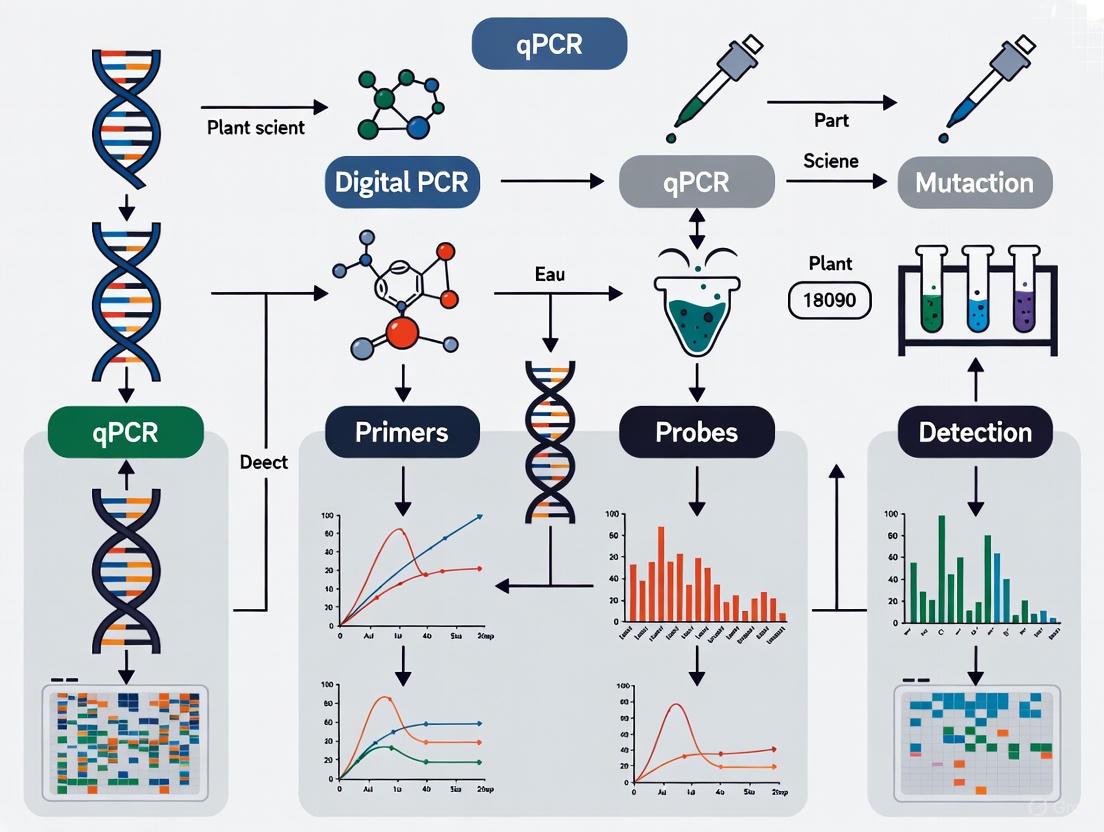
This article provides a comprehensive comparison of digital PCR (dPCR) and quantitative PCR (qPCR) for detecting genetic mutations in plants, covering foundational principles, methodological applications, optimization strategies, and validation approaches.
Digital PCR vs. qPCR for Plant Mutation Detection: A Comprehensive Guide for Researchers
Abstract
This article provides a comprehensive comparison of digital PCR (dPCR) and quantitative PCR (qPCR) for detecting genetic mutations in plants, covering foundational principles, methodological applications, optimization strategies, and validation approaches. Aimed at researchers and scientists, it explores how dPCR offers absolute quantification without standard curves, superior sensitivity for low-frequency mutations, and enhanced tolerance to PCR inhibitors—proving particularly valuable for analyzing gene-edited lines, polyploid genomes, and complex samples. The review synthesizes recent advancements and comparative data to guide method selection, troubleshoot common challenges, and outline future directions for plant genomics and biotechnology research.
Understanding Digital PCR and qPCR: Core Principles for Plant Genomic Analysis
The Evolution from qPCR to Digital PCR in Plant Science
The advent of quantitative PCR (qPCR) marked a significant milestone in plant molecular biology, enabling researchers to move from qualitative detection to precise quantification of nucleic acids. This technology has become indispensable for applications ranging from gene expression analysis to pathogen detection. However, the emergence of digital PCR (dPCR) represents a paradigm shift in nucleic acid quantification, offering distinct advantages for specific applications in plant science. This evolution is particularly impactful in the field of mutation detection, where precise, absolute quantification of rare genetic events is crucial for advancing plant breeding and genetic research. While qPCR provides relative quantification dependent on standard curves, dPCR enables absolute quantification through limiting dilution and Poisson statistical analysis, eliminating the need for external calibrators [1] [2] [3].
The transition to dPCR is driven by the growing need in plant research to detect subtle genetic variations, quantify low-abundance targets, and achieve superior precision—capabilities essential for characterizing novel traits, monitoring transgenic events, and identifying rare mutations in mutagenized populations. This comprehensive guide objectively compares the performance characteristics, experimental applications, and practical implementation of both technologies within the specific context of plant science research, with a focus on mutation detection.
Technical Comparison: qPCR versus Digital PCR
Fundamental Principles and Workflow Differences
Quantitative PCR (qPCR) operates on the principle of monitoring PCR amplification in real-time using fluorescent reporters. The quantification cycle (Cq), at which the fluorescence crosses a threshold, is used for relative quantification against a standard curve. This method relies on the efficiency of amplification, which can be affected by sample quality and inhibitors [3] [4].
In contrast, digital PCR (dPCR) employs a fundamentally different approach based on sample partitioning. The reaction mixture is divided into thousands of individual partitions, and PCR amplification occurs within each partition. After endpoint amplification, partitions are analyzed for fluorescence, and the absolute quantity of target molecules is calculated using Poisson statistics, without the need for standard curves [1] [2] [5].
Table 1: Core Technological Differences Between qPCR and dPCR
| Feature | Quantitative PCR (qPCR) | Digital PCR (dPCR) |
|---|---|---|
| Quantification Principle | Relative to standard curve | Absolute counting of molecules |
| Standard Curve Requirement | Yes | No |
| Data Output | Cq (Quantification Cycle) | Copies/μL (Absolute concentration) |
| Sample Partitioning | No (bulk reaction) | Yes (thousands of partitions) |
| Data Acquisition | Real-time during cycling | End-point |
| Impact of PCR Inhibitors | More susceptible (affects Cq) | Less susceptible (yes/no detection) |
| Ideal Application Scope | High-abundance targets, gene expression | Rare variants, copy number variation, complex samples |
Performance Comparison in Plant Research Applications
Direct comparative studies highlight distinct performance advantages for each technology. For the detection of infectious bronchitis virus (IBV) genome, dPCR demonstrated higher sensitivity and superior precision in quantification compared to qPCR, despite qPCR having a wider dynamic range [1]. This enhanced precision is quantified by improved repeatability and reproducibility of results, which is critical for detecting subtle genetic changes in plant systems.
In the detection of rare mutations—a key requirement in mutation breeding research—dPCR has demonstrated exceptional capability to detect mutant allele frequencies as low as 0.1% against a background of wild-type sequences [6] [5]. This sensitivity is invaluable for identifying early mutational events in irradiated plant populations or detecting somatic mutations in vegetatively propagated plants.
When analyzing complex samples, such as those containing PCR inhibitors common in plant tissues (polyphenols, polysaccharides), dPCR shows greater resilience. The partitioning step effectively dilutes inhibitors across thousands of reactions, reducing their impact on amplification efficiency compared to qPCR, where inhibitors affect the entire reaction [2] [3].
Figure 1: Comparative Workflows of qPCR and dPCR in Plant Research. The fundamental divergence occurs after PCR mix preparation, with qPCR relying on real-time monitoring and standard curves, while dPCR utilizes partitioning and endpoint analysis for absolute quantification.
Application in Plant Mutation Detection
Tracking Induced Mutations in Plant Breeding
Mutation breeding using ionizing radiation or chemical mutagens represents a powerful approach for crop improvement. However, identifying and quantifying these mutations has traditionally been challenging. Research on Arabidopsis thaliana has demonstrated the utility of seed color phenotypes (transparent testa mutants) for detecting radiation-induced mutations at multiple loci (TT4 and TT8) in M1 plants [7]. This system enables detection based on loss of heterozygosity, allowing direct mutation analysis without requiring subsequent generations.
The detection of radiation-induced mutations in Arabidopsis M1 plants revealed a significantly higher mutation frequency at the TT8 locus compared to TT4 (17 versus 2 mutants out of 19 anthocyanin-less seeds) [7]. This finding suggests non-random mutation patterns in plant genomes following irradiation, with important implications for mutation breeding strategies. For precisely quantifying such mutational events, dPCR offers significant advantages due to its ability to detect low-frequency mutations in heterogeneous tissue samples.
Monitoring Microbial Adaptations in the Rhizosphere
Beyond plant genomes, dPCR also facilitates the study of adaptive mutations in plant-associated microbes. Experimental evolution of Pseudomonas bijieensis 2P24 in the wheat rhizosphere revealed accumulation of mutations in the flagella-associated gene fleN, reaching 49% frequency in final communities [8]. These mutations, detected through whole-genome sequencing and single-nucleotide polymorphism (SNP) analysis, increased bacterial flagella number, enhancing motility and colonization capacity in the wheat rhizosphere [8].
This application demonstrates how dPCR can track beneficial mutations in plant microbiomes, providing insights into plant-microbe interactions and potential applications for developing improved plant growth-promoting rhizobacteria. The ability to precisely quantify allele frequencies in complex microbial communities represents a significant advancement over traditional culture-based methods or less quantitative molecular approaches.
Table 2: Performance Comparison for Mutation Detection Applications in Plant Science
| Performance Metric | qPCR | Digital PCR | Experimental Evidence |
|---|---|---|---|
| Detection Sensitivity | Moderate | High (0.1% MAF) | Can detect EGFR T790M mutation at 0.1% allele frequency [6] [5] |
| Quantification Precision | Lower (CV > 10%) | Higher (CV < 5%) | Superior repeatability and reproducibility for IBV detection [1] |
| Limit of Detection (LOD) | Higher | 2-5 times lower | SARS-CoV-2 detection in wastewater [2] |
| Tolerance to Inhibitors | Moderate | High | More reliable data with contaminated samples [3] |
| Absolute Quantification | No (requires standards) | Yes | Direct copy number calculation [1] [2] |
| Multiplexing Capability | Limited by channel availability | Enhanced by partitioning | Theoretical capability for multiple targets |
Experimental Protocols for Plant Mutation Detection
dPCR Protocol for Rare Mutation Detection
The following protocol adapts the rare mutation detection methodology for plant research applications, based on established dPCR workflows [6]:
Assay Design:
- Design two hydrolysis probes (TaqMan) with a single primer set amplifying the target region.
- Label the wild-type probe with one fluorophore (e.g., FAM) and the mutant-specific probe with another (e.g., Cy3).
- Verify fluorophore compatibility with your dPCR system and ensure sufficient spectral separation.
PCR Mix Preparation:
- Prepare a master mix containing: digital PCR mastermix (1X), reference dye (if required), forward and reverse primers (500 nM each), wild-type and mutant probes (250 nM each), and plant genomic DNA.
- Calculate DNA input based on desired sensitivity: Number of copies = mass of DNA (ng) / haploid genome mass (ng). For plants with larger genomes, adjust the haploid genome mass accordingly.
- Include necessary controls: non-template control (NTC), monocolor controls for each probe for fluorescence compensation.
Partitioning and Thermal Cycling:
- Load the reaction mix into the dPCR system's partitioning device (chips, nanowells, or droplets).
- Perform PCR amplification with optimized conditions. For example: initial denaturation at 95°C for 10 minutes, followed by 45 cycles of 95°C for 30 seconds and 62°C for 15 seconds [6].
- Adjust annealing temperature based on primer characteristics and plant species.
Data Analysis:
- Acquire endpoint fluorescence data from all partitions.
- Apply fluorescence compensation if spillover between channels is detected.
- Set appropriate thresholds to distinguish positive and negative partitions for each target.
- Calculate absolute concentration using Poisson statistics: Concentration = -ln(1 - p) / v, where p is the fraction of positive partitions and v is the partition volume.
- Determine mutant allele frequency as: (Mutant concentration / Total target concentration) × 100.
Plant-Specific Sample Preparation Considerations
Effective mutation detection in plants requires optimized nucleic acid extraction:
- For seeds high in polysaccharides and lipids, use CTAB-based extraction protocols with additional purification steps.
- For tissues high in polyphenols (e.g., young leaves, roots), include polyvinylpyrrolidone (PVP) in extraction buffers to bind inhibitors.
- Quantify DNA using fluorescence-based methods rather than UV spectrophotometry for accurate concentration assessment.
- For difficult tissues, consider DNA clean-up kits specifically designed for plant materials to remove PCR inhibitors.
The Scientist's Toolkit: Essential Research Reagents and Materials
Table 3: Key Research Reagent Solutions for Plant dPCR Studies
| Reagent/Material | Function | Application Notes |
|---|---|---|
| Digital PCR Mastermix | Provides DNA polymerase, dNTPs, buffer, MgCl₂ | Optimized for partition stability; select inhibitor-resistant versions for plant samples [6] |
| Hydrolysis Probes (TaqMan) | Sequence-specific detection | Dual-labeled probes for wild-type and mutant alleles; requires fluorophore compatibility [6] [5] |
| Partitioning Consumables | Creates individual reaction chambers | Chip-based (Naica, QIAcuity) or droplet-based (QX200) depending on system [6] [9] |
| Inhibitor-Resistant Polymerases | Enhances amplification efficiency | Critical for complex plant samples (seeds, roots) containing polysaccharides and polyphenols |
| Fluorescence Compensation Matrix | Corrects spectral overlap between fluorophores | Essential for multiplex detection; established using monocolor controls [6] |
| Plant DNA Extraction Kits | High-quality nucleic acid isolation | Should include steps for removing plant-specific inhibitors (CTAB-PVP methods) |
The evolution from qPCR to digital PCR represents a significant technological advancement for plant science research, particularly in the realm of mutation detection. While qPCR remains a versatile and cost-effective tool for many applications, dPCR offers distinct advantages for scenarios requiring absolute quantification, high precision, and detection of rare genetic events.
The future of dPCR in plant research will likely see expanded applications in tracking gene editing outcomes, monitoring low-frequency somatic mutations, quantifying transgene copy numbers, and characterizing plant-microbe interactions. As the technology continues to evolve with reduced costs and increased automation, dPCR is poised to become an increasingly accessible and indispensable tool in the plant scientist's molecular toolkit.
For researchers considering which technology to implement, the decision should be guided by specific experimental needs: qPCR for high-abundance targets and routine quantification where relative values suffice, and dPCR for applications requiring absolute quantification, detection of rare mutations, or analysis of complex samples where inhibitors may compromise qPCR results. By understanding the strengths and limitations of each platform, plant researchers can leverage these powerful technologies to advance our understanding of plant genetics and accelerate crop improvement efforts.
In plant research, the accurate detection and quantification of genetic mutations, pathogen load, or transgene expression are fundamental. Quantitative PCR (qPCR) and digital PCR (dPCR) represent two pivotal technologies for these tasks, yet they operate on fundamentally different principles. qPCR relies on relative quantification using a standard curve, while dPCR provides absolute quantification through statistical analysis of partitioned reactions. This guide objectively compares the performance, experimental protocols, and applications of these two methods, with a specific focus on their utility in plant sciences for mutation detection, pathogen diagnostics, and genetically modified organism (GMO) analysis. Understanding their core working principles, advantages, and limitations is essential for researchers selecting the optimal tool for their specific scientific questions in plant biotechnology and diagnostics.
Core Working Principles
Quantitative PCR (qPCR): Relative Quantification via Standard Curves
qPCR, also known as real-time PCR, is a well-established method for quantifying nucleic acids. Its principle is based on monitoring the amplification of a target DNA sequence in real-time during each PCR cycle. Fluorescent dyes or probes incorporated into the reaction mixture allow the instrument to detect the accumulation of PCR product. The key quantitative output is the cycle threshold (Cq) value, which represents the PCR cycle at which the fluorescence signal crosses a predefined threshold, indicating a detectable level of amplified product.
- The Role of the Standard Curve: Crucially, qPCR is a relative quantification method. To determine the quantity of an unknown sample, its Cq value is compared to a standard curve generated from samples with known concentrations. This curve is created by serially diluting a known quantity of the target nucleic acid (e.g., plasmid DNA or in vitro transcribed RNA) and plotting the Cq values against the logarithm of their known initial concentrations. The slope of this standard curve is used to determine the PCR amplification efficiency, which is critical for accurate quantification. The quantity of the target in unknown samples is then extrapolated from this curve [10] [11]. For gene expression analysis in plants, this often requires normalization to an endogenous control or reference gene (e.g., a housekeeping gene) to account for variations in sample input and quality [10] [12].
Digital PCR (dPCR): Absolute Quantification via Partitioning
dPCR is a newer approach that enables absolute quantification of nucleic acids without the need for a standard curve. Its fundamental principle involves partitioning a single PCR reaction into thousands of individual nanoliter-sized reactions. The partioning can be achieved through microfluidic chambers (cdPCR), water-in-oil droplets (ddPCR), or other array-based technologies.
- Poisson Statistics and Absolute Count: After partitioning, each microreaction ideally contains zero, one, or a few molecules of the target nucleic acid. The entire plate or droplet array is then amplified to the endpoint. Following amplification, each partition is analyzed for fluorescence. Partitions containing the target sequence (positive) are counted separately from those without it (negative). The ratio of positive to total partitions allows for the absolute calculation of the initial target concentration in the original sample using Poisson distribution statistics. This statistical model accounts for the probability that a partition may have contained more than one target molecule, thereby providing a precise and direct count of the copies per microliter in the original sample [13] [14] [15].
The following diagram illustrates the fundamental workflow and logical relationship between these two core methodologies.
Direct Comparison of Performance Characteristics
The fundamental differences in how qPCR and dPCR operate lead to distinct performance characteristics, which determine their suitability for specific applications in plant research.
Table 1: Core Methodological Comparison of qPCR and dPCR
| Feature | Quantitative PCR (qPCR) | Digital PCR (dPCR) |
|---|---|---|
| Quantification Basis | Relative to a standard curve [10] | Absolute, via Poisson statistics [13] [14] |
| Primary Output | Cycle threshold (Cq) | Copies per microliter (copies/µL) |
| Standard Curve | Required | Not required |
| Reference Genes | Needed for relative gene expression [12] | Not needed for absolute quantification [12] |
| Impact of Inhibitors | Sensitive; reduces amplification efficiency [15] | More tolerant; endpoint detection is less affected [13] [16] [17] |
| Impact of Amplification Efficiency | Highly sensitive; low efficiency skews quantification [15] | Less sensitive; robust over a range of efficiencies [15] |
| Precision & Reproducibility | Good, but lower than dPCR [18] | Higher precision, especially for low targets [18] [15] |
| Dynamic Range | Large (up to 10-log) [10] | Limited by number of partitions (typically 4-5 log) [15] |
Table 2: Experimental and Practical Considerations
| Consideration | Quantitative PCR (qPCR) | Digital PCR (dPCR) |
|---|---|---|
| Optimal Application | High-throughput gene expression, pathogen load with available standards | Absolute quantification, rare allele detection, copy number variation, NGS library quantification [13] [14] [15] |
| Sensitivity for Rare Targets | Lower, due to competition in bulk reaction [16] | Higher, as partitioning eliminates competition [16] [15] |
| Multiplexing Capability | High (4-6 colors) [15] | Limited (typically 2 colors) [15] |
| Throughput | High | Lower |
| Hands-on Time & Workflow | Standardized, relatively simple | More complex, multiple steps (e.g., droplet generation) [15] |
| Cost | Lower instrumentation and reagent costs | Higher instrumentation and reagent costs [15] |
Experimental Data and Protocol Comparison
Experimental Workflow for Plant Pathogen Detection
A recent study on detecting Phytophthora nicotianae, a devastating soil-borne pathogen, provides a direct comparison of qPCR and droplet digital PCR (ddPCR) protocols using the same primer/probe set and sample origins [17].
Shared Protocol Elements:
- Primers/Probe: Nic-Forward: 5’-CCTATCAAAAAACAAGGCGAACG-3’, Nic-Reverse: 5’-CAGAGACTTTCGTCCCCACAGT-3’, Nic-Probe: 5’-CTTCGGCCTGATTTAGTAGT-3’ (FAM/BHQ1) [17].
- Sample Source: 68 infectious tobacco root tissues and 145 surrounding soil samples [17].
- Thermal Cycling Conditions: Initial denaturation at 95°C for 10 min; 45 cycles of 94°C for 30 sec and 58°C for 1 min [17].
Method-Specific Protocol Details:
- ddPCR Protocol: A 20 µL reaction mixture was prepared with 2× ddPCR Supermix for Probes, 500 nM of each primer, 250 nM probe, and 2 µL template DNA. Droplets were generated using a QX200 Droplet Generator, amplified in a thermal cycler, and read by a QX200 Droplet Reader. Data was analyzed with QuantaSoft software which calculates the absolute concentration (copies/µL) based on the count of positive and negative droplets [17].
- qPCR Protocol: A 20 µL reaction mixture was prepared with 2× Probe qPCR MasterMix, 500 nM of each primer, 250 nM probe, and 2 µL template DNA. Amplification was performed on a Light Cycler 480 II. The Cq value for each sample was compared to a standard curve of known concentrations to determine the target quantity [17].
Comparative Performance Data from Plant Studies
The following table summarizes key quantitative findings from this and other relevant studies, highlighting the performance differences between the two technologies.
Table 3: Summary of Experimental Comparison Data
| Performance Metric | qPCR Results | dPCR/ddPCR Results | Context & Implications |
|---|---|---|---|
| Positive Detection Rate | 83.9% [17] | 96.4% [17] | ddPCR showed higher sensitivity in detecting P. nicotianae in field samples. |
| Quantification Precision (CV) | 5.0% [18] | 2.3% [18] | cdPCR demonstrated over 2-fold lower measurement variability. |
| Diagnostic Accuracy (AUC) | 0.885 [17] | 0.913 [17] | ddPCR had a slightly superior diagnostic performance in ROC analysis. |
| Tolerance to Inhibitors | Lower; quantification is affected by inhibitors in soil/plant samples [15] | Higher; accurate quantification in complex soil matrices [17] [15] | dPCR is more robust for difficult sample types without extensive purification. |
| Effect Size Concordance | Consistent in direction for 6/8 genes, but varied in magnitude at low concentrations [12] | Consistent in direction for 6/8 genes, more reliable for low-abundance targets [12] | Both methods show agreement, but dPCR is more robust for low-copy targets. |
Application in Plant Research: Mutation and GMO Detection
The unique advantages of dPCR make it particularly suited for specific, high-stakes applications in plant science.
- Detection of Genetically Modified Plants (GMOs): dPCR is increasingly used for the identification and absolute quantification of transgenic components in raw materials and food/feed. The method quantifies the ratio of the transgene copy number to the copy number of a native, single-copy reference gene (e.g., Lec-1 in soybean, hmg in maize), providing a highly precise GM percentage in a sample. This is crucial for compliance with labeling laws and traceability in agri-food chains [14].
- Detection of Rare Mutations and Gene-Edited Organisms: dPCR excels in detecting rare sequence variations. A key study successfully developed a ddPCR assay to identify a gene-edited rice line carrying only a single nucleotide insertion. This highlights dPCR's power to detect minute genetic changes, which is vital for regulating gene-edited products. However, the study also notes a critical interpretative challenge: a single variation point could occur naturally or through breeding, so its detection does not automatically confirm the presence of the specific gene-edited organism. This necessitates careful assay design and validation [19].
The Scientist's Toolkit: Essential Research Reagent Solutions
Selecting the correct reagents and tools is fundamental to the success of both qPCR and dPCR experiments in plant research.
Table 4: Essential Reagents and Materials for qPCR and dPCR
| Item | Function | Example Application/Note |
|---|---|---|
| Probe-based Master Mix | Contains polymerase, dNTPs, and optimized buffer for probe-based detection. | Essential for both qPCR and dPCR assays using hydrolysis probes (e.g., TaqMan). Reduces setup variability [17]. |
| DNA Extraction Kit (Plant) | Isolates high-quality, inhibitor-free DNA from complex plant tissues. | Kits like DNeasy Plant Mini Kit are critical for obtaining reliable PCR results from plant material [17]. |
| DNA Extraction Kit (Soil) | Isolates DNA from soil matrices, which often contain PCR inhibitors. | Kits like DNeasy PowerSoil Kit are designed to co-purify inhibitors, essential for rhizosphere soil analysis [17]. |
| Nuclease-Free Water | Serves as a solvent and negative control. | Ensures reactions are not contaminated by RNases or DNases. |
| Primers & Probes | Specifically target and detect the sequence of interest. | Must be designed for high specificity and efficiency. Probes are typically labeled with fluorophores (FAM, HEX/VIC) and quenchers (BHQ1, TAMRA) [17]. |
| Standard/Calibrator DNA | A sample of known concentration used to create the standard curve. | Crucial for qPCR quantification. Can be plasmid DNA or genomic DNA [10]. |
| Droplet Generation Oil/Reagents | Creates the water-in-oil emulsion for droplet-based dPCR. | Specific to the dPCR platform (e.g., DG8 Cartridges and Droplet Generation Oil for Bio-Rad QX200) [17]. |
| Low-Binding Tubes and Tips | Minimizes sample loss due to adhesion to plastic surfaces. | Particularly critical for dPCR due to its sensitivity to molecule loss during sample handling [10]. |
The choice between qPCR and dPCR is not a matter of one being universally superior, but rather which tool is best suited for the specific research question.
- Use qPCR when: Your project requires high-throughput analysis of many samples, cost-effectiveness is a primary concern, you have access to well-characterized standards for creating a calibration curve, and the targets are not exceptionally rare. It remains the gold standard for routine gene expression analysis and pathogen quantification where absolute copy number is not critical.
- Use dPCR when: Your research demands absolute quantification without standards, such as for calibrating assays or NGS libraries. It is the preferred tool for detecting rare mutations in a background of wild-type DNA (e.g., in gene-edited plants), for precise copy number variation analysis, and for working with complex samples that may contain PCR inhibitors, such as soil or plant extracts. Its higher precision and ability to detect small fold-changes make it ideal for validating subtle but biologically significant genetic differences.
For plant scientists focusing on the cutting edge of mutation detection, GMO analysis, and pathogen diagnostics in complex matrices, dPCR offers a powerful, precise, and increasingly accessible alternative to traditional qPCR, enabling new levels of accuracy in genetic measurement.
Digital PCR (dPCR) represents a third-generation technology in nucleic acid amplification, enabling the absolute quantification of target DNA sequences without the need for standard curves. This breakthrough technique partitions a sample into thousands of individual reactions, each acting as a separate PCR microreactor. Through endpoint amplification and Poisson statistical analysis, dPCR provides direct counting of target DNA molecules, offering unprecedented precision for detecting genetic modifications in plants [20]. As plant mutation research expands from traditional genetically modified organisms (GMOs) to precise gene-edited varieties, dPCR has emerged as a critical tool for researchers requiring high sensitivity, accuracy, and reproducibility in their genetic analyses.
This technology is particularly valuable for applications where quantitative precision is essential, including the detection of low-abundance targets, analysis of complex samples with PCR inhibitors, and verification of small genetic alterations introduced through genome editing techniques such as CRISPR/Cas9. The following sections explore the key applications of dPCR in plant mutation research, providing performance comparisons with quantitative PCR (qPCR) and detailed methodological guidance for implementation.
Key Applications of Digital PCR in Plant Mutation Research
Detection and Quantification of Genetically Modified Plants
The detection and quantification of GMO components in raw materials and derived products represents one of the most established applications of dPCR in plant sciences. dPCR assays typically target both a specific transgenic sequence and an endogenous reference gene, with the ratio between these sequences providing the GMO percentage in a sample [20]. This approach offers particular advantages for routine analysis of food and feed samples, where dPCR demonstrates reduced sensitivity to PCR inhibitors commonly found in processed matrices compared to qPCR [20]. The absolute quantification capability of dPCR eliminates the need for calibration curves, overcoming potential inaccuracies from amplification efficiency differences between samples and reference materials [20].
Multiplex dPCR assays have been successfully developed for simultaneous quantification of multiple GM lines, demonstrating significant improvements in cost efficiency while maintaining accuracy, robustness, and practicability [20]. One study highlighted the transferability of these assays through inter-laboratory trials, confirming their suitability for standardized testing protocols [20].
Verification and Characterization of Genome Edits
The emergence of genome editing technologies has created new detection challenges, particularly for plants containing small nucleotide changes without foreign DNA integration. dPCR has proven highly effective for detecting these subtle modifications, including single nucleotide variants (SNVs) and small insertions or deletions (indels) [21] [22]. Research shows that optimized dPCR assays can detect one mutant allele among up to 100,000 wild type sequences in heterogeneous samples, providing the sensitivity necessary for identifying early editing events and quantifying editing efficiency [21].
For commercial applications, dPCR enables the detection of low-level admixtures of genome-edited material in conventional seed or grain lots. Recent studies have established dPCR methods that reliably detect known mutations in genome-edited barley and oilseed rape lines in mixtures containing as little as 0.1% to 0.9% edited material [23]. This sensitivity meets regulatory testing requirements for enforcing labeling thresholds in markets that regulate genome-edited products as GMOs.
Pathogen Detection in Plant Disease Management
dPCR has emerged as a powerful tool for detecting plant pathogens, offering advantages for early disease diagnosis and management. A study on Phytophthora nicotianae, the causative agent of tobacco black shank disease, demonstrated that droplet digital PCR (ddPCR) showed greater sensitivity than qPCR, with higher positive detection rates (96.4% vs. 83.9%) in infectious tobacco root and soil samples [17]. The ddPCR assay also demonstrated better tolerance to PCR inhibitors present in complex environmental matrices like soil [17].
Receiver operating characteristic (ROC) analysis confirmed the superior diagnostic performance of ddPCR, showing an area under the curve (AUC) of 0.913 compared to 0.885 for qPCR [17]. This enhanced performance makes dPCR particularly valuable for detecting low pathogen loads in asymptomatic plants or soil, enabling earlier intervention and more effective disease management strategies.
Copy Number Variation Analysis in Protists and Microbes
While not exclusively focused on plants, copy number variation analysis represents another key application of dPCR with relevance to plant mutation research. A comparative study of the QX200 droplet digital PCR system (Bio-Rad) and the QIAcuity One nanoplate-based system (QIAGEN) demonstrated that both platforms effectively quantified gene copy numbers in the ciliate Paramecium tetraurelia across varying cell numbers [24]. Both systems showed high precision, with the QIAcuity One system achieving coefficients of variation (CV) between 0.6% and 27.7%, while the QX200 system showed CVs between 2.5% and 62.1% depending on restriction enzyme selection [24].
The study highlighted that restriction enzyme choice significantly impacted precision, with HaeIII generally providing higher precision than EcoRI, particularly for the QX200 system [24]. This finding underscores the importance of optimizing reaction conditions for specific applications to maximize dPCR performance.
Performance Comparison: Digital PCR vs. Quantitative PCR
Quantitative Performance Metrics
Table 1: Comparison of dPCR and qPCR Performance Characteristics
| Performance Parameter | Digital PCR | Quantitative PCR | Experimental Context |
|---|---|---|---|
| Limit of Detection (LOD) | 0.17-0.39 copies/µL input [24] | Varies with target and calibration | Synthetic oligonucleotides [24] |
| Limit of Quantification (LOQ) | 1.35-4.26 copies/µL input [24] | Varies with target and calibration | Synthetic oligonucleotides [24] |
| Precision (Coefficient of Variation) | 0.6%-27.7% (ndPCR) [24] 2.5%-62.1% (ddPCR) [24] | Typically higher variability | Paramecium tetraurelia DNA [24] |
| Dynamic Range | Narrower than qPCR [1] | Wider than dPCR [1] | Infectious bronchitis virus [1] |
| Inhibitor Tolerance | Higher resistance to PCR inhibitors [17] [20] | More susceptible to inhibition | Complex matrices (soil, plant tissues) [17] |
| Detection Sensitivity | Higher positive detection rate (96.4% vs. 83.9%) [17] | Lower detection rate in complex samples | Phytophthora nicotianae in tobacco [17] |
| Quantification Approach | Absolute quantification without standards [20] | Relative quantification requiring calibration curve [1] | General methodology [20] [1] |
Platform-Specific Performance Characteristics
Table 2: Comparison of Different dPCR Platforms
| Parameter | Nanoplate-based dPCR (QIAcuity One) | Droplet-based dPCR (QX200) |
|---|---|---|
| LOD | 0.39 copies/µL input [24] | 0.17 copies/µL input [24] |
| LOQ | 1.35 copies/µL input [24] | 4.26 copies/µL input [24] |
| Typical Reaction Volume | 40µL [24] | 20µL [24] |
| Precision with HaeIII enzyme | CV: 1.6%-14.6% [24] | CV: <5% for all cell numbers [24] |
| Precision with EcoRI enzyme | CV: 0.6%-27.7% [24] | CV: 2.5%-62.1% [24] |
| Partitioning Mechanism | Nanoscale chambers [24] | Water-in-oil droplets [24] |
Experimental Protocols for Key Applications
Protocol for GMO Quantification in Processed Samples
Principle: This protocol utilizes the absolute quantification capability of dPCR to determine the percentage of genetically modified material in food and feed samples by simultaneously targeting a transgene-specific sequence and an endogenous reference gene [20].
Procedure:
- Sample Preparation and DNA Extraction: Grind representative samples to homogeneous powder. Extract DNA using appropriate kits (e.g., DNeasy Plant Mini Kit), ensuring DNA quality meets recommended standards (A260/A280 ratio ~1.8-2.0) [20].
- Reaction Setup: Prepare separate dPCR reactions for transgene and reference gene targets. A typical 20µL ddPCR reaction mixture includes:
- 10µL of 2× ddPCR Supermix for Probes
- 1µL of each primer (final concentration 500nM)
- 0.5µL of probe (final concentration 250nM)
- 2µL template DNA
- Nuclease-free water to volume [17]
- Partition Generation: For ddPCR: Generate droplets using a droplet generator. For ndPCR: Load reaction mix into nanoplate cartridges [24] [17].
- PCR Amplification: Perform endpoint PCR with appropriate cycling conditions:
- Initial denaturation: 95°C for 10 minutes
- 45 cycles of: 94°C for 30 seconds (denaturation) and 58-60°C for 1 minute (annealing/extension)
- Final extension: 98°C for 10 minutes [17]
- Signal Reading and Analysis: For ddPCR: Read droplets using a droplet reader. For ndPCR: Image nanoplate using imaging system. Analyze using manufacturer's software (e.g., QuantaSoft for ddPCR) [17].
- Calculation of GMO Percentage: Calculate GMO content using the formula: (Transgene copies/µL ÷ Reference gene copies/µL) × 100% [20].
Protocol for Detection of Genome-Edited Plants with Small Mutations
Principle: This protocol enables detection of single nucleotide variants or small indels in genome-edited plants using the high sensitivity and specificity of dPCR, even in complex sample backgrounds [21] [23].
Procedure:
- Target Selection: Identify the specific edited sequence and flanking regions. For identification purposes, target combined mutations including the intended edit and closely linked natural variations when possible [23].
- Assay Design: Design primers and probes to discriminate between edited and wild-type sequences. For single nucleotide changes, use allele-specific primers or probes with the variant positioned centrally for optimal discrimination [21].
- DNA Extraction: Extract high-quality DNA from plant tissue using appropriate methods. For heterogeneous samples, ensure representative sampling [23].
- dPCR Setup: Prepare reactions as described in section 4.1, with optimization of annealing temperature for optimal allele discrimination.
- Partitioning and Amplification: Follow manufacturer's protocols for partitioning and PCR amplification with sufficient cycles (40-45) to ensure endpoint detection [17].
- Data Analysis: Use manufacturer's software to count positive and negative partitions. Apply Poisson correction for accurate quantification. For heterogeneous samples, calculate the percentage of edited alleles in the population [21].
Protocol for Pathogen Detection in Complex Matrices
Principle: This protocol leverages the superior inhibitor tolerance of dPCR for detecting plant pathogens in complex matrices like soil and plant tissues, where qPCR performance may be compromised [17].
Procedure:
- Sample Collection and DNA Extraction:
- dPCR Reaction Setup:
- Prepare 20µL reactions as described in section 4.1
- Include negative controls (nuclease-free water) and positive controls (if available)
- For difficult samples, consider dilution series to confirm inhibitor tolerance
- Droplet Generation and PCR:
- Generate droplets using droplet generator
- Amplify with optimized cycling conditions as in section 4.1
- Detection and Analysis:
- Read droplets using droplet reader
- Analyze using appropriate threshold settings
- For diagnostic applications, establish cut-off values based on receiver operating characteristic (ROC) analysis [17]
Workflow Visualization: dPCR Analysis in Plant Mutation Research
Figure 1: dPCR Workflow for Plant Mutation Research
Essential Research Reagent Solutions
Table 3: Key Research Reagents for dPCR in Plant Mutation Research
| Reagent Category | Specific Examples | Function and Importance |
|---|---|---|
| DNA Extraction Kits | DNeasy Plant Mini Kit, DNeasy PowerSoil Kit [17] | High-quality DNA extraction from various plant tissues and soil; critical for assay performance |
| dPCR Master Mixes | ddPCR Supermix for Probes [17] | Optimized reaction buffers for partitioning efficiency and amplification specificity |
| Restriction Enzymes | HaeIII, EcoRI [24] | Enhance target accessibility, especially for tandemly repeated genes; impact precision |
| Fluorescent Probes | Hydrolysis probes (FAM/BHQ-labeled) [17] | Target sequence detection with high specificity; enable multiplexing |
| Reference Materials | Certified reference materials [20] | Method validation and quality control; essential for quantitative accuracy |
| Droplet Generation Oil | Droplet Generation Oil for Probes [17] | Stable droplet formation for ddPCR; critical for partition integrity |
| Quality Control Assays | Endogenous reference gene assays [20] | DNA quality assessment and normalization; ensure reliable quantification |
Digital PCR has established itself as an indispensable technology in plant mutation research, offering significant advantages for applications requiring high sensitivity, absolute quantification, and robustness to inhibitors. As demonstrated through the applications and protocols detailed in this guide, dPCR provides enhanced performance for GMO quantification, verification of genome edits, pathogen detection, and copy number analysis compared to traditional qPCR approaches. The continuing evolution of dPCR platforms and methodologies promises to further expand its utility in plant genetics research, particularly as new breeding techniques generate increasingly subtle genetic modifications that challenge conventional detection methods. By implementing the optimized protocols and leveraging the performance characteristics outlined in this guide, researchers can effectively utilize dPCR to advance their plant mutation research programs.
Advantages of Partitioning and Endpoint Detection in Complex Plant Genomes
The detection and quantification of genetic mutations in plants present significant challenges due to the complexity of plant genomes, which are often characterized by polyploidy, high heterozygosity, and extensive repetitive elements. This comparison guide objectively evaluates the performance of digital PCR (dPCR) against quantitative real-time PCR (qPCR) for mutation detection in plant research. By examining experimental data across sensitivity, precision, and application in complex samples, we demonstrate that dPCR's unique combination of sample partitioning and endpoint detection offers distinct advantages for plant genomics, particularly for low-frequency mutation discovery and absolute quantification without standard curves.
Plant genomes present formidable obstacles for precise molecular detection. Frequent polyploidy, high heterozygosity, and repeat element expansion create complex genetic landscapes that complicate accurate mutation detection and quantification [25]. These characteristics often obscure target sequences, lead to non-specific amplification, and reduce the reliability of quantitative measurements, particularly for rare genetic events.
The emergence of gene-editing technologies like CRISPR-Cas has further intensified the need for highly sensitive detection methods [26]. Unlike traditional transgenics, gene-editing produces subtle mutations—often single base pair changes—that require detection against a complex genomic background. Existing methods, including qPCR and next-generation sequencing (NGS), face limitations in quantifying low-frequency mutations and require high DNA concentrations that may not be available from processed samples [26].
This guide examines how digital PCR (dPCR) addresses these challenges through its fundamental operational principles of sample partitioning and endpoint detection, providing plant researchers with a powerful tool for advancing genetic research and crop improvement programs.
Fundamental Technological Comparison
Core Principles: Partitioning and Endpoint Detection
Digital PCR (dPCR) operates through a fundamentally different mechanism than qPCR. The sample is partitioned into thousands to millions of individual reactions, each containing a discrete number of target molecules (0, 1, 2, 3...) [27]. After endpoint PCR amplification, each partition is scored as positive or negative based on fluorescence detection. The absolute quantity of the target sequence is then calculated using Poisson statistics, without requiring external standards [27] [24].
Quantitative Real-Time PCR (qPCR), in contrast, monitors amplification in real-time as the reaction proceeds. Quantification relies on the threshold cycle (Ct), the point at which fluorescence crosses a predetermined threshold [28]. This represents a relative quantification method that must be calibrated against standard curves, introducing potential variables and uncertainties [28] [1].
Performance Advantages in Plant Genomics
The partitioning approach of dPCR confers several distinct advantages for complex plant genomes:
- Absolute Quantification: dPCR provides direct nucleic acid counting without standard curves, eliminating calibration uncertainties [27] [24]
- Enhanced Precision: Partitioning reduces the impact of inhibitors and amplification efficiency variations that commonly affect plant samples [1]
- Superior Sensitivity: Enables detection of rare mutations and single-copy genes in polyploid backgrounds [26]
- Accurate Copy Number Variation: Precise gene copy number determination without reference genes [27] [24]
Table 1: Fundamental Methodological Differences Between dPCR and qPCR
| Parameter | Digital PCR (dPCR) | Quantitative PCR (qPCR) |
|---|---|---|
| Quantification Basis | Absolute counting via Poisson statistics | Relative to standard curve |
| Measurement Point | Endpoint detection | Real-time monitoring (Ct value) |
| Partitioning | Physical separation into nanoreactors | Bulk reaction in single tube |
| Standard Curve Requirement | No | Yes |
| Precision at Low Targets | Higher precision for rare targets [1] | Lower precision in low concentration range [28] |
| Inhibitor Tolerance | Higher resistance to PCR inhibitors [1] | More susceptible to inhibition effects |
Experimental Data and Performance Comparison
Sensitivity and Precision in Mutation Detection
A direct comparison of dPCR and qPCR for detecting gene-editing events in rice demonstrated dPCR's superior performance characteristics [26]. The study employed a duplexed dPCR assay with two probe sets—one spanning the mutation position and another targeting a reference gene—to accurately quantify editing frequencies.
Table 2: Performance Comparison for Gene-Editing Detection in Plants
| Performance Metric | Digital PCR | qPCR | Experimental Context |
|---|---|---|---|
| Limit of Detection (LOD) | Lower LOD for editing frequency [26] | Higher LOD limitation [26] | Gene-edited rice samples |
| Precision (CV%) | Higher precision (repeatability and reproducibility) [1] | Lower precision observed [1] | Infectious bronchitis virus detection |
| Quantification Range | Wider dynamic range for viral load [1] | Narrower effective range [1] | Plasmid DNA and infected samples |
| Correlation with Expected Frequency | Stronger correlation [26] | Weaker correlation [26] | Edited region detection in rice |
| Application in Processed Samples | Effective with low DNA concentrations [26] | Challenged by low DNA inputs [26] | Processed food samples |
The precision advantage of dPCR was further demonstrated in a study comparing quantification of infectious bronchitis virus, where dPCR showed higher repeatability and reproducibility compared to qPCR [1]. This precision is particularly valuable for plant research requiring longitudinal studies or comparison across multiple breeding lines.
Platform Performance and Reagent Considerations
Different dPCR platforms demonstrate varying performance characteristics. A 2025 comparison of droplet-based (ddPCR) and nanoplate-based (ndPCR) systems revealed both provide high precision, though with platform-specific optima [24].
Restriction enzyme selection significantly impacts dPCR precision in complex genomes. Using HaeIII instead of EcoRI dramatically improved precision for ddPCR, reducing coefficient of variation (CV) values to below 5% compared to up to 62.1% with EcoRI [24]. This highlights the importance of reaction optimization for specific plant genomic contexts.
Table 3: Digital PCR Platform Comparison for Gene Copy Number Analysis
| Parameter | Nanoplate dPCR (QIAcuity One) | Droplet dPCR (QX200) |
|---|---|---|
| Limit of Detection (LOD) | 0.39 copies/μL input [24] | 0.17 copies/μL input [24] |
| Limit of Quantification (LOQ) | 1.35 copies/μL input [24] | 4.26 copies/μL input [24] |
| Optimal Precision Range | 31-534 copies/μL input (CV ~8%) [24] | ~270 copies/μL input (optimal precision) [24] |
| Restriction Enzyme Impact | Moderate effect (CV 0.6-27.7%) [24] | Significant effect (CV 2.5-62.1%) [24] |
| Reaction Volume | 40μL [24] | 20μL [24] |
Experimental Protocols for Plant Mutation Detection
Duplexed dPCR for Gene-Editing Detection in Plants
The following protocol, adapted from Frontiers in Plant Science (2020), details a validated approach for detecting gene-editing frequencies in plants using duplexed dPCR [26]:
Sample Preparation:
- Extract plant genomic DNA using validated kits (e.g., QIAGEN DNeasy Plant Mini Kit)
- Quantify DNA using fluorometric methods (e.g., Qubit) for accuracy with plant samples
- For low-frequency detection, create serial dilutions of mutant DNA in wild-type background (0.1%-50%)
- For processed samples, use dedicated extraction protocols accounting for DNA degradation
Primer and Probe Design:
- Design one primer pair to span the mutation position
- Design a second primer pair for a reference gene (does not span mutation)
- Position mutation detection probe within the PAM region when detecting CRISPR edits
- Label reference gene probes with HEX and mutation-site probes with FAM
- Use dual-quenched probes (BHQ or MGB) to reduce background in plant samples
dPCR Reaction Setup:
- Prepare 20μL reactions containing: 10μL ddPCR SuperMix, 450nM of each primer, 250nM of each probe [26]
- Add 1μL template DNA (10ng/μL recommended for plant samples)
- Generate droplets using appropriate system (e.g., Bio-Rad QX200 droplet generator)
- Transfer droplets to 96-well PCR plate and seal with foil
Thermal Cycling:
- Initial denaturation: 95°C for 10 minutes
- 40 cycles of: 94°C for 30 seconds, 58-68°C (assay-specific) for 60 seconds [26]
- Enzyme deactivation: 98°C for 10 minutes
- Hold at 4°C
Data Analysis:
- Analyze plate using droplet reader (e.g., QX200 droplet reader)
- Use manufacturer's software (e.g., Bio-Rad QuantaSoft) for initial analysis
- Calculate mutation frequency as ratio of mutant droplets to wild-type droplets
- Perform statistical analysis with at least three biological replicates
Critical Optimization Steps for Plant Genomes
Inhibition Management:
- Plant samples often contain polysaccharides and phenolic compounds that inhibit PCR
- Implement additional purification steps or dilution if inhibition is suspected
- dPCR's resistance to inhibitors provides advantage, but optimization still required [1]
Partitioning Efficiency:
- Ensure proper droplet generation or nanoplate partitioning
- Monitor partition statistics - ideal occupancy should follow Poisson distribution [27]
- Adjust DNA input concentration to optimize positive partition percentage
Essential Research Reagent Solutions
Successful implementation of dPCR for plant genome analysis requires specific reagents and tools optimized for challenging plant samples. The following table details essential components and their functions:
Table 4: Essential Research Reagents for Plant dPCR Analysis
| Reagent/Tool | Function | Application Notes |
|---|---|---|
| Plant-Specific DNA Extraction Kits (e.g., QIAGEN DNeasy Plant Mini Kit [26]) | High-quality DNA purification | Removes polysaccharides and phenolic compounds that inhibit PCR |
| Dual-Labeled Probes (FAM/HEX with BHQ or MGB quenchers [26]) | Target sequence detection | Enables multiplexing; MGB quenchers improve allele discrimination |
| Restriction Enzymes (e.g., HaeIII, EcoRI [24]) | DNA digestion for target access | Critical for tandem repeat regions; significantly impacts precision |
| ddPCR SuperMix (no dUTP [26]) | PCR reaction mixture | Optimized for partitioning efficiency; dUTP-free for uracil-DNA handling |
| Droplet Generation Oil | Water-in-oil emulsion formation | Creates stable partitions for droplet-based dPCR systems |
| Quantitation Standards (synthetic oligonucleotides [24]) | Assay validation and calibration | Verify performance characteristics and limit of detection |
Digital PCR's partitioning approach and endpoint detection methodology provide plant researchers with a powerful tool for overcoming the challenges inherent in complex plant genomes. The technology demonstrates superior sensitivity for low-frequency mutations, enhanced precision in quantification, and reliable performance with challenging sample types, including processed materials with degraded DNA [26] [1].
For plant research applications requiring absolute quantification of genetic elements—including gene-editing frequency assessment, copy number variation analysis, and transgene characterization—dPCR offers significant advantages over qPCR approaches. While qPCR remains valuable for high-throughput expression analysis and applications with established standard curves, dPCR has established itself as the method of choice for precise mutation detection in complex plant genomes.
The continuing evolution of dPCR platforms and reagents promises further improvements in accessibility, throughput, and application range, solidifying its position as an essential technology in the plant researcher's molecular toolkit.
Practical Implementation: Method Selection and Application Workflows for Plant Mutation Studies
Detecting and Evaluating Gene-Editing Frequencies in Plants Using dPCR
The emergence of gene-editing technologies, particularly CRISPR-Cas systems, has revolutionized plant biology and crop improvement by enabling precise modifications to target genes [26]. However, a significant technical challenge remains: accurately detecting and quantifying the frequency of these editing events. While several detection methods exist, they often struggle with limitations in sensitivity, quantification accuracy, and application in complex plant genomes or processed samples [26].
Digital PCR (dPCR) has emerged as a powerful third-generation PCR technology that provides absolute quantification of nucleic acids without requiring standard curves [14] [29]. This review objectively compares the performance of dPCR with established alternatives like quantitative PCR (qPCR) and next-generation sequencing (NGS) for detecting and evaluating gene-editing frequencies in plants, providing researchers with experimental data to inform their methodological choices.
Technical Comparison of Detection Methods
Fundamental Principles
Quantitative PCR (qPCR) is a well-established high-throughput technique that measures DNA amplification during the exponential phase using fluorescent dyes or probes. It provides relative quantification dependent on standard curves constructed from known DNA concentrations, which can introduce variability [30].
Digital PCR (dPCR) represents a fundamental shift in approach by partitioning a sample into thousands of individual reactions. Each partition acts as a separate PCR reactor containing either 0, 1, or a few target molecules. After endpoint amplification, positive and negative partitions are counted, enabling absolute quantification through Poisson statistics without standard curves [14] [29].
Next-Generation Sequencing (NGS) provides comprehensive sequence data across targeted regions, allowing detailed characterization of editing outcomes but with higher complexity and cost [26].
Performance Comparison Data
The table below summarizes experimental data comparing these methods for detecting gene-editing events in plants:
Table 1: Performance comparison of methods for detecting gene-editing frequencies in plants
| Performance Metric | dPCR/ddPCR | qPCR | NGS | Experimental Context |
|---|---|---|---|---|
| Limit of Detection (LOD) | 0.1% editing frequency [26] | 1% editing frequency [26] | Not specified | Gene-edited rice samples |
| Accuracy in Polyploid Plants | High (precise quantification in complex genomes) [26] | Moderate (affected by genome complexity) [26] | High [26] | Polyploid plant genomes |
| Performance in Processed Samples | Maintains detection with low DNA concentrations [26] | Reduced detection capability [26] | Not specified | Processed food samples with low DNA |
| Precision (Coefficient of Variation) | 2.5-13% [24] [31] | Generally higher than dPCR [1] [31] | Not specified | Plasmid DNA and environmental samples |
| Tolerance to PCR Inhibitors | High [31] | Moderate to low [31] | Not applicable | Complex plant-derived samples |
| Absolute Quantification | Yes (without standard curves) [14] [29] | No (requires standard curves) [30] | Yes (with appropriate bioinformatics) | Various sample types |
| Multiplexing Capacity | Moderate (up to 4-plex demonstrated) [32] | High | Very high | GM canola and soybean detection |
Additional studies reinforce these findings across applications. In pathogen detection, ddPCR demonstrated superior sensitivity for Xanthomonas citri subsp. citri compared to qPCR [31]. In viral load quantification, dPCR showed higher precision, particularly at low target concentrations [1]. A 2025 study confirmed both droplet-based (QX200) and nanoplate-based (QIAcuity) dPCR systems achieve high precision in gene copy number analysis [24].
Experimental Protocols for Gene-Editing Detection in Plants
Duplexed dPCR Assay for Gene-Edited Plants
A validated protocol for detecting gene-editing frequencies in plants using duplexed dPCR involves these critical steps [26]:
Table 2: Key research reagent solutions for dPCR-based detection of gene-editing in plants
| Reagent/Category | Specific Examples/Properties | Function/Role in Experiment |
|---|---|---|
| dPCR System | QX200 Droplet Digital PCR (Bio-Rad), QIAcuity (QIAGEN) | Platform for partitioning and amplification |
| PCR Mix | ddPCR SuperMix for Probes (no dUTP) | Provides optimized reagents for digital PCR |
| Primer Design | Must span the mutation positions | Ensures amplification of the target edited region |
| Probe Design | Mutation-site specific (FAM-labeled); Reference gene (HEX-labeled) | Enables detection of both mutant and reference sequences |
| Reference Gene | Plant-specific single-copy conserved gene (e.g., HMG, Lec-1) | Normalization control for absolute quantification |
| DNA Extraction Kit | QIAGEN DNeasy Plant Mini Kit | High-quality DNA extraction from plant tissues |
| DNA Quantification | NanoDrop 1000, Qubit 2.0 Fluorometer | Accurate DNA concentration measurement |
| Restriction Enzymes | HaeIII, EcoRI (optional) | May improve precision by fragmenting DNA [24] |
Workflow Steps:
Sample Preparation and DNA Extraction: Extract genomic DNA from plant tissues using a DNeasy Plant Mini Kit. Assess DNA quality and integrity via agarose gel electrophoresis and quantify using fluorometric methods (Qubit 2.0) for superior accuracy over spectrophotometry alone [26].
Primer and Probe Design: Design one primer pair to span the mutation site and another for a stable reference gene not affected by editing. Develop hydrolysis probes with 5' FAM label for the mutation site and 5' HEX label for the reference gene, both quenched with BHQ or MGB at the 3' end. For CRISPR-induced mutations, position probes to cover the PAM region or expected mutation sites [26].
dPCR Reaction Setup: Prepare a 20μL reaction mixture containing 10μL of ddPCR SuperMix, 450nM of each primer, 250nM of each probe, and 1μL of template DNA (10ng/μL). Include appropriate negative controls [26].
Partitioning and Amplification: Transfer the mixture to a droplet generator cartridge. Generate droplets in the QX200 system, transfer to a 96-well plate, seal, and amplify using these parameters: 95°C for 10min; 40 cycles of 94°C for 10s and 58-68°C for 60s; 98°C for 10min; hold at 4°C [26].
Data Analysis: Read the plate using a droplet reader and analyze with QuantaSoft software. The mutation frequency is calculated as the ratio of mutant droplets (FAM-positive only) to wild-type droplets (FAM and HEX double-positive), applying Poisson correction for precise absolute quantification [26].
Experimental Design Considerations
For assessing low editing frequencies, prepare serial mixtures of homozygous mutant DNA with wild-type DNA, with mutant DNA ranging from 50% to 0.1% [26]. For processed samples with low DNA concentrations, dilute heterozygous gene-edited DNA to concentrations from 10ng/μL to 0.016ng/μL [26].
The precision of dPCR can be influenced by restriction enzyme choice. A 2025 study demonstrated that using HaeIII instead of EcoRI improved precision, particularly for droplet-based systems where CV values decreased to below 5% with HaeIII treatment [24].
Comparative Analysis of Method Performance
Sensitivity and Limit of Detection
dPCR demonstrates superior sensitivity for low-frequency mutation detection. In gene-edited rice, dPCR achieved a limit of detection (LOD) of 0.1% editing frequency, significantly outperforming qPCR's LOD of 1% [26]. This enhanced sensitivity makes dPCR particularly valuable for detecting early editing events or quantifying low-efficiency editing tools like base editors or prime editors where efficiency remains challenging in plants [26].
The fundamental partitioning principle of dPCR enables this superior sensitivity. By separating the reaction into thousands of compartments, dPCR enriches rare targets and reduces background noise, facilitating detection of mutations present in very low proportions within heterogeneous samples [29].
Precision and Reproducibility
dPCR consistently demonstrates higher precision compared to qPCR, particularly at low target concentrations. In a study quantifying infectious bronchitis virus, dPCR showed higher precision in terms of both repeatability and reproducibility [1]. Similarly, when detecting Xanthomonas citri subsp. citri, ddPCR exhibited lower coefficients of variation compared to qPCR, especially at low target concentrations [31].
This precision advantage stems from dPCR's binary endpoint detection (positive/negative partitions) and absolute quantification method, which eliminates variability associated with standard curve construction in qPCR [14] [31]. The resistance of dPCR to PCR inhibitors further enhances reproducibility when analyzing complex plant-derived samples [31].
Application in Complex Plant Genomes
Polyploid plant genomes present particular challenges for mutation detection due to multiple gene copies. dPCR has proven effective for accurate editing frequency quantification in complex polyploid genomes where other methods struggle [26]. This capability extends to processed food samples containing low initial DNA concentrations, where dPCR maintains detection capability while other methods falter [26].
Multiplexing capabilities further enhance dPCR's utility. Research has demonstrated simultaneous detection and quantification of up to four genetically modified events in a single assay, significantly improving analysis efficiency [32].
The experimental data comprehensively demonstrate that dPCR outperforms qPCR for quantifying gene-editing frequencies in plants regarding sensitivity, precision, and reliability in complex samples. While qPCR remains valuable for high-throughput applications where extreme sensitivity is not critical, dPCR provides superior performance for detecting low-frequency editing events, precisely quantifying editing efficiency in polyploid plants, and analyzing processed samples with degraded DNA.
For plant researchers investigating gene-editing outcomes, dPCR offers a robust solution for accurate mutation frequency quantification, particularly valuable when working with novel editing tools with low efficiency, complex plant genomes, or processed materials. As gene-editing applications in plants continue to expand, dPCR is poised to play an increasingly important role in characterizing and validating editing success.
Quantifying Transgene Copy Number Variation in Transgenic Crops
The precise quantification of transgene copy number is a critical step in the development and commercialization of genetically modified crops. Transgene copy number directly influences the stability of expression and inheritance patterns of introduced traits, making accurate characterization essential for both regulatory compliance and breeding programs [33]. While Southern blotting has traditionally served as the gold standard for this purpose, its time-consuming nature and requirement for large amounts of high-quality DNA have driven the adoption of PCR-based methods [34] [35].
The evolution of quantification technologies has progressed from quantitative PCR (qPCR) to the more recent digital PCR (dPCR), with each offering distinct advantages and limitations for transgene analysis. qPCR provides a reliable estimation but depends on standard curves and is susceptible to PCR inhibitors, while dPCR enables absolute quantification without calibration curves and demonstrates superior resistance to inhibitors [14] [36]. This guide objectively compares the performance of these technologies alongside emerging alternatives, providing researchers with experimental data and protocols to inform their methodological selections.
Technology Performance Comparison
Key Methodologies for Copy Number Quantification
Table 1: Comparison of Major Techniques for Transgene Copy Number Analysis
| Method | Principle | Throughput | Cost | Accuracy | Best Use Cases |
|---|---|---|---|---|---|
| Southern Blotting | Hybridization with labeled probes | Low | High | High, but cannot distinguish zygosity | Traditional gold standard; required for some regulatory approvals |
| Quantitative PCR (qPCR) | Relative quantification based on standard curves | High | Moderate | Moderate; requires high efficiency (≈100%) primers | High-throughput screening; zygosity determination |
| Droplet Digital PCR (ddPCR) | Absolute quantification via sample partitioning | Moderate | High | High; sensitive to DNA quality | Absolute quantification without standards; low-copy detection; zygosity analysis |
| IMPLANT PCR | Competitive PCR with integrated calibrator | High | Low | High; requires empirical correction factor | Rapid screening in early generations; resource-limited settings |
Quantitative Performance Metrics
Table 2: Experimental Performance Data Across Crop Species
| Crop Species | Technology | Target Gene | Reference Gene | Accuracy vs. Southern Blot | Inter-assay CV | Citation |
|---|---|---|---|---|---|---|
| Cotton | ddPCR | NPT II | GhTPS | Consistent | N/A | [33] |
| Maize | TaqMan qPCR | bar | hmg | Identical to dPCR | 1.18-2.94% | [34] |
| Soybean | ddPCR | Event-specific | Lectin | Equivalent to qPCR | Meets validation criteria | [36] |
| Rice | ddPCR | CRISPR edits | SPS | Accurate in polyploid genomes | N/A | [26] |
| Arabidopsis | IMPLANT | Hygromycin | SCHLEPPERLESS | Consistent with ddPCR | N/A | [35] |
Experimental Protocols and Methodologies
Detailed ddPCR Protocol for Transgene Copy Number Analysis
The droplet digital PCR (ddPCR) protocol established for cotton provides a robust framework for absolute transgene copy number quantification [33]:
Reaction Setup:
- Prepare 20μL reactions containing ddPCR SuperMix for Probes
- Use 150nM probe concentration and 5.0ng/μL DNA concentration
- Include primers/probes for both exogenous (transgene) and endogenous reference sequences
- The endogenous reference should be a single-copy gene (e.g., GhTPS in cotton)
- The exogenous target should be a marker gene within the T-DNA (e.g., NPT II)
Partitioning and Amplification:
- Generate droplets using a QX200 droplet generator
- Amplify with the following protocol: 95°C for 10min, 40 cycles of 94°C for 30s and 60°C for 60s, 98°C for 10min
- Read droplets using a QX200 droplet reader
Data Analysis:
- Calculate transgene copy number using the formula: Copy number = 2 × (concentration of transgene / concentration of reference gene)
- Apply Poisson correction to account for multiple targets per partition
- For homozygous identification in T1 generation: heterozygotes show a 1:1 ratio of transgene to reference, while homozygotes show a 2:2 ratio
High-Throughput qPCR Implementation
For large-scale screening in maize, an optimized TaqMan qPCR assay demonstrates how to achieve accuracy comparable to dPCR while maintaining high throughput [34]:
Critical Optimization Steps:
- Design primers excluding SNPs in reference gene (hmg) target regions
- Use duplexed reactions with transgene and reference targets
- Calculate copy number using efficiency-corrected ΔΔCq method
- Validate assay performance using single-copy reference materials
- Implement automated data analysis pipelines to process thousands of samples daily
Addressing Genetic Diversity:
- Sequence reference gene target regions across hundreds of accessions to identify SNPs
- Redesign primers to exclude polymorphic regions
- Validate uniform amplification efficiency across diverse germplasm
Technology Workflow Comparison
The following diagram illustrates the key procedural differences between the three main quantification methodologies:
The Scientist's Toolkit: Essential Research Reagents
Table 3: Key Reagents and Materials for Transgene Copy Number Analysis
| Reagent/Material | Function | Specification Considerations | Example from Literature |
|---|---|---|---|
| Endogenous Reference Gene | Internal control for normalization | Single-copy, conserved across cultivars, minimal SNPs | GhTPS in cotton [33], hmg in maize [34] |
| Exogenous Target Probes | Transgene-specific detection | Targets marker genes within T-DNA (e.g., NPT II, bar) | NPT II in cotton transformation [33] |
| Digital PCR Master Mix | Partitioned amplification | Optimized for droplet formation and stability | ddPCR SuperMix for Probes (no dUTP) [26] |
| Competitor Sequence | Internal calibrator for competitive PCR | Similar GC content and length to endogenous target | SCHLEPPERLESS competitor in IMPLANT [35] |
| DNA Extraction Kits | High-quality template preparation | Sufficient yield and purity for partitioning | Magnetic bead-based purification for high-throughput [34] |
| Multiplexed Probes | Simultaneous detection of multiple targets | Different fluorescent dyes (FAM, HEX) with distinct emission | FAM-labeled transgene probe, HEX-labeled reference probe [26] |
The quantification of transgene copy number in crops has evolved significantly from Southern blotting to increasingly sophisticated PCR-based methods. Each technology offers distinct advantages: ddPCR provides absolute quantification with high accuracy and resistance to inhibitors; qPCR enables high-throughput screening when optimally designed; and emerging methods like IMPLANT offer cost-effective alternatives without sacrificing reliability [33] [34] [35].
The choice of methodology should be guided by specific research constraints and objectives, including throughput requirements, available resources, and required precision. For regulatory applications where absolute quantification is essential, ddPCR demonstrates superior performance. For breeding programs screening thousands of lines, optimized qPCR assays provide the necessary balance of throughput and accuracy. As gene-editing technologies advance, these quantification methods will continue to evolve, offering plant biotechnologists an expanding toolkit for precise transgene characterization.
Molecular detection of plant pathogens has evolved significantly with the advent of sophisticated amplification technologies. This guide provides a comparative analysis of quantitative real-time PCR (qPCR) versus digital PCR (dPCR) for detecting Phytophthora nicotianae, a destructive soil-borne pathogen causing tobacco black shank disease. We evaluate analytical performance metrics including sensitivity, precision, and resistance to inhibitors through experimental data from recent studies. The comprehensive comparison includes detailed methodologies, performance characteristics under various conditions, and implementation considerations to assist researchers in selecting optimal detection platforms for plant pathogen surveillance.
Phytophthora nicotianae represents a significant threat to global tobacco production, causing substantial yield and quality losses through tobacco black shank disease (TBSD). Manifestations include wilting, stunted growth, and frequently plant death, with incidence rates exceeding 75% in severely affected areas [37]. Once established in soil, the pathogen forms resilient structures including oospores and chlamydospores, making eradication particularly challenging in wet, poorly drained conditions [37]. Traditional detection methods relying on symptom observation, pathogen isolation, and microscopic inspection are time-consuming, require specialized expertise, and are prone to misidentification due to natural pathogen-host diversity [37].
Molecular detection technologies have revolutionized plant pathogen identification, with quantitative real-time PCR (qPCR) emerging as a primary tool due to its high specificity and sensitivity [37]. However, qPCR relies on standard curves for quantification, which can produce inconsistent data and is susceptible to PCR inhibitors present in complex sample matrices [37]. Digital PCR (dPCR), the third-generation PCR technology, enables absolute quantification in a "calibration-free" manner by utilizing limiting dilutions, partitioning, and Poisson correction [37] [29]. This end-point measurement allows for quantification that is less affected by amplification efficiency, demonstrating higher resilience to inhibitors and improved accuracy, particularly with low nucleic acid concentrations in complex environmental samples [37].
Technology Comparison: qPCR versus dPCR
Fundamental Principles and Workflows
Quantitative PCR (qPCR) operates through real-time monitoring of amplification fluorescence. The technique requires a standard curve derived from samples with known concentrations to provide relative quantification of the target pathogen [38]. The cycle threshold (Ct) values are compared against this standard curve to estimate initial DNA concentration, making the process dependent on reference materials and potentially vulnerable to amplification efficiency variations [38].
Digital PCR (dPCR) employs a fundamentally different approach based on nucleic acid partitioning. The PCR mixture is randomly distributed into thousands of individual partitions, each functioning as a separate amplification reactor [39] [29]. Following end-point amplification, partitions are analyzed as positive or negative based on fluorescence signals, enabling absolute quantification without standard curves through Poisson statistical analysis [29]. This partitioning methodology minimizes competition between targets and increases tolerance to inhibitors present in complex samples [39].
Performance Comparison in Phytophthora nicotianae Detection
Recent research directly comparing qPCR and droplet digital PCR (ddPCR) for detecting P. nicotianae in tobacco reveals significant performance differences. The ddPCR assay demonstrated excellent quantification linearity with detection and quantification limits of 3.9 and 11.6 copies, respectively [37]. Compared to qPCR, ddPCR showed superior sensitivity, especially in samples with low pathogen loads, with ddPCR results 2.63-fold higher than qPCR measurements [37]. Inhibition analysis confirmed ddPCR's enhanced resilience to matrix effects present in complex environmental samples [37].
Table 1: Performance Comparison of qPCR vs. dPCR for Phytophthora nicotianae Detection
| Performance Parameter | qPCR | dPCR | Experimental Context |
|---|---|---|---|
| Limit of Detection (LOD) | Higher than dPCR | 3.9 copies | Pure genomic DNA [37] |
| Limit of Quantification (LOQ) | Higher than dPCR | 11.6 copies | Pure genomic DNA [37] |
| Sensitivity in Low Load Samples | Lower (reference value) | 2.63-fold higher | Field samples with low pathogen loads [37] |
| Precision (Coefficient of Variation) | Varies with inhibitors | Median CV: 4.5% | Intra-assay variability measurement [39] |
| Tolerance to PCR Inhibitors | Moderate | High | Complex sample matrices [37] |
| Quantification Type | Relative (requires standard curve) | Absolute (calibration-free) | Fundamental methodology [37] [29] |
| Dynamic Range | 5-6 orders of magnitude | 5-6 orders of magnitude | Instrument capability [38] |
The precision advantage of dPCR extends beyond pathogen detection to various plant science applications. In periodontal pathogen detection (a comparable microbial detection context), dPCR showed significantly lower intra-assay variability (median CV: 4.5%) compared to qPCR [39]. This enhanced precision is particularly valuable for detecting low-abundance targets within complex sample backgrounds and for monitoring pathogen load changes over time or in response to treatments [39].
Experimental Protocols for Phytophthora nicotianae Detection
Sample Collection and DNA Extraction
Field Sampling: Collect soil and plant tissue samples from tobacco fields. For soil sampling, gather samples from 1-20 cm depth near tobacco roots at multiple points within the same field [40]. For plant tissue, select stems from diseased plants, cut into small pieces (approximately 4mm) from the interval between symptomatic and apparently healthy tissue [40].
Pathogen Isolation: Surface sterilize plant tissue pieces with 70% ethanol for 15-20 seconds, followed by rinsing with 1% (wt/vol) NaClO for 35-40 seconds, then wash three times with sterile distilled water [40]. Transfer sterilized samples to potato dextrose agar (PDA) plates containing streptomycin (50 μg/ml) and incubate in darkness at 25°C until fungi sporulate [40]. Subculture fungal colonies on fresh PDA plates and maintain isolates at 25°C [40].
DNA Extraction: Extract genomic DNA from fungal mycelia using established protocols [40]. For plant and soil samples, adapt DNA extraction methods to address inhibitor challenges [37]. Assess DNA quality by agarose gel electrophoresis and quantify using spectrophotometric methods (e.g., NanoDrop) [40]. For dPCR applications, DNA fragmentation using restriction enzymes (e.g., HaeIII or EcoRI) may improve assay precision, especially for targets with potential tandem repeats [24].
qPCR Detection Protocol
Primer/Probe Design: Design species-specific primers and hydrolysis probes targeting the ITS region of P. nicotianae [37]. Validate specificity against related Phytophthora species and other soil-borne pathogens.
Reaction Setup: Prepare 20μL reactions containing:
- 10μL of 2× qPCR Master Mix
- 0.4-0.8μL of each primer (concentration optimized)
- 0.2-0.4μL of probe
- 1-2μL DNA template
- Nuclease-free water to volume [40]
Amplification Conditions:
- Initial denaturation: 95°C for 4 minutes
- 40 cycles of:
- Denaturation: 95°C for 30 seconds
- Annealing/Extension: 59°C for 30 seconds [40]
- Include standard curve samples with known concentrations for quantification
Data Analysis: Calculate pathogen load based on Ct values compared to the standard curve. Account for inhibition effects through appropriate controls and data normalization [37].
dPCR Detection Protocol
Primer/Probe Design: Similar to qPCR, design species-specific primers and double-quenched hydrolysis probes. For multiplex dPCR, apply different fluorescent dyes for various targets with minimal spectral overlap [39].
Reaction Setup: Prepare 40μL reactions containing:
- 10μL of 4× Probe PCR Master Mix
- 0.4μM of each specific primer
- 0.2μM of each specific probe
- 0.025 U/μL restriction enzyme (e.g., Anza 52 PvuII)
- 10μL sample DNA
- Nuclease-free water to 40μL [39]
Partitioning and Amplification:
- Transfer reaction mixtures to nanoplate wells
- Generate approximately 26,000 partitions using appropriate dPCR system
- Thermocycling conditions:
- Initial denaturation/enzyme activation: 95°C for 2 minutes
- 45 amplification cycles: 15 seconds at 95°C, 1 minute at 58°C [39]
- Imaging: Acquire images using appropriate channel settings for each fluorescent probe
Data Analysis: Use manufacturer's software suite to automatically calculate DNA concentrations based on Poisson statistics. Apply volume precision factor according to manufacturer's instructions to improve concentration calculation accuracy [39].
The Scientist's Toolkit: Essential Research Reagents
Table 2: Essential Research Reagents for Phytophthora nicotianae Detection
| Reagent/Category | Specific Examples | Function/Application |
|---|---|---|
| Culture Media | Potato Dextrose Agar (PDA), V8 Juice Agar | Pathogen isolation and cultivation [40] [41] |
| DNA Extraction Kits | QIAamp DNA Mini Kit, DNA Secure Plant Kit | High-quality DNA extraction from various sample types [39] [41] |
| Restriction Enzymes | HaeIII, EcoRI, Anza 52 PvuII | DNA fragmentation to improve assay precision and target accessibility [39] [24] |
| dPCR Master Mixes | ddPCR SuperMix for Probes, QIAcuity Probe PCR Kit | Optimized reaction mixtures for partition-based amplification [39] [24] |
| Specific Primers/Probes | ITS-targeting primers, ras/hgd gene primers | Species-specific detection of P. nicotianae [37] [40] |
| Quantification Standards | Synthetic oligonucleotides, reference materials | Assay validation and quality control [24] |
Application in Plant Research and Disease Management
The superior sensitivity and precision of dPCR offer significant advantages for specific research applications and disease management strategies. For early pathogen detection before symptom development, dPCR's lower limit of detection enables identification of initial infection stages, facilitating timely intervention [37]. In disease dynamics studies, finite element simulations of fungal proliferation patterns validated dPCR results and illustrated pathogen transmission from soils to roots and stems [37].
For breeding programs developing resistant varieties, dPCR provides accurate quantification of pathogen load differences between cultivars, enabling precise evaluation of resistance traits [37]. In treatment efficacy studies, dPCR's enhanced precision allows reliable monitoring of pathogen reduction in response to chemical or biological control agents [39] [37].
Regression models incorporating environmental variables with dPCR quantification data have successfully predicted fungal loads with high accuracy (R² > 0.88), highlighting dPCR's capability for modeling-based analytical applications in complex sample matrices [37]. These predictive models support the development of targeted disease management strategies based on environmental risk factors.
The comparative analysis between qPCR and dPCR for Phytophthora nicotianae detection reveals a nuanced technological landscape where each method offers distinct advantages for specific applications. qPCR remains a robust, cost-effective solution for high-throughput screening where extreme sensitivity is not required and sample inhibition is minimal. Its established protocols and lower per-reaction cost make it suitable for routine monitoring programs.
dPCR demonstrates clear advantages for applications requiring maximum sensitivity, absolute quantification without standard curves, and reliable detection in inhibitor-rich complex matrices. The technology's superior performance in detecting low pathogen loads (2.63-fold higher sensitivity than qPCR) and enhanced precision (median CV 4.5%) make it particularly valuable for early disease detection, resistance breeding programs, and treatment efficacy studies [39] [37].
Implementation decisions should consider specific research objectives, sample types, and resource constraints. For fundamental research requiring the highest sensitivity and quantification accuracy, particularly with challenging sample matrices, dPCR represents the optimal choice despite higher initial investment. For routine monitoring and applications with adequate pathogen loads, qPCR remains a capable and cost-effective solution. As dPCR technology continues to evolve with increasing automation and potentially lower costs, its adoption in plant pathogen detection is likely to expand, enabling more precise disease management strategies for tobacco and other economically important crops.
Sensitive Detection of Single-Nucleotide Mutations in Herbicide-Resistant Crops
The evolution of herbicide-resistant weeds poses a significant threat to global crop yields and food security. In response, the development of herbicide-resistant (HR) crops through genetic engineering and genome editing has become a crucial strategy for modern agriculture. A key aspect of this development is the sensitive and accurate detection of single-nucleotide mutations that confer herbicide resistance, particularly in the 5-enolpyruvylshikimate-3-phosphate synthase (EPSPS) gene targeted by glyphosate.
Digital PCR (dPCR) and real-time PCR (qPCR) have emerged as powerful molecular technologies for detecting and quantifying these genetic modifications. This guide provides an objective comparison of these platforms, supported by experimental data, to inform researchers and scientists working in plant biotechnology and crop development.
Digital PCR (dPCR) represents a third-generation technology in nucleic acid amplification, enabling absolute quantification of target sequences without requiring standard curves. It partitions a sample into thousands of nanoscale reactions, with each partition containing zero, one, or more target molecules. After endpoint amplification, positive and negative partitions are counted, and the target concentration is calculated using Poisson statistics [20]. In contrast, quantitative PCR (qPCR) measures amplification fluorescence during exponential phases, quantifying initial template concentration based on cycle threshold (Ct) values relative to standard curves [42].
Table 1: Fundamental Characteristics of qPCR and dPCR
| Parameter | Real-Time PCR (qPCR) | Digital PCR (dPCR) |
|---|---|---|
| Quantification Method | Relative to standard curve | Absolute, based on Poisson statistics |
| Detection Principle | Fluorescence kinetics during amplification | Endpoint fluorescence detection in partitions |
| Sensitivity | 0.01% for EPSPS mutations [42] | Potentially higher, enables rare allele detection [42] |
| Precision | High | Very high, especially for low-abundance targets [24] |
| Tolerance to Inhibitors | Moderate | High [17] [20] |
| Throughput | High | Moderate to high (varies by platform) |
| Multiplexing Capability | Well-established | Available but requires careful optimization |
| Cost Considerations | Lower instrument and reagent costs | Generally higher per-sample cost |
Performance Comparison in Mutation Detection
Recent studies directly comparing these platforms demonstrate their respective strengths in detecting single-nucleotide mutations. A comprehensive 2025 study evaluating EPSPS mutations in glyphosate-resistant rice provides critical sensitivity data for five detection methods [42].
Table 2: Sensitivity Comparison of Mutation Detection Methods for EPSPS in Rice
| Detection Method | Detection Sensitivity | Key Application |
|---|---|---|
| Sanger Sequencing | 10% | Precise mutation site characterization [42] |
| Next-Generation Sequencing (NGS) | 1% | High-throughput mutation profiling [42] |
| Blocker Displacement Amplification (BDA) | 0.1% | Balancing sensitivity and mutation identification [42] |
| Allele-Specific PCR (AS-PCR) | 0.05% | Large-scale rapid screening of known mutations [42] |
| Real-Time PCR (qPCR) | 0.01% | High-sensitivity screening of known sites [42] |
While this study did not include dPCR, its fundamental advantages suggest potential for high sensitivity. dPCR's superior precision for low-abundance targets and better tolerance to PCR inhibitors present in complex plant samples make it particularly suitable for analyzing heterogenous tissues or early-stage transformation events [17] [20].
Platform-specific comparisons between droplet-based (ddPCR) and nanoplate-based (ndPCR) systems reveal comparable performance. A 2025 study found the QX200 ddPCR system (Bio-Rad) and QIAcuity One ndPCR system (QIAGEN) had similar limits of detection (LOD) and quantification (LOQ), with LODs of approximately 0.17 and 0.39 copies/µL, respectively. Both showed high precision (CVs of 6-13%), though precision could be significantly affected by factors such as the choice of restriction enzyme [24].
Experimental Protocols for Mutation Detection
Sample Preparation and DNA Extraction
- Plant Material: Use fresh leaf tissue from target crops. For glyphosate-resistant rice "Rundao118," DNA was extracted using an Efficient Plant Genome DNA extraction kit (TIANGEN) [42].
- Quality Control: Assess DNA concentration and purity using a spectrophotometer (e.g., Nanodrop ND-2000). Dilute samples to a working concentration (e.g., 25 ng/µL) and store at -20°C [42].
dPCR Assay Protocol for EPSPS Mutation Detection
- Reaction Setup: Prepare a 20-40 µL reaction mixture containing ddPCR Supermix, target-specific primers (500 nM final concentration), fluorescent probes (250 nM final concentration), and template DNA (approximately 50 ng) [24] [17].
- Partitioning: Generate droplets using a QX200 Droplet Generator (Bio-Rad) or load reactions into a nanoplate-based system (QIAcuity) [24] [17].
- Thermal Cycling: Amplify using the following protocol: initial denaturation at 95°C for 10 minutes; 45 cycles of denaturation at 94°C for 30 seconds and annealing/extension at 58°C for 1 minute; final enzyme deactivation at 98°C for 10 minutes [17].
- Data Analysis: Read partitions using a droplet reader or imaging system and analyze with manufacturer-supplied software (e.g., QuantaSoft for Bio-Rad systems). Calculate target copy concentration based on the fraction of positive partitions [24].
qPCR Assay Protocol for EPSPS Mutation Detection
- Reaction Setup: Prepare a 20 µL reaction mixture containing 2× Probe qPCR MasterMix, primers (500 nM), probes (250 nM), and template DNA [42].
- Thermal Cycling: Amplify using a real-time cycler (e.g., Light Cycler 480 II) with the same thermal profile as the dPCR protocol to ensure comparable conditions [17].
- Data Analysis: Determine Ct values and quantify target concentration based on a standard curve generated from reference materials with known mutation concentrations [42].
Figure 1: Comparative Workflow for dPCR and qPCR in Mutation Detection.
The Scientist's Toolkit: Essential Research Reagents
Table 3: Key Research Reagent Solutions for Mutation Detection
| Reagent / Material | Function | Example Product |
|---|---|---|
| Plant DNA Extraction Kit | High-quality, inhibitor-free DNA isolation | DNeasy Plant Mini Kit (Qiagen) [17] |
| dPCR Supermix | Optimized reaction mix for partitioning | ddPCR Supermix for Probes (Bio-Rad) [17] |
| Hydrolysis Probes (TaqMan) | Sequence-specific detection with fluorescence signal | FAM/BHQ-labeled probes [17] |
| Restriction Enzymes | Enhance target accessibility, especially in tandem repeats | HaeIII, EcoRI [24] |
| Reference Materials | Certified controls for assay validation and qPCR standard curves | Genetically Modified Plant Reference Materials [20] |
Both dPCR and qPCR offer robust solutions for detecting single-nucleotide mutations in herbicide-resistant crops, with distinct advantages for specific applications. qPCR remains the workhorse for high-throughput screening of known mutation sites with excellent sensitivity (0.01%), while dPCR provides absolute quantification, superior precision for low-abundance targets, and enhanced resilience to PCR inhibitors.
The choice between platforms depends on specific research needs: qPCR for cost-effective, high-volume screening, and dPCR for applications requiring absolute quantification, maximal precision, or analysis of complex samples. As herbicide resistance mechanisms continue to evolve, both technologies will play complementary roles in developing and monitoring the next generation of herbicide-resistant crops.
Multiplex dPCR Assays for Simultaneous Detection of Multiple Genetic Modifications
The detection and quantification of genetically modified organisms (GMOs) represent a critical challenge in agricultural biotechnology, food safety, and regulatory compliance. As stacked-trait products with multiple genetic modifications become increasingly prevalent, analytical methods must evolve to provide comprehensive detection solutions. Digital PCR (dPCR) has emerged as a transformative technology that enables absolute quantification of nucleic acids without requiring standard curves, offering superior precision and sensitivity for analyzing complex genetic materials [14]. Within the plant science sector, more than 80% of dPCR applications focus on detecting genetically modified plants and plant pathogens, highlighting its importance for agricultural biotechnology [14]. This technology partitions samples into thousands of nanoreactions, allowing for target quantification at the single-molecule level and facilitating the simultaneous detection of multiple genetic markers in multiplex assays. This guide provides an objective comparison of multiplex dPCR platforms and assays for detecting multiple genetic modifications, with supporting experimental data from plant research applications.
Performance Comparison of dPCR Platforms and Methods
dPCR Platform Technical Specifications
Table 1: Comparison of Digital PCR Platform Capabilities
| Platform | Partitioning Method | Detection Channels | Multiplexing Capacity | Throughput (samples/8h) | Key Applications in Plant Research |
|---|---|---|---|---|---|
| QIAcuity One 5plex | Nanoplate | 8 (6+2 hybrid) | Up to 12 targets with amplitude multiplexing [43] | Up to 480 [43] | GMO quantification, copy number variation |
| QIAcuity Four | Nanoplate | 8 (6+2 hybrid) | Up to 12 targets with amplitude multiplexing [43] | Up to 768 [43] | High-throughput screening of multiple transgenes |
| QX200 Droplet Digital | Droplet | 2 | 4-plex with traditional multiplexing [24] | Varies with setup | GMO detection, gene expression analysis |
| QIAcuityDx Four | Nanoplate | 5 | 5-plex [43] | Up to 768 [43] | IVD applications, diagnostic detection |
Performance Metrics for dPCR in Genetic Analysis
Table 2: Quantitative Performance Data of dPCR Platforms
| Performance Parameter | QIAcuity One (ndPCR) | QX200 (ddPCR) | Experimental Context |
|---|---|---|---|
| Limit of Detection (LOD) | 0.39 copies/μL input [24] | 0.17 copies/μL input [24] | Synthetic oligonucleotides |
| Limit of Quantification (LOQ) | 1.35 copies/μL input (54 copies/reaction) [24] | 4.26 copies/μL input (85.2 copies/reaction) [24] | Synthetic oligonucleotides |
| Precision (Coefficient of Variation) | 0.6%-27.7% (varies with restriction enzyme) [24] | 2.5%-62.1% (varies with restriction enzyme) [24] | Paramecium tetraurelia DNA |
| Accuracy (R²adj vs expected copies) | R²adj = 0.98 [24] | R²adj = 0.99 [24] | Synthetic oligonucleotides |
| Sensitivity for Low Abundance Targets | Can detect 0.1% mutation rate [44] | Can detect 0.1% mutation rate (average 6 copies) [44] | Plasmid samples with EGFR T790M mutation |
Experimental Protocols for Multiplex dPCR in Plant Research
Standard Workflow for GMO Detection Using Multiplex dPCR
The general methodology for detecting genetically modified plants using dPCR involves sample preparation, DNA extraction, dPCR analysis of both transgenic and endogenous reference sequences, and data evaluation [14]. The ratio between transgene copy number and reference gene copy number provides the GMO percentage in a sample, with conversion factors established to translate copy number ratios into mass fractions as required by EU legislation [14].
Figure 1: Workflow for multiplex dPCR analysis of genetic modifications
Detailed Nucleic Acid Extraction and dPCR Protocol
Sample Preparation and DNA Extraction:
- Plant tissue samples (100-200 mg) are homogenized using mechanical disruption
- DNA extraction is performed using commercial kits (e.g., QIAamp DNA kits) following manufacturer's protocols [44]
- DNA concentration and purity are determined using spectrophotometry (OD260/OD280 ratios between 1.8-2.0 are acceptable) [44]
- DNA quality should be verified by agarose gel electrophoresis to ensure high molecular weight and minimal degradation
Multiplex dPCR Reaction Setup:
- Prepare 25-40 μL reactions containing 2X dPCR master mix, 1X primer-probe mix, and template DNA (10-100 ng) [44] [24]
- Primer and probe concentrations should be optimized for each target; typical concentrations are 400-900 nM for primers and 100-250 nM for probes [45]
- For multiplex assays, use probes labeled with different fluorophores (FAM, HEX/VIC, Cy5, etc.) with non-overlapping emission spectra [43]
Partitioning and Thermal Cycling:
- Load samples into nanoplate or droplet generation cartridge according to platform specifications [44] [24]
- For QIAcuity: Use 24- or 96-well nanoplate format with partitioning by fluidic effects [43]
- For QX200: Generate 20,000 nanoliter-sized droplets using water-in-oil emulsion technology [24]
- Thermal cycling conditions: 95°C for 10 min (enzyme activation), 40-45 cycles of 94°C for 30 s and 58-60°C for 1 min (amplification), 98°C for 10 min (enzyme deactivation) [44]
Data Analysis:
- Analyze partitions using platform-specific software (e.g., QIAcuity Software Suite, QuantaSoft)
- Apply Poisson correction to account for partitions containing multiple target molecules [14]
- Calculate transgene copy number relative to reference gene using the formula: %GMO = (transgene copies/reference gene copies) × 100 [14]
Method Validation and Optimization
Limit of Detection Studies:
- Prepare serial dilutions of target DNA in wild-type DNA background
- Determine the lowest concentration that can be reliably detected with 95% confidence
- For GMO detection, LOD should typically be ≤0.1% for approved events [44]
Precision and Accuracy Assessment:
- Analyze replicates (n≥3) at different target concentrations
- Calculate coefficient of variation (CV%) for repeatability and reproducibility assessment
- For dPCR, CV values below 10% are generally achievable for medium to high abundance targets [24]
Restriction Enzyme Digestion:
- To improve accessibility of tandemly repeated genes, include restriction enzyme digestion
- Use 5-10 U of enzyme (e.g., HaeIII or EcoRI) per μg DNA for 1-2 hours at appropriate temperature [24]
- Enzyme selection can significantly impact precision, with HaeIII generally providing better results than EcoRI for some targets [24]
Comparison of dPCR With Alternative Technologies
dPCR Versus qPCR for Genetic Analysis
Table 3: Method Comparison Between dPCR and qPCR
| Parameter | Digital PCR | Quantitative PCR | Experimental Evidence |
|---|---|---|---|
| Quantification Method | Absolute quantification without standard curves [14] [1] | Relative quantification requiring calibration curves [1] | Infectious bronchitis virus detection [1] |
| Precision | Higher precision, especially for low abundance targets [1] [24] | Lower precision, susceptible to amplification efficiency variations [1] | Copy number variation analysis [24] |
| Sensitivity | Can detect single molecules; reliably detects 0.1% mutation rate [44] | Detection limit typically 1-10% mutation rate depending on assay [44] | EGFR T790M mutation detection [44] |
| Tolerance to Inhibitors | Higher resistance to PCR inhibitors [1] | More susceptible to inhibition effects [1] | Environmental sample analysis [1] |
| Multiplexing Capacity | Up to 12-plex in single reaction with advanced platforms [43] | Typically 2-5 plex with potential for signal interference [46] | Respiratory virus detection [46] |
| Dynamic Range | 5-6 orders of magnitude [1] | 7-8 orders of magnitude [1] | Viral genome quantification [1] |
Comparison Between Different dPCR Platforms
The performance of different dPCR platforms varies based on partitioning technology and detection systems. A 2025 study comparing the QX200 droplet digital PCR (ddPCR) and QIAcuity One nanoplate digital PCR (ndPCR) demonstrated that while both platforms showed high accuracy (R²adj > 0.98) for synthetic oligonucleotides, the QX200 system had a slightly lower limit of detection (0.17 copies/μL vs 0.39 copies/μL) while the QIAcuity system showed a lower limit of quantification (1.35 copies/μL vs 4.26 copies/μL) [24]. The precision of both platforms was significantly influenced by restriction enzyme choice, with HaeIII generally providing better precision than EcoRI, particularly for the QX200 system [24].
The Scientist's Toolkit: Essential Research Reagents and Materials
Table 4: Key Research Reagent Solutions for Multiplex dPCR
| Reagent/Material | Function | Example Products | Application Notes |
|---|---|---|---|
| Digital PCR Master Mix | Provides enzymes, dNTPs, and buffers for amplification | ddPCR Supermix, QIAcuity Probe PCR Master Mix | Optimized for partition stability and efficient amplification |
| Hydrolysis Probes | Sequence-specific detection with fluorescent reporters | TaqMan probes, Double-Dye probes | Different fluorophores (FAM, HEX, Cy5) for multiplexing |
| Primer Sets | Target-specific amplification | Custom-designed primers | Should be optimized for Tm compatibility in multiplex reactions |
| Restriction Enzymes | Enhance DNA accessibility for repeated targets | HaeIII, EcoRI | Improve precision, especially for high-copy number targets [24] |
| DNA Extraction Kits | Nucleic acid purification from plant tissues | QIAamp DNA kits, DNeasy Plant Mini Kit | Critical for obtaining high-quality, inhibitor-free DNA [44] |
| Quantification Standards | Assay validation and quality control | Synthetic oligonucleotides, reference plasmids | Essential for determining LOD, LOQ, and assay linearity [24] |
Applications in Plant Research and Agricultural Biotechnology
Multiplex dPCR assays have been successfully developed for detecting genetically modified components in various crop species, including maize, soybean, rice, and canola [14]. These assays typically target both the specific transgenic sequence and an endogenous reference gene, enabling accurate quantification of GMO content in complex mixtures. For stacked-trait events, multiplex dPCR offers significant advantages by simultaneously quantifying multiple transgenes in a single reaction, reducing analysis time, cost, and sample consumption.
The technology has been applied for regulatory compliance testing, with studies demonstrating validated methods for EU-regulated GM events such as NK603, MON810, and Bt176 maize, as well as A2704-12, 356043, and 40-3-2 soybean events [14]. The exceptional sensitivity of dPCR also enables detection of very low levels of GMO contamination (0.1% or lower), which is crucial for meeting strict labeling thresholds in many countries [44].
Figure 2: Application scenarios benefiting from multiplex dPCR in plant research
Multiplex dPCR assays provide a powerful solution for the simultaneous detection of multiple genetic modifications in plant research and regulatory applications. The technology offers significant advantages in precision, sensitivity, and multiplexing capability compared to traditional qPCR methods, though with a somewhat narrower dynamic range. Among dPCR platforms, nanoplate-based systems such as the QIAcuity enable higher-order multiplexing (up to 12 targets), while droplet-based systems like the QX200 demonstrate excellent sensitivity for low-abundance targets. Performance optimization, including restriction enzyme selection and careful primer-probe design, is essential for robust assay development. As agricultural biotechnology continues to advance with increasingly complex genetic stacking, multiplex dPCR will play an increasingly vital role in the accurate characterization and quantification of genetic modifications in plants.
Optimizing Performance: Critical Parameters and Troubleshooting for Reliable Results
Primer and Probe Design Strategies for Mutation-Specific Detection
The exquisite specificity and sensitivity required for mutation detection in plant research are fundamentally governed by the choice of polymerase chain reaction (PCR) technology and the meticulous design of its primers and probes. While conventional quantitative PCR (qPCR) has been a longstanding tool, digital PCR (dPCR) has emerged as a third-generation technology capable of providing sensitive and absolute nucleic acid quantification without a standard curve [14]. This breakthrough is particularly valuable for applications such as detecting rare mutations in gene-edited plants, tracking single nucleotide polymorphisms (SNPs), and identifying low-frequency genetic variants in complex polyploid genomes [26]. The core principle distinguishing dPCR involves partitioning a sample into numerous separate compartments, each hosting an independent PCR amplification, thereby transforming the exponential, analog signals of qPCR into linear, digital outputs that can be statistically analyzed [14] [47]. However, irrespective of the platform chosen, the primers and probes remain the essential determinants of success. As the foundational components of any PCR assay, their properties control the specificity and sensitivity that make this method uniquely powerful [48]. Poor design combined with failure to optimize reaction conditions is likely to result in reduced technical precision and false positive or negative detection, underscoring the critical importance of appropriate design strategies [48].
Fundamental Principles of Primer and Probe Design
The design process for any PCR assay constitutes a comprehensive workflow demanding careful consideration of both in silico parameters and experimental validation. A robust assay must demonstrate minimal primer-dimer formation, high efficiency, and exquisitely specific binding to the intended target [48].
Core Design Parameters
The initial design phase requires stringent attention to several key parameters. First, the melting temperature (Tm) of each PCR primer should ideally be between 58–60°C, with the Tm of both primers within 1°C of each other to ensure simultaneous and efficient annealing [49]. For hydrolysis (TaqMan) probe-based assays, the probe Tm should be approximately 10°C higher than the primer Tm to ensure the probe binds to its target before primer extension begins [49]. Second, amplicon length should be optimized for the technology. While conventional PCR can accommodate products from 100–1000 bp, qPCR and dPCR assays achieve optimal efficiency with shorter amplicons, typically 50 to 150 bases [49] [50]. This is particularly crucial in dPCR for mutation detection, where a shorter amplicon enhances amplification efficiency and facilitates the partitioning process [6].
Third, secondary structures such as hairpin loops and primer-dimers must be avoided. These structures can form when primers bind to themselves or to each other instead of the template DNA, significantly reducing reaction efficiency and leading to false negatives or inaccurate quantification [50]. The stability of these aberrant structures is measured by their Tm, which should be well below (e.g., <10°C) the assay's annealing temperature to ensure they dissociate, leaving the primers available for target binding [50]. Finally, primer specificity must be confirmed using tools like BLAST (Basic Local Alignment Search Tool) to ensure the primers and probe bind uniquely to the intended target sequence and not to unrelated sequences or closely related paralogues [49].
Target Selection and Practical Workflow
The design workflow begins with absolute clarity on the amplification target. When designing mutation-specific assays, the primers must span the mutation site, and for the highest specificity, the probe should ideally be designed with the mutation in the middle of its sequence [49]. This is especially critical for detecting single nucleotide variants (SNVs) or insertions/deletions (indels) induced by gene-editing tools like CRISPR/Cas9, where most mutations occur within a narrow window upstream of the protospacer adjacent motif (PAM) site [26]. For plant research, an additional consideration is the potential presence of complex polyploid genomes, which may contain multiple copies of similar genes. This necessitates extra stringency in design to ensure the assay can distinguish between homologous genes or different alleles [26]. A practical design workflow can be summarized in four major steps: (i) Target Identification using curated sequence databases; (ii) In Silico Assay Design focusing on the parameters above; (iii) Experimental Characterization of primers; and (iv) Assay Optimization using a temperature gradient to establish a robust and precise assay [48].
Table 1: Essential Design Parameters for Primers and Probes
| Parameter | Optimal Range/Guideline | Rationale |
|---|---|---|
| Primer Melting Temp (Tm) | 58–60°C | Ensures specific binding at a common annealing temperature [49]. |
| Tm Difference (Forward vs. Reverse) | ≤ 1°C | Promotes simultaneous and efficient binding of both primers [49]. |
| Probe Tm | ~10°C higher than primers | Ensures probe hybridizes before primer extension begins [49]. |
| Amplicon Length | 50–150 bp (qPCR/dPCR) | Maximizes amplification efficiency and quantitative accuracy [49] [50]. |
| Mutation Position in Probe | Middle of the probe sequence | Maximizes discrimination between wild-type and mutant alleles [49]. |
Design Strategies for Mutation-Specific Detection
Different research applications demand tailored design strategies. The following section compares the predominant approaches for mutation-specific detection, with a focus on plant science applications.
Hydrolysis Probe-Based Strategy
The hydrolysis probe strategy (e.g., TaqMan) is a widely used, robust method for allele discrimination. This approach utilizes two probes that are identical except for the nucleotide covering the variant site and their fluorescent labels. One probe is complementary to the wild-type allele, and the other to the mutant allele [6]. In a typical setup for detecting a point mutation like the EGFR T790M mutation in human cancer research—a model relevant to plant SNP detection—the assay employs one primer set to amplify the locus, a FAM-labeled probe to detect the wild-type sequence, and a Cy3-labeled probe to detect the mutant sequence [6]. The dPCR system then analyzes the endpoint fluorescence in each partition to absolutely quantify the number of mutant and wild-type alleles. For plant gene-editing detection, this can be adapted into a duplexed dPCR system where one primer-probe set targets a reference gene (e.g., labeled with HEX), and a second, mutation-site-specific probe (e.g., labeled with FAM) targets the edited locus [26]. The editing frequency is then calculated from the ratio of mutant-positive partitions to wild-type partitions.
Workflow for Hydrolysis Probe-Based dPCR: The process involves sample partitioning, endpoint PCR, and fluorescence analysis to absolutely quantify mutant and wild-type alleles.
Universal Signal Encoding PCR (USE-PCR)
A recent innovation designed to overcome the multiplexing limitations of traditional probe-based assays is Universal Signal Encoding PCR (USE-PCR). This novel strategy decouples analyte detection from multiplexed signal generation by using allele-specific primers (ASPs) with a 5' synthetic tail region [47]. This tail contains a "color-coded tag" comprised of universal hydrolysis probe binding sites. A single, pre-optimized universal probe mixture—featuring probes with different fluorophores and concentrations for amplitude modulation and multi-spectral encoding—is used to read out the signals from all targets [47]. This allows a limited number of fluorophores to encode for a large number of targets; for example, four colors can theoretically encode up to 15 unique targets (2⁴ - 1) [51] [47]. USE-PCR standardizes data analysis and enables easy portability across different dPCR platforms, as the same universal probe mix can be used for various assays by simply appending the appropriate color-coded tag sequences to new primers [47]. This is particularly transformative for applications requiring the simultaneous screening of many potential targets, such as pathogen panels or complex genotyping studies in plants.
Multiplexing and Combinatorial Probe Strategies
For situations where the goal is to identify one out of many potential targets in a sample, combinatorial probe strategies offer a powerful solution. The Multicolor Combinatorial Probe Coding (MCPC) strategy uses a limited number (n) of differently colored fluorophores in various combinations to label individual probes, enabling the detection of up to 2ⁿ-1 genetic targets in a single reaction [51]. For instance, with four fluorophores, four probes can be labeled with a single color, six with a unique two-color combination, four with a three-color combination, and one with all four colors, totaling 15 uniquely labeled probes [51]. This strategy is ideal for diagnostic typing, such as identifying the specific causative pathogen from a large list of candidates after the microorganism has been isolated. To maintain sensitivity in heavily multiplexed reactions with multiple primer pairs, the Homo-Tag Assisted Non-Dimer (HAND) system can be incorporated to alleviate primer-dimer formation, which is a common pitfall that reduces analytical sensitivity [51].
Table 2: Comparison of Primer-Probe Design Strategies
| Strategy | Principle | Best For | Key Advantage | Consideration/Limitation |
|---|---|---|---|---|
| Hydrolysis Probe (TaqMan) | Sequence-specific probe hydrolyzed during amplification [6]. | Detecting known SNPs/indels; absolute quantification of alleles. | High specificity and robustness; well-established. | Limited multiplexing per color channel; requires specific probe for each target. |
| USE-PCR | Universal probes read synthetic tails on allele-specific primers [47]. | High-throughput, highly multiplexed detection on multiple dPCR platforms. | High multiplexing; standardized reagents and analysis; platform portability. | More complex initial assay design; requires tailed primers. |
| MCPC | Combinatorial fluorescence coding of probes [51]. | Identifying one specific target from a large panel of candidates. | High-plex target screening in a single reaction. | Not suitable for detecting multiple co-existing targets in the same sample. |
Experimental Data and Protocol Comparison
Performance in Plant Research Applications
Experimental data from plant studies highlights the distinct performance advantages of dPCR for challenging detection scenarios. In a direct comparison for quantifying gene-editing frequencies in rice, a duplexed dPCR assay demonstrated a superior lower limit of detection (LOD) for editing frequency compared to qPCR and a stronger correlation with expected editing frequencies than NGS-based methods [26]. Furthermore, dPCR has proven exceptionally capable in detecting genetically modified (GM) plant components in processed food samples containing low initial concentrations of DNA, a task where qPCR struggles due to its semiquantitative nature and sensitivity to inhibitors [14] [26]. For instance, multiplex ddPCR assays have been successfully developed to simultaneously detect and quantify two, three, or even four GM canola and soybean events in a single reaction, significantly increasing testing efficiency [32]. When quantifying rare mutations, the sensitivity of a dPCR assay is directly influenced by the DNA input. The theoretical limit of detection for a mutant allelic fraction can be calculated as: Sensitivity = (Theoretical LOD of dPCR system) / (Total target concentration in the sample). For example, with 10 ng of human genomic DNA and a system LOD of 0.2 copies/µL, the detectable mutant fraction can be as low as 0.15% with 95% confidence [6]. This principle is directly applicable to detecting rare somatic mutations or early-stage fungal resistance alleles in plant populations.
Detailed Experimental Protocol for a Rare Mutation dPCR Assay
The following protocol, adapted from a rare mutation detection tutorial, outlines the key steps for setting up a hydrolysis probe-based dPCR experiment [6].
PCR Mix Preparation Assemble the reaction mix in a clean area to avoid contamination. A typical 25 µL reaction contains:
- PCR Mastermix (2X): 12.5 µL (1X final)
- Reference Dye (if required): As per manufacturer's instructions
- Forward and Reverse Primers (spanning the mutation): 500 nM final concentration each
- Wild-Type and Mutant Hydrolysis Probes: 250 nM final concentration each
- Template DNA: Mass calculated to provide sufficient copies for desired sensitivity (e.g., 10 ng of human gDNA ≈ 3,333 haploid genomes)
- Nuclease-Free Water: To 25 µL
DNA Input Calculation The required DNA input is critical for sensitivity. Use the formula: Number of copies = (mass of DNA in ng) / (mass of haploid genome in ng). For plants, the haploid genome mass (C-value) must be determined for the specific species.
Partitioning and Thermocycling
- Load the PCR mix into the dPCR consumable (e.g., a cartridge or droplet generator).
- Generate partitions according to the manufacturer's protocol (e.g., ~20,000 droplets for droplet-based systems).
- Perform PCR amplification using optimized cycling conditions. An example profile for a human EGFR assay is:
- 1 cycle: 95°C for 10 min (enzyme activation)
- 45 cycles: 95°C for 30 s (denaturation), 62°C for 15 s (annealing/extension)
- 1 cycle: 10 min at 98°C (enzyme inactivation) [6]
Data Acquisition and Analysis
- Read the partitions on a digital PCR reader.
- Apply fluorescence spillover compensation if necessary for multicolor assays.
- Set thresholds to distinguish positive and negative partitions for each channel.
- The concentration of mutant and wild-type targets is automatically calculated by the software based on the fraction of positive partitions and Poisson statistics.
The Scientist's Toolkit: Essential Reagents and Materials
Successful implementation of mutation-specific detection assays requires a set of core reagents and instruments. The following table details the essential components.
Table 3: Research Reagent Solutions for Mutation-Specific dPCR
| Item | Function | Example/Note |
|---|---|---|
| Digital PCR System | Partitions samples, performs thermocycling, and reads endpoint fluorescence. | Bio-Rad QX200, QIAcuity (Qiagen), Naica System (Stilla), Absolute Q (Thermo Fisher) [26] [47]. |
| dPCR Mastermix | Provides DNA polymerase, dNTPs, buffer, and MgCl₂ optimized for dPCR. | ddPCR SuperMix for Probes (Bio-Rad); must be compatible with the instrument [6] [26]. |
| Hydrolysis Probes | Sequence-specific oligonucleotides labeled with a reporter dye and quencher. | FAM-labeled for wild-type, HEX/Cy3-labeled for mutant; often quenched with BHQ or MGB [26] [49]. |
| Primer Sets | Forward and reverse oligonucleotides that flank the target mutation site. | Designed to span the mutation; typical working stock 10–100 µM; resuspended in nuclease-free water [6] [49]. |
| Nuclease-Free Water | Solvent for resuspending primers/probes and adjusting reaction volume. | Essential to prevent degradation of reagents by nucleases. |
| Reference Dye | Passive dye for normalizing fluorescence signals. | Required for some mastermixes and instruments; check manufacturer's instructions [6]. |
The selection of a primer-probe design strategy for mutation-specific detection hinges on the specific research question and technical requirements. For the absolute quantification of a known mutation with high precision and sensitivity, especially in complex backgrounds or low-abundance scenarios, the hydrolysis probe-based dPCR method is the superior choice. Its robustness and well-understood workflow make it ideal for routine detection of SNPs and indels in gene-edited plants. When the research goal shifts to high-throughput screening or the simultaneous detection of a large panel of potential targets, USE-PCR represents a transformative approach, offering unparalleled multiplexing, reagent standardization, and cross-platform compatibility. Finally, for diagnostic applications where the goal is to identify a single causative agent from a long list of candidates, MCPC provides a powerful and efficient solution. As gene-editing and genomic technologies continue to advance in plant science, the parallel evolution of these sophisticated detection strategies will be crucial for accurate validation, tracing, and commercialization of new plant varieties.
Digital PCR (dPCR) represents a significant advancement in nucleic acid quantification by employing a fundamental principle of partitioning a single PCR reaction into thousands to millions of individual reactions, enabling absolute quantification of target molecules without the need for standard curves [29]. This partitioning step is the cornerstone of dPCR technology, as it allows for the binary detection (positive or negative) of target sequences in each partition, with subsequent application of Poisson statistics to calculate the absolute concentration of the target nucleic acid in the original sample [29] [3]. The reliability of this quantification is directly influenced by the number of partitions created, the reaction conditions within each partition, and the specific platform technology used for partitioning [24] [29].
The two primary partitioning methodologies that have emerged in commercial dPCR systems are droplet-based systems (e.g., Bio-Rad QX200) and nanoplate-based systems (e.g., QIAGEN QIAcuity) [29]. Each approach presents distinct advantages and considerations for researchers, particularly in the field of plant research where samples may contain inhibitors or target low-abundance mutations [17]. This guide provides an objective comparison of dPCR platforms and reaction conditions, with supporting experimental data to inform platform selection for mutation detection in plant research.
Platform Comparison: Performance Metrics and Experimental Data
Direct comparisons of dPCR platforms reveal important differences in performance characteristics relevant to plant research applications. The following sections summarize key performance metrics based on recent comparative studies.
Sensitivity and Limits of Detection
Sensitivity is a critical parameter for mutation detection in plants, where target sequences may be present in low abundance. A 2025 study comparing the QX200 ddPCR and QIAcuity ndPCR systems using synthetic oligonucleotides found:
- Limit of Detection (LOD): The LOD for ndPCR was approximately 0.39 copies/µL input, while ddPCR showed a slightly lower LOD of 0.17 copies/µL input [24].
- Limit of Quantification (LOQ): The LOQ for ndPCR was determined at 1.35 copies/µL input, whereas ddPCR had a slightly higher LOQ of 4.26 copies/µL input [24].
Another study on pathogen detection in plants demonstrated that ddPCR showed greater sensitivity than qPCR in field samples, with a higher positive rate of 96.4% versus 83.9% for detecting Phytophthora nicotianae in infectious tobacco root and soil samples [17].
Precision and Reproducibility
Precision, measured by the coefficient of variation (CV%), is essential for obtaining reproducible results in quantitative assays. A comparison of the QX200 and QIAcuity systems using DNA from the ciliate Paramecium tetraurelia revealed that precision can be affected by both the platform and reaction conditions [24].
Table 1: Precision Comparison Across Platforms and Restriction Enzymes [24]
| Platform | Cell Number | CV with EcoRI (%) | CV with HaeIII (%) |
|---|---|---|---|
| QX200 ddPCR | 50 | 2.5 - 62.1 | < 5 |
| QX200 ddPCR | 100 | 4.2 - 10.6 | < 5 |
| QIAcuity ndPCR | 50 | 0.6 - 27.7 | 1.6 - 14.6 |
| QIAcuity ndPCR | 100 | 1.3 - 3.4 | 1.8 - 2.4 |
The data indicates that the choice of restriction enzyme significantly impacted precision, particularly for the ddPCR system, where HaeIII dramatically improved CV values compared to EcoRI [24]. On average, the QIAcuity system demonstrated higher overall precision across most analyses [24].
Quantitative Correlation and Agreement
Despite technological differences, multiple studies have reported strong correlations between different dPCR platforms when measuring the same targets:
- A 2025 study comparing ddPCR and ndPCR for DNA methylation analysis of the CDH13 gene in breast cancer tissue samples found a strong correlation (r = 0.954) between the methylation levels measured by both methods [52].
- Both platforms demonstrated high sensitivity and specificity for methylation detection, with ndPCR achieving 99.62% specificity and 99.08% sensitivity, while ddPCR reached 100% specificity and 98.03% sensitivity [52].
- In the context of GMO quantification, both platforms met acceptance criteria for validation performance parameters, demonstrating their equivalence for quantitative analysis in complex samples [53].
Platform Workflows and Practical Considerations
The practical aspects of platform workflow can significantly impact laboratory efficiency and are an important consideration for platform selection.
Table 2: Workflow and Practical Comparison of dPCR Platforms [53] [29] [52]
| Characteristic | Droplet Digital PCR (e.g., QX200) | Nanoplate Digital PCR (e.g., QIAcuity) |
|---|---|---|
| Partitioning Method | Water-oil emulsion droplets | Microfluidic nanoplates with fixed wells |
| Partitions per Reaction | ~20,000 [52] | ~26,000 [53] or ~8,500 [52] (varies by plate) |
| Workflow | Requires separate droplet generation, transfer, and reading steps [53] | Fully integrated partitioning, thermocycling, and imaging [53] |
| Hands-on Time | Higher due to multiple handling steps | Lower due to automation and integrated system |
| Reaction Volume | Typically 20 μL [17] [52] | Typically 12-40 μL [24] [52] |
| Flexibility | Allows for temperature gradient experiments and reanalysis of droplets [52] | Limited offline options and reanalysis capabilities |
The nanoplate-based system offers a more streamlined and automated workflow, while the droplet-based system may provide greater flexibility for assay optimization [52].
Experimental Protocols for Platform Evaluation
To ensure reliable and reproducible results in dPCR experiments, following standardized protocols is essential. The following methodologies are adapted from recent comparative studies.
Protocol 1: Comparative Sensitivity and Linear Range Assessment
This protocol is adapted from studies evaluating the dynamic range and sensitivity of dPCR platforms [24] [17].
- Sample Preparation: Prepare a serial dilution series of a reference DNA material (e.g., synthetic oligonucleotides or plasmid DNA with known concentration) spanning at least 5 orders of magnitude.
- Reaction Setup:
- For QX200 ddPCR: Prepare a 20 μL reaction mixture containing 10 μL of 2× ddPCR Supermix for Probes, primers and probe at optimized concentrations (e.g., 500 nM and 250 nM, respectively), and template DNA [17].
- For QIAcuity ndPCR: Prepare the reaction according to the master mix specification (e.g., 12-40 μL volume) using the appropriate nanoplate type [24] [52].
- Partitioning and Amplification:
- Data Analysis: Calculate the absolute concentration (copies/μL) for each dilution using the platform's software. Determine LOD and LOQ based on statistical methods described in the MIQE guidelines [24].
Protocol 2: Assessing the Impact of Restriction Enzymes on Precision
This protocol is adapted from a 2025 study investigating how restriction enzymes affect the precision of gene copy number quantification in organisms with complex genomes [24].
- Sample Preparation: Extract genomic DNA from plant tissue or cultured cells. Determine DNA concentration and quality using spectrophotometry or fluorometry.
- Enzymatic Digestion: Split each DNA sample into aliquots for digestion with different restriction enzymes (e.g., EcoRI and HaeIII). Include a no-enzyme control. Perform digestion according to the enzyme manufacturer's recommendations.
- dPCR Setup: Set up identical dPCR reactions on both platforms using the digested DNA templates. Ensure reaction conditions (primer/probe concentrations, cycling parameters) are consistent across platforms.
- Quantification and Analysis: Run samples in multiple replicates (at least 3-5). Calculate the mean copy number and coefficient of variation (CV%) for each sample set. Compare precision across platforms and enzyme treatments.
The Scientist's Toolkit: Essential Reagents and Materials
Successful implementation of dPCR requires specific reagents and materials optimized for each platform. The following table details key solutions used in the experiments cited in this guide.
Table 3: Essential Research Reagent Solutions for Digital PCR
| Reagent/Material | Function | Example Use Case |
|---|---|---|
| ddPCR Supermix for Probes (No dUTP) | Provides optimized buffer, dNTPs, and polymerase for probe-based assays in droplet systems [52]. | Used in QX200 ddPCR assays for detection of plant pathogens [17] and DNA methylation [52]. |
| QIAcuity Probe PCR Master Mix | Optimized reaction mix for nanoplate-based dPCR systems, available in different multiplex configurations [52]. | Used in QIAcuity for GMO quantification [53] and methylation analysis [52]. |
| Restriction Enzymes (e.g., HaeIII) | Digest genomic DNA to improve access to target sequences, particularly in samples with high gene copy numbers or complex structures [24]. | Significantly improved precision in gene copy number quantification in ciliate DNA on the QX200 platform [24]. |
| DNase-/RNase-Free Water | Serves as a diluent for reaction preparation and blank control; essential for avoiding contaminating nucleic acids. | Used in all dPCR experiments to maintain reaction integrity and for preparation of non-template controls [17]. |
| Certified Reference Materials (CRMs) | Provide validated materials with known characteristics for assay calibration and validation [53]. | Essential for validating dPCR assays for GMO quantification [53] and establishing reference concentrations. |
Workflow and Decision Pathways
The following diagram illustrates the key decision points and workflow considerations when selecting and implementing a dPCR platform for plant mutation detection research.
Selection of an appropriate dPCR platform and optimization of reaction conditions are critical steps in developing robust assays for mutation detection in plant research. Current evidence indicates that both droplet-based and nanoplate-based dPCR platforms provide highly sensitive and precise quantification, with strong correlation between measurements obtained from different systems [24] [52]. The choice between platforms may ultimately depend on specific application needs: nanoplate systems offer streamlined, automated workflows advantageous for routine testing, while droplet systems provide flexibility for assay development and optimization [53] [52].
Beyond platform selection, the data unequivocally demonstrates that reaction conditions, particularly the use of appropriate restriction enzymes, can dramatically affect assay precision, sometimes influencing results more significantly than the platform choice itself [24]. Researchers are therefore advised to prioritize both platform characteristics and thorough optimization of reaction parameters to ensure the generation of publication-quality data in their plant mutation detection studies.
Addressing PCR Inhibition in Complex Plant and Soil Samples
Polymerase Chain Reaction (PCR) inhibition represents a significant challenge in molecular biology, particularly when analyzing complex matrices like plant and soil samples. These environmental samples often contain a variety of substances that can interfere with nucleic acid polymerization and fluorescence detection, potentially leading to false-negative results, inaccurate quantification, and reduced analytical sensitivity. The interfering compounds—including humic substances, polysaccharides, proteins, and various secondary metabolites—can inhibit DNA polymerase activity, interact with nucleic acids, or quench fluorescence signals [54]. Understanding these inhibition mechanisms and developing effective counterstrategies is crucial for researchers employing PCR-based techniques in plant research, especially for sensitive applications like mutation detection where precision is paramount.
The persistence of PCR inhibitors in sample extracts necessitates robust methodological approaches to ensure data reliability. This guide provides a comprehensive comparison of quantitative PCR (qPCR) and digital PCR (dPCR) platforms in managing inhibition, along with practical experimental protocols and reagent solutions to overcome these analytical challenges in plant and soil research contexts.
Mechanisms of PCR Inhibition in Plant and Soil Samples
PCR inhibitors present in plant and soil samples interfere with amplification through multiple biochemical mechanisms. Understanding these pathways is essential for selecting appropriate countermeasures.
Diagram 1: Mechanisms of PCR inhibition in plant and soil samples, showing the pathways from sample matrices to analytical failure.
The complex composition of plant and soil matrices introduces multiple categories of inhibitors. Humic substances, particularly humic and fulvic acids, represent some of the most potent PCR inhibitors found in soil, with molecular weights ranging up to approximately 100,000 Da [54]. These heterogeneous weak acids with carboxyl and hydroxyl groups can inhibit DNA polymerase activity and quench fluorescence through various mechanisms. Polysaccharides from plant tissues pose another significant challenge, potentially interfering with both polymerase activity and nucleic acid accessibility [55]. Additional inhibitors include proteins such as immunoglobulins and lactoferrin, secondary metabolites like polyphenols and tannins, and metal ions that can chelate essential cofactors required for enzymatic activity [54] [56].
The inhibition mechanisms are equally diverse. Inhibitors may directly interact with DNA polymerase, reducing enzymatic activity. Alternatively, they may bind to nucleic acids, preventing denaturation, primer annealing, or extension. Fluorescence quenching represents another significant pathway, where inhibitors interfere with fluorophore function through collisional quenching or formation of non-fluorescent complexes [54]. Finally, chelation of essential metal ions like magnesium can disrupt the cofactor requirements of DNA polymerases, reducing amplification efficiency.
Comparative Performance of qPCR and dPCR Under Inhibitory Conditions
The fundamental differences in how qPCR and dPCR handle quantification lead to significant variation in their tolerance to PCR inhibitors. The table below summarizes key performance characteristics of both techniques when analyzing inhibited samples.
Table 1: Performance comparison of qPCR and dPCR in the presence of PCR inhibitors
| Performance Characteristic | Quantitative PCR (qPCR) | Digital PCR (dPCR) |
|---|---|---|
| Quantification principle | Relative quantification based on standard curve and amplification kinetics [54] | Absolute quantification based on end-point measurement and Poisson statistics [14] |
| Inhibition impact on quantification | Skews Cq values, directly affecting quantification accuracy [54] | Less affected due to end-point measurement; partitioning may reduce inhibitor impact [54] [24] |
| Reported sensitivity | Lower sensitivity in inhibited samples; may fail to detect low-abundance targets [1] | Higher sensitivity; better detection of low-copy targets in complex matrices [24] [1] |
| Precision in inhibited samples | Reduced precision due to inhibition affecting amplification efficiency [1] | Higher precision and repeatability, even with inhibitors present [24] [1] |
| Dynamic range | Wider dynamic range [1] | Comparatively narrower dynamic range [1] |
| Inhibition tolerance mechanism | Relies on amplification efficiency remaining consistent between standards and samples [54] | Partitioning reduces inhibitor concentration in individual reactions; end-point measurement avoids kinetic distortions [54] |
The core difference lies in their quantification approaches. qPCR relies on monitoring amplification kinetics, where the cycle threshold (Cq) is compared to a standard curve. PCR inhibitors directly impact amplification efficiency, skewing Cq values and consequently affecting quantification accuracy [54]. In contrast, dPCR utilizes end-point measurements and Poisson statistics to provide absolute quantification without relying on amplification kinetics, making it inherently more robust to inhibitors that affect reaction efficiency [54] [24].
Partitioning in dPCR may provide additional protection against inhibition. By dividing the sample into thousands of individual reactions, the effective concentration of inhibitors is reduced in each partition, potentially minimizing their impact on amplification [54]. This partitioning effect, combined with end-point detection, explains why dPCR typically demonstrates superior performance with inhibited samples, particularly for low-abundance targets where precise quantification is most challenging.
Experimental Protocols for Inhibition Testing and Management
Protocol 1: Inhibition Testing Using Exogenous Controls
Detecting inhibition is a critical first step in managing its effects. This protocol outlines a robust method for identifying inhibitory substances in DNA extracts.
Materials Required:
- Test DNA samples
- Exogenous control DNA (synthetic oligonucleotide, plasmid, or non-target organism DNA)
- Species-specific PCR assay for exogenous control
- qPCR instrumentation and reagents
- Appropriate positive control template
Procedure:
- Prepare a master mix containing the exogenous control DNA at a fixed, known concentration
- Aliquot the master mix into two sets of reactions
- Add sample DNA extract to the test reactions, and nuclease-free water to the control reactions
- Run qPCR using the assay specific for the exogenous control
- Compare Cq values between test and control reactions
- Interpretation: Significantly higher Cq values (typically > 1 cycle difference) in samples containing test DNA indicate the presence of PCR inhibitors [55]
This method provides a direct, experimental confirmation of inhibition by measuring its effect on amplification of a known target. The exogenous control can be a commercially available synthetic DNA fragment (gBlocks or GeneStrands), a plasmid, or DNA from an organism known to be absent from the samples [55].
Protocol 2: Systematic Dilution Approach for Inhibition Management
This protocol describes a method for determining the optimal dilution factor to overcome inhibition while maintaining acceptable sensitivity.
Materials Required:
- Inhibited DNA samples
- Nuclease-free water or TE buffer
- qPCR or dPCR reagents and instrumentation
- Target-specific PCR assay
Procedure:
- Prepare a dilution series of the DNA extract (e.g., 1:2, 1:5, 1:10, 1:20, 1:50) using nuclease-free water or TE buffer
- Analyze all dilutions alongside the undiluted extract using qPCR or dPCR
- For qPCR: Identify the dilution where Cq values become consistent with expected dilution factors
- For dPCR: Identify the dilution where copy number estimates stabilize across dilutions
- Interpretation: The optimal dilution is the most concentrated (least diluted) sample that shows no signs of inhibition [57]
This approach leverages the fact that dilution reduces inhibitor concentration while maintaining detectable target levels. A 10-fold dilution is commonly effective for relieving inhibition, though finer dilution series may be necessary for severely inhibited samples or those with low target concentrations [55] [56].
Research Reagent Solutions for Overcoming PCR Inhibition
Various reagent-based approaches can enhance PCR tolerance to inhibitors. The table below summarizes key solutions and their mechanisms of action.
Table 2: Key research reagent solutions for managing PCR inhibition
| Reagent Category | Specific Examples | Mechanism of Action | Effective Against |
|---|---|---|---|
| Protein-Based Enhancers | Bovine Serum Albumin (BSA), T4 gene 32 protein (gp32) [55] [56] | Bind to inhibitory compounds (e.g., humic acids), preventing their interaction with DNA polymerase [56] | Humic substances, polyphenols, various organic inhibitors |
| Inhibitor-Tolerant Polymerases | Phusion Flash, Environmental Master Mix 2.0, Perfecta qPCR ToughMix [54] [55] | Engineered enzyme blends with enhanced resistance to inhibition | Broad-spectrum inhibition |
| Detergents & Solvents | Tween-20, DMSO, Formamide, Glycerol [56] | Destabilize DNA helix, lower melting temperature, protect enzymes from degradation | Polysaccharides, protein-based inhibitors |
| Commercial Purification Kits | Qiagen soil DNA kits with Inhibitor Removal Technology, magnetic bead-based systems [55] [56] | Specific chemistries to bind and remove inhibitory compounds during extraction | Humic acids, tannins, polyphenolic compounds |
Protein-based enhancers like BSA and gp32 work by sequestering inhibitory compounds, preventing their interaction with DNA polymerase. In wastewater studies, gp32 at a final concentration of 0.2 μg/μL proved particularly effective at eliminating false negative results caused by inhibition [56]. Similarly, inhibitor-tolerant DNA polymerase formulations represent a straightforward solution, with commercial options like Phusion Flash enabling direct PCR approaches that bypass extensive purification steps [54].
Chemical enhancers including DMSO, formamide, Tween-20, and glycerol can improve amplification in inhibited samples through various mechanisms, such as lowering DNA melting temperature or counteracting inhibitory effects on Taq DNA polymerase [56]. Commercial purification technologies specifically designed for challenging matrices incorporate specialized chemistries to remove inhibitors during nucleic acid extraction, with some systems utilizing two-stage separation processes for enhanced inhibitor removal [55].
Visualization of Experimental Workflow for Inhibition Management
A systematic approach to addressing PCR inhibition involves multiple stages, from sample collection to data interpretation. The following diagram illustrates a comprehensive workflow for managing inhibition in plant and soil samples.
Diagram 2: Comprehensive workflow for addressing PCR inhibition in plant and soil samples, from sample collection to data analysis.
This workflow emphasizes proactive inhibition management at each experimental stage. Beginning with sample collection, simple measures like thoroughly washing plant material to remove soil or selectively sampling tissues with lower polysaccharide content can significantly reduce inhibitor introduction [55]. During nucleic acid extraction, selection of appropriate technologies is critical, with commercial kits incorporating inhibitor removal technology (IRT), magnetic bead-based systems, or chemical flocculation methods offering enhanced purification [55] [58].
Following extraction, systematic inhibition testing using exogenous controls or dilution series provides objective assessment of inhibition levels [55] [57]. For inhibited samples, a tiered approach to management is recommended, beginning with simple dilution before progressing to PCR enhancers, alternative polymerase selection, or transitioning to dPCR platforms for improved robustness [54] [55] [56]. This structured workflow ensures that inhibition is systematically addressed rather than overlooked, leading to more reliable and reproducible results.
PCR inhibition in plant and soil samples presents a multi-faceted challenge that requires comprehensive understanding and systematic approaches. The complex matrices of these samples introduce diverse inhibitors that operate through distinct biochemical mechanisms, necessitating tailored solutions at each stage of the analytical process. While both qPCR and dPCR offer viable pathways for nucleic acid quantification, dPCR demonstrates superior tolerance to inhibitors, particularly for absolute quantification of low-abundance targets in challenging samples.
Successful management of PCR inhibition employs integrated strategies combining appropriate sample collection, optimized nucleic acid extraction, systematic inhibition testing, and targeted countermeasures including dilution, enhanced polymerases, and chemical additives. By implementing these evidence-based protocols and reagent solutions, researchers can significantly improve the reliability and accuracy of their molecular analyses in plant and soil research, enabling more confident detection and quantification of genetic targets including mutations even in the most complex sample matrices.
Improving Precision Through Restriction Enzyme Selection and Reaction Optimization
Digital PCR (dPCR) represents a significant advancement in nucleic acid quantification, offering absolute quantification without the need for standard curves. This technology partitions PCR reactions into thousands of individual reactions, enabling precise detection and quantification of target molecules through Poisson statistics. For plant research applications, particularly mutation detection, achieving optimal precision requires careful methodological optimization. This guide compares the performance of different dPCR platforms and hydrolysis probe-based qPCR, with a specific focus on how restriction enzyme selection and reaction optimization impact precision, sensitivity, and reproducibility in plant genomics applications.
Digital PCR (dPCR) represents the third generation of PCR technology, following conventional PCR and real-time quantitative PCR (qPCR) [29]. Unlike qPCR, which relies on relative quantification against standard curves, dPCR provides absolute quantification by partitioning a PCR mixture into thousands of individual reactions, with each partition containing zero, one, or a few nucleic acid targets according to a Poisson distribution [29]. Following end-point PCR amplification, the fraction of positive partitions is measured, allowing computation of target concentration without calibration curves [29]. This calibration-free technology offers powerful advantages including high sensitivity, absolute quantification, high accuracy and reproducibility, and rapid turnaround time [29].
In plant research, dPCR has emerged as a valuable tool for detecting rare genetic mutations, quantifying transgene copy numbers, identifying genomic variations, and monitoring gene editing outcomes [59]. The technology's ability to provide absolute quantification makes it particularly useful for characterizing genetically modified plants, where precise determination of copy number is essential for regulatory compliance and functional studies. Furthermore, dPCR's enhanced sensitivity enables detection of low-frequency mutations that might be missed by conventional PCR methods, supporting advanced plant breeding and genetic engineering applications.
Technology Comparison: dPCR Platforms and qPCR
Fundamental Technical Differences
The core difference between dPCR and qPCR lies in their quantification approaches. While qPCR monitors amplification in real-time and quantifies targets relative to standard curves, dPCR uses a binary detection system after endpoint amplification across thousands of partitions [1]. This fundamental difference gives dPCR several advantages for specific applications in plant mutation detection, including superior precision, higher tolerance to PCR inhibitors, and ability to detect rare variants without standard curves [1] [60].
Two major partitioning methods have emerged in dPCR: water-in-oil droplet emulsification (ddPCR) and microchamber-based systems (ndPCR) [29]. Droplet-based systems generate monodisperse droplets at high speeds using microfluidic chips, while microchamber systems use arrays of thousands of microscopic wells embedded in solid chips [29]. Although both approaches enable absolute quantification, they differ in partitioning mechanisms, scalability, and operational characteristics, which can impact their suitability for specific plant research applications.
Performance Metrics Comparison
Recent studies have directly compared the performance characteristics of dPCR platforms with each other and with qPCR technology. The table below summarizes key performance metrics based on experimental data from recent publications:
Table 1: Performance Comparison of qPCR and dPCR Platforms
| Performance Metric | qPCR | Droplet Digital PCR (ddPCR) | Nanoplate Digital PCR (ndPCR) |
|---|---|---|---|
| Quantification Method | Relative (requires standard curve) | Absolute (Poisson statistics) | Absolute (Poisson statistics) |
| Dynamic Range | Wider [1] | Moderate [1] | Moderate [24] |
| Sensitivity | Lower [1] | Higher [1] | Higher [24] |
| Precision | Lower [1] | Higher [1] | Higher [24] |
| Inhibitor Tolerance | Moderate [60] | Higher [60] | Higher [24] |
| Limit of Detection (LOD) | Varies with target | ~0.17 copies/µL [24] | ~0.39 copies/µL [24] |
| Limit of Quantification (LOQ) | Varies with standard curve | ~4.26 copies/µL [24] | ~1.35 copies/µL [24] |
For mutation detection in plants, dPCR's superior precision and sensitivity make it particularly valuable for identifying rare mutations, quantifying editing efficiency in CRISPR experiments, and accurately determining copy number variations in transgenic lines. The absolute quantification capability also eliminates batch-to-batch variation associated with standard curve preparation in qPCR, enhancing reproducibility across experiments and laboratories.
The Critical Role of Restriction Enzymes in Precision
Experimental Evidence of Restriction Enzyme Impact
Restriction enzyme selection significantly impacts the precision of dPCR measurements, particularly for targets with potential secondary structures or tandem repeats commonly encountered in plant genomes. A recent systematic comparison of dPCR platforms demonstrated that restriction enzyme choice directly affects measurement precision [24].
In this study, researchers evaluated the precision of copy number quantification using two different restriction enzymes (EcoRI and HaeIII) with DNA extracted from varying cell numbers of the ciliate Paramecium tetraurelia, a model organism with high gene copy number variability relevant to plant genomics studies [24]. The results demonstrated marked differences in precision depending on enzyme selection, with HaeIII consistently providing higher precision compared to EcoRI, especially for the QX200 ddPCR system [24].
For the QX200 ddPCR system, coefficient of variation (CV) values using EcoRI varied considerably (2.5% to 62.1%) depending on cell numbers, with the highest variability observed at lower template concentrations [24]. In contrast, when using HaeIII, all CV values were below 5%, demonstrating significantly improved precision across all concentration levels [24]. For the QIAcuity One ndPCR system, restriction enzyme choice had less dramatic but still notable effects on precision, with CV values ranging between 0.6% and 27.7% for EcoRI and 1.6% to 14.6% for HaeIII [24].
Optimization Guidelines for Restriction Enzyme Selection
The experimental evidence suggests that restriction enzyme selection should be carefully optimized for each specific application in plant mutation detection. The following guidelines can help researchers select appropriate restriction enzymes:
- Screen Multiple Enzymes: Test multiple restriction enzymes with different recognition sequences to identify the optimal enzyme for your specific target region.
- Consider Amplicon Characteristics: Choose enzymes that generate amplicons without secondary structures and with balanced GC content.
- Evaluate Precision Systematically: Calculate coefficient of variation across replicates for each enzyme candidate to quantitatively assess precision.
- Platform-Specific Optimization: Recognize that enzyme effects may vary between dPCR platforms and adjust selection accordingly.
For plant genomics applications with potentially complex genomic regions or repetitive sequences, preliminary restriction enzyme screening is recommended to maximize quantification precision in dPCR assays.
Experimental Protocols for Optimization
Digital PCR Assay Protocol for Mutation Detection in Plants
The following protocol provides a standardized approach for dPCR-based mutation detection in plant research, incorporating optimization steps for restriction enzyme selection:
Sample Preparation
- Extract genomic DNA from plant tissue using a validated method (e.g., CTAB protocol for plants with high polysaccharide content).
- Quantify DNA using fluorometric methods and dilute to working concentration (10-100 ng/µL).
- Digest DNA with selected restriction enzyme (e.g., HaeIII or optimal enzyme from screening):
- DNA: 1 µg
- Restriction enzyme: 10 U
- Appropriate buffer: 1X
- Incubate at recommended temperature for 1-2 hours
- Heat-inactivate enzyme if required
dPCR Reaction Setup
- Prepare dPCR master mix:
- dPCR supermix: 1X
- Forward and reverse primers (10 µM each): 0.9 µL each
- Probe (10 µM): 0.25 µL
- Restriction enzyme-digested DNA template: 5-100 ng
- Nuclease-free water to final volume
- Partition reaction according to manufacturer's instructions for your dPCR system.
- Perform PCR amplification with optimized cycling conditions:
- Enzyme activation: 95°C for 10 minutes
- 40 cycles of:
- Denaturation: 95°C for 30 seconds
- Annealing/Extension: 60°C for 60 seconds
- Enzyme deactivation: 98°C for 10 minutes
- Hold at 4°C
Data Analysis
- Analyze partitions using system-specific software.
- Apply Poisson correction to calculate absolute copy numbers.
- Calculate mutation frequency or copy number variation based on positive partition ratios.
Restriction Enzyme Optimization Protocol
To systematically evaluate restriction enzymes for precision optimization:
- Select 3-4 restriction enzymes with different recognition sequences that do not cut within your target amplicon.
- Prepare identical DNA samples and digest with each enzyme separately using the protocol above.
- Run dPCR reactions in at least 8 replicates for each enzyme.
- Calculate coefficient of variation (CV) for each enzyme: CV = (Standard Deviation / Mean) × 100%
- Select the enzyme with the lowest CV values across replicates.
- Validate optimal enzyme with additional biological replicates.
Research Reagent Solutions
The following table outlines essential reagents and their functions for optimized dPCR experiments in plant research:
Table 2: Essential Research Reagents for Digital PCR Optimization
| Reagent Category | Specific Examples | Function in dPCR | Optimization Considerations |
|---|---|---|---|
| Restriction Enzymes | HaeIII, EcoRI, HindIII | Digest genomic DNA to improve target accessibility | Significantly impacts precision; HaeIII generally provides higher precision than EcoRI [24] |
| dPCR Master Mix | ddPCR Supermix, QIAcuity PCR Mix | Provides enzymes, nucleotides, and buffers for amplification | Platform-specific formulations; contains DNA polymerase, dNTPs, MgCl₂, and stabilizers |
| Hydrolysis Probes | FAM, HEX, VIC-labeled probes | Sequence-specific detection with fluorescent reporters | Dual-labeled TaqMan probes (reporter-quencher); design following dMIQE guidelines |
| Primers | Target-specific forward and reverse | Amplify specific target regions | Optimal length 18-22 bp; TM ~60°C; avoid secondary structures and dimers |
| Partitioning Oil/Reagents | Droplet Generation Oil, Nanoplates | Create individual reaction chambers | Platform-specific (droplet oil for ddPCR, nanoplates for ndPCR) |
| Quantification Standards | Synthetic oligonucleotides, reference plasmids | Validate assay performance and accuracy | Used for determining LOD, LOQ, and dynamic range [24] |
Visualizing the Experimental Workflow
The following diagram illustrates the optimized dPCR workflow for precise mutation detection in plant research, highlighting the critical role of restriction enzyme selection:
dPCR Workflow with Restriction Enzyme
The workflow emphasizes the crucial restriction enzyme digestion step, which experimental evidence has shown to significantly enhance measurement precision in dPCR applications [24].
Restriction enzyme selection represents a critical, yet often overlooked, factor in optimizing digital PCR precision for plant mutation detection. Experimental evidence demonstrates that careful enzyme selection can reduce coefficient of variation from over 60% to below 5% in some applications [24]. When combined with appropriate platform selection and methodological optimization, this approach enables researchers to achieve the high precision required for detecting low-frequency mutations, quantifying subtle gene expression changes, and accurately determining transgene copy numbers in plant systems.
As dPCR technology continues to evolve with improvements in partitioning density, detection sensitivity, and workflow automation [29], the fundamental importance of reaction optimization remains constant. By implementing the systematic optimization strategies outlined in this guide, plant researchers can maximize the precision and reliability of their dPCR assays, advancing molecular plant breeding, genetic engineering, and functional genomics research.
Establishing Limits of Detection and Quantification for Low-Frequency Mutations
The accurate detection and quantification of low-frequency mutations are critical across multiple scientific disciplines, from cancer research monitoring minimal residual disease to plant genetics identifying rare genetic variants introduced through new genomic techniques (NGTs) [61]. For researchers and drug development professionals, establishing robust Limits of Detection (LOD) and Limits of Quantification (LOQ) is fundamental to assay validation and reliable result interpretation. While real-time quantitative PCR (qPCR) has long been the workhorse for nucleic acid analysis, digital PCR (dPCR) has emerged as a powerful alternative offering absolute quantification without standard curves [9] [62]. This guide objectively compares the performance of these two technologies for detecting low-frequency mutations, providing experimental data and protocols to inform methodological selection for your research needs, particularly in the context of plant mutation analysis.
The fundamental challenge in low-frequency mutation detection lies in reliably distinguishing true signal from background noise, including amplification artifacts, sampling errors, and detection system limitations. In plant research, where mutations might be present in only a fraction of cells in chimeric tissues or where detecting rare editing events is crucial, this challenge is particularly acute [63] [61]. The selection between dPCR and qPCR technologies significantly impacts sensitivity, precision, and the confidence researchers can place in their quantification results.
Technology Comparison: dPCR vs. qPCR for Mutation Detection
Fundamental Principles and Workflows
Quantitative PCR (qPCR) operates by monitoring DNA amplification in real-time using fluorescent probes or dyes. The cycle threshold (Ct) at which fluorescence crosses a detection threshold is used to determine the initial template quantity relative to a standard curve [30]. This relative quantification approach is highly effective for many applications but introduces variability through the standard curve and is susceptible to amplification efficiency variations [62].
Digital PCR (dPCR) takes a different approach by partitioning a PCR reaction into thousands of individual reactions, performing endpoint PCR amplification, and then counting positive versus negative partitions [9] [30]. This binary readout enables absolute quantification of target molecules using Poisson statistics, eliminating the need for standard curves and reducing susceptibility to amplification efficiency variations [62].
Performance Comparison: Sensitivity and Precision
Direct comparative studies demonstrate significant differences in detection capabilities between the two technologies:
Table 1: Comparative Performance of dPCR and qPCR for Nucleic Acid Detection
| Parameter | Digital PCR (dPCR) | Quantitative PCR (qPCR) | Experimental Context |
|---|---|---|---|
| Limit of Detection | 10-100 times lower than qPCR [64] | Higher LOD, varies with assay design | Detection of Lactiplantibacillus plantarum in food samples [64] |
| Quantification Precision | Superior accuracy for high viral loads (Influenza A/B, SARS-CoV-2) and medium loads (RSV) [9] | Reduced precision for medium viral loads [9] | Respiratory virus detection during 2023-2024 tripledemic [9] |
| Sensitivity in Clinical Samples | Equal or superior to RT-qPCR, better for low viral loads [62] | Variable sensitivity depending on primer/probe design [62] | SARS-CoV-2 detection in patient samples [62] |
| Ability to Detect Rare Mutations | Excellent for rare mutation detection [30] | Limited by background noise and quantification dynamic range [30] | Cancer research and liquid biopsy applications [30] |
Table 2: Practical Considerations for Technology Selection
| Characteristic | Digital PCR (dPCR) | Quantitative PCR (qPCR) |
|---|---|---|
| Quantification Method | Absolute quantification without standard curves [9] [30] | Relative quantification dependent on standard curves [30] |
| Throughput | Moderate, increasing with newer systems [65] | High-throughput capabilities [65] [30] |
| Cost Considerations | Higher initial instrument costs [9] | Lower initial costs, established in laboratories [9] |
| Ease of Use | Requires specific partitioning systems [9] | Well-established protocols and workflows [59] |
| Resistance to Inhibitors | Higher, due to endpoint detection [9] | Lower, amplification efficiency affected [9] |
| Multiplexing Capabilities | Limited by fluorescence channels [65] | Well-developed multiplexing approaches [65] |
Experimental Protocols for Establishing LOD and LOQ
dPCR Protocol for Rare Mutation Detection
The following protocol adapts methodologies from sensitive detection studies for application in low-frequency mutation analysis [9] [62]:
Sample Preparation and DNA Extraction:
- Extract genomic DNA using validated kits (e.g., MagMax Viral/Pathogen kit, DNeasy Blood & Tissue Kit) depending on sample type [9] [64].
- Prefer magnetic bead-based systems for consistent yield and purity.
- Precisely quantify DNA using fluorometric methods (e.g., Qubit) rather than spectrophotometry for improved accuracy.
- For plant samples, include additional purification steps to remove polysaccharides and polyphenols that can inhibit amplification [63].
Assay Design Considerations:
- Design primers and probes to flank the mutation site with the variant nucleotide positioned centrally in the probe sequence.
- For single nucleotide polymorphism (SNP) detection, consider Locked Nucleic Acid (LNA) modifications to enhance specificity, particularly at the 3' terminal nucleotide [63] [66].
- Incorporate appropriate modifications (BIOTIN, FITC) for detection systems when required [66].
- Validate specificity using wild-type and mutant control templates.
dPCR Reaction Setup and Partitioning:
- Prepare reaction mix according to manufacturer specifications (e.g., QIAcuity system, QuantStudio Absolute Q) [9] [30].
- Optimize primer and probe concentrations through empirical testing; typical concentrations range from 400-600 nM for primers and 100-300 nM for probes [63].
- Include negative controls (no-template) and positive controls (known mutation frequency).
- Load samples into partitioning devices (nanoplates, droplet generators) to create 20,000+ partitions [9].
Amplification and Data Analysis:
- Perform endpoint PCR with optimized cycling conditions.
- For plant DNA with high complexity, extend elongation time to ensure complete amplification of target sequences.
- Collect fluorescence data from all partitions and analyze using platform-specific software (e.g., QIAcuity Suite) [9].
- Apply Poisson correction to calculate absolute copy numbers of mutant and wild-type alleles.
- Calculate mutant allele frequency as: [Mutant copies / (Mutant copies + Wild-type copies)] × 100%.
Establishing LOD and LOQ: Experimental Approach
Limit of Detection (LOD) Determination:
- Prepare serial dilutions of mutant DNA in wild-type background spanning expected detection limits (e.g., 0.01% to 5% mutant alleles).
- Analyze each dilution with sufficient technical replicates (n ≥ 8) to establish precision.
- Process results using probit analysis to determine the concentration at which 95% of positive samples are detected.
- Alternatively, use signal-to-noise approach where LOD = Meanblank + 3SDblank.
Limit of Quantification (LOQ) Determination:
- Analyze dilution series with multiple replicates (n ≥ 5) across the expected quantitative range.
- Calculate coefficient of variation (CV) for mutant allele frequency at each concentration.
- LOQ is typically defined as the lowest concentration where CV ≤ 25-35% while maintaining accuracy of 80-120% of expected value.
- For rare mutations below 1%, expect higher CV values; establish acceptable thresholds based on application requirements.
Data Analysis Considerations:
- Apply background correction using no-template and wild-type-only controls.
- For rare mutations (<0.1%), use statistical confidence intervals (e.g., Clopper-Pearson) to report uncertainty.
- Document false positive rates in wild-type controls to establish specificity thresholds.
The Scientist's Toolkit: Essential Reagents and Materials
Table 3: Essential Research Reagent Solutions for Mutation Detection Assays
| Reagent/Material | Function | Examples/Specifications |
|---|---|---|
| Nucleic Acid Extraction Kits | Isolation of high-quality DNA from source material | MagMax Viral/Pathogen kit [9], DNeasy Blood & Tissue Kit [64], plant-specific extraction kits |
| dPCR/qPCR Master Mixes | Provides enzymes, buffers, nucleotides for amplification | TaqMan Fast Advanced Master Mix, Kapa Probe Fast qPCR Master Mix [63] |
| Assay Plates/Chips | Reaction vessels compatible with detection systems | dPCR nanoplates (QIAcuity), 96-well PCR plates |
| Primers and Probes | Sequence-specific detection of wild-type and mutant alleles | HPLC-purified, LNA-modified for SNP detection [63] [66] |
| Reference Materials | Controls for assay validation and quantification | Genomic DNA with known mutation frequency, synthetic gene fragments |
| Partitioning Oil/Reagents | Creation of nanodroplets or partitions for dPCR | Droplet generation oil for ddPCR systems [62] |
| Quantification Standards | DNA quantification for input normalization | Fluorometric dsDNA assays (Qubit), spectral measurements |
Application in Plant Research: Special Considerations
Detecting low-frequency mutations in plant research presents unique challenges and considerations. For organisms developed through New Genomic Techniques (NGTs), the minimal genetic alterations (e.g., single nucleotide variations) can be indistinguishable from natural mutations [61]. This necessitates exceptionally specific detection methods.
Plant-Specific Protocol Modifications:
- Inhibitor Management: Plant tissues contain polysaccharides, polyphenols, and other compounds that inhibit PCR. Incorporate additional purification steps or inhibitor-resistant polymerases [63].
- Ploidy Considerations: Account for plant ploidy when calculating copy numbers and expected mutation frequencies.
- Chimerism Detection: In early generations of gene-edited plants, mutations may be present in only a subset of cells, requiring exceptional sensitivity.
- Multiplexing Strategies: Implement multiplex dPCR to simultaneously detect the edited sequence, wild-type sequence, and reference genes in a single reaction [63].
Case studies in Arabidopsis demonstrate that real-time PCR methods can detect specific SNPs in the grf1-3 gene modified using CRISPR-Cas9 technology, but achieving absolute specificity remains challenging [63]. The use of LNA-modified primers has proven particularly effective in enhancing specificity for SNP detection in plant genomes [63] [66].
The establishment of precise Limits of Detection and Quantification for low-frequency mutations requires careful consideration of technological capabilities and application requirements. Digital PCR demonstrates clear advantages for absolute quantification of rare mutations, particularly below 1% allele frequency, due to its superior sensitivity, precision, and resistance to amplification efficiency artifacts [9] [64] [62]. Quantitative PCR remains a valuable tool for higher-frequency mutations and when throughput and cost considerations predominate [30].
For plant researchers specifically, the selection between these technologies should be guided by:
- Mutation Frequency: dPCR for mutations <1%, qPCR for mutations >5%
- Regulatory Requirements: dPCR for absolute quantification needs in regulated environments
- Sample Throughput: qPCR for high-volume screening applications
- Assay Development Stage: qPCR for initial screening, dPCR for confirmatory analysis
Future developments in both technologies will likely focus on increased multiplexing capabilities, improved workflow automation, and reduced costs [65] [67]. The integration of dPCR with next-generation sequencing approaches provides a powerful combination for both sensitive quantification and comprehensive sequence characterization [61]. As mutation detection requirements continue to evolve toward increasingly rare variants, digital PCR technologies are poised to play an expanding role in basic plant research, agricultural biotechnology, and diagnostic applications.
Validation and Comparative Analysis: Assessing Method Performance and Applicability
In the field of plant research, the ability to accurately detect and quantify genetic mutations is fundamental to advancements in crop improvement, functional genomics, and the development of new plant varieties. For decades, real-time quantitative PCR (qPCR) has served as the gold standard for nucleic acid quantification. However, the emergence of digital PCR (dPCR) as a third-generation PCR technology has provided researchers with a powerful alternative that offers absolute quantification without the need for standard curves [14] [29]. This comparison guide objectively evaluates the performance of these two technologies specifically for mutation detection in plant research, drawing upon recent experimental data to compare their sensitivity, precision, and accuracy.
The fundamental difference between these technologies lies in their approach to quantification. While qPCR relies on measuring amplification kinetics during PCR cycles relative to a standard curve, dPCR partitions a sample into thousands of individual reactions, allowing for absolute quantification of target molecules through binary counting of positive and negative partitions [14] [29]. This technical distinction forms the basis for the performance differences explored in this guide.
Fundamental Technical Differences
Real-time quantitative PCR (qPCR) operates by monitoring the amplification of DNA in real-time using fluorescent reporters. The cycle threshold (Ct) at which fluorescence crosses a predetermined threshold is used to quantify the initial amount of target nucleic acid relative to a standard curve. This relative quantification approach is susceptible to variations in amplification efficiency and inhibitor presence [9].
Digital PCR (dPCR) takes a different approach by dividing the PCR reaction into thousands to millions of separate partitions, effectively creating a digital array of parallel reactions. After endpoint amplification, partitions are analyzed as positive or negative for the target, and the absolute concentration is calculated using Poisson statistics [14] [24]. This partitioning provides dPCR with inherent advantages for precise quantification, especially for rare mutations and complex samples.
Performance Metric Comparison
Table 1: Direct comparison of qPCR and dPCR performance characteristics based on experimental data
| Performance Metric | qPCR | dPCR | Experimental Support |
|---|---|---|---|
| Quantification Principle | Relative (requires standard curve) | Absolute (no standard curve) | [14] [68] |
| Sensitivity (Limit of Detection) | Lower sensitivity for rare variants (<1%) | Superior for rare mutations (0.1%-1%) | [26] [6] |
| Precision (Data Variation) | Higher variation (up to 20% in copy number ratios) | Excellent reproducibility (CVs typically <10%) | [24] [69] |
| Accuracy in Mutation Frequency | Less accurate for low-frequency edits | Highly accurate across frequency range | [26] [70] |
| Dynamic Range | Wider (up to 8 logs) | Good (typically 6 logs) | [69] |
| Tolerance to Inhibitors | Moderate | High (due to partitioning) | [24] [53] |
| Multiplexing Capability | Limited in practice | Excellent for multiplex applications | [53] [69] |
Experimental Data and Case Studies in Plant Research
Detection of Gene-Editing Mutations
The application of dPCR for detecting CRISPR/Cas9-induced mutations in plants demonstrates its superior performance characteristics. In a 2020 study, researchers developed a duplexed dPCR assay for detecting gene-editing frequencies in rice and rapeseed. When compared to qPCR and next-generation sequencing (NGS) methods, the dPCR approach demonstrated a lower limit of detection (LOD) for editing frequency and exhibited a stronger correlation with expected editing frequencies, particularly in complex polyploid plant genomes [26].
The experimental protocol for this comparison involved:
- Plant materials: Gene-edited rice and rapeseed plants
- DNA extraction: QIAGEN DNeasy Plant Mini Kit
- dPCR system: Bio-Rad QX200 droplet digital PCR
- Probe design: FAM-labeled mutation-site-specific probes and HEX-labeled reference gene probes
- Thermal cycling: 40 cycles with optimized annealing temperatures
This study highlighted dPCR's particular advantage in detecting rare mutation events in processed food samples containing low initial concentrations of DNA, where qPCR struggled with accurate quantification [26].
GMO Quantification in Soybean and Maize
The quantification of genetically modified organisms (GMO) represents another area where dPCR has demonstrated enhanced performance. A 2025 study compared two dPCR platforms (Bio-Rad QX200 and QIAGEN QIAcuity) for quantifying MON-04032-6 and MON89788 soybean events. Both platforms showed excellent performance that met validated method criteria, with dPCR demonstrating reduced sensitivity to PCR inhibitors and improved suitability for multiplexing compared to qPCR methods [53].
The experimental workflow included:
- DNA extraction: Maxwell RSC Instrument with PureFood GMO kit
- Inhibition testing: Serial dilution with lectin reference gene
- Platform comparison: Identical primer-probe sets on both systems
- Validation parameters: Specificity, dynamic range, linearity, limit of quantification, and accuracy
This research confirmed that dPCR methods provide equivalent performance to validated qPCR methods while offering the advantages of absolute quantification and robust performance in complex matrices [53].
Precision Comparison in Microbial Ecology
While not specific to plants, a 2025 study comparing dPCR platforms for gene copy number quantification in protists provides valuable insights into precision metrics relevant to plant research. The study compared the QX200 droplet digital PCR (Bio-Rad) and QIAcuity One nanoplate digital PCR (QIAGEN) systems using Paramecium tetraurelia DNA and synthetic oligonucleotides [24].
Table 2: Precision comparison between dPCR platforms using Paramecium DNA
| Cell Numbers | QX200 CV with EcoRI (%) | QIAcuity CV with EcoRI (%) | QX200 CV with HaeIII (%) | QIAcuity CV with HaeIII (%) |
|---|---|---|---|---|
| 10 cells | 15.2 | 7.3 | 3.1 | 4.8 |
| 50 cells | 62.1 | 27.7 | 4.9 | 14.6 |
| 100 cells | 11.5 | 4.6 | 2.8 | 3.1 |
| 500 cells | 2.5 | 0.6 | 1.9 | 1.6 |
The results demonstrated that both platforms achieved high precision across most analyses, with coefficient of variation (CV) values typically below 10% under optimized conditions. The study also revealed that restriction enzyme choice significantly impacted precision, especially for the QX200 system, where HaeIII dramatically improved CV values compared to EcoRI [24].
Experimental Protocols for Mutation Detection in Plants
dPCR Workflow for Plant Mutation Analysis
The following diagram illustrates the generalized dPCR workflow for mutation detection in plant samples, as implemented in the cited studies:
Detailed dPCR Protocol for Gene-Editing Detection
Based on the methodology from Frontiers in Plant Science [26], the specific protocol for detecting gene-editing events in plants includes:
Reaction Setup:
- Reaction Volume: 20 μL total
- Master Mix: 10 μL ddPCR SuperMix for Probes (no dUTP)
- Primers: 450 nM each primer (for both reference and mutation-site-specific genes)
- Probes: 250 nM each (HEX-labeled reference gene, FAM-labeled mutation-specific probe)
- Template DNA: 1 μL (10 ng/μL concentration recommended)
- Droplet Generation: Using DG8 cartridge and droplet generator oil
Thermal Cycling Conditions:
- Initial Denaturation: 95°C for 10 minutes
- Amplification (40 cycles): 94°C for 10 seconds, 58-68°C for 60 seconds
- Enzyme Deactivation: 98°C for 10 minutes
- Hold: 4°C
Data Analysis:
- Droplet Reading: QX200 Droplet Reader
- Analysis Software: QuantaSoft with default threshold settings
- Mutation Frequency Calculation: Ratio of mutant droplets to wild-type droplets
Probe Design Strategies for Mutation Detection
The cited research demonstrates two primary approaches for probe design in plant mutation detection:
Dual-Probe System (GEF-dPCR): This method uses two probes within a single amplicon: an "NHEJ-sensitive probe" that selectively matches with the wild-type allele but not the NHEJ-mutated allele, and an "NHEJ-insensitive probe" that matches both [70]. The proportion of wild-type and indel sequences is quantified based on double-positive and single-positive events. However, this approach can produce false-positive signals and "raindrops" between positive and negative clusters, complicating data interpretation [70].
get-dPCR with Enhanced Taq Polymerase: A more recent approach utilizes a "watching primer" with its 3' end spanning 3-5 bases across the cutting site, making it indel-sensitive. When combined with an enhanced Taq polymerase (Taq388) with improved sensitivity to primer/template mismatches, this method demonstrates superior accuracy in distinguishing mutated sequences from wild-type sequences, effectively eliminating raindrop issues [70].
The Scientist's Toolkit: Essential Reagents and Materials
Table 3: Key research reagents and materials for dPCR-based mutation detection in plants
| Reagent/Material | Function/Purpose | Examples/Specifications |
|---|---|---|
| Digital PCR System | Partitions samples, performs amplification, detects signals | Bio-Rad QX200, QIAGEN QIAcuity, Naica System |
| Plant DNA Extraction Kit | High-quality DNA extraction from plant tissues | QIAGEN DNeasy Plant Mini Kit, CTAB-based methods |
| dPCR Master Mix | Provides optimized reagents for amplification | ddPCR SuperMix for Probes, PerfeCTa Multiplex |
| Sequence-Specific Primers | Amplifies target region of interest | Designed to span mutation sites, 450 nM final concentration |
| Hydrolysis Probes | Detects specific alleles (wild-type/mutant) | FAM/HEX-labeled, 250 nM final concentration |
| Restriction Enzymes | Improves DNA accessibility for tandem repeats | HaeIII, EcoRI (choice impacts precision) |
| Reference DNA Materials | Controls for quantification accuracy | Certified reference materials (CRMs) for GMO events |
| Microfluidic Chips/Cartridges | Creates partitions for digital amplification | DG8 Cartridges (Bio-Rad), Nanoplates (QIAGEN) |
The experimental data comprehensively demonstrates that dPCR offers significant advantages in sensitivity, precision, and accuracy for mutation detection in plant research compared to traditional qPCR. The absolute quantification capability of dPCR, combined with its superior tolerance to inhibitors and enhanced precision at low target concentrations, makes it particularly valuable for applications requiring detection of rare mutations, such as gene-editing efficiency assessment and early detection of specific mutations in plant populations.
However, qPCR maintains advantages in dynamic range and remains a cost-effective solution for applications where extreme sensitivity is not required. The choice between these technologies should be guided by specific research needs:
- For rare mutation detection (<1% frequency) and absolute quantification without standards, dPCR is unequivocally superior
- For routine quantification where relative quantification suffices and cost is a primary concern, qPCR remains adequate
As dPCR technology continues to evolve with improvements in multiplexing capabilities, sample throughput, and data analysis algorithms, its adoption in plant research is likely to expand, particularly for quality control in gene-edited crops and regulatory detection of genetically modified materials.
The advancement of gene-editing technologies, particularly CRISPR-Cas systems, has revolutionized plant research by enabling precise modifications of target genes in organisms [71]. However, these breakthroughs have created an escalating demand for sophisticated detection methods that can accurately identify and quantify the resulting mutations. While several techniques have emerged for detecting mutations at targeted loci induced by the CRISPR/Cas system in different organisms, they often prove semiquantitative and struggle with challenging samples such as processed food products containing low initial concentrations of DNA [71]. Furthermore, the complex polyploid nature of many plant genomes presents additional challenges for accurate mutation frequency quantification, especially at very low frequencies [71]. Within this context, digital PCR (dPCR), quantitative PCR (qPCR), and next-generation sequencing (NGS) have emerged as three cornerstone technologies, each with distinct strengths and limitations that make them complementary rather than competitive for comprehensive mutation analysis workflows in plant research and diagnostics.
Quantitative PCR (qPCR): The Established Workhorse
Quantitative PCR represents a well-established methodology valued for its speed, sensitivity, specificity, and ease of use [72]. This technology operates by monitoring PCR amplification in real-time through fluorescence detection, enabling relative quantification of nucleic acid sequences. However, qPCR requires standard curves or reference samples for absolute quantification and collects data during the exponential phase of amplification, making it susceptible to variations in PCR efficiency [72]. In mutation detection, qPCR typically demonstrates a detection limit of approximately 1% mutant alleles, meaning it can reliably detect mutations present in at least 1% of the population [72]. While suitable for analyzing a limited number of targets, qPCR workflows can become cumbersome when multiple targets need to be analyzed simultaneously [73]. Its applications in plant research include gene expression analysis, pathogen detection, and validation of known genetic variants where high throughput and established protocols are prioritized over ultimate sensitivity [72].
Digital PCR (dPCR): The Precision Instrument
Digital PCR represents a paradigm shift in nucleic acid quantification by employing a sample partitioning approach that divides the reaction into thousands of individual compartments [71]. This partitioning allows for absolute quantification without the need for standard curves by applying Poisson statistics to count the positive and negative reactions [72]. dPCR conducts endpoint measurement after amplification completion, making it less affected by changes in amplification efficiency and more tolerant to PCR inhibitors [72]. These characteristics make dPCR particularly powerful for applications requiring superior precision, including copy number variation analysis, detection of rare mutations, and allelic discrimination [72]. In plant research, dPCR has demonstrated exceptional capability in detecting gene-editing events, with studies reporting detection limits as low as 0.1% for mutation frequencies [71] [72]. This exquisite sensitivity makes it invaluable for characterizing gene-edited plants with complex polyploid genomes and for analyzing processed food samples where DNA quality and quantity may be compromised [71].
Next-Generation Sequencing (NGS): The Discovery Powerhouse
Next-generation sequencing technologies provide a hypothesis-free approach that does not require prior knowledge of sequence information [73]. Unlike targeted methods like qPCR and dPCR, NGS offers unparalleled discovery power to detect novel genes and higher sensitivity to quantify rare variants and transcripts across thousands of target regions simultaneously [73]. Through massive parallel sequencing, NGS can identify variants across extensive genomic regions with single-base resolution, detecting both known and novel transcripts as well as subtle changes in gene expression down to 10% [73]. However, this comprehensive capability comes with trade-offs in complexity, cost, and turnaround time compared to PCR-based methods. In plant research, NGS excels at characterizing unknown mutations, identifying off-target effects of gene editing, and comprehensive profiling of genetic diversity [74]. Specialized NGS approaches like duplex sequencing, which uses unique molecular identifiers (UMIs) to confirm mutations on both strands, can achieve remarkable sensitivity down to 0.1% while avoiding PCR artefacts or sequencing miscalls [74] [75].
Comparative Performance Analysis
Quantitative Performance Metrics
Table 1: Direct comparison of key technical parameters between dPCR, qPCR, and NGS
| Parameter | dPCR | qPCR | NGS |
|---|---|---|---|
| Quantification Type | Absolute, no standards needed | Relative, requires standard curve | Absolute (based on read counts) |
| Detection Limit for Mutations | 0.1% [72] | ≥1% [72] | 0.1% (duplex sequencing) [74] to 1% (standard) [76] |
| Sample Processing | Partitioning-based | Bulk PCR | Library preparation required |
| Throughput | Medium | High for limited targets | Very high (massively parallel) |
| Discovery Power | Low (targeted only) | Low (targeted only) | High (hypothesis-free) [73] |
| Tolerance to Inhibitors | High [72] | Moderate [72] | Variable (depends on library prep) |
| Mutation Resolution | Single nucleotide [70] | Limited by probe design | Single nucleotide [73] |
| Dynamic Range | Limited by partition number | Broad | Very broad |
| Multiplexing Capacity | Moderate (2-5 plex) | Limited (2-3 plex) | High (hundreds to thousands) [73] |
Application-Based Performance Comparison
Table 2: Technology performance across common applications in plant mutation detection
| Application | dPCR Performance | qPCR Performance | NGS Performance |
|---|---|---|---|
| Rare Mutation Detection | Excellent (0.1% LOD) [72] | Poor (≥1% LOD) [72] | Good to Excellent (0.1-1% LOD) [74] [76] |
| Gene Editing Efficiency | Excellent for known targets [71] [70] | Moderate for known targets | Excellent, especially for unknown edits [73] |
| Copy Number Variation | Excellent (absolute quantification) [72] | Moderate (relative quantification) [72] | Good (requires sufficient coverage) |
| Expression Analysis | Good (absolute quantification) | Excellent (broad dynamic range) [72] | Excellent (discovery power) [73] |
| Complex Genome Analysis | Excellent (polyploid plants) [71] | Moderate | Excellent (comprehensive view) |
| Processed Sample Analysis | Excellent (low DNA quality) [71] | Moderate | Variable (depends on DNA integrity) |
Experimental Approaches and Protocols
Duplexed dPCR for Gene-Editing Detection in Plants
Recent research has demonstrated the power of duplexed dPCR assays for detecting and evaluating gene-editing frequencies in plants [71]. The methodology involves a carefully optimized workflow that enables precise quantification of even minor editing events in complex plant genomes.
Experimental Protocol:
- DNA Extraction: Plant genomic DNA is prepared using commercial kits (e.g., QIAGEN DNeasy Plant Mini Kit) with quality assessment via Nanodrop and agarose gel electrophoresis [71].
- Primer and Probe Design: Primers are designed to span mutant positions, with probes positioned in the PAM region for optimal sensitivity. Reference gene probes are 5' HEX-labeled, while mutation-site-specific probes are 5' FAM-labeled, both quenched with BHQ or MGB at the 3' end [71].
- Reaction Setup: The dPCR assay consists of 10 μl ddPCR SuperMix for Probes, 450 nM of each primer pair, and 250 nM of each probe in a 20 μl total reaction volume with 1 μl template DNA [71].
- Partitioning and Amplification: The reaction mixture is partitioned into droplets using a droplet generator, followed by PCR amplification with the following conditions: 95°C for 10 min, 40 cycles of 94°C for 10 s and 58-68°C for 60 s, followed by 98°C for 10 min [71].
- Data Analysis: The plate is read in a droplet reader, and mutation frequency is quantified by the ratio of mutant droplets to wild-type droplets using appropriate software [71].
This approach has shown superior performance in detecting gene-editing mutations in rice and rapeseed, even in processed samples with low DNA concentrations, demonstrating a lower limit of detection compared to qPCR and NGS-based methods [71].
Enhanced Specificity dPCR with Taq388 Polymerase
A novel dPCR method termed "get-dPCR" (genome editing test dPCR) utilizes an enhanced Taq DNA polymerase with improved specificity to overcome limitations of conventional probe-based dPCR methods [70]. This approach employs a "watching primer" with its 3' end spanning 3-5 bases across the CRISPR cutting site, making it indel-sensitive [70].
Key Advancements:
- The enhanced Taq388 polymerase contains three amino acid substitutions (S577A, W645R, and I707V) that improve sensitivity to primer/template mismatches [70].
- This system eliminates the "raindrop" effect observed in conventional GEF-dPCR, where indel sequences produce intermediate signals that complicate analysis [70].
- The method demonstrates accurate quantification of indel frequencies from 0.1% to 100%, with precise measurement of single-base mutations [70].
Performance Comparison: In validation experiments using plasmid mixtures with known indel frequencies, the get-dPCR method with Taq388 polymerase achieved nearly perfect correlation with expected frequencies (100%, 50.78%, 11.2%, 1.04%, and 0.91% for expected 100%, 50%, 10%, 1%, and 0% indels, respectively), while conventional methods with wild-type Taq significantly overestimated low-frequency mutations [70].
Duplex Sequencing for High-Sensitivity NGS Detection
Duplex sequencing represents a cutting-edge NGS approach that achieves exceptional sensitivity for detecting NGT-induced DNA modifications in plants [74]. This method combines unique molecular identifiers (UMIs) with strand-specific confirmation to distinguish true mutations from PCR artefacts.
Methodology:
- Library Preparation: Target regions are amplified using primers containing UMIs that uniquely tag each original DNA molecule [74].
- Sequencing: Massive parallel sequencing is performed to generate reads covering the target regions [74].
- Duplex Consensus: Reads derived from the same original molecule are grouped using UMIs, and mutations must be confirmed on both strands to be considered real, effectively eliminating false positives from PCR errors or sequencing miscalls [74].
Performance: This approach successfully identified single nucleotide mutations and small insertions/deletions (InDels) down to 0.1% frequency in mixed NGT-modified tomato lines, without requiring a priori knowledge of the exact mutation type and position [74]. This makes it particularly valuable for screening gene-edited plants where the precise editing outcome may not be known in advance.
Technology Selection Workflow
The decision-making process for selecting the appropriate detection technology can be visualized through the following workflow:
Research Reagent Solutions
Table 3: Essential research reagents and their applications in mutation detection workflows
| Reagent/Category | Specific Examples | Function/Application |
|---|---|---|
| Polymerases | Taq388 enhanced polymerase [70] | High-specificity amplification for mutation discrimination |
| Probe Chemistry | BHQ/MGB-quenched probes [71], LNA probes [70] | Enhanced specificity and signal-to-noise ratio |
| Digital PCR Systems | QX200 droplet generator [71], QIAcuity nanoplate system [72] | Sample partitioning and absolute quantification |
| NGS Library Prep | Illumina Stranded mRNA Prep [73], Agencourt AMPure XP Beads [76] | Library construction and purification for sequencing |
| Quantification Kits | Qubit dsDNA HS Assay [76] | Accurate nucleic acid quantification pre-analysis |
| DNA Extraction Kits | QIAGEN DNeasy Plant Mini Kit [71] | High-quality DNA isolation from plant tissues |
The comparative analysis of dPCR, qPCR, and NGS technologies reveals a landscape of complementary rather than competitive solutions for mutation detection in plant research. Each technology occupies a distinct niche based on the specific requirements of the research question, sample type, and analytical goals. dPCR excels in scenarios demanding absolute quantification of rare mutations with maximal sensitivity, particularly in challenging samples with inhibitors or low DNA quality [71] [72]. qPCR remains the workhorse for high-throughput analysis of known targets where extreme sensitivity is not required [72] [73]. NGS provides unparalleled discovery power for characterizing unknown mutations, profiling complex editing outcomes, and comprehensive genomic analysis [74] [73]. The most effective molecular diagnostics strategy often involves integrating these technologies in a complementary workflow, leveraging their respective strengths to provide comprehensive mutation characterization across the spectrum of plant research applications. As gene-editing technologies continue to advance, the parallel evolution of these detection platforms will be essential for validating editing precision, quantifying outcomes, and ensuring the safety and efficacy of genetically modified plants.
The detection and quantification of genetic mutations stand as fundamental processes in plant research, breeding, and biotechnology. For years, quantitative real-time PCR (qPCR) has been the cornerstone technique for such analyses, valued for its speed, sensitivity, and specificity [72]. However, the increasing complexity of modern agricultural research—including the analysis of polyploid plant genomes and the need to detect low-frequency mutations in processed food samples—has exposed limitations in qPCR's capabilities. Digital PCR (dPCR), particularly droplet digital PCR (ddPCR), has emerged as a powerful alternative, promising absolute quantification without standard curves and enhanced resilience to challenging sample conditions [26] [77]. This guide provides an objective comparison of qPCR and dPCR performance for mutation detection in complex scenarios, supported by experimental data, to inform researchers and development professionals in selecting the most appropriate technology for their specific applications.
Fundamental Technical Comparison: qPCR vs. dPCR
Core Principles and Workflows
Quantitative Real-Time PCR (qPCR) is a relative quantification method that measures the accumulation of PCR product in real-time during each cycle of the amplification reaction. The quantification cycle (Cq), at which the fluorescence crosses a threshold, is used to estimate the initial template concentration relative to a standard curve [31]. This method requires external calibrators and assumes consistent, optimal amplification efficiency across all reactions, which can be compromised by sample impurities or inhibitors.
Digital PCR (dPCR), including droplet digital PCR (ddPCR), takes a fundamentally different approach. The reaction mixture is partitioned into thousands of individual nanoliter-sized reactions (droplets or wells) so that each contains zero, one, or a few template molecules [64] [31]. After end-point PCR amplification, each partition is analyzed as positive or negative for the target. The absolute quantification of the original target concentration is then calculated directly from the ratio of positive to total partitions using Poisson statistics, eliminating the need for a standard curve [78].
Table 1: Core Technical Characteristics of qPCR and dPCR
| Characteristic | Quantitative PCR (qPCR) | Digital PCR (dPCR) |
|---|---|---|
| Quantification Basis | Relative (Cq value vs. standard curve) | Absolute (binary counting & Poisson statistics) |
| Standard Curve Required | Yes | No |
| Dynamic Range | Broad (often 6-8 logs) [31] | More limited (up to 4-5 logs) [78] |
| Data Collection | During exponential phase (real-time) | At reaction endpoint |
| Impact of PCR Efficiency Variations | High sensitivity | Reduced impact due to endpoint detection |
| Typical Mutation Detection Limit | >1% [72] | ≥0.1% [72] |
Performance Comparison in Standard Applications
When applied to straightforward detection tasks, both technologies demonstrate high specificity and sensitivity. However, key differences emerge in precision, sensitivity, and robustness. A study on lactic acid bacteria detection found that while both qPCR and ddPCR exhibited excellent linearity (R² ≥ 0.996), ddPCR showed a 10-fold lower limit of detection, indicating superior sensitivity [64]. Furthermore, dPCR demonstrates lower coefficients of variation, especially at low target concentrations, translating to higher precision and reproducibility [31] [1]. This is particularly valuable for applications requiring high quantitative accuracy, such as the certification of reference materials [78].
Performance in Complex Scenarios: Experimental Data
Analysis in Polyploid Plant Genomes
Polyploid plants, such as wheat, possess complex genomes with multiple copies of chromosomes, making mutation detection and quantification particularly challenging. Semiquantitative methods like T7 Endonuclease I assays or high-resolution melting curve analysis often struggle to accurately quantify editing frequencies in these complex genomes [26].
Experimental Protocol for Gene-Editing Frequency in Polyploid Plants: A duplexed ddPCR assay was developed to detect and evaluate CRISPR/Cas9-induced mutations in rice and rapeseed [26]. Genomic DNA was extracted using a QIAGEN DNeasy Plant Mini Kit. The ddPCR reaction mixture included ddPCR SuperMix, primers spanning the mutation site, a reference gene primer pair, and FAM-labeled mutation-site-specific and HEX-labeled reference gene probes. The mixture was partitioned into ~20,000 droplets using a QX200 droplet generator. After endpoint PCR amplification, droplets were read in a QX200 droplet reader, and the mutation frequency was quantified by QuantaSoft software as the ratio of mutant-only droplets (HEX-positive) to wild-type droplets (FAM/HEX double-positive) [26].
Results and Comparison: The ddPCR method demonstrated sensitive detection of different gene-editing mutations and was applicable to polyploid plants. When compared to qPCR and Next-Generation Sequencing (NGS), the dPCR method showed a lower limit of detection (LOD) for editing frequency and a better correlation with the expected editing frequency in gene-edited rice samples [26]. This highlights dPCR's superior accuracy for quantifying subtle genetic changes in complex genomes.
Furthermore, ddPCR has been successfully applied to determine copy number variation (CNV) in the large α-gliadin gene family in hexaploid bread wheat. A study demonstrated that ddPCR enabled linear CNV detection of up to 95 gene copies and could distinguish CRISPR/Cas-induced small indels from large deletions, proving it suitable for high-throughput screening in polyploids [79].
Analysis in Processed Food Samples
Processed food samples present significant challenges for molecular detection, including DNA degradation and the presence of PCR inhibitors from the food matrix. These factors can severely impact the accuracy and reliability of qPCR results [77] [78].
Experimental Protocol for GMO Quantification in Processed Food: The applicability of ddPCR for routine GMO analysis in food and feed was demonstrated using MON810 maize certified reference materials [78]. DNA was extracted from various matrices using commercial kits or CTAB methods. For ddPCR, a duplex assay simultaneously quantified the absolute copy numbers of the MON810 transgene and the hmg maize reference gene. The same primers and probes were used for both ddPCR and qPCR assays to allow direct comparison. In qPCR, MON810 content was determined via relative quantification using a standard curve [78].
Results and Comparison: The ddPCR system provided precise absolute and relative quantification of GMO targets without calibration curves and showed a sensitivity of five target DNA copies, comparing favorably with qPCR [78]. A key finding was ddPCR's greater tolerance to PCR inhibitors compared to qPCR. This robustness is attributed to reaction partitioning, which effectively dilutes inhibitors, and the reliance on endpoint detection, which is less affected by efficiency variations caused by inhibitors [31] [78]. This makes dPCR particularly advantageous for analyzing processed foods where inhibitor removal during DNA extraction can be incomplete.
DNA degradation in processed samples is another critical factor. While degradation can affect both techniques, the impact is minimized when short amplicons (≤100 bp) are used for both target and reference sequences [77]. One study found that for the quantification of low-level GMOs (0.01%), using higher amounts of DNA (e.g., 400-600 ng) in ddPCR improved detection, though care must be taken to avoid system saturation [77].
Table 2: Performance Comparison in Challenging Scenarios
| Scenario / Metric | qPCR Performance | dPCR Performance | Supporting Evidence |
|---|---|---|---|
| Polyploid Genome Editing Frequency | Less accurate quantification of low-frequency edits [26] | Accurate, precise quantification; lower LOD [26] | Detection in gene-edited rice and rapeseed [26] |
| Copy Number Variation in Polyploids | Challenging for large, complex gene families | Linear quantification of up to 95 gene copies in wheat [79] | CNV analysis in α-gliadin genes [79] |
| Presence of PCR Inhibitors | High sensitivity; results in underestimation [78] | High tolerance; more robust quantification [31] [78] | GMO analysis in complex food matrices [78] |
| Low Abundance Targets (<0.1%) | Quantification challenging, less precise [77] [78] | High precision and accuracy at low concentrations [77] [78] | Quantification of 0.01% GMO events [77] |
| Degraded DNA (Processed Food) | Underestimation if amplicons are large [77] | More reliable if short, matched amplicons are used [77] | Analysis of heat-treated food samples [77] |
The Scientist's Toolkit: Essential Reagents and Materials
Successful application of either qPCR or dPCR in complex scenarios requires careful selection of reagents and materials. The following table details key components for these analyses.
Table 3: Research Reagent Solutions for Plant Mutation Detection
| Reagent / Material | Function / Description | Application Notes |
|---|---|---|
| DNeasy Plant Mini Kit (QIAGEN) | Silica-membrane-based purification of high-quality genomic DNA from plant tissues. | Standardized protocol for consistent yields; suitable for both qPCR and dPCR [26]. |
| CTAB DNA Extraction Method | Cetyltrimethylammonium bromide-based method for extracting DNA from polysaccharide-rich plants. | Traditional, cost-effective method; may require further purification to remove inhibitors [77]. |
| ddPCR SuperMix for Probes (Bio-Rad) | Optimized reaction mix for droplet digital PCR, including a stable emulsion agent. | Formulated specifically for the generation of stable water-in-oil droplets [26]. |
| TaqMan Genotyping Master Mix | Optimized mix for allele discrimination assays using hydrolyzing probes. | Compatible with both qPCR and dPCR platforms when used with appropriate probes [80]. |
| Hydrolysis Probes (FAM, HEX/VIC) | Fluorescently-labeled oligonucleotides that report specific target amplification. | 5' FAM and HEX dyes with 3' BHQ or MGB quenchers are widely compatible [26]. |
| Restriction Enzymes (e.g., TaqI) | Enzymes that cut DNA at specific recognition sites. | Used to fragment genomic DNA to ensure a single target molecule per partition in dPCR [78]. |
Workflow and Decision Pathway
The following diagram illustrates the key decision points and methodological workflows for selecting and applying qPCR and dPCR in the analysis of polyploid genomes and processed foods.
Both qPCR and dPCR are powerful techniques for mutation detection in plant research, yet they exhibit distinct performance characteristics in complex scenarios. qPCR remains a robust and efficient choice for applications requiring a broad dynamic range and high throughput where extreme precision at low abundance is not critical.
However, the experimental data consistently demonstrate that dPCR offers significant advantages for specific challenges:
- For polyploid genomes, dPCR provides more accurate quantification of gene-editing frequencies and copy number variations due to its single-molecule counting approach and resilience to amplification efficiency variations [26] [79].
- For processed food samples, dPCR's superior tolerance to PCR inhibitors and ability to accurately quantify degraded DNA make it a more robust and reliable choice for GMO detection and similar applications [77] [78].
The choice between these technologies should be guided by the specific requirements of the experiment, considering factors such as the required precision, the abundance of the target, the complexity of the sample matrix, and the necessity for absolute versus relative quantification. As plant research continues to tackle increasingly complex genetic questions, dPCR is poised to become an indispensable tool in the molecular biologist's arsenal.
The development of glyphosate-resistant rice through mutations in the 5-enolpyruvylshikimate-3-phosphate synthase (EPSPS) gene represents a significant advancement in agricultural biotechnology [42]. Glyphosate inhibits the EPSPS enzyme, which is essential for the synthesis of aromatic amino acids in plants [81]. Mutations at key amino acid positions (e.g., G172A, T173I, A174V, P177S) in rice EPSPS can confer glyphosate tolerance, enabling the development of herbicide-resistant crops like "Rundao118" rice [42]. Accurate detection of these genetic modifications is crucial for safety regulation, intellectual property protection, and compliance with labeling thresholds, such as China's requirement to label products containing >3% genetically modified ingredients [42].
This case study objectively compares the performance of five established methods for detecting EPSPS mutations in rice: Sanger sequencing, next-generation sequencing (NGS), allele-specific PCR (AS-PCR), quantitative PCR (qPCR), and blocker displacement amplification (BDA). We focus particularly on the emerging role of digital PCR (dPCR) within the broader context of PCR-based mutation detection technologies, providing experimental protocols and quantitative sensitivity data to guide researchers in method selection.
Experimental Design and Sample Preparation
The comparative analysis is based on experiments conducted using fresh leaf samples from the glyphosate-tolerant rice line Rundao118, which contains three copies of the mutated EPSPS (mEPSPS) gene and one copy of the endogenous wild-type EPSPS gene [42]. Control samples included Nipponbare rice (with a single wild-type EPSPS copy) and ten conventional rice varieties [42].
DNA extraction was performed using an Efficient Plant Genome DNA Extraction Kit (TIANGEN, China). DNA quality and concentration were measured with a Nanodrop ND-2000 spectrophotometer, and samples were diluted to a standardized concentration of 25 ng/μL for subsequent analysis [42]. To evaluate detection sensitivity, total DNA from Rundao118 was mixed with Nipponbare rice DNA in specific ratios to create samples with 100%, 10%, 1%, 0.1%, 0.05%, 0.01%, and 0% Rundao118 DNA content [42].
Principle of Digital PCR
Digital PCR (dPCR) represents the third generation of PCR technology, enabling absolute quantification of nucleic acids without standard curves [29]. The method involves partitioning a PCR mixture into thousands to millions of individual reactions so that each compartment contains either 0, 1, or a few target molecules [29]. Following PCR amplification, the fraction of positive partitions is counted, and the target concentration is calculated using Poisson statistics [29]. This approach provides high sensitivity, absolute quantification, and exceptional accuracy and reproducibility, making it particularly suitable for detecting rare mutations against a background of wild-type sequences [29].
Table 1: Key Technical Approaches for EPSPS Mutation Detection
| Method | Principle | Key Applications |
|---|---|---|
| Sanger Sequencing | Chain-termination method with dideoxynucleotides | Accurate analysis of known mutations; considered gold standard for sequence verification |
| Next-Generation Sequencing (NGS) | High-throughput parallel DNA sequencing | Rapid, efficient large-scale sequencing; enables comprehensive mutation profiling |
| Allele-Specific PCR (AS-PCR) | Primers designed to preferentially amplify mutant sequences | Rapid identification of known mutation sites; suitable for large-scale screening |
| Quantitative PCR (qPCR) | Real-time monitoring of amplification with fluorescent probes/dyes | Quantitative analysis of mutation abundance; widely used for GMO quantification |
| Blocker Displacement Amplification (BDA) | Suppresses wild-type amplification while enriching mutant alleles | Precise identification of low-frequency mutations; enables sequencing of amplified products |
Results: Sensitivity Comparison of Detection Methods
Quantitative Performance Metrics
All five detection methods effectively identified EPSPS mutations in Rundao118 rice, but with significantly different sensitivity thresholds [42]. The quantitative performance data demonstrate a clear hierarchy in detection capabilities, with qPCR and dPCR-based methods offering superior sensitivity for low-abundance mutations.
Table 2: Sensitivity Comparison of EPSPS Mutation Detection Methods
| Detection Method | Detection Sensitivity | Key Advantages | Primary Applications |
|---|---|---|---|
| Sanger Sequencing | 10% | High accuracy for known mutations; considered gold standard | Precise mutation site characterization; research applications |
| Next-Generation Sequencing (NGS) | 1% | High-throughput; comprehensive mutation profiling | Large-scale studies; discovery of novel mutations |
| Blocker Displacement Amplification (BDA) | 0.1% | Suppresses wild-type amplification; enables sequencing of products | Identification of low-frequency mutations; precise characterization |
| Allele-Specific PCR (AS-PCR) | 0.05% | Rapid; cost-effective for large-scale screening | High-throughput screening of known mutation sites |
| Quantitative PCR (qPCR) | 0.01% | Highly sensitive quantification; real-time monitoring | Regulatory compliance; precise quantification for labeling |
| Digital PCR (dPCR) | Not specified in study; typically 0.001%-0.01%* | Absolute quantification without standards; high precision | Rare mutation detection; quality control; method validation |
Note: While dPCR sensitivity for EPSPS detection was not explicitly quantified in the primary study [42], general dPCR performance for rare mutation detection is well-established in the literature, typically achieving sensitivities of 0.001%-0.01% [29].
Method Selection Guidelines
The optimal detection method depends on specific research requirements, including mutation type, required sensitivity, throughput needs, and cost considerations [42]:
- Sanger, NGS, and BDA methods excel in rapid identification of single-nucleotide mutations, making them suitable for precise mutation site characterization and identification [42].
- AS-PCR and qPCR methods are more appropriate for large-scale rapid screening of known mutation sites, with qPCR offering superior quantitative capabilities for regulatory applications [42].
- dPCR technology provides an alternative approach for absolute quantification without standard curves, offering high sensitivity and precision particularly valuable for quality control and method validation [29] [82].
Experimental Protocols for Key Methods
Sanger Sequencing Protocol
For Sanger sequencing of EPSPS mutations, researchers used the primer pair Osep-1020F/Osep-3081R [42]. PCR was performed in a 20 μL reaction mixture containing:
- 10 μL Go Taq GreenMaster Mix (Promega)
- 1 μL of each forward and reverse primer (10 μM)
- 2 μL DNA template (25 ng/μL)
- 6 μL ddH₂O
Thermal cycling conditions were: 4 min at 95°C; 35 cycles of 30 s at 95°C, 30 s at 56°C, and 90 s at 72°C; final extension of 10 min at 72°C [42]. After amplification, PCR products were subjected to 2% agarose gel electrophoresis, and target bands were excised and sequenced using the same primers [42].
Quantitative PCR (qPCR) Methodology
The qPCR assays utilized a probe-based approach with fluorescence detection [42]. Reaction mixtures contained:
- 12.5 μL of 2× TaqMan Universal PCR Master Mix
- 400 nM primers
- 200 nM probe
- 2 μL DNA template
- Nuclease-free water to 25 μL total volume
Amplification was performed on a real-time PCR system with the following protocol: 5 min at 95°C; 40 cycles of 15 s at 95°C and 1 min at 58°C [42]. The cycle threshold (Ct) values were used for quantification, with the method demonstrating a detection sensitivity of 0.01% for EPSPS mutations [42].
Digital PCR (dPCR) Workflow
While not specifically applied to EPSPS in the primary study, the general dPCR workflow for mutation detection involves [29]:
- Partitioning: The PCR mixture is divided into thousands of nanoliter-sized droplets or microchambers
- Amplification: PCR amplification is performed to endpoint
- Detection: Fluorescence in each partition is measured
- Quantification: Target concentration is calculated based on Poisson statistics from the ratio of positive to negative partitions
This approach enables absolute quantification without standard curves and offers particularly high sensitivity for rare variant detection [29].
dPCR Mutation Detection Workflow
Research Reagent Solutions
Successful detection of EPSPS mutations requires specific reagents and tools optimized for each methodology. The following table summarizes essential research reagents and their applications in mutation detection workflows.
Table 3: Essential Research Reagents for EPSPS Mutation Detection
| Reagent/Tool | Specification/Example | Application/Function |
|---|---|---|
| DNA Extraction Kit | Efficient Plant Genome DNA Extraction Kit (TIANGEN, Cat# DP350-02) | High-quality DNA isolation from plant tissues |
| PCR Master Mix | Go Taq GreenMaster Mix (Promega, Cat# M7122) | Conventional PCR amplification for Sanger sequencing |
| qPCR Master Mix | TaqMan Universal PCR Master Mix | Probe-based real-time quantification of mutations |
| dPCR Master Mix | 2× ddPCR Master Mix (Bio-Rad) | Digital PCR partitioning and amplification |
| Primer/Probe Design | Target-specific oligonucleotides | Selective amplification of mutant vs. wild-type sequences |
| Spectrophotometer | Nanodrop ND-2000 (ThermoFisher) | Nucleic acid quality and quantity assessment |
| Real-time PCR System | CFX96 (Bio-Rad) | qPCR amplification and fluorescence detection |
| Droplet dPCR System | QX200 (Bio-Rad) | Partition generation, amplification, and droplet reading |
The sensitivity comparison reveals that qPCR and dPCR methods offer the highest detection capabilities for EPSPS mutations in rice, with qPCR achieving 0.01% sensitivity in the referenced study [42]. While dPCR performance for EPSPS was not explicitly quantified in this particular case study, the technology generally provides comparable or superior sensitivity for rare mutation detection, typically in the 0.001%-0.01% range [29]. The key advantage of dPCR lies in its ability to provide absolute quantification without requiring standard curves, making it particularly valuable for certification of reference materials and method validation [82].
The choice between these methods should be guided by specific research objectives:
- For precise mutation characterization, Sanger sequencing, NGS, and BDA provide detailed sequence information.
- For large-scale screening of known mutations, AS-PCR offers a cost-effective solution.
- For regulatory compliance and quantitative analysis, qPCR and dPCR deliver the required sensitivity and precision.
As global regulations evolve toward stricter GMO labeling thresholds, the demand for highly sensitive detection methods like qPCR and dPCR will continue to grow. The comprehensive detection systems established in this study provide a valuable toolkit for monitoring EPSPS mutations in glyphosate-resistant rice, supporting both safety assessments and intellectual property protection in agricultural biotechnology.
Within plant research, the accurate detection of mutations and pathogens is fundamental for advancing crop breeding and disease management. Two cornerstone technologies for this task are quantitative PCR (qPCR) and digital PCR (dPCR). While qPCR is a well-established workhorse for relative nucleic acid quantification, dPCR offers absolute quantification without the need for standard curves. This guide provides an objective, data-driven comparison of these two methods, focusing on the critical cost-benefit aspects of throughput, equipment, and operational considerations to inform researchers' decisions in the context of plant science.
Performance and Operational Comparison
The choice between qPCR and dPCR involves balancing performance needs with practical laboratory constraints. The following table summarizes the core characteristics of each technology.
Table 1: Key Characteristics of qPCR and dPCR
| Feature | Quantitative PCR (qPCR) | Digital PCR (dPCR) |
|---|---|---|
| Quantification Method | Relative (based on standard curve) | Absolute (based on Poisson statistics) |
| Sensitivity | High | Potentially higher, superior for low-abundance targets [38] |
| Tolerance to Inhibitors | Moderate | Higher, more robust in complex samples like soil [17] [83] |
| Throughput | High (96-well standard, scalable to 384-well) | Lower (fewer samples per run) |
| Multiplexing Capability | Well-established | Developing, but can be challenging [38] |
| Data Analysis Complexity | Moderate (requires standard curve) | Low (direct count of positive/negative partitions) |
| Cost per Sample | Lower | Higher, primarily due to specialized consumables [38] |
A primary operational difference lies in their fundamental mechanics. qPCR monitors the amplification of DNA in real-time across a single, bulk reaction, with quantification determined by the cycle threshold (Ct) relative to a standard curve. In contrast, dPCR partitions a sample into thousands to millions of individual reactions; after end-point amplification, the fraction of positive reactions is counted to provide an absolute count of the target molecule [38]. This partitioning is the source of dPCR's advantages in sensitivity and precision, particularly for rare mutation detection in a background of wild-type sequences in plants.
Experimental Data from Plant Research
Case Study: Detection ofPhytophthora nicotianae
A direct comparative study on detecting the plant pathogen Phytophthora nicotianae in complex tobacco and soil samples provides robust experimental data. The study developed a droplet digital PCR (ddPCR) assay and compared its performance directly with a established qPCR assay [17] [83].
Table 2: Comparative Experimental Data for Pathogen Detection
| Parameter | qPCR Results | ddPCR Results |
|---|---|---|
| Positive Detection Rate | 83.9% | 96.4% |
| Analytical Accuracy (AUC from ROC curve) | 0.885 | 0.913 |
| Key Performance Insight | Effective for detection but less sensitive in complex matrices. | Superior sensitivity and better tolerance to PCR inhibitors present in soil. |
Experimental Protocol: The methodology involved collecting 213 field samples (68 tobacco roots and 145 soil samples). DNA was extracted from all samples. Both qPCR and ddPCR assays were performed using the same primer-probe set targeting the ITS region of P. nicotianae. The qPCR was run on a Light Cycler 480 II (Roche), while the ddPCR was performed using a QX200 Droplet Digital PCR System (Bio-Rad). The limits of blank (LoB), detection (LoD), and quantitation (LoQ) were determined for both assays to rigorously compare their analytical performance [83].
Throughput, Equipment, and Cost Analysis
The decision between these technologies is heavily influenced by throughput needs, initial investment, and ongoing operational expenses, as outlined below.
Table 3: Throughput and Cost Considerations
| Consideration | qPCR | dPCR |
|---|---|---|
| Instrument Cost | Generally lower | Higher, requires specialized partitioning and reading equipment [38] |
| Consumable Cost | Lower (standard plates and seals) | Higher (specialized chips or droplet generation cartridges) [38] |
| Sample Throughput | High; rapid thermal cycling and support for 384-well plates enable large-scale screening. | Lower; instrument processing time and chip/plate formats limit the number of samples per run [38] |
| Operational Workflow | Streamlined, high-throughput, and automated. | Can involve more manual steps for partitioning, transferring, and reading. |
| Best Suited For | High-throughput screening, routine diagnostics, gene expression analysis where relative quantification is sufficient. | Applications requiring high precision: rare allele detection, copy number variation, absolute quantification, and analyzing complex samples with inhibitors [67] [17] [38]. |
Decision Framework and Future Outlook
Selecting the optimal PCR method depends on the specific requirements of the experiment. The following decision pathway can guide researchers:
Future advancements aim to increase the multiplexing capabilities of both technologies and integrate advanced data analysis, including artificial intelligence (AI). A significant trend is the push towards practical point-of-care (POC) applications, which could bring robust molecular diagnostics directly to the field [67] [38].
The Scientist's Toolkit: Essential Research Reagent Solutions
The following table details key reagents and their functions, as utilized in the protocols cited in this guide.
Table 4: Essential Reagents for dPCR/qPCR in Plant Research
| Reagent / Kit | Function | Example Use Case |
|---|---|---|
| DNeasy Plant Mini Kit | Extraction of high-quality genomic DNA from plant tissues. | DNA extraction from tobacco root samples [83]. |
| DNeasy PowerSoil Kit | Specialized DNA extraction from soil, effective against common inhibitors. | DNA extraction from rhizosphere soil for pathogen detection [83]. |
| ddPCR Supermix for Probes | Optimized reaction mix for droplet digital PCR assays. | Detection of Phytophthora nicotianae via ddPCR [83]. |
| TaqMan Probe qPCR MasterMix | Reaction mix for hydrolysis probe-based qPCR, offering high specificity. | Used in comparative qPCR assays for pathogen quantification [83]. |
| Primers & Probes | Sequence-specific oligonucleotides that define the amplification target. | Essential for all applications; must be designed for the specific plant gene, mutation, or pathogen [83] [84]. |
| Nuclease-free Water | A critical, pure solvent to bring the reaction to volume without degrading nucleic acids. | A standard component in all PCR master mixes. |
In conclusion, the decision between qPCR and dPCR is not a matter of which technology is superior, but which is more appropriate for the specific research question and operational context. qPCR remains the champion of cost-effective, high-throughput screening. In contrast, dPCR is a powerful tool for applications where absolute quantification, superior sensitivity, and robustness are paramount, such as in the identification of rare mutations or the detection of elusive plant pathogens.
Conclusion
Digital PCR represents a significant advancement for mutation detection in plants, offering unparalleled sensitivity for low-frequency mutations, absolute quantification without standard curves, and superior performance in complex matrices. While qPCR remains valuable for high-throughput routine analysis, dPCR excels in applications requiring precise quantification of rare variants, characterization of gene-editing events, and analysis of inhibitor-rich samples. The future of plant mutation detection lies in leveraging the complementary strengths of both technologies, alongside emerging methods like next-generation sequencing. As plant biotechnology continues to advance with more sophisticated gene-editing tools, the precision and sensitivity of dPCR will become increasingly crucial for regulatory compliance, intellectual property protection, and accelerating crop improvement programs. Researchers should consider implementing dPCR for critical applications requiring the highest levels of accuracy and sensitivity in plant genetic analysis.
References
- 1. Comparison of quantitative PCR and digital PCR assays ... [https://www.sciencedirect.com/science/article/pii/S0166093423001842]
- 2. Comparison of RT-qPCR and RT-dPCR Platforms for the ... [https://pmc.ncbi.nlm.nih.gov/articles/PMC8848507/]
- 3. Droplet Digital PCR versus qPCR for gene expression ... [https://www.nature.com/articles/s41598-017-02217-x]
- 4. The Ultimate qPCR Experiment: Producing Publication ... [https://www.sciencedirect.com/science/article/pii/S0167779918303421]
- 5. Digital PCR for Rare Mutation Detection [https://www.thermofisher.com/us/en/home/life-science/pcr/digital-pcr/mutation-detection.html]
- 6. Rare Mutation Detection Digital PCR Tutorial [https://www.stillatechnologies.com/digital-pcr/primer-design/rare-mutation-detection/]
- 7. Development of a simple multiple mutation detection ... [https://www.nature.com/articles/s41598-022-26989-z]
- 8. Experimental evolution of plant rhizobacteria reveals ... [https://pmc.ncbi.nlm.nih.gov/articles/PMC12345224/]
- 9. Comparative Performance of Digital PCR and Real-Time RT ... [https://pmc.ncbi.nlm.nih.gov/articles/PMC12474457/]
- 10. Absolute vs. Relative Quantification for qPCR [https://www.thermofisher.com/us/en/home/life-science/pcr/real-time-pcr/real-time-pcr-learning-center/real-time-pcr-basics/absolute-vs-relative-quantification-real-time-pcr.html]
- 11. Efficient experimental design and analysis of real-time ... [https://pmc.ncbi.nlm.nih.gov/articles/PMC3710343/]
- 12. Relative versus absolute RNA quantification [https://pmc.ncbi.nlm.nih.gov/articles/PMC7883443/]
- 13. What Is Digital PCR? – Learn About the Advantages of dPCR [https://www.thermofisher.com/blog/behindthebench/what-is-digital-pcr/]
- 14. Digital PCR: What Relevance to Plant Studies? - PMC [https://pmc.ncbi.nlm.nih.gov/articles/PMC7760125/]
- 15. Applications of Digital PCR for Clinical Microbiology - PMC [https://pmc.ncbi.nlm.nih.gov/articles/PMC5442518/]
- 16. What are the advantages of digital PCR versus real-time ... [https://www.stillatechnologies.com/digital-pcr/naica-system-test-faqs/what-are-the-advantages-of-digital-pcr-versus-real-time-pcr/]
- 17. Development and validation of a droplet digital PCR assay ... [https://www.frontiersin.org/journals/plant-science/articles/10.3389/fpls.2025.1573949/full]
- 18. Precision performance of Crystal Digital PCR vs. ... [https://www.stillatechnologies.com/digital-pcr/naica-system-analysis/precision-performance-of-crystal-digital-pcr-vs-quantitative-pcr/]
- 19. ddPCR strategy to detect a gene-edited plant carrying ... [https://www.sciencedirect.com/science/article/pii/S0956713522000974]
- 20. Digital PCR: What Relevance to Plant Studies? [https://www.mdpi.com/2079-7737/9/12/433]
- 21. Frontiers | Detection and Identification of Genome in Editing ... Plants [https://www.frontiersin.org/journals/plant-science/articles/10.3389/fpls.2019.00236/full]
- 22. - Genome : Opportunities and Challenges for an... Edited Plants [https://pmc.ncbi.nlm.nih.gov/articles/PMC7920036/]
- 23. Successful detection methods for new genomic techniques [https://www.gmwatch.org/en/106-news/latest-news/20457-successful-detection-methods-for-new-genomic-techniques]
- 24. Comparing the precision of two digital PCR applications for ... [https://www.nature.com/articles/s41598-025-13143-8]
- 25. Making sense of complexity: Advances in bioinformatics for ... [https://pmc.ncbi.nlm.nih.gov/articles/PMC10439821/]
- 26. Accurate Detection and Evaluation of the Gene-Editing ... [https://www.frontiersin.org/journals/plant-science/articles/10.3389/fpls.2020.610790/full]
- 27. Digital Assays Part I: Partitioning Statistics and Digital PCR [https://www.sciencedirect.com/science/article/pii/S2472630322013334]
- 28. Real-Time vs. Endpoint PCR: Choosing the Right Method ... [https://www.labx.com/resources/real-time-vs-endpoint-pcr-choosing-the-right-method-for-your-experiment/5578]
- 29. Digital PCR: from early developments to its future application ... [https://pubs.rsc.org/en/content/articlehtml/2025/lc/d5lc00055f]
- 30. Digital PCR (dPCR) vs Real-Time PCR (qPCR) [https://firalismolecularprecision.com/2025/04/09/dpcr-qpcr-differences/]
- 31. Comparison of Droplet Digital PCR and Quantitative PCR ... [https://journals.plos.org/plosone/article?id=10.1371/journal.pone.0159004]
- 32. Biology | Special Issue : Digital PCR and Plant Studies [https://www.mdpi.com/journal/biology/special_issues/Digital_PCR]
- 33. An efficient and accurate droplet digital PCR method for ... [https://www.sciencedirect.com/science/article/abs/pii/S092666902301049X]
- 34. From DNA Extraction to Data Analysis - PMC [https://pmc.ncbi.nlm.nih.gov/articles/PMC8619409/]
- 35. IMPLANT: a new technique for transgene copy number ... [https://plantmethods.biomedcentral.com/articles/10.1186/s13007-022-00965-0]
- 36. Comparison of two digital PCR platforms for quantification ... [https://pubmed.ncbi.nlm.nih.gov/41220334/]
- 37. Precise quantification of Phytophthora nicotianae in ... [https://www.sciencedirect.com/science/article/abs/pii/S0026265X25012196]
- 38. Quantitative or digital PCR? A comparative analysis for ... [https://www.sciencedirect.com/science/article/abs/pii/S0165993624001584]
- 39. Digital PCR outperforms quantitative real-time PCR for the ... [https://pmc.ncbi.nlm.nih.gov/articles/PMC12288185/]
- 40. A Duplex PCR Assay for Rapid Detection of Phytophthora ... [https://pmc.ncbi.nlm.nih.gov/articles/PMC6464196/]
- 41. Rapid and Efficient Molecular Detection of Phytophthora ... [https://www.mdpi.com/1999-4907/15/6/952]
- 42. Methods Established for EPSPS Gene Mutation Detection ... [https://pmc.ncbi.nlm.nih.gov/articles/PMC12348478/]
- 43. Guide to multiplexing | QIAGEN dPCR assays [https://www.qiagen.com/us/applications/digital-pcr/beginners/dpcr-multiplexing]
- 44. Comparison of droplet digital PCR and conventional ... [https://pmc.ncbi.nlm.nih.gov/articles/PMC4353752/]
- 45. digital PCR for the simultaneous quantification of a miRNA... Multiplex [https://pubmed.ncbi.nlm.nih.gov/39643296/]
- 46. Comparison of two multiplex PCR assays for the detection of ... [https://pmc.ncbi.nlm.nih.gov/articles/PMC7162222/]
- 47. Multiplexed, universal probe-based rare variant detection ... [https://www.nature.com/articles/s41598-025-08814-5]
- 48. qPCR primer design revisited - PMC - PubMed Central - NIH [https://pmc.ncbi.nlm.nih.gov/articles/PMC5702850/]
- 49. Top Ten Pitfalls in Quantitative Real-time PCR Primer ... [https://www.thermofisher.com/us/en/home/references/ambion-tech-support/rtpcr-analysis/general-articles/top-ten-pitfalls-in-quantitative-real-time-pcr-primer.html]
- 50. A Definitive, Practical Guide to Designing Primers for PCR ... [https://medium.com/@zweyehtut/a-definitive-practical-guide-to-designing-primers-for-pcr-qpcr-88d7bf6e2d93]
- 51. Multicolor Combinatorial Probe Coding for Real-Time PCR [https://pmc.ncbi.nlm.nih.gov/articles/PMC3021529/]
- 52. Comparative Analysis of Two Digital PCR Platforms for ... [https://pmc.ncbi.nlm.nih.gov/articles/PMC12361875/]
- 53. Comparison of two digital PCR platforms for quantification ... [https://pmc.ncbi.nlm.nih.gov/articles/PMC12622311/]
- 54. PCR inhibition in qPCR, dPCR and MPS—mechanisms and ... [https://pmc.ncbi.nlm.nih.gov/articles/PMC7072044/]
- 55. Tips for coping with PCR inhibitors [https://www.npdn.org/newsletter/2020/12/article/3]
- 56. Evaluation of PCR-enhancing approaches to reduce ... [https://www.sciencedirect.com/science/article/abs/pii/S0048969724069250]
- 57. A simple method for testing and controlling inhibition in soil ... [https://www.sciencedirect.com/science/article/pii/S016770122300129X]
- 58. Removal of PCR inhibitors from soil DNA by chemical ... [https://pubmed.ncbi.nlm.nih.gov/12531508/]
- 59. Integrating biotechnology into diagnostic labs: Innovations ... [https://www.sciencedirect.com/science/article/pii/S2590262825000565]
- 60. Comparison of Quantitative PCR and Droplet Digital PCR ... [https://pmc.ncbi.nlm.nih.gov/articles/PMC4495218/]
- 61. Current status and trends in the analysis of GMO and new ... [https://link.springer.com/article/10.1007/s00003-025-01542-y]
- 62. Comparison of Digital PCR and Quantitative PCR with ... [https://pmc.ncbi.nlm.nih.gov/articles/PMC9705847/]
- 63. Suitability of Real-Time PCR Methods for New Genomic ... [https://www.mdpi.com/1422-0067/26/7/3308]
- 64. Comparison of Real-Time PCR and Droplet Digital PCR for ... [https://pmc.ncbi.nlm.nih.gov/articles/PMC9105557/]
- 65. Digital PCR and Real-time PCR(qPCR) 2025-2033 Analysis [https://www.marketreportanalytics.com/reports/digital-pcr-and-real-time-pcrqpcr-314646]
- 66. Rapid SNP genotyping detection method based on PCR ... [https://www.nature.com/articles/s41598-025-16207-x]
- 67. Digital PCR (DPCR) and QPCR Strategic Insights [https://www.archivemarketresearch.com/reports/digital-pcr-dpcr-and-qpcr-183926]
- 68. Digital PCR method for detection and quantification of ... [https://www.sciencedirect.com/science/article/pii/S0166093420301166]
- 69. A Comparative Study of qPCR and dPCR [https://www.sciencedirect.com/science/article/abs/pii/S1465324925004992]
- 70. A Digital PCR Method Based on Highly Specific Taq for ... [https://www.mdpi.com/1422-0067/24/17/13405]
- 71. Accurate Detection and Evaluation of the Gene-Editing ... [https://pmc.ncbi.nlm.nih.gov/articles/PMC7767858/]
- 72. dPCR vs qPCR [https://www.qiagen.com/us/applications/digital-pcr/beginners/dpcr-vs-qpcr]
- 73. NGS vs qPCR [https://www.illumina.com/science/technology/next-generation-sequencing/beginners/advantages/ngs-vs-qpcr.html]
- 74. A duplex sequencing approach for high-sensitivity ... [https://www.sciencedirect.com/science/article/pii/S2666566225000395]
- 75. A duplex sequencing approach for high-sensitivity detection of ... [https://publications.jrc.ec.europa.eu/repository/handle/JRC140387]
- 76. Evaluation of droplet digital PCR and next generation ... [https://www.nature.com/articles/s41598-018-27368-3]
- 77. Considerations for the Successful Detection and ... [https://pmc.ncbi.nlm.nih.gov/articles/PMC11719948/]
- 78. Quantitative Analysis of Food and Feed Samples with Droplet ... [https://journals.plos.org/plosone/article?id=10.1371/journal.pone.0062583]
- 79. Optimisation of droplet digital PCR for determining copy ... [https://www.sciencedirect.com/science/article/pii/S0733521019305843]
- 80. SERS combined with PCR as a potent tool for detecting ... [https://pmc.ncbi.nlm.nih.gov/articles/PMC9752429/]
- 81. The Naturally Evolved EPSPS From Goosegrass Confers ... [https://www.frontiersin.org/journals/plant-science/articles/10.3389/fpls.2021.756116/full]
- 82. Digital PCR-Based Characterization of a g10evo-epsps ... [https://www.mdpi.com/2304-8158/11/13/1888]
- 83. Development and validation of a droplet digital PCR assay ... [https://pmc.ncbi.nlm.nih.gov/articles/PMC12061998/]
- 84. Real-time quantitative PCR method for assessing wheat ... [https://www.frontiersin.org/journals/plant-science/articles/10.3389/fpls.2025.1605156/full]