CRISPR-Cas Genome Editing: Engineering Abiotic Stress Tolerance in Plants for a Sustainable Agricultural Future
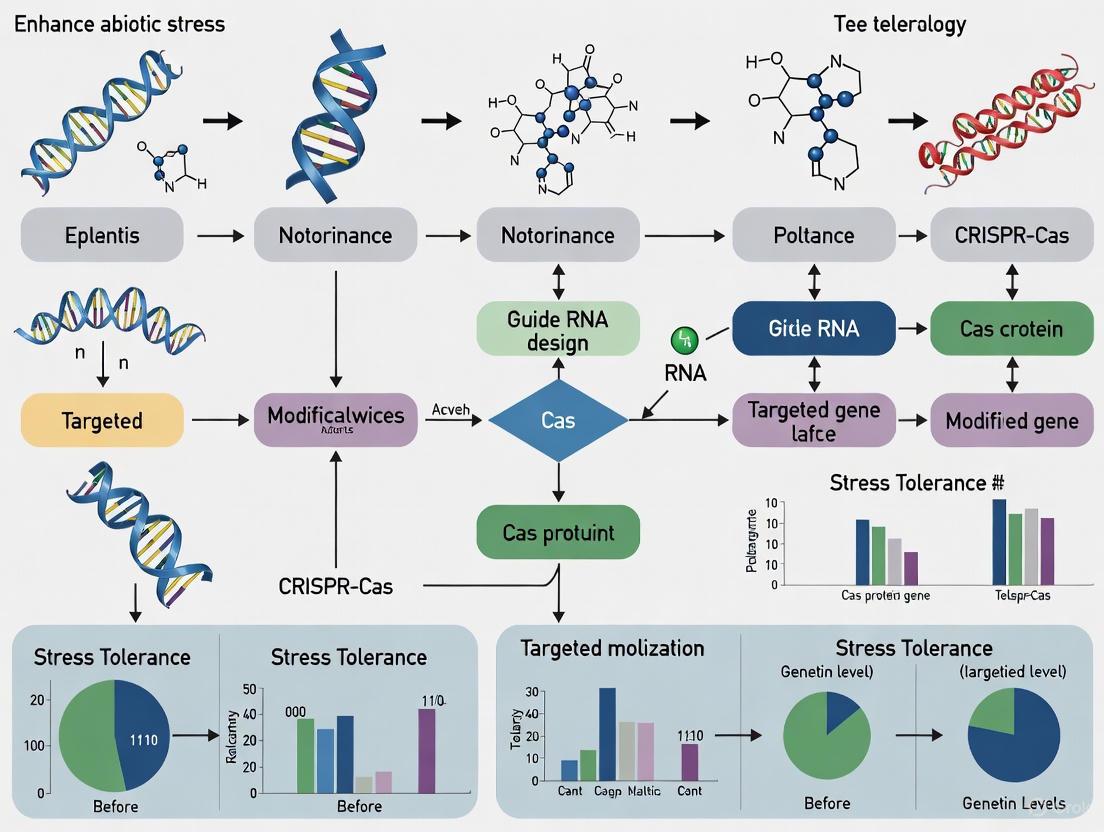
This article provides a comprehensive overview of the application of CRISPR-Cas genome editing technology for enhancing abiotic stress tolerance in plants.
CRISPR-Cas Genome Editing: Engineering Abiotic Stress Tolerance in Plants for a Sustainable Agricultural Future
Abstract
This article provides a comprehensive overview of the application of CRISPR-Cas genome editing technology for enhancing abiotic stress tolerance in plants. Aimed at researchers and scientists, it explores the foundational mechanisms by which plants perceive and respond to environmental stresses like drought, salinity, and extreme temperatures. The content details the methodological workflow of CRISPR-Cas systems, from target gene selection to the delivery of editing components into plant cells, and highlights successful applications across major crop species. Furthermore, it addresses critical challenges such as editing efficiency and off-target effects, presenting advanced optimization strategies including base editing and multiplexing. Finally, the article offers a comparative analysis of CRISPR against conventional breeding and transgenic approaches, validating its precision, speed, and potential to develop non-genetically modified (non-GMO) climate-resilient crops, thereby contributing to global food security.
Understanding Plant Stress Responses and the CRISPR-Cas Revolution
The Global Impact of Abiotic Stresses on Agriculture and Food Security
Abiotic stress in crops, stemming from non-living environmental factors such as drought, salinity, and extreme temperatures, has emerged as a defining challenge for sustainable agriculture, especially as climate change accelerates and global food demands intensify [1]. These stresses significantly affect crop productivity, food security, and the livelihoods of farmers worldwide [1]. With increasingly erratic weather patterns and greater pressure on natural resources, research into enhancing abiotic stress tolerance is no longer merely an academic pursuit but a crucial component of global food security strategies. The integration of advanced biotechnological tools, particularly CRISPR-based genome editing, offers transformative potential for developing climate-resilient crops capable of withstanding these environmental challenges [2] [3]. This application note provides a comprehensive overview of the global impact of abiotic stresses and details experimental protocols for investigating and enhancing plant stress tolerance through modern molecular approaches, with emphasis on CRISPR activation (CRISPRa) technologies that enable precise modulation of gene expression without altering DNA sequences [2].
Quantitative Global Impact of Abiotic Stresses
Abiotic stress is responsible for substantial and recurring yield losses across major agricultural production systems worldwide. The following table summarizes the projected impact of various abiotic stresses on global crop yields by 2025, along with their primary physiological effects on plants.
Table 1: Projected Impact of Major Abiotic Stresses on Global Crop Yields by 2025
| Abiotic Stress Type | Estimated Yield Loss (%) | Primary Physiological Effects on Plants | Most Affected Regions |
|---|---|---|---|
| Drought | 35-50% | Cellular dehydration, disrupted photosynthesis, reduced flowering [1] | Arid and semi-arid regions [1] |
| Salinity | 20-30% | Inhibited water uptake, ion toxicity, tissue damage [1] | Irrigated areas worldwide [4] |
| Extreme Heat | 15-25% | Disrupted metabolism, reduced pollen viability, accelerated respiration [1] | Global, increasing with climate change [1] |
| Nutrient Deficiency | 10-15% | Impaired energy production, reduced protein synthesis [1] | Regions with degraded soils [1] |
| Heavy Metal Toxicity | 5-12% | Oxidative damage, inhibition of root growth, metabolic interference [1] [4] | Areas with industrial contamination [4] |
Without effective intervention strategies, these stresses may collectively reduce global crop yields by up to 50%, creating food shortages for an estimated 1.8 billion people [1] [4]. The economic impacts are similarly profound, particularly in developing countries with limited adaptive capacity [1]. Research indicates that over 70% of crop losses worldwide are linked to abiotic stresses, exceeding losses from all biotic stressors combined [1] [4].
Molecular Mechanisms of Abiotic Stress Response
Plants respond to abiotic stresses through sophisticated molecular networks involving stress perception, signal transduction, and expression of stress-responsive genes [3]. Understanding these mechanisms is fundamental to developing enhanced tolerance through genetic engineering.
Key Regulatory Components
- Transcription Factors: NAC, MYB, WRKY, and DREB families regulate expression of numerous stress-responsive genes [3]. These function as master switches controlling complex stress adaptation pathways.
- MicroRNAs (miRNAs): Small non-coding RNAs that fine-tune gene expression by mediating transcript cleavage or translational repression [3].
- Reactive Oxygen Species (ROS) Signaling: While excessive ROS causes oxidative damage, baseline levels function as signaling molecules that activate stress response pathways [5].
- Epigenetic Regulation: Histone modifications, including acetylation and methylation, dynamically regulate chromatin accessibility and gene expression under stress conditions [4].
Common and Stress-Specific Response Pathways
Transcriptome meta-analyses of rice subjected to drought, salt, and cold stress have revealed both shared and unique molecular responses [5]. Only 14 genes demonstrated consistent differential expression across all three stresses, with 12 downregulated and 2 upregulated [5]. Key findings include:
- Identification of non-ABC transporters in the proton-dependent oligopeptide transport (POT) family that are downregulated under multiple stresses, potentially explaining reduced nutrient uptake under stress conditions [5].
- Discovery of TraB-related proteins with vital roles in mitochondrial function that are consistently downregulated [5].
- Stress-specific regulatory networks that enable tailored responses to distinct environmental challenges [5].
Table 2: Key Molecular Players in Abiotic Stress Responses and Their Applications in Crop Improvement
| Molecular Component | Function in Stress Response | Biotechnological Application | Example Crops |
|---|---|---|---|
| DREB/CBF Transcription Factors | Activate cold and dehydration-responsive genes [5] | Overexpression for enhanced drought and cold tolerance [3] | Rice, Arabidopsis [5] |
| OsNCED Genes | Encode rate-limiting enzymes in ABA biosynthesis for stomatal closure [5] | CRISPR-mediated modulation for improved water use efficiency [3] | Rice [5] |
| Hsp20 Chaperones | Prevent protein aggregation under heat stress [4] | Genome editing of promoter elements to enhance thermo-tolerance [4] | Lettuce [4] |
| Vacuolar H⁺-Pyrophosphatase | Enhances vacuolar solute accumulation for osmotic adjustment [6] | Promoter engineering to improve spikelet fertility under heat stress [6] | Rice [6] |
| SiEPF2 | Regulates stomatal density and panicle morphology [6] | CRISPR knockout to optimize water use efficiency and yield trade-offs [6] | Foxtail millet [6] |
Experimental Protocols for Abiotic Stress Research
Protocol 1: Quantitative Proteomic Time-Course Analysis of Abiotic Stress Responses
Objective: To quantify dynamic proteome-level changes in plant shoots and roots during osmotic and salt stress using high-throughput mass spectrometry [7].
Materials and Reagents:
- Arabidopsis thaliana Col-0 seeds
- 0.5× MS medium with 0.8% plant agar
- Stress solutions: 150 mM NaCl (salt stress), 300 mM mannitol (osmotic stress)
- Protein extraction buffer: 50 mM Hepes-KOH (pH 8.0), 100 mM NaCl, 4% (w/v) SDS
- Geno/Grinder for tissue homogenization
- FAIMSpro-coupled Orbitrap mass spectrometer with BoxCarDIA acquisition capability [7]
Methodology:
- Plant Growth and Stress Treatment:
- Sterilize and stratify Arabidopsis seeds at 4°C for 4 days in darkness.
- Germinate under 16h:8h photoperiod (100 μmol/m²/s LED) at constant 22°C for 15 days using vertical plate holders to minimize root light exposure.
- At Zeitgeber Time 3 (ZT3) of day 14, transfer seedlings to control, 150 mM NaCl, or 300 mM mannitol plates.
- Harvest shoots and roots separately at 0h, 1h, 3h, 6h, 12h, and 24h post-stress exposure with minimum 3 biological replicates per time point [7].
Protein Extraction and Digestion:
- Flash-freeze tissues in liquid N₂ and homogenize using Geno/Grinder (30s at 1200 rpm).
- Aliquot 100 mg (shoot) and 50 mg (root) fractions maintaining liquid N₂ temperature.
- Resuspend in protein extraction buffer at 1:2 (w/v) ratio.
- Extract by shaking at 1000 RPM, 95°C for 5 minutes.
- Centrifuge at 20,000×g for 10 minutes at room temperature and retain supernatant [7].
LC-MS/MS Analysis with Multi-CV FAIMSpro:
- Utilize compensation voltage (CV) stepping (-30, -50, -70) with BoxCarDIA acquisition.
- Perform chromatographic separation using 21-minute microflow gradients.
- Acquire ∼42 samples daily with consistent quantification of >5000 Arabidopsis proteins [7].
Data Analysis:
- Process raw files using DIA-NN or Spectronaut software.
- Identify significantly changing proteins (q-value < 0.05, |log2FC| > 1).
- Perform cluster analysis to identify early, mid, and late stress response proteins.
- Validate candidate targets using gene-deficient knockout plant lines under stress conditions [7].
Figure 1: Proteomic analysis workflow for time-course abiotic stress studies.
Protocol 2: CRISPR Activation for Enhanced Abiotic Stress Tolerance
Objective: To employ CRISPRa systems for targeted upregulation of endogenous stress-responsive genes, creating gain-of-function phenotypes without altering DNA sequences [2].
Materials and Reagents:
- dCas9 transcriptional activators (e.g., dCas9-VPR, dCas9-TV)
- Plant-specific programmable transcriptional activators (PTAs)
- sgRNA design software (e.g, CRISPOR, CHOPCHOP)
- Agrobacterium strains for plant transformation
- Selection antibiotics appropriate for plant species
- qRT-PCR reagents for expression validation
- Stress induction materials (PEG, NaCl, temperature-controlled growth chambers)
Methodology:
- Target Identification and sgRNA Design:
Vector Construction:
- Clone dCas9-activator fusion (e.g., dCas9-6×TAL-2×VP64) into plant expression vector.
- Insert sgRNA expression cassettes using Golden Gate or Gibson Assembly.
- Include appropriate plant selection markers (e.g., hygromycin, kanamycin resistance) [2].
Plant Transformation:
Molecular Characterization:
- Confirm transgene integration via PCR and Southern blotting.
- Quantify target gene expression using qRT-PCR.
- Assess epigenetic changes at target loci through ChIP-qPCR for H3K27ac marks [2].
Phenotypic Validation Under Stress Conditions:
- Subject T1 and T2 generations to controlled stress conditions:
- Drought: Withhold irrigation or use PEG-infused media
- Salinity: Apply 100-150 mM NaCl solutions
- Heat: Expose to 35-42°C depending on species
- Measure physiological parameters (photosynthetic rate, stomatal conductance, water use efficiency).
- Evaluate biochemical markers (proline content, antioxidant enzyme activities, chlorophyll retention).
- Quantify yield components under stress conditions [2] [6].
- Subject T1 and T2 generations to controlled stress conditions:
Figure 2: CRISPR activation workflow for enhancing abiotic stress tolerance.
Research Reagent Solutions Toolkit
Table 3: Essential Research Reagents and Resources for Abiotic Stress Studies
| Reagent/Resource | Function/Application | Examples/Specifications | Key Considerations |
|---|---|---|---|
| CRISPRa Systems | Targeted gene activation without DNA cleavage [2] | dCas9-VPR, dCas9-TV, plant-specific PTAs [2] | Optimize activator strength for specific applications; monitor potential pleiotropic effects [2] |
| FAIMSpro Technology | Enhanced proteome coverage in LC-MS/MS [7] | Multi-CV settings (-30, -50, -70) with BoxCarDIA [7] | Reduces sample complexity; enables shorter gradients while maintaining depth [7] |
| Abiotic Stress Inducers | Simulate environmental stresses in controlled conditions | NaCl (salinity), PEG-8000 (osmotic stress), temperature-controlled chambers | Standardize concentration and duration for reproducible phenotyping [5] |
| Plant Transformation Vectors | Delivery of genetic constructs | Gateway-compatible vectors, modular CRISPR systems | Species-specific optimization required; consider binary vectors for Agrobacterium [2] [6] |
| Phenotyping Equipment | Quantify physiological responses | Infrared gas analyzers (photosynthesis), chlorophyll fluorimeters, osmometers | Establish baseline measurements before stress application [1] |
| RNAi Constructs | Gene silencing for functional validation | Hairpin RNAs, artificial miRNAs | Useful for comparative studies with CRISPRa approaches [3] |
| Nanoparticle Delivery Systems | Alternative transformation method | Zinc oxide nanoparticles for gene modulation [4] | Potential for reducing transgenic footprint; optimize size and concentration [4] |
The escalating threat of abiotic stresses to global agriculture necessitates innovative approaches to crop improvement. Integrating advanced molecular tools – from high-throughput proteomics to precision genome editing – provides powerful strategies for elucidating stress response mechanisms and developing climate-resilient crops. The experimental protocols detailed herein enable comprehensive investigation of abiotic stress responses at multiple biological levels, from protein dynamics to phenotypic outcomes. CRISPR activation technologies represent a particularly promising avenue for crop improvement, as they allow for precise upregulation of endogenous genes while preserving native regulatory contexts and minimizing unintended effects [2]. As climate change intensifies, these advanced biotechnological approaches will be increasingly crucial for safeguarding global food security against the mounting challenges of abiotic stress.
Mechanisms of Plant Perception and Signaling under Drought, Salinity, and Heat Stress
Abiotic stresses such as drought, salinity, and heat represent major environmental constraints that severely impair plant growth, development, and crop productivity worldwide. Understanding the sophisticated mechanisms plants employ to perceive and respond to these stresses is fundamental for developing climate-resilient crops. This application note comprehensively reviews the core signaling pathways and response mechanisms activated under drought, salinity, and heat stress conditions, with particular emphasis on their implications for CRISPR-mediated genetic improvement. We detail the key sensors, signaling components, hormonal cross-talk, and gene regulatory networks that constitute the plant's adaptive toolkit. Additionally, we provide standardized protocols for assessing stress responses and leveraging CRISPR technology to enhance abiotic stress tolerance, supported by data tables and pathway visualizations tailored for research applications.
Plants, as sessile organisms, have evolved complex molecular networks to perceive, transduce, and respond to environmental stresses including drought, salinity, and heat [8] [9]. These abiotic stresses disrupt cellular homeostasis, triggering a cascade of physiological, biochemical, and molecular changes that can significantly reduce crop yields [10] [11]. Climate change is exacerbating the prevalence and intensity of these stresses, posing a serious threat to global food security [10] [12]. Consequently, understanding plant stress signaling has become imperative for developing strategies to enhance crop resilience.
Plants respond to abiotic stresses through integrated mechanisms involving stress perception, signal transduction, and transcriptional reprogramming [9]. The initial perception of stress occurs through specific sensors and receptors located in various cellular compartments, which then activate downstream signaling pathways involving phytohormones, secondary messengers, and protein kinases [9]. These signaling cascades ultimately modulate gene expression through transcription factors, leading to physiological and metabolic adjustments that enhance stress tolerance [10] [11].
This application note synthesizes current knowledge on plant perception and signaling mechanisms under drought, salinity, and heat stress, with a specific focus on their application in CRISPR-based crop improvement strategies. We provide detailed experimental protocols for investigating these pathways and a comprehensive toolkit of research reagents to facilitate research in this critical area.
Stress Perception and Signaling Pathways
Primary Stress Sensors and Signal Transduction
Plants employ sophisticated mechanisms to detect changes in their environment at the cellular level. The initial perception of abiotic stresses involves specific sensors that detect alterations in osmotic pressure, ion concentration, membrane fluidity, and protein stability [9].
Table 1: Putative Abiotic Stress Sensors and Their Characteristics
| Stress Type | Putative Sensor/Channel | Localization | Mechanism of Action | Reference |
|---|---|---|---|---|
| Osmotic Stress | OSCA1 | Plasma Membrane | Hyperosmolality-gated calcium-permeable channel; mediates Ca²⁺ influx | [9] |
| Cold Stress | COLD1 | Plasma Membrane & ER | Interacts with RGA1 (Gα protein); potentially regulates Ca²⁺ channels | [9] |
| Heat Stress | Phytochrome B (phyB) | Cytoplasm/Nucleus | Photoreceptor that also perceives temperature changes; regulates PIF4 | [12] |
| General Stress | Mechanosensitive (MSL) channels | Various membranes | Sense membrane tension changes induced by osmotic imbalances | [9] |
| Salt Stress | Unknown | - | Likely involves ion-specific sensors that detect Na⁺ influx | [13] |
For drought and salt stress, the primary signal is hyperosmotic stress, which reduces cellular turgor pressure [9]. The Arabidopsis OSCA1 protein represents a identified hyperosmolality-gated calcium channel that mediates the rapid increase in cytosolic Ca²⁺ in response to osmotic stress [9]. Similarly, the COLD1 protein in rice interacts with the G-protein alpha subunit RGA1 to confer chilling tolerance, potentially through calcium signaling [9]. Heat stress perception involves multiple mechanisms, including the phytochrome B photoreceptor that also functions as a thermosensor, and changes in membrane fluidity that activate various signaling pathways [12].
The sensing of stress is not limited to the plasma membrane. Organelles including the endoplasmic reticulum (ER) and chloroplasts also participate in stress perception. ER stress, caused by the accumulation of unfolded proteins under adverse conditions, activates the unfolded protein response (UPR) through sensors such as bZIP28 and IRE1 [9]. Similarly, chloroplasts generate retrograde signals to the nucleus in response to stress-induced dysfunction [9].
Figure 1: Integrated Stress Signaling Pathway in Plants. This diagram illustrates the coordinated sequence of events from initial stress perception through sensor activation, secondary messenger generation, signaling pathway engagement, and ultimate cellular responses that confer stress tolerance.
Hormonal Regulation and Cross-Talk
Phytohormones function as central regulators of plant responses to abiotic stresses, engaging in complex cross-talk to fine-tune adaptive processes [10]. Abscisic acid (ABA) emerges as a primary signaling molecule in drought and salinity responses, while ethylene, jasmonates, and auxins play modulating roles across stress conditions [10] [12].
Table 2: Key Phytohormones in Abiotic Stress Responses
| Hormone | Primary Role in Stress Response | Key Signaling Components | Target Processes |
|---|---|---|---|
| Abscisic Acid (ABA) | Master regulator of drought and salinity responses; induces stomatal closure | PYL receptors, PP2C, SnRK2, ABF TFs | Stomatal regulation, osmotic adjustment, stress-responsive gene expression |
| Ethylene | Multifunctional role in heat, drought, and flooding responses; promotes aerenchyma formation | CTR1, EIN2, EIN3, ERF TFs | Growth regulation, senescence, aerenchyma formation, metabolic adjustment |
| Jasmonic Acid (JA) | Defense regulation under combined stresses; cross-talk with ABA | COI1, JAZ, MYC2 | Antioxidant defense, secondary metabolism, growth-defense balance |
| Auxin | Growth regulation under mild stress; organ patterning and architecture | TIR1/AFB, AUX/IAA, ARF | Root architecture, cell expansion, differential growth |
| Gibberellins (GA) | Often down-regulated under stress to conserve energy; antagonists with ABA | DELLA proteins, GID1 | Growth suppression, resource allocation, energy conservation |
ABA accumulation under drought and salinity stress triggers stomatal closure to reduce water loss and activates expression of stress-responsive genes [10] [9]. ABA signaling involves a core module consisting of PYL receptors, PP2C phosphatases, and SnRK2 kinases, which ultimately phosphorylate transcription factors such as ABFs to mediate transcriptional reprogramming [10]. Recent studies have shown that ABA signaling genes (PP2C, SnRK2) can be downregulated by master transcription factors like AHL20, PBF, and MNB1A, indicating complex regulatory networks [10].
Hormonal cross-talk creates a sophisticated signaling network that allows plants to prioritize specific responses according to the stress type and severity [10]. For instance, ABA and JA pathways often interact synergistically, while SA and JA pathways typically exhibit antagonistic interactions [10]. The transcription factor PBF interacts with JA signaling genes like MYC2, COI1, and JAZ, illustrating the molecular basis for hormone integration [10]. Furthermore, hormonal signaling varies significantly across developmental stages, with auxin and gibberellin prominent in early floral stages, while ABA, ethylene, and JA dominate during later developmental phases [10].
Experimental Protocols for Investigating Stress Signaling
Protocol: Assessing Early Stress Signaling Events
Objective: To detect and quantify early signaling events in plant stress responses, including calcium spikes, ROS bursts, and phosphorylation cascades.
Materials:
- Genetically encoded biosensors (e.g., calcium indicators, ROS probes)
- Phospho-specific antibodies for key signaling kinases
- Real-time PCR equipment
- Confocal microscopy system
Procedure:
- Plant Material Preparation:
- Grow Arabidopsis seedlings or crop plant specimens under controlled conditions for 10-14 days.
- For stress treatments, transfer plants to media containing 300 mM mannitol (drought simulation), 150 mM NaCl (salinity stress), or incubate at 38°C (heat stress).
Calcium Flux Measurement:
- Utilize plants expressing the calcium reporter aequorin or GCAMP.
- Monitor cytosolic Ca²⁺ changes in real-time using a luminometer or confocal microscope.
- Apply stress treatments and record calcium spikes for 30-60 minutes post-treatment.
ROS Detection:
- Incubate roots or leaves with H₂DCFDA (10 µM) for 30 minutes in darkness.
- Apply stress treatments and quantify fluorescence intensity at excitation/emission of 485/535 nm.
- Collect samples at 0, 15, 30, 60, and 120 minutes post-stress application.
Kinase Activation Assessment:
- Extract proteins from stress-treated tissues at designated time points.
- Perform western blotting with phospho-specific antibodies against SnRK2, MAPK, or CDPK kinases.
- Quantify band intensities using densitometry software.
Early Response Gene Expression:
- Isolate RNA from samples collected at 0, 30, 60, and 120 minutes post-stress.
- Conduct RT-qPCR for immediate early genes such as RD29A, COR15A, and HSP70.
- Normalize expression levels using reference genes (e.g., ACTIN, UBQ10).
Data Analysis: Compare the kinetics of signaling events across different stress conditions. Statistical analysis should include at least three biological replicates with appropriate ANOVA and post-hoc tests.
Protocol: CRISPR-Mediated Gene Editing for Stress Tolerance
Objective: To implement CRISPR/Cas9 genome editing for enhancing abiotic stress tolerance in plants, using the AsDREBL gene in creeping bentgrass as a model [14].
Materials:
- Plant expression vector with codon-optimized Cas9 (e.g., pRD297)
- gRNA cloning backbone with plant-specific promoter (e.g., wheat U6)
- Plant material with established transformation system (e.g., embryogenic calli)
- Selection agents (hygromycin for pCAMBIA1300-based vectors)
- Restriction enzymes for RFLP analysis (e.g., EcoRV)
Procedure:
- Target Selection and gRNA Design:
- Identify target gene sequence (e.g., AsDREBL) and scan for 5'-NGG PAM sites.
- Select 20-nucleotide target sequence with minimal off-target potential.
- Design primers for cloning target sequence into gRNA expression cassette.
Vector Construction:
- Incorporate the 20-nt target sequence into the sgRNA cassette upstream of the tracrRNA scaffold.
- Clone the sgRNA expression cassette into a plant transformation vector containing Cas9 driven by a maize ubiquitin promoter.
- Use pCAMBIA1300 with hygromycin resistance as the plant selection marker.
Plant Transformation:
- Induce embryogenic calli from mature seeds on MS medium containing 6.6 mg/L dicamba.
- Transform calli via gene gun bombardment using the constructed CRISPR vector.
- Select transformed calli on MS medium with 200 mg/L hygromycin.
- Regenerate shoots on MS medium with 1 mg/L 6-BA and 100 mg/L hygromycin.
- Root regenerated shoots on hormone-free MS medium with 50 mg/L hygromycin.
Mutant Identification:
- Isolate genomic DNA from regenerated plants using a commercial kit.
- PCR-amplify the target region using gene-specific primers.
- Perform restriction digestion (RFLP) with enzyme matching the target site.
- Identify mutants by undigested PCR products on agarose gels.
- Confirm mutations by Sanger sequencing of cloned PCR products.
Phenotypic Validation:
- Subject mutant and wild-type plants to drought by water withholding.
- Apply salinity stress through salt spray or irrigation with NaCl solutions.
- Monitor and score stress tolerance phenotypes over 2-4 weeks.
Applications: This protocol can be adapted for various crop species by modifying the transformation method and target genes. Successful application results in enhanced drought and salinity tolerance, as demonstrated in creeping bentgrass [14].
Figure 2: CRISPR/Cas9 Workflow for Enhancing Abiotic Stress Tolerance. This diagram outlines the systematic approach from target identification to phenotypic validation, highlighting key applications in modifying stress-responsive genes.
The Scientist's Toolkit: Research Reagent Solutions
Table 3: Essential Research Reagents for Abiotic Stress Signaling Studies
| Reagent Category | Specific Examples | Application/Function | Research Context |
|---|---|---|---|
| Genetic Reporters | Aequorin, GCAMP6, R-GECO1 | Real-time monitoring of Ca²⁺ signatures in response to stress | Elucidating early signaling events [9] |
| Biosensors | H₂DCFDA, Amplex Red | Detection of ROS accumulation in stressed tissues | Quantifying oxidative stress levels [10] |
| Antibodies | Phospho-SnRK2, Anti-HSP, Anti-LEA | Detection of stress-responsive protein accumulation | Protein-level validation of stress responses |
| Hormone Assay Kits | ABA ELISA, JA/MS kits | Quantification of phytohormone levels in stressed plants | Hormonal profiling under different stresses [10] |
| CRISPR Components | Cas9 expression vectors, gRNA scaffolds | Targeted genome editing of stress-related genes | Functional validation and trait improvement [11] [14] |
| Transformation Systems | Agrobacterium strains, Gene gun | Delivery of genetic constructs into plant cells | Generating modified plants for stress studies [14] |
| Selection Agents | Hygromycin, Kanamycin | Selection of successfully transformed plant tissues | Plant transformation workflows [14] |
CRISPR Applications in Abiotic Stress Tolerance
CRISPR/Cas9 genome editing technology has revolutionized the development of stress-resilient crops by enabling precise modifications of key stress-responsive genes [11] [3]. This technology allows researchers to knockout negative regulators, fine-tune expression of positive regulators, and engineer transcription factors that control complex stress response networks.
Successful applications include the knockout of the AsDREBL gene in creeping bentgrass, which resulted in enhanced drought and salinity tolerance [14]. Similarly, editing of OsRR22 and OsDST genes in rice has improved salinity tolerance, while modifications to TaERF3 and TaHKT1;5 in wheat have enhanced drought resilience [10]. The CRISPR system has been successfully applied in more than 20 agriculturally important crops, enabling targeted modification of stress-related genes to enhance abiotic stress tolerance [11].
Beyond simple gene knockouts, advanced CRISPR applications include:
- CRISPRa (activation): For upregulating stress-tolerance genes [11]
- Base editing: For precise nucleotide changes without double-strand breaks [11]
- Multiplex editing: For simultaneous modification of multiple stress-related genes [3]
The technology is particularly valuable for manipulating complex quantitative trait loci (QTLs) and transcription factors such as DREB, WRKY, and NAC that regulate broad stress response networks [11] [3]. These approaches allow for the development of crops with enhanced tolerance without introducing foreign DNA, potentially streamlining regulatory approval [11].
The mechanistic understanding of plant perception and signaling under drought, salinity, and heat stress provides critical insights for developing climate-resilient crops through advanced biotechnological approaches. The integrated signaling networks involving stress sensors, hormonal cross-talk, and transcriptional reprogramming represent key targets for genetic improvement. CRISPR/Cas9 technology, in particular, offers unprecedented precision in modifying these pathways to enhance stress tolerance without compromising yield. The protocols and reagents detailed in this application note provide researchers with practical tools to investigate and manipulate these mechanisms, accelerating the development of crops capable of withstanding the challenging environmental conditions imposed by climate change. Future research should focus on understanding the complex interactions between multiple simultaneous stresses and developing editing strategies that enhance broad-spectrum resilience while maintaining agricultural productivity.
The Bacterial Origins of a Revolutionary Tool
The Clustered Regularly Interspaced Short Palindromic Repeats (CRISPR) and CRISPR-associated (Cas) system originated as an adaptive immune mechanism in prokaryotes. First identified in 1987 in E. coli by Yoshizumi Ishino and colleagues, these strange repeated sequences in bacterial genomes remained mysterious for nearly two decades [15] [16]. Francisco Mojica later characterized these sequences and coined the term "CRISPR," recognizing them as a bacterial defense system [16]. The system functions as a molecular memory bank: when bacteria survive viral attacks, they incorporate fragments of viral DNA as "spacers" between repetitive CRISPR sequences in their own genome [17] [18]. Upon subsequent viral invasion, these stored sequences are transcribed into RNA guides that direct Cas proteins to recognize and cleave matching foreign DNA, thus disabling the pathogen [17] [18].
The transformation of this bacterial immunity mechanism into a programmable gene-editing platform earned Emmanuelle Charpentier and Jennifer Doudna the 2020 Nobel Prize in Chemistry [15] [16]. Their critical breakthrough was recognizing that the system could be simplified by combining two natural RNA components – the CRISPR RNA (crRNA) and trans-activating crRNA (tracrRNA) – into a single guide RNA (sgRNA) [16]. This engineered sgRNA could be programmed to direct the Cas9 nuclease to any DNA sequence of interest, creating a versatile and precise genetic scissor [15] [16].
Molecular Mechanisms: From Scissors to Dimmer Switches
Core Components and DNA Recognition
The CRISPR-Cas9 system requires two fundamental components for targeted DNA modification: the Cas9 endonuclease and a guide RNA (gRNA) [11] [19]. The gRNA is a synthetic fusion molecule comprising both the crRNA, which contains a 20-nucleotide spacer sequence complementary to the target DNA, and the tracrRNA, which serves as a scaffold for Cas9 binding [19] [16]. For successful DNA recognition and cleavage, the target sequence must be adjacent to a short Protospacer Adjacent Motif (PAM) [19]. For the most commonly used Cas9 from Streptococcus pyogenes, the PAM sequence is 5'-NGG-3' located immediately downstream of the target sequence [11].
The DNA cleavage mechanism involves two distinct nuclease domains within Cas9 [11] [19]. The HNH domain cleaves the DNA strand complementary to the gRNA spacer sequence, while the RuvC domain cleaves the opposite strand [11] [19]. This coordinated action generates a precise double-strand break (DSB) at the target site [11] [19].
DNA Repair Pathways and Genetic Outcomes
Once a double-strand break is introduced, cellular repair mechanisms are activated, leading to different genetic outcomes:
- Non-Homologous End Joining (NHEJ): This dominant repair pathway directly ligates broken DNA ends without a template, often resulting in small insertions or deletions (indels) [15] [11]. When these indels occur in coding sequences and disrupt the reading frame, they effectively knock out gene function [15] [19].
- Homology-Directed Repair (HDR): This pathway uses a homologous DNA template – either the sister chromatid or an externally supplied donor DNA – to precisely repair the break [15] [11]. By providing a designed donor template, researchers can introduce specific gene corrections, insertions, or replacements [15] [19].
Beyond Cutting: Regulatory Functions
Recent research has revealed that CRISPR-Cas systems possess functions beyond DNA cleavage. Studies in Streptococcus pyogenes have identified a long form of tracrRNA that can reprogram Cas9 to function as a transcriptional repressor rather than a nuclease [17]. This long tracrRNA contains a segment that mimics the guide RNA, allowing it to bind DNA without triggering cleavage [17]. When abundant, this long tracrRNA sits on DNA and prevents gene expression, effectively acting as a genetic dimmer switch that can dial down CRISPR-Cas9 activity or other targeted genes [17]. This discovery expands CRISPR's applications to include fine-tuned gene regulation without permanent genetic alterations.
Advanced CRISPR Toolboxes and Applications
The Expanding CRISPR Arsenal
While Cas9 remains the most widely recognized CRISPR system, diverse Cas variants with distinct properties have been discovered and harnessed for specialized applications:
Table 1: CRISPR-Cas Systems and Their Applications
| System Type | Signature Protein | Target | PAM Requirement | Key Applications | Examples in Abiotic Stress Research |
|---|---|---|---|---|---|
| Type II | Cas9 | DNA | 5'-NGG-3' (SpCas9) | Gene knockout, knock-in, transcriptional regulation | Editing transcription factors (DREB, ERF) for drought tolerance [11] |
| Type V | Cas12a/b | DNA | 5'-TTN-3' (AsCas12a) | Gene editing, DNA detection, multiplexed editing | Multiplex editing of stress-responsive genes [15] |
| Type VI | Cas13a-d | RNA | Minimal | RNA knockdown, RNA editing, viral interference | Targeting RNA viruses, degrading stress-related transcripts [20] |
CRISPR Systems in Agricultural Innovation
The application of CRISPR systems has revolutionized plant biotechnology, particularly in developing crops with enhanced abiotic stress tolerance. Several studies demonstrate this potential:
Table 2: CRISPR-Mediated Enhancement of Abiotic Stress Tolerance in Plants
| Plant Species | Edited Gene(s) | CRISPR System | Stress Tolerance Improved | Key Physiological Changes |
|---|---|---|---|---|
| Fraxinus mandshurica | FmbHLH1 | CRISPR/Cas9 | Drought | Enhanced ROS scavenging, improved osmotic adjustment [21] |
| Rice (Oryza sativa) | OsRR22, OsDST | CRISPR/Cas9 | Salinity, drought | Improved ion homeostasis, water use efficiency [11] [10] |
| Brassica crops | Various transcription factors | CRISPR/Cas9 | Heat, salinity, drought | Activation of heat shock proteins, antioxidant defense [20] |
| Wheat (Triticum aestivum) | TaERF3, TaHKT1;5 | CRISPR/Cas9 | Salinity | Sodium exclusion, tissue tolerance mechanisms [10] |
Experimental Protocols for Plant Stress Tolerance Research
Protocol: CRISPR-Cas9 Mediated Gene Editing for Drought Tolerance in Woody Plants
This protocol adapts established methods from recent Fraxinus mandshurica research [21] for applications in abiotic stress tolerance studies.
Target Selection and Vector Construction
- Target Site Identification: Input the coding sequence of your target gene (e.g., FmbHLH1 transcription factor) into the online tool Target Design (http://skl.scau.edu.cn/targetdesign/). Select three target sites within the 5' region of the gene to maximize chances of functional knockout [21].
- Vector Assembly: Clone synthesized oligonucleotides corresponding to selected targets into the BsaI-digested pYLCRISPR/Cas9P35S-N vector behind the AtU6-26 promoter [21].
- Transformation: Introduce the constructed vector into Agrobacterium tumefaciens strain EHA105 using freeze-thaw method. Verify construction by PCR amplification using vector primers paired with target-specific primers [21].
Plant Transformation and Selection
- Plant Material Preparation: Surface-sterilize seeds and culture embryos on Woody Plant Medium (WPM) solid medium (WPM + 20 g/L sucrose + 6 g/L agar, pH = 5.8) without plant hormones [21].
- Kanamycin Lethal Concentration Test: Culture wild-type embryos on WPM containing kanamycin at concentrations (20, 30, 40, 50, 60, and 70 mg/L) to determine the optimal selection concentration. Embryo death is indicated by color change from green to white [21].
- Agrobacterium-Mediated Transformation: Grow Agrobacterium cultures to OD600 = 0.5-0.8 in LB medium with appropriate antibiotics. Centrifuge at 1,500 × g for 10 minutes, resuspend in inoculation medium, and infect plant growing points for 15-30 minutes [21].
- Selection and Regeneration: Co-culture infected explants on WPM solid medium for 3 days, then transfer to selection medium containing determined kanamycin concentration. Subculture every 2 weeks until shoot regeneration [21].
Screening and Validation
- Molecular Screening: Extract genomic DNA from regenerated shoots using plant genomic DNA extraction kit. Amplify target region and sequence to identify mutations [21].
- Homozygous Plant Generation: Induce clustered buds by supplementing media with appropriate cytokinin concentrations. Screen multiple buds from each transformed growing point to identify homozygous edits [21].
- Phenotypic Validation: Subject T1 generation plants to drought stress by withholding water or applying PEG6000 solution. Evaluate physiological parameters including ROS scavenging enzymes, osmotic potential, and photosynthetic efficiency [21].
The Scientist's Toolkit: Essential Research Reagents
Table 3: Essential Reagents for CRISPR-Cas Plant Transformation
| Reagent/Category | Specific Examples | Function and Application Notes |
|---|---|---|
| CRISPR Vectors | pYLCRISPR/Cas9P35S-N, pHEE401E | Binary vectors for plant transformation; contain Cas9 expression cassette and gRNA cloning sites [21] |
| Agrobacterium Strains | EHA105, GV3101 | Disarmed strains for plant transformation; optimized for DNA delivery to plant cells [21] |
| Plant Culture Media | Woody Plant Medium (WPM), Murashige and Skoog (MS) medium | Nutrient formulations supporting plant growth and regeneration; composition varies by species [21] |
| Selection Agents | Kanamycin, Hygromycin B | Antibiotics for selecting transformed plants; concentration must be optimized for each species [21] |
| DNA Extraction Kits | Plant genomic DNA extraction kit | For high-quality DNA isolation from plant tissues for PCR genotyping and sequencing [21] |
| Target Design Tools | Target Design website, CRISPR-P 2.0 | Bioinformatics platforms for designing specific gRNAs with minimal off-target effects [21] |
The journey of CRISPR-Cas from a bacterial immune system to programmable gene scissors represents one of the most significant breakthroughs in modern biotechnology. While this technology has already demonstrated remarkable potential for enhancing abiotic stress tolerance in crops, several frontiers remain unexplored. Future directions include developing PAM-relaxed Cas variants to expand targeting range, improving base editing systems for precise nucleotide changes without double-strand breaks, and implementing multiplex editing strategies to simultaneously modify multiple stress-responsive pathways [11] [19]. As climate change intensifies environmental stresses, these CRISPR-based approaches will be crucial for developing resilient crops that can maintain productivity under challenging conditions, ultimately contributing to global food security [20] [11].
Clustered Regularly Interspaced Short Palindromic Repeats (CRISPR) and CRISPR-associated (Cas) systems have initiated a new chapter in genetic engineering, derived from an adaptive immune system in bacteria [22]. This technology has revolutionized plant genome editing due to its relative ease, efficiency, and wide applicability [22] [23]. For researchers aiming to enhance abiotic stress tolerance in crops—addressing challenges like drought, salinity, heat, and heavy metals—mastering the core components of the CRISPR/Cas system is the foundational step [23] [24]. This document provides detailed application notes and protocols centered on these core components: the Cas nuclease, guide RNA (gRNA), Protospacer Adjacent Motif (PAM), and the DNA repair pathways (Non-Homologous End Joining and Homology-Directed Repair) that execute the final edit.
Core Components and Their Functions
The CRISPR/Cas9 system functions as a precise two-component genetic scissor [22] [25].
- CRISPR-associated endonuclease (Cas9): This is the DNA-cleaving enzyme, the "scissor" itself. In the commonly used system from Streptococcus pyogenes (SpCas9), it is a large multi-domain protein that creates double-strand breaks (DSBs) in the target DNA [23] [25].
- Guide RNA (gRNA): This is a short, synthetic RNA molecule that guides the Cas9 nuclease to a specific DNA locus. It is a single guide RNA (sgRNA) formed by fusing two natural RNA molecules: the CRISPR RNA (crRNA) and the trans-activating crRNA (tracrRNA) [22] [25]. The gRNA consists of:
- A scaffold sequence: Necessary for binding to the Cas9 protein.
- A spacer sequence (∼20 nucleotides): A user-defined sequence that is complementary to the target DNA site and confers specificity to the entire system [25].
The genomic target of the gRNA can be any ~20-nucleotide sequence, provided it is unique in the genome and is located immediately upstream of a short DNA sequence known as the Protospacer Adjacent Motif (PAM) [25]. For SpCas9, the PAM sequence is 5'-NGG-3', where 'N' is any nucleotide [23] [25]. The PAM serves as a binding signal for the Cas9 nuclease, and its presence is absolutely required for DNA cleavage [25].
Once the Cas9-gRNA complex binds to a complementary DNA target adjacent to a PAM, the Cas9 nuclease induces a double-strand break (DSB) ∼3–4 nucleotides upstream of the PAM sequence [25]. The cell then repairs this DSB through one of two primary endogenous repair pathways, which ultimately result in the desired genetic alteration [23] [26].
Table 1: Core Components of the CRISPR/Cas9 System for Genome Editing
| Component | Function | Key Characteristics |
|---|---|---|
| Cas9 Nuclease | DNA-cleaving enzyme; creates double-strand breaks. | Derived from S. pyogenes (SpCas9); has two nuclease domains: RuvC and HNH [25]. |
| Guide RNA (gRNA) | Directs Cas9 to the specific target DNA locus. | ~20 nt spacer defines target; scaffold binds Cas9 [22] [25]. |
| PAM Sequence | Cas9-binding signal in the DNA. | For SpCas9, the sequence is 5'-NGG-3'; essential for cleavage [25]. |
| DNA Repair Pathways | Cellular machinery that repairs DSBs to create edits. | NHEJ (error-prone) and HDR (precise) [23] [26]. |
DNA Repair Pathways: NHEJ and HDR
The double-strand break generated by CRISPR/Cas9 is repaired by the host cell's machinery, primarily through two distinct pathways: Non-Homologous End Joining (NHEJ) and Homology-Directed Repair (HDR). The choice of pathway determines the nature of the final genetic outcome and is therefore a critical consideration for experimental design [23] [26].
Non-Homologous End Joining (NHEJ)
NHEJ is the primary and most efficient DSB repair mechanism in higher plants [25] [26]. It functions by directly ligating the broken ends of the DNA strand without the need for a homologous template. This process is inherently error-prone, frequently resulting in small insertions or deletions (indels) at the DSB site [25]. In the context of gene editing for abiotic stress tolerance, NHEJ is typically exploited for SDN-1 (Site-Directed Nuclease 1) type editing to create gene knockouts [22]. When these indels occur within the open reading frame of a target gene, they often lead to frameshift mutations and premature stop codons, effectively resulting in a loss-of-function allele [25]. This is a powerful strategy for knocking out negative regulators of abiotic stress tolerance pathways.
Homology-Directed Repair (HDR)
In contrast to NHEJ, HDR is a high-fidelity repair pathway that uses a homologous DNA template to accurately repair the break [25] [26]. This allows for precise genetic modifications, including the introduction of specific point mutations, gene insertions, or gene replacements [26]. This approach aligns with SDN-2 (small edits using a donor template) and SDN-3 (entire gene insertion) strategies [22]. While HDR is the preferred method for precise editing—such as introducing a specific allele of a stress-tolerant gene—its major limitation in plants is its very low natural frequency, which ranges from 10⁻³ to 10⁻⁶, making it inefficient compared to NHEJ [26]. A significant focus of modern protocol development is on enhancing HDR frequency for precise genome editing in plants [26].
Table 2: Comparison of DNA Repair Pathways in CRISPR/Cas9 Genome Editing
| Feature | Non-Homologous End Joining (NHEJ) | Homology-Directed Repair (HDR) |
|---|---|---|
| Repair Mechanism | Direct ligation of break ends; no template needed. | Uses homologous donor DNA template for accurate repair. |
| Efficiency in Plants | High; primary repair pathway. | Very low (10⁻³ to 10⁻⁶); a major barrier [26]. |
| Outcome | Error-prone; creates random insertions/deletions (indels). | Precise; enables specific point mutations, insertions, or replacements. |
| Primary Application | Gene knockouts (SDN-1) [22]. | Precise edits, gene correction, gene insertion (SDN-2/SDN-3) [22] [26]. |
| Key Experimental Factor | Requires only Cas9 and gRNA expression. | Requires a donor template with homology arms. |
Protocol for Designing gRNAs for Abiotic Stress Tolerance Genes in Wheat
Designing a highly specific and efficient gRNA is the most crucial step for successful genome editing, especially in complex genomes like that of wheat (Triticum aestivum). Wheat is a hexaploid crop with a large genome size (17.1 Gb) and over 80% repetitive DNA, which increases the risk of off-target mutations [22]. The following protocol outlines a comprehensive, three-phase strategy for designing gRNAs for knocking out negative regulators of abiotic stress tolerance in wheat, tailored for the SDN-1 approach [22].
Phase 1: Gene Identification and Verification
Objective: To identify and thoroughly characterize the target gene (e.g., a known negative regulator of drought or salinity tolerance).
- Gene Selection: Identify the most promising negative regulator gene through an extensive literature review of genome editing, RNAi, or TILLING studies. The ideal target should have no pleiotropic effects and preferably exhibit tissue-specific expression [22].
- Sequence Retrieval: Obtain the gene sequence, including chromosomal location and homologs, using the Ensembl Plants database or KnetMiner Triticum aestivum tool [22].
- Homolog Analysis: Use the Basic Local Alignment Search Tool (BLAST) and Clustal Omega software to assess the degree of similarity across the three wheat sub-genomes (A, B, D) and with genes in other species. This is critical for identifying a unique target sequence and predicting potential off-target effects [22].
- Cultivar-Specific Variation: Consult the Wheat PanGenome database to incorporate presence-absence variations and diverse allelic forms across different wheat cultivars, enabling precise, cultivar-specific gRNA designing [22].
Phase 2: gRNA Designing and On-/Off-Target Analysis
Objective: To design candidate gRNAs and rigorously analyze their specificity.
- gRNA Design Tool: Use WheatCRISPR software for initial gRNA designing. This tool is specifically developed considering the complexities of the wheat genome [22].
- Parameter Selection:
- Target Sequence: The 20-nucleotide target should be immediately 5' to a PAM sequence (5'-NGG-3' for SpCas9).
- Uniqueness: Ensure the target sequence is unique compared to the rest of the genome to minimize off-target effects. Selecting a target with few genetically similar off-target sites is paramount [22].
- Off-Target Analysis: Use BLAST again to identify sequences in the genome with significant homology to the candidate gRNA spacer, especially in the "seed sequence" (8–10 bases at the 3' end of the gRNA), as mismatches here are more likely to inhibit cleavage [22] [25].
Phase 3: gRNA Validation and Optimization
Objective: To validate the structural stability and functionality of the designed gRNA.
- Secondary Structure Prediction: Use RNA folding tools (e.g., UNAFold, Mfold) to analyze the potential secondary structure of the gRNA. Avoid gRNAs with a propensity to base pair within themselves, which can impede Cas9 binding.
- Gibbs Free Energy Calculation: Assess the binding stability of the gRNA-DNA duplex. A more negative Gibbs free energy generally indicates a more stable binding.
- Vector Homology Check: Verify that the gRNA spacer sequence has no significant similarity to the cloning binary vector to be used in the study, preventing unintended vector integration.
Table 3: Key Parameters for Efficient gRNA Design in Wheat [22]
| Parameter | Goal | Tool/Method |
|---|---|---|
| Target Gene Nature | Identify negative regulator, qualitative trait, tissue-specific expression. | Literature review, KnetMiner. |
| Sequence Uniqueness | Ensure target is unique across A, B, D sub-genomes. | BLAST, Clustal Omega, Wheat PanGenome. |
| Off-Target Score | Minimize off-target activity; prioritize gRNAs with few/similar off-targets. | WheatCRISPR, BLAST. |
| gRNA Secondary Structure | Avoid self-complementarity; ensure gRNA scaffold is accessible for Cas9. | RNA folding software (e.g., UNAFold). |
| Binding Stability | Favor gRNA-DNA duplex with high stability (negative ΔG). | Gibbs free energy calculation. |
Protocol for Selecting and Optimizing Cas Nuclease Variants
The standard SpCas9 can be optimized or replaced with engineered variants to enhance specificity, flexibility, and editing efficiency for abiotic stress studies.
Increasing Specificity with High-Fidelity Cas9 Variants
To minimize off-target effects, which is critical in the large, repetitive wheat genome, replace wild-type SpCas9 with a high-fidelity variant [22] [25]. These enzymes are engineered for enhanced specificity while maintaining robust on-target activity.
- Examples: eSpCas9(1.1), SpCas9-HF1, HypaCas9, evoCas9, and Sniper-Cas9 [25].
- Mechanism: These variants typically work by weakening non-specific interactions between Cas9 and the DNA backbone or by increasing the enzyme's proofreading capabilities [25].
- Protocol: When using these plasmids, follow the supplier's instructions for expression and delivery. The gRNA design rules remain the same as for wild-type SpCas9.
Increasing Targeting Range with PAM-Flexible Cas9 Variants
The requirement for an NGG PAM adjacent to the target site can be a limitation. Engineered "PAM-flexible" Cas9 variants can significantly expand the number of targetable sites in the genome, which is particularly useful for targeting specific domains of a stress-responsive gene [25].
- Examples:
- SpCas9-NG: Recognizes NG PAMs.
- SpG: Recognizes NGN PAMs.
- SpRY: Recognizes NRN (N=A/G) and NYN (N=C/T) PAMs, approaching near-PAMless editing [25].
- Protocol: These variants are used similarly to SpCas9, but the PAM requirement in the target DNA must match the variant's specificity. Always verify the editing efficiency of these novel variants for your target locus.
Precise Editing with Nickase and Catalytically Inactive Cas9
For applications requiring higher precision, the Cas9 nuclease can be converted into a nickase (Cas9n) or a dead Cas9 (dCas9).
- Cas9 Nickase (Cas9n): Generated by a D10A mutation, which inactivates the RuvC domain. Cas9n nicks only one DNA strand. Using two nickases targeting opposite strands and in close proximity (a "double nickase" system) creates a DSB with overhangs. This dramatically increases specificity because it is unlikely that two off-target nicks will occur close enough to generate a DSB [25].
- dead Cas9 (dCas9): Generated by D10A and H840A mutations, which inactivate both nuclease domains. dCas9 binds DNA without cutting it. It can be fused to effector domains (e.g., transcriptional activators, repressors, or base editors) to modulate gene expression or make single-base changes without creating a DSB, which is useful for fine-tuning the expression of stress-related genes [25].
Protocol for Enhancing Homology-Directed Repair (HDR) in Plants
As HDR is inefficient in plants, specific strategies must be employed to make precise edits for introducing abiotic stress-tolerant alleles [26].
Optimize the Donor Template:
- Structure: Use double-stranded DNA donors (e.g., plasmids) with homology arms of at least 500-800 bp for higher efficiency.
- Delivery: Increase donor template dosage using methods like geminivirus-based replicons (GVRs), which achieve high copy numbers in plant nuclei [26].
- Modification: Attach the donor template to the Cas9 protein or gRNA to localize it to the DSB site. Alternatively, use 5' or 3' end modifications (e.g., phosphorothioate linkages) to protect the donor from exonuclease activity [26].
Manipulate the Cell's Repair Machinery:
Control the Cell Cycle and Environment: HDR is most active in the late S and G2 phases of the cell cycle. Synchronizing plant cell cultures or delivering editing components to cells in these phases can improve HDR frequency. Certain environmental factors and hormones can also influence HR efficiency [26].
The Scientist's Toolkit: Research Reagent Solutions
Table 4: Essential Reagents and Resources for CRISPR/Cas9 Experiments in Plants
| Reagent / Resource | Function / Application | Examples / Notes |
|---|---|---|
| WheatCRISPR [22] | gRNA design tool tailored for the complex wheat genome. | Critical for designing specific gRNAs and predicting off-targets in a polyploid species. |
| SpCas9 Plasmids [25] | Source of the wild-type Cas9 endonuclease. | Available from repositories like Addgene; can be codon-optimized for plant expression. |
| High-Fidelity Cas9 [25] | Reduces off-target effects while maintaining on-target activity. | eSpCas9(1.1), SpCas9-HF1. Essential for experiments in wheat. |
| PAM-Flexible Cas9 [25] | Expands the range of targetable sites in the genome. | SpRY, SpCas9-NG. Useful when NGG PAMs are not available near the desired edit. |
| dCas9 Base Editors [25] | Enables precise single-base changes without creating a DSB. | Fused with deaminase enzymes (e.g., APOBEC1). Ideal for introducing specific point mutations. |
| Geminivirus Replicons [26] | High-copy number donor template delivery system to enhance HDR. | Significantly increases the local concentration of the donor template in the nucleus. |
| NHEJ Pathway Inhibitors [26] | Shifts DNA repair balance from NHEJ toward HDR. | Chemical inhibitors or RNAi constructs targeting Ku70/Ku80/Lig4. |
Abiotic stresses such as drought, salinity, and extreme temperatures pose major threats to global agricultural productivity, contributing to nearly 50% yield losses in annual crop species worldwide [11]. Developing climate-resilient crops is therefore essential for ensuring future food security. The emergence of CRISPR/Cas-based genome editing technology has revolutionized plant biotechnology, enabling precise manipulation of key gene families that orchestrate plant stress responses [11] [24]. This document details the application of CRISPR technologies to engineer stress tolerance by targeting three core gene families: transcription factors that regulate stress-responsive gene networks; ion transporters that maintain cellular homeostasis; and osmoprotectant biosynthesis genes that mitigate stress-induced damage. Within the broader context of enhancing abiotic stress tolerance in plants through CRISPR research, these targeted approaches represent the most promising strategies for developing next-generation climate-resilient crops.
Key Gene Families and CRISPR Applications
Transcription Factors
Transcription factors (TFs) are master regulators that bind to specific DNA sequences to control the transcription of stress-responsive genes. Their central role in signaling networks makes them prime targets for improving abiotic stress tolerance [27].
Table 1: Key Transcription Factor Families Targeted via CRISPR for Stress Tolerance
| TF Family | Example Gene | CRISPR Modification | Plant Species | Stress Phenotype | Key Regulatory Targets |
|---|---|---|---|---|---|
| bHLH | OsbHLH024 | Knockout [28] | Rice | Enhanced salinity tolerance | Upregulation of OsHKT1;3, OsHAK7, OsSOS1 [28] |
| AP2/ERF | ERF | Editing [11] | Multiple crops | Improved multiple stress tolerance | Regulation of ethylene-responsive genes [11] |
| NAC | OsNAC45 | Knockout/Overexpression [29] | Rice | Enhanced salt tolerance | Regulation of OsCYP89G1, OsDREB1F, OsEREBP2 [29] |
| WRKY | WRKY | CRISPRa [11] | Multiple crops | Drought and salinity tolerance | Modulation of ROS and defense genes [27] |
| MYB | Multiple members | CRISPRa [27] | Rice | Salinity tolerance | Regulation of phenylpropanoid and secondary metabolite biosynthesis [27] |
The functional characterization of OsbHLH024 exemplifies the promise of TF engineering. CRISPR/Cas9-mediated knockout of this TF resulted in a rice mutant (A91) with significantly enhanced salinity tolerance. The mutant exhibited improved physiological parameters including increased shoot weight, total chlorophyll content, and chlorophyll fluorescence under salt stress [28]. Mechanistically, the enhanced tolerance was attributed to reduced reactive oxygen species (ROS) accumulation, improved ionic homeostasis (lower Na+/higher K+), and upregulated expression of critical ion transporter genes including OsHKT1;3, OsHAK7, and OsSOS1 [28]. This study demonstrates that TFs acting as negative regulators of stress responses can be effectively targeted for knockout to confer stress resilience.
Ion Transporters
Ion transporters are crucial for maintaining cellular ion homeostasis, particularly under salinity stress. CRISPR-mediated manipulation of these transporters helps regulate sodium sequestration, potassium homeostasis, and cellular pH balance.
Table 2: Key Ion Transporter Families Targeted via CRISPR for Stress Tolerance
| Transporter Family | Example Gene | Function | CRISPR Application | Impact on Stress Tolerance |
|---|---|---|---|---|
| HKT | OsHKT1;3 | Na+ selective transport [28] | Regulatory modulation | Reduced Na+ accumulation in shoots [28] |
| SOS | OsSOS1 | Na+/H+ antiporter [28] | Regulatory modulation | Enhanced Na+ exclusion from roots [28] |
| HAK/KUP/KT | OsHAK7 | K+ uptake [28] | Regulatory modulation | Improved K+ homeostasis under salinity [28] |
| NHX | OsNHX1 | Vacuolar Na+/H+ antiporter [11] | Knockout/Editing | Enhanced Na+ sequestration into vacuoles [11] |
The SOS signaling pathway represents a key regulatory network for ion homeostasis. Core components include SOS1 (Na+/H+ antiporter), SOS2 (serine/threonine kinase), and SOS3 (calcium sensor) that work coordinately to mitigate sodium toxicity [27]. CRISPR approaches have successfully targeted this pathway either directly by modifying transporter genes or indirectly by manipulating their upstream regulators.
Osmoprotectant Biosynthesis Genes
Osmoprotectants are compatible solutes that accumulate in plants under abiotic stress to maintain cellular turgor, stabilize proteins and membranes, and scavenge reactive oxygen species. CRISPR technologies have been applied to optimize their biosynthesis pathways.
Table 3: Key Osmoprotectant Pathways Targeted via CRISPR for Stress Tolerance
| Osmoprotectant | Biosynthesis Gene | CRISPR Strategy | Plant Species | Stress Tolerance Outcome |
|---|---|---|---|---|
| Proline | OsProDH | Knockout [29] | Rice | Enhanced thermotolerance through proline accumulation and reduced ROS [29] |
| Glycine Betaine | OsBADH2 | Editing [24] | Rice | Improved drought and salinity tolerance [24] |
| Soluble Sugars | TPS1 | Editing [11] | Multiple crops | Enhanced drought and cold tolerance [11] |
| Polyamines | SAMDC | CRISPRa [27] | Rice | Improved salinity tolerance through polyamine-mediated signaling [27] |
The manipulation of OsProDH (proline dehydrogenase) illustrates how redirecting metabolic flux can enhance stress tolerance. CRISPR/Cas9 was used to knockout OsProDH, resulting in proline accumulation and consequent reduction in ROS levels, ultimately conferring higher thermotolerance in rice [29]. This approach demonstrates the potential of targeting key steps in metabolic pathways to engineer stress-resilient crops.
Experimental Protocols
Protocol: CRISPR/Cas9-Mediated Knockout of a Negative Regulator Transcription Factor
This protocol details the methodology for generating stress-tolerant rice plants through knockout of the OsbHLH024 gene, a negative regulator of salinity tolerance [28].
Research Reagent Solutions and Essential Materials
| Reagent/Material | Specification | Function/Purpose |
|---|---|---|
| Binary Vector | pCBC-DT1T2 or similar [28] | Intermediate vector for sgRNA cloning |
| Cas9 Source | Streptococcus pyogenes SpCas9 | DNA endonuclease for double-strand breaks |
| Promoters | OsU6a and OsU6b [28] | Drive sgRNA expression in plants |
| Agrobacterium Strain | Agrobacterium tumefaciens | Plant transformation delivery system |
| Plant Material | Rice calli (Nipponbare cultivar) [28] | Target for transformation and regeneration |
| Selection Antibiotics | Hygromycin or similar | Selection of transformed plant tissues |
| Salt Stress Medium | 150 mM NaCl [28] | Phenotypic screening for salinity tolerance |
Step-by-Step Workflow:
sgRNA Design and Vector Construction:
- Design two sgRNAs targeting distinct exonic regions of the target TF gene (e.g., OsbHLH024) separated by 300-500 bp [28].
- Clone sgRNA expression cassettes, each driven by a Pol III promoter (e.g., OsU6a and OsU6b), into a CRISPR/Cas9 binary vector containing the plant codon-optimized Cas9 nuclease.
- Verify the final construct by Sanger sequencing.
Plant Transformation:
- Introduce the verified binary vector into Agrobacterium tumefaciens.
- Transform embryogenic rice calli via Agrobacterium-mediated transformation.
- Culture transformed calli on selection medium containing appropriate antibiotics to generate transgenic plants [28].
Mutation Identification:
- Extract genomic DNA from regenerated transgenic plants (T0 generation).
- Amplify the target region by PCR using gene-specific primers.
- Identify mutations through Sanger sequencing or next-generation sequencing of the PCR products. Select homozygous or biallelic mutants with frameshift indels that create premature stop codons [28].
Molecular and Phenotypic Validation:
- Confirm the knockout of the target TF at the transcript level using qRT-PCR.
- Subject T1 or T2 generation mutant and wild-type plants to stress conditions (e.g., 150 mM NaCl for salinity stress).
- Evaluate physiological parameters: chlorophyll content, chlorophyll fluorescence, biomass, and ROS levels (e.g., H2O2 and O2−) [28].
- Analyze ionic content (Na+, K+, Ca2+, Mg2+) in shoots and roots using atomic absorption spectrometry.
- Examine expression levels of downstream target genes (e.g., ion transporters OsHKT1;3, OsHAK7, OsSOS1) via qRT-PCR to confirm altered regulatory networks [28].
Protocol: Modulating Ion Transporter Expression via CRISPRa
This protocol describes the activation of positive regulator ion transporters using nuclease-deficient Cas9 (dCas9) fused to transcriptional activators to enhance salinity tolerance [11].
Step-by-Step Workflow:
sgRNA Design for Activation:
- Design sgRNAs targeting the promoter regions (within -200 to +50 bp relative to transcription start site) of key ion transporter genes (e.g., OsHKT1;3, OsSOS1).
- To enhance effectiveness, design multiple sgRNAs targeting different promoter regions for multiplexed activation.
CRISPR Activation System Selection:
- Utilize a plant-optimized CRISPRa system such as dCas9-VPR (VP64-p65-Rta) or dCas9-EDLL/TAL effectors.
- Clone the sgRNA array and the dCas9-activator fusion into a plant binary vector.
Plant Transformation and Screening:
- Transform the construct into rice using Agrobacterium-mediated methods as described in Protocol 3.1.
- Screen for transgenic plants with upregulated target gene expression using qRT-PCR.
Physiological and Ionic Homeostasis Assessment:
- Evaluate the performance of activation lines under salinity stress (e.g., 150 mM NaCl).
- Measure ion concentrations (Na+, K+) in roots and shoots to confirm improved ionic homeostasis.
- Assess physiological indicators of stress tolerance, including photosynthetic efficiency, membrane stability, and growth parameters.
Visualizing the Core Stress Tolerance Network
The following diagram illustrates the logical relationships and regulatory interactions between the three key gene families targeted by CRISPR to enhance abiotic stress tolerance.
Technical Considerations and Optimization
Enhancing CRISPR Editing Efficiency
Recent studies indicate that applying mild salt or osmotic stress during the transformation and regeneration process can significantly improve CRISPR/Cas9 editing efficiency. In potato, treatment with 10-50 mM NaCl or 50-200 mM mannitol during Agrobacterium rhizogenes-mediated transformation increased positive transformation rates and mutation frequency, though it may partially inhibit root regeneration [30]. The proposed mechanism involves stress-induced genomic instability that may facilitate DNA repair processes, including those involved in integrating CRISPR components or resolving edits.
Advanced CRISPR Tool Selection
Beyond standard knockout approaches, researchers should consider advanced editing tools for precise modulation of stress tolerance traits:
- Base Editing: Enables precise single-nucleotide changes without double-strand breaks, suitable for creating gain-of-function mutations in positive regulator genes [11] [23].
- Prime Editing: Offers versatile editing capabilities including all possible base substitutions, small insertions, and deletions, allowing for fine-tuning of gene function [23].
- Multiplex Editing: Allows simultaneous targeting of multiple genes within a gene family or across different stress-responsive pathways to pyramid tolerance traits [24].
For studies aiming to dissect gene function, creating CRISPR-based mutant libraries provides valuable resources for high-throughput screening of stress tolerance genes [23].
A Practical Guide to CRISPR Workflow and Crop Transformation
This application note provides a detailed, step-by-step protocol for implementing CRISPR/Cas9 genome editing to enhance abiotic stress tolerance in plants. With climate change intensifying pressures from drought, salinity, and extreme temperatures—responsible for nearly 50% yield losses in annual crops—developing resilient varieties is crucial for global food security [11]. CRISPR/Cas9 technology enables precise manipulation of stress-responsive genes and regulatory pathways, offering a powerful tool for both basic research and crop improvement [10]. This document outlines a complete workflow from computational gRNA design to regeneration of transgene-free edited plants, with a specific focus on protocols applicable to polyploid species that present unique challenges for genome editing.
In Silico gRNA Design Workflow
Designing highly specific guide RNAs (gRNAs) is the most critical step for successful CRISPR/Cas9 genome editing, particularly for polyploid crops where homologous genes can lead to off-target effects [22]. The gRNA sequence determines the target region recognized by the Cas9 nuclease for cleavage. An inefficient gRNA results in suboptimal editing efficiency and ambiguous results.
Gene Identification and Verification
- Gene Selection Criteria: Select target genes that are negative regulators of stress responses, exhibit qualitative inheritance, and ideally have tissue-specific expression to avoid pleiotropic effects [22]. For abiotic stress tolerance, promising targets include transcription factors like DREB, WRKY, NAC, and genes involved in ion homeostasis (e.g., NHX1), osmoprotectant accumulation, and antioxidant defense [11] [10].
- Genome Database Mining: Use Ensembl Plants and crop-specific databases (e.g., Wheat PanGenome for wheat) to identify gene sequences, chromosomal locations, and homologs across sub-genomes [22]. For polyploid species, analyze similarity between homoeologs.
- Sequence Alignment: Perform multiple sequence alignments using Clustal Omega to assess conservation across species and sub-genomes, informing decisions about designing common or specific gRNAs [22].
gRNA Designing and Validation
- gRNA Design Parameters: Use specialized software like WheatCRISPR (for wheat) or CRISPR-P for gRNA design [31] [22]. Select 20-nucleotide sequences adjacent to a 5'-NGG-3' Protospacer Adjacent Motif (PAM).
- Specificity Screening: Conduct BLAST analysis against the entire genome to identify and minimize off-target sites with high sequence similarity [22].
- Secondary Structure Analysis: Validate gRNA secondary structure and Gibbs free energy using RNA folding tools (e.g., mFold). Avoid gRNAs with extensive self-complementarity that may impair Cas9 binding [31] [22].
- Efficiency Prediction: Utilize computational tools that incorporate features like GC content (40-80%), position-specific nucleotide preferences, and absence of polyT tracts to predict gRNA efficiency [22].
Table 1: Key Parameters for Efficient gRNA Design
| Parameter | Optimal Characteristic | Rationale |
|---|---|---|
| PAM Sequence | 5'-NGG-3' | Required for S. pyogenes Cas9 recognition |
| gRNA Length | 20 nucleotides | Standard length for sufficient specificity |
| GC Content | 40-80% | Ensures stable binding; avoids extreme values |
| Off-Target Hits | Minimal or none | Reduces unintended edits in homologous regions |
| Self-Complementarity | Low | Prevents gRNA folding that impedes Cas9 binding |
| Target Position | First exon downstream of ATG | Increases likelihood of gene knockout |
Experimental Implementation
Vector Construction and Transformation
Cloning of sgRNAs:
- For a two-sgRNA system, clone sgRNA expression cassettes under U6 polymerase III promoters using GoldenGate assembly with Type IIs restriction enzymes (e.g., BsaI, BpiI) [32].
- Assemble expression cassettes into a binary vector containing the Cas9 endonuclease driven by a plant-specific promoter (e.g., CaMV 35S or Ubiqutin) [32].
Transformation:
- Introduce the assembled construct into Agrobacterium tumefaciens strain GV3101 through heat shock or electroporation [31] [32].
- For Agrobacterium-mediated transformation of explants, use culture media supplemented with 200 μM acetosyringone to enhance transformation efficiency [32].
DNA-free Editing Alternative:
- As a transgene-free alternative, deliver preassembled CRISPR-Cas9 ribonucleoprotein (RNP) complexes directly into protoplasts via PEG-mediated transfection [33]. This approach eliminates DNA integration concerns and is particularly suitable for species with efficient protoplast regeneration systems.
Protoplast Regeneration for Transgene-Free Plants
Protoplast-based regeneration systems enable recovery of plants without integrated transgenes. Recent research on Brassica carinata has established a highly efficient, five-stage protocol achieving up to 64% regeneration frequency [33].
Table 2: Five-Stage Protoplast Regeneration System for Brassica carinata
| Stage | Media Code | Key Components | Purpose | Duration |
|---|---|---|---|---|
| Initial Culture | MI | High NAA and 2,4-D (auxins) | Cell wall formation | 7-10 days |
| Cell Division | MII | Lower auxin relative to cytokinin | Active cell division | 14 days |
| Callus Growth & Shoot Induction | MIII | High cytokinin-to-auxin ratio | Callus growth and shoot initiation | 21-28 days |
| Shoot Regeneration | MIV | Very high cytokinin-to-auxin ratio | Shoot regeneration | 21-28 days |
| Shoot Elongation | MV | Low BAP and GA3 | Shoot elongation and development | 21-28 days |
Protoplast Isolation Protocol (adapted from Li et al., 2021) [33]:
- Plant Material: Harvest fully expanded leaves from 3- to 4-week-old seedlings.
- Plasmolysis: Incubate finely sliced leaves in plasmolysis solution (0.4 M mannitol, pH 5.7) in dark at room temperature for 30 minutes.
- Enzymatic Digestion: Incubate leaf pieces in enzyme solution (1.5% cellulase Onozuka R10, 0.6% Macerozyme R10, 0.4 M mannitol, 10 mM MES, 0.1% BSA, 1 mM CaCl₂, 1 mM β-mercaptoethanol, pH 5.7) for 14-16 hours in dark with gentle shaking.
- Purification: Filter protoplast suspension through 40 μm nylon mesh, centrifuge at 100 × g for 10 minutes, and resuspend in W5 solution.
- Transfection: Mix protoplasts with CRISPR-Cas9 RNP complexes using PEG-mediated transfection.
Key Success Factors [33]:
- Maintain appropriate osmotic pressure at early stages using mannitol
- Optimize culture duration on each medium type
- Use genotype-dependent protocols (test multiple genotypes if possible)
Molecular Analysis and Validation
Genotype Screening
- DNA Extraction: Use CTAB method to extract genomic DNA from putative edited plants and wild-type controls [31].
- Mutation Detection: Employ PCR amplification of target regions followed by Sanger sequencing or high-throughput methods like Hi-TOM for precise editing profiling [31].
- Transgene Segregation: Screen for transgene-free edited plants using primers specific to Cas9 and selectable marker genes. Select T1 plants that lack the Cas9 transgene but retain the desired mutation [32].
Phenotypic Validation for Abiotic Stress Tolerance
- Drought Stress: Withhold water and measure physiological parameters (stomatal conductance, relative water content, photosynthetic rate) [10].
- Salinity Stress: Apply NaCl treatments and assess ion accumulation (Na⁺, K⁺), chlorophyll content, and growth parameters [11].
- Oxidative Stress Markers: Quantify reactive oxygen species (ROS) and antioxidant enzyme activities (SOD, CAT, APX) [10].
The Scientist's Toolkit: Research Reagent Solutions
Table 3: Essential Research Reagents for CRISPR Plant Genome Editing
| Reagent/Category | Specific Examples | Function/Purpose |
|---|---|---|
| CRISPR Vectors | pICSL01009::AtU6p, pICH47742::2x35S-5'UTR-hCas9(STOP)-NOST [32] | gRNA expression and Cas9 protein production |
| Restriction Enzymes | BsaI-HFv2, BpiI (BbsI) [32] | GoldenGate assembly of gRNA expression cassettes |
| Agrobacterium Strains | GV3101 [31] [32] | Plant transformation via T-DNA delivery |
| Plant Growth Regulators | 2,4-D, NAA, BAP, Kinetin, Zeatin, GA₃ [33] [32] | Direct cell differentiation and regeneration |
| Selection Agents | Kanamycin, Hygromycin, Timentin [32] | Select transformed tissue and eliminate Agrobacterium |
| Protoplast Isolation | Cellulase Onozuka R10, Macerozyme R10 [33] | Digest cell walls for protoplast isolation |
| Transfection Reagents | Polyethylene Glycol (PEG) [33] | Deliver RNP complexes into protoplasts |
This comprehensive protocol outlines a complete workflow for enhancing abiotic stress tolerance in plants through CRISPR/Cas9 genome editing. The integration of robust in silico gRNA design with efficient transformation and regeneration systems enables researchers to successfully develop edited plants with improved resilience to environmental stresses. The provided framework can be adapted to various crop species, with particular considerations for polyploid species requiring multiple gene edits. By following this step-by-step workflow, researchers can advance both fundamental understanding of stress response mechanisms and development of improved crop varieties for sustainable agriculture under changing climate conditions.
The application of CRISPR technologies in plant biology has revolutionized the development of crops with enhanced abiotic stress tolerance. The efficacy of this editing is fundamentally dependent on the efficiency and precision of the delivery method used to introduce CRISPR components into plant cells. This article provides detailed Application Notes and Protocols for three principal delivery strategies: Agrobacterium-mediated transformation, protoplast transfection, and delivery via ribonucleoprotein (RNP) complexes. Framed within the context of enhancing drought and salinity tolerance, this guide offers researchers a critical toolkit for selecting and optimizing delivery methods to accelerate the development of climate-resilient crops.
Methodologies & Application Notes
Agrobacterium-Mediated Transformation
Agrobacterium-mediated transformation is a widely adopted technique that leverages the natural DNA transfer capability of Agrobacterium tumefaciens. It is prized for its ability to produce stable transformants with low copy number insertions.
Application Note: Floral Dip for Arabidopsis
The simplified "floral dip" method is a cornerstone for Arabidopsis transformation, achieving transformation rates above 1% (one transformant per 100 seeds harvested) [34]. Its key advantage is bypassing tissue culture, making it highly accessible. Recent adaptations have extended this meristem-based principle to other species. A 2025 protocol reported a 12% transformation frequency in Arabidopsis using apical meristems from precultured seedlings, while similar approaches have been successful in quinoa [35]. Another 2025 study achieved near-100% transient transformation efficiency in photosynthetic Arabidopsis suspension cells by using the hypervirulent strain AGL1 and co-cultivation on solidified medium with AB minimal salts and the surfactant Pluronic F68 [36].
Detailed Protocol: Simplified Arabidopsis Floral Dip
This protocol is adapted from the widely used method by Clough and Bent [34].
- Step 1: Plant Material Preparation. Grow healthy Arabidopsis thaliana plants under long-day conditions until flowering. To increase transformation targets, clip the first bolts (primary inflorescences) to encourage the growth of many secondary bolts. Plants are typically ready for transformation 4-6 days after clipping [34].
- Step 2: Agrobacterium Culture Preparation. Grow Agrobacterium tumefaciens (e.g., strain AGL1 [36] or AB32 [35]) carrying the gene of interest in a liquid culture. Pellet the bacteria by centrifugation and resuspend to an OD₆₀₀ of ~0.8 in a 5% sucrose solution. The exact OD is not critical but should be consistent [34].
- Step 3: Inoculation Solution Preparation. Immediately before dipping, add the surfactant Silwet L-77 to a final concentration of 0.05% (v/v) (500 µl/L) to the resuspended Agrobacterium solution and mix thoroughly. If toxicity is observed, the concentration can be reduced to as low as 0.005% [34].
- Step 4: Plant Transformation. Dip the above-ground parts (inflorescences and rosette) of the plant into the Agrobacterium solution for 2-3 seconds with gentle agitation. The plant should be coated with a thin film of the solution after dipping [34].
- Step 5: Post-Treatment and Harvest. Place the dipped plants under a dome or cover for 16-24 hours to maintain high humidity. Avoid direct, excessive sunlight during this period. Afterwards, grow plants normally until seeds mature. Harvest dry seed and screen for transformants using the appropriate selectable marker (e.g., antibiotic or herbicide) [34].
Protoplast Transfection
Protoplast-based systems provide a versatile platform for transient assays and the rapid validation of CRISPR/Cas editing efficiency before undertaking stable transformation.
Application Note: High-Efficiency Regeneration for CRISPR
Protoplast systems are being refined for difficult-to-transform species, which is crucial for introducing complex abiotic stress tolerance traits. A landmark 2025 study in Brassica carinata developed a highly efficient, five-stage protoplast regeneration protocol, achieving an average regeneration frequency of up to 64% and a transfection efficiency of 40% using a GFP marker [33]. This protocol's key innovation was optimizing the hormone ratios across different media stages to guide protoplast development from cell wall formation to shoot elongation. Similarly, a 2025 study on pea (Pisum sativum L.) optimized protoplast isolation and transfection, achieving a transfection efficiency of 59% and a targeted mutagenesis rate of up to 97% for the PsPDS gene when using a multiplexed gRNA construct [37]. This highlights the system's potential for validating editing reagents with high accuracy.
Detailed Protocol: Protoplast Isolation and PEG-Mediated Transfection
This protocol synthesizes methods from recent studies on Brassica and pea protoplasts [33] [37].
- Step 1: Plant Material and Enzymatic Digestion. Harvest fully expanded leaves from 3- to 4-week-old plants. Slice leaves finely with a razor blade and incubate in a plasmolytic solution (e.g., 0.4 M mannitol) for 30 minutes. Transfer the tissues to an enzyme solution. A typical solution contains 1.5% Cellulase Onozuka R-10, 0.6% Macerozyme R-10, 0.4 M mannitol, 10 mM MES, 0.1% BSA, 1 mM CaCl₂, and 1 mM β-mercaptoethanol, pH 5.7 [33]. Incubate in the dark for 14-16 hours with gentle shaking.
- Step 2: Protoplast Purification. After digestion, add an equal volume of W5 solution (154 mM NaCl, 125 mM CaCl₂, 5 mM KCl, 2 mM MES, pH 5.7) to stop the reaction. Filter the protoplast suspension through a 40 µm nylon mesh to remove undigested debris. Centrifuge the filtrate at 100 × g for 10 minutes. Gently resuspend the pellet in W5 solution and repeat the washing step. Keep the purified protoplasts on ice in the dark for 30 minutes to enhance viability [33].
- Step 3: PEG-Mediated Transfection. Count protoplasts using a hemocytometer and adjust the density to 400,000-600,000 cells/mL. For transfection, mix a volume of protoplasts with your DNA vector or RNP complexes. Add an equal volume of PEG solution (40% PEG-4000) to the protoplast-DNA mix, and incubate for 15-30 minutes [37]. Stop the reaction by diluting with W5 solution, then wash and culture the transfected protoplasts in appropriate osmotically stabilized medium.
Ribonucleoprotein (RNP) Complexes
The direct delivery of pre-assembled Cas protein-gRNA complexes as RNPs represents the most advanced method for achieving transgene-free editing, minimizing off-target effects and regulatory hurdles.
Application Note: DNA-Free Genome Editing
RNP delivery is gaining traction for its precision and transient activity. A 2025 study demonstrated its application in conifer species, achieving 13.5% delivery efficiency and 2.1% editing efficiency for the phenylalanine ammonia-lyase (PAL) gene in Loblolly pine, a target for reducing lignin content to improve industrial pulping [38]. This DNA-free approach is critical for the genetic improvement of long-lived forest trees. A 2025 review further underscores that RNP technology avoids the integration of foreign DNA, simplifying the regulatory path for engineered crops and making it particularly attractive for modifying complex abiotic stress tolerance pathways [39].
Detailed Protocol: RNP Delivery for Conifer Protoplasts
This protocol is adapted from a 2025 study on Pinus taeda and Abies fraseri [38].
- Step 1: RNP Complex Assembly. Design and synthesize sgRNAs targeting your gene of interest (e.g., PAL for lignin modification or stress-responsive transcription factors). In a tube, pre-complex the purified Cas9 protein with the sgRNA at a molar ratio of 1:2 (e.g., 5 µg Cas9 with 1.5 µg sgRNA) in a suitable buffer. Incubate at 25°C for 15-30 minutes to form the functional RNP complexes.
- Step 2: Protoplast Transfection with RNPs. Isolate and purify protoplasts as described in Section 2.2.2. Mix ~100,000 protoplasts with the pre-assembled RNP complexes. Add an equal volume of 40% PEG-4000 solution to the protoplast-RNP mixture to facilitate delivery. Gently mix and incubate for 5-20 minutes.
- Step 3: Post-Transfection Analysis. Dilute the transfection mixture with W5 solution to stop the PEG reaction. Wash the protoplasts and proceed with culture or molecular analysis. To confirm editing efficiency, extract genomic DNA from transfected protoplasts and use methods like T7 Endonuclease I assay or Sanger sequencing with tracking of indels by decomposition (TIDE) to quantify mutation rates at the target locus [38].
Comparative Analysis of Delivery Methods
The choice of delivery method significantly impacts the outcome and resource allocation of a CRISPR project aimed at improving abiotic stress tolerance. The table below provides a structured comparison to guide method selection.
Table 1: Quantitative Comparison of CRISPR Delivery Method Efficiencies
| Delivery Method | Typical Editing Efficiency | Key Advantages | Primary Limitations | Best Suited For |
|---|---|---|---|---|
| Agrobacterium-Mediated | 1% - 15% (stable transformation) [34] [35] | Produces stable transformants; low copy number; applicable to whole plants. | Lower efficiency in some species; potential for vector integration. | Stable transformation, whole-plant trait evaluation. |
| Protoplast Transfection | 40% - 59% (transfection); Up to 97% (mutation in cells) [33] [37] | High transfection and mutation rates; no species limitation for transient assays. | Regeneration bottleneck; can be genotype-dependent; chimerism possible. | Rapid validation of gRNAs and editing constructs. |
| RNP Delivery | 2.1% (gene editing in conifers) [38] | Transgene-free editing; minimal off-target effects; rapid degradation. | Requires efficient protoplast isolation and regeneration. | DNA-free genome editing, species with strict GMO regulations. |
Table 2: Essential Research Reagent Solutions
| Reagent / Solution | Function / Application | Example Usage / Note |
|---|---|---|
| Silwet L-77 | Surfactant that reduces surface tension for Agrobacterium infiltration. | Critical for floral dip protocol; use at 0.005%-0.05% [34]. |
| Acetosyringone | Phenolic compound that induces the Agrobacterium vir genes. | Added to co-cultivation media to enhance T-DNA transfer [36]. |
| Cellulase R-10 / Macerozyme R-10 | Enzyme mixture for digesting plant cell walls to release protoplasts. | Concentration and combination must be optimized for each species [33] [37]. |
| Polyethylene Glycol (PEG) | Polymer that mediates the fusion of cell membranes and delivery of biomolecules. | Used for protoplast transfection; concentrations of 20-40% are common [37]. |
| Mannitol | Osmoticum to maintain protoplast stability and prevent lysis. | Used in enzyme solutions and washing buffers at 0.4-0.6 M [33]. |
| CRISPR RNP Complex | Pre-assembled complex of Cas9 protein and guide RNA for DNA-free editing. | Direct delivery into protoplasts avoids foreign DNA integration [38] [39]. |
Workflow Visualization
The following diagram illustrates the key decision points and parallel workflows for the three delivery methods discussed, from initial preparation to the final analysis of edited plants.
The strategic selection of a delivery method is paramount for the successful application of CRISPR technologies in enhancing abiotic stress tolerance. Agrobacterium-mediated transformation remains the workhorse for generating stable transformations, while protoplast-based systems offer an unparalleled platform for the high-throughput validation of CRISPR reagents. The emergence of RNP delivery provides a path to transgene-free editing, which is crucial for regulatory approval and public acceptance. Integrating these methods—using protoplast/RNP systems for rapid gRNA validation followed by Agrobacterium for stable line generation—creates a powerful, iterative pipeline. This synergistic approach will significantly accelerate the development of drought-tolerant, salt-resistant, and climate-resilient crop varieties, which is essential for future global food security.
Abiotic stresses, particularly drought, pose a significant threat to global agricultural productivity. As sessile organisms, plants have evolved sophisticated molecular mechanisms to cope with water deficit, with the phytohormone abscisic acid (ABA) playing a central regulatory role [40] [41]. The ABA-responsive element-binding protein AREB1/ABF2, a basic leucine zipper (bZIP) transcription factor, functions as a master regulator in ABA-dependent drought stress responses [40] [42] [43]. This application note details a case study utilizing CRISPR activation (CRISPRa) technology to enhance AREB1/ABF2 expression, thereby improving drought tolerance in Arabidopsis thaliana. The protocols and data presented herein provide a framework for researchers aiming to employ similar transcriptional modulation strategies in crop species, contributing to the broader thesis of enhancing abiotic stress tolerance through CRISPR-based interventions.
Molecular Basis of AREB1/ABF2 in Drought Response
AREB/ABF Transcription Factors in ABA Signaling
The AREB/ABF transcription factors belong to the Group A subfamily of bZIP transcription factors in Arabidopsis, which includes nine members [42] [43]. Under osmotic stress conditions such as drought and high salinity, AREB1/ABF2, AREB2/ABF4, and ABF3 are activated by subclass III SNF1-related kinase 2s (SnRK2s), primarily SRK2D/SnRK2.2, SRK2E/SnRK2.6, and SRK2I/SnRK2.3 [42]. These transcription factors recognize and bind to ABA-responsive elements (ABREs) with the core sequence PyACGTGG/TC present in the promoters of many stress-responsive genes [42] [43] [41]. ABF1 has also been identified as a functional homolog that works cooperatively with the other three AREB/ABFs [42]. The quadruple areb1 areb2 abf3 abf1 mutant shows substantially impaired expression of downstream ABA-inducible genes and increased drought sensitivity, demonstrating that these four transcription factors are predominant in ABA signaling under osmotic stress [42].
Regulatory Pathways and Target Genes
The AREB1/ABF2-regulated network encompasses genes involved in various protective mechanisms, including those encoding late embryogenesis abundant (LEA) proteins, osmolyte biosynthesis enzymes, antioxidant defense components, and other regulatory proteins [42] [43]. Under drought conditions, AREB1/ABF2 coordinates the expression of these genes, leading to physiological adaptations such as stomatal closure, reduced water loss, ROS scavenging, and osmotic adjustment [40] [41]. The diagram below illustrates the core ABA signaling pathway and the central role of AREB1/ABF2.
Case Study: Transcriptional Modulation of AREB1 by CRISPRa
Experimental Design and Workflow
A study published in Scientific Reports (2020) demonstrated the use of CRISPRa to enhance AREB1 gene expression and improve drought tolerance in Arabidopsis thaliana [40]. The experimental design involved fusing the catalytically inactive dCas9 with Arabidopsis histone acetyltransferase 1 (HAT1), which remodels chromatin into a more open configuration, thereby facilitating gene transcription [40]. The approach targeted the promoter region of the AREB1 gene to enhance its expression without causing DNA double-strand breaks.
Detailed Experimental Protocol
Vector Construction and Plant Transformation
Materials:
- dCas9-HAT1 fusion construct
- AREB1-specific sgRNA expression cassette
- Agrobacterium tumefaciens strain GV3101
- Arabidopsis thaliana (Col-0) plants
Procedure:
- sgRNA Design: Design sgRNAs targeting the promoter region of AREB1 (AT1G45249). Select sequences with high on-target scores and minimal off-target potential.
- Vector Assembly: Clone the sgRNA expression cassette into the plant transformation vector containing the dCas9-HAT1 fusion gene under the control of the CaMV 35S promoter.
- Plant Transformation: Transform Arabidopsis plants using the floral dip method [40].
- Grow A. tumefaciens harboring the construct to OD600 = 0.8
- Centrifuge and resuspend in infiltration medium (5% sucrose, 0.05% Silwet L-77)
- Dip developing inflorescences into the bacterial suspension for 30 seconds
- Cover plants for 24 hours to maintain humidity
- Grow plants to maturity and collect T1 seeds
- Selection of Transgenic Plants: Select transformed plants on agar plates containing appropriate antibiotics. Transfer resistant seedlings to soil and grow to maturity to obtain T2 seeds.
Molecular Characterization of Transgenic Lines
Materials:
- TRIzol reagent for RNA extraction
- Reverse transcription kit
- Quantitative PCR system with SYBR Green
- Primers for AREB1 and downstream target genes
Procedure:
- Gene Expression Analysis:
- Extract total RNA from transgenic and wild-type plants using TRIzol reagent
- Treat with DNase I to remove genomic DNA contamination
- Synthesize cDNA using reverse transcriptase
- Perform quantitative PCR with gene-specific primers
- Use Actin2/8 or UBQ10 as reference genes for normalization
- Analyze relative gene expression using the 2-ΔΔCt method
- Identification of Homozygous Lines:
- Advance transgenic lines to T3 generation
- Analyze segregation patterns on selection media
- Select lines with 100% transmission of the transgene for further experiments
Physiological and Biochemical Phenotyping Under Drought Stress
Drought Tolerance Assays
Materials:
- Soil-grown plants at 5-week-old stage
- Precision balance for pot weighing
- Chlorophyll meter
- MDA assay kit
- Hydrogen peroxide detection reagents
Procedure:
- Drought Treatment:
- Grow transgenic and wild-type plants under well-watered conditions for 5 weeks
- Withhold water completely for up to 30 days
- Monitor soil moisture content daily
- Record visual phenotypes every 10 days
- Re-water after 30 days and assess recovery after 7 days
- Physiological Parameter Measurements:
- Relative Water Content (RWC): Measure fresh weight (FW), turgid weight (TW, after hydrating leaves for 4h), and dry weight (DW, after drying at 80°C for 24h). Calculate RWC as (FW - DW)/(TW - DW) × 100.
- Biomass Loss: Measure shoot fresh and dry weight before and after drought stress.
- Chlorophyll Content: Extract chlorophyll with 80% acetone and measure absorbance at 645nm and 663nm.
- Lipid Peroxidation: Measure MDA content using the thiobarbituric acid-reactive substances (TBARS) assay.
- Hydrogen Peroxide Measurement: Quantify H₂O₂ content using spectrophotometric or fluorometric methods.
Key Findings and Data Analysis
Quantitative Assessment of Drought Tolerance
The CRISPRa-mediated upregulation of AREB1 resulted in significant improvements in physiological performance under severe water deficit [40]. The following table summarizes key quantitative data from the study:
Table 1: Physiological performance of AREB1-OX plants under drought stress
| Parameter | Wild-Type | AREB1-OX | Change | Conditions |
|---|---|---|---|---|
| Survival Rate (%) | ~50% | ~90% | +80% | After 30-day drought + 7-day rewatering |
| Relative Water Content (%) | ~30% | ~60% | +100% | After 20-day drought |
| Biomass Loss (%) | ~60% | ~30% | -50% | After 20-day drought |
| Chlorophyll A Content | Significant decrease | Minimal decrease | Improved retention | After 30-day drought |
| MDA Content | 8-fold increase | 4-5-fold increase | ~40% reduction | After 20-day drought |
| H₂O₂ Accumulation | High | Significantly lower | Reduced oxidative stress | During drought stress |
Molecular Characterization Data
Table 2: Gene expression changes in AREB1-OX plants
| Gene/Gene Category | Expression Change | Functional Significance |
|---|---|---|
| AREB1 | 2-fold increase | Successful transcriptional modulation |
| Downstream ABA-inducible genes | Significant upregulation | Enhanced stress-responsive transcriptome |
| Antioxidant enzymes | Increased activity | Improved ROS scavenging capacity |
| LEA proteins | Upregulated | Enhanced cellular protection |
The constitutive expression of AREB1 in transgenic homozygous plants promoted better physiological performance under drought conditions, which was associated with increased chlorophyll content, antioxidant enzyme activity, and soluble sugar accumulation, leading to lower reactive oxygen species (ROS) accumulation [40]. The AREB1-OX plants displayed a green and healthy phenotype even after 30 days of water suspension, while wild-type plants exhibited curly, dehydrated, and purple- and yellow-colored leaves, indicating high levels of ROS and secondary metabolite production [40].
The Scientist's Toolkit: Research Reagent Solutions
Table 3: Essential research reagents for AREB1/ABF2 drought tolerance studies
| Reagent/Material | Function/Application | Specific Examples |
|---|---|---|
| dCas9-HAT1 fusion system | Transcriptional activation | Arabidopsis HAT1 fused to dCas9 |
| AREB1-specific sgRNAs | Promoter targeting | sgRNAs targeting AREB1 promoter region |
| ABA biosynthesis inhibitors | Pathway dissection | Fluridone, Norflurazon |
| SnRK2 inhibitors | Signaling studies | Not specified in literature |
| ROS detection kits | Oxidative stress measurement | DAB staining, H₂O₂ quantification kits |
| Antibodies for AREB1/ABF2 | Protein level analysis | Specific antibodies for immunoblotting |
| ABRE-luciferase reporters | Promoter activity assessment | Recombinant constructs with ABRE elements |
This case study demonstrates that CRISPRa-mediated transcriptional modulation of AREB1 represents a powerful biotechnological tool for improving drought stress tolerance in plants [40]. The dCas9-HAT1 system effectively enhanced AREB1 expression, which subsequently activated downstream ABA-responsive genes and improved physiological performance under severe water deficit. The use of CRISPRa avoids pleiotropic effects and post-transcriptional gene silencing associated with classical overexpression using constitutive viral promoters [40].
The protocols and data presented provide a framework for extending this approach to crop species. Future research should focus on optimizing sgRNA design for specific crop promoters, testing inducible promoter systems for precise temporal control, and combining AREB1/ABF2 editing with other beneficial traits to develop climate-resilient crops. As CRISPR technologies continue to evolve, the precision modulation of transcription factors like AREB1/ABF2 offers promising strategies for enhancing abiotic stress tolerance in agriculture.
Salinity stress poses a significant threat to global crop productivity, primarily by disrupting ionic balance within plant tissues. Engineering ion homeostasis genes presents a promising strategy for developing salt-tolerant crop varieties. This application note details experimental case studies and protocols for investigating and manipulating two key regulators of salinity resilience in rice: the sodium transporter OsHKT1;3 and the salt-induced transcription factor OsRAV2. The protocols are framed within the context of employing CRISPR-based research to enhance abiotic stress tolerance, providing researchers with practical methodologies for gene characterization and genome editing.
Case Study I: OsHKT1;3 — A Sodium Transporter
Gene Function and Relevance
OsHKT1;3 is a class 1 High-Affinity Potassium Transporter (HKT) that functions as a Na+-selective transporter [44]. It plays a crucial role in ion homeostasis and distribution of Na+ in plant cells and tissues under salt stress conditions. In rice, HKT transporters are integral to the mechanisms that limit Na+ accumulation in shoots, thereby reducing sodium toxicity [45].
Key Experimental Data and Expression Analysis
Absolute quantification qPCR analyses reveal that the full-length OsHKT1;3 (OsHKT1;3FL) is the predominant transcript, with expression levels significantly higher than its splice variants in both roots and shoots [44]. Salt stress treatments (50 mM and 100 mM NaCl) induce a significant upregulation of OsHKT1;3FL transcript levels in shoots and roots after 24 hours [44].
Table 1: Expression Profile of OsHKT1;3 Variants under 100 mM NaCl Stress at 24 Hours
| Transcript Variant | Expression in Shoots | Expression in Roots | Functional Characterization |
|---|---|---|---|
| OsHKT1;3_FL (Full-Length) | Significant increase | Significant increase | Weak Na+-selective transporter [44] |
| V1 | Decrease | Not significant | Weak Na+ currents [44] |
| V2 | Decrease | Significant increase | Weak Na+ currents [44] |
| V3 | Not significant | Not significant | Weak Na+ currents [44] |
| V4 | Significant increase | Not significant | Weak Na+ currents [44] |
| V5 | Significant increase | Significant increase (100 mM only) | Weak Na+ currents [44] |
Functional characterization using the Two-Electrode Voltage Clamp (TEVC) method in Xenopus laevis oocytes confirmed that OsHKT1;3_FL and all its identified variants mediate small inward Na+ currents, indicating weak but specific Na+-transporting activity [44].
Detailed Protocol: Functional Characterization of OsHKT1;3 via TEVC
Objective: To characterize the ion transport properties and selectivity of OsHKT1;3 and its variants. Principle: This electrophysiological technique measures ionic currents across the membrane of a single oocyte expressing the protein of interest.
Materials & Reagents:
- Expression Vector: pGEMHE or similar oocyte expression vector.
- cRNA Template: Linearized plasmid containing the full-length OsHKT1;3 or variant cDNA.
- In Vitro Transcription Kit: e.g., mMessage mMachine T7 Kit (Thermo Fisher Scientific).
- Biological System: Xenopus laevis oocytes (Stage V-VI).
- Microelectrodes: Filled with 3 M KCl (resistance 0.5–2.0 MΩ).
- Perfusion Solutions: ND96 solution (96 mM NaCl, 2 mM KCl, 1.8 mM CaCl₂, 1 mM MgCl₂, 5 mM HEPES, pH 7.4). For selectivity tests, prepare solutions with varying Na+ concentrations (e.g., 9.6 mM, 96 mM).
Procedure:
- cRNA Synthesis: Transcribe OsHKT1;3_FL and variant cDNases in vitro to produce cRNA. Purify and quantify the cRNA.
- Oocyte Preparation and Injection: Isolate healthy Xenopus laevis oocytes and microinject 50 nL of cRNA (~1 µg/µL) per oocyte. Include a control batch injected with nuclease-free water.
- Incubation: Incubate injected oocytes at 16–18°C in ND96 solution supplemented with antibiotics for 2–4 days to allow for protein expression.
- TEVC Recording:
- Impale a single oocyte with two microelectrodes.
- Perfuse the oocyte with ND96 solution.
- Clamp the oocyte membrane potential at a holding potential (e.g., -20 mV).
- Apply voltage pulses from -150 mV to +50 mV in 20 mV increments.
- Record the resulting currents.
- Ion Selectivity Assay: Repeat step 4 while perfusing the oocyte with solutions containing different Na+ concentrations (e.g., 96 mM vs. 9.6 mM NaCl, with an osmoticum like N-Methyl-D-glucamine to maintain osmolarity).
- Data Analysis: Plot current-voltage (I-V) relationships. A positive shift in the reversal potential with increasing external Na+ concentration indicates Na+ selectivity.
Case Study II: OsRAV2 — A Salt-Regulated Transcription Factor
Gene Function and Relevance
OsRAV2 is an AP2/ERF domain-containing transcription factor belonging to the RAV (Related to ABI3/VP1) family. It is uniquely and stably induced by high-salinity treatment but not by osmotic stress, KCl, cold, or ABA, indicating a specific role in the salt stress response [46].
Key Regulatory Element and Expression Data
Promoter analysis of OsRAV2 (POsRAV2) revealed that a GT-1 element located at position -664 is essential for its salt induction [46]. Transgenic studies confirmed that POsRAV2 is activated specifically by salt stress.
Table 2: Key Findings from OsRAV2 Promoter Analysis
| Experimental Approach | Key Finding | Implication |
|---|---|---|
| Serial 5' Deletion Analysis | Deletion of the GT-1 element abolishes salt induction. | The GT-1 cis-element is necessary for the salt stress response. |
| Site-Specific Mutagenesis | Mutation within the GT-1 element eliminates promoter activity. | The integrity of the GT-1 sequence is crucial for function. |
| In Situ Validation (CRISPR/Cas9) | Targeted mutation of the GT-1 element in the native genome confirms its role. | The GT-1 element directly controls the salt response of OsRAV2 in planta. |
Detailed Protocol: Identifying and Validating Salt-Responsive Promoter Elements
Objective: To identify and functionally validate the cis-regulatory element responsible for the salt-specific induction of the OsRAV2 gene. Principle: A combination of ex situ promoter-reporter assays and in situ genome editing is used to pinpoint and confirm the function of a specific promoter element.
Materials & Reagents:
- Vector Backbone: A plant transformation vector with a reporter gene (e.g., GUS, GFP, LUC).
- Plant Material: Rice calli or seedlings for transformation.
- CRISPR/Cas9 System: Vectors expressing Cas9 and sgRNA(s) designed to target the GT-1 element in the OsRAV2 promoter.
- Agrobacterium Strain: EHA105 or LBA4404 for rice transformation.
Procedure: Part A: Ex Situ Promoter Analysis
- Promoter Cloning: Isolate and clone the native ~1-2 kb OsRAV2 promoter region upstream of the reporter gene in the transformation vector.
- Construct Generation:
- Serial Deletions: Generate a series of 5' promoter deletions.
- Site-Directed Mutagenesis: Introduce specific mutations into the GT-1 motif (e.g., "GGTTAA" -> "AACCGG").
- Plant Transformation: Introduce the native, deleted, and mutated promoter constructs into rice via Agrobacterium-mediated transformation.
- Reporter Assay: Subject T1 or T2 transgenic seedlings to salt stress (e.g., 150 mM NaCl). Quantify reporter gene activity (e.g., fluorescence, luminescence, or GUS staining) before and after stress to identify the minimal promoter region and essential cis-element.
Part B: In Situ Validation via CRISPR/Cas9
- sgRNA Design: Design one or more sgRNAs with spacer sequences complementary to the genomic region encompassing the GT-1 element.
- Vector Construction: Clone the sgRNA expression cassette into a CRISPR/Cas9 binary vector.
- Rice Transformation: Transform rice calli with the CRISPR/Cas9 construct to generate edited lines.
- Genotyping: Sequence the target region in regenerated plants to identify heterozygous or homozygous mutants with indels or precise mutations in the GT-1 element.
- Phenotypic Validation: Analyze OsRAV2 expression in wild-type and mutant lines under control and salt-stress conditions using qRT-PCR. Confirmation of abolished or reduced salt induction in the mutants validates the in planta function of the GT-1 element.
CRISPR-Cas Mediated Engineering for Salinity Tolerance
Application of Genome Editing
The CRISPR/Cas system is a powerful tool for precisely manipulating stress-responsive genes like OsHKT1;3 and OsRAV2. It can be used to knock out negative regulators, create loss-of-function mutants, or even fine-tune gene expression without introducing foreign DNA [47] [11] [24].
Strategies for Ion Homeostasis Genes:
- Knock-out of Negative Regulators: Target genes that repress the expression or function of positive regulators like OsHKT1;3 or OsRAV2.
- Promoter Engineering: Use CRISPR-deactivated Cas9 (dCas9) fused to transcriptional activators to upregulate desirable genes [47]. The identified GT-1 element in OsRAV2 could be a target for such fine-tuning.
- Multiplexing: Simultaneously edit multiple genes within the HKT family or network to achieve synergistic improvements in Na+ exclusion [48] [24].
Detailed Protocol: Developing OsHKT1;3/OsRAV2 Knock-out Lines
Objective: To generate stable rice lines with targeted mutations in OsHKT1;3 or OsRAV2 to study their function and potentially enhance salt tolerance.
Materials & Reagents:
- CRISPR Tool Selection: High-fidelity SpCas9 plasmid for rice.
- sgRNA Design Tools: In silico tools for designing specific sgRNAs with minimal off-target effects.
- Plant Transformation System: Agrobacterium tumefaciens and embryogenic rice calli.
- Selection Media: Hygromycin or other appropriate selection agents.
- Genotyping Reagents: PCR primers flanking the target site and sequencing reagents.
Procedure:
- Target Selection and sgRNA Design: Identify specific exons of OsHKT1;3 or functional domains of OsRAV2 for knockout. Design 2-3 sgRNAs per gene to increase mutation efficiency.
- Vector Construction: Clone the sgRNA expression cassettes into the CRISPR/Cas9 binary vector. For multiplexing, clone multiple sgRNAs using a polycistronic tRNA-gRNA system.
- Rice Transformation: Introduce the constructed vector into Agrobacterium and transform embryogenic rice calli via co-cultivation.
- Regeneration and Selection: Regenerate plantlets from transformed calli on media containing selection agents.
- Molecular Genotyping:
- Extract genomic DNA from regenerated T0 plants.
- Perform PCR amplification of the genomic regions targeted by the sgRNAs.
- Sequence the PCR products and analyze the chromatograms for indels using tools like TIDE or DECODR.
- Phenotypic Screening:
- Grow T1 generation seedlings from independent mutant lines under controlled and saline conditions (e.g., 100 mM NaCl).
- Assess salt tolerance by measuring shoot Na+ and K+ content (e.g., via ICP-MS for HKT mutants), chlorophyll content, biomass, and survival rates.
- For OsRAV2 mutants, analyze expression of potential downstream target genes via qRT-PCR.
The Scientist's Toolkit: Research Reagent Solutions
Table 3: Essential Research Reagents for Ion Homeostasis and Salinity Tolerance Studies
| Reagent / Solution | Function / Application | Example / Note |
|---|---|---|
| Heterologous Expression System | Functional characterization of transporters. | Xenopus laevis oocytes for TEVC [44]. |
| CRISPR/Cas9 System | Targeted genome editing (knock-out, knock-in). | Streptococcus pyogenes Cas9 with plant-codon optimization [11] [24]. |
| dCas9-Activator System | Targeted gene activation (overexpression). | dCas9 fused to VP64/p65/Rta for promoter engineering [47]. |
| Agrobacterium Strains | Stable plant transformation for gene validation. | A. tumefaciens EHA105 for rice transformation. |
| Absolute Quantification qPCR | Precise measurement of transcript copy numbers. | Standard curve method with cloned target gene fragment [44]. |
| Ion Content Analysis | Quantifying Na+, K+ and other ions in plant tissues. | Inductively Coupled Plasma Mass Spectrometry (ICP-MS). |
| Promoter-Reporter Vectors | Analyzing promoter activity and cis-element function. | Vectors containing GUS (β-glucuronidase) or GFP. |
In the face of climate change, enhancing abiotic stress tolerance in crops is a critical goal for global food security. Many agronomically important traits, including resilience to drought, salinity, and extreme temperatures, are polygenic, controlled by complex networks of genes and regulatory elements [49] [10]. Conventional single-gene editing approaches often prove inadequate for engineering such complex traits. Multiplexed CRISPR genome editing has emerged as a transformative solution, enabling the simultaneous targeting of multiple genetic loci to orchestrate sophisticated reprogramming of plant stress responses [49] [50]. This protocol outlines the application of multiplexed CRISPR strategies for complex trait engineering, specifically within the context of enhancing abiotic stress tolerance, providing researchers with a detailed framework for experimental implementation.
Key Concepts and Applications in Abiotic Stress Tolerance
Multiplexed CRISPR editing involves the co-expression of multiple guide RNAs (gRNAs) with a Cas nuclease to induce concurrent modifications at several genomic sites. This capability is particularly powerful for addressing genetic redundancy, where multiple gene family members share overlapping functions in stress response pathways [49]. For instance, knocking out three clade V MLO genes in cucumber was necessary to achieve full powdery mildew resistance, demonstrating how multiplexing can overcome redundancy that confounds single-gene approaches [49].
Beyond knocking out redundant genes, multiplexing enables polygenic trait stacking, allowing researchers to pyramid multiple favorable alleles into a single elite cultivar. This is essential for engineering durable, broad-spectrum tolerance to combined abiotic stresses commonly encountered in field conditions, such as drought and heat [49] [11]. Applications now extend to chromosomal engineering—creating large deletions, inversions, or duplications—and epigenetic modulation of stress-responsive genes using nuclease-deficient Cas (dCas) proteins fused to regulatory domains [49] [50].
Experimental Protocols for Multiplex Editing
Design and Assembly of Multiplex gRNA Constructs
The choice of gRNA expression architecture significantly impacts editing efficiency. Below are the most prevalent systems for expressing multiple gRNAs, each with distinct advantages [51].
Protocol: Golden Gate Assembly of a tRNA-gRNA Array
This method exploits endogenous tRNA processing machinery to produce multiple functional gRNAs from a single Pol II promoter [51].
- gRNA Design: Design gRNA spacer sequences (20-nt) targeting genes of interest using validated bioinformatics tools (e.g., CHOPCHOP, CRISPR-P). Ensure targets are unique within the genome and located adjacent to a compatible PAM sequence (e.g., 5'-NGG-3' for SpCas9).
- Oligonucleotide Preparation: Synthesize oligonucleotide pairs for each gRNA spacer. Include 5'-GTTT-3' overhangs for the initial spacer and 5'-TTGT-3' for subsequent spacers to facilitate directional ligation.
- Golden Gate Reaction:
- Vector Digestion: Linearize a recipient vector containing a Pol II promoter (e.g., Ubiqutin for plants) and a Cas9 expression cassette. Use a Type IIS restriction enzyme (e.g., BsaI) that cleaves outside its recognition site.
- Assembly: Set up a Golden Gate assembly reaction containing:
- 50 ng of linearized recipient vector
- 1 µL of each annealed gRNA oligonucleotide pair (10-100 fmol each)
- 1 µL T4 DNA Ligase Buffer (10X)
- 0.5 µL BsaI-HFv2
- 0.5 µL T4 DNA Ligase
- Nuclease-free water to 10 µL
- Thermocycling: Run the following program: 30 cycles of (37°C for 5 minutes + 16°C for 5 minutes), then 50°C for 5 minutes, and 80°C for 5 minutes.
- Transformation and Verification: Transform the reaction into competent E. coli, isolate plasmid DNA, and verify the assembly by Sanger sequencing or restriction digest analysis.
Table 1: Comparison of Multiplex gRNA Expression Architectures
| Architecture | Processing Mechanism | Key Features | Typical gRNA Number | Example Application |
|---|---|---|---|---|
| Individual Pol III Promoters | Independent transcription | High fidelity, but risk of recombination from repeated sequences [51] | 2-4 [49] | Targeting 3 MLO genes in cucumber [49] |
| tRNA-gRNA Array | Endogenous RNase P and Z [51] | High processing efficiency, compatible with Pol II promoters | >10 [51] | Large-scale gene family knockout in rice |
| Ribozyme-gRNA Array | Self-cleaving hammerhead and HDV ribozymes [51] | No auxiliary proteins needed, works with Pol II/III | 4-8 | Simultaneous gene activation and repression |
| Cas12a crRNA Array | Native Cas12a processing of direct repeats [51] | Simplified vector design, self-processing | 2-6 [51] | Multiplex editing in rice and tomato |
Plant Transformation and Selection
- Vector Delivery: For stable transformation, introduce the assembled multiplex CRISPR vector into Agrobacterium tumefaciens (e.g., strain LBA4404). Use standard transformation protocols for your plant species (e.g., leaf disc inoculation for tobacco, floral dip for Arabidopsis, or biolistics for monocots) [52].
- Selection and Regeneration: Transfer infected explants to selection media containing appropriate antibiotics. Regenerate shoots and subsequently root them on media with selection agents. The T0 plants generated are typically heterozygous and potentially chimeric for the induced mutations [49] [52].
- Elimination of CRISPR Machinery: To obtain transgene-free edited plants, advance T0 plants to the T1 generation by self-pollination. Genotype T1 progeny to identify individuals that harbor the desired mutations but have segregated out the CRISPR transgene [49] [52]. In one study, this approach successfully generated Cas9-free, marker-free transgenic tobacco plants [52].
Molecular Analysis of Editing Outcomes
Robust genotyping is crucial, as multiplex editing can generate complex mutation patterns, including large deletions and structural variations often missed by standard PCR [49].
Protocol: High-Throughput Amplicon Sequencing for Mutation Detection
- DNA Extraction: Isolate genomic DNA from regenerated T0 plants and subsequent generations using a CTAB-based method.
- Multiplex PCR Amplification: Design primers flanking each of the gRNA target sites. Perform a multiplex PCR to amplify all target regions in a single reaction for each plant line.
- Library Preparation and Sequencing: Purify the PCR products and prepare sequencing libraries using a kit compatible with Illumina platforms. Incorporate dual-index barcodes to pool samples from multiple plants.
- Bioinformatic Analysis: Process the sequencing data through a pipeline that:
- Demultiplexes reads by sample.
- Aligns reads to the reference genome sequence.
- Identifies and quantifies indels and other mutations at each target site.
- Detects large deletions between target sites by analyzing read pairs that span these regions.
Table 2: Quantitative Outcomes of Multiplex Editing in Selected Studies
| Species | Target Trait/Goal | Number of Targets | Editing Efficiency | Key Outcome |
|---|---|---|---|---|
| Cucumis sativus (Cucumber) | Powdery mildew resistance [49] | 3 genes (Csmlo1, Csmlo8, Csmlo11) | Not specified | Achieved full disease resistance requiring triple knockout [49] |
| Arabidopsis thaliana | Growth regulation [49] | 8 genes | 0-93% per target | Generated combinatorial mutants to dissect genetic networks [49] |
| Nicotiana tabacum (Tobacco) | Selectable marker gene (SMG) excision [52] | 4 gRNAs (flanking SMG) | ~10% (SMG excision) | Recovered marker-free and Cas9-free transgenic plants [52] |
| Human Cell Lines | Gene knockout library [50] | 2 genes per cell (genome-wide) | Highly efficient | Identified synthetic lethal gene pairs [50] |
Figure 1: An experimental workflow for multiplex CRISPR editing in plants, from target identification to the selection of transgene-free edited lines in the T1 generation.
The Scientist's Toolkit: Essential Reagents for Multiplex Editing
Table 3: Key Research Reagent Solutions for Multiplex CRISPR Experiments
| Reagent / Tool Category | Specific Examples | Function and Application Notes |
|---|---|---|
| CRISPR Nucleases | SpCas9, FnCas12a (Cpf1), Cas12b | SpCas9 is most common; Cas12a enables simpler crRNA arrays and processes its own transcripts [51]. |
| gRNA Expression Systems | U6/U3 Pol III promoters, tRNA-Val, Hammerhead/HDV ribozymes | tRNA and ribozyme systems allow for multiplexing from a single transcript and are compatible with inducible Pol II promoters [51]. |
| Assembly Cloning Kits | Golden Gate Assembly Kits (e.g., BsaI-HFv2), Gibson Assembly | Type IIS restriction enzyme-based kits are preferred for seamless, scarless assembly of multiple gRNA units [50]. |
| Delivery Vectors | pRIGS (Plant CRISPR), pYLCRISPR, pCambia-based vectors | Binary vectors for Agrobacterium-mediated plant transformation. Must contain a plant-selectable marker (e.g., hygromycin resistance) [52]. |
| Detection & Validation | Long-read sequencers (PacBio, Nanopore), Amplicon-EZ kits | Essential for accurately characterizing complex editing outcomes, including large deletions and structural variations [49]. |
| Bioinformatics Software | CRISPR-P, CHOPCHOP, Cas-Analyzer, TIDE | For gRNA design, specificity checking, and quantification of editing efficiency from sequencing data [49]. |
Concluding Remarks
Multiplexed editing represents a paradigm shift in plant biotechnology, moving beyond single-gene manipulation to the engineering of complex polygenic networks. The protocols and tools outlined here provide a roadmap for researchers to deploy this powerful strategy to develop crop varieties with enhanced, durable tolerance to abiotic stresses, a critical step toward climate-resilient agriculture. Future directions will focus on improving spatiotemporal control of editing through inducible systems, enhancing the precision of DNA repair for allele replacement, and integrating AI-driven predictive tools for optimal gRNA design and outcome prediction [49] [10].
Overcoming Technical Hurdles and Enhancing Editing Efficiency
The Protospacer Adjacent Motif (PAM) represents a fundamental constraint in CRISPR-Cas genome editing systems. For the most commonly used Streptococcus pyogenes Cas9 (SpCas9), the requirement for a 5'-NGG-3' PAM sequence immediately adjacent to the target site restricts the editable genomic space to approximately one in every eight base pairs in the plant genome [19]. This limitation poses a significant challenge for applications in enhancing abiotic stress tolerance, where ideal target genes may not reside near suitable PAM sites. Engineering Cas variants with expanded PAM recognition capabilities, such as xCas9 and SpCas9-NG, has emerged as a critical strategy to overcome this constraint, thereby unlocking broader access to the genome for precise modification of stress-responsive pathways [11] [19].
Technical Specifications of PAM-Expanded Cas Variants
The development of PAM-expanded Cas variants has progressed through both rational design and directed evolution approaches, resulting in several promising tools for plant genome editing.
Table 1: Comparison of Major PAM-Expanded Cas Variants
| Cas Variant | Parental Nuclease | Recognized PAM | Editing Window | Key Features | Reported Efficiency in Plants |
|---|---|---|---|---|---|
| SpCas9-NG | SpCas9 | NG (N=G/A/T/C) | Standard Cas9 | Engineered variant recognizing relaxed NG PAM | Up to 68.6% editing efficiency demonstrated with Cas12i2Max in rice [6] |
| xCas9 | SpCas9 | NG, GAA, GAT | Standard Cas9 | Evolved variant with broad PAM recognition | Not explicitly quantified in search results |
| Cas12i2Max | Cas12i (Type V) | Not specified | ~1,000 aa (compact) | Miniaturized editor with high specificity | 68.6% in stable rice lines [6] |
Recent advances have also introduced miniaturized CRISPR-Cas systems such as Cas12i2Max, which at approximately 1,000 amino acids is significantly smaller than the standard Cas9 (~1,400 amino acids) while maintaining high editing efficiency [6]. This compact size facilitates easier delivery into plant cells, a critical consideration for plant transformation protocols.
Application Workflow for Abiotic Stress Tolerance
The application of PAM-expanded Cas variants for enhancing abiotic stress tolerance follows a systematic workflow from target identification to plant regeneration.
Figure 1: Experimental workflow for developing abiotic stress-tolerant crops using PAM-expanded Cas variants. Key decision points are highlighted in yellow, with the final transgene-free selection step in green.
Target Identification and Validation
Target genes for enhancing abiotic stress tolerance typically include negative regulators of stress responses, transcription factors, and genes involved in key stress-responsive pathways [11]. For example, researchers have successfully targeted genes such as:
- OsRR22 and OsDST in rice for drought and salinity tolerance [53]
- Ethylene-Responsive Factors (ERFs) belonging to the AP2/ERF superfamily [11]
- OsPsbS1 in rice to investigate photoprotective mechanisms under stress [6]
Protocol: gRNA Design for PAM-Expanded Variants
- Identify Target Region: Locate the critical domain within your target gene responsible for abiotic stress response
- PAM Scanning: Survey the region for available PAM sites compatible with your selected Cas variant:
- For SpCas9-NG: Scan for NG sequences
- For xCas9: Scan for NG, GAA, or GAT sequences
- Specificity Evaluation: Use computational tools (e.g., CRISPR-P, CCTop) to assess potential off-target sites across the genome
- Efficiency Prediction: Apply algorithms considering GC content, position effects, and secondary structure
- Multiplexing Design: For complex traits like abiotic stress tolerance, design 3-5 gRNAs targeting different genes in parallel pathways [6]
Research Reagent Solutions
Table 2: Essential Reagents for CRISPR-Mediated Abiotic Stress Tolerance Enhancement
| Reagent Category | Specific Examples | Function/Application | Considerations for Abiotic Stress Research |
|---|---|---|---|
| Cas Expression Plasmids | pRGEB32-XCas9, pYPQ15-SpCas9-NG | Delivery of PAM-expanded nucleases | Select vectors with plant-specific promoters (e.g., Ubiquitin, 35S) |
| gRNA Scaffolds | AtU6-26, OsU3 pol III promoters | Drive gRNA expression | Species-specific pol III promoters enhance efficiency |
| Transformation Vectors | pCAMBIA series with plant selection markers | T-DNA delivery | Include visual markers (e.g., GFP) for early transformation detection |
| Delivery Tools | Agrobacterium tumefaciens (EHA105, GV3101), PEG-mediated protoplast transformation, Ribonucleoprotein (RNP) complexes | Introduction of editing components | RNPs enable transgene-free editing, important for regulatory compliance [6] |
| Selection Markers | Hygromycin phosphotransferase (hpt), Kanamycin resistance (nptII) | Selection of transformed tissue | Use minimal selection periods to avoid pleiotropic effects on stress responses |
| Regeneration System Components | Wuschel2 (Wus2), Baby Boom (BBM) morphogenic regulators | Enhance plant regeneration from transformed cells | Improved regeneration efficiency of 21.88% reported with morphogenic regulators [6] |
Molecular Characterization and Validation Protocols
Editing Efficiency Quantification
A recent systematic comparison of seven different detection methods revealed significant variation in accuracy, sensitivity, and cost [6]. The following protocol represents best practices for validation:
- DNA Extraction: Use CTAB-based method from putative edited plant leaves (100-200mg tissue)
- PCR Amplification: Design primers flanking the target site (amplicon size: 400-800bp)
Editing Analysis:
- Primary Screening: T7 Endonuclease I or PCR-RFLP assay
- Quantification: Targeted amplicon sequencing as gold standard [6]
- Advanced Analysis: Sanger sequencing with DECODR or TIDE analysis for indel characterization
Homozygous Mutant Identification: Screen T0 or T1 generations for biallelic mutations
Protocol: Off-Target Assessment
- In Silico Prediction: Identify potential off-target sites with up to 5 nucleotide mismatches
- PCR Amplification of top 10-15 predicted off-target loci
- Deep Sequencing (≥1000X coverage) of these regions
- Comparative Analysis with wild-type controls
Phenotypic Characterization Under Abiotic Stress
Comprehensive phenotyping is essential to validate the functional impact of edits on abiotic stress tolerance.
Figure 2: Multi-level phenotyping framework for evaluating abiotic stress tolerance in CRISPR-edited plants, showing progression from molecular to physiological outcomes.
Abiotic Stress Assays
Drought Stress Protocol:
- Plant Establishment: Grow edited and control plants under well-watered conditions for 3-4 weeks
- Water Withdrawal: Withhold irrigation for 10-14 days (species-dependent)
- Physiological Measurements:
- Stomatal conductance (using porometer)
- Relative water content (RWC%)
- Photosynthetic efficiency (Fv/Fm using PAM fluorometry)
- Recovery Assessment: Re-water and measure survival rate after 7 days
Salinity Stress Protocol:
- Gradual Acclimation: Irrigate with 50mM NaCl increments every 2 days until final concentration (150-200mM)
- Ion Accumulation Analysis: Measure Na+, K+, and Cl- content in shoots and roots
- Oxidative Stress Markers: Quantify malondialdehyde (MDA) and hydrogen peroxide (H₂O₂) levels
- Antioxidant Enzyme Activity: Assess SOD, CAT, and APX activities [11]
Regulatory Compliance and Transgene-Free Plant Production
For commercial application, obtaining transgene-free edited plants is essential to navigate regulatory frameworks in many countries [19]. The following protocol enables production of transgene-free edited plants:
- RNP Delivery: Assemble Cas9 protein with sgRNA in vitro and deliver via PEG-mediated transfection to protoplasts
- Transient Transformation: Use Agrobacterium with minimal T-DNA containing editing components
- Generational Advancement: Grow T0 plants to maturity and screen T1 progeny for:
- Presence of desired edit (PCR + sequencing)
- Absence of Cas9 transgene (PCR with Cas9-specific primers)
- Homozygous Line Selection: Identify lines with stable, heritable edits in T2 generation
Success has been demonstrated in multiple species, with researchers successfully producing transgene-free, gene-edited carrot plants by delivering CRISPR-Cas9 ribonucleoprotein complexes directly into protoplasts [6].
The engineering of Cas variants with expanded PAM recognition represents a transformative advancement in our capacity to enhance abiotic stress tolerance in crops. These tools substantially increase the targetable genomic space, enabling precise manipulation of key stress-responsive genes previously inaccessible to CRISPR editing. The protocols outlined herein provide a roadmap for researchers to implement these technologies, from initial target selection through molecular validation and physiological phenotyping. As the field progresses, integration of PAM-expanded editors with emerging technologies—including base editing, prime editing, and multiplexed gene regulation—will further accelerate development of climate-resilient crops essential for global food security under changing environmental conditions [11] [53]. Continued refinement of these tools will focus on enhancing specificity, expanding PAM recognition further, and improving delivery efficiency across diverse crop species.
In CRISPR-based research aimed at enhancing abiotic stress tolerance in plants, achieving precise genetic modifications is paramount. Unintended "off-target" edits at genomic sites with sequence similarity to the intended target can confound experimental results and raise safety concerns for future therapeutic or agricultural applications [54]. These off-target effects occur primarily because wild-type CRISPR systems can tolerate mismatches between the guide RNA (gRNA) and the DNA target site [55] [56]. This application note details a combined strategy utilizing high-fidelity Cas9 variants and sophisticated computational gRNA design to minimize off-target effects, ensuring high data integrity and paving the way for robust plant biotechnology innovations.
Understanding and Addressing Off-Target Effects
The wild-type Cas9 nuclease from Streptococcus pyogenes (SpCas9) can maintain activity even with several base-pair mismatches between the gRNA and the genomic DNA, particularly outside the crucial "seed" region adjacent to the Protospacer Adjacent Motif (PAM) [55] [56]. Factors such as high GC content, prolonged expression of CRISPR components, and the chromatin accessibility of the target site can further influence the likelihood of off-target editing [54] [56].
The core strategies for mitigating these risks involve two complementary approaches: using engineered Cas9 enzymes with superior specificity and designing gRNAs with minimal potential for off-target binding. The following workflow outlines the integrated protocol for achieving high-precision genome editing in plant systems.
High-Fidelity Cas9 Variants
High-fidelity Cas9 variants are engineered mutants of the wild-type SpCas9 that exhibit reduced tolerance for gRNA-DNA mismatches, thereby dramatically lowering off-target cleavage while maintaining robust on-target activity [57]. Their use is particularly critical in plant biotechnology, where the complexity of polyploid genomes and the need for clean, traceable edits are essential for developing abiotic stress-tolerant crops.
Table 1: Comparison of High-Fidelity Cas9 Variants
| Variant Name | Key Mutations | Reported Reduction in Off-Target Activity | Considerations for Plant Research |
|---|---|---|---|
| SpCas9-HF1 | N497A/R661A/Q695A/Q926A | Near-undetectable off-targets in human cells [57] | Maintains high on-target efficiency in plant models; suitable for complex trait engineering. |
| eSpCas9(1.1) | K848A/K1003A/R1060A | Significant reduction, maintains on-target efficiency [57] | Effective for multiplexed editing of stress-related gene families. |
| HiFi Cas9 | R691A | >90% reduction vs. wild-type, high on-target activity as RNP [58] [57] | Ideal for RNP delivery into protoplasts; demonstrated in preclinical cancer models [58]. |
Protocol 2.1: Implementing HiFi Cas9 in Plant Systems
- Selection of Cas9 Variant: Choose a high-fidelity variant such as HiFi Cas9 (Table 1) for your plant transformation system. Ensure the expression vector (e.g., plasmid, viral vector) is compatible with your plant species.
- Delivery as Ribonucleoprotein (RNP): For the highest specificity, complex the purified HiFi Cas9 protein with in vitro-transcribed or synthetic gRNA to form RNPs in vitro. Incubate at 25°C for 10-15 minutes to allow complex formation [58] [57].
- Plant Transformation: Deliver the RNP complexes into plant cells using one of the following methods:
- Protoplast Transfection: Introduce RNPs into protoplasts via polyethylene glycol (PEG)-mediated transfection. This method offers transient activity, minimizing off-target risks [59].
- Agrobacterium-Mediated Transformation: For stable integration, use a binary vector encoding the HiFi Cas9 and gRNA expression cassettes.
- Regeneration and Selection: Regenerate whole plants from transformed cells or tissues on selective media and molecularly screen for the desired edits.
Computational gRNA Design and Evaluation
A carefully designed gRNA is the most critical factor in determining CRISPR specificity. Computational tools are indispensable for selecting gRNAs with optimal on-target activity and minimal off-target potential across the genome.
Table 2: Key Criteria for Optimal gRNA Design in Plants
| Design Factor | Optimal Parameter | Rationale |
|---|---|---|
| On-Target Efficiency Score | >50 (tool-specific) | Predicts a high rate of successful editing at the intended locus. |
| Off-Target Score | As high as possible | Indicates lower predicted activity at unintended sites. |
| GC Content | 40-60% | Content outside this range can destabilize DNA-RNA pairing or cause misfolding [56]. |
| Specificity | No off-targets with ≤3 mismatches, especially in the seed region (PAM-proximal 8-12 nt) | Mismatches in the seed region are less tolerated and a primary source of off-target effects [55] [56]. |
| Genomic Context | Avoids repetitive regions; considers chromatin accessibility data if available. | Targets unique sequences to prevent editing of multiple loci. |
Protocol 3.1: A Workflow for Computational gRNA Design
- Input Target Sequence: Obtain the genomic DNA sequence of the abiotic stress-related gene (e.g., a transcription factor or ion transporter) from a plant-specific database.
- Run In Silico Prediction: Use specialized algorithms to scan for potential gRNAs and their off-target sites.
- Cas-OFFinder: An alignment-based tool to comprehensively identify all potential off-target sites with defined numbers of mismatches and bulges [57].
- CRISPOR or GuideScan: Integrative tools that provide both on-target efficiency and off-target specificity scores, often incorporating plant genome data [54].
- Select and Rank gRNAs: Rank all possible gRNAs based on a combined assessment of their high on-target efficiency scores and low number of predicted off-targets (Table 2). Select the top 2-3 candidates for empirical testing.
- Chemical Modification of gRNA: For synthetic gRNAs used in RNP delivery, consider 5' chemical modifications like 2'-O-methyl analogs (2'-O-Me) and 3' phosphorothioate bonds (PS) to enhance stability and further reduce off-target effects [54].
Experimental Validation of Editing Specificity
After performing genome editing, it is essential to experimentally confirm the absence of unintended modifications.
Protocol 4.1: Off-Target Assessment in Edited Plant Lines
- Candidate Site Sequencing:
- Identify Sites: Compile a list of the top potential off-target sites from the in silico prediction in Protocol 3.1.
- Design PCR Primers: Design primers to amplify ~500-700 bp genomic regions surrounding each predicted off-target site.
- PCR and Sequencing: Perform PCR on genomic DNA from edited and wild-type control plants. Sanger sequence the amplicons and compare the chromatograms using tools like ICE (Inference of CRISPR Edits) to detect indels [58] [54].
- Targeted Sequencing Methods:
- For a more comprehensive, unbiased analysis, use methods like GUIDE-seq or CIRCLE-seq. These can identify off-target sites genome-wide, including those not predicted computationally, though they may require protocol adaptation for plant tissues [57].
- Phenotypic Screening:
- Under abiotic stress conditions (e.g., drought, salinity), screen edited plant lines for the expected phenotype. Uniformity in the phenotypic response across multiple independent edited lines increases confidence that the observed trait is due to the on-target edit and not a confounding off-target mutation.
The Scientist's Toolkit: Research Reagent Solutions
Table 3: Essential Reagents for High-Fidelity CRISPR in Plant Research
| Reagent / Tool | Function | Example Use Case |
|---|---|---|
| High-Fidelity Cas9 Expression Vector | Engineered nuclease with reduced off-target activity. | Stable expression in plants for multiplexed editing of drought-responsive genes. |
| Synthetic sgRNA with Chemical Modifications | Enhanced stability and reduced immunogenicity/cellular toxicity. | Used in RNP delivery for transient, highly specific editing in protoplasts. |
| Cas-OFFinder Software | Bioinformatics tool for genome-wide prediction of potential off-target sites. | Initial gRNA screening to exclude guides with high-risk off-target profiles. |
| GUIDE-seq Kit | Experimental method for unbiased, genome-wide identification of off-target double-strand breaks. | Comprehensive safety profiling in a model plant line before scaling experiments. |
| Inference of CRISPR Edits (ICE) Tool | Software for quantifying editing efficiency from Sanger sequencing data. | Rapid analysis of on-target and candidate off-target sites in primary transformants. |
The synergistic application of high-fidelity Cas9 variants and rigorously designed gRNAs is a foundational strategy for minimizing off-target effects in CRISPR plant research. By adhering to the detailed protocols for computational design, RNP delivery, and thorough validation outlined in this document, researchers can significantly enhance the precision of their edits. This rigorous approach is critical for reliably engineering complex traits such as abiotic stress tolerance, ensuring that observed phenotypic improvements are unequivocally linked to the intended genomic modifications.
Boosting Editing Efficiency through Promoter Optimization and gRNA Scaffold Improvements
In plant CRISPR research, achieving high editing efficiency is paramount for successful functional genomics and trait improvement. This is particularly critical for enhancing complex, polygenic traits such as abiotic stress tolerance. Two of the most effective strategies for boosting the performance of the CRISPR/Cas9 system are the optimization of promoters driving the expression of Cas nuclease and guide RNAs (gRNAs), and the engineering of the gRNA scaffold itself. This Application Note details practical protocols and data-driven recommendations for implementing these strategies, providing researchers with a toolkit to significantly enhance genome editing outcomes in a variety of plant species, with a focus on applications in abiotic stress research.
Promoter Optimization for Enhanced Expression
The choice of promoter is a critical determinant of CRISPR/Cas9 efficiency, as it directly controls the spatiotemporal expression and abundance of the Cas nuclease and gRNAs. Constitutive promoters like CaMV 35S often lead to widespread Cas9 accumulation but can result in low rates of homozygous mutations and increased off-target effects. Optimized strategies involve using endogenous, tissue-specific, or highly expressed constitutive promoters better suited to the host plant's biology.
Endogenous and Tissue-Specific Promoters
The use of promoters native to the host plant species or those that activate expression specifically in regenerable tissues can dramatically increase editing efficiency, especially the recovery of homozygous and biallelic mutations.
Table 1: Editing Efficiency Gains from Endogenous and Tissue-Specific Promoters
| Plant Species | Promoter Type | Specific Promoter | Key Finding | Overall Mutation Rate | Homozygous/Biallelic Rate | Citation |
|---|---|---|---|---|---|---|
| Cassava | Callus-Specific | pYCE1 | Superior to 35S promoter in FECs (transformation tissue). | 95.24% | 52.38% (Homozygous) | [60] |
| Walnut | Endogenous Pol III | JrU3-chr3 | Outperformed exogenous promoters (AtU6, BpU6). | 58.82% | Higher frequencies reported | [61] |
| Larch | Endogenous | LarPE004 | Outperformed 35S and ZmUbi1 in a single transcription unit system. | Significantly Enhanced | Improved multi-gene editing | [62] |
Protocol 1: Identifying and Validating a Tissue-Specific Promoter for Cassava Editing
This protocol is adapted from the successful identification and use of the pYCE1 promoter in cassava [60].
- Transcriptome Analysis: Collect RNA from 11 different cassava tissues (e.g., leaf, stem, root, and critically, friable embryogenic callus (FECs)). Perform RNA-sequencing to generate transcriptome data.
- Bioinformatic Identification: Analyze the transcriptome data to identify genes that are highly and specifically expressed in the FEC tissue. The gene YCE1 (Manes.18G120800) was identified this way.
- Promoter Cloning: Clone the genomic DNA sequence upstream (approximately 1.5-2 kb) of the start codon of the identified gene. This is the candidate tissue-specific promoter (e.g., pYCE1).
- Initial Validation (Optional): Fuse the cloned promoter to a reporter gene like EGFP and transform it into cassava FECs. Confirm that EGFP expression is strong and specific to callus tissues.
- CRISPR/Cas9 Vector Assembly: Replace the constitutive promoter (e.g., 35S) in your standard CRISPR/Cas9 vector with the cloned pYCE1 promoter to drive Cas9 expression. The sgRNA should still be driven by a standard Pol III promoter (e.g., U6).
- Plant Transformation and Evaluation:
- Transform the construct into cassava FECs via Agrobacterium-mediated transformation.
- Regenerate transgenic plants and extract genomic DNA from leaf tissue.
- Amplify the target gene region by PCR and subject the amplicons to Sanger sequencing or next-generation sequencing (NGS) to determine mutation efficiency and zygosity. Compare the results directly with a control group transformed with a 35S::Cas9 vector.
Endogenous RNA Polymerase III Promoters for gRNA Expression
The expression of gRNAs is typically driven by RNA Pol III promoters, such as U3 and U6. Using species-specific endogenous Pol III promoters, rather than heterologous ones, consistently leads to higher editing efficiency.
Protocol 2: Deploying Endogenous U6/U3 Promoters in Walnut [61]
- Genome Mining: Using the assembled walnut genome, identify all putative U6 and U3 snRNA genes.
- Promoter Cloning: Clone the genomic region approximately 500 bp upstream of the U6 or U3 snRNA coding sequence. This region typically contains the functional promoter elements.
- Vector Construction: Insert the cloned endogenous promoter (e.g., JrU3-chr3) into a CRISPR/Cas9 vector to drive the expression of the sgRNA targeting a visible marker gene like JrPDS (phytoene desaturase). The Cas9 nuclease can be driven by a strong constitutive promoter like 35S or Ubi.
- Transformation and Efficiency Assessment:
- Transform the constructed vector into walnut somatic embryos via Agrobacterium-mediated transformation.
- After regeneration, calculate the editing efficiency by counting the number of plants showing a photobleaching phenotype (for PDS) and confirming mutations via sequencing.
- Compare the mutation efficiency, and the frequency of homozygous and biallelic mutations, with vectors using exogenous U6 promoters (e.g., Arabidopsis AtU6-26).
gRNA Scaffold and Multiplexing Improvements
The structure of the gRNA itself, including its length and the scaffold sequence, influences its stability and ability to guide the Cas9 nuclease. Furthermore, for complex traits like abiotic stress tolerance, which are often controlled by multiple genes, simultaneously targeting several loci is essential.
Optimizing sgRNA Length
The length of the spacer sequence in the sgRNA affects its specificity and activity.
Table 2: Impact of sgRNA Spacer Length on Editing Efficiency in Poplar [63]
| sgRNA Spacer Length | Relative Editing Efficiency | Observation |
|---|---|---|
| 18 nt | Lower than 20 nt | Suboptimal performance |
| 19 nt | Lower than 20 nt | Suboptimal performance |
| 20 nt | Highest (30% Efficiency) | Demonstrated optimal performance |
| 21 nt | Lower than 20 nt | Suboptimal performance |
| 22 nt | Lower than 20 nt | Suboptimal performance |
Advanced gRNA Scaffold Engineering
Engineering the gRNA scaffold to include additional RNA motifs can recruit effector proteins that enhance editing.
Protocol 3: Implementing the MS2-UGI System to Enhance Base Editing in Poplar [64]
This protocol describes the optimization of a cytosine base editor (CBE) by modifying the gRNA scaffold to recruit more uracil glycosylase inhibitor (UGI) protein, which prevents the repair of the edited base and increases efficiency.
- Vector Design - hyPopCBE-V2:
- MCP-UGI Fusion: Create a fusion protein consisting of the MS2 coat protein (MCP), a flexible glycine-serine linker (e.g., 5x GS), and the UGI protein. Add a nuclear localization signal (SV40NLS) to both the N-terminus of MCP and the C-terminus of UGI.
- sgRNA Scaffold Modification: Engineer the standard sgRNA scaffold by inserting MS2 RNA hairpin sequences at two specific positions: the 13th and 50th nucleotides of the scaffold.
- Co-expression System: Connect the original CBE protein (deaminase-nCas9-UGI) and the new MCP-UGI fusion protein via a T2A self-cleaving peptide sequence to ensure their co-expression from a single transcript.
- Plant Transformation and Analysis:
- Transform the hyPopCBE-V2 construct and the original CBE (hyPopCBE-V1) into poplar.
- Use NGS to analyze the editing outcomes at the target sites.
- Key Metrics: The hyPopCBE-V2 system is expected to show a higher C-to-T editing efficiency and a higher proportion of "clean" edits (without undesired byproducts like indels or other base substitutions) compared to the V1 system [64].
Multiplexing for Polygenic Traits
Abiotic stress tolerance is polygenic. Multiplex CRISPR systems allow for the simultaneous editing of multiple genes or regulatory elements in a single transformation event.
Protocol 4: Designing a tRNA-gRNA Array for Multiplex Gene Editing [49]
The tRNA-processing system utilizes endogenous enzymes to cleave apart multiple gRNAs transcribed as a single array, ensuring efficient release and function of each gRNA.
- Designing the Array: Design your target-specific gRNA spacer sequences (20 nt). Then, assemble them in a sequential array where each gRNA cassette (spacer + partial scaffold) is flanked by a tRNA sequence (e.g., tRNA^Gly).
- Vector Construction: Synthesize the full tRNA-gRNA array and clone it into a CRISPR/Cas9 vector under the control of a single Pol III promoter (e.g., U6). The structure is: U6 Promoter - [tRNA - gRNA1 - tRNA - gRNA2 - tRNA - gRNA3...] - Terminator.
- Application Example - Engineering Powdery Mildew Resistance in Cucumber:
- To achieve full resistance, three clade V MLO genes (Csmlo1, Csmlo8, Csmlo11) need to be knocked out [49].
- A single multiplex vector with a tRNA-gRNA array targeting all three genes was transformed into cucumber.
- Regenerated T0 plants were screened, and individuals with multiplex knockouts in all three genes were recovered, demonstrating the efficiency of this approach for addressing genetic redundancy.
The Scientist's Toolkit: Essential Reagents and Solutions
Table 3: Key Research Reagent Solutions for Promoter and gRNA Optimization
| Reagent / Solution | Function | Examples & Notes |
|---|---|---|
| Endogenous Pol II Promoters | Drives high-level, sometimes tissue-specific, expression of Cas9. | pYCE1 (cassava callus) [60], LarPE004 (larch) [62]. Clone from the target species' genome. |
| Endogenous Pol III Promoters | Drives high-fidelity expression of gRNAs. | JrU3/JrU6 (walnut) [61], GmU6 (soybean). More effective than heterologous promoters. |
| Tissue-Specific Vectors | Confines Cas9 expression to regenerable tissues, boosting homozygosity. | pYCE1::Cas9 for cassava FECs [60]. Reduces somatic chimerism. |
| tRNA-gRNA Array Vectors | Enables simultaneous expression of multiple gRNAs from a single transcript. | Effective for knocking out redundant gene families (e.g., MLO genes) [49]. |
| Engineered Scaffold Systems | Recruits auxiliary proteins to enhance editing efficiency and purity. | MS2-MCP-UGI system for improved base editing (hyPopCBE-V2) [64]. |
| Hairy Root Transformation System | Rapid, non-sterile method for in planta validation of editing efficiency. | Using Agrobacterium rhizogenes (e.g., K599) with a 35S:Ruby vector for visual selection [65]. |
Workflow and Strategy Diagrams
The following diagrams summarize the key experimental workflows and optimization strategies discussed in this note.
Diagram 1: A comprehensive workflow for optimizing plant CRISPR experiments through promoter selection, gRNA engineering, and multiplexing, culminating in rigorous molecular and phenotypic validation.
Diagram 2: A synergistic optimization strategy for a poplar base editor, demonstrating how combining multiple component enhancements (MS2-UGI, Rad51, NLS) leads to a superior overall editing system [64].
The systematic optimization of CRISPR/Cas system components, particularly promoters and gRNA scaffolds, is no longer an optional refinement but a necessity for efficient plant genome engineering. The protocols and data presented here provide a clear roadmap for researchers to significantly boost editing efficiency. By adopting endogenous and tissue-specific promoters, optimizing gRNA architecture, and implementing robust multiplexing strategies, scientists can more effectively tackle the challenge of elucidating and engineering the complex genetic networks underlying abiotic stress tolerance, accelerating the development of climate-resilient crops.
The escalating challenges of climate change have intensified abiotic stresses such as drought, salinity, and extreme temperatures, which collectively cause significant yield losses in major crops worldwide [11]. Traditional breeding approaches and conventional genetic engineering have contributed to developing stress-resilient crops but face limitations including time-consuming processes, lower precision, and regulatory constraints [11]. The emergence of CRISPR/Cas-based genome editing technologies has revolutionized plant biotechnology, enabling precise manipulation of stress-responsive genes with unprecedented accuracy [66]. Among these advancements, base editing and prime editing represent transformative technologies that facilitate precise single-nucleotide changes without creating double-strand DNA breaks (DSBs) or requiring donor DNA templates [67] [55]. These precision editing tools are particularly valuable for fine-tuning gene function and modulating quantitative trait loci involved in complex stress adaptation pathways, offering new opportunities to develop climate-resilient crops for sustainable agriculture [68] [69].
Table 1: Comparison of Major Genome Editing Platforms
| Editing Platform | Editing Mechanism | Precision | Theoretical Edit Types | DSB Formation | Template Required |
|---|---|---|---|---|---|
| CRISPR/Cas9 | Nuclease-induced DSB followed by repair | Moderate | Indels, large deletions | Yes | No for indels; Yes for HDR |
| Base Editing | Direct chemical conversion of bases | High | C•G to T•A or A•T to G•C | No | No |
| Prime Editing | Reverse transcription of edited sequence | Very High | All 12 base-to-base conversions, small insertions/deletions | No | No |
Technical Mechanisms of Base Editing and Prime Editing
Molecular Architecture of Base Editing Systems
Base editors are engineered through the fusion of a catalytically impaired Cas nuclease (nickase) with a deaminase enzyme and, in some cases, a uracil glycosylase inhibitor (UGI) to enhance editing efficiency [68] [55]. The system functions through a sophisticated molecular mechanism that begins with the guide RNA directing the base editor complex to the target DNA sequence. Unlike standard CRISPR/Cas9 systems, base editors use a nickase variant of Cas9 (nCas9) that cuts only a single DNA strand, or a completely deactivated Cas9 (dCas9) that lacks nuclease activity entirely [67]. Once bound to the target site, the deaminase enzyme performs a direct chemical conversion on a specific DNA base within a narrow editing window typically spanning positions 4-8 in the protospacer [68]. Cytosine base editors (CBEs) utilize cytidine deaminase enzymes to convert cytosine to uracil, which is subsequently processed by cellular repair machinery to yield a C•G to T•A base pair conversion [68]. Similarly, adenine base editors (ABEs) employ engineered tRNA adenosine deaminase enzymes to convert adenine to inosine, resulting in an A•T to G•C change [67]. More recently, dual base editors (DBEs) have been developed to enable concurrent C-to-T and A-to-G conversions, while thymine base editors (TBEs) and guanine base editors (GBEs) further expand the targeting scope of base editing technologies [68].
Figure 1: Base Editing Mechanism for C•G to T•A Conversion
Prime Editing Architecture and Evolution
Prime editing represents a more versatile precision editing technology that functions as a "search-and-replace" system capable of installing all possible base-to-base conversions, small insertions, and deletions without requiring double-strand breaks or donor DNA templates [67] [55]. The core prime editing complex consists of a prime editor protein, which is a fusion of a Cas9 nickase (H840A) with an engineered reverse transcriptase (RT), programmed with a specialized prime editing guide RNA (pegRNA) [67] [70]. The pegRNA contains both a spacer sequence that identifies the target DNA site and an extended 3' tail that incorporates a primer binding site (PBS) and a reverse transcriptase template (RTT) encoding the desired edit [70]. The editing process initiates when the prime editor complex binds to the target DNA and the nCas9 nicks the non-target strand, exposing a 3'-hydroxyl group that serves as a primer for the reverse transcriptase [67]. The RT then extends the DNA using the RTT portion of the pegRNA as a template, synthesizing a new DNA flap containing the desired edit. Cellular repair mechanisms subsequently resolve this branched intermediate by removing the original unedited flap and ligating the edited strand into the genome [70].
The development of prime editing systems has progressed through several generations of optimization. The initial PE1 system established the proof-of-concept but exhibited limited editing efficiency [67]. PE2 incorporated an engineered reverse transcriptase with enhanced processivity and stability, significantly improving editing outcomes [67]. PE3 further augmented efficiency by incorporating an additional sgRNA that nicks the non-edited DNA strand to encourage the cellular machinery to use the newly synthesized edited strand as a repair template [67]. More recently, PE4 and PE5 systems have integrated dominant-negative MLH1 (MLH1dn) to suppress mismatch repair pathways that often counter prime editing outcomes, while PE6 introduced compact RT variants and enhanced Cas9 variants for improved delivery and efficiency [67]. The latest PE7 system fused the La protein to the prime editor complex to enhance pegRNA stability and editing efficiency, particularly in challenging genomic contexts [67].
Figure 2: Prime Editing Search-and-Replace Mechanism
Application Notes for Abiotic Stress Tolerance
Target Genes and Editing Strategies for Stress Resilience
Precision genome editing technologies have been successfully deployed to enhance abiotic stress tolerance in crops by targeting key genes involved in stress perception, signaling, and response pathways [11] [24]. For drought stress management, researchers have targeted transcription factors such as DREB (Dehydration-Responsive Element Binding) and ERF (Ethylene Responsive Factor) that function as master regulators of osmotic stress responses [11] [53]. Base editing of the OsDREB1 gene in rice has yielded variants with enhanced transcriptional activity, resulting in improved drought tolerance without yield penalties [11]. Similarly, prime editing has been employed to develop precise alleles of the OsERA1 gene that reduce ABA sensitivity and improve water-use efficiency under drought conditions [24]. For salinity stress, precision editing of ion transporter genes including NHX (Na+/H+ antiporters) and HKT (High-Affinity K+ Transporters) has enabled the development of crops with enhanced sodium exclusion and compartmentalization capabilities [11] [53]. Prime editing of the TaHKT1;5 locus in wheat has generated alleles that improve shoot-to-root sodium partitioning, significantly enhancing salt tolerance in edited lines [53].
Table 2: Key Target Genes for Abiotic Stress Tolerance Engineering
| Stress Type | Target Gene | Gene Function | Editing Strategy | Edited Crop | Outcome |
|---|---|---|---|---|---|
| Drought | OsDREB1 | Transcription factor | Base editing | Rice | Enhanced osmotic adjustment |
| Drought | OsERA1 | ABA signaling | Prime editing | Rice | Improved water-use efficiency |
| Salinity | TaHKT1;5 | Sodium transporter | Prime editing | Wheat | Enhanced sodium exclusion |
| Salinity | OsNHX1 | Vacuolar Na+/H+ antiporter | Base editing | Rice | Improved ion compartmentalization |
| Heat | OsHSP101 | Chaperone protein | Base editing | Rice | Sustained protein folding |
| Cold | OsSFR6 | Freezing tolerance | Prime editing | Rice | Enhanced membrane stability |
| Heavy Metal | OsNramp5 | Metal transporter | Base editing | Rice | Reduced cadmium accumulation |
Experimental Protocols for Stress Tolerance Engineering
Protocol 1: Base Editing of Stress-Responsive Transcription Factors
This protocol outlines the steps for developing drought-tolerant rice varieties through base editing of the OsDREB1 transcription factor. Begin by designing adenine base editor (ABE) constructs targeting the promoter region of OsDREB1, focusing on regulatory motifs known to influence expression levels under stress conditions [24]. Select spacer sequences of 20-22 nucleotides adjacent to NGG PAM sites within the target region, ensuring minimal off-target potential through comprehensive in silico analysis [24]. Assemble the ABE construct using a plant-optimized coding sequence for the nickase Cas9 (D10A)-TadA fusion protein driven by a ubiquitin promoter, with the guide RNA expressed under a U6 promoter [24]. Transform the construct into rice embryogenic calli via Agrobacterium-mediated transformation and regenerate plants under selection pressure. Screen primary transformants (T0) through PCR amplification of the target locus followed by Sanger sequencing, with potential off-target sites analyzed through whole-genome sequencing of representative lines [24]. Evaluate edited lines for drought tolerance at both vegetative and reproductive stages by imposing progressive water stress and measuring physiological parameters including relative water content, stomatal conductance, and photosynthetic efficiency [11]. Selected high-performing T1 lines should be advanced for multi-location field trials to assess yield stability under drought conditions.
Protocol 2: Prime Editing for Ion Homeostasis Engineering
This protocol describes the development of salt-tolerant wheat lines through prime editing of the TaHKT1;5 sodium transporter gene. Design pegRNAs encoding the desired nucleotide conversions that enhance TaHKT1;5 expression specifically in root tissues, incorporating a 10-15 nucleotide primer binding site (PBS) and a 12-18 nucleotide reverse transcriptase template (RTT) [70]. Optimize secondary structure stability of the pegRNA 3' extension to minimize degradation and enhance editing efficiency, potentially using engineered pegRNAs (epegRNAs) with structured RNA motifs [67] [70]. For wheat transformation, clone the PE2 editor (nCas9-H840A- M-MLV RT) and pegRNA expression cassettes into a binary vector system suitable for particle bombardment or Agrobacterium-mediated transformation of immature embryos [70]. After regeneration under selection, initially screen editing efficiency in callus tissue using targeted deep sequencing, then confirm precise edits in regenerated T0 plants through amplicon sequencing. Phenotypic evaluation should include controlled environment hydroponic assays with progressive salinity stress (0-150 mM NaCl), measuring ion concentrations (Na+, K+) in roots and shoots, chlorophyll fluorescence parameters, and biomass accumulation [53]. Advanced generations (T2-T3) should be evaluated in field conditions with moderate salinity to assess yield components and ion exclusion capacity.
The Scientist's Toolkit: Research Reagent Solutions
Table 3: Essential Reagents for Precision Genome Editing Research
| Reagent Category | Specific Examples | Function | Considerations for Plant Applications |
|---|---|---|---|
| Base Editor Systems | ABE8e, evoFERNY-CBE, Target-AID | Catalyze specific base conversions | Optimize codon usage for plant species; consider plant-specific promoters |
| Prime Editor Systems | PE2, PE3, PE5, PE6abc | Enable precise edits without DSBs | PE3b system reduces indels in plants; pegRNA stability is critical |
| Editor Delivery Vectors | pGE系列, pCBC系列, pHEE401 | Express editing components | Binary vectors for Agrobacterium; minimal T-DNA size improves efficiency |
| pegRNA Scaffolds | epegRNA, circular pegRNA | Enhance prime editing efficiency | RNA motifs (e.g., mpknot) improve stability in plant cells |
| Plant Transformation Systems | Agrobacterium LBA4404, AGL1; Biolistics PDS-1000/He | Deliver editing components to plant cells | Species-specific optimization required; consider meristem transformation |
| Selection Markers | Hygromycin, Kanamycin, Bialaphos | Identify transformed tissue | Use visual markers (GFP, RFP) for rapid screening; excisable markers available |
| Screening Tools | PCR/RE assay, Sanger sequencing, Amplicon sequencing | Identify and characterize edits | High-throughput amplicon sequencing enables efficiency quantification |
Advanced Methodologies and Optimization Strategies
Enhancing Editing Efficiency and Specificity
Recent advancements in precision editing tools have addressed several limitations related to editing efficiency, specificity, and delivery in plant systems. ProPE (prime editing with prolonged editing window) represents a significant innovation that uses two distinct sgRNAs - an essential nicking guide RNA (engRNA) and a template providing guide RNA (tpgRNA) - to enhance editing efficiency, particularly for modifications that are challenging with conventional prime editing systems [70]. This approach expands the editable window and improves overall efficiency up to 6.2-fold for low-performing edits (<5% with standard PE) by addressing key bottlenecks in the prime editing process, including PBS-spacer interactions, template degradation, and incomplete reverse transcription [70]. For base editing systems, protein evolution strategies have yielded editors with expanded targeting scope, including dual base editors that simultaneously perform C-to-T and A-to-G conversions, and improved variants with reduced off-target editing [68]. Editing efficiency can be further optimized through the use of engineered pegRNA architectures that incorporate structural motifs to enhance RNA stability, as well as the implementation of dual pegRNA strategies that simultaneously target both DNA strands to improve editing outcomes [67] [55].
Delivery and Regulatory Considerations for Edited Crops
Effective delivery of precision editing components to plant cells remains a critical consideration for successful implementation. Agrobacterium-mediated transformation continues to be widely employed for stable integration of editing constructs, particularly for dicot species [66]. However, for applications requiring transgene-free edited plants, DNA-free delivery methods using preassembled ribonucleoprotein (RNP) complexes of base editors or prime editors with their guide RNAs have gained prominence, as they eliminate the integration of foreign DNA and may simplify regulatory approval [66] [55]. Viral-based delivery systems, including engineered plant RNA viruses, have also been adapted for efficient sgRNA or pegRNA delivery in combination with stable expression of base editors or prime editors, enabling high editing efficiency in meristematic tissues [66]. From a regulatory perspective, precision-edited crops with minimal DNA changes and no integrated transgenes are increasingly being evaluated under distinct frameworks from conventional genetically modified organisms in several countries [24]. The commercialization of CRISPR-edited high-GABA tomatoes in Japan exemplifies this evolving regulatory landscape and provides a precedent for future precision-edited crops with enhanced abiotic stress tolerance [24].
The development of crops with enhanced resilience to abiotic stresses such as drought, salinity, and extreme temperatures is critical for ensuring global food security in the face of climate change [11] [10]. While CRISPR-based genome editing provides powerful tools for introducing these beneficial traits, plants containing foreign DNA (transgenes) face complex regulatory hurdles and public skepticism worldwide, significantly impeding commercialization [71] [72]. Producing transgene-free edited plants—those with desired genetic modifications but without any integrated foreign DNA—has therefore emerged as an essential strategy for translating laboratory research into commercially viable, climate-resilient crops [73]. This Application Note provides a comprehensive framework of strategies, protocols, and regulatory considerations for efficiently generating and commercializing transgene-free edited plants with enhanced abiotic stress tolerance.
Strategic Approaches for Transgene-Free Plant Production
Comparison of Major Production Methods
Multiple molecular strategies have been developed to generate edited plants devoid of foreign DNA, each with distinct advantages, limitations, and optimal use cases as summarized in the table below.
Table 1: Comparison of Transgene-Free Plant Production Methods
| Method | Key Principle | Editing Efficiency | Key Advantages | Limitations | Best Applications |
|---|---|---|---|---|---|
| Agrobacterium-Mediated Transient Expression [73] | Temporary CRISPR gene expression without DNA integration | 17x improvement with chemical selection [73] | High efficiency; applicable to diverse species; simple implementation | Requires optimization of selection window; potential for low integration events | Perennial crops, citrus, vegetatively propagated species |
| DNA-Free RNP Delivery [71] | Direct delivery of pre-assembled Cas9-gRNA ribonucleoproteins | 6.5-17.3% editing rates in carrot [6] | No foreign DNA; minimal off-target effects; simplified regulation | Technically challenging protoplast culture; regeneration difficulties | Model plants, crops with established protoplast systems |
| Meristem Transformation | Direct editing of meristematic cells avoiding tissue culture | Varied by species | Avoids somaclonal variation; faster regeneration | Technically demanding; limited to accessible meristems | Species with exposed meristems |
| Viral Delivery Systems [6] | Engineered viruses as CRISPR component vectors | Heritable modifications in Arabidopsis [6] | Potentially field-deployable; high mobility in plants | Limited cargo capacity; regulatory concerns | Research applications, some crop species |
The following decision pathway provides a visual guide for selecting the most appropriate transgene-free method based on key experimental parameters:
Research Reagent Solutions for Transgene-Free Editing
Successful implementation of transgene-free editing requires specialized reagents and materials. The following table catalogs essential research tools for major experimental approaches.
Table 2: Essential Research Reagents for Transgene-Free Plant Editing
| Reagent Category | Specific Examples | Function & Application | Key Considerations |
|---|---|---|---|
| Delivery Vectors | Agrobacterium strains (GV3101, EHA105) [73] | Temporary delivery of CRISPR components; minimal integration | Strain selection affects efficiency; binary vector design critical |
| Chemical Selection Agents | Kanamycin, Paraquat Resistance (PAR-1) [71] [73] | Enrichment of successfully edited cells; identification of transgene-free events | Treatment duration optimization essential to avoid integration |
| RNP Components | Cas9 protein, synthetic guide RNAs [71] | DNA-free editing; direct delivery to protoplasts | Guide design critical; protein purity affects efficiency |
| Plant Regeneration Materials | Protoplast isolation kits, regeneration media [71] [6] | Recovery of whole plants from single edited cells | Species-specific protocols; morphology regulators enhance efficiency |
| Detection Tools | PCR-free detection methods, amplicon sequencing [6] | Confirmation of edits without external DNA contamination | Essential for regulatory compliance; 20-target validation available |
Regulatory Compliance and Commercialization Pathways
Global Regulatory Landscape for Genome-Edited Crops
The regulatory classification of genome-edited plants varies significantly across international jurisdictions, profoundly impacting commercialization strategies. The table below summarizes key regulatory approaches in major agricultural regions.
Table 3: Global Regulatory Approaches to Genome-Edited Crops
| Region/Country | Regulatory Approach | Classification of Transgene-Free Edited Plants | Key Requirements |
|---|---|---|---|
| United States (USDA) [74] [75] | Product-based | Generally exempt if no plant pest risk | Case-by-case review; SECURE rule provisions |
| European Union [72] | Process-based | Currently classified as GMOs | Potential labeling and segregation requirements |
| Argentina, Brazil, Chile [72] | Case-by-case product assessment | Conventional products if no novel genetic combination | Early consultation; simplified pathway for non-transgenic |
| Canada [72] | Product-based (Plants with Novel Traits) | Assessment based on final trait characteristics | Trait-based risk assessment regardless of method |
| China [72] | Flexible product-based | Shortened approval (1-2 years) for some edited products | Food safety assessment; mandatory labeling |
| India [72] | Exemption for SDN1/SDN2 | Not considered GMO if no foreign DNA | Institutional Biosafety Committee certification |
| Kenya, Nigeria [72] | Adaptive case-by-case | Different tiers based on modification type | Early consultation mechanism; risk-proportional |
Experimental Protocol: Agrobacterium-Mediated Transient Expression with Chemical Selection
This optimized protocol builds upon the method developed by Li et al. (2018, 2025) that achieved a 17-fold improvement in editing efficiency for citrus and is readily adaptable to other crop species targeting abiotic stress tolerance genes [73].
Reagents and Equipment
- Agrobacterium tumefaciens strain EHA105
- Binary vector with Cas9/sgRNA expression cassette
- Plant explant material (leaf discs, cotyledons, or embryogenic callus)
- Kanamycin selection medium (50-100 mg/L)
- Acetosyringone (200 μM)
- Regeneration media species-appropriate
- PCR reagents for transgene detection
- Sequencing primers for edit verification
Step-by-Step Procedure
Day 1-3: Preparation
- Vector Construction: Clone species-specific sgRNAs targeting abiotic stress tolerance genes (e.g., OsRR22, OsDST for rice; TaERF3, TaHKT1;5 for wheat) into binary vector with Cas9 expression cassette [11].
- Agrobacterium Transformation: Introduce constructed vector into Agrobacterium strain EHA105 using freeze-thaw method.
- Explant Preparation: Surface-sterilize and dissect appropriate explant tissues from donor plants.
Day 4-7: Co-cultivation & Transient Expression
- Agrobacterium Culture: Grow transformed Agrobacterium in liquid medium with appropriate antibiotics to OD600 = 0.5-0.8.
- Induction: Pellet bacteria and resuspend in induction medium containing 200 μM acetosyringone for 2-4 hours.
- Co-cultivation: Immerse explants in bacterial suspension for 15-30 minutes, blot dry, and transfer to co-cultivation medium.
- Incubate: Co-cultivate for 3 days in dark at 23-25°C.
Day 8-21: Selection & Regeneration
- Chemical Selection: Transfer explants to selection medium containing kanamycin (50-100 mg/L). Critical: Limit selection window to 3-4 days only to eliminate stably transformed cells while allowing edited cells to survive [73].
- Recovery: After brief selection, transfer explants to antibiotic-free regeneration medium.
- Shoot Development: Culture explants with regular subculturing every 2 weeks until shoot formation.
Day 22-90: Plant Regeneration & Screening
- Rooting: Transfer developed shoots to rooting medium.
- Molecular Screening: PCR-screen regenerated plants for absence of Cas9/sgRNA transgenes.
- Edit Verification: Sequence target loci in transgene-free plants to confirm desired edits.
- Acclimatization: Transfer rooted, transgene-free plants to soil and acclimatize gradually.
The following workflow diagram illustrates the complete experimental pipeline and key decision points:
Troubleshooting Guide
- Low Editing Efficiency: Optimize Agrobacterium density (OD600), co-cultivation duration, and acetosyringone concentration
- Excessive Bacterial Overgrowth: Increase washing after co-cultivation; include bacteriostats in media
- Poor Regeneration: Adjust plant growth regulator ratios in regeneration media; use younger explant tissues
- Transgene Persistence: Shorten selection window further; verify kanamycin concentration efficacy
Producing transgene-free edited plants requires integration of robust scientific methods with strategic regulatory planning. The optimized transient expression protocol presented here provides an efficient pathway for generating plants with improved abiotic stress tolerance while avoiding GMO classification in many jurisdictions. For successful commercialization, researchers should: (1) Select the appropriate transgene-free method based on target species and available technical resources; (2) Engage with regulatory authorities early through "Am I Regulated" inquiries [74]; (3) Implement detection methods that can distinguish products of genome editing from transgenic plants [6]; and (4) Maintain detailed records of the editing process and screening results to demonstrate the absence of foreign DNA. As global regulatory frameworks continue to evolve toward product-based assessment [72], these strategies will become increasingly essential for delivering climate-resilient crops to address the pressing challenges of food security under changing environmental conditions.
Benchmarking CRISPR Against Traditional and Modern Breeding Techniques
Application Notes
Within CRISPR/Cas9-mediated plant research for abiotic stress tolerance, validating edited lines requires a multi-tiered approach that integrates phenotypic screening with molecular analysis. This process confirms that genetic modifications successfully translate into enhanced stress resilience without compromising plant viability or genetic stability. The validation framework ensures that edited lines exhibit durable, field-relevant traits by systematically assessing performance from the cellular level to whole-plant physiology under controlled and field conditions [11] [76].
Key objectives for validation include:
- Establishing a direct causal link between genetic modifications and improved stress tolerance phenotypes
- Quantifying the stability and heritability of edited traits across generations
- Identifying and minimizing potential off-target effects that may impact plant development or ecological fitness
- Providing standardized protocols for reproducible assessment of drought, salinity, and temperature stress tolerance
Key Validation Parameters and Quantitative Metrics
Table 1: Core phenotypic and molecular parameters for validating stress tolerance in edited lines.
| Validation Tier | Parameter Category | Specific Metrics | Target Genes/Pathways |
|---|---|---|---|
| Molecular Validation | Genetic Stability | Sequencing confirmation of edits, off-target effect screening, heritability analysis | OsRR22, OsbHLH024, SlHyPRP1 [76] |
| Gene Expression | Transcript levels of stress-responsive genes, alternative splicing patterns | OsHKT1;3, OsHAK7, OsSOS1, VRF1 [76] [77] | |
| Physiological Validation | Drought Response | Water use efficiency, stomatal conductance, root architecture, leaf rolling index | OsDREB1, PQT3, ABA signaling genes (PP2C, SnRK2) [11] [10] |
| Salinity Tolerance | Na+/K+ ratio, chlorophyll content, osmotic adjustment capacity | NHX1, OsRR22, OsRAV2 [11] [76] | |
| Oxidative Stress | ROS levels (H₂O₂, O₂⁻), antioxidant enzyme activity (SOD, CAT, APX) | PQT3, OsGhd8, OsSAUR11 [10] [78] | |
| Agronomic Validation | Yield Components | Biomass under stress, harvest index, survival rate, grain quality | OsLOGL5, BADH2, EPSPS [79] [76] |
Experimental Protocols
Protocol 1: Integrated Phenomic Screening for Drought Tolerance
Background: High-throughput phenomics enables non-destructive, temporal monitoring of drought response dynamics, capturing complex traits not visible through traditional methods [78]. This protocol utilizes image-based traits (i-traits) for precise quantification of drought avoidance and tolerance mechanisms.
Workflow Overview:
Materials:
- Recombinant Inbred Line (RIL) population or edited lines with wild-type controls
- Automated phenomics platform with RGB, hyperspectral, and fluorescence imaging capabilities
- Controlled environment growth chambers with precise irrigation control
- Image analysis software (e.g., PlantCV, DeepPlant)
Procedure:
- Plant Growth and Stress Application:
- Establish 1262 RIL population (F8 generation) or edited lines in randomized complete block design [78]
- Apply progressive drought stress at critical developmental stages (e.g., flowering, grain filling)
- Maintain control groups at optimal soil moisture levels (100% irrigation) versus drought stress (50% irrigation) [80]
Multimodal Image Acquisition:
- Capture whole-plant images daily throughout growth cycle using aboveground and root imaging systems
- Acquire 139,040 image-based traits per experiment across multiple modalities [78]
- Synchronize image capture with environmental data logging (VPD, light intensity, temperature)
Image Analysis and Trait Extraction:
- Extract quantitative morphological features (leaf area, root architecture, canopy coverage)
- Calculate physiological indices (NDVI, chlorophyll fluorescence, water index)
- Identify drought-responsive i-traits through temporal analysis
Data Integration and QTL Mapping:
- Perform genome-wide association studies using 1,189,216 SNP markers [78]
- Map 32,586 drought-responsive QTLs to identify genomic regions associated with resilience
- Validate candidate genes (e.g., OsMADS50, OsGhd8, OsSAUR11) through functional studies
Validation Metrics:
- Heritability of image-based traits across environments
- Correlation between i-traits and traditional physiological measurements
- Co-localization of QTLs with known drought resistance genes (76.9% overlap benchmark) [78]
Protocol 2: Molecular Validation of Gene Edits and Stability
Background: Following CRISPR/Cas9 editing, comprehensive molecular characterization confirms precise genetic modifications, assesses off-target effects, and validates the inheritance patterns of edited alleles [79] [76].
Workflow Overview:
Materials:
- Plant genomic DNA extraction kit
- SCoT-PCR primers (e.g., SCoT-21 showing 88.24% polymorphism) [80]
- CRISPR/Cas9 target-specific sequencing primers
- Next-generation sequencing platform
- Bioinformatics software for sequence alignment and polymorphism detection
Procedure:
- Genomic DNA Extraction and Quality Control:
- Extract DNA from fresh leaf tissue of edited lines and wild-type controls
- Verify DNA quality and concentration through spectrophotometry and gel electrophoresis
- Normalize all samples to 50 ng/μL for downstream applications
Target Region Sequencing and Edit Verification:
- Design primers flanking CRISPR target sites (e.g., OsRR22, OsRAV2, SlHyPRP1) [76]
- Amplify target regions using high-fidelity DNA polymerase
- Clone PCR products and sequence multiple independent clones to verify edit homogeneity
- Compare sequences with reference genome to confirm intended modifications
Genetic Stability Assessment Using SCoT Markers:
- Perform SCoT-PCR with primer SCoT-21 and other high-polymorphism primers [80]
- Configure 20 μL reactions: 50 ng template DNA, 1X PCR buffer, 2.5 mM MgCl₂, 0.2 mM dNTPs, 0.4 μM primer, 1 U Taq polymerase
- Use thermocycler program: 94°C for 5 min; 35 cycles of 94°C for 1 min, 50°C for 1 min, 72°C for 2 min; final extension at 72°C for 7 min
- Separate amplification products on 1.5% agarose gels, visualize with ethidium bromide
- Calculate polymorphism percentage as (number of polymorphic bands / total bands) × 100
Off-Target Effect Analysis:
- Identify potential off-target sites using CRISPR design tools with sequence similarity to target site
- Amplify and sequence top 5-10 potential off-target loci across all edited lines
- Compare with wild-type sequences to identify unintended mutations
Gene Expression Validation:
- Extract total RNA from stress-treated and control plants
- Synthesize cDNA and perform qRT-PCR for stress-responsive genes (e.g., OsHKT1;3, OsHAK7, OsSOS1) [76]
- Use reference genes (e.g., actin, ubiquitin) for normalization
- Analyze expression fold changes using the 2^(-ΔΔCt) method
Validation Metrics:
- 100% sequence confirmation of intended edits in homozygous edited lines
- Polymorphism information content >0.85 for SCoT markers [80]
- No detectable off-target effects in predicted high-risk sites
- Significant upregulation/downregulation of target stress-responsive pathways
Protocol 3: Physiological and Biochemical Stress Response Profiling
Background: Comprehensive physiological and biochemical profiling validates the functional consequences of genetic edits by quantifying key stress tolerance mechanisms, including osmotic adjustment, antioxidant defense, and photosynthetic efficiency [10] [76].
Materials:
- Portable photosynthesis system (LI-6400 or similar)
- Chlorophyll fluorescence imaging system
- Spectrophotometer for biochemical assays
- Specific reagents: nitroblue tetrazolium (NBT), thiobarbituric acid (TBA), anthrone reagent
Procedure:
- Drought Stress Tolerance Screening:
- Apply progressive drought stress by withholding irrigation for 7-14 days based on species
- Monitor pre-dawn leaf water potential daily using pressure chamber
- Measure stomatal conductance and photosynthetic rate weekly using portable gas exchange system
- Quantify water use efficiency (WUE) as μmol CO₂ fixed per mmol H₂O transpired
Salinity Stress Tolerance Screening:
- Irrigate with NaCl solutions in stepwise increments (50 mM every 48 hours) to final 150-200 mM
- Measure Na⁺ and K⁺ content in roots and shoots using flame photometry after 14 days of treatment
- Calculate Na⁺/K⁺ ratio as key indicator of ion homeostasis
- Assess chlorophyll content using SPAD meter or spectrophotometric methods
Oxidative Stress Biomarker Quantification:
- Extract leaf proteins in cold phosphate buffer (pH 7.8) containing 1% PVPP
- Measure superoxide dismutase (SOD) activity via NBT photoreduction inhibition assay [10]
- Determine catalase (CAT) activity by monitoring H₂O₂ decomposition at 240 nm
- Quantify malondialdehyde (MDA) content as lipid peroxidation marker using TBA method
- Assess proline content for osmotic adjustment using acid-ninhydrin method
Validation Metrics:
- Significant improvement in water use efficiency under drought stress (≥20% increase over controls)
- Lower Na⁺/K⁺ ratio in shoots (<0.5) under salinity stress [76]
- Enhanced antioxidant enzyme activities (1.5-2.0 fold increase in SOD, CAT, APX)
- Reduced MDA content (≤50% of wild-type levels) indicating less oxidative damage
Table 2: Biochemical profiling for oxidative stress response in edited lines.
| Biomarker | Assay Method | Expected Change in Tolerant Lines | Example Reference Values |
|---|---|---|---|
| Superoxide Dismutase (SOD) | NBT inhibition assay | 1.5-2.0 fold increase | 25-35 U/mg protein [10] |
| Catalase (CAT) | H₂O₂ decomposition at 240 nm | 1.8-2.2 fold increase | 15-25 μmol H₂O₂/min/mg protein [10] |
| Ascorbate Peroxidase (APX) | Ascorbate oxidation at 290 nm | 1.6-2.0 fold increase | 12-18 μmol ascorbate/min/mg protein [10] |
| Malondialdehyde (MDA) | Thiobarbituric acid reactive substances | 40-60% decrease | 5-10 nmol/g FW [10] |
| Proline Content | Acid-ninhydrin method | 2.0-3.0 fold increase | 25-40 μg/g FW [10] |
The Scientist's Toolkit: Research Reagent Solutions
Table 3: Essential research reagents and materials for phenotypic and molecular validation.
| Reagent/Material | Function/Application | Example Specifications |
|---|---|---|
| SCoT-PCR Primers | Genetic diversity assessment and stability checking | SCoT-21 (88.24% polymorphism); 35 amplification cycles at 50°C annealing [80] |
| CRISPR/Cas9 Editing System | Targeted gene modification | Streptococcus pyogenes Cas9; 20-nt gRNA with 5'-NGG PAM [11] [79] |
| Phenomics Imaging Systems | High-throughput phenotypic trait capture | Multimodal cameras for RGB, hyperspectral, and fluorescence imaging [78] |
| Antioxidant Assay Kits | Oxidative stress biomarker quantification | SOD, CAT, APX activity assays; MDA detection [10] |
| Ion Content Analysis Kits | Salinity tolerance assessment (Na⁺/K⁺ ratio) | Flame photometry or ICP-MS standards [76] |
| qRT-PCR Reagents | Gene expression validation of stress-responsive genes | SYBR Green master mix; stress-responsive gene primers (OsHKT1;3, OsHAK7) [76] |
| Next-Generation Sequencing Kits | Edit verification and off-target analysis | Illumina-compatible libraries; 150bp paired-end reads [79] |
| Plant Stress Induction Reagents | Controlled application of abiotic stresses | PEG-6000 (osmotic stress); NaCl (salinity); H₂O₂ (oxidative stress) [10] |
The escalating challenge of abiotic stresses, such as drought, salinity, and extreme temperatures, poses a significant threat to global food security, with annual crop yield losses estimated between 20% and 50% [81] [11]. Developing crop varieties with enhanced resilience is a paramount objective of modern agricultural research. Within this context, two primary breeding paradigms—conventional breeding and CRISPR-mediated genome editing—offer distinct pathways for improving abiotic stress tolerance. Conventional breeding, relying on the selective crossing of plants based on observable traits, has been the cornerstone of agricultural improvement for millennia [82]. In contrast, CRISPR (Clustered Regularly Interspaced Short Palindromic Repeats) technology represents a transformative leap, enabling precise, direct modifications to a plant's DNA to enhance desirable characteristics [83]. This application note provides a structured comparison of these two approaches, focusing on the critical metrics of precision, speed, and the mitigation of genetic drag. It is tailored for researchers and scientists aiming to leverage these technologies to develop crops resilient to environmental stresses.
Quantitative Comparison: CRISPR vs. Conventional Breeding
The following tables summarize a direct comparison between conventional breeding and CRISPR genome editing across key parameters relevant to developing abiotic stress-tolerant crops.
Table 1: Core Characteristics Comparison
| Parameter | Conventional Breeding | CRISPR Genome Editing |
|---|---|---|
| Fundamental Principle | Sexual crossing and selection based on phenotype [82] | Precise, targeted modifications to the DNA sequence at a specific genomic locus [83] [11] |
| Level of Precision | Low; involves shuffling thousands of genes via meiosis [82] | Very High; can modify a single nucleotide or a specific gene [11] |
| Typical Trait Introgression | Backcrossing over 6-8 generations to eliminate linkage drag [82] | Direct editing of elite varieties, potentially without backcrossing [11] |
| Regulatory Status | Generally unregulated, globally accepted [84] | Varied; some regions treat it as GMO, others have more favorable regulations [84] |
Table 2: Performance Metrics for Breeding Abiotic Stress Tolerance
| Metric | Conventional Breeding | CRISPR Genome Editing |
|---|---|---|
| Development Timeline | 8-12 years or more for a new variety [82] [85] | Can be reduced to 4-6 years, accelerating breeding cycles [82] [85] |
| Handling of Genetic Drag | High risk; requires extensive backcrossing to remove unwanted linked genes [82] | Minimal to no linkage drag; edits are targeted [11] |
| Key Challenge for Abiotic Stress | Difficulty in selecting for complex, polygenic traits like drought tolerance [86] | Efficiency in editing and regulatory hurdles; ideal for both single-gene and multiplexed edits [84] [6] |
| Example for Stress Tolerance | Selection for deeper root systems over multiple generations [86] | Knock-out of negative regulators (e.g., OsRR22 in rice for salinity tolerance) [86] [11] |
Molecular Mechanisms of Abiotic Stress Tolerance
A deep understanding of plant molecular responses to abiotic stress is fundamental to designing effective CRISPR editing strategies.
Key Signaling Pathways and Hormonal Regulation
Plants perceive abiotic stress via sensors located at the cell wall, plasma membrane, and organelles, leading to signal transduction involving secondary messengers like calcium ions (Ca²⁺) and reactive oxygen species (ROS) [81]. A network of transcription factors, including DREB, WRKY, NAC, and MYB, then regulates the expression of stress-responsive genes [86] [11]. Phytohormones are central signaling molecules in these responses:
- Abscisic Acid (ABA): Plays a central role in drought and salinity stress, primarily by mediating stomatal closure to reduce water loss [86] [10]. Genes like SlPYL2, SlABI3, and SlABI5 are upregulated to enhance stress tolerance [86].
- Ethylene (ET): A gaseous phytohormone that modulates growth and senescence, mediating responses to drought, extreme temperatures, and heavy metal toxicity [86] [10].
- Jasmonic Acid (JA) and Salicylic Acid (SA): These hormones modulate stress responses and defense-related gene expression, often interacting synergistically or antagonistically with other hormones in a complex crosstalk [86] [10].
The following diagram illustrates the core signaling network and the key nodes targeted by CRISPR editing to enhance abiotic stress tolerance.
Antioxidant Defense and Osmotic Adjustment
A critical consequence of abiotic stress is the surge in reactive oxygen species (ROS), which can damage lipids, proteins, and nucleic acids [86] [11]. Plants deploy enzymatic antioxidants like superoxide dismutase (SOD), catalase (CAT), and ascorbate peroxidase (APX) to neutralize ROS [86] [10]. Furthermore, plants accumulate osmolytes, such as proline and glycine betaine, for osmotic adjustment, which helps maintain cell turgor and protect cellular structures under drought and salinity [11]. CRISPR can be used to upregulate the genes encoding these protective enzymes and biosynthetic pathways for osmolyte production.
Experimental Protocols
This section outlines a generalized workflow for implementing a CRISPR-based experiment aimed at enhancing abiotic stress tolerance, contrasted with a key conventional breeding method.
Protocol: CRISPR-Cas9 Mediated Gene Editing for Abiotic Stress Tolerance
Application: Knock-out of a negative regulator gene (e.g., OsRR22 in rice) to confer salinity tolerance [86] [11].
Workflow Diagram:
Materials:
- Plant Material: Embryogenic calli or protoplasts from an elite crop variety (e.g., rice).
- CRISPR Reagents:
- Plasmid Vector: A T-DNA binary vector containing a plant codon-optimized Cas9 gene and a customizable gRNA scaffold under U3/U6 promoters [11].
- Alternative: Pre-assembled CRISPR-Cas9 Ribonucleoprotein (RNP) complexes for direct delivery into protoplasts, eliminating the need for transgene integration [6].
- Transformation Kit: Agrobacterium tumefaciens strain (e.g., EHA105) and associated transformation reagents, or a protoplast transfection system.
- Culture Media: Callus induction, co-cultivation, selection, and regeneration media with appropriate plant growth regulators.
- Selection Agents: Antibiotics (e.g., hygromycin) or herbicides for selecting transformed tissues, if using a vector with a selectable marker.
- Molecular Biology Kits: PCR kit, gel extraction kit, and Sanger sequencing services.
Procedure:
- Target Identification & gRNA Design: Identify a negative regulator of stress tolerance (e.g., OsRR22 for salinity) via literature and genomic databases. Design 2-3 specific gRNAs (20 nt) targeting early exons of the gene, ensuring high on-target efficiency and minimal off-target potential using specialized software [11].
- Vector Construction: Clone the selected gRNA sequence(s) into the CRISPR-Cas9 binary vector using Golden Gate cloning or other methods. Verify the construct by sequencing. Alternatively, synthesize the gRNA and complex it with purified Cas9 protein to form RNPs [6].
- Plant Transformation:
- For Agrobacterium-mediated transformation: Introduce the vector into Agrobacterium. Infect embryogenic calli with the transformed Agrobacterium, co-cultivate, and then transfer to selection media to eliminate non-transformed tissue [11] [6].
- For RNP delivery: Isolate protoplasts and transfert with the pre-assembled RNP complexes using PEG-mediated transformation [6].
- Regeneration & Selection: Transfer putative transformed calli to regeneration media to stimulate shoot and root development. Maintain selection pressure if applicable.
- Molecular Screening: Extract genomic DNA from regenerated plantlets (T0).
- Perform PCR to amplify the targeted genomic region.
- Analyze the PCR products by Sanger sequencing or next-generation sequencing (NGS) to detect insertion/deletion (indel) mutations at the target site.
- Screen for plants that are edited but lack the Cas9 transgene ("transgene-free") by PCR for the Cas9 sequence [6].
- Phenotypic Validation: Subject the gene-edited T1 plants to controlled abiotic stress conditions (e.g., 150mM NaCl for salinity stress). Compare their physiological parameters (ion content, chlorophyll fluorescence, ROS levels) and survival rates against wild-type controls to validate enhanced tolerance [11].
Protocol: Marker-Assisted Backcrossing (MAB) - A Conventional Breeding Enhancement
Application: Introgression of a major stress tolerance QTL (e.g., TaHKT1;5 for sodium exclusion in wheat) from a donor parent into a high-yielding, stress-susceptible elite cultivar [86] [10].
Materials:
- Plant Material: Donor parent (possessing the target QTL) and recurrent parent (elite cultivar).
- Molecular Markers: Kompetitive Allele-Specific PCR (KASP) or SSR markers that are tightly linked to the target QTL.
- Genomic DNA Extraction Kit.
- PCR Equipment and Supplies.
- Phenotyping Equipment for abiotic stress trials.
Procedure:
- Initial Cross: Create an F1 population by crossing the donor and recurrent parents.
- Backcrossing: Cross the F1 plants as the male parent with the recurrent parent to generate the BC1F1 population.
- Marker-Assisted Selection (MAS):
- Extract DNA from each BC1F1 plant.
- Screen with the foreground marker (linked to the target QTL) to select plants that have inherited the desired locus.
- Screen the selected plants with background markers (covering the rest of the genome) to identify individuals with the highest proportion of recurrent parent genome.
- Repeated Backcrossing: Repeat steps 2 and 3 for 4-6 generations (to BC4F1 or BC6F1), each time selecting for the target QTL and maximizing recovery of the recurrent parent's background.
- Selfing and Homozygosity: Self-pollinate the final selected BC plants and screen the progeny to identify homozygous lines for the target QTL.
- Phenotypic Evaluation: Conduct multi-location field trials under stress and non-stress conditions to evaluate the performance, yield, and stability of the new near-isogenic lines compared to the recurrent parent.
The Scientist's Toolkit: Essential Research Reagents
The following table catalogs key reagents and their applications in CRISPR-based research for abiotic stress tolerance.
Table 3: Key Research Reagent Solutions for CRISPR-Mediated Stress Tolerance Engineering
| Reagent / Solution | Function & Application in CRISPR Workflow |
|---|---|
| CRISPR-Cas9 Vector System | A binary plasmid containing Cas9 nuclease and a customizable gRNA scaffold; used for stable plant transformation via Agrobacterium [11]. |
| Ribonucleoprotein (RNP) Complexes | Pre-assembled complexes of purified Cas9 protein and in vitro transcribed gRNA; delivered into protoplasts for transgene-free editing, reducing regulatory hurdles [6]. |
| Agrobacterium tumefaciens Strains | A soil bacterium naturally capable of transferring T-DNA (containing the CRISPR construct) into plant cells; the most common delivery method for many crops [6]. |
| Plant Tissue Culture Media | Specialized media (e.g., MS Basal Medium) supplemented with hormones (auxins, cytokinins) for callus induction, maintenance, and plant regeneration from transformed cells [11]. |
| Protoplast Isolation & Transfection Kits | Contain enzymes for cell wall digestion to isolate protoplasts and reagents (like PEG) for introducing RNP complexes or DNA directly into plant cells [6]. |
| PCR and Sequencing Kits | For amplifying the target genomic locus and confirming the presence and nature of edits via Sanger sequencing or next-generation sequencing (NGS) [6]. |
| Antibiotics for Selection | (e.g., Hygromycin, Kanamycin). Used in tissue culture media to select for plant cells that have successfully integrated the CRISPR T-DNA containing the resistance gene. |
The escalating challenges of global food security, intensified by climate change and a growing population, have necessitated the development of crops with enhanced abiotic stress tolerance [11]. For decades, transgenic genetically modified (GM) technologies have been utilized to introduce new traits into crops. More recently, CRISPR-based genome editing has emerged as a revolutionary tool for precise genetic modifications [87]. Despite some superficial similarities, these technologies differ fundamentally in their molecular mechanisms, which in turn drives divergent regulatory classifications and public acceptance [88]. A nuanced understanding of these distinctions is critical for researchers aiming to deploy these tools effectively, particularly for enhancing resilience to stresses like drought, salinity, and extreme temperatures [11]. This article delineates the technical, regulatory, and societal landscapes of CRISPR and transgenic approaches, providing a framework for their application in developing climate-resilient crops.
Technological Distinctions: Mechanisms and Applications in Abiotic Stress
The fundamental distinction between transgenic and CRISPR techniques lies in the nature and precision of genetic alteration.
Transgenic (GMO) Approaches typically rely on recombinant DNA technology to introduce foreign DNA sequences—often from a different species—into the plant genome. This process, frequently using Agrobacterium-mediated transformation or biolistics, results in the stable integration of a transgene, such as the Bt toxin gene for insect resistance [88]. The insertion site is generally random, which can lead to unpredictable effects on the plant's own genes and necessitates the screening of numerous transformation events [87].
CRISPR-Based Genome Editing employs the CRISPR-Cas system, most commonly the Cas9 nuclease, which is directed by a guide RNA (gRNA) to a specific locus in the genome to create a double-strand break (DSB) [11]. The cell's own repair mechanisms are then harnessed to generate the desired mutation.
- SDN-1: The break is repaired via Non-Homologous End Joining (NHEJ), which often results in small insertions or deletions (indels) that can disrupt gene function, effectively creating a knockout [88]. This is ideal for silencing negative regulators of stress pathways.
- SDN-2: A repair template with minor homology is used to introduce specific, predefined small sequence changes via Homology-Directed Repair (HDR) [88].
- SDN-3: A larger DNA template is used to insert entire genes or coding sequences [88].
For abiotic stress tolerance, CRISPR is frequently used in its SDN-1 capacity to knock out genes that encode negative regulators of stress response pathways. For instance, editing genes like OsDREB1, NHX1, and ERF has successfully enhanced tolerance to drought, salinity, and cold in various crops [11]. A key advantage is the ability to create these precise modifications without integrating foreign DNA into the genome, resulting in products that are genetically similar to those obtainable through conventional breeding, albeit much more rapidly [88].
The diagram below illustrates the differing mechanisms of trait development between the two technologies.
Global Regulatory Frameworks
The regulatory landscape for genetically engineered crops is fragmented globally, primarily divided into process-based and product-based approaches [89] [90]. This divergence creates significant challenges for the international development and commercialization of edited crops, especially for traits like abiotic stress tolerance designed for a changing climate.
Process-Based Regulations (e.g., European Union): The European Union regulates organisms based on the process used to create them. The Court of Justice of the EU ruled in 2018 that organisms obtained by mutagenesis techniques, including CRISPR, are genetically modified organisms (GMOs) and fall under the stringent EU GMO Directive [89] [88]. This means that even transgene-free CRISPR-edited crops are subject to the same rigorous risk assessment, approval process, and labeling requirements as traditional transgenic GMOs. However, a recent EC study has acknowledged that this legislation may not be fit for purpose for new genomic techniques, creating regulatory uncertainty [89].
Product-Based Regulations (e.g., United States, Canada, Argentina): These countries focus on the characteristics of the final product. If a CRISPR-edited crop is transgene-free and contains genetic changes that could theoretically arise through conventional breeding (akin to SDN-1 and SDN-2), it is not subject to restrictive GMO regulations [89] [88]. For example, the USDA has deregulated several CRISPR-edited crops, such as a mushroom with reduced browning and a drought-tolerant soybean [88]. Regulation is triggered only if the edited product contains foreign DNA or presents a plant pest risk.
Table 1: Regulatory Classification of CRISPR-Edited Crops in Key World Regions
| Country/Region | Regulatory Basis | Classification of Transgene-Free CRISPR Edits (SDN-1/2) | Key Regulatory Body |
|---|---|---|---|
| European Union | Process-based | Regulated as GMOs | European Commission (EC) |
| United States | Product-based | Largely deregulated | United States Department of Agriculture (USDA) |
| Canada | Product-based | Assessed on novelty of trait, not process | Canadian Food Inspection Agency (CFIA) |
| Argentina | Product-based | Not considered GMOs if no novel combination of genetic material | National Advisory Commission on Agricultural Biotechnology (CONABIA) |
| Japan | Product-based | Not regulated as GMOs | Ministry of Environment |
| China | Process-based | Regulated under GMO framework | Ministry of Agriculture and Rural Affairs |
Public Perception and Acceptance
Public perception is a critical, non-scientific factor that can determine the commercial success and societal impact of new crop technologies. Overall, CRISPR-edited crops have encountered relatively less public resistance compared to first-generation transgenic GMOs [87].
Underlying Factors for Perception Differences:
- Naturalness and Familiarity: CRISPR edits, especially those that mimic natural mutations, are often perceived as more "natural" than transferring genes between distant species, which is viewed as "unnatural" and can trigger intuitive opposition [89].
- Safety Perceptions: While the global scientific consensus affirms the safety of approved GM crops for consumption, persistent concerns about long-term health and environmental effects have plagued the technology [90]. CRISPR, being newer, has not accumulated the same level of public controversy, though familiarity remains low.
- Trust and Information: Attitudes are heavily influenced by trust in regulatory authorities, scientists, and the media. Emotions, values, and ideological beliefs are often stronger determinants of acceptance than scientific knowledge alone [89].
Quantitative Insights into Acceptance: Multi-country studies reveal that a significant portion of consumers still views CRISPR-produced food similarly to GM food. A 2018 study highlighted that willingness-to-consume (WTC) and willingness-to-pay (WTP) for CRISPR food were substantially lower than for conventional food, and on par with GM food in several Western countries [91].
Table 2: Public Willingness-to-Consume (WTC) CRISPR and GM Foods in Selected Countries (Based on [91])
| Country | WTC Both GM and CRISPR Food | Primary Drivers of Acceptance |
|---|---|---|
| United States | 56% | Familiarity with biotechnology, perception of safety |
| Canada | 47% | Familiarity with biotechnology, perception of safety |
| Australia | 51% | Familiarity with biotechnology, perception of safety |
| Belgium | 46% | Familiarity with biotechnology, perception of safety |
| France | 30% | Familiarity with biotechnology, perception of safety |
Application Notes: Enhancing Abiotic Stress Tolerance
The following protocols outline a comparative experimental workflow for developing drought tolerance, a key abiotic stress, using both transgenic and CRISPR approaches.
Protocol 1: Transgenic Approach for Expressing a Protective Metabolite
Objective: Develop transgenic plants expressing a key enzyme from a stress-tolerant donor species to synthesize the osmoprotectant glycine betaine.
- Gene Isolation: Isolate the BADH (Betaine Aldehyde Dehydrogenase) gene coding sequence from a halophyte model (e.g., Atriplex canescens) [92].
- Vector Construction: Clone the BADH sequence into a binary expression vector (e.g., pCAMBIA1300) under the control of a constitutive (e.g., CaMV 35S) or stress-inducible (e.g., rd29A) promoter [92].
- Plant Transformation: Introduce the constructed vector into potato (Solanum tuberosum) explants via Agrobacterium tumefaciens-mediated transformation.
- Selection and Regeneration: Culture explants on media containing antibiotics (e.g., hygromycin) to select for transformed tissue and hormones to induce shoot and root regeneration.
- Molecular Confirmation:
- Perform PCR on genomic DNA to confirm the presence of the BADH transgene.
- Conduct Southern blot analysis to determine transgene copy number and integration sites.
- Use RT-qPCR and western blot to verify BADH gene expression and protein accumulation.
- Phenotypic Screening: Subject T1 and subsequent generation plants to controlled drought stress. Monitor physiological parameters (relative water content, stomatal conductance) and measure glycine betaine levels to correlate with improved stress tolerance.
Protocol 2: CRISPR-Cas9 Approach for Knockout of a Negative Regulator
Objective: Generate transgene-free potato plants with enhanced drought tolerance by knocking out a negative regulator of stomatal closure, the OST1 kinase gene.
- Target Selection: Identify specific 20-bp target sequences within the first exon of the OST1 gene, ensuring they are adjacent to a 5'-NGG PAM sequence.
- gRNA and Cas9 Vector Construction: Synthesize the gRNA sequence and clone it into a CRISPR-Cas9 binary vector (e.g., pRGEB32) that contains a plant codon-optimized Cas9 gene and a plant selection marker.
- Plant Transformation and Regeneration: Transform potato explants and regenerate plants as described in Protocol 1, steps 3-4.
- Identification of Transgene-Free Edited Events:
- Extract genomic DNA from regenerated (T0) plants and amplify the OST1 target region.
- Use a restriction enzyme digest or T7 Endonuclease I (T7EI) assay to detect mutation-induced mismatches in the PCR product. Alternatively, sequence the PCR amplicons directly.
- Screen mutation-positive plants via PCR for the absence of the Cas9 transgene.
- Phenotypic Screening: Propagate transgene-free, mutation-positive T0 plants and subject them to drought stress assays. Compare water retention and stomatal aperture dynamics to wild-type controls. Confirm heritability of the mutation and phenotype in the next generation.
The logical workflow for developing and commercializing a stress-tolerant crop, navigating from technology choice to market release, is summarized below.
The Scientist's Toolkit: Key Reagents and Solutions
Table 3: Essential Research Reagents for CRISPR and Transgenic Crop Development
| Reagent / Solution | Function | Example Use-Case |
|---|---|---|
| Binary Vectors (e.g., pCAMBIA) | T-DNA-based plant transformation vectors for stable gene integration. | Used in both transgenic (for gene expression) and CRISPR (for Cas9/gRNA delivery) approaches [88]. |
| CRISPR-Cas9 Vector Systems | All-in-one plasmids expressing Cas9 nuclease and single-guide RNA (sgRNA). | For targeted gene knockout (e.g., of stress response negative regulators) [11]. |
| Guide RNA (gRNA) | Synthetic RNA that directs Cas9 to a specific DNA sequence for cleavage. | Core component for precision editing; designed against stress-related gene targets [11]. |
| Agrobacterium tumefaciens Strains (e.g., GV3101) | A soil bacterium used as a vector to introduce DNA into plant cells. | The most common delivery method for both transgenic and CRISPR constructs in dicot plants [88] [92]. |
| Plant Tissue Culture Media (e.g., MS Media) | Nutrient media supporting the growth and regeneration of plant cells and tissues. | Essential for the in vitro selection and regeneration of transformed plants after Agrobacterium co-cultivation [92]. |
| Selection Agents (e.g., Hygromycin, Kanamycin) | Antibiotics or herbicides used to select for successfully transformed plant cells. | Added to tissue culture media to eliminate non-transformed tissues, ensuring only edited/transgenic plants regenerate [88]. |
| T7 Endonuclease I / CAPS Assay | Enzymatic methods to detect small mutations (indels) at the target site. | Used for initial, rapid screening of CRISPR-edited plants before sequencing [88]. |
CRISPR and transgenic technologies represent two powerful but distinct paradigms for crop improvement. For enhancing abiotic stress tolerance, CRISPR offers a precise tool to fine-tune endogenous genetic networks without foreign DNA, while transgenic methods allow for the introduction of entirely novel traits. The future of crop improvement lies not in choosing one over the other, but in understanding their complementary applications. However, the full potential of these technologies, particularly CRISPR, will only be realized through the development of harmonized, science-based global regulations and proactive public engagement that addresses societal concerns transparently. For researchers, selecting the appropriate technology must be a strategic decision based on the trait target, the intended deployment environment, and the associated regulatory and public perception pathways.
The advent of programmable gene-editing technologies has revolutionized plant molecular biology, providing powerful tools to dissect genetic pathways and engineer crops with enhanced traits. In the context of abiotic stress tolerance, technologies like Zinc Finger Nucleases (ZFNs), Transcription Activator-Like Effector Nucleases (TALENs), and the Clustered Regularly Interspaced Short Palindromic Repeats (CRISPR) system offer distinct approaches for precise genome modification [93]. Abiotic stresses such as drought, salinity, and extreme temperatures are responsible for nearly 50% of yield losses in annual crops worldwide, intensifying the need for rapid development of resilient varieties [11]. This application note provides a comparative analysis of these three major nuclease platforms, focusing on their cost, efficiency, and accessibility for research aimed at enhancing plant abiotic stress tolerance. We include structured experimental protocols and key reagent solutions to guide researchers in selecting and implementing the most appropriate editing tool for their specific projects.
Technology Mechanisms
- CRISPR-Cas9: This system utilizes a guide RNA (gRNA) molecule to direct the Cas9 nuclease to a specific DNA sequence. The gRNA is complementary to the target DNA, and the Cas9 enzyme induces a double-strand break (DSB) at that site. The cell's natural repair mechanisms, Non-Homologous End Joining (NHEJ) or Homology-Directed Repair (HDR), are then harnessed to create gene knockouts or precise edits, respectively [94] [11]. Its simplicity stems from the need to only redesign the gRNA for new targets.
- TALENs: TALENs are fusion proteins consisting of a Transcription Activator-Like Effector (TALE) DNA-binding domain and a FokI nuclease domain. Each TALE repeat recognizes a single nucleotide in the target DNA sequence. The FokI domain must dimerize to become active, necessitating a pair of TALENs binding to opposite DNA strands to create a DSB in the spacer region [95] [93].
- ZFNs: Similar to TALENs, ZFNs are chimeric proteins composed of a zinc finger DNA-binding domain and the FokI nuclease domain. Each zinc finger typically recognizes a triplet of nucleotides. Like TALENs, ZFNs function as pairs, with each member binding to one half of the target site to facilitate FokI dimerization and DSB formation [94] [95].
Quantitative Comparison of Platform Characteristics
The table below summarizes key performance and usability metrics for CRISPR, TALENs, and ZFNs, critical for platform selection in plant stress tolerance research.
Table 1: Comparative Analysis of Gene-Editing Platforms for Plant Research
| Feature | CRISPR | TALENs | ZFNs |
|---|---|---|---|
| Targeting Principle | RNA-guided (gRNA) | Protein-based (TALE repeat) | Protein-based (Zinc finger) |
| Protein Engineering | Not required | Required | Required |
| Relative Design Time | Days [94] | Days to weeks [95] | Months [95] |
| Relative Cost | Low [94] | High [94] [96] | High [94] [96] |
| Targeting Range | Limited by PAM sequence (e.g., 5'-NGG-3' for SpCas9) | Flexible, but requires 5' T [93] | Limited, ~18 bp [95] |
| Multiplexing Capacity | High (multiple gRNAs) [94] | Low [94] | Low [94] |
| Typical Mutation Rate | High [93] | Medium [93] | High [93] |
| Off-Target Effects | Moderate to High (subject to off-target effects) [94] | Low (High specificity) [94] [97] | Low (High specificity) [94] |
| Ease of Use | Simple | Complex | Highly Complex |
Table 2: Market Share and Projected Growth (2024-2034)
| Technology | Approx. Market Share (2024) | Projected CAGR | Key Applications in Plants |
|---|---|---|---|
| CRISPR | 50-60% [96] | 9.2% (Kits Market) [96] | High-throughput screening, multiplex gene editing, functional genomics [94] [11] |
| TALENs | 10-15% [96] | N/A | Niche applications requiring high specificity [94] |
| ZFNs | 5-10% [96] | N/A | Stable cell line generation, well-characterized precision edits [94] |
Application Notes for Enhancing Abiotic Stress Tolerance
Enhancing abiotic stress tolerance often involves knocking out negative regulators of stress responses or editing key transcription factors [11]. CRISPR's scalability makes it ideal for high-throughput functional genomics screens to identify such candidate genes.
Experimental Workflow for Plant Gene Editing
The following diagram illustrates the generalized workflow for creating abiotic stress-tolerant plants using gene-editing technologies.
Protocol: CRISPR-Cas9 Mediated Knockout of a Stress-Sensitivity Gene
Objective: To generate a knockout mutation in a known negative regulator of drought stress tolerance (e.g., an AP2/ERF transcription factor) using CRISPR-Cas9 in a model plant like Nicotiana benthamiana.
Materials:
- Plants: N. benthamiana seeds.
- Vectors: Cas9 expression vector, gRNA cloning vector (e.g., pRGEB32).
- Enzymes: Restriction enzymes, T4 DNA ligase, or Golden Gate assembly mix.
- Kits: Plasmid extraction kit, gel extraction kit, plant DNA extraction kit.
- Primers: Designed for target amplification and sequencing.
Procedure:
- gRNA Design and Vector Construction:
- Identify a 20-nucleotide target sequence adjacent to a 5'-NGG-3' PAM within the first exon of the target gene (e.g., ERF).
- Synthesize oligonucleotides corresponding to the target, with appropriate overhangs for your chosen cloning method (e.g., BsaI site for Golden Gate assembly).
- Anneal and ligate the oligonucleotides into the gRNA expression vector. Transform the ligation product into competent E. coli cells. Confirm positive clones by colony PCR and Sanger sequencing.
- The final binary vector, harboring both Cas9 and gRNA expression cassettes, is transformed into Agrobacterium tumefaciens strain GV3101.
Plant Transformation and Regeneration:
- Use the Agrobacterium-mediated leaf disc transformation method.
- Surface-sterilize N. benthamiana leaves and cut them into small discs.
- Co-cultivate the leaf discs with the Agrobacterium culture for 2-3 days.
- Transfer the explants to selection media containing antibiotics (e.g., kanamycin) to select for transformed cells and hormones to induce callus and shoot formation.
- Once shoots develop, transfer them to rooting media.
Molecular Characterization of T0 Plants:
- Extract genomic DNA from regenerated plantlets.
- Amplify the target region by PCR using gene-specific primers.
- Analyze the PCR products for mutations:
- T7 Endonuclease I Assay: Digest heteroduplexed PCR products with T7EI and run on an agarose gel. Cleaved bands indicate mutation presence.
- Sanger Sequencing: Clone the PCR amplicons and sequence multiple colonies to identify the exact indel sequences.
Phenotypic Screening for Drought Tolerance:
- Grow T1 generation (progeny of T0 plants) and wild-type controls under well-watered conditions.
- Subject plants to drought stress by withholding water.
- Monitor and record physiological parameters: leaf wilting score, relative water content, stomatal conductance, and photosynthetic efficiency.
- After stress period, re-water plants and assess survival rates.
The Scientist's Toolkit: Essential Research Reagent Solutions
Successful implementation of gene-editing projects requires a suite of reliable reagents and tools. The following table details essential solutions for research aimed at enhancing abiotic stress tolerance.
Table 3: Key Research Reagent Solutions for Plant Gene Editing
| Reagent / Solution | Function | Example Application in Stress Tolerance Research |
|---|---|---|
| CRISPR/Cas9 System Kits | All-in-one kits containing vectors for easy gRNA cloning and Cas9 expression. | High-throughput knockout of candidate stress-sensitive genes (e.g., OsDREB1, NHX1) [11] [96]. |
| TALEN Assembly Kits | Commercial kits utilizing modular systems (e.g., Golden Gate) for efficient TALEN repeat assembly. | Precision editing of complex loci where CRISPR off-targets are a concern [95]. |
| Custom gRNA Synthesis | Chemically synthesized gRNAs for direct delivery, bypassing cloning. | Rapid testing of gRNA efficiency in protoplasts before stable transformation. |
| Agrobacterium Strains | Engineered strains (e.g., GV3101, EHA105) for delivering gene-editing constructs into plant cells. | Stable transformation of dicot crops like tomato and N. benthamiana for drought tolerance studies [11]. |
| Plant DNA Extraction Kits | High-quality genomic DNA isolation for PCR and sequencing. | Genotyping of edited plants to identify homozygous mutants for stress phenotyping. |
| Mutation Detection Kits | Kits for T7EI or Cas9-based mismatch detection assays. | Initial screening of edited plant populations to identify mutation carriers [93]. |
| Next-Generation Sequencing | Deep sequencing services for comprehensive on- and off-target analysis. | Validating the specificity of edits in a potential abiotic stress tolerance gene network. |
Pathway Diagram: Targeting the Abiotic Stress Response Network
The diagram below outlines a simplified signaling pathway for abiotic stress response in plants, highlighting potential gene targets for editing to enhance tolerance.
The global agricultural sector faces unprecedented challenges from climate change-induced abiotic stresses, including drought, salinity, and extreme temperatures, which severely compromise crop productivity and threaten food security [11] [98]. CRISPR-Cas9 genome editing technology has emerged as a revolutionary tool for developing crop varieties with enhanced resilience to these environmental pressures [11] [23]. Unlike traditional genetic modification, CRISPR enables precise, targeted mutations without necessarily introducing foreign DNA, potentially streamlining regulatory approval and public acceptance [23] [98]. This Application Note delineates the commercial and regulatory pathway for bringing CRISPR-edited abiotic stress-tolerant crops to market, providing researchers and developers with actionable protocols and strategic frameworks.
Regulatory Frameworks for CRISPR-Edited Crops
Global regulatory approaches for CRISPR-edited crops vary significantly, ranging from product-based frameworks that distinguish transgene-free edits from transgenic GMOs to more precautionary process-based systems [23] [6] [98].
Comparative Global Regulatory Approaches
Table: Global Regulatory Status for CRISPR-Edited Crops
| Country/Region | Regulatory Approach | Key Examples/Decisions | Implications for CRISPR R&D |
|---|---|---|---|
| Argentina | Product-based (case-by-case) | Early adopter of flexible regulations | Favorable environment for commercial development |
| Japan | Product-based | Commercialized GABA-enriched tomato [23] | Established market pathway for non-browning edit |
| United States | Mixed approach | USDA exempted specific non-browning edit mushrooms from regulation [99] | Certain transgene-free edits may bypass GMO regulations |
| European Union | Evolving from process-based | Shifting toward product-based approach for certain edits [6] [98] | Potential for streamlined approval for non-transgenic edits |
| Ecuador | Product-based | Approved Cibus' herbicide-tolerant rice as conventional [6] | Opens commercial pathway in Latin American markets |
Regulatory Strategy for Abiotic Stress-Tolerant Crops
For crops edited to enhance abiotic stress tolerance, regulatory strategy should be integrated early in the R&D pipeline. Key considerations include:
- Trait Introgression: Use CRISPR to introduce precise mutations into elite, locally adapted cultivars with established regulatory status to potentially leverage prior safety data [98].
- Transgene-Free Development: Implement delivery methods that eliminate CRISPR components from the final edited line, such as ribonucleoprotein (RNP) complexes or transient transformation systems [6] [19].
- Documentation: Meticulously record the editing process, including off-target analysis and phenotypic characterization, to demonstrate the precision and predictability of the genetic changes [6].
Commercial Pipeline for Abiotic Stress-Tolerant Crops
The commercial pipeline for CRISPR-edited crops encompasses trait discovery, product development, regulatory approval, and market deployment. Strategic partnerships between biotechnology companies and agricultural seed distributors are accelerating this pipeline [6].
Commercialization Timeline and Value Chain
Table: Stage-Gate Pipeline for CRISPR-Edited Abiotic Stress-Tolerant Crops
| Development Stage | Key Activities | Typical Timeline | Critical Go/No-Go Decisions |
|---|---|---|---|
| Trait Discovery & Target Identification | Gene identification, gRNA design, proof-of-concept validation | 1-2 years | Target gene efficacy, intellectual property position |
| Product Development | Plant transformation, line selection, phenotypic screening, greenhouse trials | 2-3 years | Stable inheritance of edited trait, absence of yield penalty |
| Regulatory Preparation | Molecular characterization, compositional analysis, environmental assessment | 1-2 years | Regulatory classification, data requirements |
| Field Testing & Breeding | Multi-location field trials, trait introgression into elite lines | 2-3 years | Consistent performance across environments |
| Commercial Scale-Up & Market Launch | Seed production, market education, supply chain development | 1-2 years | Grower acceptance, market demand |
Industry Partnerships and Business Models
Strategic alliances are forming to leverage complementary expertise in gene editing, breeding, and distribution [6]. Notable examples include:
- Syngenta-Tropic Collaboration: Partnership utilizing Tropic's GEiGS technology to develop disease-resistant vegetables, demonstrating the application of CRISPR for climate resilience traits [6].
- Inari's SEEDesign Platform: Utilizing AI-driven predictive design and multiplex gene editing to develop crops with region-specific abiotic stress tolerance traits [6].
- Bayer's R&D Consolidation: Strategic focus on differentiated, innovation-driven products through centralized R&D hubs [6].
Experimental Protocols for Developing Abiotic Stress-Tolerant Crops
This section provides detailed methodologies for key experiments in the development and characterization of CRISPR-edited crops with enhanced tolerance to drought and salinity stress.
Protocol: Multiplex Editing for Abiotic Stress Tolerance in Cereal Crops
Objective: Simultaneously target multiple negative regulators of abiotic stress tolerance pathways in rice or wheat to achieve enhanced resilience.
Materials:
- Plant material: Embryogenic calli of target cereal crop
- CRISPR components: Cas9 expression vector, sgRNA cloning backbone
- Primers for sgRNA template synthesis targeting stress-related genes (e.g., OsERA1, OsSAPK2 for drought; OsHAK5, OsRR22 for salinity) [23] [100]
- Transformation reagents: Agrobacterium strain (e.g., EHA105) or biolistic device
- Selection media: Appropriate antibiotics for plant selection
- Molecular analysis: DNA extraction kit, PCR reagents, gel electrophoresis equipment
Procedure:
- sgRNA Design and Vector Construction:
- Design 20-nt guide sequences for each target gene using computational tools (e.g., CRISPR-P, CCTop) [101]
- Clone sgRNA expression cassettes into a multiplex CRISPR vector system using Golden Gate assembly
- Transform the final construct into Agrobacterium for plant transformation
Plant Transformation and Regeneration:
- Infect embryogenic calli with Agrobacterium harboring the CRISPR construct
- Co-cultivate for 3 days in darkness at 25°C
- Transfer to selection media containing appropriate antibiotics
- Regenerate shoots on regeneration media over 4-6 weeks
- Root regenerated shoots and acclimatize plants to greenhouse conditions
Molecular Characterization:
- Extract genomic DNA from putative edited lines
- Perform PCR amplification of target regions
- Analyze editing efficiency via restriction enzyme digestion (for targets with introduced restrictions sites) or sequencing
- Identify transgene-free edited lines through segregation analysis
Phenotypic Screening:
- Subject T1 generation plants to controlled drought stress by withholding water for 7-10 days at vegetative stage
- For salinity screening, irrigate with 150 mM NaCl solution for 14 days
- Evaluate physiological parameters: relative water content, chlorophyll fluorescence, ion content (for salinity)
- Select lines with improved stress recovery and minimal yield penalty under stress conditions
Troubleshooting:
- Low editing efficiency: Optimize sgRNA design using updated algorithms with validated efficacy scores
- High off-target effects: Use high-fidelity Cas9 variants and avoid sgRNAs with high similarity to non-target genomic regions
- Somaclonal variation: Increase sample size and include proper controls to distinguish editing effects from tissue culture artifacts
Protocol: Rapid Evaluation of Drought Tolerance Traits
Objective: Assess the physiological and molecular responses of CRISPR-edited lines to drought stress.
Materials:
- Plant materials: CRISPR-edited lines and wild-type controls
- Growth facilities: Controlled-environment growth chambers or greenhouse
- Physiological measurements: Portable photosynthesis system, porometer, chlorophyll fluorometer
- Molecular biology: RNA extraction kit, qPCR reagents, primers for stress-responsive genes (e.g., DREB, LEA, HSP)
Procedure:
- Experimental Design:
- Arrange plants in a randomized complete block design with sufficient replication (n≥8)
- Grow plants under standard conditions until vegetative growth stage (4-5 weeks)
Drought Stress Application:
- Divide plants into two groups: well-watered control and drought stress treatment
- For drought treatment, withhold water completely for specified duration (species-dependent)
- Monitor soil moisture content daily using soil moisture sensors
Physiological Measurements:
- Measure stomatal conductance and photosynthetic rate daily during stress period
- Determine leaf water potential using pressure chamber at peak stress
- Assess membrane stability through electrolyte leakage assay
- Quantify accumulation of compatible solutes (proline, glycine betaine)
Molecular Analysis:
- Sample leaf tissue at multiple time points during stress progression
- Extract RNA and synthesize cDNA for gene expression analysis
- Perform qPCR for stress-responsive genes to validate enhanced stress response in edited lines
Data Analysis:
- Compare physiological parameters between edited and control lines under stress
- Calculate stress tolerance indices based on maintained biomass and photosynthetic capacity
- Correlate molecular markers with physiological responses to identify predictive biomarkers
The Scientist's Toolkit: Essential Research Reagents and Databases
Table: Key Research Reagent Solutions for CRISPR-Cas9 Mediated Abiotic Stress Tolerance Research
| Category | Specific Tool/Reagent | Function/Application | Examples/Sources |
|---|---|---|---|
| CRISPR Systems | Cas9 variants (SpCas9, HypaCas9) | DNA cleavage for gene knockout | [98] [102] |
| Base editors (ABE, CBE) | Precision nucleotide conversion without DSBs | [11] [19] | |
| Cas12i systems | Compact editing system with high specificity | [6] | |
| Delivery Methods | Agrobacterium-mediated transformation | Stable DNA integration | [6] [101] |
| Ribonucleoprotein (RNP) complexes | Transient editing, reduced off-target effects | [6] | |
| Viral delivery systems (e.g., TAHITI) | Efficient gene insertion | [6] | |
| Bioinformatics Tools | gRNA design tools (CRISPR-P, CCTop) | Target selection and off-target prediction | [101] |
| Plant stress gene databases | Identification of target genes | PlantStress, Plant Stress Gene Database [101] | |
| Edit detection software | Validation of editing efficiency and specificity | [6] | |
| Phenotyping Systems | High-throughput stress screening platforms | Automated evaluation of stress tolerance traits | [100] [98] |
| Molecular stress markers | Early detection of stress responses | Antibodies for HSPs, ROS detection kits [11] |
Visualizing the Pathway: Key Workflows and Relationships
Regulatory Decision Pathway for CRISPR-Edited Crops
Regulatory Decision Pathway for CRISPR-Edited Crops: This diagram illustrates the critical decision points in determining the regulatory classification and pathway for CRISPR-edited crops, highlighting the significance of foreign DNA presence in the final product.
CRISPR Crop Development Pipeline
CRISPR Crop Development Pipeline: This workflow visualizes the comprehensive stages from initial trait discovery to commercial launch of CRISPR-edited crops with enhanced abiotic stress tolerance, highlighting the integration of molecular screening with phenotypic evaluation.
The path to market for CRISPR-edited crops with enhanced abiotic stress tolerance is becoming increasingly defined, with evolving regulatory frameworks that recognize the distinction between transgene-free editing and traditional genetic modification. Success requires integrated strategies that combine scientific innovation with regulatory intelligence and market awareness. As global climate variability intensifies, the accelerated development and commercialization of stress-resilient crops through precision breeding approaches will be critical for ensuring sustainable agricultural productivity and global food security.
Conclusion
CRISPR-Cas genome editing has unequivocally emerged as a transformative force in plant biotechnology, offering an unprecedented ability to rapidly develop crops with enhanced resilience to abiotic stresses. This technology surpasses traditional methods in precision, efficiency, and potential to create non-GMO products, directly addressing the urgent challenge of climate change on global food production. The synthesis of foundational knowledge, refined methodologies, and robust optimization strategies provides a powerful toolkit for researchers. Future directions should focus on the continued discovery and characterization of novel stress-related genes, the application of next-generation editing tools like prime editors for more subtle trait fine-tuning, and the exploration of complex gene regulatory networks. For the biomedical and clinical research community, the progress in plant genome editing not only ensures a more stable supply of plant-derived pharmaceuticals but also serves as a valuable model for developing advanced genetic therapies, underscoring a convergent future for agricultural and medical biotechnology in building a more resilient and healthier world.
References
- 1. Abiotic Stress in Crops: Top 2025 Management Strategies [https://farmonaut.com/blogs/abiotic-stress-in-crops-top-2025-management-strategies]
- 2. CRISPR activation: identifying and using novel genes for ... [https://pmc.ncbi.nlm.nih.gov/articles/PMC12450905/]
- 3. Unlocking crop resilience: How molecular tools enhance ... [https://www.sciencedirect.com/science/article/pii/S2667064X25002180]
- 4. Editorial: Plant stress – a threat to food security [https://www.frontiersin.org/journals/plant-science/articles/10.3389/fpls.2025.1631524/full]
- 5. Responses of rice plant to multiple abiotic stresses ... [https://www.nature.com/articles/s41598-025-92527-2]
- 6. CARBON Newsletter (27 May 2025) - Your Latest ... [https://crisprmedicinenews.com/news/carbon-newsletter-27-may-2025-your-latest-news-about-crispr-in-agrobio/]
- 7. Quantitative Time-Course Analysis of Osmotic and Salt ... [https://pmc.ncbi.nlm.nih.gov/articles/PMC10663867/]
- 8. Physiological Responses to Drought, Salinity, and Heat ... [https://www.mdpi.com/2673-7140/2/1/9]
- 9. Abiotic stress signaling and responses in plants - PMC [https://pmc.ncbi.nlm.nih.gov/articles/PMC5104190/]
- 10. Molecular Breeding for Abiotic Stress Tolerance in Crops [https://pmc.ncbi.nlm.nih.gov/articles/PMC12470692/]
- 11. Unlocking crop resilience through CRISPR Cas9 mediated ... [https://link.springer.com/article/10.1007/s44372-025-00408-9]
- 12. Mechanisms of plant acclimation to multiple abiotic stresses [https://www.nature.com/articles/s42003-025-08077-w]
- 13. Review Insights into plant salt stress signaling and tolerance [https://www.sciencedirect.com/science/article/pii/S1673852723001790]
- 14. CRISPR-Editing AsDREBL Improved Creeping Bentgrass ... [https://www.mdpi.com/2037-0164/16/3/89]
- 15. CRISPR-Cas: 'The Multipurpose Molecular Tool' for Gene ... [https://pmc.ncbi.nlm.nih.gov/articles/PMC10454384/]
- 16. Harnessing bacterial immunity: CRISPR-Cas system as a ... [https://www.frontiersin.org/journals/cellular-and-infection-microbiology/articles/10.3389/fcimb.2025.1588446/full]
- 17. Gene-Editing 'Scissor' Tool May Also be a 'Dimmer Switch' [https://www.hopkinsmedicine.org/news/newsroom/news-releases/2021/01/gene-editing-scissor-tool-may-also-be-a-dimmer-switch]
- 18. CRISPR-Cas systems: From gene scissors to ... [https://www.sciencedirect.com/science/article/abs/pii/S0165993621000327]
- 19. An insight into the journey of CRISPR-CAS9 and its ... [https://link.springer.com/article/10.1007/s44372-025-00343-9]
- 20. Applications of CRISPR/Cas tools in improving stress ... [https://www.frontiersin.org/journals/plant-science/articles/10.3389/fpls.2025.1616526/full]
- 21. Establishment of a CRISPR/Cas9 gene editing system ... [https://pmc.ncbi.nlm.nih.gov/articles/PMC12379479/]
- 22. Comprehensive approaches to design efficient gRNA for ... [https://pmc.ncbi.nlm.nih.gov/articles/PMC12259558/]
- 23. Application of CRISPR/Cas9-mediated gene editing for abiotic ... [https://pmc.ncbi.nlm.nih.gov/articles/PMC10153630/]
- 24. Application of CRISPR/Cas9-mediated gene editing for ... [https://www.frontiersin.org/journals/plant-science/articles/10.3389/fpls.2023.1157678/full]
- 25. CRISPR Guide [https://www.addgene.org/guides/crispr/]
- 26. Enhancing HR Frequency for Precise Genome Editing in ... [https://www.frontiersin.org/journals/plant-science/articles/10.3389/fpls.2022.883421/full]
- 27. OsWNK9 regulates the expression of key transcription ... [https://www.nature.com/articles/s41598-025-14775-6]
- 28. CRISPR/Cas9 Mediated Knockout of the OsbHLH024 ... [https://pmc.ncbi.nlm.nih.gov/articles/PMC9101608/]
- 29. CRISPR/Cas9 in plant biotechnology: applications and ... [https://www.biotechnologia-journal.org/CRISPR-Cas9-in-plant-biotechnology-applications-and-challenges,143748,0,2.html]
- 30. Salt and osmotic stress can improve the editing efficiency ... [https://pmc.ncbi.nlm.nih.gov/articles/PMC10399558/]
- 31. CRISPR mutant rapid identification in B. napus: RNA-Seq ... [https://pmc.ncbi.nlm.nih.gov/articles/PMC12052763/]
- 32. CRISPR-Cas9 Protocol for Efficient Gene Knockout and ... [https://en.bio-protocol.org/en/bpdetail?id=5012&type=0]
- 33. Development of a highly efficient protoplast regeneration ... [https://www.frontiersin.org/journals/plant-science/articles/10.3389/fpls.2025.1604283/full]
- 34. Simplified Arabidopsis Transformation Protocol [https://plantpath.wisc.edu/simplified-arabidopsis-transformation-protocol-2/]
- 35. Floral and apical meristems as a target for Agrobacterium- ... [https://link.springer.com/article/10.1007/s11627-025-10516-6]
- 36. Efficient Agrobacterium‐Mediated Transformation of Green ... [https://pmc.ncbi.nlm.nih.gov/articles/PMC12550646/]
- 37. Efficient protoplast isolation and transfection for CRISPR ... [https://link.springer.com/article/10.1007/s11240-025-03198-w]
- 38. A Protoplast System for CRISPR-Cas Ribonucleoprotein ... [https://pmc.ncbi.nlm.nih.gov/articles/PMC11990275/]
- 39. CRISPR RNP-Mediated Transgene-Free Genome Editing ... [https://pubmed.ncbi.nlm.nih.gov/40923633/]
- 40. Transcriptional modulation of AREB-1 by CRISPRa ... [https://www.nature.com/articles/s41598-020-72464-y]
- 41. A key regulator of abiotic stress tolerance in plants [https://www.sciencedirect.com/science/article/abs/pii/S2352407317300410]
- 42. Four Arabidopsis AREB/ABF transcription factors function ... [https://pmc.ncbi.nlm.nih.gov/articles/PMC4302978/]
- 43. Transcriptional gene network involved in drought stress ... [https://pmc.ncbi.nlm.nih.gov/articles/PMC12132078/]
- 44. Identification and Characterization of Rice OsHKT1;3 Variants [https://pmc.ncbi.nlm.nih.gov/articles/PMC8537747/]
- 45. The Rice High-Affinity Potassium Transporter1;1 Is Involved in ... [https://pmc.ncbi.nlm.nih.gov/articles/PMC4741328/]
- 46. Identification of a regulatory element responsible for salt ... [https://pubmed.ncbi.nlm.nih.gov/26482477/]
- 47. Genome Editing Targets for Improving Nutrient Use Efficiency ... [https://pmc.ncbi.nlm.nih.gov/articles/PMC9237392/]
- 48. Recent advances of CRISPR-based genome editing for ... [https://www.frontiersin.org/journals/plant-science/articles/10.3389/fpls.2024.1478398/full]
- 49. harnessing multiplex editing for polygenic trait engineering ... [https://pmc.ncbi.nlm.nih.gov/articles/PMC12527382/]
- 50. Applications of multiplexed CRISPR–Cas for genome ... [https://www.nature.com/articles/s12276-025-01500-6]
- 51. Multiplexed CRISPR technologies for gene editing and ... [https://pmc.ncbi.nlm.nih.gov/articles/PMC7062760/]
- 52. Application of a multiplex CRISPR/Cas9 strategy for ... [https://www.frontiersin.org/journals/genome-editing/articles/10.3389/fgeed.2025.1633104/full]
- 53. Molecular Breeding for Abiotic Stress Tolerance in Crops [https://pubmed.ncbi.nlm.nih.gov/41009726/]
- 54. CRISPR Off-Target Editing: Prediction, Analysis, and More [https://www.synthego.com/blog/crispr-off-target-editing/]
- 55. A long journey towards genome editing technologies in ... [https://www.frontiersin.org/journals/genome-editing/articles/10.3389/fgeed.2025.1663352/full]
- 56. CRISPR Off-Target Effects: Mechanisms and Solutions [https://lifesciences.danaher.com/us/en/library/crispr-off-target-effects.html]
- 57. evaluating and mitigating off-target effects in CRISPR gene ... [https://www.frontiersin.org/journals/bioengineering-and-biotechnology/articles/10.3389/fbioe.2023.1339189/full]
- 58. High-fidelity Cas9-mediated targeting of KRAS driver ... [https://www.nature.com/articles/s41467-025-62350-4]
- 59. Editorial: Engineering future crops through genome editing [https://www.frontiersin.org/journals/plant-science/articles/10.3389/fpls.2025.1720325/full]
- 60. Improving gene editing of CRISPR/Cas9 using the callus ... [https://www.frontiersin.org/journals/plant-science/articles/10.3389/fpls.2025.1600438/full]
- 61. Walnut genome editing: an optimized CRISPR/Cas9 ... [https://pmc.ncbi.nlm.nih.gov/articles/PMC12539868/]
- 62. Development and activity evaluation of a highly efficient ... [https://www.sciencedirect.com/science/article/pii/S2468014125001190]
- 63. Increased genome editing efficiency in poplar by ... [https://www.sciencedirect.com/science/article/pii/S0926669025002109]
- 64. Synergistic optimization enhancing the precision and ... [https://www.nature.com/articles/s42003-025-08308-0]
- 65. A simple and efficient system for evaluating plant genome ... [https://www.frontiersin.org/journals/plant-science/articles/10.3389/fpls.2025.1620874/full]
- 66. CRISPR-Cas applications in agriculture and plant research [https://pubmed.ncbi.nlm.nih.gov/40055491/]
- 67. Emerging trends in prime editing for precision genome ... [https://pmc.ncbi.nlm.nih.gov/articles/PMC12322275/]
- 68. Plant base editing: a decade of progress and future ... [https://www.sciencedirect.com/science/article/pii/S2662173825002103]
- 69. Call for articles – Genome editing for improving plant stress ... [https://physiologiaplantarum.org/2025/06/18/call-for-articles-genome-editing-for-improving-plant-stress-tolerance-challenges-and-opportunities/]
- 70. ProPE expands the prime editing window and enhances ... [https://www.nature.com/articles/s41929-025-01406-6]
- 71. Frontiers in global regulatory landscape of CRISPR-edited ... [https://pmc.ncbi.nlm.nih.gov/articles/PMC10851166/]
- 72. Regulatory challenges and global trade implications of ... [https://pmc.ncbi.nlm.nih.gov/articles/PMC12222225/]
- 73. New Method Makes Transgene-Free Gene Editing Even More ... [https://today.uconn.edu/2025/11/new-method-makes-transgene-free-gene-editing-even-more-promising/]
- 74. Biotechnology Regulatory Services [https://www.aphis.usda.gov/biotechnology]
- 75. Viewpoint: The U.S. Congress needs to dramatically and ... [https://geneticliteracyproject.org/2025/11/25/viewpoint-the-u-s-congress-needs-to-dramatically-and-quickly-overhaul-its-regulation-of-agricultural-biotechnology/]
- 76. CRISPR/Cas genome editing improves abiotic and biotic ... [https://www.frontiersin.org/journals/genome-editing/articles/10.3389/fgeed.2022.987817/full]
- 77. Special Issue “Genetic Engineering of Plants for Stress ... [https://www.mdpi.com/1422-0067/26/22/11138]
- 78. Phenomics-assisted genetic dissection and molecular ... [https://www.sciencedirect.com/science/article/pii/S2590346224006394]
- 79. Recent Developments in CRISPR /Cas9 Genome-Editing Technology... [https://pmc.ncbi.nlm.nih.gov/articles/PMC10376527/]
- 80. Integrating phenotypic, molecular, and bioinformatics ... [https://www.nature.com/articles/s41598-025-06891-0]
- 81. Crop management to enhance plant resilience to abiotic ... [https://www.frontiersin.org/journals/plant-science/articles/10.3389/fpls.2025.1728599/full]
- 82. Plant Breeding and CRISPR Plants Market Analysis Report ... [https://www.insightaceanalytic.com/report/plant-breeding-and-crispr-plants-market/3003]
- 83. CRISPR/CAS9: A new paradigm for crop improvement ... [https://www.sciencedirect.com/science/article/pii/S2666154322002174]
- 84. Plant Breeding and CRISPR Plants Market [https://www.marketsandmarkets.com/Market-Reports/plant-breeding-crispr-plants-market-256910775.html]
- 85. Plant Breeding and CRISPR Plants 2025-2033 Overview [https://www.datainsightsmarket.com/reports/plant-breeding-and-crispr-plants-1395674]
- 86. Molecular Breeding for Abiotic Stress Tolerance in Crops [https://www.mdpi.com/1422-0067/26/18/9164]
- 87. Genetic modification techniques in plant breeding [https://www.sciencedirect.com/science/article/pii/S2468014124001675]
- 88. GMOs or non-GMOs? The CRISPR Conundrum [https://www.frontiersin.org/journals/plant-science/articles/10.3389/fpls.2023.1232938/full]
- 89. Public perception of plant gene technologies worldwide in the ... [https://pmc.ncbi.nlm.nih.gov/articles/PMC9415543/]
- 90. Genetically modified Crops: Balancing safety, sustainability ... [https://www.sciencedirect.com/science/article/pii/S0013935125021449]
- 91. CRISPR versus GMOs: Public acceptance and valuation [https://www.sciencedirect.com/science/article/pii/S2211912418300877]
- 92. Stress Resilience in Tuber Crops: A Closer View on ... [https://link.springer.com/article/10.1007/s00344-025-11936-9]
- 93. A Revolution toward Gene-Editing Technology and Its ... [https://pmc.ncbi.nlm.nih.gov/articles/PMC7461041/]
- 94. Comparing Gene Editing Platforms: CRISPR vs. Traditional ... [https://blog.crownbio.com/comparing-gene-editing-platforms-crispr-vs-traditional-methods]
- 95. A Comparative Review of Genetic Modification Tools for ... [https://nhsjs.com/2025/a-comparative-review-of-genetic-modification-tools-for-crop-improvement-efficiency-scalability-and-usability/]
- 96. Gene Editing Kit Market Growth Outlook for 2024 [https://exactitudeconsultancy.com/reports/65919/gene-editing-kit-market]
- 97. CRISPR vs. TALEN vs. ZFN: Which Gene Editing Tool ... [https://synapse.patsnap.com/article/crispr-vs-talen-vs-zfn-which-gene-editing-tool-should-you-use]
- 98. CRISPR/Cas9: a sustainable technology to enhance climate ... [https://pmc.ncbi.nlm.nih.gov/articles/PMC11958969/]
- 99. CRISPR in Agriculture: An Era of Food Evolution [https://www.synthego.com/blog/crispr-agriculture-foods/]
- 100. Roles of CRISPR to mitigate drought and salinity stresses ... [https://www.sciencedirect.com/science/article/pii/S2667064X23000374]
- 101. Genetic Databases and Gene Editing Tools for Enhancing ... [https://www.mdpi.com/2079-7737/12/11/1400]
- 102. CRISPR/Cas9: a sustainable technology to enhance ... [https://www.frontiersin.org/journals/genome-editing/articles/10.3389/fgeed.2025.1533197/full]