Advanced Strategies to Enhance Homology-Directed Repair Efficiency in Plant Genome Editing
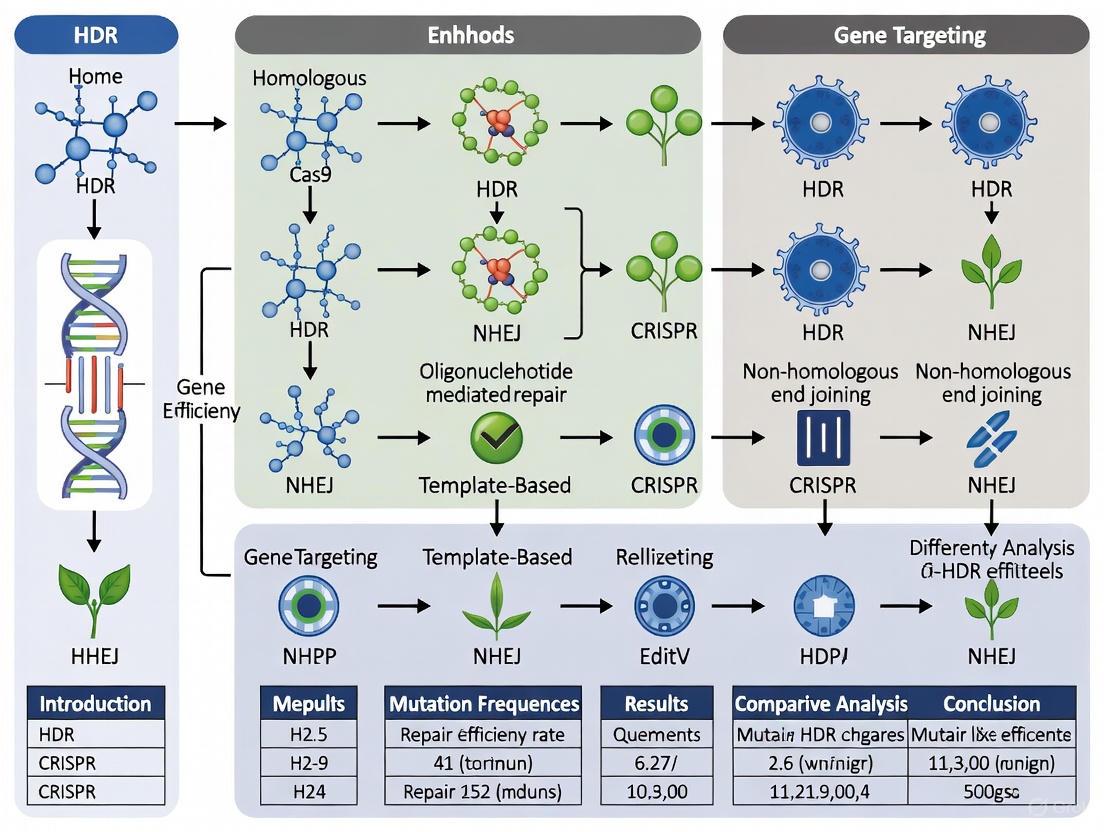
This comprehensive review explores cutting-edge methodologies and optimization strategies to improve homology-directed repair (HDR) efficiency in plant systems.
Advanced Strategies to Enhance Homology-Directed Repair Efficiency in Plant Genome Editing
Abstract
This comprehensive review explores cutting-edge methodologies and optimization strategies to improve homology-directed repair (HDR) efficiency in plant systems. Covering foundational mechanisms, advanced delivery techniques, and rigorous validation approaches, we address the critical challenges limiting HDR application in major crops including maize, wheat, and rice. Recent breakthroughs in CRISPR-Cas12a systems, shoot apical meristem targeting, and donor DNA design are examined alongside practical troubleshooting guidance for researchers developing precision genome editing applications in both model and commercially important plant species. The synthesis of current evidence provides a strategic framework for overcoming historical bottlenecks in plant gene targeting and trait development.
Understanding HDR Mechanisms and Key Influencing Factors in Plants
Fundamental Principles of Homology-Directed Repair in Plant Systems
Homology-Directed Repair (HDR) is a precise DNA repair mechanism that uses a homologous template to accurately repair double-strand breaks (DSBs). In plants, HDR enables precise genome modifications, including gene insertions, replacements, and specific nucleotide changes, making it invaluable for both basic research and crop improvement [1] [2]. Unlike error-prone non-homologous end joining (NHEJ), which dominates plant DNA repair, HDR facilitates predictable, precise editing outcomes but occurs at significantly lower frequencies—typically between 10⁻³ to 10⁻⁶ in higher plants [3] [2]. This technical support center provides troubleshooting guidance and foundational principles to help researchers overcome the challenge of low HDR efficiency in plant systems.
Core HDR Mechanisms and Pathways
Key HDR Pathways
When a DSB occurs, it can be repaired via several conservative, homology-dependent pathways. Understanding these mechanisms is crucial for designing effective editing strategies.
Table 1: Key Homology-Directed Repair Pathways
| Pathway | Key Features | Primary Outcome | Applicability in Plant Editing |
|---|---|---|---|
| Synthesis-Dependent Strand Annealing (SDSA) | Involves strand invasion, synthesis, and displacement; considered the primary pathway for HDR in somatic cells [4]. | Exclusively produces non-crossover products [5]. | Ideal for precise gene editing without chromosomal rearrangements. |
| Double-Strand Break Repair (DSBR) | Involves formation of double Holliday junctions [5]. | Can result in both crossover and non-crossover products [5]. | Less common in somatic cells; may lead to unwanted sequence exchanges. |
| Break-Induced Repair (BIR) | Initiated by one-ended break; involves extensive DNA synthesis [5]. | Can result in long-tract gene conversions [5]. | Important for repairing complex breaks but less relevant for standard editing. |
| Single-Strand Annealing (SSA) | Requires flanking homologous repeats; not a true HDR pathway as it doesn't require a donor template [1]. | Always results in deletions between repeats [1]. | Considered mutagenic; generally avoided for precise editing. |
Visualizing the HDR Process in Plants
The following diagram illustrates the key steps and cellular factors involved in the SDSA pathway, the primary mechanism for HDR in plant somatic cells:
Diagram 1: SDSA Pathway for HDR in Plants
Essential Research Reagents and Tools
Table 2: Key Research Reagent Solutions for Plant HDR Experiments
| Reagent/Tool | Function | Application Notes | Key References |
|---|---|---|---|
| CRISPR-Cas Systems | Induces targeted DSBs at specific genomic loci. | Cas9, Cas12a most common; targeting efficiency varies by plant species. | [3] [2] |
| Donor Templates | Provides homologous sequence for repair. | ssODNs for small edits (<50 bp); dsDNA with long homology arms (>500 bp) for large insertions. | [5] |
| Geminivirus Replicons (GVRs) | High-copy-number donor templates. | Increases local donor concentration; significantly boosts HDR efficiency. | [6] |
| NHEJ Inhibitors | Suppresses competing repair pathway. | SCR7 (Ligase IV inhibitor); chemical or genetic suppression of Ku70/Ku80. | [7] |
| HDR Enhancers | Promotes recombination machinery. | Overexpression of RAD51, RAD52, RAD54; cell cycle synchronization factors. | [6] [2] |
| Morphogenic Regulators | Enhances regeneration of edited cells. | BBM, WUS2; crucial for obtaining whole plants from edited cells. | [6] |
Troubleshooting Common HDR Experimental Challenges
FAQ: Addressing Frequent HDR Problems
Q1: Why is my HDR efficiency consistently low compared to NHEJ mutations?
A: Low HDR frequency relative to NHEJ is expected since NHEJ is the dominant DSB repair pathway in plant somatic cells and operates throughout the cell cycle, while HDR is restricted primarily to late S and G2 phases [3] [7]. To improve HDR efficiency:
- Implement cell cycle synchronization to enrich for cells in S/G2 phase [6]
- Use NHEJ inhibitors like SCR7 (DNA ligase IV inhibitor) to reduce competing repair [7]
- Overexpress HDR-promoting factors such as RAD51 or RAD54 [2]
- Employ high-efficiency donor delivery systems like geminivirus replicons [6]
Q2: What are the optimal design specifications for donor templates?
A: Donor design critically impacts HDR success:
- Homology arm length: 30-50 bp for ssODNs; 500-1000 bp for dsDNA templates [5]
- Modification position: Place desired edits as close as possible to the DSB site (ideally <10 bp) [5]
- PAM disruption: Include silent mutations in the donor to disrupt the PAM sequence and prevent re-cutting [5]
- Template form: ssODNs generally provide higher HDR efficiency for small changes; linear dsDNA for larger insertions [5]
Q3: How can I verify true HDR events versus random integration?
A: Proper verification is essential:
- Use PCR strategies that span both homology arms and the insertion site
- Perform Southern blot analysis to confirm single-copy integration and rule off-target insertions
- Include functional assays to verify intended gene function where possible
- Sequence the entire modified locus to ensure precise editing without secondary mutations
Q4: What environmental factors influence HDR efficiency in plants?
A: Several external factors can impact HDR rates:
- Temperature affects protein activity and cell division rates
- Light conditions influence plant hormone levels and cell cycle progression
- Plant growth regulators in tissue culture media can shift cell cycle distributions
- Oxidative stress may alter DNA repair pathway choices [2]
Advanced Methodologies and Protocols
Experimental Workflow for Enhanced HDR in Plants
The following diagram outlines a comprehensive experimental strategy for maximizing HDR efficiency in plant systems:
Diagram 2: HDR Experimental Workflow
Quantitative Data on HDR Enhancement Strategies
Table 3: Efficacy of HDR Enhancement Approaches in Plants
| Strategy | Experimental Approach | Reported Efficiency Gain | Applicable Plant Systems |
|---|---|---|---|
| NHEJ Inhibition | Knockout of Ku70/Ku80/Lig4; chemical inhibition (SCR7) | 2-5 fold increase in HDR events [7] | Arabidopsis, tobacco, rice |
| HDR Gene Overexpression | Constitutive expression of RAD51, RAD52, RAD54 | 3-8 fold enhancement [2] | Tobacco, maize, Arabidopsis |
| Cell Cycle Synchronization | Aphidicolin, hydroxyurea treatment; specific promoter use | Up to 10-fold increase in some systems [6] | Plant protoplasts, cell cultures |
| Viral Replicon Donors | Gemini virus-based replication system | 5-20 fold improvement over plasmid donors [6] | Tobacco, tomato, wheat |
| Cas9-Fusion Proteins | Cas9-VirD2, Cas9-RAD52, Cas9-CtIP fusions | 3-15 fold enhancement [6] [2] | Rice, tobacco |
| Temperature Optimization | Controlled growth conditions post-transformation | 2-3 fold improvement [2] | Various species |
Mastering HDR in plant systems requires meticulous attention to multiple experimental parameters, from donor design to cellular context. The strategies outlined here—including pathway manipulation, cell cycle synchronization, and advanced delivery systems—provide a roadmap for significantly improving HDR efficiency. As plant genome engineering continues to evolve, emerging technologies like prime editing and base editing offer complementary approaches for precise modifications, though HDR remains essential for larger-scale sequence integrations and replacements. By systematically applying these troubleshooting guidelines and methodological refinements, researchers can overcome the inherent challenges of low HDR frequency in plants and unlock the full potential of precision genome editing for crop improvement and fundamental plant biology research.
Comparative Analysis of HDR Versus NHEJ Pathways in Plant Cells
FAQs and Troubleshooting Guides
FAQ 1: What are the fundamental differences between HDR and NHEJ in plant cells?
Answer: HDR (Homology-Directed Repair) and NHEJ (Non-Homologous End Joining) are the two primary pathways for repairing double-strand breaks (DSBs) in plant cells, but they differ significantly in mechanism, precision, and experimental application [8] [9].
- Precision and Template Dependence: HDR is a precise, template-dependent repair mechanism. It uses a homologous DNA template (e.g., from a sister chromatid or an supplied donor) to accurately restore the DNA sequence at the break site. This makes it ideal for precise gene knock-ins, point mutations, or gene replacements [3] [8] [9]. In contrast, NHEJ is an error-prone, template-independent pathway that directly ligates the broken DNA ends. This often results in small insertions or deletions (indels), leading to frameshift mutations and gene knockouts [10] [8].
- Efficiency and Cell Cycle Dependency: In higher plants, NHEJ is the dominant and highly efficient DSB repair pathway throughout most of the cell cycle. HDR, however, is intrinsically inefficient and is primarily active during the late S and G2 phases when a homologous sister chromatid is available [3]. This competition from the highly active NHEJ pathway is a major bottleneck for achieving efficient HDR in plants [3].
- Experimental Outcome: For researchers, the choice of pathway dictates the outcome. Use NHEJ when the goal is to create gene knockouts. Use HDR when the goal requires precision, such as inserting a specific DNA sequence (e.g., a fluorescent protein tag) or correcting a point mutation with a donor template [8] [9].
Table 1: Fundamental Comparison of HDR and NHEJ Pathways in Plants
| Feature | HDR (Homology-Directed Repair) | NHEJ (Non-Homologous End Joining) |
|---|---|---|
| Template Required | Yes (homologous donor DNA) | No |
| Precision | High, error-free | Low, error-prone (generates indels) |
| Primary Role in Plants | Precise gene insertion, replacement, and correction [3] | Generation of gene knockouts via disruptive mutations [10] |
| Relative Efficiency in Plants | Very low [3] | High (dominant pathway) [3] |
| Cell Cycle Phase | S and G2 phases [3] | Active throughout all phases [9] |
| Key Applications in Research | Gene knock-ins, precise point mutations, allele replacement [11] | Gene knockouts, loss-of-function studies [10] |
FAQ 2: Why is HDR efficiency so low in plants, and how can I improve it in my experiments?
Answer: The extremely low efficiency of HDR in higher plants is a well-known challenge, primarily caused by the dominance of the NHEJ pathway, the cell-cycle dependence of HDR, and the difficulty in co-localizing the repair template with the DSB [3]. Several strategies have been developed to overcome this bottleneck.
Troubleshooting Low HDR Efficiency:
- Problem: NHEJ pathway outcompetes HDR.
- Solution: Inhibit key NHEJ proteins. Suppressing proteins in the NHEJ pathway, such as Ku70/Ku80, using chemical inhibitors or siRNA, can shift the repair balance toward HDR [9].
- Problem: HDR is restricted to S/G2 cell cycle phases.
- Solution: Synchronize cells. Synchronizing plant cells to the S or G2 phase, when homologous templates are available, can increase HDR opportunities [9].
- Problem: The donor repair template is insufficient or not accessible.
- Solution: Optimize donor template design and delivery.
- Use single-stranded oligodeoxynucleotides (ssODNs) as donors for small edits, as they are more efficient [9].
- Employ geminivirus replicons, which achieve high copy numbers in plant nuclei, to increase template availability [3].
- Tether the donor template directly to the CRISPR-Cas9 machinery. Strategies like chimeric guide RNA (cgRNA) or CRISPEY (Cas9-Retron system) fuse the donor template to the guide RNA, though their success in plants has been limited and requires further optimization [10].
- Solution: Optimize donor template design and delivery.
Table 2: Strategies to Improve HDR Efficiency in Plant Cells
| Strategy | Mechanism of Action | Example Approach | Reported Outcome in Plants |
|---|---|---|---|
| NHEJ Inhibition | Reduces competition from the error-prone NHEJ pathway | Using chemical inhibitors or siRNA against Ku70/Ku80 proteins [9] | Can increase relative HDR rates; potential pleiotropic effects require careful control |
| Cell Cycle Synchronization | Increases the proportion of cells in HDR-active phases (S/G2) | Treatment with drugs like hydroxyurea or aphidicolin [9] | Theoretically beneficial; can be challenging to apply in whole plant tissues |
| Donor Template Optimization | Enhances the local concentration and availability of the repair template | Using geminivirus replicons or single-stranded ODNs (ssODNs) [3] [9] | Geminivirus replicons have shown promising results for gene targeting |
| Template Tethering | Co-localizes the DSB and donor template | Fusing donor sequence to gRNA (cgRNA) or using retron systems (CRISPEY) [10] | Variable success; e.g., cgRNA and CRISPEY did not significantly improve HDR in a rice study [10] |
FAQ 3: My HDR experiment worked, but I'm getting a high number of off-target edits. What could be the cause?
Answer: A high rate of off-target edits is often linked to the prolonged activity and broad specificity of the genome editing machinery, particularly the CRISPR-Cas9 system. The core issue is that the Cas9 nuclease remains active in the cell and can cleave at genomic sites with high sequence similarity to your intended target.
Troubleshooting High Off-Target Edits:
- Problem: Persistent Cas9 nuclease activity.
- Solution: Use transient expression systems. Instead of stable transformation, deliver the CRISPR-Cas9 reagents transiently (e.g., via ribonucleoprotein (RNP) complexes). This shortens the window for off-target activity [3].
- Problem: Guide RNA has high similarity to multiple genomic sites.
- Solution: Meticulous guide RNA design. Use bioinformatic tools to design highly specific guide RNAs with minimal similarity to other sites in the genome. Select guides with a low off-target prediction score.
- Problem: The chosen editing system has inherent fidelity issues.
- Solution: Switch to high-fidelity base or prime editors. Consider using base editors or prime editors for specific types of precise edits. These systems do not create DSBs and can have a lower risk of off-target effects compared to standard CRISPR-Cas9 HDR [12] [3]. Note that prime editing efficiency in plants can be highly variable and is an area of active optimization [12].
Experimental Protocols for Key Techniques
Protocol 1: HDR-Mediated Gene Replacement Using Geminivirus Replicons
This protocol is adapted from methods used to achieve precise allele replacement in plants [3].
Vector Construction:
- Clone your gene of interest, flanked by homology arms (typically 500-1000 bp each), into a geminivirus-based replicon vector.
- Clone the specific Cas9 nuclease and guide RNA expression cassettes into the same or a co-delivered vector.
- Introduce silent mutations (synonymous SNPs) in the protospacer adjacent motif (PAM) site or the seed sequence within the donor template to prevent re-cleavage by Cas9 after successful HDR.
Plant Transformation:
- Transform the construct into Agrobacterium tumefaciens strain EHA105.
- Perform Agrobacterium-mediated transformation of your plant material (e.g., rice callus).
Selection and Regeneration:
- Transfer the transformed tissue to selection media containing the appropriate antibiotic (e.g., hygromycin).
- Regenerate whole plants from the selected, resistant calli.
Genotyping and Validation:
- Extract genomic DNA from regenerated plants.
- Perform PCR amplification of the target locus and sequence the products to confirm precise gene replacement.
- Use restriction fragment length polymorphism (RFLP) or cleaved amplified polymorphic sequences (CAPS) analysis if silent mutations were introduced to disrupt the PAM site.
Protocol 2: Assessing NHEJ Repair Outcomes Using Prediction Tools
This protocol describes how to predict the spectrum of mutations resulting from NHEJ at a given target site [10].
Target Site Selection and Sequencing:
- Identify the precise genomic DNA sequence surrounding your target site (approximately 50-100 bp on either side of the predicted Cas9 cut site).
In Silico Analysis:
- Input the target DNA sequence into one or more NHEJ prediction tools, such as inDelphi, FORECasT, or SPROUT. These tools were developed in mammalian systems but have been validated in rice [10].
Data Interpretation:
- The tools will output a list of predicted repair outcomes (indels) and their relative frequencies.
- The most frequent single-nucleotide insertions can be highly predictable based on the target sequence context. For example, in rice, a 'T' nucleotide insertion is often predictable at specific sequence contexts [10].
Experimental Validation:
- Perform CRISPR-Cas9 mutagenesis on your target site.
- Sequence the target locus in multiple independent transgenic lines and compare the experimentally observed indels with the in silico predictions to validate the tool's accuracy for your plant species.
Pathway and Workflow Visualizations
The Scientist's Toolkit: Research Reagent Solutions
Table 3: Essential Reagents for HDR and NHEJ Research in Plants
| Reagent / Tool | Function / Application | Key Characteristics |
|---|---|---|
| Cas9 Nuclease | Creates a targeted double-strand break (DSB) in the genome. | The foundation for initiating both NHEJ and HDR repair. Can be delivered as DNA, mRNA, or protein (RNP complexes). |
| NHEJ Prediction Tools (inDelphi, FORECasT, SPROUT) | Predicts the spectrum of indel mutations from NHEJ repair at a specific target site [10]. | Helps anticipate the most likely knockout mutations. Validated in plant systems like rice. |
| Single-Stranded Oligodeoxynucleotides (ssODNs) | Serves as a donor template for HDR to introduce small, precise edits (point mutations, short tags) [9]. | Easy to synthesize; higher efficiency for small changes compared to plasmid donors. |
| Geminivirus Replicon Vectors | Delivers high-copy-number donor templates for HDR-mediated gene replacement or large insertions [3]. | Replicates to high levels in plant nuclei, significantly increasing template availability for HDR. |
| Ku Protein Inhibitors | Chemically inhibits key proteins in the NHEJ pathway (e.g., Ku70/Ku80) [9]. | Shifts the repair balance towards HDR by reducing competition from the NHEJ pathway. |
| Prime Editing System (PE2/PE3) | Facilitates precise edits without requiring a DSB or a separate donor template [12]. | Consists of a Cas9 nickase-reverse transcriptase fusion and a pegRNA. Can mediate all 12 base-to-base conversions and small indels. |
Homology-Directed Repair (HDR) is a powerful mechanism for precise genome editing, but its efficiency is often a critical bottleneck in experimental workflows. For researchers aiming to achieve precise knock-ins or specific base changes, understanding the fundamental biological factors that limit HDR is the first step toward developing successful protocols. This guide addresses the core challenges and provides targeted troubleshooting strategies.
Frequently Asked Questions
FAQ 1: What are the primary biological factors that limit HDR efficiency in my experiments?
The low efficiency of HDR is predominantly due to two interconnected biological realities: the cell cycle stage and the activity of competing DNA repair pathways.
- Cell Cycle Stage: The HDR pathway is highly dependent on the cell cycle because it requires the presence of a sister chromatid to use as a template. Consequently, HDR is primarily active and effective during the S and G2 phases. In contrast, the error-prone Non-Homologous End Joining (NHEJ) pathway operates throughout all cell cycle phases, including G0/G1, where it is the dominant and most accessible repair mechanism [13] [14]. This gives NHEJ a significant numerical advantage in most asynchronous cell populations.
- Competitive Repair Pathways: When a CRISPR-Cas9 system induces a double-strand break (DSB), it creates a race between several DNA repair pathways. NHEJ is typically the fastest and most predominant pathway in mammalian cells [14]. Beyond NHEJ, other alternative end-joining pathways, such as Microhomology-Mediated End Joining (MMEJ) and Single-Strand Annealing (SSA), also compete for the DSB. These pathways can result in imprecise repair with deletions, further reducing the share of repairs that proceed through the precise HDR pathway [15] [13]. Even with NHEJ inhibition, MMEJ and SSA can still account for nearly half of all integration events, highlighting the complex interplay of these competing mechanisms [15].
FAQ 2: How can I experimentally counteract the low efficiency of HDR?
You can employ strategies that target the two main limiting factors: the cell cycle and pathway competition. The table below summarizes key reagent-based solutions.
| Research Reagent / Tool | Primary Function | Example in Use |
|---|---|---|
| NHEJ Pathway Inhibitors | Suppresses the dominant competitive repair pathway to increase HDR availability. | Alt-R HDR Enhancer; SCR7 (targets DNA Ligase IV) [15] [16]. |
| MMEJ/SSA Pathway Inhibitors | Suppresses alternative error-prone repair pathways to reduce imprecise integration. | ART558 (inhibits POLQ/MMEJ); D-I03 (inhibits Rad52/SSA) [15]. |
| HDR-Enhancing Proteins | Recruits or activates the cellular HDR machinery directly at the break site. | Fusing Cas9 to HDR-promoting domains like CtIP or MRN complex-recruiting domains [16]. |
| Cell Cycle Synchronizers | Enriches the cell population in HDR-permissive phases (S/G2). | Chemicals like nocodazole or thymidine to synchronize cells at the G2/M or G1/S boundary, respectively [13]. |
| HDR Pathway Activators | Boosts the efficiency of the core HDR machinery. | RS-1 (activates RAD51, a key protein for strand invasion) [16]. |
The following diagram illustrates how these competitive pathways interact at a Cas-induced double-strand break and where common inhibitors act.
Quantitative Data: HDR Efficiency Under Pathway Inhibition
Empirical data is crucial for setting realistic expectations. The following table summarizes quantitative findings on how inhibiting specific repair pathways can alter the outcome distribution of editing events, based on research in human cell lines [15].
| DSB Repair Pathway Targeted | Effect on Perfect HDR Frequency | Effect on Imprecise Integration / Deletions | Key Experimental Insight |
|---|---|---|---|
| NHEJ Inhibition | ~3-fold increase (e.g., from 5.2% to 16.8%) | Significantly reduces small deletions (<50 nt) | Major boost in HDR, but imprecise integration from other pathways remains. |
| MMEJ Inhibition | Significant increase | Reduces large deletions (≥50 nt) and complex indels | Effective at suppressing MMEJ-specific deletion patterns. |
| SSA Inhibition | No substantial effect on overall mNG+ cells | Reduces asymmetric HDR and other donor mis-integration events | Specifically improves the precision of integration, not the raw efficiency. |
| Combined Inhibition | Most effective strategy (specific fold-increase varies) | Simultaneously reduces small/large deletions and imprecise integration | Synergistic effect of targeting multiple competing pathways is recommended for high-fidelity editing. |
Experimental Protocol: Enhancing HDR via Pathway Modulation
This protocol outlines a methodology to suppress NHEJ and alternative repair pathways to enhance HDR efficiency in cell culture, based on the strategies cited above [15] [16].
Title: Boosting Precise Knock-In Efficiency Through Pharmacological Inhibition of Competing Repair Pathways.
Goal: To increase the frequency of perfect HDR events during CRISPR-Cas9-mediated knock-in by transiently inhibiting key proteins in the NHEJ and SSA repair pathways.
Materials:
- Cells: hTERT-immortalized RPE1 cells (or your target cell line).
- CRISPR Components: Recombinant Cas9 or Cpf1 (Cas12a) nuclease, in vitro transcribed guide RNA (sgRNA or crRNA).
- Donor DNA: HDR template with homology arms (90 bp used in source study [15]), prepared via PCR.
- Chemical Inhibitors:
- Alt-R HDR Enhancer V2 (NHEJ inhibitor).
- D-I03 (Rad52/SSA inhibitor).
- ART558 (POLQ/MMEJ inhibitor) - optional for MMEJ suppression.
- Equipment: Electroporator, flow cytometer, PacBio long-read sequencer for genotyping.
Step-by-Step Procedure:
- RNP Complex Formation: Combine the recombinant Cas nuclease and guide RNA to form ribonucleoprotein (RNP) complexes in vitro.
- Co-Delivery: Electroporate the cells with the pre-formed RNP complexes and the HDR donor DNA template.
- Inhibitor Treatment: Immediately after electroporation, treat the cells with the pathway inhibitors.
- Prepare culture media containing the inhibitors at their optimized concentrations (e.g., Alt-R HDR Enhancer V2 for NHEJ inhibition, D-I03 for SSA inhibition).
- Culture the transfected cells in this media for 24 hours, as HDR typically occurs within this timeframe post-Cas9 delivery [15].
- Post-Treatment Culture: After 24 hours, replace the inhibitor-containing media with standard growth medium.
- Analysis and Validation:
- Efficiency Check (4 days post-electroporation): Use flow cytometry to quantify the percentage of cells expressing the knock-in marker (e.g., mNeonGreen).
- Precision Genotyping: Harvest genomic DNA and amplify the target locus. Perform long-read amplicon sequencing (e.g., PacBio) and use a computational framework like "knock-knock" to classify and quantify repair outcomes, including "perfect HDR," "imprecise integration," and various indel patterns [15].
Key Takeaways for Researchers
- HDR is a Cell-Cycle-Dependent Process: Your experimental success is inherently linked to the proliferation state of your cell population. Strategies that enrich for S/G2 phase cells can provide a significant boost.
- Competition is Inevitable: NHEJ is the default and fastest cellular response to DSBs. To favor HDR, you must actively tilt the balance by inhibiting competitors like NHEJ, MMEJ, and SSA.
- Precision and Efficiency are Different Metrics: Some strategies (like NHEJ inhibition) primarily increase the number of successful edits, while others (like SSA inhibition) primarily improve the accuracy of those edits. Your specific goal (high yield vs. high fidelity) should guide your strategy.
- A Combined Approach is Best: The most effective way to achieve high rates of precise HDR is to synergistically combine multiple strategies, such as cell cycle synchronization, NHEJ inhibition, and the use of HDR-enhancing reagents.
The Role of CRISPR-Cas Systems (Cas9, Cas12a) in Initiating Targeted DNA Breaks for HDR
Troubleshooting Guides
FAQ 1: Why is my HDR efficiency so low compared to NHEJ, and how can I improve it?
Low HDR efficiency is a common challenge because the error-prone Non-Homologous End Joining (NHEJ) pathway is the dominant and more active DNA repair mechanism in most cell types, particularly in plants [3] [17]. The HDR pathway is inherently rare in somatic cells and is primarily active during the late S and G2 phases of the cell cycle, whereas NHEJ is active throughout the cell cycle and competes for the repair of the double-strand break (DSB) [3] [18].
Solutions to Improve HDR Efficiency:
- Inhibit the NHEJ Pathway: Use small molecule inhibitors to suppress key NHEJ factors. Compounds such as LigIV inhibitors, DNA-PKcs inhibitors (e.g., KU-0060648), and 53BP1-inhibitory peptides can shift the repair balance toward HDR [18].
- Modulate Cell Cycle: Synchronize your cells to the S/G2 phases, where HDR is most active. This can be achieved using cell cycle inhibitors like aphidicolin or nocodazole [17] [18].
- Optimize Donor Template Delivery and Design:
- Ensure the donor template is delivered in close proximity to the DSB.
- Use single-stranded oligodeoxynucleotides (ssODNs) with optimized homology arm lengths (e.g., 30-40 nucleotides) [19].
- Incorporate "blocking mutations" in the donor template to prevent re-cleavage of the edited site by the Cas nuclease [19].
- Choose the Appropriate Cas Nuclease: Consider using Cas12a, which creates staggered cuts with 5' overhangs. These overhangs can be more favorable for HDR compared to the blunt ends generated by Cas9 [20].
FAQ 2: How do I choose between Cas9 and Cas12a for my HDR experiment in plants?
The choice between Cas9 and Cas12a depends on your target sequence and desired editing outcome. The table below summarizes the key differences:
Table 1: Comparison of Cas9 and Cas12a for HDR Experiments
| Feature | Cas9 | Cas12a |
|---|---|---|
| PAM Sequence | 5'-NGG-3' (G-rich) [21] | 5'-TTTV-3' (T-rich) [22] [20] |
| DSB End Structure | Blunt ends [22] | Staggered ends with 5' overhangs [22] [20] |
| Guide RNA | Requires both crRNA and tracrRNA (often fused as sgRNA) [23] [22] | Requires only a short crRNA (∼41-44 nt) [22] |
| Multiplexing | Possible, but can be complex [23] | Simplified; can process a crRNA array naturally [22] [20] |
| Reported HDR Efficiency in Plants | High efficiency reported in maize [22] | Lower efficiency in some plant systems like maize, needs optimization [22] |
| Best Suited For | Targeting GC-rich genomic regions | Targeting AT-rich genomic regions; applications where staggered cuts are beneficial [20] |
Protocol: Experimental Workflow for Optimized HDR in Plants
- Target Selection and gRNA/crRNA Design: Select a target site with the appropriate PAM sequence for your chosen nuclease (Cas9 or Cas12a). Use online tools to predict gRNA efficiency and potential off-target sites [24] [22].
- Donor Template Design: Design an ssODN donor template with 30-40 nt homology arms. Incorporate silent "blocking mutations" in the PAM or seed sequence to prevent re-cleavage [19].
- Delivery Method: Use ribonucleoprotein (RNP) complex delivery. Pre-complex the purified Cas protein with the synthesized gRNA in vitro and deliver this complex into plant cells (e.g., via biolistics or transfection). RNP delivery leads to faster editing onset and reduced off-target effects compared to plasmid DNA delivery [19].
- Co-delivery with Modulators: Co-deliver the RNP and donor template with small molecule inhibitors of NHEJ (e.g., LigIV inhibitor) to favor the HDR pathway [18].
- Validation: Use next-generation sequencing (NGS) to accurately quantify the frequency of perfect HDR events and to screen for any off-target modifications [19].
Diagram Title: Competition Between NHEJ and HDR Pathways
FAQ 3: What are the common causes of off-target effects, and how can I minimize them?
Off-target effects occur when the Cas nuclease cuts at unintended genomic sites with sequences similar to the target site [24].
Solutions to Minimize Off-Target Effects:
- Use High-Fidelity Cas Variants: Engineered Cas proteins like eSpCas9(1.1), SpCas9-HF1, HypaCas9, and evoCas9 have mutations that reduce off-target activity while maintaining on-target efficiency [23] [21].
- Optimize gRNA Design: Select a gRNA with maximal uniqueness in the genome. Use bioinformatic tools (e.g., Cas-OFFinder) to predict and avoid gRNAs with potential off-target sites [23] [22].
- Utilize Cas9 Nickase (Cas9n): Employ a paired nickase strategy. Using two gRNAs with a Cas9 nickase (D10A mutant) to create nicks on opposite strands generates a DSB only at the intended overlapping site, dramatically reducing off-target effects [23] [19].
- Delivery Method: RNP delivery is preferred over plasmid-based expression, as the transient presence of the nuclease reduces the window for off-target cleavage [19].
- Validate with CIRCLE-seq: For critical applications, use methods like CIRCLE-seq to identify genome-wide potential off-target sites for your specific gRNA and experimentally validate editing in those regions [22].
FAQ 4: I am not detecting any edited cells. What could be wrong?
A lack of detectable edits can stem from several issues related to the delivery and functionality of the CRISPR components.
Troubleshooting Steps:
- Verify Component Expression and Activity:
- Optimize Delivery Efficiency: Your delivery method (e.g., Agrobacterium-mediated transformation, particle bombardment, transfection) may be inefficient for your cell type. Optimize the delivery protocol and consider alternative methods [24].
- Confirm gRNA Efficacy: The gRNA might be ineffective. If possible, test your gRNA in a well-established, validated system first to confirm it can direct cleavage. Use algorithms to predict gRNA efficiency scores during the design phase [24] [22].
- Check for Cell Toxicity: High levels of Cas9 expression or excessive DSBs can cause cell death, leaving no viable edited cells. Titrate the amount of CRISPR components delivered and consider using inducible Cas9 systems to control the timing and level of expression [24].
Experimental Protocols
Detailed Methodology for High-Efficiency HDR using RNP and ssODN
This protocol is adapted from comprehensive design parameter studies for CRISPR-Cas9 and Cas12a HDR [19].
Materials Required:
- Purified Cas Protein: S.p. Cas9, S.p. Cas9 D10A nickase, or A.s. Cas12a protein.
- Synthesized Guide RNA: Target-specific sgRNA (for Cas9) or crRNA (for Cas12a).
- Donor Template: Single-stranded oligodeoxynucleotide (ssODN) with ~40 nt homology arms and desired edit. Phosphorothioate modifications at the ends can improve stability [19].
- Delivery Reagents: Equipment for nucleofection or your plant-specific transformation method.
- Cell Line: Your target plant cells or protoplasts.
- NHEJ Inhibitor (Optional): Small molecule such as a DNA-PKcs inhibitor.
Step-by-Step Procedure:
RNP Complex Formation:
- In a nuclease-free tube, combine purified Cas protein and synthesized gRNA at a molar ratio that ensures complete complex formation (e.g., a 1:2 ratio of Cas:gRNA).
- Incubate the mixture at room temperature for 10-20 minutes to allow RNP complex assembly.
Preparation of Cells:
- Harvest and resuspend your plant cells or protoplasts in an appropriate electroporation/nucleofection buffer.
Nucleofection/Nucleofection:
- Mix the assembled RNP complex with the donor template ssODN and the cell suspension. If using, add the NHEJ inhibitor to the mixture.
- Transfer the entire mixture to a certified cuvette and electroporate/nucleofect using a program optimized for your cell type.
Post-Transfection Recovery:
- Immediately transfer the cells to recovery medium and culture under standard conditions.
Analysis of Editing:
- After 48-72 hours, harvest cells and extract genomic DNA.
- Amplify the target region by PCR and analyze the editing efficiency using next-generation sequencing (NGS) for accurate quantification of HDR and NHEJ events.
Table 2: Quantitative Data on HDR Improvement Strategies
| Strategy | Experimental Details | Reported Outcome | Citation |
|---|---|---|---|
| ssODN Strand Preference | Tested T-strand vs. NT-strand ssODNs at 254 loci in Jurkat cells. | No statistical difference in HDR efficiency between strands. | [19] |
| NHEJ Inhibition | Use of small molecule inhibitors (e.g., targeting DNA-PKcs, LigIV). | Significant increase in HDR efficiency by suppressing competing NHEJ pathway. | [18] |
| Blocking Mutations | Incorporation of silent mutations in donor template to disrupt PAM/protospacer. | Prevents re-cleavage, leading to a dramatic increase in perfect HDR product yield. | [19] |
| Cas12a vs. Cas9 Efficiency | Direct comparison in maize; targeting the glossy2 gene. | Cas9: 90-100% of plants had mutations. Cas12a: 0-60% of plants had mutations. | [22] |
The Scientist's Toolkit: Research Reagent Solutions
Table 3: Essential Reagents for CRISPR-HDR Experiments
| Reagent / Tool | Function / Description | Example Products / Notes |
|---|---|---|
| High-Fidelity Cas Nucleases | Engineered Cas proteins with reduced off-target activity. | eSpCas9(1.1), SpCas9-HF1, HypaCas9, evoCas9, eSpOT-ON (ePsCas9) [23] [21]. |
| Cas9 Nickase (Cas9n) | Cas9 D10A mutant that creates single-strand nicks; used in pairs for specific DSB generation. | Paired nickase strategy reduces off-target effects by 50-1500 fold [23] [19]. |
| Chemically Modified gRNA | Synthetic gRNAs with chemical modifications (e.g., 2'-O-methyl analogs) for improved stability and reduced immune response. | Increases RNP stability and editing efficiency [19]. |
| NHEJ Inhibitors | Small molecules that inhibit key proteins in the NHEJ pathway to favor HDR. | DNA-PKcs inhibitors (KU-0060648), LigIV inhibitors [18]. |
| HDR Donor Design Tools | Online bioinformatics tools for designing optimal ssODN donor templates with homology arms and blocking mutations. | IDT HDR Design Tool [19]. |
| CIRCLE-seq | An in vitro method for comprehensive, genome-wide identification of off-target sites for a given gRNA. | Used for profiling nuclease specificity before costly experiments [22]. |
Diagram Title: Optimized HDR Experimental Workflow
FAQs: Overcoming Fundamental Plant Transformation Hurdles
Q1: What are the primary biological barriers that limit efficient genetic transformation in plants? The main barriers are the plant cell wall, which physically blocks the entry of foreign biomolecules; the limited regenerative capacity of many plant cells to form entire new plants (totipotency); and the significant variation in transformation efficiency between different species and genotypes (genotype dependency) [25]. The cell wall is a particular challenge for delivering genetic material, as it excludes large molecules and pathogens.
Q2: Why are some plant species and varieties considered "recalcitrant" to genetic transformation? Recalcitrance occurs because the ability of plant cells to dedifferentiate, form a pluripotent callus, and then regenerate new organs via somatic embryogenesis or de novo organogenesis is highly dependent on the plant's genetic background [25] [26]. This regenerative capacity is governed by complex internal signaling networks involving hormones and developmental genes, which are not equally active in all plants.
Q3: What strategies can be used to overcome genotype dependency in transformation? Two key emerging strategies are:
- Ectopic Expression of Developmental Regulators: Introducing genes such as BABY BOOM (BBM), WUSCHEL (WUS), and GROWTH-REGULATING FACTOR (GRF) can enhance a plant's innate capacity for somatic embryogenesis and shoot organogenesis, making transformation less dependent on the native genotype [25] [26].
- Nanoparticle-Based Delivery: Nanoparticles can penetrate the rigid plant cell wall without external force and protect delivered cargoes (like DNA or proteins) from degradation, offering a promising route for genotype-independent transformation [25].
Q4: How can I improve the efficiency of shoot regeneration from a callus in a recalcitrant species? The key is manipulating the hormonal pathways that govern shoot meristem formation. Transferring callus to a shoot-inducing medium (SIM) activates cytokinin signaling. This, in turn, activates the expression of key transcription factors like WUSCHEL (WUS), which is essential for shoot meristem formation [26]. Co-expressing WUS with other regulators like GRF and its cofactor GIF1 has been shown to dramatically enhance shoot regeneration efficiency [26].
Troubleshooting Common Experimental Failures
| Problem Area | Specific Issue | Potential Causes | Recommended Solutions |
|---|---|---|---|
| Callus Formation | No callus forms on explants. | Incorrect explant type; unsuitable auxin:cytokinin ratio in Callus-Inducing Medium (CIM); poor wounding response [25] [26]. | Optimize basal media and hormone concentrations; ensure proper wounding to trigger necessary signaling pathways [25]. |
| Non-embryonic callus forms but cannot regenerate. | Pluripotency not fully established; failure to activate root meristematic genes (e.g., PLT1/2) and shoot factors (e.g., CUC1/2) [26]. | Ensure callus is transferred to appropriate Shoot-Inducing Medium (SIM); consider leveraging developmental regulators like BBM or LEC2 to promote embryogenic transition [26]. | |
| Organogenesis | Shoots fail to regenerate from callus. | Inefficient cytokinin response; failure to initiate and maintain WUS expression domain [26]. | Optimize cytokinin type/concentration in SIM; consider expressing GRF-GIF chimeric proteins to boost shoot regeneration potential [26]. |
| Transformation Delivery | Low transformation efficiency due to cell wall barrier. | Large biomolecules cannot passively cross the cell wall; traditional methods (Agrobacterium, biolistics) can be damaging or genotype-dependent [25]. | Utilize nanoparticle carriers (e.g., magnetic nanoparticles) for passive cell wall penetration and biomolecule protection [25]. |
| Genotype Dependence | Protocol works in model genotype but fails in desired cultivar. | Underlying genetic variation in hormone signaling, cell wall properties, and regenerative capacity [25]. | Employ genotype-independent promoters; stably integrate or transiently express developmental regulator genes (e.g., BBM, WUS) to force enhanced regeneration [25] [26]. |
Key Signaling Pathways in Plant Regeneration
The diagrams below illustrate the core molecular pathways that govern plant regeneration, which are primary targets for overcoming transformation challenges.
Diagram 1: Molecular Basis of Callus Formation and Shoot Regeneration
- Callus and Shoot Formation Pathway: This workflow outlines the hormonal and genetic triggers for callus formation and subsequent shoot regeneration, key steps for successful transformation [26].
Diagram 2: Pathway for Somatic Embryogenesis
- Somatic Embryogenesis Pathway: This sequence shows the genetic network that induces embryonic pathways in somatic cells, a crucial mechanism for regenerating whole plants from single cells [26].
Research Reagent Solutions
The table below lists key reagents and their applications for addressing plant transformation challenges.
| Research Reagent / Tool | Function & Application in Transformation |
|---|---|
| Developmental Regulator Genes | |
| BABY BOOM (BBM) | Master regulator that induces somatic embryogenesis; enhances transformation efficiency in recalcitrant genotypes [25] [26]. |
| WUSCHEL (WUS) | Key transcription factor for shoot meristem establishment; critical for de novo shoot organogenesis [26]. |
| GRF-GIF Fusion | Chimeric protein that dramatically boosts shoot regeneration capacity across species [26]. |
| LEAFY COTYLEDON (LEC1/LEC2) | Embryonic regulators that promote the initiation of somatic embryogenesis [26]. |
| Nanoparticles (NPs) | |
| Magnetic NPs (MNPs) | Penetrate cell wall passively; used for stable genetic transformation by delivering biomolecules [25]. |
| Hormones & Media | |
| Callus-Inducing Medium (CIM) | Auxin-rich medium used to induce formation of pluripotent callus from explants [25] [26]. |
| Shoot-Inducing Medium (SIM) | Cytokinin-rich medium used to induce shoot regeneration from callus [26]. |
| Transformation Methods | |
| Agrobacterium-mediated | Most common method; uses Agrobacterium tumefaciens to transfer T-DNA into plant genome [25]. |
| Biolistic (Particle Bombardment) | Physically shoots DNA-coated particles into cells; less genotype-dependent but can cause more tissue damage [25]. |
| in planta Particle Bombardment (iPB) | Delivers DNA to shoot apical meristem (SAM) of seeds; bypasses tissue culture for some species [25]. |
Advanced Delivery Systems and Donor Design Strategies for Enhanced HDR
In the pursuit of enhancing Homology-Directed Repair (HDR) for precise genetic modifications in plants, the choice of how CRISPR components are delivered is paramount. Researchers primarily choose between two fundamental approaches: Ribonucleoprotein (RNP) complexes and DNA-based expression cassettes.
An RNP complex consists of the purified Cas nuclease protein pre-assembled with its guide RNA (sgRNA or crRNA) in vitro before delivery into cells. In contrast, an expression cassette involves delivering a DNA molecule (e.g., a plasmid) that encodes the Cas nuclease and the guide RNA(s). Once inside the cell, this DNA must be transcribed and translated to produce the functional editing machinery [27].
The selection between these platforms directly impacts critical factors for HDR success, including the kinetics of nuclease activity, cellular toxicity, and the potential for unwanted DNA integration, making it a foundational decision in experimental design.
Comparative Analysis: RNP vs. Expression Cassettes
The following table summarizes the core characteristics of each delivery method, providing a direct comparison to guide protocol selection.
| Feature | CRISPR RNP Complexes | DNA Expression Cassettes |
|---|---|---|
| Editing Speed | Very fast (hours); immediate activity [27] | Slower (days); requires transcription/translation [27] |
| Off-Target Effects | Generally lower; transient activity reduces off-target exposure [27] [28] | Potentially higher; prolonged expression can increase risk [27] |
| Transgene Integration | DNA-free; no integration of foreign DNA, creating transgene-free edited plants [27] [29] | Foreign DNA integrates into the genome, creating transgenic plants [27] |
| Toxicity & Immune Response | Lower cytotoxicity and reduced immunogenicity reported [28] | Can trigger immune responses and exhibit cellular toxicity [27] |
| Delivery Flexibility | High; usable in all organisms without promoter compatibility concerns [27] | Limited; requires species-specific functional promoters [27] |
| Multiplexing Capability | Straightforward; multiple gRNAs with different Cas proteins can be co-delivered [27] | Possible but more complex; requires careful design of multiple expression units [27] |
| Production & Cost | Requires protein purification and synthetic gRNA; can be costly and technically challenging [27] | Relies on standard molecular cloning; generally simpler and more cost-effective to produce [27] |
| HDR Efficiency (Reported Examples) | Maize: Up to 60% with selection [29]Zebrafish (Prime Editing): Up to 16% with PE7 RNP [30]CHO-K1 Cells: 50% knock-in efficiency with TILD-CRISPR [28] | Highly variable; depends on transformation method, target site, and promoter strength. Agrobacterium-mediated is common but can lead to complex integration patterns [31]. |
Decision Workflow: RNP vs. DNA Cassette Delivery
Key Experimental Protocols
Protocol 1: RNP Delivery via Particle Bombardment in Maize
This protocol, adapted from Dong et al. (2021), details how to achieve high-efficiency gene editing in a major crop using Cas12a RNP, co-delivered with a selectable marker to enrich for edited cells [29].
- Key Materials: Immature embryos of an elite maize inbred line (e.g., NP2222), purified Cas12a protein (e.g., AsCas12a-Ultra for high activity), synthetic crRNA, PDS-1000/He biolistic device, gold microparticles (0.6 µm), and a selectable marker plasmid (e.g., pMI for mannose selection) [29].
- Step-by-Step Workflow:
- RNP Complex Assembly: Pre-assemble the Cas12a RNP complex by mixing purified Cas12a protein with synthesized crRNA targeting your gene of interest. Incubate to allow complex formation.
- Microcarrier Preparation: Coat gold microparticles with the pre-assembled RNP complexes and the selectable marker plasmid DNA.
- Biolistic Transformation: Bombard the coated particles into immature maize embryos using a helium-driven biolistic gun.
- Selection and Regeneration: Transfer bombarded embryos to callus induction medium containing the appropriate selective agent (e.g., mannose for PMI). Select for resistant callus and regenerate plants under selective pressure.
- Molecular Analysis: Genotype the regenerated plants using PCR/RE assay and sequencing to confirm the presence of targeted mutations and assess editing efficiency.
Protocol 2: RNP Delivery via PEG-Mediated Transformation of Banana Protoplasts
This DNA-free method is ideal for transient expression assays and sgRNA validation, laying the groundwork for regenerating transgene-free edited plants [32].
- Key Materials: Cavendish banana cell suspension cultures, purified Cas9 protein, synthetic sgRNAs, cell wall-digesting enzymes (cellulase, macerozyme), and Polyethylene Glycol (PEG) solution (optimally at 50% concentration) [32].
- Step-by-Step Workflow:
- Protoplast Isolation: Digest banana cell walls using an enzyme mixture to release intact protoplasts. Purify the protoplasts through washing and filtration.
- RNP Complex Assembly: Pre-assemble Cas9 RNP complexes by combining purified Cas9 protein with target-specific sgRNAs.
- PEG-Mediated Transformation: Incubate the protoplasts with the RNP complexes and a 50% PEG solution for about 30 minutes to facilitate delivery.
- Culture and DNA Extraction: Wash away the PEG, culture the transformed protoplasts in the dark for several days, and then extract genomic DNA.
- Efficiency Validation: Analyze editing efficiency at the target locus using methods like PCR-Restriction Enzyme (PCR-RE) digestion, Sanger sequencing of cloned PCR products, or deep amplicon sequencing.
Experimental Workflow for Two RNP Delivery Methods
The Scientist's Toolkit: Essential Research Reagents
| Reagent / Material | Function in the Experiment |
|---|---|
| Purified Cas9/Cas12a Protein | The core nuclease enzyme; purified from E. coli or commercially sourced for RNP assembly [27] [29]. |
| Synthetic sgRNA/crRNA | Chemically synthesized guide RNA that directs the Cas nuclease to the specific genomic target site [27]. |
| Gold Microparticles (0.6 µm) | Microcarriers used in biolistic transformation to physically deliver RNPs and DNA into plant cells [29] [31]. |
| Selectable Marker Plasmid | A DNA vector (e.g., containing a hygromycin or PMI gene) co-delivered to enable selection of transformed cells, enriching for edited events [29] [31]. |
| PEG Solution | A chemical polymer that facilitates the delivery of macromolecules like RNPs through the plasma membrane of protoplasts [32]. |
| Cell Wall-Digesting Enzymes | A mixture of cellulase and macerozyme used to break down plant cell walls to create protoplasts for PEG transformation [32]. |
| La-accessible pegRNA | A modified prime editing guide RNA with a polyU tail, designed to enhance efficiency when used with the PE7 editor in RNP format [30]. |
Troubleshooting Guide & FAQs
FAQ 1: Why is my editing efficiency low with RNPs, and how can I improve it?
Low efficiency with RNPs is a common challenge, often linked to delivery barriers and rapid degradation.
- Problem: Inefficient delivery into plant cells.
- Solution: Optimize delivery parameters. For biolistics, adjust helium pressure and rupture disk strength. For PEG-mediated transformation, titrate the PEG concentration and incubation time (e.g., 50% PEG for 30 min was optimal in banana) [32]. Consider advanced nanocarriers like cationic cyclodextrin-based polymers, which have shown over 90% encapsulation efficiency and significantly enhanced knock-in rates in other systems [28].
- Problem: Rapid degradation of the RNP complex before it reaches the nucleus.
- Solution: Use higher-activity nuclease variants (e.g., AsCas12a-Ultra, PE7) that are more efficient and sometimes more stable [30] [29]. Co-deliver a selectable marker to enrich the population of cells that successfully received the RNP, dramatically increasing the frequency of edited events recovered (e.g., from ~7% to 60% in maize) [29].
FAQ 2: I am concerned about random DNA integration. Which delivery method minimizes this risk?
Your concern is valid, as the method of delivery directly influences this risk. RNP delivery is the superior choice for minimizing random DNA integration.
- Evidence: Studies in rice have shown a high frequency (over 14%) of random plasmid or chromosomal DNA fragment insertion at CRISPR target sites when biolistic co-delivery of RNP and a marker plasmid was used. In contrast, Agrobacterium-mediated transformation of DNA cassettes resulted in no such random integrations at the target site, though the T-DNA itself integrates randomly elsewhere in the genome [31]. Since pure RNP delivery is DNA-free, it entirely eliminates the risk of any DNA integration at the cut site. If a selectable marker is necessary, the strategy is to segregate it away from the edited locus in subsequent plant generations.
FAQ 3: I need to perform precise edits via HDR, not just knock-outs. Are RNPs suitable?
Yes, RNPs are not only suitable but can be highly effective for HDR-based precise editing.
- Explanation: The transient, rapid activity of RNPs creates a sharp peak of double-strand breaks (DSBs), which can be advantageous for HDR by providing a clear window for the cell to repair the break using a co-delivered donor template before error-prone NHEJ dominates.
- Evidence: The integration of the TILD-CRISPR (Targeted Integration with Linearized dsDNA-CRISPR) method with RNP delivery has demonstrated high HDR efficiency. This approach involves co-delivering RNP with a linearized double-stranded DNA donor template. One study using cyclodextrin-based nanosponges for RNP delivery achieved a remarkable 50% integration efficiency for a GFP gene in CHO-K1 cells, vastly outperforming a commercial reagent [28]. This synergy between optimized donor design (linearized dsDNA) and RNP delivery is a powerful strategy for enhancing HDR in plants.
FAQs and Troubleshooting Guides
FAQ: Core Design Principles
What is the fundamental purpose of a homology arm in HDR experiments? Homology arms are sequences flanking your desired edit in the donor DNA template that are homologous to the target genomic locus. They facilitate the homologous recombination process by allowing the cellular repair machinery to recognize and use your donor template to repair the CRISPR-induced double-strand break, thereby precisely incorporating the new sequence [3] [33].
What are the key strategies to prevent re-cleavage of the edited locus? After successful HDR, the CRISPR-Cas system may re-cleave the edited locus if the protospacer and PAM sequence remain intact. To prevent this, incorporate "blocking mutations" into your donor template. These are silent or near-silent mutations within the protospacer or PAM sequence that disrupt complementarity to the gRNA or Cas protein binding, thus preventing repeated cutting and enriching for perfectly edited cells [19].
Is there a preferred strand for single-stranded DNA (ssDNA) donor templates? Evidence suggests that the optimal strand for ssDNA donors can depend on the specific experimental system and locus. In potato protoplasts, a study found that ssDNA donors in the "target" orientation (complementary to the gRNA) outperformed other configurations at three out of four tested loci [33]. Research in mammalian cells indicates that the preference may be cell-type specific, with no universal strand preference observed across all loci [19]. We recommend empirically testing both orientations for your specific experiment.
Troubleshooting Guide: Low HDR Efficiency
PROBLEM: Consistently low or undetectable HDR efficiency despite high rates of indels (NHEJ).
| Possible Cause | Explanation & Diagnostic Tips | Solution |
|---|---|---|
| Suboptimal Homology Arm Length | Homology arms that are too short may not support efficient strand invasion and homology search. | Optimize arm length based on your donor type. For ssODN donors, test arms in the 30-60 nt range. For dsDNA donors, consider much longer arms (200 bp to 2 kbp+) [33]. |
| Overwhelming Competition from NHEJ | The NHEJ repair pathway is active throughout the cell cycle and is typically faster and more dominant than HDR in somatic plant cells [3] [2]. | Modulate the DNA repair pathway. Consider transiently inhibiting key NHEJ proteins (e.g., Ku70/Ku80, DNA Ligase IV) using chemical inhibitors like SCR7 or by genetic knockout to favor HDR [34] [2]. |
| Inefficient Donor Delivery & Localization | The donor template may not be in the right place at the right time. HDR is most active in the S and G2 phases of the cell cycle [3]. | Synchronize cells to S/G2 phase when transfecting. Use strategies to co-localize the donor with the DSB, such as covalently conjugating the donor template to the Cas9 protein or gRNA [2]. |
| Insufficient DSB Induction | Low efficiency of the initial double-strand break at the target site will limit the opportunity for HDR. | Verify and maximize on-target cleavage efficiency. Optimize your gRNA design and use high-activity Cas9 RNP complexes. Check for sequence polymorphisms in your cell line that might affect gRNA binding [33]. |
Optimized Design Parameters: Data-Driven Recommendations
Homology Arm Length Performance
The table below summarizes optimal homology arm (HA) lengths based on donor template type and organism, as reported in recent literature.
| Donor Template Type | Organism / System | Recommended HA Length | Reported HDR Efficiency | Citation |
|---|---|---|---|---|
| ssODN (Targeting strand) | Potato Protoplasts | 30 - 97 nucleotides | Up to 1.12% (Precise HDR); Up to 24.89% (All targeted insertions) | [33] |
| ssODN | Mammalian Cells (Jurkat, HAP1) | 40 nucleotides | Tested for 6 bp insertion; efficiency varies by locus and cell type | [19] |
| dsDNA | Mouse | 200 bp - 2,000+ bp | HDR efficiency increases sharply with longer arms | [33] |
| dsDNA | Human Cells | 50 bp - 900 bp | 6% - 10% efficiency even with 50 bp arms | [33] |
Donor Strand and Configuration Optimization
This table compares the performance of different donor template configurations.
| Configuration Parameter | Options | Performance & Recommendation |
|---|---|---|
| ssDNA Strand Orientation | Target (complementary to gRNA) vs. Non-Target (contains PAM) | In plants (potato), the target orientation is often superior. In mammalian cells, preference can be locus and cell-type specific; testing both is advised [19] [33]. |
| Blocking Mutations | Silent mutations in Protospacer vs. PAM | Essential for preventing re-cleavage. Incorporating mutations in both the seed region of the protospacer and the PAM sequence is most effective [19]. |
| Donor "Strandedness" | ssDNA vs. dsDNA | ssODNs are often preferred for short edits (< 200 nt total) and can work efficiently with short HAs. dsDNA donors (e.g., plasmids) are required for larger insertions and typically need longer HAs for high efficiency [33]. |
Experimental Protocols for Key Experiments
Protocol 1: Rapid Testing of HDR Donor Designs in Plant Protoplasts
This protocol, adapted from a 2025 study, allows for rapid, high-throughput assessment of different donor template designs in potato protoplasts before committing to stable plant transformation [33].
Key Research Reagent Solutions:
- CRISPR Components: High-purity Cas9 protein and in vitro transcribed or synthetic sgRNA.
- Donor Templates: A library of ssODN donors with varying homology arm lengths (e.g., 30 nt, 60 nt, 90 nt) and strand orientations.
- Enzymes: Protoplast isolation enzymes (e.g., cellulase, macerozyme).
- Buffer: Mannitol-based solution to maintain osmotic pressure.
Methodology:
- Protoplast Isolation: Isolate protoplasts from in vitro-grown potato leaves using enzymatic digestion.
- RNP Complex Formation: Pre-assemble Cas9 protein and sgRNA into Ribonucleoprotein (RNP) complexes in vitro.
- Transfection: Co-transfect the RNP complexes and your donor DNA templates into the protoplasts using polyethylene glycol (PEG)-mediated transformation.
- Incubation: Incubate the transfected protoplasts for 48-72 hours to allow for genome editing and repair.
- DNA Extraction & Analysis: Harvest protoplasts, extract genomic DNA, and amplify the target locus by PCR. Quantify HDR and NHEJ frequencies using next-generation sequencing (NGS).
Protocol 2: Systematic Evaluation of ssODN Design in Mammalian Cells
This protocol outlines a robust method for comparing HDR efficiency of different ssODN designs in mammalian cell lines [19].
Key Research Reagent Solutions:
- Cells: Adherent or suspension mammalian cells (e.g., HEK293, Jurkat, HAP1).
- CRISPR Components: S.p. Cas9 Nuclease and synthetic sgRNA.
- Donor Templates: Fluorescently labeled or modified ssODNs with different designs (strand, blocking mutations).
- Delivery Reagent: Nucleofection kit optimized for your cell type.
Methodology:
- Cell Preparation: Culture and harvest cells to achieve optimal health and concentration.
- RNP Complex Formation: Assemble Cas9 protein with sgRNA to form RNP complexes.
- Nucleofection: Combine RNP complexes and ssODN donors with the cell pellet. Perform nucleofection using a pre-optimized program.
- Post-Transfection Recovery: Transfer cells to pre-warmed culture media. Allow recovery for 3-7 days, with or without selection pressure.
- Analysis: Analyze editing outcomes. This can include:
- Flow Cytometry: If a fluorescent reporter is inserted.
- Restriction Fragment Length Polymorphism (RFLP): If a new restriction site is introduced.
- Next-Generation Sequencing (NGS): For the most accurate and quantitative measurement of all repair outcomes (HDR, NHEJ, indels).
Visualization of Strategies and Workflows
HDR Optimization Strategy Workflow
This diagram outlines the logical flow of key decisions and strategies for optimizing Homology-Directed Repair (HDR) experiments.
Donor Template Design Strategies
This diagram illustrates the key components and configuration options for designing an effective HDR donor template.
Frequently Asked Questions (FAQs)
Q1: What are the main advantages of using in planta biolistics with shoot apical meristems (SAMs) over traditional tissue culture-based transformation?
In planta biolistics targeting the SAM offers several key advantages. It is genotype-independent, making it applicable to recalcitrant commercial crop varieties that are not amenable to cell culture and regeneration [35]. The method bypasses tissue culture, thus avoiding associated issues like somaclonal variation and lengthy regeneration processes [36]. SAMs contain L2 layer cells destined to become germ cells, allowing for the direct generation of heritable edits in the T0 generation [35]. Furthermore, the highly active cell division in meristematic tissue, with many cells in the G2/M phase, provides a favorable cellular environment for homology-directed repair (HDR) [35].
Q2: Why is HDR efficiency often low in plant systems, and how can in planta biolistics help improve it?
HDR is a low-frequency event in plants because the dominant cellular repair pathway for double-strand breaks is the error-prone non-homologous end joining (NHEJ) [37]. In planta biolistics can improve HDR efficiency by enabling the direct delivery of CRISPR ribonucleoproteins (RNPs) and donor DNA templates into the shoot apical meristem [35]. The high cell division activity in the SAM means more cells are in the prerequisite G2/M stage for HDR, increasing the likelihood of precise gene targeting [35]. Optimization of delivery parameters, such as using higher amounts of Cas9 RNP with fewer gold particles, has been shown to significantly boost HDR efficiency [35].
Q3: What are the common causes of low editing efficiency in biolistic delivery, and how can they be addressed?
Low editing efficiency in biolistics can stem from several factors. A primary cause is the inherent inefficiency of conventional gene gun designs, where gas and particle flow barriers lead to significant particle loss, inconsistent distribution, and low velocity [38]. This can be addressed with modernized hardware like the Flow Guiding Barrel (FGB), which creates a more uniform laminar flow, dramatically increasing delivery efficiency and coverage area [38]. Other factors include suboptimal gold particle size and amount, insufficient RNP quantity, and incorrect bombardment parameters (pressure and target distance) [35] [38]. Using purified, high-quality reagents and optimizing the DNA/RNP-to-particle coating ratio are also critical steps.
Q4: My E0 plants show positive HDR events but fail to pass them to the next generation. Why does this happen?
This is typically due to the chimeric nature of E0 plants generated via SAM bombardment [35]. While the editing event may occur in some cells of the meristem, it may not be present in the specific L2 cell lineage that gives rise to the gametes (pollen and egg cells). Consequently, the edit will not be inherited by the next generation (E1). This is a common characteristic of the methodology, and genotyping multiple E1 progeny from a positive E0 plant is necessary to identify those that have successfully inherited the HDR event [35].
Troubleshooting Guide
Table 1: Common Experimental Problems and Solutions
| Problem | Potential Causes | Recommended Solutions |
|---|---|---|
| Low Transformation/Editing Efficiency | Inefficient particle delivery system [38]Suboptimal RNP or donor DNA quantity [35]Improper gold particle size or coating | Adopt a Flow Guiding Barrel (FGB) to enhance particle velocity and coverage [38].Optimize RNP and donor DNA amounts (e.g., 25 µg Cas9 RNP with 1080 µg gold particles) [35].Test different particle sizes (e.g., 0.6-1.0 µm gold microcarriers). |
| No HDR Events Detected | Overwhelming NHEJ repair [37]Insufficient donor DNA templateLow cellular activity in targeted tissue | Ensure donor DNA has adequate homology arms (500-1000 bp).Target highly active meristematic tissues (SAMs) rich in G2/M phase cells [35].Increase the molar ratio of donor DNA to RNP during particle coating. |
| High Plant Tissue Damage | Excessive bombardment pressure or particle velocityToo many gold particles per bombardment | Reduce helium pressure or increase the target distance [38].Decrease the amount of gold particles per shot (e.g., from 2700 µg to 1080 µg) [35]. |
| Chimeric E0 Plants | Editing not occurring in all SAM cell lineages, particularly the L2 layer [35] | This is inherent to the method. Screen a larger number of E0 plants and analyze multiple E1 progeny to find stable heterozygotes [35]. |
Table 2: Quantitative Data from Key In Planta HDR Studies
| Experimental Parameter | Standard Protocol (Condition A) [35] | Optimized Protocol (Condition C) [35] | With FGB Enhancement (Cas12a RNP in Wheat) [38] |
|---|---|---|---|
| Gold Particles | 2700 µg | 1080 µg | Not Specified |
| Cas9/Cas12a RNP | 8 pmol (est.) | 25 µg | Not Specified |
| Donor DNA | 8 pmol | Not Specified | Not Specified |
| HDR Efficiency (E0) | 0.17% | 0.86% | ~2x increase over control* |
| HDR Efficiency (E1) | 0.08% | 0.34% | ~2x increase over control* |
*The FGB study reported a doubling of editing efficiency in both T0 and T1 generations compared to the conventional protocol [38].
Experimental Workflow & Protocols
Detailed Protocol: HDR-Mediated Gene Targeting in Wheat SAMs
This protocol is adapted from the study that achieved precise HDR-mediated gene targeting in wheat [35].
1. Preparation of CRISPR-Cas9 RNP Complex and Donor DNA:
- Synthesize and purify the Cas9 protein.
- Chemically synthesize the target-specific gRNA.
- Mix the Cas9 protein and gRNA to form the RNP complex.
- Prepare a double-stranded DNA (dsDNA) donor template with homology arms (approximately 1 kb each) flanking the gene of interest and the desired insertion (e.g., sGFP).
2. Coating of Gold Microcarriers:
- Use 0.6 µm gold particles.
- For a high-efficiency condition, use 1080 µg of gold particles.
- Coat the gold particles with 25 µg of the pre-formed Cas9 RNP complex and the dsDNA donor template (e.g., 16 pmol).
- Use spermidine and calcium chloride as precipitating agents.
3. Particle Bombardment of Wheat SAMs:
- Isolate immature embryos of wheat (e.g., cv. "Haruyokoi") and target the Shoot Apical Meristem.
- Use a biolistic particle delivery system (e.g., Bio-Rad PDS-1000/He) equipped with a Flow Guiding Barrel (FGB) for enhanced efficiency [38].
- Perform a single bombardment per plate using optimized helium pressure and target distance.
4. Plant Regeneration and Screening:
- Grow the bombarded embryos (E0) in vitro until leaves and roots are established, then transfer to soil.
- Isolate genomic DNA from flag leaves of E0 plants.
- Perform PCR screening with primers external to the homology arms (F1/R1) and internal to the inserted cassette (F2/R2) to detect precise HDR events.
- Confirm the precise integration and zygosity of the HDR event in the next generation (E1) through PCR and Sanger sequencing.
Workflow Diagram: In Planta HDR via SAM Biolistics
The diagram below illustrates the key steps and critical decision points in the experimental workflow for achieving heritable HDR in plants using SAM biolistics.
The Scientist's Toolkit: Research Reagent Solutions
Table 3: Essential Materials and Reagents for In Planta Biolistics
| Item | Function / Role in the Experiment | Specific Example / Note |
|---|---|---|
| CRISPR-Cas9 Ribonucleoprotein (RNP) | The active editing complex that creates a double-strand break at the target genomic locus. | Purified recombinant SpCas9 protein mixed with chemically synthesized gRNA. Using RNP minimizes off-target effects and avoids DNA integration [35]. |
| dsDNA Donor Template | Provides the homologous template for the HDR repair pathway, containing the desired modification (e.g., GFP) flanked by homology arms. | A linear dsDNA fragment with 1 kb homology arms. Using RNA as a donor template has also been explored in other systems [35]. |
| Gold Microcarriers | Inert particles that act as microprojectiles to physically deliver the RNP and donor DNA into the plant cells. | 0.6 µm gold particles are commonly used. The amount and coating efficiency are critical [35] [38]. |
| Biolistic Delivery Device | The instrument used to accelerate the microcarriers into the target tissue. | Bio-Rad PDS-1000/He system. The Flow Guiding Barrel (FGB) is a key upgrade that optimizes gas and particle flow for superior efficiency [38]. |
| Shoot Apical Meristem (SAM) | The target tissue. Its active cell division and germline destiny enable the recovery of non-chimeric, heritable edits in the T1 generation. | Immature wheat embryos are a common explant for accessing the SAM [35]. |
CRISPR-Cas12a Applications for Large Sequence Insertions (Up to 10 kb) in Maize
Frequently Asked Questions (FAQs)
Q1: Why should I choose CRISPR-Cas12a over Cas9 for inserting large DNA sequences in maize?
Cas12a offers several distinct advantages for complex genome engineering in plants, particularly for large sequence insertions [39] [40] [22]:
- T-rich PAM Recognition: Its requirement for a T-rich PAM (5'-TTTV-3') expands the targetable genomic space, which is especially useful for AT-rich regions where Cas9 (NGG PAM) might have limited target sites [39] [22].
- Simplified Guide RNA System: Cas12a requires only a single, short CRISPR RNA (crRNA), eliminating the need for a trans-activating crRNA (tracrRNA). Furthermore, its inherent RNase activity allows it to process its own pre-crRNA, simplifying multiplexed editing from a single transcriptional unit [39] [40].
- Staggered DNA Breaks: It creates double-strand breaks with 5' overhangs, which are hypothesized to be more favorable for homology-directed repair (HDR) compared to the blunt ends generated by Cas9 [39].
- Higher Specificity: The longer guide sequence and mechanism of action make Cas12a highly sensitive to mismatches, resulting in reduced off-target effects [39].
Q2: What is a realistic HDR efficiency I can expect for a 10 kb insertion in maize?
Efficiency remains a significant challenge. Recent research demonstrates that while possible, rates are low. One study reported successful double-junction integrations of sequences up to 10 kb at a rate of up to 4% in maize immature embryos [41]. It is critical to note that final efficiency is influenced by multiple factors, including the specific genomic locus, the design of the repair template, and the delivery method.
Q3: What are the major bottlenecks that reduce the recovery of perfectly edited plants?
Even when HDR occurs, several post-editing bottlenecks can prevent the recovery of high-quality events. Key challenges include [41] [42]:
- Partial Insertion: The donor sequence may not integrate fully or correctly.
- Additional Donor Insertion: The donor DNA may insert randomly at non-target genomic locations.
- Chimerism: The initial edited tissue may be a mixture of edited and unedited cells.
- Linkage to Undesired Sequences: The desired edit may be physically linked to the DNA encoding the editing machinery (e.g., the Cas12a protein), making it difficult to segregate them out in subsequent generations [41].
Q4: How can I screen for successful large insertion events?
A combination of molecular techniques is recommended for robust identification and characterization:
- Large Amplicon TaqMan Assays: Useful for the initial, high-throughput screening of putative events to confirm the presence and integrity of the large insert [41].
- Nanopore Sequencing: Ideal for detailed characterization of the insertion site, confirming junction sequences, and checking for any unintended structural variations around the integration site [41].
- Sanger Sequencing with ICE Analysis: For smaller edits or initial genotyping, Synthego's ICE tool can analyze Sanger sequencing data to quantify editing efficiency and characterize indel profiles [43].
Troubleshooting Guides
Low HDR Efficiency
Problem: You are observing very low or undetectable rates of homology-directed repair for your large DNA insertion.
Solutions:
- Optimize the Donor Template Design
- Homology Arm Length: For large insertions (e.g., 10 kb), use long homology arms. While single-stranded oligonucleotide donors for small edits can use arms as short as 30-40 bp [19], efficient HDR for large fragments in maize has been demonstrated with arms of several hundred base pairs to over 1 kb [41] [3].
- Blocking Mutations: Incorporate silent mutations in the protospacer or PAM sequence within the donor template. This prevents the Cas12a complex from re-cleaving the locus after a successful HDR event, thereby enriching for correctly edited cells [19].
Enhance CRISPR Component Performance
- gRNA Screening: Not all guide RNAs are equally efficient. Use a leaf protoplast transient assay to screen and validate the cleavage efficiency of multiple gRNAs targeting your chosen locus before proceeding with stable transformation [41].
- Cas12a Variant Selection: Consider using high-performance Cas12a orthologs. Table 1 compares the properties of commonly used variants.
Manipulate Cellular Conditions
- Timing of DSB Induction: HDR is most active in the late S and G2 phases of the cell cycle. Synchronizing cells or inducing breaks during these phases could potentially improve HDR efficiency [3].
- Modulate DNA Repair Pathways: Research is ongoing to inhibit the competing NHEJ pathway or enhance HDR factors. This can be achieved by using chemical inhibitors or co-expressing proteins that favor HDR, though these strategies may need adaptation for plant systems [19] [3].
Summary Workflow for Troubleshooting Low HDR Efficiency: The following diagram outlines a logical workflow to diagnose and address low HDR efficiency.
Complex On-Target Mutations
Problem: Sequencing of the target site reveals large, unexpected deletions, insertions, or complex rearrangements instead of a clean insertion.
Explanation: This is a common phenomenon, as DNA double-strand breaks can be repaired by multiple pathways beyond HDR. Research in various organisms, including fungi, has shown that Cas12a-induced breaks can be repaired via error-prone pathways like Alternative End-Joining (A-EJ) or Microhomology-Mediated End Joining (MMEJ), leading to kilobase-scale deletions or templated insertions [42]. The frequency of these outcomes can be highly locus-dependent [42].
Solutions:
- Verify the Locus: If possible, test your gRNAs at a different genomic locus to see if the complex mutations are site-specific.
- Characterize Fully: Use long-read sequencing technologies (e.g., Nanopore sequencing) to fully characterize the nature of the mutations, as they can resolve complex rearrangements that Sanger sequencing might miss [41] [42].
- Screen More Events: The presence of these events underscores the necessity of screening a larger number of independent transformation events to identify the subset with clean, precise insertions.
Experimental Protocol: Targeted Insertion in Maize using Cas12a-HDR
This protocol summarizes the key steps for achieving large sequence insertion in maize, as detailed in recent literature [41].
Step 1: Target Site Selection and gRNA Design
- Bioinformatic Analysis: Prioritize genomic regions that are accessible and support high transgene expression. Use bioinformatics tools to identify unique target sequences with a Cas12a-compatible PAM (5'-TTTV-3').
- gRNA Screening: Design multiple crRNAs for the selected locus. Clone them into an appropriate expression vector and test their cleavage efficiency in a maize leaf protoplast transient assay. Measure indel formation rates to select the most effective gRNA for the main experiment [41].
Step 2: Donor Vector Construction
- Assembly: Clone the large DNA sequence of interest (up to 10 kb) into a donor vector. This vector should contain homology arms (length optimized, potentially up to 1 kb or more) that are identical to the sequences flanking the intended Cas12a cut site.
- Blocking Mutations: Introduce silent mutations in the sequence corresponding to the gRNA binding site and/or PAM within the donor to prevent re-cleavage [19].
Step 3: Delivery and Regeneration
- Transformation: Co-deliver the following components into maize immature embryos using a method like Agrobacterium-mediated transformation:
- A vector expressing the optimized Cas12a nuclease.
- A vector expressing the validated crRNA.
- The donor vector containing the large insert and homology arms.
- Selection and Regeneration: Culture the transformed embryos on selective media to generate stable, transgenic callus lines and subsequently regenerate whole T0 plants [41].
Step 4: Molecular Analysis of Events
- Primary Screening (TaqMan PCR): Use large-amplicon, junction-specific TaqMan qPCR assays to screen T0 plants. This confirms the presence and precise integration of the insert at both the 5' and 3' junctions [41].
- Deep Characterization (Nanopore Sequencing): For candidate events that pass initial screening, perform long-read nanopore sequencing. This confirms the integrity of the entire inserted sequence and rules out any unintended off-target integrations or rearrangements [41].
- Segregation Analysis: Grow the T1 progeny. Screen to identify plants that have the desired insertion but have lost the T-DNA carrying the Cas12a and crRNA genes. This produces "transgene-free" edited maize plants [41].
Research Reagent Solutions
Table 1: Key Cas12a Orthologs and Their Properties
| Cas12a Variant | Source Organism | PAM Sequence | Temperature Sensitivity | Reported Efficiency in Plants |
|---|---|---|---|---|
| LbCas12a | Lachnospiraceae bacterium | TTTV | Intermediate | Very high for gene editing in multiple species [39] [44] |
| AsCas12a | Acidaminococcus sp. | TTTV | Sensitive | High, but may be less efficient than LbCas12a for nuclease activity [39] |
| FnCas12a | Francisella novicida | TTN | Intermediate | Variable efficiency reported [39] |
| Mb2Cas12a | Moraxella bovis | TTV | Tolerant | Very high efficiency reported in rice [39] |
Table 2: Essential Reagents for Cas12a-Mediated HDR in Maize
| Reagent / Tool Category | Specific Examples & Notes | Primary Function |
|---|---|---|
| Nuclease & Guides | LbCas12a expression vector; crRNA expression cassette under a Pol II promoter with ribozyme/tRNA processing systems [39] [44] | Creates a targeted double-strand break in the genome at the intended site. |
| Donor Template | Plasmid-based donor with long homology arms (hundreds of bp to >1kb) and blocking mutations [41] [19] | Serves as the repair template for precise integration of the large DNA fragment via HDR. |
| Delivery Method | Agrobacterium-mediated transformation of immature maize embryos [41] | Introduces all genetic components into plant cells. |
| Analysis Software | Synthego ICE (for knockout analysis) [43]; CRISPR-Cas design web tools (e.g., chopchop) [45] | Designs gRNAs and analyzes sequencing results to quantify editing success. |
| Validation Assays | Large amplicon TaqMan qPCR; Nanopore sequencing [41] | Confirms the structure, integrity, and precise location of the inserted sequence. |
HDR Improvement Strategies Workflow
Improving HDR is a central challenge in plant genome editing. The following diagram integrates key strategies from the search results into a coherent workflow, highlighting how different approaches can be combined to enhance precise editing outcomes.
Cell Cycle Synchronization Techniques to Enhance HDR-Competent Cell Populations
## Frequently Asked Questions (FAQs)
Q1: Why is cell cycle synchronization necessary to improve HDR efficiency? Homology-Directed Repair (HDR) is active during the S and G2 phases of the cell cycle, when a sister chromatid is available as a template. In contrast, error-prone repair pathways like Non-Homologous End Joining (NHEJ) operate throughout all cell cycle phases and are dominant in G1. Synchronizing a cell population to enrich for S/G2 phases therefore increases the proportion of cells that are competent for HDR, thereby improving the odds of precise genome editing [13] [46].
Q2: What are the primary methods for synchronizing the cell cycle in plant or mammalian cell cultures? The main methods involve treating cells with pharmacological agents that reversibly halt cell cycle progression:
- Nocodazole: This inhibitor of microtubule polymerization arrests cells at the M phase. Upon release, a synchronized wave of cells progresses into G1 and subsequently into HDR-permissive S/G2 phases [46].
- CDK Inhibitors (e.g., Indirubin): Inhibitors of cyclin-dependent kinases can be used to block cell cycle progression at specific checkpoints, allowing for synchronization [46].
- Aphidicolin: This inhibitor blocks DNA polymerase and can be used to arrest cells at the G1/S boundary.
Q3: How can I restrict CRISPR-Cas9 activity to HDR-permissive phases without chemical synchronization? You can fuse Cas9 to a Geminin-derived domain. Geminin is a protein that accumulates during S, G2, and M phases and is degraded during G1 by the APC/C complex. Fusing a fragment of Geminin (amino acids 1-110) to Cas9 confines the nuclease's expression and activity to the S/G2 phases, naturally biasing repair toward HDR without requiring chemical treatment [46].
Q4: What is a common pitfall when using cell cycle synchronization agents, and how can it be mitigated? A major pitfall is cellular toxicity. Overly long exposure or high concentrations of agents like nocodazole can cause irreversible arrest or apoptosis. Mitigation strategies include:
- Performing a dose-response and time-course experiment to identify the minimal effective concentration and shortest exposure time needed for synchronization.
- Monitoring cell viability before and after transfection/editing.
- Using a reversible agent and carefully optimizing the "release" time before introducing editing components.
Q5: Beyond synchronization, what other strategies can be combined to further enhance HDR? Cell cycle synchronization is often used in combination with other approaches for a synergistic effect:
- Inhibiting NHEJ: Using small molecule inhibitors (e.g., Scr7 to target DNA Ligase IV) or RNAi to knock down key NHEJ factors like Ku70/80 [46] [34].
- Modifying the donor template: Using single-stranded DNA (ssDNA) donors, which can be more efficient than double-stranded DNA (dsDNA) templates for HDR in some systems [47].
- Targeting HDR factors to the cut site: Fusing Cas9 to HDR-promoting proteins or recruiting them via RNA aptamers to locally bias the repair outcome [46].
Q6: Are there safety concerns related to the use of CRISPR-Cas9 nuclease that synchronization cannot address? Yes. While synchronization improves HDR, the use of Cas9 nuclease itself can lead to unwanted on-target genomic alterations. These include small insertions or deletions (indels) and, importantly, large chromosomal truncations resulting from a single double-strand break. Studies suggest that using Cas9 nickase or Cas12a can be safer alternatives, as they induce staggered cuts or single-strand breaks and have been associated with fewer large-scale genomic rearrangements [48] [49].
## Troubleshooting Guide
| Problem | Potential Cause | Suggested Solution |
|---|---|---|
| Low HDR efficiency after synchronization | High cellular toxicity from synchronization agent; low transfection efficiency post-release. | Titrate synchronization drug concentration and duration; optimize delivery method and timing for editing components after release. |
| Poor cell viability after synchronization and transfection | Cytotoxicity from combined stress of cell cycle arrest and CRISPR machinery (plasmid transfection, RNP electroporation). | Switch to a less toxic synchronization agent; use ribonucleoprotein (RNP) complexes instead of plasmid DNA to shorten Cas9 exposure; increase recovery time. |
| High indel background despite synchronization | NHEJ remains active and successfully competes with HDR; Cas9 is still active in non-synchronized cells. | Combine synchronization with small-molecule NHEJ inhibitors (e.g., Scr7); use high-fidelity Cas9 variants and Geminin-fused Cas9 to restrict activity window. |
| Ineffective synchronization | Incorrect drug concentration or exposure time; cell type-specific differences in drug response. | Validate cell cycle arrest using flow cytometry (e.g., PI staining) before proceeding with editing experiments; optimize protocol for your specific cell type. |
Table 1: Comparison of Cell Cycle Synchronization and HDR Enhancement Methods
| Method | Key Reagent / Tool | Proposed Mechanism of Action | Reported HDR Enhancement (Fold) | Key Considerations |
|---|---|---|---|---|
| Pharmacological Synchronization | Nocodazole | Microtubule inhibitor; arrests cells in M phase. Upon release, cells progress into S/G2. | Not specified in search results | Potential for cytotoxicity; requires optimization of timing [46]. |
| Pharmacological Synchronization | Indirubin | CDK inhibitor; arrests cell cycle at G1/S or G2/M transition. | Not specified in search results | Specific checkpoint target depends on the CDK inhibitor used [46]. |
| Genetic Fusion | Geminin-Cas9 fusion | Limits Cas9 protein stability and activity to S/G2 phases via the APC/C-mediated degradation in G1. | Not specified in search results | Avoids chemical toxicity; built-in cell cycle regulation [46]. |
| NHEJ Inhibition (Combination) | Scr7 | Small molecule inhibitor of DNA Ligase IV, a key enzyme in the NHEJ pathway. | 2-4 fold (in other studies) | Often used in combination with synchronization; can increase HDR:indel ratio [46] [34]. |
| Donor Template Optimization | Single-stranded DNA (ssDNA) | Provides a more accessible repair template for the cellular HDR machinery compared to dsDNA. | Up to 24.89% targeted insertion rate (via HDR/MMEJ) in potato protoplasts [47]. | Shorter homology arms (30-nt) may favor imprecise MMEJ; design is critical [47]. |
## Experimental Protocols
### Protocol 1: Cell Synchronization with Nocodazole for HDR Enhancement
This protocol is adapted from general strategies discussed in the literature for increasing HDR-competent cell populations [46].
Key Reagent Solutions:
- Nocodazole (e.g., Sigma-Aldrich, cat. no. M1404)
- Appropriate cell culture medium and reagents
- CRISPR-Cas9 editing components (RNP complex or plasmid)
- HDR donor template (e.g., ssODN or dsDNA with homology arms)
Methodology:
- Culture and Seed Cells: Seed the target cells (e.g., mammalian cell line, plant protoplasts) at an appropriate density and allow them to adhere and grow for 24 hours.
- Apply Nocodazole: Add a pre-optimized concentration of nocodazole (e.g., 100 ng/mL for many mammalian cells) to the culture medium. Incubate for a duration sufficient to arrest most cells in mitosis (typically 12-18 hours).
- Validate Arrest: (Critical Step) Harvest a sample of cells and analyze by flow cytometry using Propidium Iodide (PI) staining to confirm a high percentage of cells are in G2/M phase.
- Release and Transfect: Gently wash the cells to remove the nocodazole and add fresh pre-warmed medium. Transfert with the CRISPR-Cas9 components (e.g., RNP complex) and HDR donor template shortly after release (within 1-2 hours), as cells will begin to re-enter the cell cycle synchronously.
- Harvest and Analyze: Allow sufficient time for editing and repair (e.g., 48-72 hours). Harvest cells and analyze HDR efficiency using methods like NGS, RFLP, or flow cytometry-based assays.
### Protocol 2: Using a Geminin-Cas9 Fusion to Confine Editing to S/G2
This genetic approach avoids the use of chemicals by making the editor itself cell cycle-regulated [46].
Key Reagent Solutions:
- Plasmid encoding the Geminin(1-110)-Cas9 fusion protein.
- Guide RNA expression plasmid or synthetic gRNA.
- HDR donor template.
Methodology:
- Construct Preparation: Clone the sequence for the N-terminal fragment of human Geminin (amino acids 1-110) in-frame to the N-terminus of your Cas9 gene. This construct can be placed in your preferred expression vector.
- Deliver Editing Components: Co-transfect the target cells with the Geminin-Cas9 fusion plasmid, the guide RNA targeting your gene of interest, and the HDR donor template. No pre-synchronization is required.
- Mechanism of Action: During the G1 phase, the Geminin tag is recognized by the APC/C-E3 ubiquitin ligase and targeted for proteasomal degradation, minimizing Cas9 presence and activity. The fusion protein accumulates naturally during S, G2, and M phases, coinciding with peak HDR competency.
- Analysis: Harvest cells and analyze editing outcomes as in Protocol 1. Compare the HDR:indel ratio to that achieved with wild-type Cas9.
## Signaling Pathways and Logical Workflows
### Diagram 1: DNA Repair Pathway Choice at a Double-Strand Break
This diagram illustrates how cell cycle phase and key proteins influence the choice between the error-prone NHEJ and precise HDR pathways, highlighting the rationale for synchronization.
### Diagram 2: Experimental Workflow for HDR Enhancement
This workflow outlines the key decision points and steps for planning and executing an HDR enhancement experiment using cell cycle synchronization.
## The Scientist's Toolkit: Research Reagent Solutions
Table 2: Essential Reagents for HDR Enhancement via Cell Cycle Synchronization
| Item | Function / Application | Example / Note |
|---|---|---|
| Nocodazole | Microtubule polymerization inhibitor used for cell cycle arrest in M phase. | Often used at concentrations ranging from 50-200 ng/mL; requires careful optimization for each cell type. |
| Indirubin | Cyclin-dependent kinase (CDK) inhibitor used for cell cycle synchronization. | Targets specific cell cycle checkpoints (e.g., G1/S, G2/M). |
| Geminin(1-110)-Cas9 Plasmid | Genetic tool to restrict Cas9 activity to S/G2 phases without chemical treatment. | The Geminin tag directs Cas9 degradation in G1 phase, biasing repair toward HDR [46]. |
| Scr7 | Small molecule inhibitor of DNA Ligase IV, a core component of the NHEJ pathway. | Used to chemically inhibit the competing NHEJ pathway, often in combination with synchronization [46] [34]. |
| Single-stranded DNA (ssDNA) | Optimized donor repair template for HDR. Can be a single-stranded oligodeoxynucleotide (ssODN). | Shown to enable high-frequency targeted insertions in some plant systems; optimal homology arm length should be tested [47]. |
| Cas12a (Cpf1) Nuclease | Alternative to Cas9 that generates staggered DNA ends. | Associated with fewer large-scale genomic rearrangements, offering a potentially safer editing profile [49]. |
Overcoming Efficiency Bottlenecks and Technical Limitations in Plant HDR
Addressing Chimerism and Event Attrition Across Plant Generations
In plant genome editing, chimerism describes a plant organism composed of cells of more than one genotype [50]. This occurs when editing events fail to uniformly incorporate into all cells during regeneration, leading to sectors of edited and unedited tissue. Event attrition, the loss of edited sequences across subsequent generations, compounds this challenge, often resulting from inefficient homologous recombination (HR) or incomplete repair of double-strand breaks. This technical support center provides targeted guidance for researchers navigating these hurdles to achieve stable, heritable genome modifications.
FAQ: Core Concepts and Challenges
1. What is chimerism in the context of plant genome editing, and why is it a problem? A plant chimera is an organism composed of cells of more than one genotype [50]. In editing, this occurs when a genetic modification is not uniformly present in all cells of the regenerated plant. This is problematic because chimeric plants may not express the desired trait uniformly and can fail to transmit the edit to the next generation, leading to event attrition.
2. Why is Homology-Directed Repair (HDR) so inefficient in plants? In higher plants, the non-homologous end joining (NHEJ) pathway is the primary mechanism for repairing double-strand breaks (DSBs), and it is highly active [2]. The natural rate of HR-based repair in higher plants is very low, ranging from 10⁻³ to 10⁻⁶ [2]. This makes the error-free, precise integration of a donor template via HDR a rare event compared to the error-prone NHEJ pathway.
3. What are the primary causes of event attrition between generations? Event attrition primarily stems from two issues. First, chimerism in the T₀ generation means the edit is not present in the germline cells, so it cannot be inherited. Second, even if transmitted, incomplete repair or heterozygosity can lead to the edit being segregated out in subsequent Mendelian generations if not properly fixed in the homozygous state.
4. Which DNA repair pathway is predominantly used in plants, and how does it affect editing? The NHEJ pathway is the primary mechanism in higher plants [2]. While it is efficient at sealing breaks, it is unpredictable and often results in undesired mutations, such as small insertions or deletions (indels), at the cut site. This competes with and often overwhelms the desired HDR pathway.
Troubleshooting Guide: Common Experimental Problems
| Problem | Possible Causes | Recommended Solutions |
|---|---|---|
| No or low editing efficiency | Inefficient nuclease delivery or activity; Low HDR competition vs. NHEJ. | Use optimized CRISPR-Cas systems; Co-express HR-enhancing factors (e.g., RAD51); Use geminivirus replicons to increase donor template dose [2]. |
| High chimerism in T₀ plants | Editing event occurred late during regeneration; Non-uniform delivery of editing machinery. | Use meristem-targeted transformation; Employ multiple regeneration cycles; Genotype multiple sectors and conduct careful progeny testing [50]. |
| Event attrition in progeny | Chimeric T₀ plant; Somatic editing not in germline; Heterozygous edits segregating out. | Advance multiple T₀ lines to T₁; Perform molecular screening (PCR, sequencing) on T₁ population; Select for biallelic/homozygous edits in subsequent generations. |
| Unpredictable edits/ large deletions | Dominant NHEJ pathway; Complex DNA repair at DSB site. | Use of "nickases" to create single-strand breaks; Modulate cell cycle (favor S/G2 phases for HR); Knockout key NHEJ genes (e.g., Ku70/80, Lig4) [2]. |
| Low transformation efficiency | Construct is too large; DNA is toxic; Incorrect transformation conditions. | Ensure vector size is optimal; Use Rec A- cell strains for cloning; Follow manufacturer's specific heat-shock or electroporation protocols [51] [52]. |
Experimental Protocols for Enhancing HR and Reducing Chimerism
Protocol 1: Using Geminivirus Replicons to Boost Donor Template Dose
Geminivirus-based replicons (GVRs) can dramatically increase the local concentration of the donor template inside the nucleus, which is a key factor in promoting HR [2].
Detailed Methodology:
- Clone Donor Template: Clone your donor DNA sequence (containing the desired edit and homology arms) into a geminivirus replicon vector.
- Co-Deliver with Nuclease: Co-transform plant cells (e.g., via Agrobacterium or biolistics) with the GVR donor construct and a plasmid expressing your sequence-specific nuclease (e.g., Cas9/gRNA).
- Selection and Regeneration: Apply selection pressure to identify transformed cells. The GVR will replicate episomally to high copy numbers, increasing the chance of HDR.
- Screening: Regenerate plants and screen for precise edits using PCR-based genotyping and sequencing. The increased donor availability significantly enhances GT frequency [2].
Protocol 2: Modulating DNA Repair Pathways by Knocking Out NHEJ Factors
By temporarily suppressing the competing NHEJ pathway, you can shift the cellular repair balance toward HDR [2].
Detailed Methodology:
- Select NHEJ Targets: Choose key NHEJ genes for disruption, such as Ku70, Ku80, or DNA Ligase 4 (Lig4).
- Create Knockout Lines: Use CRISPR-Cas9 to generate knockout mutations in the selected NHEJ genes in your target plant.
- Perform Editing Experiment: Introduce your desired genome editing construct (nuclease + donor template) into the NHEJ-deficient plant line.
- Validate Edits: Screen for edits. Studies show that ku70 or lig4 mutants exhibit a significant increase in HR-based GT efficiency compared to wild-type plants [2].
Quantitative Data on HR Enhancement Strategies
The table below summarizes various strategies and their demonstrated effectiveness in improving HR frequency in plants, based on published research.
Table: Efficacy of Different Strategies for Enhancing Homologous Recombination in Plants
| Strategy Category | Specific Method | Target Plant | Reported Increase in HR Frequency | Key References (from search results) |
|---|---|---|---|---|
| DSB Induction | I-SceI meganuclease | Tobacco | ~100-fold increase over natural rate [2] | [2] |
| Programmable Nucleases | ZFNs | Tobacco | HR frequency of 0.2% to 4% for endogenous genes [2] | [2] |
| Donor Template Modulation | Geminivirus Replicons (GVRs) | Various | Increases local donor concentration; significantly enhances GT [2] | [2] |
| DNA Repair Pathway Modulation | Knockout of Ku70/Ku80/Lig4 | Various | Significant increase in HR efficiency [2] | [2] |
| DNA Repair Pathway Modulation | Overexpression of RAD51/RAD54 | Various | Can enhance HR frequency [2] | [2] |
Signaling Pathways and Experimental Workflows
Homologous Recombination and NHEJ Competition in Plants
The following diagram illustrates the core decision-making process a plant cell undergoes when a double-strand break (DSB) is detected, and the factors that can be manipulated to favor the HDR pathway.
Workflow for Generating Non-Chimeric Edited Plants
This workflow outlines the key experimental steps from initial transformation to the selection of stable, non-chimeric lines in the T₂ generation.
The Scientist's Toolkit: Essential Reagents and Solutions
Table: Key Research Reagents for Enhancing HR in Plant Genome Editing
| Reagent / Material | Function in Experiment | Specific Examples & Notes |
|---|---|---|
| Programmable Nucleases | Induces a site-specific DSB to initiate the DNA repair process. | CRISPR-Cas9, TALENs, ZFNs. Cas9 fusion proteins (e.g., Cas9-CtIP) can further enhance HR [2]. |
| Geminivirus Replicon (GVR) Vectors | Serves as the donor template platform that amplifies to high copy number in plant cells, drastically increasing donor availability for HR [2]. | Bean yellow dwarf virus (BeYDV)-based vectors. |
| HR-Enhancing Factors | Proteins that directly facilitate the strand invasion and exchange steps of the HR pathway. | RAD51, RAD52, RAD54. Overexpression can increase HR frequency [2]. |
| NHEJ Inhibitors | Knocking out these genes reduces competition from the error-prone NHEJ pathway. | CRISPR constructs targeting Ku70, Ku80, Lig4 [2]. |
| Chemical Modulators | Small molecules that can be applied to temporarily inhibit NHEJ or synchronize the cell cycle. | Ligase IV inhibitors; Cell cycle synchronizing agents (e.g., aphidicolin). |
| Rec A- Cell Strains | For plasmid cloning; prevents unwanted recombination of the donor template in E. coli during plasmid propagation [51]. | NEB 5-alpha, NEB 10-beta Competent E. coli [51]. |
Strategies to Minimize Random Integration and Complex Rearrangements
Troubleshooting Guide: FAQs on HDR Efficiency and Repair Pathway Control
This guide addresses common challenges in achieving precise genome edits via Homology-Directed Repair (HDR) in plant research, focusing on strategies to favor HDR over error-prone repair pathways.
FAQ 1: Why is HDR efficiency low in my plant experiments, and how can I improve it?
HDR is intrinsically low because it competes with faster, error-prone repair pathways like Non-Homologous End Joining (NHEJ). Furthermore, HDR is active primarily in the late S and G2 phases of the cell cycle, and the presence of a cell wall can limit the delivery of DNA repair templates [3].
Strategies for Improvement:
- Modulate the DNA Repair Pathway: Temporarily inhibit key NHEJ proteins, such as DNA ligase IV, using chemical inhibitors like SCR7 to reduce competition with HDR [34].
- Control Cell Cycle Timing: Synchronize cells to the S/G2 phase or induce double-strand breaks (DSBs) during this window when HDR is active [3].
- Optimize Donor Template Delivery: Enhance the local concentration and accessibility of the HDR donor template. Using a PaqMan donor plasmid linearized in vitro with a type IIS endonuclease (like PaqCI) significantly improves on-target integration compared to circular plasmids [53].
FAQ 2: How can I reduce complex rearrangements and random integration events?
Complex rearrangements can arise from multiple, closely spaced DSBs or the mis-repair of a single break via alternative end-joining pathways [54] [55]. Random integration often occurs when the donor template is integrated via NHEJ at off-target DSBs.
Strategies for Improvement:
- Use Optimized Microhomology (µH) Repair Arms: Design donor templates with short, tandemly repeated microhomology sequences (3-6 bp) that match the genomic sequence flanking the DSB. This promotes precise integration via the Microhomology-Mediated End Joining (MMEJ) pathway, which is more predictable than NHEJ and reduces deletions at the integration junctions [53].
- Precision Donor Design with Deep Learning: Utilize computational tools like Pythia or inDelphi to predict DNA repair outcomes. These tools help design optimal microhomology-based repair arms for precise, frame-retentive cassette integration, minimizing complex on-target indels [53].
- Ensure Donor Linearization: Always use a linearized donor template. Circular plasmid donors are far more likely to integrate randomly into the genome through illegitimate recombination [53].
FAQ 3: What experimental protocols can maximize precise HDR in plant cells?
The following methodology outlines a strategy combining optimized donor design and cell cycle modulation.
Detailed Protocol for Enhanced HDR
- Step 1: gRNA and Donor Design
- Design a gRNA with high on-target efficiency and low off-target activity.
- For the donor template, use a deep-learning tool (e.g., Pythia) to analyze the sequence context around the cut site. Design donor repair arms containing 4-5 tandem repeats of a 3-6 bp microhomology sequence matching the genomic sequence immediately flanking the DSB [53].
- Clone the donor cassette into a PaqMan-type plasmid, flanked by inverted PaqCI restriction sites for clean linearization [53].
Step 2: Plant Transformation and Co-delivery
Step 3: Modulate Repair Pathways (Optional)
- Treat transformed cells with a small molecule inhibitor. A common approach is to use SCR7 (e.g., 1-10 µM), a DNA ligase IV inhibitor, for a limited duration post-transformation to suppress NHEJ [34].
Step 4: Screening and Validation
- Screen for precise integration using PCR across the genome-donor boundaries.
- Validate edits by Sanger sequencing of the PCR products and perform functional assays to confirm the desired phenotype.
Quantitative Data on Strategies to Improve HDR
The table below summarizes key interventions and their relative impact on improving precise genome editing outcomes.
Table 1: Strategies to Improve HDR and Minimize Undesired Repair
| Strategy | Method | Key Outcome / Efficiency | Key Reference |
|---|---|---|---|
| NHEJ Inhibition | Chemical inhibition of DNA Ligase IV (SCR7) | Increased HDR efficiency; reduced random integration via NHEJ. | [34] |
| Optimized Donor Design | Using 5x 3-bp µH tandem repeat repair arms | 73% of reads showed no trimming into the genome at the left junction; 46% of total reads were trimming-free in both genome and transgene. | [53] |
| Donor Linearization | In vitro linearization of PaqMan donor plasmid with PaqCI | Achieved 5.2% on-target integration vs. 2.3% with circular plasmid (random integration). | [53] |
| Pathway Timing | Inducing DSBs during S/G2 cell cycle phase | Biases repair toward HDR, the dominant pathway in these phases. | [3] [34] |
DNA Repair Pathway Decision Diagram
The following diagram illustrates the critical cellular decision points between precise HDR and error-prone repair pathways like NHEJ following a double-strand break (DSB).
Diagram Title: Cellular Decision Points for DNA Double-Strand Break Repair
Research Reagent Solutions
Table 2: Essential Reagents for Optimizing HDR-Based Genome Editing
| Item | Function in HDR Experiment | Key Consideration |
|---|---|---|
| SCR7 | Small molecule inhibitor of DNA ligase IV; suppresses NHEJ to favor HDR. | Use in a limited, dose-dependent manner to avoid cytotoxicity [34]. |
| PaqMan Donor Plasmid | Donor vector containing inverted PaqCI sites for precise in vitro linearization, enhancing on-target integration. | Superior to circular plasmids for reducing random integration [53]. |
| Pythia / inDelphi | Deep-learning-based software tools; predict DSB repair outcomes to design optimal microhomology repair arms. | Critical for designing donor templates that yield predictable, precise integrations [53]. |
| Fluorescent DNA Damage Sensor | A tool built from a natural protein domain to visualize DNA damage and repair in real-time in living cells. | Useful for monitoring DSB induction and repair kinetics without disrupting cellular processes [56]. |
Optimizing Gold Particle and Donor DNA Ratios in Biolistic Delivery
Troubleshooting Guides
Guide 1: Poor DNA Binding to Gold Particles
Problem: During the preparation of microcarriers, a significant amount of DNA remains in the supernatant after precipitation steps, rather than binding to the gold particles. This results in low transformation efficiency.
Solutions:
- Verify Spermidine Integrity: Spermidine is unstable in aqueous solution and can degrade if stored improperly. Purchase pure spermidine (e.g., Sigma S2626) and prepare a fresh solution in water for each use. Store the stock vial at 4°C [57].
- Optimize Incubation Time: After adding spermidine, extend the mixing and incubation time. One recommended protocol is to vortex for 3-5 minutes and then place the mixture on ice for 30 minutes before proceeding with the washing steps [57].
- Adjust Resuspension Solvent: Using 100% ethanol to resuspend the gold/DNA complex can lead to excessive droplet spreading. Resuspending in 50% ethanol instead increases surface tension, resulting in more controlled loading and improved alignment [58].
Typical DNA Binding Protocol:
- Combine 50 µL of DNA (at ~200 ng/µL) with 100 µL of well-suspended gold beads and vortex [57].
- Add 150 µL of CaCl₂ and vortex well [57].
- Add 60 µL of 0.1 M fresh spermidine and vortex for 3-5 minutes [57].
- Allow the mixture to incubate on ice for 30 minutes [57].
- Perform a quick tap spin and remove the supernatant.
- Wash with 300 µL of 70% ethanol, vortex, tap spin, and discard the supernatant.
- Finally, resuspend the pellet in 170 µL of 100% ethanol (or 50% ethanol for improved control) [58] [57].
Guide 2: Low Transformation Efficiency and High Cell Death
Problem: After bombardment, few cells express the transgene, and a large area of cell death is observed on the target tissue.
Solutions:
- Optimize Physical Parameters: The rupture disk pressure, target distance, and amount of gold per shot critically influence cell viability and delivery efficiency. Simply copying standard parameters can cause excessive damage [58].
- Rupture Disk: Test lower pressures (e.g., 650 psi) [58].
- Target Distance: Increase the distance between the stopping screen and the target tissue (S-T distance). A 12 cm distance demonstrated better results than 6 cm in onion epidermis [58].
- Gold Quantity: Reduce the amount of gold per shot. A quantity of 18 µg/shot provided consistent DNA delivery with minimal cell damage in optimization experiments [58].
- Implement a Flow-Guiding Barrel (FGB): A recent innovation (2025) uses a 3D-printed FGB to modulate gas and particle flow dynamics within the gene gun. This device achieves more uniform laminar flow, directs nearly 100% of loaded particles to the target (vs. 21% in conventional systems), and can increase transient transfection efficiency by up to 22-fold while reducing tissue damage [59].
Frequently Asked Questions (FAQs)
Q1: What is the optimal ratio of gold particles to donor DNA for biolistic delivery? While optimal ratios can be system-dependent, a foundational protocol uses 50 µL of gold particles (e.g., 60 mg/mL stock) with 10 µg of DNA (in 50 µL volume) for preparation [57]. Note that using a Flow-Guiding Barrel (FGB) allows for a significant reduction in DNA load while maintaining high efficiency; one study achieved strong transient expression with only 2.2 ng of DNA, a 10-fold reduction from the standard amount [59].
Q2: How can I improve the consistency and reproducibility of my bombardment experiments?
- Use an Internal Control: Employ a double-barrel (DB) device that allows you to bombard two test reagents side-by-side on the same tissue sample. This controls for shot-to-shot and sample-to-sample variability. Using the internal control to normalize results can reduce the standard deviation by half [58].
- Standardize Drying Conditions: Dry the macrocarriers loaded with gold/DNA under vacuum in the gene gun chamber instead of air-drying in a laminar flow hood to reduce the "coffee-ring effect" and improve uniformity [58].
- Prevent Cross-Contamination: Include a step to rinse the barrel thoroughly between bombardments of different samples to prevent residual gold/DNA from contaminating subsequent shots [58].
Q3: What are the key physical parameters to optimize for a new tissue type? The key parameters to systematically test are [58] [59]:
- Rupture Disk Pressure: Lower pressures (e.g., 650 psi) are often less damaging.
- Stopping Screen to Target (S-T) Distance: Greater distances (e.g., 9-12 cm) can reduce tissue damage.
- Quantity of Gold per Shot: Lower amounts (e.g., 18 µg) can balance delivery and cell viability.
- Helium Pressure: The pressure used to accelerate the macrocarrier.
Q4: How can I accurately count transfected cells to quantify efficiency? Manual counting is time-consuming and variable. For plant cells, which have unique shapes and autofluorescence, you can adapt the open-source software CellProfiler [58]. It allows you to create a customized workflow with parameters optimized to differentiate GFP-expressing cells from the auto-fluorescent background, increasing throughput and consistency [58].
Quantitative Data for Biolistic Optimization
Table 1: Optimized Physical Parameters for Onion Epidermis Delivery
| Parameter | Suboptimal Condition | Optimized Condition | Effect of Optimization |
|---|---|---|---|
| Rupture Disk Pressure | 1100 psi | 650 psi | Reduced cell damage [58] |
| S-T Distance | 6 cm | 12 cm | Reduced cell death, improved delivery [58] |
| Gold Quantity per Shot | 250 µg | 18 µg | Consistent delivery with minimal damage [58] |
| Resuspension Solvent | 100% Ethanol | 50% Ethanol | Controlled droplet spreading, better alignment [58] |
Table 2: Performance Improvement with Flow-Guiding Barrel (FGB)
| Metric | Conventional System | FGB System | Fold Improvement |
|---|---|---|---|
| Particle Delivery to Target | 21% | ~100% | 4.8x [59] |
| Transient GFP+ Cells (Onion) | 153 | 3,351 | 22x [59] |
| CRISPR-Cas9 RNP Editing | Baseline | - | 4.5x [59] |
| Stable Transformation (Maize) | Baseline | - | >10x [59] |
Experimental Workflow and Pathway
Biolistic Troubleshooting Workflow
Research Reagent Solutions
Table 3: Essential Materials for Optimized Biolistic Delivery
| Reagent / Tool | Function / Purpose | Optimization Notes |
|---|---|---|
| Spermidine (Pure) | Facilitates co-precipitation of DNA onto gold particles. | Use pure stock; make fresh aqueous solution for each experiment to ensure activity [57]. |
| Gold Microcarriers | Inert particles to carry DNA into cells. | 0.6-1.0 µm diameter common; use 18 µg/shot for optimized balance of delivery & damage [58] [59]. |
| CaCl₂ | Works with spermidine to precipitate DNA onto gold. | Standard component of the coating protocol [57]. |
| Double-Barrel (DB) Device | 3D-printed attachment for simultaneous bombardment of control & test samples. | Serves as an internal control to normalize variance, cutting standard deviation by half [58]. |
| Flow-Guiding Barrel (FGB) | 3D-printed device to optimize gas/particle flow dynamics. | Increases particle velocity & target area; boosts efficiency 2- to 30-fold across applications [59]. |
| CellProfiler Software | Open-source platform for automated image analysis. | Customizable for counting transfected plant cells, overcoming autofluorescence & shape issues [58]. |
Managing Competitive Repair Pathways to Favor HDR Over NHEJ
Frequently Asked Questions (FAQs)
FAQ 1: Why is Homology-Directed Repair (HDR) inherently less efficient than Non-Homologous End Joining (NHEJ) in plants?
HDR is less efficient primarily because it is active only during specific cell cycle phases (late S and G2), while NHEJ is the predominant, error-prone repair pathway that operates throughout the cell cycle and competes with HDR for repairing double-strand breaks (DSBs) [3] [2]. Furthermore, in plants, the physical barrier of the cell wall can limit the delivery of donor repair templates, and the natural rate of homologous recombination is exceptionally low, ranging from 10⁻³ to 10⁻⁶ [3] [2].
FAQ 2: What are the primary cellular factors that determine which repair pathway is used after a CRISPR-induced break?
The choice between repair pathways is influenced by several key factors [17] [3] [2]:
- Cell Cycle Phase: HDR is restricted to the late S and G2 phases.
- Competition from NHEJ: NHEJ is the dominant and faster pathway in most somatic cells.
- Availability of Donor Template: The presence, quantity, and physical proximity of a homologous donor template are crucial for HDR.
- DNA Repair Machinery: The relative activity and expression levels of proteins in the NHEJ (e.g., Ku70, Ku80, Lig4) and HDR (e.g., RAD51, RAD54) pathways.
FAQ 3: Can I use CRISPR-Cas systems other than Cas9 to improve HDR efficiency?
Yes, alternative systems like CRISPR-Cas12a (Cpfl) have been successfully used for HDR-mediated targeted insertion in plants. For instance, one study in maize achieved double-junction integration rates of up to 4% using Cas12a and a carefully optimized workflow [41]. The choice of nuclease, along with its expression and delivery, is a key factor in improving HDR outcomes [17] [60].
Troubleshooting Guides
Problem: Low HDR Efficiency Despite Successful DSB Formation
Potential Causes and Solutions:
Cause: NHEJ pathway outcompetes HDR.
Cause: Suboptimal donor template design or delivery.
- Solution: Optimize the donor template.
- Choose the right template: Use single-stranded oligodeoxynucleotides (ssODNs) for short insertions (<120 bp) and double-stranded DNA (dsDNA) or plasmids for larger insertions [60].
- Use chemical modifications: Stabilize donor oligonucleotides against nucleases by adding phosphorothioate modifications [60] [2].
- Incorporate silent mutations: Introduce silent mutations in the PAM site or the protospacer sequence within the donor template to prevent re-cleavage by Cas9 after successful HDR [60].
- Improve delivery: Utilize delivery methods that increase the local concentration of the donor template, such as geminivirus-based replicons (GVRs) or conjugating the donor template directly to the Cas9-gRNA complex [2].
- Solution: Optimize the donor template.
Problem: High Incidence of Unwanted Mutations Alongside HDR Events
Potential Causes and Solutions:
- Cause: Co-editing from the error-prone NHEJ pathway at the target site.
- Solution: Employ high-fidelity Cas variants and "nickase" systems that create single-strand breaks instead of DSBs, which can favor HDR-associated repair mechanisms over NHEJ [2].
- Solution: As mentioned above, use donor templates designed with silent mutations to prevent repeated cutting and re-editing of the successfully modified locus, thereby reducing NHEJ-derived indels [60].
The following table summarizes key strategies and their reported effects on improving HDR frequency.
Table 1: Strategies to Enhance HDR Efficiency in Genome Editing
| Strategy Category | Specific Method | Example/Description | Reported Effect/Enhancement |
|---|---|---|---|
| Nuclease Optimization | Use of Programmable Nucleases [2] | Introduction of DSBs via ZFNs, TALENs, or CRISPR-Cas systems. | Up to 100-fold increase in HR frequency compared to native rate. |
| CRISPR-Cas12a System [41] | Optimized gRNA screening and donor delivery in maize. | Up to 4% targeted insertion (TIN) rate. | |
| Donor Template Design | Geminivirus Replicons [2] | High-copy number viral vectors for donor template delivery. | Increases donor template availability. |
| 5'/3' End Modifications [2] | Phosphorothioate linkages or biotin labeling to protect the donor. | Improves donor stability and GT efficiency. | |
| Repair Pathway Modulation | Knockout of NHEJ Genes [2] | Disruption of Ku70, Ku80, or Lig4. |
Increases relative HR frequency. |
| Overexpression of HDR Genes [2] | Enhanced expression of RAD51, RAD54. |
Boosts the cell's HDR capability. | |
| Experimental Conditioning | Cell Cycle Synchronization [3] | Timing DSB induction to S/G2 phase. | Capitalizes on peak HDR activity. |
Experimental Protocols
Protocol 1: Enhancing HDR by Transient NHEJ Inhibition
This protocol uses chemical inhibition to temporarily suppress the NHEJ pathway.
- Design and synthesize your CRISPR-Cas9 components (gRNA, Cas9 nuclease) and HDR donor template with ~800-1000 bp homology arms [61].
- Transfert your CRISPR components and donor template into your plant cells (e.g., protoplasts) using a suitable method (e.g., PEG-mediated transformation, electroporation).
- Add NHEJ inhibitor (e.g., small molecule compounds like Scr7) to the culture medium immediately after transfection.
- Incubate the cells for a period of 24-72 hours in the presence of the inhibitor.
- Wash the cells to remove the inhibitor and continue culture under standard conditions.
- Screen and validate edited events using PCR-based genotyping and sequencing to confirm precise HDR events [17] [2].
Protocol 2: HDR Donor Template Design and Assembly for Gene Insertion
This protocol outlines steps for creating an effective dsDNA donor template for inserting a gene of interest.
- Identify the target site and select a gRNA whose cut site is as close as possible to the intended insertion locus [61].
- Clone your gene of interest (GOI) into a suitable donor vector backbone.
- Add homology arms: Flank the GOI with 5' and 3' homology arms (500-1500 bp each) that are homologous to the sequences immediately upstream and downstream of the target DSB site [60] [61].
- Incorporate blocking mutations: Introduce 2-3 silent mutations into the gRNA target sequence located within one of the homology arms to prevent re-cleavage of the edited locus [60].
- Verify the final donor plasmid using restriction digest and Sanger sequencing before delivery into plant cells.
Signaling Pathways and Workflows
The following diagram illustrates the critical decision point after a double-strand break and the primary strategies used to bias the cellular repair machinery toward the HDR pathway.
The Scientist's Toolkit
Table 2: Essential Reagents for Optimizing HDR-Based Genome Editing
| Research Reagent | Function & Application | Key Considerations |
|---|---|---|
| Programmable Nucleases (e.g., Cas9, Cas12a) [41] [2] | Induce a site-specific DSB to initiate the DNA repair process. | Cas12a recognizes different PAM sites than Cas9, offering target site flexibility [41]. |
| HDR Donor Template (ssODN, dsDNA, Plasmid) [60] | Provides the homologous sequence for precise repair and desired edit. | Template choice depends on insert size. Use chemical modifications to enhance stability [60]. |
| NHEJ Pathway Inhibitors (e.g., Scr7) [2] | Small molecules that transiently inhibit key NHEJ proteins, reducing competing repair. | Can be added during a critical window post-transfection to bias repair toward HDR. |
| HDR Enhancer Proteins (e.g., RAD51, RAD54) [2] | Overexpression of these proteins can boost the efficiency of the homologous recombination machinery. | Requires genetic constructs for co-expression in the target cells. |
| Geminivirus Replicons (GVRs) [2] | A type of donor vector that amplifies to high copy numbers within the plant nucleus, increasing donor template availability. | Particularly useful for achieving HDR in plants where donor delivery is a bottleneck. |
Temperature and Light Regulation to Enhance HDR Efficiency in Regenerating Tissues
Frequently Asked Questions (FAQs)
Q1: What is the fundamental challenge with Homology-Directed Repair (HDR) in plants that this guide addresses? HDR in plants is inherently inefficient because it competes with the error-prone non-homologous end joining (NHEJ) pathway, which is the dominant DNA repair mechanism in somatic plant cells. While NHEJ is active throughout the cell cycle, HDR is primarily restricted to the late S and G2 phases, making it a rare event. Natural HDR rates in higher plants are typically very low, ranging from 10⁻³ to 10⁻⁶, which is a major barrier to precise genome editing [3] [2]. This guide addresses how to modulate the physical environment—specifically temperature and light—to tip this balance in favor of HDR.
Q2: How exactly do temperature and light influence the HDR process? Temperature and light act as key modulators of the cellular processes that underpin HDR efficiency.
- Temperature: Elevated temperatures can influence the activity of enzymes involved in the HDR pathway, such as those responsible for the DNA end-resection step that is critical for initiating HDR. It may also affect the replication of viral vectors used to deliver repair templates, thereby increasing their copy number and the local concentration of the donor template at the break site [62].
- Light: As plants are photoautotrophic, light is a central regulator of their metabolism and cell cycle. Light regimes can synchronize cell cycles and influence the expression of genes involved in DNA repair. A proper light/dark cycle ensures healthy, actively dividing cells, which is a prerequisite for HDR, as this pathway is most active in the S and G2 phases [62].
Q3: What are the optimal temperature and light conditions reported for enhancing HDR? A key study in tomato provides specific quantitative data on optimal conditions. The table below summarizes the findings from this research [62].
Table 1: Optimized Physical Culture Conditions for HDR in Tomato
| Factor | Optimal Condition | Experimental Context | Observed Outcome |
|---|---|---|---|
| Temperature | 31°C | Incubation for 10 days post-transformation | A nearly threefold increase in HDR efficiency compared to control conditions [62]. |
| Light Cycle | Standard Light/Dark Cycle | Incubation at 31°C under this cycle | Resulted in the best performance for HDR when compared to other tested conditions [62]. |
Q4: Can I use these conditions for any plant species, or are they specific to tomato? The specific parameters of 31°C for 10 days were optimized for tomato in the cited study [62]. While the general principle that temperature and light modulation can enhance HDR is likely applicable across species, the exact optimal conditions (specific temperature, duration, light intensity) may vary depending on the plant species and the specific genome editing system used. We recommend using the provided protocol as a starting point for method development in other species.
Troubleshooting Guide
Problem: Low HDR efficiency despite using a CRISPR/Cas9 system and a donor template. This is a common issue. Follow this diagnostic workflow to identify potential causes and solutions.
Detailed Protocol for Temperature and Light Optimization
Based on the successful methodology from [62], here is a step-by-step protocol to implement in your experiments.
Objective: To enhance HDR frequency in regenerating plant tissues by optimizing physical culture conditions.
Materials:
- Plant explants (e.g., tomato cotyledons)
- Agrobacterium tumefaciens strain carrying your CRISPR/geminiviral replicon construct
- Standard plant tissue culture media and supplies
- Precision incubators with temperature and light control
Method:
- Transformation & Co-cultivation: Perform your standard Agrobacterium-mediated transformation protocol on your plant explants.
- Critical Intervention Phase: Immediately after transformation, transfer the explants to fresh culture media.
- Apply Optimized Conditions: Place the cultures in an incubator set to 31°C under a standard light/dark cycle (e.g., 16h light/8h dark).
- Duration: Maintain these conditions for a period of 10 days.
- Return to Standard Conditions: After the 10-day intervention, transfer the explants to standard culture conditions (e.g., 25°C) for the remainder of the regeneration and selection process.
- Analysis: Proceed with molecular analysis (e.g., PCR, sequencing) to identify and quantify successful HDR events.
The Scientist's Toolkit: Key Research Reagent Solutions
The following table lists essential reagents and their functions for implementing environmental and molecular strategies to enhance HDR.
Table 2: Essential Reagents for Enhancing HDR in Plants
| Reagent / Tool | Function / Explanation | Key Feature |
|---|---|---|
| Geminiviral Multi-Replicon System | A vector system based on plant viruses (e.g., Bean Yellow Dwarf Virus) that achieves high copy numbers of the donor DNA template inside the host nucleus, dramatically increasing its local availability for HDR [62]. | Can increase HDR efficiency approximately threefold compared to single-replicon systems [62]. |
| CRISPR/LbCpf1 (Cas12a) System | An alternative to Cas9 that creates staggered DNA breaks (sticky ends). Some studies suggest it may be more conducive to HDR and result in fewer large, unintended deletions compared to Cas9, potentially offering a safer editing profile [62] [49]. | Cohesive-end cuts may favor precise repair pathways; less prone to recutting after initial editing [62]. |
| Alt-R HDR Enhancer Protein | A protein-based reagent that inhibits 53BP1, a key protein that suppresses the end-resection step of HDR and promotes NHEJ. Blocking 53BP1 tilts the repair balance toward HDR [63]. | Shown to increase perfect HDR rates by a median of ~2 fold in human cells without increasing off-target effects or cellular toxicity [63]. |
| Precision Incubators | Equipment required to precisely control and maintain the elevated temperatures (e.g., 31°C) and light cycles needed to optimize the cellular environment for HDR [62]. | Essential for implementing the physical regulation strategy. |
Analytical Frameworks and Performance Assessment of HDR Events
FAQs: TaqMan Assay Troubleshooting
My custom TaqMan probe is not working. What should I check? If your probe sequence is new, first run it with a verified positive control to check for amplification. Ensure you have tested different probe concentrations and confirmed specific amplification via agarose gel. Verify your probe was designed for specificity in your species of interest and that the correct reporter dye is selected in your analysis software [64]. If a previously successful probe fails, perform a side-by-side test on the same plate with probe from a different lot to rule out issues with your current sample or master mix [64].
My assay shows no amplification, but my sample is positive. What are the causes? This can result from several factors. Check for reaction inhibitors, such as residual phenol, salts (e.g., EDTA, guanidine), or polysaccharides carried over from the sample extraction process, which can inhibit polymerase activity [65]. Also, verify that your input DNA is not degraded and that quantification is accurate—fluorometric methods (e.g., Qubit) are recommended over absorbance (NanoDrop) to avoid overestimation from non-template background [65].
How can I obtain the sequence information for my ordered TaqMan assay?
Sequence information is provided on the Certificate of Analysis (COA) or CD that arrives with your order. If these are lost, you can contact technical support at techsupport@lifetech.com with your order number to request the sequence information [64].
FAQs: Nanopore Sequencing Troubleshooting
I am getting low yield from my nanopore amplicon sequencing run. What is wrong? Low yield can stem from multiple points in the workflow. The table below summarizes common causes and corrective actions.
| Cause | Mechanism of Yield Loss | Corrective Action |
|---|---|---|
| Poor Input DNA Quality [65] | Enzyme inhibition during library prep. | Re-purify input DNA; ensure high purity (260/280 ~1.8, 260/230 >1.8). |
| Inaccurate Quantification [65] | Suboptimal enzyme stoichiometry due to pipetting error. | Use fluorometric methods (Qubit); calibrate pipettes; use master mixes. |
| Inefficient Adapter Ligation [66] [65] | Poor ligase performance reduces library molecules. | Titrate adapter-to-insert molar ratio; ensure fresh ligase and buffer. |
| Overly Aggressive Cleanup [65] | Desired library fragments are accidentally removed. | Optimize bead-to-sample ratios; avoid over-drying beads. |
Additionally, for amplicon sequencing, ensure you have performed a PCR clean-up step to remove primers and dNTPs, which can interfere with the subsequent tagmentation reaction [66].
My consensus sequence from nanopore amplicon sequencing is missing the terminal ends. How do I fix this? Small truncations (~10–20 bp) at both ends of a consensus sequence are a known characteristic of the Rapid Barcoding chemistry due to how terminal ends are assembled [66]. Solution: During primer design, include an extra 15–20 bp at the start and end of your actual target sequence. This ensures your entire region of interest is captured in the final consensus [66].
The EPI2ME wf-amplicon analysis fails or performs poorly. What are the requirements? The wf-amplicon workflow is optimized for single-species amplicons in the size range of 500 bp to 5 kb [66]. Using amplicons outside this range may lead to sub-optimal performance. The workflow is not intended for marker gene sequencing of mixed communities (e.g., 16S sequencing) and expects a single amplicon sequence per barcode for optimal de-novo consensus generation [66].
Experimental Protocol: Nanopore Sequencing of Large Amplicons
This protocol is adapted from the Oxford Nanopore "Amplicon sequencing from DNA using SQK-RBK114" guide [66], ideal for validating homologous recombination events in plants by sequencing the edited locus.
Workflow: Nanopore Amplicon Sequencing
1. Prepare for Your Experiment
- DNA Input: You will need 50 ng of single-species amplicon DNA per sample. The protocol is optimized for amplicons between 500 bp and 5 kb [66].
- Primer Design Critical Step: To prevent truncation of the consensus sequence, design your PCR primers to include an extra 15–20 bp beyond the start and end of your actual target region of interest [66].
- PCR Clean-up: Perform a purification step (e.g., using AMPure XP Beads) after PCR to remove primers, dNTPs, and enzymes. This is essential for successful library preparation [66].
2. Library Preparation (Total time: ~60 minutes)
- Amplicon DNA Barcoding: Combine up to 96 purified amplicon samples with the unique barcodes from the Rapid Barcoding Kit V14 (SQK-RBK114.24 or SQK-RBK114.96) for the tagmentation reaction. Incubate at 30°C for 1 minute, then 80°C for 1 minute, before holding at 4°C [66].
- Sample Pooling and Clean-up: Pool all barcoded reactions together. Purify the pooled library using AMPure XP Beads to remove excess reagents [66].
- Rapid Adapter Attachment: Add the Rapid Adapter (RA) to the purified library and incubate for 5 minutes at room temperature. The library should be sequenced immediately after this step [66].
3. Sequencing and Analysis
- Load the Library: Prime the R10.4.1 flow cell with the provided buffers, then load the prepared library [66].
- Start Sequencing Run: Begin the run using the MinKNOW software, which will control the instrument, perform basecalling, and demultiplex barcoded samples [66].
- Downstream Analysis: For analysis, use the EPI2ME amplicon workflow (wf-amplicon). This generates an interactive report, FASTQ consensus files, and BAM alignment files. For validating cloning experiments, the EPI2ME wf-clone-validation workflow can perform de-novo assembly of plasmids and locate insert sequences using provided primers [67].
The Scientist's Toolkit: Key Research Reagent Solutions
The following table details essential materials and kits for successfully executing nanopore-based amplicon sequencing for molecular validation.
| Item | Function/Benefit | Example/Specification |
|---|---|---|
| Rapid Barcoding Kit V14 | Enables rapid barcoding of up to 96 amplicon samples with a 60-min library prep; includes fragmentation [66]. | SQK-RBK114.24 or SQK-RBK114.96 [66]. |
| R10.4.1 Flow Cell | Provides high-accuracy sequencing data, which is optimal for variant calling within amplicons [66]. | FLO-MIN114 [66]. |
| AMPure XP Beads | Used for multiple clean-up steps to purify DNA and remove contaminants like salts and adapter dimers [66] [65]. | Beckman Coulter, A63881 (or equivalent) [66]. |
| Qubit dsDNA HS Assay Kit | Accurate fluorometric quantification of DNA concentration, critical for ensuring optimal input into the library prep [66] [65]. | Invitrogen, Q32851 [66]. |
| EPI2ME wf-amplicon | Bioinformatics workflow for analyzing barcoded amplicon data, generating consensus sequences, and calling variants [66]. | — |
| EPI2ME wf-clone-validation | Bioinformatics workflow for de-novo plasmid assembly and validation of cloning experiments, such as insert verification [67]. | — |
FAQs on Homology-Directed Repair in Plants
What is considered a "perfect" HDR event in plant genome editing? A perfect HDR event occurs when a double-strand break (DSB) in the plant genome is repaired using an exogenously supplied donor DNA template, leading to precise, predefined genetic modifications such as targeted insertions, deletions, or substitutions without any additional unintended changes at the target locus. This is in contrast to the error-prone non-homologous end joining (NHEJ) pathway, which often results in small, random insertions or deletions (indels) [68] [2] [17].
Why is HDR efficiency generally low in plants, and what are the typical baseline frequencies? HDR efficiency is inherently low in higher plants because the NHEJ pathway dominates DSB repair, especially in somatic cells. Native HR frequency in plants naturally occurs at rates between 10⁻³ and 10⁻⁶. While inducing a DSB with a programmable nuclease can increase HDR frequency by up to 100-fold, absolute efficiencies often remain low, typically ranging from 0.2% to 20% depending on the species, target locus, and experimental method [2] [17]. For example, early gene targeting in tobacco protoplasts showed frequencies of only 0.5–4.2 × 10⁻⁴ [2].
What are the key metrics for quantifying HDR success in an experiment? Key metrics include the HDR efficiency rate (the percentage of successfully edited cells or plants containing the precise edit), the ratio of perfect HDR to NHEJ indels, and the absence of off-target edits. Confirmation typically involves a combination of PCR-based genotyping (to detect the presence of the desired edit), Sanger sequencing (to verify sequence precision), and functional assays like the loss of reporter gene fluorescence or phenotypic analysis [2] [69]. Quantitative real-time PCR (qPCR) can also be used to confirm the absence of excised sequences, such as selectable marker genes [69].
Troubleshooting Common HDR Experimental Challenges
Low HDR Efficiency
Problem: The frequency of perfect HDR events is unsatisfactory compared to NHEJ-derived mutations.
Solutions:
- Modulate DNA Repair Pathways: Inhibit key NHEJ factors (e.g., using small molecule inhibitors like Ligase IV inhibitors) or overexpress HDR-supportive proteins (e.g., RAD51, RAD52, RAD54) to shift the repair balance toward HDR [68] [2] [70].
- Optimize Donor Template Design:
- For short insertions (< 120 nt), use single-stranded DNA (ssDNA) donors with 30-60 nt homology arms [70] [71].
- For longer insertions, use double-stranded DNA (dsDNA) donors with 200-300 bp homology arms [71].
- Tether the donor template directly to the Cas9 ribonucleoprotein complex to enhance its local availability at the DSB site [70].
- Control Cell Cycle Timing: Restrict Cas9 activity to the S and G2 phases of the cell cycle, when HDR is naturally active. This can be achieved by using cell cycle-specific promoters or inducible systems [68] [70].
- Use High-Activity gRNAs: Select guide RNAs with high cleavage efficiency. Synthetic gRNAs can be more predictable and efficient than transcribed ones. Tools like the EVA score model can help predict synthetic gRNA activity [49].
- Employ Advanced Delivery Systems: Novel delivery methods, such as the droplet cell pincher (DCP) microfluidic platform, have been shown to outperform electroporation, achieving knock-in efficiencies ~3.8-fold higher [72]. Geminivirus-based replicons can also increase donor template copy number in plant cells [2].
Off-Target Effects and Complex Rearrangements
Problem: Editing occurs at unintended genomic sites, or large, unintended deletions are detected at the target locus.
Solutions:
- Choose Safer Nucleases: Consider using Cas12a instead of Cas9. Studies show Cas12a, which generates staggered cuts, tends to favor perfect repair over large-scale deletions, potentially making it a safer option [49].
- Perform Comprehensive Genotyping: Use long-range PCR and sequencing assays to detect large deletions and complex rearrangements that might be missed by standard genotyping methods. Research has revealed a high prevalence of such "cryptic repair events" [49].
- Optimize gRNA Specificity: Carefully design gRNAs to minimize off-target potential using bioinformatics tools, and select those with high on-target scores [71] [49].
Isolating Marker-Free Plants
Problem: The need to remove selectable marker genes (SMGs) or CRISPR machinery after successful HDR for commercial or regulatory compliance.
Solutions:
- Multiplex CRISPR Excision: Re-transform edited plants with a CRISPR vector containing multiple gRNAs targeting the flanking regions of the SMG cassette. This can induce a large deletion that removes the entire SMG. One study achieved about 10% SMG excision efficiency in tobacco using this strategy [69].
- Segregation in Progeny: For plants where the edit and the CRISPR transgene are unlinked, grow the T1 generation to recover lines that have segregated away the SMG and Cas9 transgenes, resulting in marker-free and Cas9-free edited plants [69].
Quantitative HDR Efficiency Data Across Crop Species
Table 1: Reported HDR Efficiencies in Various Crop Species
| Crop Species | Target Gene | Nuclease System | HDR Efficiency | Key Experimental Factors |
|---|---|---|---|---|
| Tobacco | ALS SuRA/SuRB | ZFN | 0.2% - 4% | Endogenous gene modification [2] |
| Tobacco | ALS | TALEN | Up to 4% | 6 bp modification in protoplasts [2] |
| Tobacco | DsRED (SMG excision) | CRISPR-Cas9 | ~10% | Multiplex gRNAs for cassette deletion [69] |
| Maize | IPK | ZFN | Not Specified | Herbicide-resistant phenotype achieved [2] |
| Rice | Promoters for architecture | CRISPR-Cas12a | Highly Efficient | Scalable effects on gene expression [73] |
| Various (optimal conditions) | Point Mutations | CRISPR-Cas9 | Up to 78% | Optimal donor design & sequence features [49] |
Table 2: Recommended Donor Templates for HDR in Plants
| Donor Type | Ideal Insert Size | Homology Arm Length | Key Advantages |
|---|---|---|---|
| Single-stranded DNA (ssODN) | < 120 nucleotides | 30 - 60 nt | Lower cytotoxicity, high specificity for point mutations and short insertions [70] [71] |
| Double-stranded DNA (e.g., Donor Blocks) | 200 - 3000 bp | 200 - 300 bp | Suitable for larger insertions like fluorescent tags or entire gene cassettes [71] |
| Geminivirus Replicons | Large fragments | ~500-1000 bp | High copy number in plant cells, enhancing HDR template availability [2] |
Experimental Workflow for HDR Efficiency Analysis
The following diagram outlines a general workflow for conducting and validating HDR experiments in plants.
DNA Repair Pathway Logic
This diagram illustrates the cellular decision process between the error-prone NHEJ and precise HDR pathways after a double-strand break is introduced by CRISPR-Cas9.
The Scientist's Toolkit: Key Reagents and Solutions
Table 3: Essential Reagents for HDR Experiments in Plants
| Reagent / Tool | Function | Application Note |
|---|---|---|
| Synthetic gRNAs | Guides Cas nuclease to target DNA sequence | More predictable activity than transcribed gRNAs; use prediction tools like EVA score [49]. |
| ssODN Donors | Template for precise, short edits (SNPs, small tags) | Design with 30-60 nt homology arms; phosphorothioate modifications can enhance stability [70] [71]. |
| dsDNA HDR Donor Blocks | Template for larger insertions (e.g., gene cassettes) | Use 200-300 bp homology arms; can be delivered via geminivirus replicons for high copy number [2] [71]. |
| HDR Enhancers (e.g., Alt-R HDR Enhancer V2) | Small molecule compounds that inhibit NHEJ | Diverts DNA repair toward the HDR pathway, boosting precise editing rates [71]. |
| NHEJ Inhibitors (e.g., SCR7) | Chemical inhibitors of key NHEJ proteins (e.g., Ligase IV) | Can be used to tilt the repair balance in favor of HDR [70]. |
| Microfluidic Delivery (DCP) | Highly efficient physical delivery of editing components | Outperforms electroporation, increasing knock-in efficiency by ~3.8-fold [72]. |
| HDR Design Tools (e.g., Alt-R HDR Design Tool) | Bioinformatics software for optimal gRNA and donor design | Automates selection of homology arm lengths and can introduce silent mutations to prevent re-cutting [71]. |
Homology-Directed Repair (HDR) is a precise genome editing mechanism that enables researchers to make specific, predetermined changes to plant DNA. Unlike error-prone repair pathways, HDR uses a donor DNA template to introduce precise genetic modifications, including specific nucleotide changes, gene insertions, or reporter tags. This technology holds tremendous potential for plant research and breeding, allowing for the introduction of beneficial alleles from landraces or related species directly into elite cultivars without linkage drag, a process that could take more than a decade using conventional breeding methods [3].
However, several significant challenges impede HDR's effective application in plants. The pathway competes with the more dominant and error-prone Non-Homologous End Joining (NHEJ) repair mechanism [3] [74]. HDR efficiency is inherently low in plants due to its restriction to late S and G2 phases of the cell cycle, difficulties in co-localizing CRISPR reagents with repair templates, and physical barriers posed by plant cell walls that limit donor template delivery [3]. Furthermore, ensuring that HDR-mediated edits are stable and faithfully inherited through subsequent generations remains a substantial hurdle for practical breeding applications.
Frequently Asked Questions (FAQs) on HDR Stability and Heritability
FAQ 1: What factors most significantly affect the heritability of HDR-mediated edits in plants?
Multiple factors influence whether an HDR edit will be stably inherited:
- Edit Type and Location: Larger insertions or edits in genetically unstable regions may be less stably inherited.
- Plant Tissue Used: Edits in meristematic cells have a higher chance of being incorporated into the germline.
- Homozygosity: Plants homozygous for the edit are more likely to pass it to progeny. A Mendelian inheritance pattern (typically 3:1 in F2) should be observed for stable edits.
- Absence of Off-Target Effects: Unintended edits elsewhere in the genome can affect plant health and edit stability.
- Precise Edit Confirmation: Initial thorough molecular characterization is critical to ensure the edit is exactly as intended without hidden errors.
FAQ 2: Our HDR efficiency in T0 plants is low. How can we increase the chance of obtaining heritable edits?
Focus on improving initial HDR efficiency and screening:
- Optimize Delivery: Use optimal transformation methods (e.g., Agrobacterium or biolistics) to deliver both CRISPR components and donor templates effectively [3].
- Employ HDR Enhancers: Utilize strategies like NHEJ pathway inhibition (e.g., with small molecules) or cell cycle synchronization to favor HDR [3] [74]. Note: Recent studies show that some enhancers like the DNA-PKcs inhibitor AZD7648 can cause large-scale genomic deletions [75].
- Robust Screening: Implement a multi-tiered screening protocol (PCR, sequencing, functional assays) across a large population of T0 plants to identify rare HDR events.
FAQ 3: We confirmed a precise HDR edit in a T0 plant, but it was not inherited by the T1 progeny. What went wrong?
This is often due to chimerism in the T0 plant. The edit may have occurred in somatic tissue but not in the germline cells that produce the next generation.
- Solution: Generate multiple independent T0 lines and screen a larger number of T1 progeny from each. Backcrossing the T0 plant can also help recover the edit if it is present in a subset of gametes.
FAQ 4: What is the gold standard method to confirm a stable, heritable HDR edit?
Confirmation requires a combination of techniques:
- PCR-Based Genotyping: Amplify the target region.
- Sanger Sequencing: Confirm the precise nucleotide sequence of the edit.
- Southern Blotting or Long-Range Sequencing: Essential for ruling out large, unintended structural variations or tandem insertions that might not be detected by short-read sequencing [75].
- Phenotypic Validation: If the edit is expected to change a trait, confirm this in subsequent generations.
- Segregation Analysis: Track the edit through T1, T2, and T3 generations to confirm stable Mendelian inheritance.
Troubleshooting Common Experimental Problems
| Problem | Potential Causes | Recommended Solutions |
|---|---|---|
| No HDR events detected | Low delivery efficiency of donor template; Overwhelming NHEJ competition; Inefficient gRNA [3] [74] | - Optimize donor template design (ssODN vs. dsDNA).- Co-deliver NHEJ inhibitors (use with caution).- Validate gRNA efficiency with a knockout assay first. |
| HDR edit is mosaic in T0 | Editing occurred after cell differentiation; Late delivery of editing components [3] | - Use meristem-specific or early-embryo promoters.- Propagate the plant and screen subsequent tissues/progeny. |
| Edit is inherited but segregates abnormally | The edit may be detrimental; Large unintended deletions affecting fitness [75] | - Backcross to a wild-type parent.- Use long-range sequencing to check for large structural variations. |
| Precise edit confirmed, but unexpected phenotype | Off-target editing; Epigenetic silencing; The edit itself disrupts gene regulation | - Perform whole-genome sequencing to check for off-targets.- Analyze gene expression levels (RNA-seq). |
Key Methodologies for Tracking HDR Stability
Protocol 1: Multi-Generational Segregation Analysis
This protocol is fundamental for assessing the heritability and stability of an HDR-generated edit.
Materials:
- Seeds from successfully edited T0 plant (Generation 0)
- DNA extraction kit
- PCR reagents, primers flanking the edited locus
- Gel electrophoresis equipment
- Sanger sequencing facility
Procedure:
- T1 Generation: Germinate ~20-30 seeds from the self-pollinated T0 plant. Extract genomic DNA from leaf tissue of each seedling.
- Initial Genotyping: Perform PCR amplification of the target locus and confirm by Sanger sequencing. Calculate the segregation ratio. A stable, heterozygous edit in the T0 parent should yield approximately 25% wild-type, 50% heterozygous, and 25% homozygous edited plants in the T1 generation.
- Homozygous Line Selection: Select multiple T1 plants that are homozygous for the desired edit and self-pollinate them to produce the T2 generation.
- T2 Generation Stability Check: Germinate seeds from each selected T1 line (~15-20 seeds per line). Genotype as before. A stable, homozygous T1 plant should produce 100% homozygous edited progeny in the T2 generation. The absence of segregation confirms the edit is fixed.
- T3 Generation Confirmation (Optional but Recommended): Grow T2 homozygous plants to maturity and self-pollinate to produce T3 seeds. Genotyping the T3 generation provides final confirmation of stable inheritance.
Protocol 2: Detecting Large-Scale Unintended Edits
As highlighted by [75], enhancing HDR can sometimes introduce large genomic alterations. This protocol outlines methods to detect them.
Materials:
- Genomic DNA from edited and control plants
- Long-range PCR kit
- Oxford Nanopore or PacBio long-read sequencer
- Droplet Digital PCR (ddPCR) system with probes for flanking regions
Procedure:
- Long-Range PCR & Sequencing: Design primers that amplify a region of at least 3-5 kb encompassing the target site. Perform long-range PCR on edited and wild-type control DNA.
- Analyze the products by gel electrophoresis. Larger-than-expected amplicons may indicate insertions; smaller products may indicate deletions.
- For precise characterization, subject the PCR products to long-read sequencing (e.g., Oxford Nanopore) to identify the exact nature of any structural variations [75].
- Copy Number Variation (CNV) Analysis via ddPCR: If long-read sequencing is unavailable, use ddPCR with two probe assays: one targeting the edited site and one targeting a reference gene on a different chromosome.
- The ratio of the target concentration to the reference concentration in the edited sample, compared to a wild-type control, will reveal if a heterozygous or homozygous deletion has occurred [75].
Essential Research Reagent Solutions
The following table details key reagents and their functions for HDR and heritability analysis research.
| Research Reagent | Function & Application in HDR Research |
|---|---|
| CRISPR-Cas9 System (Cas9 nuclease, sgRNA) | Creates a targeted double-strand break (DSB) in the genome, which is the initial step that can be repaired via HDR [76] [74]. |
| HDR Donor Template (ssODN, dsDNA) | Provides the homologous DNA sequence containing the desired edit (SNP, insertion, etc.) for the cellular repair machinery to use during HDR [3] [74]. |
| NHEJ Pathway Inhibitors (e.g., Ku70/80 inhibitors) | Chemical or genetic tools to suppress the competing NHEJ repair pathway, thereby potentially increasing the relative frequency of HDR [74]. Caution advised due to potential for large deletions [75]. |
| Cell Cycle Synchronization Agents | Chemicals used to arrest cells in S/G2 phase, where the HDR pathway is most active, to improve HDR efficiency [3]. |
| Long-Range PCR Kit | Essential reagent for amplifying large genomic fragments to screen for kilobase-scale unintended deletions that are invisible to standard PCR [75]. |
| Functional Markers (FMs) | Molecular markers developed from the precise HDR edit itself. They are "perfect markers" for tracking the stable inheritance of the edited allele through subsequent breeding generations [77]. |
Visualizing the HDR Pathway and Stability Analysis Workflow
HDR Inheritance Analysis Workflow
DNA Repair Pathway Competition
Comparative Performance of Cas9 Versus Cas12a in HDR-Mediated Insertions
Homology-Directed Repair (HDR) is a precise genome editing pathway that enables researchers to insert specific DNA sequences or correct mutations using an exogenous donor template. Within plant research, achieving efficient HDR is a primary goal for advanced trait development and functional genomics. The CRISPR-Cas system, particularly the Cas9 and Cas12a nucleases, has become the instrument of choice for creating the targeted double-strand breaks (DSBs) that can initiate HDR. However, these two nucleases possess distinct biochemical characteristics that influence their performance in HDR-mediated insertion experiments. This guide provides a technical comparison of these systems, offering troubleshooting advice and proven strategies to enhance HDR efficiency in your plant research.
FAQ: Cas9 vs. Cas12a at a Glance
Q1: What are the fundamental mechanistic differences between Cas9 and Cas12a that affect HDR?
The core differences lie in their guide RNA structure, protospacer adjacent motif (PAM) requirement, and the nature of the DNA break they create, all of which influence their applicability for HDR.
- Guide RNA: Cas9 requires a two-part guide RNA system (crRNA and tracrRNA), often fused into a single-guide RNA (sgRNA). In contrast, Cas12a requires only a short, ~42 nucleotide crRNA, simplifying reagent design and delivery [78] [20].
- PAM Recognition: Cas9 typically recognizes a 5'-NGG-3' PAM, which is GC-rich. Cas12a recognizes a 5'-TTTV-3' PAM (where V is A, G, or C), making it superior for targeting AT-rich genomic regions, such as plant promoters [78] [20].
- DNA Break Structure: Cas9 generates a blunt-ended DSB. Cas12a generates a staggered cut with a 5' overhang, creating "sticky ends." These overhangs are thought to facilitate more predictable repair and may enhance HDR-mediated integration by mimicking natural restriction enzyme sites [79] [20].
Q2: In a direct comparison, which nuclease delivers higher HDR efficiency?
The answer is context-dependent, as efficiency varies by target locus, cell type, and organism. However, some general trends have emerged from comparative studies.
- Similar Total Editing, Potentially Higher Precision for Cas12a: A study in Chlamydomonas reinhardtii found that when delivered as ribonucleoprotein (RNP) complexes with single-stranded oligodeoxynucleotide (ssODN) donors, Cas9 and Cas12a induced similar total editing levels (20-30%). However, Cas12a showed a slightly higher level of precise editing, meaning a greater proportion of the edits were the intended HDR outcome [80].
- Target-Dependent Efficiency: Research in tomato cells revealed that Cas12a and Cas9 have similar overall editing efficiencies, but this is highly dependent on the specific target site. Furthermore, Cas12a was found to induce more and larger deletions than Cas9, which could be advantageous for specific knockout applications [79].
- Variant Performance: Among Cas12a variants, LbCas12a often demonstrates higher mutagenesis rates than AsCas12a in plants [81].
Table 1: Quantitative Comparison of Cas9 and Cas12a Editing Outcomes in Different Species
| Organism | Observation | Cas9 Performance | Cas12a Performance | Source |
|---|---|---|---|---|
| Chlamydomonas reinhardtii | Total Editing Efficiency | ~20-30% | ~20-30% | [80] |
| Chlamydomonas reinhardtii | Precision of ssODN-templated Editing | Slightly lower | Slightly higher | [80] |
| Tomato | Mutation Pattern | Mixed indels | More & larger deletions | [79] |
| Nicotiana benthamiana | On-target Efficacy (Locus-dependent) | Variable | Higher at 5/8 loci tested | [81] |
Q3: What are the primary challenges in achieving HDR with these nucleases in plants?
The major challenge is the innate competition between DNA repair pathways in plant cells.
- Low Native HDR Frequency: The natural rate of HDR in higher plants is very low, ranging from 10⁻³ to 10⁻⁶, making it an infrequent event without intervention [2].
- Pathway Competition: The non-homologous end joining (NHEJ) pathway is highly active throughout the cell cycle and is the dominant DSB repair mechanism in plants. It rapidly and error-pronely repairs breaks, outcompeting the more precise but slower HDR pathway, which is primarily active in the late S and G2 phases [3] [2].
- Delivery Limitations: The plant cell wall presents a physical barrier to the efficient delivery of both the editing machinery (RNP) and the HDR donor template [3].
Troubleshooting Guide: Improving HDR Outcomes
Problem: Low HDR Efficiency Due to NHEJ Competition
Potential Solutions:
- Inhibit the NHEJ Pathway: Chemically or genetically suppress key NHEJ proteins. Using small-molecule inhibitors of proteins like DNA-PKcs or KU70/80 can tilt the repair balance toward HDR [17]. In plant models, generating knockout mutations in Ku70, Ku80, or Lig4 genes has been shown to enhance HDR efficiency [2].
- Synchronize Cells and Time DSB Induction: Since HDR is active in the S/G2 phases, inducing DSBs when a higher proportion of cells are in these phases can boost HDR. This can be achieved by synchronizing cell cultures or using cell cycle-specific promoters to control nuclease expression [3].
- Use Cas9 Nickases: Employing a Cas9 D10A nickase in a "paired nicking" strategy, where two closely spaced nicks on opposite strands create a DSB, can favor the HDR pathway over NHEJ and reduce off-target effects [19].
Problem: Inefficient Donor Template Delivery or Design
Potential Solutions:
- Optimize Donor Template Structure:
- For ssODN Donors: Use asymmetric donors with 30-40 nt homology arms. Incorporate "blocking mutations" in the PAM sequence or seed region of the protospacer in the donor template to prevent re-cleavage of the successfully edited locus by the Cas nuclease [19].
- Enhance Stability: Modify the ends of ssODNs with phosphorothioate linkages to protect them from exonuclease degradation [19] [2].
- Increase Donor Template Dosage:
- Viral Replicons: Use geminivirus-based replicons (GVRs) as donor vectors. These systems achieve high copy numbers in plant nuclei, significantly increasing the local concentration of the donor template [2].
- Advanced Delivery: Explore novel delivery methods like carbon nanotubes (CNTs) to more efficiently co-deliver editing reagents and donor templates into plant cells [2].
Problem: Difficulty Targeting AT-Rich Genomic Regions
Potential Solution:
- Switch to Cas12a: If your target locus is in an AT-rich region (e.g., a promoter), Cas9's NGG PAM will be a limiting factor. Cas12a, with its TTTV PAM, provides access to these previously difficult-to-edit regions and may be the only viable option [78] [20].
Diagram 1: HDR Troubleshooting Flowchart. This diagram outlines a logical path for diagnosing and addressing common causes of low HDR efficiency in plant experiments.
Experimental Protocols for Comparative Analysis
Protocol 1: Testing Cas9 vs. Cas12a HDR at a Single Locus
This protocol is adapted from studies in tomato and algal cells [80] [79].
- Target Selection: Identify a target locus of interest with overlapping Cas9 (NGG) and Cas12a (TTTV) PAM sites.
- Reagent Design:
- Nucleases: Use SpCas9 and LbCas12a.
- gRNAs: Design a sgRNA for Cas9 and a crRNA for Cas12a targeting the same genomic window.
- Donor Template: Design an ssODN donor template with ~30-40 nt homology arms. The insert should introduce a silent restriction site or a small tag for easy detection. Incorporate blocking mutations to prevent re-cleavage for both nucleases.
- Delivery: Transfect plant protoplasts with a mixture of RNP (pre-complexed nuclease + guide RNA) and the ssODN donor template. Include separate transfections for Cas9-RNP + donor and Cas12a-RNP + donor.
- Analysis: After 48-72 hours, extract genomic DNA. Use next-generation sequencing (NGS) of PCR amplicons spanning the target site to quantify the percentage of reads with perfect HDR insertion, as well as overall indel rates.
Protocol 2: Assessing Mutation Patterns Post-Editing
This protocol helps characterize the nature of the edits made by each nuclease, which is critical for applications where specific deletion sizes are desired [79].
- Editing: Perform mutagenesis in tomato protoplasts using Cas9-RNP or Cas12a-RNP without a donor template (to assess NHEJ patterns).
- Amplicon Sequencing: Amplify the target region from a pool of transfected cells and subject it to high-throughput amplicon sequencing.
- Bioinformatic Analysis: Use tools like CRISPResso2 to align sequencing reads to the reference sequence and categorize the types of mutations.
- Key Metrics: Calculate the distribution of insertion and deletion (indel) sizes. Cas12a typically produces a profile enriched with larger deletions (-10 to -2 nt) compared to Cas9 [79].
Diagram 2: HDR Comparison Workflow. A generalized experimental workflow for directly comparing HDR efficiency between Cas9 and Cas12a at a single genomic locus.
The Scientist's Toolkit: Essential Reagents for HDR Experiments
Table 2: Key Research Reagent Solutions for HDR Experiments in Plants
| Reagent / Tool | Function / Description | Application Note |
|---|---|---|
| LbCas12a Nuclease | A type V CRISPR nuclease with TTTV PAM specificity. | Often shows higher efficiency than AsCas12a in plants; ideal for AT-rich targets [79] [81]. |
| SpCas9 Nuclease | The standard type II CRISPR nuclease with NGG PAM specificity. | The most widely used nuclease; extensive validation and design tools available. |
| Ribonucleoprotein (RNP) | Pre-complexed Cas protein and guide RNA. | Reduces off-target effects, enables faster editing, and avoids the need for codon optimization [19]. |
| ssODN Donor Template | Single-stranded DNA oligo with homology arms. | Best for small insertions (<100 bp). Phosphorothioate modifications enhance stability [19]. |
| Geminivirus Replicon | A plant viral vector that replicates to high copy numbers. | Dramatically increases donor template concentration in the nucleus to boost HDR frequency [2]. |
| NHEJ Inhibitors (e.g., Scr7) | Small molecules that inhibit key NHEJ pathway enzymes. | Can be added to culture media to temporarily suppress NHEJ and favor HDR [17]. |
| Ku70/Ku80 Knockout Lines | Plant lines with genetically disrupted NHEJ pathways. | Provides a stable background where HDR is a more dominant repair pathway [2]. |
Troubleshooting Guides and FAQs
No or Low HDR Efficiency
Problem: You are observing very low or no HDR events in your plant transformations.
Potential Cause 1: Donor Template Structure
- The structure of the donor repair template (DRT), including its strandedness and homology arm (HA) length, significantly impacts HDR efficiency. Research in potato indicates that single-stranded DNA (ssDNA) donors in the target orientation outperform double-stranded DNA (dsDNA) donors [47].
- Solution: Use a ssDNA donor template. Interestingly, for HDR in potato, efficiency was independent of HA length, but short HAs (e.g., 30 nucleotides) favored alternative repair pathways like MMEJ [47].
Potential Cause 2: Low PCR Amplification Efficiency
- If you are using PCR to validate edits and see no amplification, the reaction may be inhibited, or the expression levels may be too low [82].
- Solution: Check RNA quality and concentration. Perform a literature search to confirm appropriate endogenous controls for your plant species. Use absolute quantification with a standard curve if necessary [82].
Potential Cause 3: Poor PCR Assay Design
- The efficiency of your PCR assay itself is critical. An inefficient assay will not accurately reflect gene expression changes [82].
- Solution: Validate PCR efficiency. A slope between -3.6 and -3.3 (efficiency of 90%-100%) is acceptable. If the slope is outside this range, re-design your assay primers [82].
Inconsistent or Atypical qPCR Results
Problem: Your qPCR amplification curves have an abnormal shape or show inconsistent results across replicates.
Potential Cause 1: Incorrect Baseline Setting
Potential Cause 2: Inappropriate Endogenous Control
- Using an unstable reference gene for normalization can lead to inaccurate relative quantification results [82].
- Solution: Screen for stable endogenous controls. Perform a literature search or use pre-plated endogenous control array plates specific to your plant species to identify the most consistent reference genes [82].
High Off-Target Editing or Imprecise Integration
Problem: Sequencing results show a high degree of imprecise integrations mediated by non-homologous end joining (NHEJ) or microhomology-mediated end joining (MMEJ), rather than precise HDR.
- Potential Cause: Competition from Alternative Repair Pathways
- Even with optimized ssDNA donors, the cell's endogenous repair machinery may favor error-prone NHEJ or MMEJ over HDR [47].
- Solution: While studies in potato found that small molecules known to inhibit competing pathways in animals did not improve HDR, using donors with very short HAs (30 nt) can achieve high targeted insertion rates, albeit primarily via MMEJ. For precise HDR, focus on optimizing the donor template structure and delivery [47].
Quantitative Data on Donor Template Efficiency
Table 1: Impact of Donor Repair Template (DRT) Structure on HDR and Targeted Insertion Efficiency in Potato Protoplasts [47]
| Donor Template Structure | Homology Arm Length | Efficiency (HDR) | Efficiency (Total Targeted Insertions) | Primary Repair Pathway |
|---|---|---|---|---|
| ssDNA (target orientation) | 30 nt | 1.12% of sequencing reads | Up to 24.89% of reads | HDR and MMEJ |
| ssDNA (target orientation) | Not specified | Achieved highest HDR at 2/3 additional loci tested | Achieved highest targeted insertion at 2/3 additional loci tested | HDR |
| Other Configurations | Various | Lower than target-oriented ssDNA | Lower than target-oriented ssDNA | Varies |
Table 2: Acceptable Ranges for qPCR Quality Control Metrics [82]
| Metric | Acceptable Range | Interpretation |
|---|---|---|
| PCR Efficiency | 90% - 100% | Slope between -3.6 and -3.3. Ensures accurate quantification. |
| No-Template Control (NTC) Ct | > 38 | No detectable amplification in negative control, indicating no contamination. |
Detailed Experimental Protocols
Protocol 1: Assessing HDR Efficiency via NGS in Plant Protoplasts
This protocol is adapted from a study achieving high-frequency targeted insertions in potato [47].
- Design CRISPR/Cas9 System: Design a highly efficient sgRNA targeting your gene of interest (e.g., the soluble starch synthase 1 (SS1) gene).
- Design Donor Repair Templates: Synthesize ssDNA donor templates with the insert flanked by homology arms. The study tested various HA lengths, including 30 nucleotides.
- Prepare RNP Complexes: Form ribonucleoprotein (RNP) complexes by pre-assembling the Cas9 protein with the sgRNA.
- Transfect Protoplasts: Co-deliver the RNP complexes and the ssDNA donor repair template into potato protoplasts via transfection.
- Extract Genomic DNA: Harvest protoplasts after a suitable incubation period and extract genomic DNA.
- Amplify Target Region: Design primers to amplify the genomic region surrounding the target site for next-generation sequencing (NGS).
- Next-Generation Sequencing: Sequence the amplicons using an NGS platform to generate deep sequencing data.
- Bioinformatic Analysis: Analyze the sequencing data to quantify the percentage of reads containing precise HDR events versus indels (NHEJ) or other repair outcomes.
Protocol 2: Analytical Validation for NGS-Based Detection of Somatic Variants
This protocol summarizes professional guidelines for validating NGS panels, which can be applied to validating HDR events [83].
- Define Test Intended Use: Specify the types of variants to detect (SNVs, indels), the genomic regions covered, and the required sensitivity.
- Select Reference Materials: Use well-characterized reference cell lines or synthetic samples with known variants to establish assay performance.
- Wet-Lab Testing:
- Sample Preparation: Have a pathologist or trained researcher assess and, if needed, microdissect samples to ensure sufficient target material (e.g., transformed plant cells).
- Library Preparation: Use either hybrid capture-based or amplification-based methods to create sequencing libraries.
- Sequencing: Run the libraries on your NGS platform.
- Bioinformatic Analysis: Process raw data through a validated pipeline for alignment, variant calling, and annotation.
- Determine Performance Metrics: Calculate:
- Positive Percentage Agreement (PPA): Analogous to sensitivity. The proportion of known variants correctly detected.
- Positive Predictive Value (PPV): The proportion of called variants that are true positives.
- Ongoing Quality Control: Establish thresholds for depth of coverage and variant allele frequency, and monitor these in subsequent runs.
The Scientist's Toolkit
Table 3: Essential Research Reagents and Materials for HDR Analysis
| Item | Function / Application |
|---|---|
| CRISPR/Cas9 Ribonucleoprotein (RNP) Complex | Delivers the editing machinery directly into cells, reducing off-target effects and enabling editing in plants [47]. |
| Single-stranded DNA (ssDNA) Donor Template | Serves as the repair template for HDR. Shown to be highly effective for targeted insertions in plants [47]. |
| TaqMan Gene Expression Assays | Probe-based qPCR assays for specific and sensitive quantification of gene expression levels [82]. |
| No-Template Control (NTC) | Critical negative control in qPCR to detect contamination or non-specific amplification [82]. |
| Reference Cell Lines/DNA | Samples with known genotypes used for validation and quality control of NGS methods [83]. |
| Hybrid Capture or Amplicon NGS Panel | Targeted NGS approaches to sequence specific genomic regions of interest for validating HDR events [83]. |
| DataAssist or ExpressionSuite Software | Software tools for analyzing qPCR data, including managing multiple endogenous controls and generating statistical significance (p-values) [82]. |
Experimental Workflow and Pathway Diagrams
Conclusion
Significant progress has been made in enhancing HDR efficiency in plants through optimized nuclease systems, advanced delivery methods, and strategic donor designs. The development of genotype-independent approaches like in planta biolistics and shoot apical meristem targeting represents a paradigm shift for applying HDR in recalcitrant crops. Current evidence demonstrates that precise integration of large DNA fragments up to 10 kb is achievable with efficiencies reaching 0.34-4% in model systems. However, challenges remain in minimizing chimerism, preventing random integration, and ensuring heritable edits. Future directions should focus on developing chemical modulators of DNA repair pathways, refining cell cycle synchronization techniques, and creating computational tools for predicting optimal genomic target sites. These advances will ultimately enable routine precision genome editing for crop improvement and accelerate the development of novel plant traits for agricultural and biomedical applications.
References
- 1. Homology Directed Repair - an overview [https://www.sciencedirect.com/topics/agricultural-and-biological-sciences/homology-directed-repair]
- 2. Enhancing HR Frequency for Precise Genome Editing in ... [https://www.frontiersin.org/journals/plant-science/articles/10.3389/fpls.2022.883421/full]
- 3. An update on precision genome editing by homology- ... [https://pmc.ncbi.nlm.nih.gov/articles/PMC8968426/]
- 4. AtMCM10 facilitates SDSA-mediated intermolecular ... [https://www.nature.com/articles/s41467-025-66705-9]
- 5. CRISPR 101: Homology Directed Repair [https://blog.addgene.org/crispr-101-homology-directed-repair]
- 6. Opportunities and challenges with CRISPR-Cas mediated ... [https://pubmed.ncbi.nlm.nih.gov/36315306/]
- 7. Strategies to improve homology-based repair outcomes ... [https://pmc.ncbi.nlm.nih.gov/articles/PMC9338592/]
- 8. HDR vs. NHEJ: CRISPR Gene Editing Techniques [https://www.zeclinics.com/blog/hdr-vs-nhej-in-crispr-gene]
- 9. HDR vs NHEJ: DNA Repair Pathway Comparison [https://invivobiosystems.com/crispr/hdr-vs-nhej/]
- 10. Predictable NHEJ Insertion and Assessment of HDR ... [https://pmc.ncbi.nlm.nih.gov/articles/PMC9037586/]
- 11. Genetic engineering, including genome editing, for ... [https://www.sciencedirect.com/science/article/pii/S2590346224006163]
- 12. Prime Editing for Crop Improvement: A Systematic Review ... [https://pmc.ncbi.nlm.nih.gov/articles/PMC12385346/]
- 13. Fine-Tuning Homology-Directed Repair (HDR) for ... [https://www.mdpi.com/1422-0067/26/9/4067]
- 14. Current Strategies for Increasing Knock-In Efficiency in ... [https://www.mdpi.com/1422-0067/25/5/2456]
- 15. Comparative analysis of multiple DNA double-strand break ... [https://pmc.ncbi.nlm.nih.gov/articles/PMC12075812/]
- 16. Recent applications, future perspectives, and limitations of the ... [https://pmc.ncbi.nlm.nih.gov/articles/PMC12329533/]
- 17. CRISPR-Cas9-mediated homology-directed repair for ... [https://www.sciencedirect.com/science/article/pii/S2162253124002312]
- 18. Advance trends in targeting homology-directed repair for ... [https://pmc.ncbi.nlm.nih.gov/articles/PMC9376165/]
- 19. Optimized design parameters for CRISPR Cas9 and ... [https://www.nature.com/articles/s41598-021-98965-y]
- 20. Cas9 vs Cas12a: A Revolutionary Chapter in Genome ... [https://invivobiosystems.com/crispr/cas9-vs-cas12a/]
- 21. How to Choose the Right Cas Variant for Every CRISPR ... [https://www.synthego.com/guide/how-to-use-crispr/cas-nuclease-variants/]
- 22. Activities and specificities of CRISPR/Cas9 and Cas12a ... [https://pmc.ncbi.nlm.nih.gov/articles/PMC6320322/]
- 23. CRISPR Guide [https://www.addgene.org/guides/crispr/]
- 24. Troubleshooting Guide for Common CRISPR-Cas9 Editing ... [https://synapse.patsnap.com/article/troubleshooting-guide-for-common-crispr-cas9-editing-problems]
- 25. Promoting genotype-independent plant transformation by ... [https://pmc.ncbi.nlm.nih.gov/articles/PMC10447291/]
- 26. Application of Developmental Regulators for Enhancing ... [https://www.mdpi.com/2223-7747/13/9/1272]
- 27. CRISPR ribonucleoprotein-mediated genetic engineering in plants ... [https://pmc.ncbi.nlm.nih.gov/articles/PMC8060726/]
- 28. Efficient Delivery of CRISPR-Cas9 RNP Complexes with ... [https://www.mdpi.com/1422-0067/26/21/10682]
- 29. Frontiers | Efficient Targeted Mutagenesis Mediated by... [https://www.frontiersin.org/journals/genome-editing/articles/10.3389/fgeed.2021.670529/full]
- 30. Optimized Ribonucleoprotein Complexes Enhance Prime ... [https://pmc.ncbi.nlm.nih.gov/articles/PMC12345536/]
- 31. -frequency random DNA insertions upon co-delivery of... High [https://www.nature.com/articles/s41598-019-55681-y?error=cookies_not_supported&code=ea18ef12-4ebd-4f93-87b2-b45df8638b22]
- 32. Establishment of a PEG-mediated protoplast transformation system... [https://bmcplantbiol.biomedcentral.com/articles/10.1186/s12870-020-02609-8]
- 33. Single-stranded DNA (ssDNA) donor repair templates and ... [https://pmc.ncbi.nlm.nih.gov/articles/PMC12491282/]
- 34. Strategies to improve homology-based repair outcomes ... [https://virologyj.biomedcentral.com/articles/10.1186/s12985-022-01859-2]
- 35. Precise in planta genome editing via homology‐directed ... [https://pmc.ncbi.nlm.nih.gov/articles/PMC10037140/]
- 36. Crop genome editing through tissue-culture-independent ... [https://www.frontiersin.org/journals/genome-editing/articles/10.3389/fgeed.2024.1490295/full]
- 37. Challenges and Opportunities in the Application of CRISPR ... [https://pmc.ncbi.nlm.nih.gov/articles/PMC12503735/]
- 38. Enhancing biolistic plant transformation and genome ... [https://www.nature.com/articles/s41467-025-60761-x]
- 39. Current and Prospective Applications of CRISPR-Cas12a ... [https://pmc.ncbi.nlm.nih.gov/articles/PMC9841005/]
- 40. CRISPR-Cas12a: Functional overview and applications [https://pmc.ncbi.nlm.nih.gov/articles/PMC7090318/]
- 41. Development of efficient targeted insertion mediated by ... [https://www.frontiersin.org/journals/genome-editing/articles/10.3389/fgeed.2025.1713347/full]
- 42. CRISPR-Cas12a induced DNA double-strand breaks are ... [https://pmc.ncbi.nlm.nih.gov/articles/PMC9684475/]
- 43. How To Use ICE: A Detailed Guide for Analyzing CRISPR ... [https://www.synthego.com/guide/how-to-use-crispr/ice-analysis-guide/]
- 44. Systematic optimization of Cas12a base editors in wheat and ... [https://genomebiology.biomedcentral.com/articles/10.1186/s13059-022-02836-2]
- 45. Protocol for establishing CRISPR-Cas12a for efficient ... [https://pmc.ncbi.nlm.nih.gov/articles/PMC11697554/]
- 46. Strategies to Increase HDR-Dependent CRISPR-Cas9 ... [https://encyclopedia.pub/entry/29954]
- 47. Single-stranded DNA (ssDNA) donor repair templates and ... [https://pubmed.ncbi.nlm.nih.gov/41049828/]
- 48. CRISPR-Cas9 genome editing induces megabase-scale ... [https://www.nature.com/articles/s41467-019-09006-2]
- 49. “Gene scissors”: Synthetic CRISPR gRNAs almost always cut [https://www.mpg.de/24789825/gene-scissors-synthetic-crispr-grnas-almost-always-cut]
- 50. Plant chimeras: The good, the bad, and the 'Bizzaria' [https://www.sciencedirect.com/science/article/pii/S0012160616300902]
- 51. Troubleshooting Transformation Reactions [https://www.neb.com/en-us/tools-and-resources/troubleshooting-guides/troubleshooting-transformation-reactions?srsltid=AfmBOor-fdAtbQsOqz-_Wd07gXg8digoGMiiPyOUI79ZF4YXLjluyBlL]
- 52. DNA Transformation Troubleshooting Guide [https://www.genscript.com/dna-transformation-troubleshooting-guide.html]
- 53. Precise, predictable genome integrations by deep-learning ... [https://www.nature.com/articles/s41587-025-02771-0]
- 54. Resolving complex structural genomic rearrangements using ... [https://genomebiology.biomedcentral.com/articles/10.1186/s13059-016-0993-1]
- 55. Complex genomic rearrangements: an underestimated ... [https://pmc.ncbi.nlm.nih.gov/articles/PMC9851044/]
- 56. Scientists capture stunning real-time images of DNA ... [https://www.sciencedaily.com/releases/2025/11/251123085554.htm]
- 57. Troubleshooting Biolistic Bombardment [https://community.alliancegenome.org/t/troubleshooting-biolistic-bombardment/4911]
- 58. An improved biolistic delivery and analysis method for ... [https://pmc.ncbi.nlm.nih.gov/articles/PMC8032657/]
- 59. Enhancing biolistic plant transformation and genome editing ... [https://pmc.ncbi.nlm.nih.gov/articles/PMC12216195/]
- 60. Tips and tricks for a successful CRISPR knock-in experiment [https://sg.idtdna.com/page/support-and-education/decoded-plus/crispr-knock-in/]
- 61. Plan Your CRISPR Experiment [https://www.addgene.org/guides/crispr/plan-your-experiment/]
- 62. Highly efficient homology‐directed repair using CRISPR/ ... [https://pmc.ncbi.nlm.nih.gov/articles/PMC7540044/]
- 63. Boost HDR precision with Alt-R™ HDR Enhancer Protein [https://www.idtdna.com/page/support-and-education/decoded-plus/alt-r-hdr-enhancer-protein-improving-homology-directed-repair-from-bench-to-bedside/]
- 64. TaqMan Primers and Probes Support—Troubleshooting [https://www.thermofisher.com/us/en/home/technical-resources/technical-reference-library/real-time-digital-PCR-applications-support-center/taqman-primers-and-probes-support/taqman-primers-and-probes-support-troubleshooting.html]
- 65. How to Troubleshoot Sequencing Preparation Errors (NGS ... [https://www.cd-genomics.com/resource-sequencing-preparation-troubleshooting.html]
- 66. Amplicon sequencing from DNA using SQK-RBK114 (.24 ... [https://nanoporetech.com/document/rapid-sequencing-v14-amplicon-sequencing-sqk-rbk114-24-or-sqk]
- 67. wf-clone-validation [https://nanoporetech.com/document/epi2me-workflows/wf-clone-validation]
- 68. Fine-Tuning Homology-Directed Repair (HDR) for ... [https://pubmed.ncbi.nlm.nih.gov/40362308/]
- 69. Application of a multiplex CRISPR/Cas9 strategy for ... [https://www.frontiersin.org/journals/genome-editing/articles/10.3389/fgeed.2025.1633104/full]
- 70. Review Optimizing homology-directed repair for gene editing [https://www.sciencedirect.com/science/article/abs/pii/S0168952525001064]
- 71. What is homology-directed repair (HDR)? | IDT [https://www.idtdna.com/page/support-and-education/decoded-plus/hdr-what-is-it-and-how-can-yours-improve/]
- 72. Highly efficient CRISPR-mediated genome editing through ... [https://www.nature.com/articles/s41467-024-52493-1]
- 73. Combining AI and new genomic techniques to 'fine-tune' ... [https://www.frontiersin.org/journals/plant-science/articles/10.3389/fpls.2025.1677066/full]
- 74. CRISPR-Cas9-mediated homology-directed repair for ... [https://pmc.ncbi.nlm.nih.gov/articles/PMC11531618/]
- 75. Genome editing with the HDR-enhancing DNA-PKcs ... [https://www.nature.com/articles/s41587-024-02488-6]
- 76. Programmable genome engineering and gene ... [https://www.sciencedirect.com/science/article/pii/S2590346225001890]
- 77. Beyond the genome: the role of functional markers in ... [https://www.frontiersin.org/journals/plant-science/articles/10.3389/fpls.2025.1637299/full]
- 78. Frontiers | CRISPR-Cas12a (Cpf1): A Versatile Tool in the Plant ... [https://www.frontiersin.org/articles/10.3389/fpls.2020.584151/full]
- 79. Comparison of Cas12a and Cas9-mediated mutagenesis in tomato cells | Scientific Reports [https://www.nature.com/articles/s41598-024-55088-4]
- 80. Comparison of CRISPR/Cas9 and Cas12a for gene editing ... [https://www.sciencedirect.com/science/article/pii/S2211926424004089]
- 81. Assessment of Cas12a‐mediated gene editing efficiency in ... [https://pmc.ncbi.nlm.nih.gov/articles/PMC6737022/]
- 82. Gene Expression Support—Troubleshooting [https://www.thermofisher.com/us/en/home/technical-resources/technical-reference-library/real-time-digital-PCR-applications-support-center/gene-expression-support/gene-expression-support-troubleshooting.html]
- 83. Guidelines for Validation of Next-Generation Sequencing– ... [https://pmc.ncbi.nlm.nih.gov/articles/PMC6941185/]